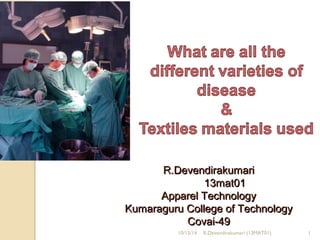
RR..DDeevveennddiirraakkuummaarrii 
1133mmaatt0011 
AAppppaarreell TTeecchhnnoollooggyy 
KKuummaarraagguurruu CCoolllleeggee ooff TTeecchhnnoollooggyy 
CCoovvaaii--4499 
10/15/14 R.Devendirakumari (13MAT01) 1
IInnttrroo 
Textile materials and products that have been 
engineered to meet particular needs, are 
suitable for any medical and surgical application 
where a combination of strength, flexibility, and 
sometimes moisture and air permeability are 
required. 
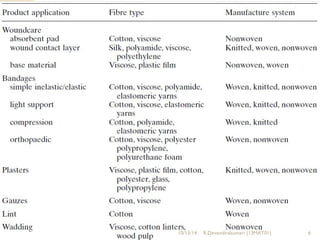
Materials used 
monofilament and multifilament yarns 
Woven 
knitted, and 
nonwoven fabrics, and 
composite structures. 10/15/14 R.Devendirakumari (13MAT01) 2
Applications: 
Single thread suture to the complex 
composite structures for bone 
replacement, and 
Simple cleaning wipe to advanced barrier 
fabrics used in operating rooms. 
10/15/14 R.Devendirakumari (13MAT01) 3
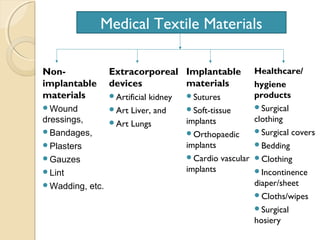
Medical Textile Materials 
Non-implantable 
materials 
Wound 
dressings, 
Bandages, 
Plasters 
Gauzes 
Lint 
Wadding, etc. 
Implantable 
materials 
Sutures 
Soft-tissue 
implants 
Orthopaedic 
implants 
Cardio vascular 
implants 
Extracorporeal 
devices 
Artificial kidney 
Art Liver, and 
Art Lungs 
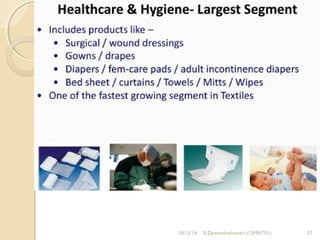
Healthcare/ 
hygiene 
products 
Surgical 
clothing 
Surgical covers 
Bedding 
Clothing 
Incontinence 
diaper/sheet 
Cloths/wipes 
Surgical 
hosiery
11.. NNoonn--iimmppllaannttaabbllee mmaatteerriiaallss 
Introduction 
These materials are used for external 
applications on the body and may or may 
not make contact with skin. 
10/15/14 R.Devendirakumari (13MAT01) 5
10/15/14 R.Devendirakumari (13MAT01) 6
II.. WWoouunndd ccaarree 
A number of wound dressing types are 
available for a variety of medical and 
surgical applications. 
The functions of these materials are to 
provide 
Protection against infection, 
Absorb blood and exudate, 
Promote healing and, 
Apply medication to the wound. 
10/15/14 R.Devendirakumari (13MAT01) 7
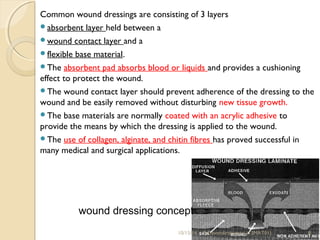
Common wound dressings are consisting of 3 layers 
absorbent layer held between a 
wound contact layer and a 
flexible base material. 
The absorbent pad absorbs blood or liquids and provides a cushioning 
effect to protect the wound. 
The wound contact layer should prevent adherence of the dressing to the 
wound and be easily removed without disturbing new tissue growth. 
The base materials are normally coated with an acrylic adhesive to 
provide the means by which the dressing is applied to the wound. 
The use of collagen, alginate, and chitin fibres has proved successful in 
many medical and surgical applications. 
wound dressing concept 
10/15/14 R.Devendirakumari (13MAT01) 8
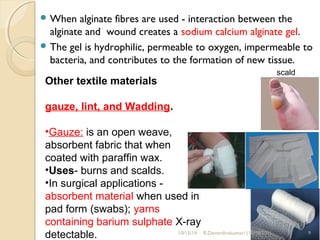
When alginate fibres are used - interaction between the 
alginate and wound creates a sodium calcium alginate gel. 
The gel is hydrophilic, permeable to oxygen, impermeable to 
bacteria, and contributes to the formation of new tissue. 
scald 
Other textile materials 
gauze, lint, and Wadding. 
•Gauze: is an open weave, 
absorbent fabric that when 
coated with paraffin wax. 
•Uses- burns and scalds. 
•In surgical applications - 
absorbent material when used in 
pad form (swabs); yarns 
containing barium sulphate X-ray 
detectable. 
10/15/14 R.Devendirakumari (13MAT01) 9
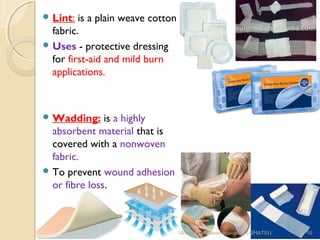
Lint: is a plain weave cotton 
fabric. 
Uses - protective dressing 
for first-aid and mild burn 
applications. 
Wadding: is a highly 
absorbent material that is 
covered with a nonwoven 
fabric. 
To prevent wound adhesion 
or fibre loss. 
10/15/14 R.Devendirakumari (13MAT01) 10
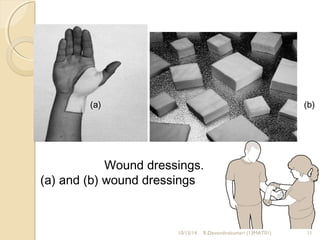
(a) (b) 
Wound dressings. 
(a) and (b) wound dressings 
10/15/14 R.Devendirakumari (13MAT01) 11
IIII.. BBaannddaaggeess 
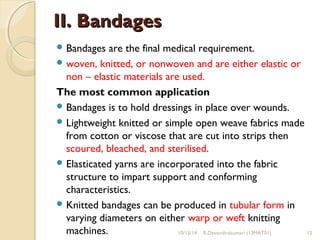
Bandages are the final medical requirement. 
woven, knitted, or nonwoven and are either elastic or 
non – elastic materials are used. 
The most common application 
Bandages is to hold dressings in place over wounds. 
Lightweight knitted or simple open weave fabrics made 
from cotton or viscose that are cut into strips then 
scoured, bleached, and sterilised. 
Elasticated yarns are incorporated into the fabric 
structure to impart support and conforming 
characteristics. 
Knitted bandages can be produced in tubular form in 
varying diameters on either warp or weft knitting 
machines. 10/15/14 R.Devendirakumari (13MAT01) 12
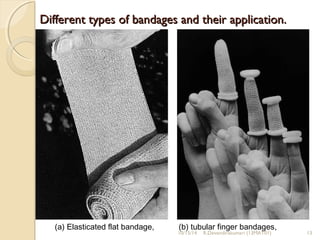
Different types of bandages aanndd tthheeiirr aapppplliiccaattiioonn.. 
(a) Elasticated flat bandage, (b) tubular finger bandages, 
10/15/14 R.Devendirakumari (13MAT01) 13
Woven light support bandages - sprains 
or strains and the elasticated properties 
are obtained by weaving cotton crepe 
yarns that have a high twist content. 
Similar properties can also be achieved 
by weaving two warps together, one 
beam under a normal tension and the 
other under a high tension. 
When applied under sufficient tension, 
the stretch and recovery properties of 
the bandage provides support for the 
sprained limb. 
10/15/14 R.Devendirakumari (13MAT01) 14
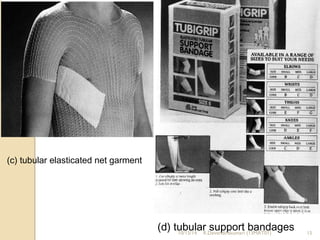
(c) tubular elasticated net garment 
(d) tubular support bandages 10/15/14 R.Devendirakumari (13MAT01) 15
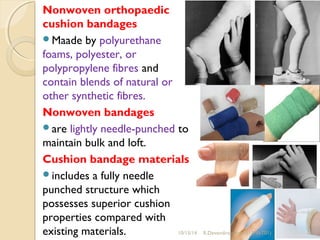
Nonwoven orthopaedic 
cushion bandages 
Maade by polyurethane 
foams, polyester, or 
polypropylene fibres and 
contain blends of natural or 
other synthetic fibres. 
Nonwoven bandages 
are lightly needle-punched to 
maintain bulk and loft. 
Cushion bandage materials 
includes a fully needle 
punched structure which 
possesses superior cushion 
properties compared with 
existing materials. 10/15/14 R.Devendirakumari (13MAT01) 16
Compression bandages 
Treatment and prevention of 
deep vein thrombosis, 
leg ulceration, and 
varicose veins 
Classification of Compression bandages 
extra-high 
High 
moderate, and 
light compression. 
Woven and contain cotton and elastomeric yarns or warp and 
weft knitted in both tubular or fully fashioned forms. 
Orthopaedic cushion bandage: 
Used under plaster casts and compression bandages to provide 
padding and prevent discomfort. 10/15/14 R.Devendirakumari (13MAT01) 17
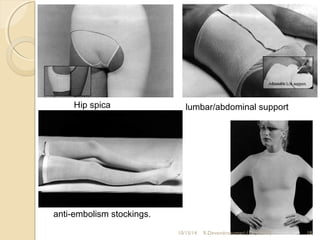
Hip spica lumbar/abdominal support 
anti-embolism stockings. 
10/15/14 R.Devendirakumari (13MAT01) 18
Lymphatic System Disorders 
The lymphatic system is part of the body's 
immune system. It consists of 
nodes, 
vessels and 
fluid. 
10/15/14 R.Devendirakumari (13MAT01) 19
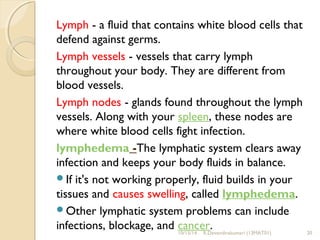
Lymph - a fluid that contains white blood cells that 
defend against germs. 
Lymph vessels - vessels that carry lymph 
throughout your body. They are different from 
blood vessels. 
Lymph nodes - glands found throughout the lymph 
vessels. Along with your spleen, these nodes are 
where white blood cells fight infection. 
lymphedema -The lymphatic system clears away 
infection and keeps your body fluids in balance. 
If it's not working properly, fluid builds in your 
tissues and causes swelling, called lymphedema. 
Other lymphatic system problems can include 
infections, blockage, and cancer. 
10/15/14 R.Devendirakumari (13MAT01) 20
Causes of lymphatic obstruction 
include: 
Infections 
Injury 
Radiation therapy 
Skin infections such as cellulitis (more 
common in obese patients) 
Surgery & Tumors (swelling) 
10/15/14 R.Devendirakumari (13MAT01) 21
TTrreeaattmmeenntt ffoorr llyymmpphheeddeemmaa 
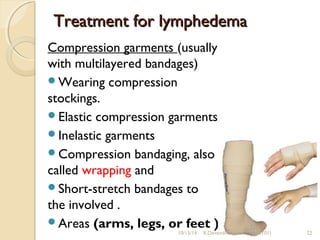
Compression garments (usually 
with multilayered bandages) 
Wearing compression 
stockings. 
Elastic compression garments 
Inelastic garments 
Compression bandaging, also 
called wrapping and 
Short-stretch bandages to 
the involved . 
Areas (arms, legs, or feet ). 
10/15/14 R.Devendirakumari (13MAT01) 22
Venous System disorders 
Blood flows from the heart through the 
arterial system, and back to the heart 
through the venous system. 
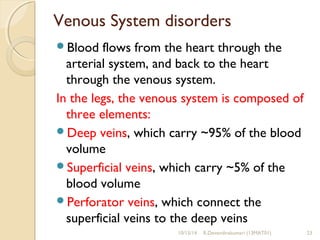
In the legs, the venous system is composed of 
three elements: 
Deep veins, which carry ~95% of the blood 
volume 
Superficial veins, which carry ~5% of the 
blood volume 
Perforator veins, which connect the 
superficial veins to the deep veins 
10/15/14 R.Devendirakumari (13MAT01) 23
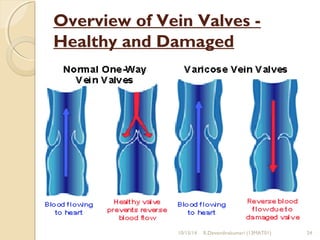
Overview of Vein Valves - 
Healthy and Damaged 
10/15/14 R.Devendirakumari (13MAT01) 24
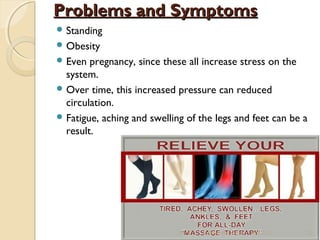
PPrroobblleemmss aanndd SSyymmppttoommss 
Standing 
Obesity 
Even pregnancy, since these all increase stress on the 
system. 
Over time, this increased pressure can reduced 
circulation. 
Fatigue, aching and swelling of the legs and feet can be a 
result. 
10/15/14 R.Devendirakumari (13MAT01) 25
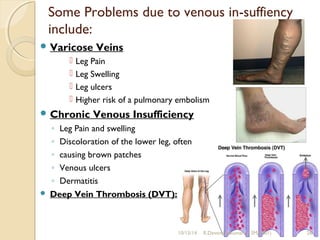
Some Problems due to venous in-suffiency 
include: 
Varicose Veins 
 Leg Pain 
 Leg Swelling 
 Leg ulcers 
 Higher risk of a pulmonary embolism 
Chronic Venous Insufficiency 
◦ Leg Pain and swelling 
◦ Discoloration of the lower leg, often 
◦ causing brown patches 
◦ Venous ulcers 
◦ Dermatitis 
 Deep Vein Thrombosis (DVT): 
10/15/14 R.Devendirakumari (13MAT01) 26
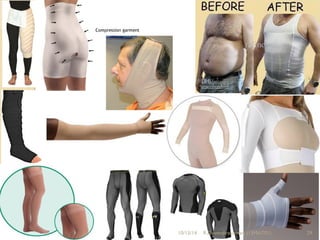
Benefits of Compression Garments 
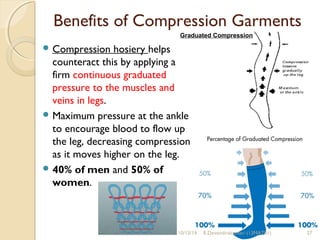
Graduated Compression 
Compression hosiery helps 
counteract this by applying a 
firm continuous graduated 
pressure to the muscles and 
veins in legs. 
Maximum pressure at the ankle 
to encourage blood to flow up 
the leg, decreasing compression 
as it moves higher on the leg. 
40% of men and 50% of 
women. 
10/15/14 R.Devendirakumari (13MAT01) 27
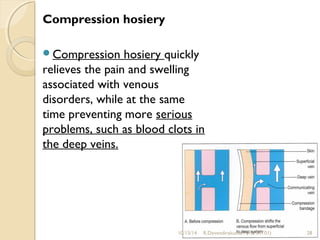
Compression hosiery 
Compression hosiery quickly 
relieves the pain and swelling 
associated with venous 
disorders, while at the same 
time preventing more serious 
problems, such as blood clots in 
the deep veins. 
10/15/14 R.Devendirakumari (13MAT01) 28
10/15/14 R.Devendirakumari (13MAT01) 29
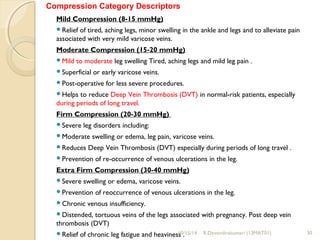
Compression Category Descriptors 
Mild Compression (8-15 mmHg) 
Relief of tired, aching legs, minor swelling in the ankle and legs and to alleviate pain 
associated with very mild varicose veins. 
Moderate Compression (15-20 mmHg) 
Mild to moderate leg swelling Tired, aching legs and mild leg pain . 
Superficial or early varicose veins. 
Post-operative for less severe procedures. 
Helps to reduce Deep Vein Thrombosis (DVT) in normal-risk patients, especially 
during periods of long travel. 
Firm Compression (20-30 mmHg) 
Severe leg disorders including: 
Moderate swelling or edema, leg pain, varicose veins. 
Reduces Deep Vein Thrombosis (DVT) especially during periods of long travel . 
Prevention of re-occurrence of venous ulcerations in the leg. 
Extra Firm Compression (30-40 mmHg) 
Severe swelling or edema, varicose veins. 
Prevention of reoccurrence of venous ulcerations in the leg. 
Chronic venous insufficiency. 
Distended, tortuous veins of the legs associated with pregnancy. Post deep vein 
thrombosis (DVT) 
Relief of chronic leg fatigue and heaviness . 
10/15/14 R.Devendirakumari (13MAT01) 30
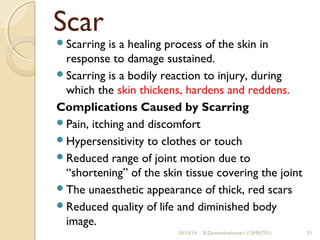
Scar 
Scarring is a healing process of the skin in 
response to damage sustained. 
Scarring is a bodily reaction to injury, during 
which the skin thickens, hardens and reddens. 
Complications Caused by Scarring 
Pain, itching and discomfort 
Hypersensitivity to clothes or touch 
Reduced range of joint motion due to 
“shortening” of the skin tissue covering the joint 
The unaesthetic appearance of thick, red scars 
Reduced quality of life and diminished body 
image. 
10/15/14 R.Devendirakumari (13MAT01) 31
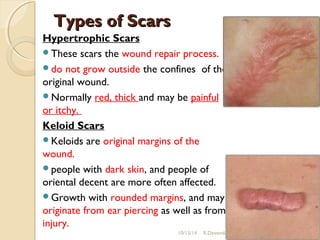
TTyyppeess ooff SSccaarrss 
Hypertrophic Scars 
These scars the wound repair process. 
do not grow outside the confines of the 
original wound. 
Normally red, thick and may be painful 
or itchy. 
Keloid Scars 
Keloids are original margins of the 
wound. 
people with dark skin, and people of 
oriental decent are more often affected. 
Growth with rounded margins, and may 
originate from ear piercing as well as from 
injury. 
10/15/14 R.Devendirakumari (13MAT01) 32
PPrreessssuurree GGaarrmmeenntt RReedduuccee 
SSccaarrrriinngg 
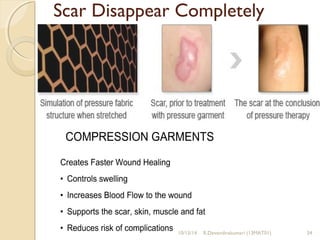
Pressure garments help prevent the 
development of hypertrophic and keloid 
scars by applying mechanical pressure to 
the affected area. 
The pressure garment counteracts the 
thickening of the scar tissue and thus 
scarring is minimized. 
To reduce the blood circulation to the 
scarred area which in turn reduces 
thickening of irregular tough scar tissue & 
Recovering skin fro1m0/15 /1a4 dR.dDeivetnidioraknumaari l(1 3iMnATj0u1) ry. 33
Scar Disappear Completely 
10/15/14 R.Devendirakumari (13MAT01) 34
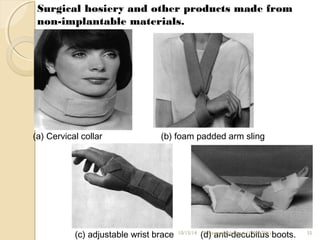
Surgical hosiery and other products made from 
non-implantable materials. 
(a) Cervical collar (b) foam padded arm sling 
(c) adjustable wrist brace (d) anti-10/15/14 R.Devendirakdumeacri u(1b3MitAuT0s1 )boots. 35
22.. EExxttrraaccoorrppoorreeaall ddeevviicceess 
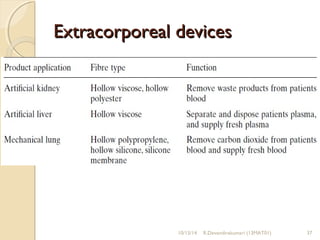
Extracorporeal devices are mechanical 
organs that are used for blood purification 
and include the 
Artificial kidney (dialyser), 
The artificial liver, and 
The mechanical lung. 
10/15/14 R.Devendirakumari (13MAT01) 36
EExxttrraaccoorrppoorreeaall ddeevviicceess 
10/15/14 R.Devendirakumari (13MAT01) 37
ARTIFICIAL KIDNEY 
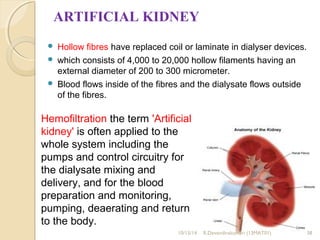
 Hollow fibres have replaced coil or laminate in dialyser devices. 
 which consists of 4,000 to 20,000 hollow filaments having an 
external diameter of 200 to 300 micrometer. 
 Blood flows inside of the fibres and the dialysate flows outside 
of the fibres. 
Hemofiltration the term 'Artificial 
kidney' is often applied to the 
whole system including the 
pumps and control circuitry for 
the dialysate mixing and 
delivery, and for the blood 
preparation and monitoring, 
pumping, deaerating and return 
to the body. 
10/15/14 R.Devendirakumari (13MAT01) 38
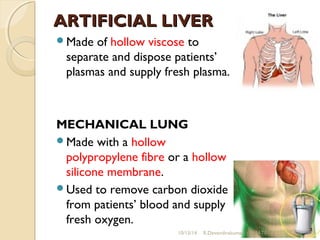
AARRTTIIFFIICCIIAALL LLIIVVEERR 
Made of hollow viscose to 
separate and dispose patients’ 
plasmas and supply fresh plasma. 
MECHANICAL LUNG 
Made with a hollow 
polypropylene fibre or a hollow 
silicone membrane. 
Used to remove carbon dioxide 
from patients’ blood and supply 
fresh oxygen. 
10/15/14 R.Devendirakumari (13MAT01) 39
33.. IImmppllaannttaabbllee mmaatteerriiaallss 
Introduction 
These materials are used in effecting 
repair to the body whether it be wound 
closure (sutures) or replacement surgery. 
(vascular grafts, artificial ligaments, etc.). 
10/15/14 R.Devendirakumari (13MAT01) 40
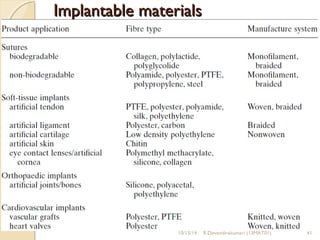
IImmppllaannttaabbllee mmaatteerriiaallss 
10/15/14 R.Devendirakumari (13MAT01) 41
II.. SSuuttuurreess 
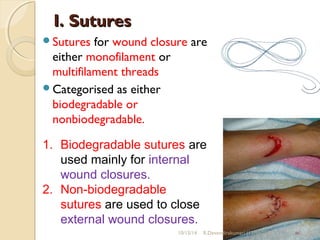
Sutures for wound closure are 
either monofilament or 
multifilament threads 
Categorised as either 
biodegradable or 
nonbiodegradable. 
1. Biodegradable sutures are 
used mainly for internal 
wound closures. 
2. Non-biodegradable 
sutures are used to close 
external wound closures. 
10/15/14 R.Devendirakumari (13MAT01) 42
IIII.. SSoofftt--ttiissssuuee iimmppllaannttss 
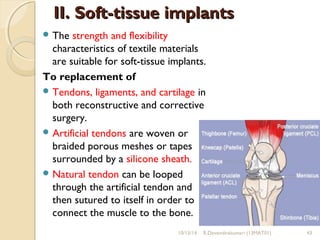
The strength and flexibility 
characteristics of textile materials 
are suitable for soft-tissue implants. 
To replacement of 
Tendons, ligaments, and cartilage in 
both reconstructive and corrective 
surgery. 
Artificial tendons are woven or 
braided porous meshes or tapes 
surrounded by a silicone sheath. 
Natural tendon can be looped 
through the artificial tendon and 
then sutured to itself in order to 
connect the muscle to the bone. 
10/15/14 R.Devendirakumari (13MAT01) 43
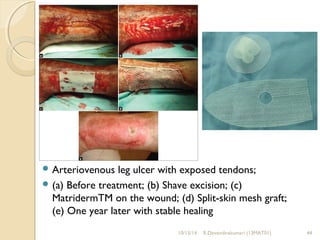
Arteriovenous leg ulcer with exposed tendons; 
(a) Before treatment; (b) Shave excision; (c) 
MatridermTM on the wound; (d) Split-skin mesh graft; 
(e) One year later with stable healing 
10/15/14 R.Devendirakumari (13MAT01) 44
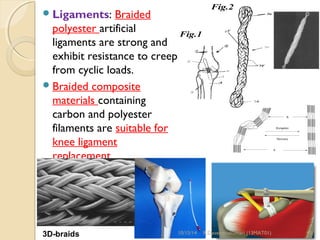
Ligaments: Braided 
polyester artificial 
ligaments are strong and 
exhibit resistance to creep 
from cyclic loads. 
Braided composite 
materials containing 
carbon and polyester 
filaments are suitable for 
knee ligament 
replacement. 
3D-braids 10/15/14 R.Devendirakumari (13MAT01) 45
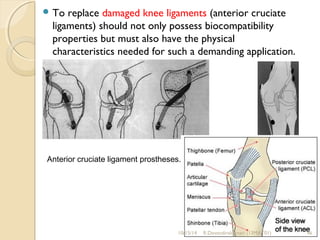
To replace damaged knee ligaments (anterior cruciate 
ligaments) should not only possess biocompatibility 
properties but must also have the physical 
characteristics needed for such a demanding application. 
Anterior cruciate ligament prostheses. 
10/15/14 R.Devendirakumari (13MAT01) 46
10/15/14 R.Devendirakumari (13MAT01) 47
CCaarrttiillaaggee 
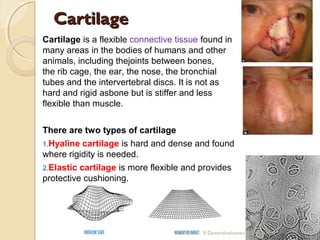
Cartilage is a flexible connective tissue found in 
many areas in the bodies of humans and other 
animals, including thejoints between bones, 
the rib cage, the ear, the nose, the bronchial 
tubes and the intervertebral discs. It is not as 
hard and rigid asbone but is stiffer and less 
flexible than muscle. 
There are two types of cartilage 
1.Hyaline cartilage is hard and dense and found 
where rigidity is needed. 
2.Elastic cartilage is more flexible and provides 
protective cushioning. 
10/15/14 R.Devendirakumari (13MAT01) 48
Low density polyethylene 
1.To replace facial, 
2.Nose 
3.ear, and 
4.throat cartilage; 
the material is particularly suitable for this 
application because it resembles natural 
cartilage in many ways. 
Carbon fibre reinforced composite 
structures are used to resurface the 
defective areas of articular cartilage within 
synovial joints (knee, etc.) as a result of 
osteoarthritis. 10/15/14 R.Devendirakumari (13MAT01) 49
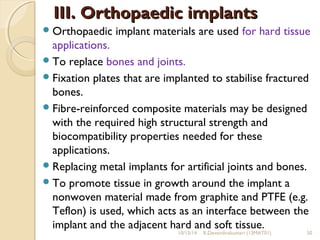
IIIIII.. OOrrtthhooppaaeeddiicc iimmppllaannttss 
Orthopaedic implant materials are used for hard tissue 
applications. 
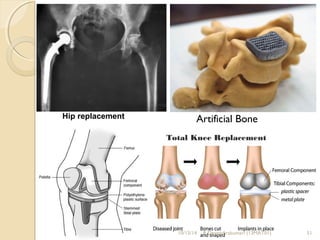
To replace bones and joints. 
Fixation plates that are implanted to stabilise fractured 
bones. 
Fibre-reinforced composite materials may be designed 
with the required high structural strength and 
biocompatibility properties needed for these 
applications. 
Replacing metal implants for artificial joints and bones. 
To promote tissue in growth around the implant a 
nonwoven material made from graphite and PTFE (e.g. 
Teflon) is used, which acts as an interface between the 
implant and the adjacent hard and soft tissue. 
10/15/14 R.Devendirakumari (13MAT01) 50
Hip replacement Artificial Bone 
Total Knee Replacement 
10/15/14 R.Devendirakumari (13MAT01) 51
Composite structures composed of 
poly(d, l-lactide urethane) and reinforced 
with polyglycolic acid have excellent 
physical properties. 
The composite can be formed into shape 
during surgery at a temperature of 60 °C 
and is used for both hard and soft tissue 
applications. 
Braided surgical cables composed of steel 
filaments ranging from 13–130mm are 
used to stabilise fractured bones or to 
secure orthopaedic implants to the 
skeleton. 10/15/14 R.Devendirakumari (13MAT01) 52
IIVV.. CCaarrddiioovvaassccuullaarr iimmppllaannttss 
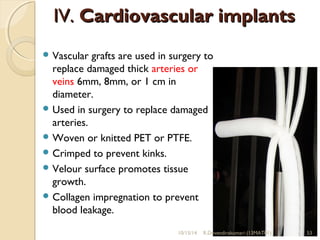
Vascular grafts are used in surgery to 
replace damaged thick arteries or 
veins 6mm, 8mm, or 1 cm in 
diameter. 
Used in surgery to replace damaged 
arteries. 
Woven or knitted PET or PTFE. 
Crimped to prevent kinks. 
Velour surface promotes tissue 
growth. 
Collagen impregnation to prevent 
blood leakage. 
10/15/14 R.Devendirakumari (13MAT01) 53
VVaassccuullaarr pprroosstthheessiiss 
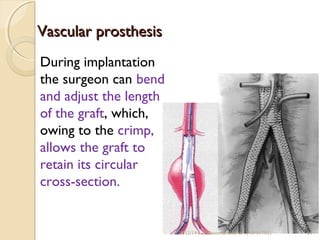
During implantation 
the surgeon can bend 
and adjust the length 
of the graft, which, 
owing to the crimp, 
allows the graft to 
retain its circular 
cross-section. 
10/15/14 R.Devendirakumari (13MAT01) 54
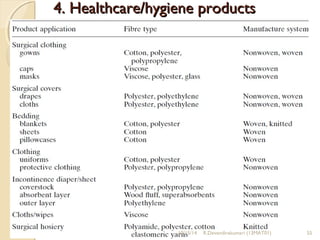
44.. HHeeaalltthhccaarree//hhyyggiieennee pprroodduuccttss 
 
10/15/14 R.Devendirakumari (13MAT01) 55
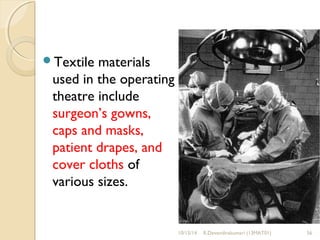
Textile materials 
used in the operating 
theatre include 
surgeon’s gowns, 
caps and masks, 
patient drapes, and 
cover cloths of 
various sizes. 
10/15/14 R.Devendirakumari (13MAT01) 56
10/15/14 R.Devendirakumari (13MAT01) 57
RReeffeerreenncceess 
Handbook of technical textiles “Edited by A R 
Horrocks and S C Anand” ‘Published by Woodhead 
Publishing Limited in association with The Textile 
Institute’. Abington Hall, Abington Cambridge CB1 6AH 
England. 
www.elastictherapy.com/benefits.html 
http://www.comar-medical.com/scarinfo-en.html 
http://www.comar-medical.com/clothing-en.html 
http://www.jcasonline.com/article.asp?issn=0974- 
2077;year=2011;volume=4;issue=3;spage=176;epage=18 
2;aulast=Wollina 
http://textileaid.blogspot.in/2014/06/medical-textile-use-of- 
technical.html 
10/15/14 R.Devendirakumari (13MAT01) 58 
http://biotextiles.wordpress.com/acl-prostheses/

Disease and suitable textile materials

  • 1.
    RR..DDeevveennddiirraakkuummaarrii 1133mmaatt0011 AAppppaarreellTTeecchhnnoollooggyy KKuummaarraagguurruu CCoolllleeggee ooff TTeecchhnnoollooggyy CCoovvaaii--4499 10/15/14 R.Devendirakumari (13MAT01) 1
  • 2.
    IInnttrroo Textile materialsand products that have been engineered to meet particular needs, are suitable for any medical and surgical application where a combination of strength, flexibility, and sometimes moisture and air permeability are required. Materials used monofilament and multifilament yarns Woven knitted, and nonwoven fabrics, and composite structures. 10/15/14 R.Devendirakumari (13MAT01) 2
  • 3.
    Applications: Single threadsuture to the complex composite structures for bone replacement, and Simple cleaning wipe to advanced barrier fabrics used in operating rooms. 10/15/14 R.Devendirakumari (13MAT01) 3
  • 4.
    Medical Textile Materials Non-implantable materials Wound dressings, Bandages, Plasters Gauzes Lint Wadding, etc. Implantable materials Sutures Soft-tissue implants Orthopaedic implants Cardio vascular implants Extracorporeal devices Artificial kidney Art Liver, and Art Lungs Healthcare/ hygiene products Surgical clothing Surgical covers Bedding Clothing Incontinence diaper/sheet Cloths/wipes Surgical hosiery
  • 5.
    11.. NNoonn--iimmppllaannttaabbllee mmaatteerriiaallss Introduction These materials are used for external applications on the body and may or may not make contact with skin. 10/15/14 R.Devendirakumari (13MAT01) 5
  • 6.
  • 7.
    II.. WWoouunndd ccaarree A number of wound dressing types are available for a variety of medical and surgical applications. The functions of these materials are to provide Protection against infection, Absorb blood and exudate, Promote healing and, Apply medication to the wound. 10/15/14 R.Devendirakumari (13MAT01) 7
  • 8.
    Common wound dressingsare consisting of 3 layers absorbent layer held between a wound contact layer and a flexible base material. The absorbent pad absorbs blood or liquids and provides a cushioning effect to protect the wound. The wound contact layer should prevent adherence of the dressing to the wound and be easily removed without disturbing new tissue growth. The base materials are normally coated with an acrylic adhesive to provide the means by which the dressing is applied to the wound. The use of collagen, alginate, and chitin fibres has proved successful in many medical and surgical applications. wound dressing concept 10/15/14 R.Devendirakumari (13MAT01) 8
  • 9.
    When alginate fibresare used - interaction between the alginate and wound creates a sodium calcium alginate gel. The gel is hydrophilic, permeable to oxygen, impermeable to bacteria, and contributes to the formation of new tissue. scald Other textile materials gauze, lint, and Wadding. •Gauze: is an open weave, absorbent fabric that when coated with paraffin wax. •Uses- burns and scalds. •In surgical applications - absorbent material when used in pad form (swabs); yarns containing barium sulphate X-ray detectable. 10/15/14 R.Devendirakumari (13MAT01) 9
  • 10.
    Lint: is aplain weave cotton fabric. Uses - protective dressing for first-aid and mild burn applications. Wadding: is a highly absorbent material that is covered with a nonwoven fabric. To prevent wound adhesion or fibre loss. 10/15/14 R.Devendirakumari (13MAT01) 10
  • 11.
    (a) (b) Wounddressings. (a) and (b) wound dressings 10/15/14 R.Devendirakumari (13MAT01) 11
  • 12.
    IIII.. BBaannddaaggeess Bandagesare the final medical requirement. woven, knitted, or nonwoven and are either elastic or non – elastic materials are used. The most common application Bandages is to hold dressings in place over wounds. Lightweight knitted or simple open weave fabrics made from cotton or viscose that are cut into strips then scoured, bleached, and sterilised. Elasticated yarns are incorporated into the fabric structure to impart support and conforming characteristics. Knitted bandages can be produced in tubular form in varying diameters on either warp or weft knitting machines. 10/15/14 R.Devendirakumari (13MAT01) 12
  • 13.
    Different types ofbandages aanndd tthheeiirr aapppplliiccaattiioonn.. (a) Elasticated flat bandage, (b) tubular finger bandages, 10/15/14 R.Devendirakumari (13MAT01) 13
  • 14.
    Woven light supportbandages - sprains or strains and the elasticated properties are obtained by weaving cotton crepe yarns that have a high twist content. Similar properties can also be achieved by weaving two warps together, one beam under a normal tension and the other under a high tension. When applied under sufficient tension, the stretch and recovery properties of the bandage provides support for the sprained limb. 10/15/14 R.Devendirakumari (13MAT01) 14
  • 15.
    (c) tubular elasticatednet garment (d) tubular support bandages 10/15/14 R.Devendirakumari (13MAT01) 15
  • 16.
    Nonwoven orthopaedic cushionbandages Maade by polyurethane foams, polyester, or polypropylene fibres and contain blends of natural or other synthetic fibres. Nonwoven bandages are lightly needle-punched to maintain bulk and loft. Cushion bandage materials includes a fully needle punched structure which possesses superior cushion properties compared with existing materials. 10/15/14 R.Devendirakumari (13MAT01) 16
  • 17.
    Compression bandages Treatmentand prevention of deep vein thrombosis, leg ulceration, and varicose veins Classification of Compression bandages extra-high High moderate, and light compression. Woven and contain cotton and elastomeric yarns or warp and weft knitted in both tubular or fully fashioned forms. Orthopaedic cushion bandage: Used under plaster casts and compression bandages to provide padding and prevent discomfort. 10/15/14 R.Devendirakumari (13MAT01) 17
  • 18.
    Hip spica lumbar/abdominalsupport anti-embolism stockings. 10/15/14 R.Devendirakumari (13MAT01) 18
  • 19.
    Lymphatic System Disorders The lymphatic system is part of the body's immune system. It consists of nodes, vessels and fluid. 10/15/14 R.Devendirakumari (13MAT01) 19
  • 20.
    Lymph - afluid that contains white blood cells that defend against germs. Lymph vessels - vessels that carry lymph throughout your body. They are different from blood vessels. Lymph nodes - glands found throughout the lymph vessels. Along with your spleen, these nodes are where white blood cells fight infection. lymphedema -The lymphatic system clears away infection and keeps your body fluids in balance. If it's not working properly, fluid builds in your tissues and causes swelling, called lymphedema. Other lymphatic system problems can include infections, blockage, and cancer. 10/15/14 R.Devendirakumari (13MAT01) 20
  • 21.
    Causes of lymphaticobstruction include: Infections Injury Radiation therapy Skin infections such as cellulitis (more common in obese patients) Surgery & Tumors (swelling) 10/15/14 R.Devendirakumari (13MAT01) 21
  • 22.
    TTrreeaattmmeenntt ffoorr llyymmpphheeddeemmaa Compression garments (usually with multilayered bandages) Wearing compression stockings. Elastic compression garments Inelastic garments Compression bandaging, also called wrapping and Short-stretch bandages to the involved . Areas (arms, legs, or feet ). 10/15/14 R.Devendirakumari (13MAT01) 22
  • 23.
    Venous System disorders Blood flows from the heart through the arterial system, and back to the heart through the venous system. In the legs, the venous system is composed of three elements: Deep veins, which carry ~95% of the blood volume Superficial veins, which carry ~5% of the blood volume Perforator veins, which connect the superficial veins to the deep veins 10/15/14 R.Devendirakumari (13MAT01) 23
  • 24.
    Overview of VeinValves - Healthy and Damaged 10/15/14 R.Devendirakumari (13MAT01) 24
  • 25.
    PPrroobblleemmss aanndd SSyymmppttoommss Standing Obesity Even pregnancy, since these all increase stress on the system. Over time, this increased pressure can reduced circulation. Fatigue, aching and swelling of the legs and feet can be a result. 10/15/14 R.Devendirakumari (13MAT01) 25
  • 26.
    Some Problems dueto venous in-suffiency include: Varicose Veins  Leg Pain  Leg Swelling  Leg ulcers  Higher risk of a pulmonary embolism Chronic Venous Insufficiency ◦ Leg Pain and swelling ◦ Discoloration of the lower leg, often ◦ causing brown patches ◦ Venous ulcers ◦ Dermatitis  Deep Vein Thrombosis (DVT): 10/15/14 R.Devendirakumari (13MAT01) 26
  • 27.
    Benefits of CompressionGarments Graduated Compression Compression hosiery helps counteract this by applying a firm continuous graduated pressure to the muscles and veins in legs. Maximum pressure at the ankle to encourage blood to flow up the leg, decreasing compression as it moves higher on the leg. 40% of men and 50% of women. 10/15/14 R.Devendirakumari (13MAT01) 27
  • 28.
    Compression hosiery Compressionhosiery quickly relieves the pain and swelling associated with venous disorders, while at the same time preventing more serious problems, such as blood clots in the deep veins. 10/15/14 R.Devendirakumari (13MAT01) 28
  • 29.
  • 30.
    Compression Category Descriptors Mild Compression (8-15 mmHg) Relief of tired, aching legs, minor swelling in the ankle and legs and to alleviate pain associated with very mild varicose veins. Moderate Compression (15-20 mmHg) Mild to moderate leg swelling Tired, aching legs and mild leg pain . Superficial or early varicose veins. Post-operative for less severe procedures. Helps to reduce Deep Vein Thrombosis (DVT) in normal-risk patients, especially during periods of long travel. Firm Compression (20-30 mmHg) Severe leg disorders including: Moderate swelling or edema, leg pain, varicose veins. Reduces Deep Vein Thrombosis (DVT) especially during periods of long travel . Prevention of re-occurrence of venous ulcerations in the leg. Extra Firm Compression (30-40 mmHg) Severe swelling or edema, varicose veins. Prevention of reoccurrence of venous ulcerations in the leg. Chronic venous insufficiency. Distended, tortuous veins of the legs associated with pregnancy. Post deep vein thrombosis (DVT) Relief of chronic leg fatigue and heaviness . 10/15/14 R.Devendirakumari (13MAT01) 30
  • 31.
    Scar Scarring isa healing process of the skin in response to damage sustained. Scarring is a bodily reaction to injury, during which the skin thickens, hardens and reddens. Complications Caused by Scarring Pain, itching and discomfort Hypersensitivity to clothes or touch Reduced range of joint motion due to “shortening” of the skin tissue covering the joint The unaesthetic appearance of thick, red scars Reduced quality of life and diminished body image. 10/15/14 R.Devendirakumari (13MAT01) 31
  • 32.
    TTyyppeess ooff SSccaarrss Hypertrophic Scars These scars the wound repair process. do not grow outside the confines of the original wound. Normally red, thick and may be painful or itchy. Keloid Scars Keloids are original margins of the wound. people with dark skin, and people of oriental decent are more often affected. Growth with rounded margins, and may originate from ear piercing as well as from injury. 10/15/14 R.Devendirakumari (13MAT01) 32
  • 33.
    PPrreessssuurree GGaarrmmeenntt RReedduuccee SSccaarrrriinngg Pressure garments help prevent the development of hypertrophic and keloid scars by applying mechanical pressure to the affected area. The pressure garment counteracts the thickening of the scar tissue and thus scarring is minimized. To reduce the blood circulation to the scarred area which in turn reduces thickening of irregular tough scar tissue & Recovering skin fro1m0/15 /1a4 dR.dDeivetnidioraknumaari l(1 3iMnATj0u1) ry. 33
  • 34.
    Scar Disappear Completely 10/15/14 R.Devendirakumari (13MAT01) 34
  • 35.
    Surgical hosiery andother products made from non-implantable materials. (a) Cervical collar (b) foam padded arm sling (c) adjustable wrist brace (d) anti-10/15/14 R.Devendirakdumeacri u(1b3MitAuT0s1 )boots. 35
  • 36.
    22.. EExxttrraaccoorrppoorreeaall ddeevviicceess Extracorporeal devices are mechanical organs that are used for blood purification and include the Artificial kidney (dialyser), The artificial liver, and The mechanical lung. 10/15/14 R.Devendirakumari (13MAT01) 36
  • 37.
  • 38.
    ARTIFICIAL KIDNEY Hollow fibres have replaced coil or laminate in dialyser devices.  which consists of 4,000 to 20,000 hollow filaments having an external diameter of 200 to 300 micrometer.  Blood flows inside of the fibres and the dialysate flows outside of the fibres. Hemofiltration the term 'Artificial kidney' is often applied to the whole system including the pumps and control circuitry for the dialysate mixing and delivery, and for the blood preparation and monitoring, pumping, deaerating and return to the body. 10/15/14 R.Devendirakumari (13MAT01) 38
  • 39.
    AARRTTIIFFIICCIIAALL LLIIVVEERR Madeof hollow viscose to separate and dispose patients’ plasmas and supply fresh plasma. MECHANICAL LUNG Made with a hollow polypropylene fibre or a hollow silicone membrane. Used to remove carbon dioxide from patients’ blood and supply fresh oxygen. 10/15/14 R.Devendirakumari (13MAT01) 39
  • 40.
    33.. IImmppllaannttaabbllee mmaatteerriiaallss Introduction These materials are used in effecting repair to the body whether it be wound closure (sutures) or replacement surgery. (vascular grafts, artificial ligaments, etc.). 10/15/14 R.Devendirakumari (13MAT01) 40
  • 41.
  • 42.
    II.. SSuuttuurreess Suturesfor wound closure are either monofilament or multifilament threads Categorised as either biodegradable or nonbiodegradable. 1. Biodegradable sutures are used mainly for internal wound closures. 2. Non-biodegradable sutures are used to close external wound closures. 10/15/14 R.Devendirakumari (13MAT01) 42
  • 43.
    IIII.. SSoofftt--ttiissssuuee iimmppllaannttss The strength and flexibility characteristics of textile materials are suitable for soft-tissue implants. To replacement of Tendons, ligaments, and cartilage in both reconstructive and corrective surgery. Artificial tendons are woven or braided porous meshes or tapes surrounded by a silicone sheath. Natural tendon can be looped through the artificial tendon and then sutured to itself in order to connect the muscle to the bone. 10/15/14 R.Devendirakumari (13MAT01) 43
  • 44.
    Arteriovenous leg ulcerwith exposed tendons; (a) Before treatment; (b) Shave excision; (c) MatridermTM on the wound; (d) Split-skin mesh graft; (e) One year later with stable healing 10/15/14 R.Devendirakumari (13MAT01) 44
  • 45.
    Ligaments: Braided polyesterartificial ligaments are strong and exhibit resistance to creep from cyclic loads. Braided composite materials containing carbon and polyester filaments are suitable for knee ligament replacement. 3D-braids 10/15/14 R.Devendirakumari (13MAT01) 45
  • 46.
    To replace damagedknee ligaments (anterior cruciate ligaments) should not only possess biocompatibility properties but must also have the physical characteristics needed for such a demanding application. Anterior cruciate ligament prostheses. 10/15/14 R.Devendirakumari (13MAT01) 46
  • 47.
  • 48.
    CCaarrttiillaaggee Cartilage isa flexible connective tissue found in many areas in the bodies of humans and other animals, including thejoints between bones, the rib cage, the ear, the nose, the bronchial tubes and the intervertebral discs. It is not as hard and rigid asbone but is stiffer and less flexible than muscle. There are two types of cartilage 1.Hyaline cartilage is hard and dense and found where rigidity is needed. 2.Elastic cartilage is more flexible and provides protective cushioning. 10/15/14 R.Devendirakumari (13MAT01) 48
  • 49.
    Low density polyethylene 1.To replace facial, 2.Nose 3.ear, and 4.throat cartilage; the material is particularly suitable for this application because it resembles natural cartilage in many ways. Carbon fibre reinforced composite structures are used to resurface the defective areas of articular cartilage within synovial joints (knee, etc.) as a result of osteoarthritis. 10/15/14 R.Devendirakumari (13MAT01) 49
  • 50.
    IIIIII.. OOrrtthhooppaaeeddiicc iimmppllaannttss Orthopaedic implant materials are used for hard tissue applications. To replace bones and joints. Fixation plates that are implanted to stabilise fractured bones. Fibre-reinforced composite materials may be designed with the required high structural strength and biocompatibility properties needed for these applications. Replacing metal implants for artificial joints and bones. To promote tissue in growth around the implant a nonwoven material made from graphite and PTFE (e.g. Teflon) is used, which acts as an interface between the implant and the adjacent hard and soft tissue. 10/15/14 R.Devendirakumari (13MAT01) 50
  • 51.
    Hip replacement ArtificialBone Total Knee Replacement 10/15/14 R.Devendirakumari (13MAT01) 51
  • 52.
    Composite structures composedof poly(d, l-lactide urethane) and reinforced with polyglycolic acid have excellent physical properties. The composite can be formed into shape during surgery at a temperature of 60 °C and is used for both hard and soft tissue applications. Braided surgical cables composed of steel filaments ranging from 13–130mm are used to stabilise fractured bones or to secure orthopaedic implants to the skeleton. 10/15/14 R.Devendirakumari (13MAT01) 52
  • 53.
    IIVV.. CCaarrddiioovvaassccuullaarr iimmppllaannttss Vascular grafts are used in surgery to replace damaged thick arteries or veins 6mm, 8mm, or 1 cm in diameter. Used in surgery to replace damaged arteries. Woven or knitted PET or PTFE. Crimped to prevent kinks. Velour surface promotes tissue growth. Collagen impregnation to prevent blood leakage. 10/15/14 R.Devendirakumari (13MAT01) 53
  • 54.
    VVaassccuullaarr pprroosstthheessiiss Duringimplantation the surgeon can bend and adjust the length of the graft, which, owing to the crimp, allows the graft to retain its circular cross-section. 10/15/14 R.Devendirakumari (13MAT01) 54
  • 55.
    44.. HHeeaalltthhccaarree//hhyyggiieennee pprroodduuccttss  10/15/14 R.Devendirakumari (13MAT01) 55
  • 56.
    Textile materials usedin the operating theatre include surgeon’s gowns, caps and masks, patient drapes, and cover cloths of various sizes. 10/15/14 R.Devendirakumari (13MAT01) 56
  • 57.
  • 58.
    RReeffeerreenncceess Handbook oftechnical textiles “Edited by A R Horrocks and S C Anand” ‘Published by Woodhead Publishing Limited in association with The Textile Institute’. Abington Hall, Abington Cambridge CB1 6AH England. www.elastictherapy.com/benefits.html http://www.comar-medical.com/scarinfo-en.html http://www.comar-medical.com/clothing-en.html http://www.jcasonline.com/article.asp?issn=0974- 2077;year=2011;volume=4;issue=3;spage=176;epage=18 2;aulast=Wollina http://textileaid.blogspot.in/2014/06/medical-textile-use-of- technical.html 10/15/14 R.Devendirakumari (13MAT01) 58 http://biotextiles.wordpress.com/acl-prostheses/