What is Educational Technology?
Educational Technology is the study and
ethical practice of facilitating learning and
improving performance by creating,using
and managing appropriate technological
processes and resources.
 1780 - Early public schools adopt the teacher/manager model
with
the teacher as the primary manager of instruction and
assessment in a single classroom.
 1946 - First vacuum tube-based computers
developed;universities
help in computer development effort;technology used in
war effort.
 1960 – PLATO (programmed logic for automatic teaching
operations),the first computer-assisted-instruction (CAI)
system, is initiated at the University of Illinois.It
profoundly
influences computer –based education systems
throughout
the world.
 1965 – Elementary and Secondary Education Act as brings
new
money into schools for technology,mainframes and
minicomputers are put into place in some schools,but
most are used for administration or for school
counseling
(databases for information about and for students).
 1970 – Texas instruments develops the first hand-held
electronic
calculator.The working heart of the first miniature
calculator is an integrated semiconductor circuit for
performing addition,subtraction,multiplication and
division.
 1969 – The children’s program Sesame Street debuts on the
National Educational Television network and soon
becomes an internet hit.
 1970 – ARPANET,the forerunner of the Internet,goes
online.Engelbart invents the mouse,hypertext and
groupware.He also creates hypermedia,multiple-window
screens,online publishing and electronic mail systems,all
of
great importance in modern education.
 1971 – Intel’s first microprocessor develop; the first
microcomputers (PCs) are developed;mainframes and
minicomputers are in wide user in business;a few
software
companies begin to develop mainframe and
minicomputer-
based instructional programs.
 1974 – The first affordable personal computer is featured on
the
cover of the magazine Popular Electronics.The Altais
8800
has 1KB of memory and an Intel 8080 processor.
 1977 – Japan Victor Company (JVC) introduces the VHS format
video cassette recorder.
 1983 – Compact Disc (CD-ROM-invented by James T.Russell in the
late
1960’s) technology is introduced in the United States.
 1990 – Multimedia PCs are developed;schools are using
videodiscs;object-oriented multimedia authoring tools are in
wide use;Simulations,educational databases and other types
of CAI programs are being delivered on CD-ROM
disks,many with animation and sound.
 1994 – Digital video,virtual reality,and 3-D systems capture the
attention of many,but fewer multimedia PCs than basic
business PCs are sold;object-oriented authoring systems
such as HyperCard,Hyperstudio,and Authoware grow in
popularity in schools;most US classrooms now have at least
one PC available for instructional delivery,but not all
teachers have access to a computer for instructional
preparation.
 1995 – The Internet and the World Wide Web began to catch on
as business,schools and individuals create web pages;most
CAI is delivered on CD_ROM disks and is growing in
popularity.
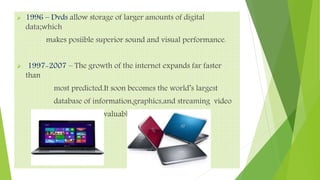
 1996 – Dvds allow storage of larger amounts of digital
data;which
makes posiible superior sound and visual performance.
 1997-2007 – The growth of the internet expands far faster
than
most predicted.It soon becomes the world’s largest
database of information,graphics,and streaming video
making it an invaluable resource for educators.
 Search engines such as Google and Yahoo constantly develop
ways to find information within the ever-growing number of
web
pages.Web sites that offer individuas a place to put personal
information become popular,as does internet-based publishing
and discussion forums.
 Voice recognition slowly enters the computing maintstream.
 Some computers incorporate TV input.
 Larger computer storage capacity and the growing prevalence
of
CD-ROM and DVD drives in personal computers make it easier
for educators to store larger flies for educational applications.
 2009 – Introduction of the first fully automated
classroom.
 2010 – The internet is accessed entirely through
wireless,handheld,pocket computers.
Presentation1.pptx fss 3

Presentation1.pptx fss 3

  • 2.
    What is EducationalTechnology? Educational Technology is the study and ethical practice of facilitating learning and improving performance by creating,using and managing appropriate technological processes and resources.
  • 3.
     1780 -Early public schools adopt the teacher/manager model with the teacher as the primary manager of instruction and assessment in a single classroom.  1946 - First vacuum tube-based computers developed;universities help in computer development effort;technology used in war effort.  1960 – PLATO (programmed logic for automatic teaching operations),the first computer-assisted-instruction (CAI) system, is initiated at the University of Illinois.It profoundly influences computer –based education systems throughout the world.
  • 4.
     1965 –Elementary and Secondary Education Act as brings new money into schools for technology,mainframes and minicomputers are put into place in some schools,but most are used for administration or for school counseling (databases for information about and for students).  1970 – Texas instruments develops the first hand-held electronic calculator.The working heart of the first miniature calculator is an integrated semiconductor circuit for performing addition,subtraction,multiplication and division.
  • 5.
     1969 –The children’s program Sesame Street debuts on the National Educational Television network and soon becomes an internet hit.  1970 – ARPANET,the forerunner of the Internet,goes online.Engelbart invents the mouse,hypertext and groupware.He also creates hypermedia,multiple-window screens,online publishing and electronic mail systems,all of great importance in modern education.
  • 6.
     1971 –Intel’s first microprocessor develop; the first microcomputers (PCs) are developed;mainframes and minicomputers are in wide user in business;a few software companies begin to develop mainframe and minicomputer- based instructional programs.  1974 – The first affordable personal computer is featured on the cover of the magazine Popular Electronics.The Altais 8800 has 1KB of memory and an Intel 8080 processor.
  • 7.
     1977 –Japan Victor Company (JVC) introduces the VHS format video cassette recorder.  1983 – Compact Disc (CD-ROM-invented by James T.Russell in the late 1960’s) technology is introduced in the United States.  1990 – Multimedia PCs are developed;schools are using videodiscs;object-oriented multimedia authoring tools are in wide use;Simulations,educational databases and other types of CAI programs are being delivered on CD-ROM disks,many with animation and sound.
  • 8.
     1994 –Digital video,virtual reality,and 3-D systems capture the attention of many,but fewer multimedia PCs than basic business PCs are sold;object-oriented authoring systems such as HyperCard,Hyperstudio,and Authoware grow in popularity in schools;most US classrooms now have at least one PC available for instructional delivery,but not all teachers have access to a computer for instructional preparation.  1995 – The Internet and the World Wide Web began to catch on as business,schools and individuals create web pages;most CAI is delivered on CD_ROM disks and is growing in popularity.
  • 9.
     1996 –Dvds allow storage of larger amounts of digital data;which makes posiible superior sound and visual performance.  1997-2007 – The growth of the internet expands far faster than most predicted.It soon becomes the world’s largest database of information,graphics,and streaming video making it an invaluable resource for educators.
  • 10.
     Search enginessuch as Google and Yahoo constantly develop ways to find information within the ever-growing number of web pages.Web sites that offer individuas a place to put personal information become popular,as does internet-based publishing and discussion forums.  Voice recognition slowly enters the computing maintstream.  Some computers incorporate TV input.  Larger computer storage capacity and the growing prevalence of CD-ROM and DVD drives in personal computers make it easier for educators to store larger flies for educational applications.
  • 12.
     2009 –Introduction of the first fully automated classroom.  2010 – The internet is accessed entirely through wireless,handheld,pocket computers.