EDUCATIONAL TECHNOLOGY
Prepared by: Group A
Group members:
Abdul Ghafar
Ibrahim Shah
Enayatullah
Rahimullah
What is Educational Technology ?
Educational technology
is the study and ethical
practice of facilitating
learning and impeoving
performnce by creating,
using and managing
appropiate technological
processes and
resources.
The use of technology in the process of learning and teaching has
improved the way in which students learn throughout the years
Have a look at the influence of technology in education…
Scope:
 Educational technology as the theory
and practice of educational
approaches.
 Educational technology as
technological tools and media that assits
in the communication of knowledge.
 Educational technology for the learning
system mangement.
 Educatioal technology itself as an
educatioanl subject
History of Education Technology
1946 - First vacuum tube-based computers developed; universities
help in computer development effort; technology used in war effort.
1960 – PLATO (programmed logic for automatic teaching
operations), the first computer – assisted – instruction (CAI) system,
is initiated at the University of Illinois. It profundly influences
computer – based education systems throughout the world.
1965 -. mainframes and minicomputers are put into place in some
schools, but most are used for administration.
1970 – Texas instruments develops the first hand – held electronic
calculator.
1969 – The children’s program Sesame Street debuts on the National
Educational Television network and soon becomes an international hit.
1970 – ARPANET, the forerunner of the Internet, goes online. Engelbart
invents the mouse, hypertext and groupware.
1971 - Intel's first microprocessor developed.
1974 – The first affordable personal computer is featured on the cover of the
magazine Popular Electronics.
1977 – Japan Victor Company (JVC) introduces the VHS format video
cassette recorder.
1983 – Compact Disc (CD-ROM – invented by James T. Russell in the late
1960s -) technology is introduced in the United States
1990 - Multimedia PCs are developed.
1994 - Digital video, virtual reality, and 3-D systems capture the attention of
many, but fewer multimedia PCs than basic business PCs are sold.
1995 - The Internet and the world wide web began to catch on as businesses,
schools, and individuals create web pages.
1996 – Dvds allow storage of larger amounts of digital data.
1997-2007 - The growth of the internet expands far faster than most
predicted.
It soon becomes the world's largest database of information, graphics, and
streaming video making it an invaluable resource for educators.
Search engines such as Google and Yahoo constantly develop new ways
to find information within the ever-growing number of web pages. Web
sites that offer individuals a place to put personal information become
popular, as does internet-based publishing and discussion forums.
Voice recognition slowly enters the computing mainstream.
Some computers incorporate TV input.
Larger computer storage capacity and the growing prevalence of CD-
ROM and DVD drives in personal computers make it easier for educators
to store larger files for educational applications.
Theory
 Behaviorism
B.F. Skinner said: The Technology of Teaching” attempts to contemporary
Education.
 Cognitivism
The Cognitive concepts of working memory (formerly known as short term
memory) and long term memory have been facilitated by research and
technology from the field of Computer Science..
 Constructivism
This form of constructivism has a primary focus on how learners construct
their own meaning from new information.
Practice:
• Synchronous
Synchronous learning refers to the exchange of
ideas and information with one or more
participants during the same period.
• Asynchronous
Asynchronous learning may use
technologies such as email, blogs, wikis,
and discussion boards, as well as web-
supported textbooks,hypertext documents,
audiovideo courses, and social networking
using web 2.0. At
the professional educational level, training
may include virtual operating rooms.
The linear learner learns best when information is presented in a well-organized,
structured, and logically sequenced manner.
Linear learning
Collaborative learning is a
situation in which two or more
people learn or attempt to learn
something together
Collaborative learning
Classroom 2.0 refers to online multi-user virtual environments (MUVEs) that
connect schools across geographical frontiers.
Classroom 2.0
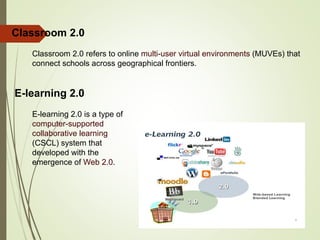
E-learning 2.0
E-learning 2.0 is a type of
computer-supported
collaborative learning
(CSCL) system that
developed with the
emergence of Web 2.0.
Media
Educational media and tools can be used for:
• task structuring
support: help with
how to do a task.
• access to knowledge
bases (help user find
information needed).
• alternate forms of
knowledge
representation
(multiple
representations of
knowledge, e.g.
video, audio, text,
image, data).
Audio and video
Radio offers synchronous educational vehicle, while
streaming audio over the internet with webcasts and
podcasts can be asynchronous.
Video technologyhas included VHS tapes and DVDs,
as well as on-demand and synchronous methods with
digital video via server or web-based options such as
streamed video from YouTube, Teacher Tube, Skype,
Adobe Connect,
and webcams.
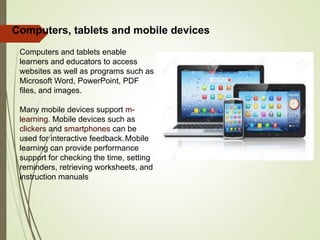
Computers and tablets enable
learners and educators to access
websites as well as programs such as
Microsoft Word, PowerPoint, PDF
files, and images.
Many mobile devices support m-
learning. Mobile devices such as
clickers and smartphones can be
used for interactive feedback.Mobile
learning can provide performance
support for checking the time, setting
reminders, retrieving worksheets, and
instruction manuals
Computers, tablets and mobile devices
Group webpages, blogs, and wikis allow
learners and educators to post thoughts,
ideas, and comments on a website in an
interactive learning environment.
Social networks
Webcams and webcasting have
enabled creation of virtual classrooms
and virtual learning environment.[
Webcams
Interactive whiteboards and
smart boards allow learners and
instructors to write on the touch
screen. The screen markup can
be on either a blank whiteboard
or any computer screen content.
Whiteboards
Screencasting is when you
record a video of your computer
screen, oftentimes for teaching
or sharing ideas.
Screencasting
Virtual classroom
A virtual classroom is a teaching
and learning environment where
participants can interact,
communicate, view and discuss
presentations, and engage with
learning resources while working in
groups, all in an online setting.
Learning management system
A learning management system(LMS) is
software used for delivering, tracking and
managing training and education.
Computer-aided assessment
Educational technology

Educational technology

  • 1.
    EDUCATIONAL TECHNOLOGY Prepared by:Group A Group members: Abdul Ghafar Ibrahim Shah Enayatullah Rahimullah
  • 2.
    What is EducationalTechnology ? Educational technology is the study and ethical practice of facilitating learning and impeoving performnce by creating, using and managing appropiate technological processes and resources.
  • 3.
    The use oftechnology in the process of learning and teaching has improved the way in which students learn throughout the years Have a look at the influence of technology in education…
  • 4.
    Scope:  Educational technologyas the theory and practice of educational approaches.  Educational technology as technological tools and media that assits in the communication of knowledge.  Educational technology for the learning system mangement.  Educatioal technology itself as an educatioanl subject
  • 5.
    History of EducationTechnology 1946 - First vacuum tube-based computers developed; universities help in computer development effort; technology used in war effort. 1960 – PLATO (programmed logic for automatic teaching operations), the first computer – assisted – instruction (CAI) system, is initiated at the University of Illinois. It profundly influences computer – based education systems throughout the world. 1965 -. mainframes and minicomputers are put into place in some schools, but most are used for administration. 1970 – Texas instruments develops the first hand – held electronic calculator.
  • 6.
    1969 – Thechildren’s program Sesame Street debuts on the National Educational Television network and soon becomes an international hit. 1970 – ARPANET, the forerunner of the Internet, goes online. Engelbart invents the mouse, hypertext and groupware. 1971 - Intel's first microprocessor developed. 1974 – The first affordable personal computer is featured on the cover of the magazine Popular Electronics. 1977 – Japan Victor Company (JVC) introduces the VHS format video cassette recorder. 1983 – Compact Disc (CD-ROM – invented by James T. Russell in the late 1960s -) technology is introduced in the United States
  • 7.
    1990 - MultimediaPCs are developed. 1994 - Digital video, virtual reality, and 3-D systems capture the attention of many, but fewer multimedia PCs than basic business PCs are sold. 1995 - The Internet and the world wide web began to catch on as businesses, schools, and individuals create web pages. 1996 – Dvds allow storage of larger amounts of digital data. 1997-2007 - The growth of the internet expands far faster than most predicted. It soon becomes the world's largest database of information, graphics, and streaming video making it an invaluable resource for educators.
  • 8.
    Search engines suchas Google and Yahoo constantly develop new ways to find information within the ever-growing number of web pages. Web sites that offer individuals a place to put personal information become popular, as does internet-based publishing and discussion forums. Voice recognition slowly enters the computing mainstream. Some computers incorporate TV input. Larger computer storage capacity and the growing prevalence of CD- ROM and DVD drives in personal computers make it easier for educators to store larger files for educational applications.
  • 9.
    Theory  Behaviorism B.F. Skinnersaid: The Technology of Teaching” attempts to contemporary Education.  Cognitivism The Cognitive concepts of working memory (formerly known as short term memory) and long term memory have been facilitated by research and technology from the field of Computer Science..  Constructivism This form of constructivism has a primary focus on how learners construct their own meaning from new information.
  • 10.
    Practice: • Synchronous Synchronous learningrefers to the exchange of ideas and information with one or more participants during the same period. • Asynchronous Asynchronous learning may use technologies such as email, blogs, wikis, and discussion boards, as well as web- supported textbooks,hypertext documents, audiovideo courses, and social networking using web 2.0. At the professional educational level, training may include virtual operating rooms.
  • 11.
    The linear learnerlearns best when information is presented in a well-organized, structured, and logically sequenced manner. Linear learning Collaborative learning is a situation in which two or more people learn or attempt to learn something together Collaborative learning
  • 12.
    Classroom 2.0 refersto online multi-user virtual environments (MUVEs) that connect schools across geographical frontiers. Classroom 2.0 E-learning 2.0 E-learning 2.0 is a type of computer-supported collaborative learning (CSCL) system that developed with the emergence of Web 2.0.
  • 13.
    Media Educational media andtools can be used for: • task structuring support: help with how to do a task. • access to knowledge bases (help user find information needed). • alternate forms of knowledge representation (multiple representations of knowledge, e.g. video, audio, text, image, data).
  • 14.
    Audio and video Radiooffers synchronous educational vehicle, while streaming audio over the internet with webcasts and podcasts can be asynchronous. Video technologyhas included VHS tapes and DVDs, as well as on-demand and synchronous methods with digital video via server or web-based options such as streamed video from YouTube, Teacher Tube, Skype, Adobe Connect, and webcams.
  • 15.
    Computers and tabletsenable learners and educators to access websites as well as programs such as Microsoft Word, PowerPoint, PDF files, and images. Many mobile devices support m- learning. Mobile devices such as clickers and smartphones can be used for interactive feedback.Mobile learning can provide performance support for checking the time, setting reminders, retrieving worksheets, and instruction manuals Computers, tablets and mobile devices
  • 16.
    Group webpages, blogs,and wikis allow learners and educators to post thoughts, ideas, and comments on a website in an interactive learning environment. Social networks Webcams and webcasting have enabled creation of virtual classrooms and virtual learning environment.[ Webcams Interactive whiteboards and smart boards allow learners and instructors to write on the touch screen. The screen markup can be on either a blank whiteboard or any computer screen content. Whiteboards
  • 17.
    Screencasting is whenyou record a video of your computer screen, oftentimes for teaching or sharing ideas. Screencasting Virtual classroom A virtual classroom is a teaching and learning environment where participants can interact, communicate, view and discuss presentations, and engage with learning resources while working in groups, all in an online setting.
  • 18.
    Learning management system Alearning management system(LMS) is software used for delivering, tracking and managing training and education. Computer-aided assessment