‧國
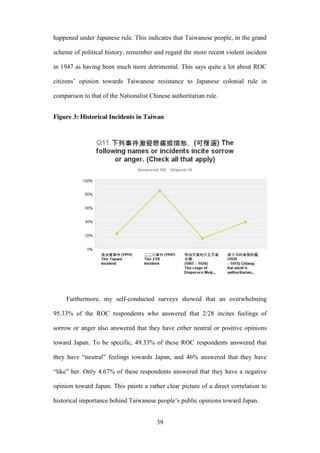
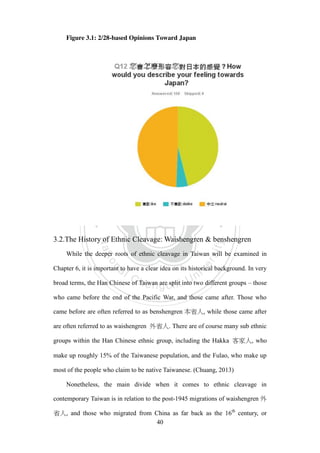
立
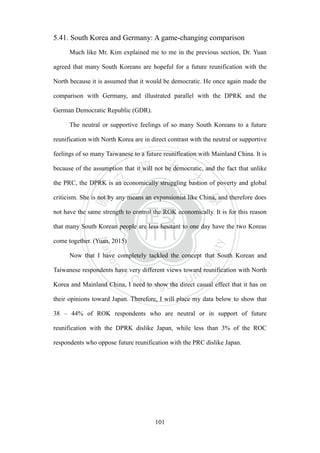
政 治
大
學
‧
Nation
al Chengchi Univ
ersity
國立政治大學亞太研究英語碩士學位學程
International Master‘s Program in Asia-Pacific Studies
College of Social Sciences
National Chengchi University
碩士論文
Master‘s Thesis
Tigers in the sun:
South Korean and Taiwanese people‘s opinions toward Japan
旭日下的雙龍: 南韓與台灣人對日本整體觀感研究
Student: Daniel Josephson
林文森
Advisor: Dr. Ming Lee
李明
中華民國 105 年 3 月
March 2016
‧國
立
政 治
大
學
‧
Nation
al Chengchi Univ
ersity
i
Table of Contents
List of Figures………………………………………………v
Preface………………………………………………………vi
Acknowledgements…………………………………………vii
Abstract……………………………………………………..x
CHAPTER 1: Introduction…………………………………1
1.1. Tigers in the Sun………………...………………1
1.2. Background of South Korean and Taiwanese Public
Opinions Toward Japan……………………………………..1
1.3. Personal Motivations……………………………..3
1.4. Research Objectives………………………………5
1.5. Methodology……………………………………..7
1.51. Hypothesis………………………………….…..14
1.6. Theoretical Framework………………………….15
1.61. Age Group……………………………………..16
1.62. Historical Differences in Japanese Occupations of
Taiwan and Korea………………………………………….18
1.63. 2/28 and White Terror KMT………………….19
1.64. Contemporary Political Issues…………..…….19
‧國
立
政 治
大
學
‧
Nation
al Chengchi Univ
ersity
ii
CHAPTER 2: Literature Review…………………………….21
2.1. Establishing the difference in Korean/Taiwanese
opinions………………………………………………………..21
2.2. The Japanese Occupation of Korea……………….23
2.3. The Japanese Occupation of Taiwan……………...24
2.4. Martial Law in Korea……………………………..28
2.5. Martial Law in Taiwan……………………………29
2.6. Contemporary Political Issues……………………31
2.61. Japan – Korea: Dokdo/Takeshima Islands………31
2.62. Japan – Taiwan: Diaoyutai Islands………………32
2.63. China – Taiwan: Cross-strait Relations &
Unification……………………………………………………32
2.64. South Korea – North Korea: Border Disputes &
Unification……………………………………………………35
CHAPTER 3: Historical Differences (I): Authoritarian
Regimes……………………………………………………….36
3.1. Post-war Taiwan: The Japanese surrender, the KMT
takeover……………………………………………………….36
3.11. February 28, 1947: The 2/28 Incident……………37
‧國
立
政 治
大
學
‧
Nation
al Chengchi Univ
ersity
iii
3.2. Ethnic Cleavage: Waishengren & benshengren……40
3.3.The Korean War and Martial Law………………….45
3.4. Synghman Rhee……………………………………47
3.5. Park Chung-Hee……………………………………47
3.6. Kwangju Massacre………………………………....49
CHAPTER 4: Historical Differences (II):
Japanese colonial rule…………………………………………53
4.1. Japan and Korea……………………………………53
4.11. Korea Under Japanese Rule (1910 – 1945)...…….53
4.12. Administrative Policies…………………………...56
4.13. Educational Policies………………………………59
4.14. Resistance………………………………………...62
4.2. Japan and Taiwan………………………………….64
4.21. Paradox Attitude………………………………….64
4.22. Taiwan Under Japanese Rule (1895 – 1945)……..65
4.23. Administrative Policies…………………………...67
4.24. Educational Policies………………………………70
4.3. Resistance………………………………………….74
‧國
立
政 治
大
學
‧
Nation
al Chengchi Univ
ersity
iv
CHAPTER 5: Contemporary Political Issues………………..80
5.1. Japan and Korea…………………………………..80
5.11. The Dokdo/Takeshima Islands Dispute…………83
5.2. Japan and Taiwan…………………………………85
5.21. Diaoyutai Islands Dispute……………………….85
5.22. Cross – strait Relations: The China Factor & Ethnic
Cleavage………………………………………………………89
5.3. China – Taiwan: Cross-strait Relations &
Unification…………………………………………………….93
5.4. South Korea – North Korea: Border Disputes &
Unification…………………………………………………….95
5.41. South Korea and Germany: A game-changing
comparison…………………………………………………...101
CHAPTER 6: Conclusion………………………………103
Self-conducted Surveys………………………………….......106
REFERENCES………………………………………………114
‧國
立
政 治
大
學
‧
Nation
al Chengchi Univ
ersity
v
List of Figures
Figure 1: Taiwanese Public Opinions Toward Japan………………………………………………...…..2
Figure 1.1: South Korean Public Opinions Toward Japan…………….……....……………………...….3
Figure 1.2: Citizenship (Taiwan)………………………………………………………...………………9
Figure 1.3: Citizenship (South Korea)………………….……………......................................................9
Figure 1.4: Korean Age Groups.…………………………….………………………………………….10
Figure 1.5: Taiwanese Age Groups …………...……………………………………..............................10
Figure 1.6: Korean Political Party Identification …………………………………................................10
Figure 1.7: Taiwanese Political Party Identification …………………………………………………..10
Figure 1.8: Age-group based opinions toward Japan (Taiwan)………………………………………...17
Figure 1.9: Age-group based opinions toward Japan (South Korea)…………………………………...18
Figure 3: Historical Incidents in Taiwan…………………………………..............................................39
Figure 3.1: 2/28-based Opinions Toward Japan………………………………………………………..40
Figure 3.2: Kwangju Massacre-based Feelings Toward Japan…………………………………………51
Figure 3.3: Historical Incidents in South Korea………………………………………………………..52
Figure 4: Japanese Colonial Rule –Education & Economy (South Korea)…….……………………....61
Figure 4.1: Colonial Rules-based Opinions Toward Japan (South Korea)………..................................62
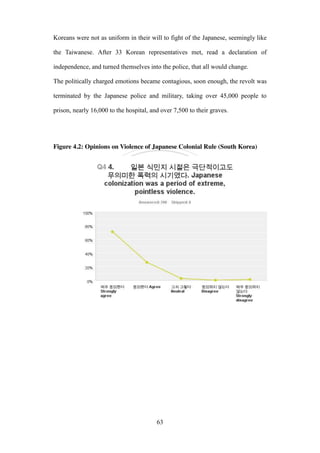
Figure 4.2: Opinions on Violence of Japanese Colonial Rule (South Korea)….....................................63
Figure 4.3: Japanese Colonial Rule - Education & Economy (Taiwan)..................................................72
Figure 4.4: Colonial-based Opinion Toward Japan (Taiwan)…………………………………………..73
Figure 4.5: Opinions on Violence of Japanese Colonial Rule (Taiwan)……………………………… 79
Figure 5: Geopolitical Opinions (South Korea)………………………………………………………...82
Figure 5.1: Choosing Sides (South Korea)…………………………..…………………………………83
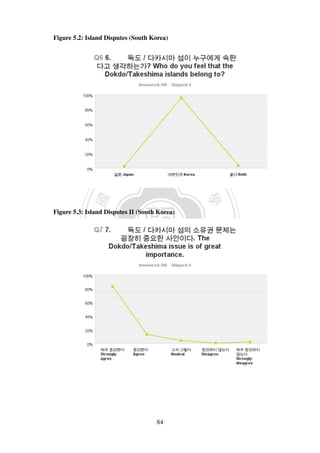
Figure 5.2: Island Disputes (South Korea)……………………………………..………………………84
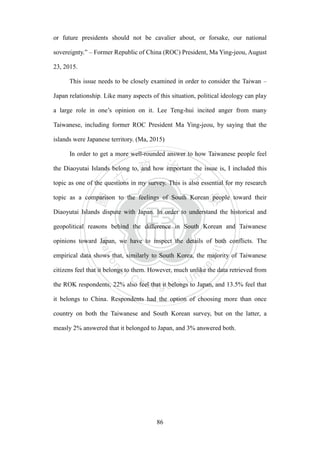
Figure 5.3: Island Disputes II (South Korea)…………………………………………………………..84
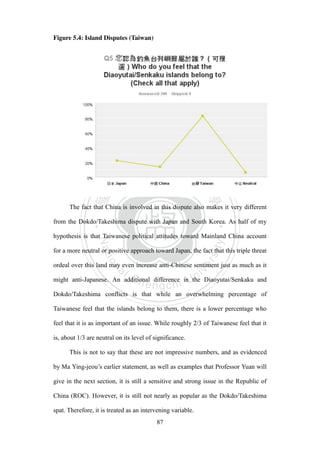
Figure 5.4: Island Disputes (Taiwan)…………………………………………………………………..87
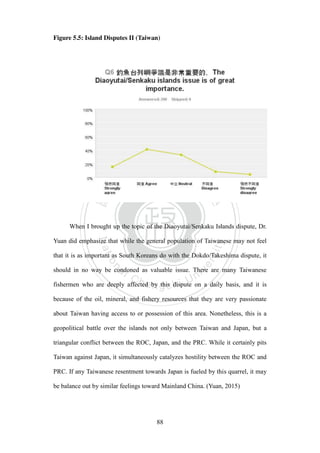
Figure 5.5: Island Disputes II (Taiwan)…………………..…………………………………………….88
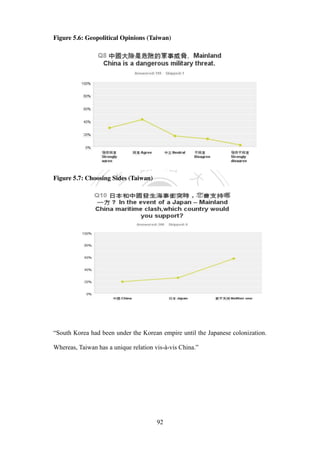
Figure 5.6: Geopolitical Opinions (Taiwan)……………….…………………………………………...92
Figure 5.7: Choosing Sides (Taiwan)…………………………………………………………………..92
Figure 5.8: Opinions on Unification (South Korea)…………………….…………………………….100
Figure 5.9: Opinions on Unification (Taiwan)………………………….……………………………..100
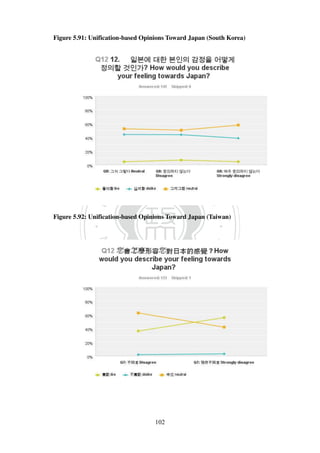
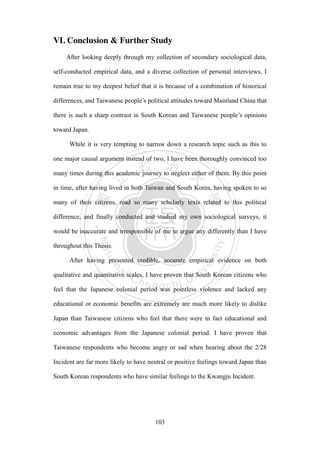
Figure 5.91: Unification-based Opinions Toward Japan (South Korea)...………………………...….102
Figure 5.92: Unification-based Opinions Toward Japan (Taiwan)…..……………………….…..…..102
‧國
立
政 治
大
學
‧
Nation
al Chengchi Univ
ersity
vi
Preface
This Thesis is based on a conglomeration of secondary empirical data conducted from
sociological surveys, empirical data self-conducted through my own sociological
surveys, and several personal interviews that I conducted with both Taiwanese and
South Korean people. As this is still a qualitative research paper, I have used an
extensive amount of scholarly textbooks, journals, and articles. Some of these texts
include excerpts from personal interviews that were conducted by the authors.
Despite the fact that this is a qualitative research paper, there is still a lengthy amount
of quantitative data that I have used to support my arguments that both historical
differences and Taiwanese people‘s political attitudes toward Mainland China account
for the difference between South Korean and Taiwanese public opinions toward Japan.
The use of both qualitative and quantitative data is used to ensure that a balanced and
in-depth perspective is given to take into account all considerations for the reasons of
this split in the Republic of Korea (ROK) and the Republic of Chine (ROC) public
opinions.
‧國
立
政 治
大
學
‧
Nation
al Chengchi Univ
ersity
vii
Acknowledgements
First and foremost, I have to thank my professor and advisor, Dr. Ming Lee of
the Department of Diplomacy at National Chengchi University in Taipei, Taiwan.
Upon taking his course titled International Status of Mainland China, my interest in
both historically and geopolitically based opinions of East Asian people and their
opinions toward their neighbors grew significantly. I was especially interested in Dr.
Lee‘s outlook on my particular study of South Korean and Taiwanese public opinions,
as he is an expert in Korean studies. I could not have had the resources, motivation, or
proper research techniques without Dr. Lee‘s guidance and inspiration, and because of
this I will forever be indebted to him and his scholarly accomplishments.
I need to express my gratitude to Won Jong Eem for her generosity in
distributing South Korean surveys, and explaining her personal perception of Japan. I
am also intensely lucky to have had the opportunities to interview Dr. Yuan I, Kelvin
Chen, Jia-ge, Mr. Kim, Mr. Lai, and Wu Xuan Liang in regards to their own
perspectives on South Korean and Taiwanese public opinions toward Japan. I thank
them for their patience and precision regarding such a sensitive topic of discussion. I
need to extend my unwavering gratefulness to Wu Yi-Ying for her help with
translations, interpretations, and distribution of Taiwanese surveys. I also deeply
appreciate both Eo Yoon Kyung Walters and Jerrel Lai for their assistance with
meticulous translations. Esther Yuna Liu was also heavily instrumental in distributing
and translating South Korean surveys. For this, I am immensely thankful.
‧國
立
政 治
大
學
‧
Nation
al Chengchi Univ
ersity
viii
In no particular order, I have to praise Aaron Lee Crossen, Steven Mantovani,
Yoon-Young Lee Mantovani, Annalisa Feiden, Freya Chou, Caroline Chan, Lee Jia
Yan, and Wu Li-Ying for their unyielding support through survey distribution. I could
not have completed my research without the help of any of these outstanding
individuals, and their hard work is reflected on every page of this Thesis.
My father, Sanford, was stationed at Fort Zama, the headquarters for the US
Army in Sagamihara Prefecture, Japan from 1965 – 1967, where he worked as a
journalist for the Red Cross. In the summer of 1983, he and my mother, Linda, visited
Tokyo, where she, like my father, fell in absolute love with the country‘s culture and
scenery. Growing up in their household, I was showered with my parents‘ magical
stories and photos from their valued experiences in Japan. From a very early age, I
was using chopsticks and watching specials on Kabuki theatre. I owe this childhood
influence turned long-term passion for Asia – Pacific Studies to both of them. While
Japan may not be portrayed in the most positive light throughout this Thesis, it means
so much to me have her included as one of my key academic subjects for this study.
2009 was the year that I made the most important decision of my life to move to
South Korea and teach English, where I would spend two years soaking in every
aspect of the culture, and realize that I was hungry for more knowledge about the
entire East Asia region. I continued my teaching career in Taiwan, where I also
enrolled in the International Master‘s of Asia – Pacific Studies (IMAS) program at
National Chengchi University (NCCU). These past six years have molded my life in a
way that I never could have imagined.
‧國
立
政 治
大
學
‧
Nation
al Chengchi Univ
ersity
ix
In the months leading up to my decision to leave my home country, the United
States, and depart for South Korea, my brother Alex and his wonderful wife, Rebecca,
were extremely encouraging for me to take on this exceptional opportunity. I must
thank them for their support, which was the stepping stone to a social and academic
journey that has forever changed my life, and I look forward to watching their
beautiful children – my niece, Reese, and nephew Riley, grow up.
I would also like to give thanks to Ramona Sojacy, who always took a specific
interest in my time abroad. My dear Aunt Mona, an avid Korean soap opera fan,
would always pick my brain about very different familial concepts that she would
notice in these television series. Through our countless conversations, her curiosity
kept me on my toes, and I urged myself to dig deeper into such anthropological
Korean topics.
I need to bow down to the fine people of South Korea and Taiwan, including my
students, who have made their countries a home for me over all of these years.
Without their acceptance and perspective, I would not have been able to enjoy and
learn from this ex-patriot life, which has given me the chance to write this very Thesis.
I will always consider both the Republic of Korea (ROK) and Republic of China
(ROC) to be my homes away from home. Thank you for giving me this most precious
option.
Finally, this work is dedicated to my old friend, Jeffrey Diebold, who left our
world this past December at the tender age of 28. Once upon a time, he inspired me to
be on a ―quest for knowledge, not grades.‖ From the musty billiards halls of North
Jersey, to the steamy rechao 熱炒 (hot-fry) restaurants of Taipei, I take Jeff‘s
brilliant words with me everywhere I go.
‧國
立
政 治
大
學
‧
Nation
al Chengchi Univ
ersity
x
Abstract
Over the past few years, numerous survey polls have shown empirical data that
suggests that the majority South Korean adults have negative views toward Japan,
while the majority of Taiwanese adults have neutral or positive views toward her. This
is despite the fact that Taiwan was under Japanese control for 15 years longer than
Korea was. There are many theories behind the drastic difference between the two
former Japanese colonies and their citizens‘ public opinions towards Japan today. It is
the purpose of this Thesis Paper to prove that the reason for this difference in
Taiwanese and South Korean people‘s public opinions toward Japan is a combination
of historical differences during and after Japanese occupation in Taiwan and Korea, as
well as Taiwanese people‘s political attitudes towards their neighbor to the west,
Mainland China. In this paper, I will show a very visible link between events in Korea
and Taiwan in the 20th
century, and public opinions toward Japan. I will also show a
very visible link between Taiwanese people‘s political attitudes towards Mainland
China, and their public opinions toward Japan.
Key words: Japanese colonial rule, The 2/28 Incident, The Tapani Incident,
March 1st
Movement, The Kwangju Massacre, Authoritarian Rule,
Administrative Policies, Educational Policies, Dokdo/Takeshima Islands,
Diaoyutai/Senkaku Islands, Authoritarian Regime, Unification, Democratic
Progressive Party (DPP), Kuomintang (KMT)
‧國
立
政 治
大
學
‧
Nation
al Chengchi Univ
ersity
1
Introduction
1.1. Tigers in the Sun
The term ―tigers‖ is often used to describe the four East Asian countries who
accelerated their economies in the 1970s, a decade where many of their neighbors,
with an exception of Japan, severely struggled. These tigers – Hong Kong,
Singapore, South Korea, and Taiwan, are constantly referred to in scholarly Asian
articles and texts, especially in the light of economic studies. While all four of
these tigers were at some point occupied by the once rising sun of the Japanese
empire, only two of the four underwent long-term Japanese colonial periods. It is
these same two tigers, in fact, that went through the trials and tribulations of
martial law in the mid-twentieth century, only to rise to prominent democracies by
the 1990s. It is these same two tigers – South Korea and Taiwan, which are now
so often compared in virtually every category, from economics to democratization,
that will be investigated throughout this research paper to determine the reason for
their heavily differing public opinions toward their former colonial master –
Japan.
1.2. Background of Korean and Taiwanese Public Opinions Toward
Japan
In 2013, a Japanese – South Korean joint poll from Genron –EAI showed
that 76.6% of South Koreans ―held ‗unfavorable‘ or ‗relatively unfavorable‘ views
of Japan.‖ (Hiroshima, Shimizu, 2013) By contrast, a 2012 Interchange
Association Japan (IAJ) survey found that ―65 percent of Taiwanese feel either
‗close‘ or ‗really close‘ to Japan.‖ (Thim, Matusoka, 2014). These are just two of
many data collections that show the bizarre divide in how these two former
Japanese colonies feel towards the country who once dominated them. Scholars
‧國
立
政 治
大
學
‧
Nation
al Chengchi Univ
ersity
2
can search far and wide, and they will always find results that show a heavy skew
of Taiwanese who appreciate Japan, and Koreans who despise her.
During the late autumn of 2015, and early winter of 2016, I conducted my
own opinion polls among both Taiwanese and South Korean respondents about
their views toward Japan, as well as other demographically, historically, and
politically driven questions to try to find out the reasons for such differing
opinions toward Japan from two places who were once colonized by her. My
results were not terribly close to those of the Genron-EAI or IAJ, but certainly
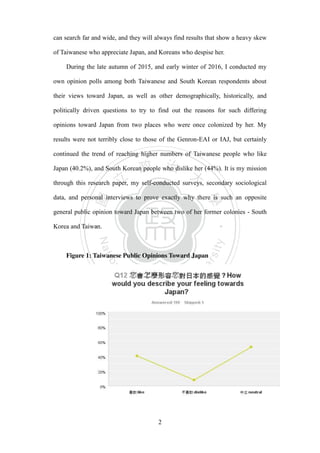
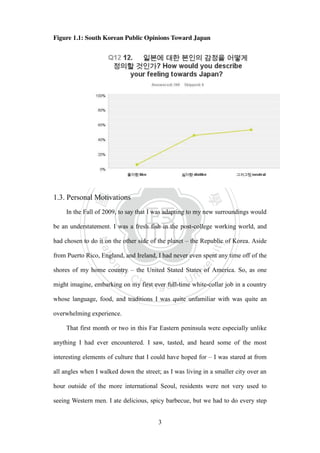
continued the trend of reaching higher numbers of Taiwanese people who like
Japan (40.2%), and South Korean people who dislike her (44%). It is my mission
through this research paper, my self-conducted surveys, secondary sociological
data, and personal interviews to prove exactly why there is such an opposite
general public opinion toward Japan between two of her former colonies - South
Korea and Taiwan.
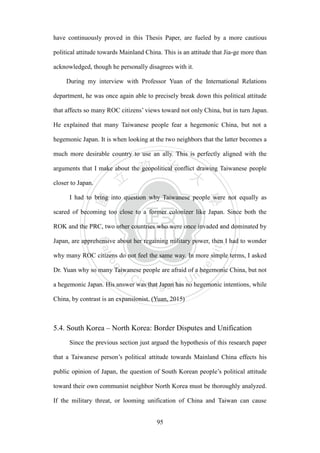
Figure 1: Taiwanese Public Opinions Toward Japan
‧國
立
政 治
大
學
‧
Nation
al Chengchi Univ
ersity
3
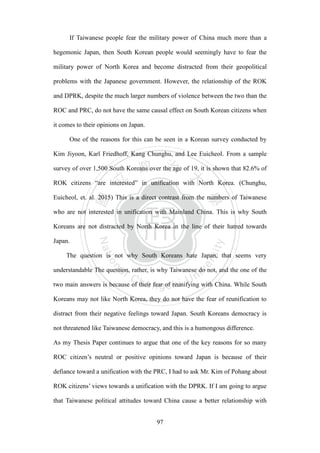
Figure 1.1: South Korean Public Opinions Toward Japan
1.3. Personal Motivations
In the Fall of 2009, to say that I was adapting to my new surroundings would
be an understatement. I was a fresh fish in the post-college working world, and
had chosen to do it on the other side of the planet – the Republic of Korea. Aside
from Puerto Rico, England, and Ireland, I had never even spent any time off of the
shores of my home country – the United Stated States of America. So, as one
might imagine, embarking on my first ever full-time white-collar job in a country
whose language, food, and traditions I was quite unfamiliar with was quite an
overwhelming experience.
That first month or two in this Far Eastern peninsula were especially unlike
anything I had ever encountered. I saw, tasted, and heard some of the most
interesting elements of culture that I could have hoped for – I was stared at from
all angles when I walked down the street; as I was living in a smaller city over an
hour outside of the more international Seoul, residents were not very used to
seeing Western men. I ate delicious, spicy barbecue, but we had to do every step
‧國
立
政 治
大
學
‧
Nation
al Chengchi Univ
ersity
4
of the cooking process ourselves on a wok at the restaurant table; my legs also
often fell asleep from having to sit cross-legged on the floor. Neon lights
enveloped the torn up streets at an even higher rate than the booming metropolis
of Manhattan that I had grown up so close to; Korean Pop songs blared out of the
speakers of almost every coffee, eye glass, and cell phone shop in sight as
pedestrians went on with their days in what were usually stylish outfits that made
me feel dangerously underdressed and unsophisticated. Amongst all of the
mind-blowing every day aspects of this new life, though, one moment will always
stay particularly tattooed to my brain; it was a quote from one of my seven-year
old students, as I was working in this country as an English teacher.
―Why [did] the Japanese people take the Koreans?‖
In English that was miraculously barely broken, this kindergartener had
unmistakably inquired about the humiliating years of the Japanese occupation of
Korea. He proceeded to explain to me that he had heard about this from his
mother, and it had not taken long to also make him upset. As this was very early
on in my Korean life, I was still taken aback by the forwardness of this child who
had not even been alive a decade ago, let alone during the period of Japanese
colonization. It did not take me long to find out that this student‘s negative
impression turned opinion of the giant island to the East was by no means an
exception. From students expressing their feelings during many of my lectures, to
locals in the bars rooting for whichever team was playing against Japan in a
soccer match, the disdain for the former colonizer was in full affect, even more so
than the looming threat of North Korea. Korean Studies scholars explain such
situations as key examples of Koreans expressing their ―han‖ or inner rage; such
‧國
立
政 治
大
學
‧
Nation
al Chengchi Univ
ersity
5
feelings can be fueled by history such as Japanese war crimes. (Hyong, 2014)
During the two years that I lived in the ROK, such a sentiment in no way wavered.
It was in 2011, after all, that a South Korean friend of mine compared Japan and
the ROK‘s contemporary geopolitical situation to that of Israel and Palestine.
It was for these reasons that I wondered, when moving to former Japanese
colony Taiwan, if I would encounter similar feelings. Soon after arriving there,
though, I found out that, despite the shared colonial history, many feelings
towards Japan do not replicate those that I had experienced in South Korea. For
the four years of my Taiwanese life, this has truly been a topic that I have tried to
dig to the bottom of. I have been back to visit the ROK twice, and this difference
in Japanese feelings still creates a web of confusion not just for me, but other
friends of mine who are from or live there. Not only was Taiwan also a Japanese
colony, but for fifteen years longer. The Republic of China was the very first
colony of Japan, and completely controlled by her for a whopping five decades.
I have now lived, worked, and studied in South Korea and Taiwan for a total
of six years. My experiences in both countries have been incredible, but at the
same time quite different. I find this topic to be especially interesting since Korea
and Taiwan are so often compared in fields such as economics, politics, and
technology. Their relationships with Japan, though, could not be any more on the
contrary. It is my aim, through this thesis paper, to find out exactly why.
1.4. Research Objectives
The purpose of this paper is to find out why so many Taiwanese like Japan,
and why so many Koreans hate her, despite their shared colonial history with the
superpower. While this Thesis paper is undoubtedly geared toward Asia – Pacific
studies, the specific focus within this subject is that of Area Studies.
‧國
立
政 治
大
學
‧
Nation
al Chengchi Univ
ersity
6
The aim of this paper, like most of my academic research, is to gather
answers that allow us to distinguish key differences within East Asia. It is forever
my goal to establish and explain the reasons behind geopolitical relationships and
socio-cultural differences within the Asia – Pacific region. We live in an age
where, 70 years after the end of the Pacific War, governmental and cultural
relationships within East Asian neighbors are tenser than ever. East Asia continues
to struggle to achieve regional strength, due to painstaking differences among
different nations in the region. (Goh, 2013) Japan still stands as a historical, yet
contemporary piece that does not fit to the puzzle when dealing with Korean and
Chinese diplomatic strategy. She is one of the key agitators in the line of hopeful
progress and peace in Asia – Pacific relations, due in a large part to her violent
role in the Pacific War and what many Chinese and Korean citizens feel is an
insincere approach to apologize. (Curtis, 2015)
Quite differently, as this Thesis will very often reflect, Taiwanese people, and
typically the soon to be ruling Democratic Progressive Party (DPP), tend to be
more favorable to Japan. They focus their tension towards Mainland China in
relation to a struggle for sovereignty, and fear of annexation. Through any of these
geopolitical and cultural wars, it is important for us to understand the differences
between the people, and understand the sociological concepts why. In an effort to
master Area Studies, despite the fact that such problems may indeed continue for
quite some time, we cannot make any hint of progress without first grasping the
meaning behind such quarrels. With recent empirical data, I will first confirm the
striking differences in opinion towards Japan. Such data will not only be
secondary, but also my own. I will then dissect several possible motivations, and
come to a conclusion.
‧國
立
政 治
大
學
‧
Nation
al Chengchi Univ
ersity
7
It is very easy to detect the contrast in public opinions towards Japan after
visiting, reading, or watching media on Taiwan or South Korea. However, not
many people can answer why such a contrast exists. Moreover, not many scholars
have published a work like mine that actually digs beneath the possible reasons
for why. There are an infinite number of academic textbooks, articles, and journals
that explain why South Korea and Mainland Chinese have a disdain for the
Japanese. This is researched and discussed almost regularly in East Asian
academic circles. There seem to be just as many publications and dialogue in
regards to the Taiwanese and their more positive opinions of their former imperial
tyrant. Nonetheless, it is extremely difficult to identify work which touches base
on the interest in and mystery behind why the two former colonies to the west of
Japan hold such differing images of her.
More importantly, in an academic world where Taiwan and South Korea are
regularly compared in almost every other category, be it economics, history of
democratization, or technology, they are not in their psychological approaches to
the Land of the Rising Sun. Because of this absence of information, and what I
have experienced in my years in both the ROC and ROK, I plan to deliver on this
topic with both accuracy and depth.
1.5. Methodology
Despite the plethora of information that confirms the fact that Taiwanese and
South Korean public opinions toward Japan are quite different, I have also
conducted my own sociological surveys. This is not only to further cement the
differences in this Northeast Asian triangle‘s opinions of each other, but to also
dig deeper and clarify such reasons for this. For example, I have asked the general
question in regards to the surveyors‘ feelings towards Japan (like/dislike/neutral).
‧國
立
政 治
大
學
‧
Nation
al Chengchi Univ
ersity
8
This has allowed me to gather the percentages of Taiwanese and South
Koreans who feel a certain way towards their neighbor to the East. In addition,
each survey contained questions about age, importance of political issues,
historical events, and how they feel that the overall Japanese occupation has
affected the education and economies of their countries. This allowed me to
deduce the key factor(s) as to why there is such a difference in opinion between
the two former colonies. The surveys for South Koreans and Taiwanese have
some different questions pertaining to their own historical events and political
issues with Japan.
I have distributed a total of 400 surveys – 200 in both South Korea, and 200
in Taiwan. The surveys each asked 12 questions in relation to Japan in the
countries‘ respective languages. I truly feel that I was able to get a very
well-rounded pool of respondents from different age groups and backgrounds.
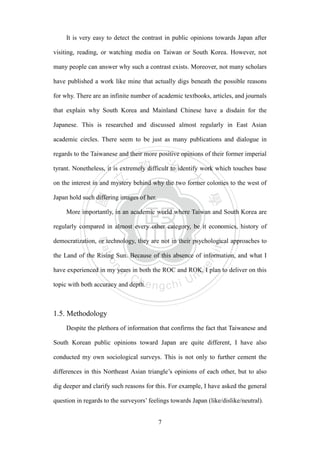
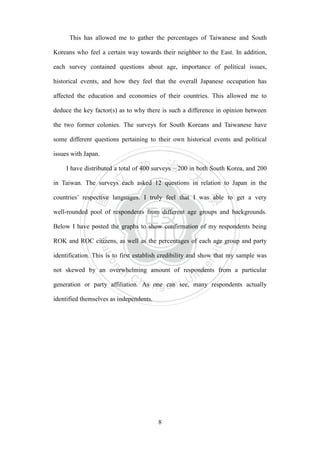
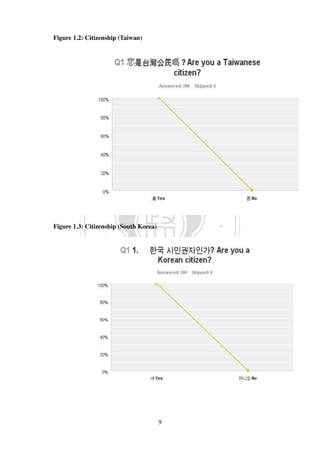
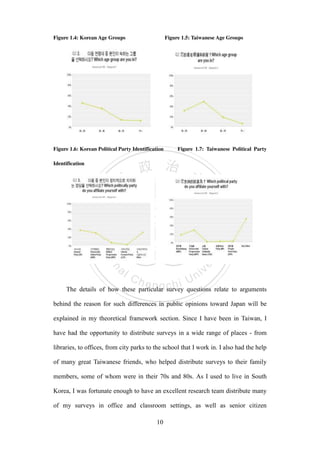
Below I have posted the graphs to show confirmation of my respondents being
ROK and ROC citizens, as well as the percentages of each age group and party
identification. This is to first establish credibility and show that my sample was
not skewed by an overwhelming amount of respondents from a particular
generation or party affiliation. As one can see, many respondents actually
identified themselves as independents.
‧國
立
政 治
大
學
‧
Nation
al Chengchi Univ
ersity
9
Figure 1.2: Citizenship (Taiwan)
Figure 1.3: Citizenship (South Korea)
‧國
立
政 治
大
學
‧
Nation
al Chengchi Univ
ersity
10
Figure 1.4: Korean Age Groups Figure 1.5: Taiwanese Age Groups
Figure 1.6: Korean Political Party Identification Figure 1.7: Taiwanese Political Party
Identification
The details of how these particular survey questions relate to arguments
behind the reason for such differences in public opinions toward Japan will be
explained in my theoretical framework section. Since I have been in Taiwan, I
have had the opportunity to distribute surveys in a wide range of places - from
libraries, to offices, from city parks to the school that I work in. I also had the help
of many great Taiwanese friends, who helped distribute surveys to their family
members, some of whom were in their 70s and 80s. As I used to live in South
Korea, I was fortunate enough to have an excellent research team distribute many
of my surveys in office and classroom settings, as well as senior citizen
‧國
立
政 治
大
學
‧
Nation
al Chengchi Univ
ersity
11
communities. Out of my Taiwanese sample, 43/200 surveys were distributed
online. Out of my Korean sample, 11/200 surveys were distributed online. The
rest were all manually distributed.
As this is still a qualitative research paper, I have conducted several
interviews from a varied group of Taiwanese and South Korean people in regards
to their opinions on Japan. My Taiwanese interviewees include an established
professor from the International Relations Department at National Chengchi
University (NCCU), a first generation restaurateur who actively supports both the
Kuomintang (KMT) and the New Party (NP), and a camera equipment company
boss who actively supports the Democratic Progressive Party (DPP).
My Korean interviewees include a well-traveled housewife who is tri-lingual
with fluencies in both English and Japanese, and a Pattern Related Design student
at the Fashion Institute of Technology (FIT). All in all, my interviewees‘ ages
range from as young as 26, and as old as 70 years.
Because this Thesis is on the subject of public opinion, I purposely chose
interviewees from a wide range of backgrounds. Typically, the credibility of a
Thesis rises with a larger amount of expert opinions and interviews. However, the
goal of my particular research is not to only unveil the public opinions of South
Korean and Taiwanese professors toward Japan, but all types of citizens. Surely,
self-conducted and secondary sociological data that I have collected, analyzed,
and reported on are not limited to ROC and ROK citizens of certain categories.
For this reason, to fulfill my scholarly responsibility to use sociological methods
to answer questions regarding the vast difference in South Korean and Taiwanese
public opinions toward Japan, I interviewed the diverse group of people that I did.
This is quite similar to the fact that I distributed my surveys in many different
types of atmospheres.
‧國
立
政 治
大
學
‧
Nation
al Chengchi Univ
ersity
12
In addition to my self-conducted surveys and interviews, as I will mention in
my literature, I have gathered, analyzed, and reflected on a massive amount of
secondary sociological data from scholarly articles, books, films, and journals.
Once again, such secondary sociological data is gathered from studies on
perspectives from South Korean and Taiwanese people from all different wakes of
life in order to have a fair understanding of where such public opinion towards
Japan comes from. By using quantitative methods such as self-conducted and
secondary sociological data, I was able to establish a lot of credibility from
numbers that do not lie. There are many parts to this study, first having to confirm
the statistic that show that many more South Korean people hold negative views
toward Japan, and many more Taiwanese people hold positive views toward her.
After clarifying that, it of course becomes important to gain statistics that explain
exactly why such a difference in public opinion occurs. Due to the complexity and
sensitivity of the issue, I felt that it was indeed necessary to use quantitative data
to illustrate a level of objectivity in regards to how big the difference is, as well as
the reasons behind it.
As crucial as quantitative data is, though, I also found it necessary to use
qualitative methods such as interviews and scholarly articles. These are equally as
valuable, because as accurate and telling as numbers can be, an issue such as
public opinion toward Japan requires much background information, whether it be
political ideologies, historical perspectives, or cultural identification. By also
utilizing qualitative data, I was able to provide a backbone to the quantitative data,
and provide logical, personal answers to the numbers at hand. Through the voices
of many scholarly authors, and members of my subject population group, this
Thesis provides deeper questions, theories, and closure while simultaneously
resting on some very convincing data.
‧國
立
政 治
大
學
‧
Nation
al Chengchi Univ
ersity
13
I strongly believe that both qualitative and quantitative data are needed to get
to the root of many research questions. In this Thesis, my quantitative and
qualitative data complement each other, rather than contradict each other.
Moreover, they give additional coatings of truth, rather than take the risk of
plunging into a deep sea of generalizations. It is my scholarly responsibility to
make sure that this does not happen, especially in the light of such an emotionally
acute topic such as Japanese occupation, or cross-strait relations. There are only
so many interviews that one can have without them merely being regarded as
anecdotal, and there are only so many graphs and dots that one can use without
them being regarded as junk science.
However, when they are used together, with the consistency that is displayed
in this Thesis, the value of both is quite strong. The answers in my interviews, and
scholarly information in the articles that I used go in complete alignment with the
quantitative data that I retrieved from my self-conducted and secondary
sociological data. The answers, both qualitative and quantitative, do an
unwavering job of informing the reader of why the societies of South Korea and
Taiwan have the public opinion toward Japan that they do. The data is
sociological because it shows how a certain number of people feel the way they
due in relation to the historical and contemporary events of their local and
surrounding governments. This public opinion Thesis, with its use of the
aforementioned data, succeeds in interpreting how society affects the people being
studied. It is the most effective way to truly answer such sociological questions as
to why public opinion toward Japan differs amongst Taiwanese and South
Koreans.
‧國
立
政 治
大
學
‧
Nation
al Chengchi Univ
ersity
14
1.51. Hypothesis
Based on my empirical data and sociological evidence, I have reason to
believe that the reasons for the differences in South Korean and Taiwanese
opinions towards Japan are politically and historically motivated. My hypothesis,
to be exact, is that South Korean and Taiwanese people have very contrasting
opinions toward Japan due to a combination of historical differences, and
Taiwanese people‘s political attitudes toward Mainland China. Specifically
speaking, I believe that the Japanese occupation of Taiwan, while extraordinarily
violent, is viewed by many Taiwanese as more economically and educationally
beneficial than in South Korea. I also believe that it is not merely a difference of
historical differences during Japanese rule, but also immediately after it.
The February 28, 1947 incident, which will be explained in great detail
throughout this paper, accounts for a large part of why so any ROC citizens
decrease their level of animosity toward Japan, and rather focus it towards the
Mainland Chinese. Equally as effective, the fact that roughly 2/3 of ROC citizens
oppose unification causes them to have neutral or positive feelings toward Japan.
Since, by contrast, roughly 80% of South Koreans want unification with North
Korea (Feffer, 2015), they are not detracted from their negative feelings toward
Japan, and therefore still have a higher level of people who ―dislike‖ her.
‧國
立
政 治
大
學
‧
Nation
al Chengchi Univ
ersity
15
Independent variable (1): Overall effects of Japanese occupation dependent
variable: opinion towards Japan
Independent variable (2):Opinions toward 2/28 & White Terror KMT/Kwangju
Massacre & Authoritative Korean/Taiwan Regimes dependent variable:
opinion towards Japan
independent variable (3): Political attitude towards unification with China/North
Korea dependent variable: opinion towards Japan
1.6. Theoretical Framework
The thesis paper will be divided into several sections to cover the two main
theories that I am exploring. I will mention additional intervening variables. Some
of these intervening variables will prove to have been weak, while others will still
fall into the same two categories of historical differences, and political attitudes
toward China or North Korea. The theory, once again, ties a lower level of
negativity from Taiwanese people toward Japan because of a more negative
political attitude toward China, as well and a different historical outlook on the
Japanese rule and what followed it. I am taking the approach from a historically
and contemporarily based theory; this theory involves the effects of mid-twentieth
century history, in combination with an international relations based theory which
is tied to ideologies surrounding reunification with China or North Korea. Every
element of this theory will be argued through my secondary data, self-conducted
data, and personal interviews.
‧國
立
政 治
大
學
‧
Nation
al Chengchi Univ
ersity
16
1.61. Age Group
When I tell some friends in Korea how people here in Taiwan tend to be
more favorable to Japan, one reaction is that it might be more of the new
generations, while the older generations may still have hatred. Because of this, the
age has to be addressed as an intervening variable. However, as I will show from
my data, it proves to be somewhat insignificant for explaining the reason why
more Taiwanese people have neutral or positive feelings toward Japan. While
differences in public opinion toward Japan are certainly illustrated among
different age groups of both the ROC and ROK, it still does not explain why there
is such an overall contrast in the public opinions between the populations of both
places. In addition, according to my interviews, younger Taiwanese or South
Korean people of today are still influenced by what happened during their parents
or grandparents‘ lives, so the fact that they were not alive during the Japanese
occupation does not necessarily rid them of a relevant opinion towards it.
To be specific about the effects I encountered, and why I am eliminating age
group as a prime independent variable, I will calculate and share that according to
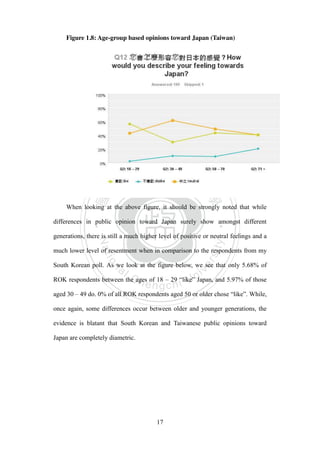
my self-conducted surveys, 55.93% of Taiwanese citizens between the ages of 18
– 29 answered that they ―like‖ Japan. This admittedly does largely outweigh the
29.47% of those aged 30 – 49 who answered the same, but 61.05% of that same
age group selected the choice ―neutral‖ for their feelings toward Japan.
Furthermore, 42.86% of Taiwanese between the ages of 50 – 70 years old
answered ―like‖, as did 40% of respondents who were 71 or older; the latter group
was actually alive during the period of Japanese rule.
‧國
立
政 治
大
學
‧
Nation
al Chengchi Univ
ersity
17
Figure 1.8: Age-group based opinions toward Japan (Taiwan)
When looking at the above figure, it should be strongly noted that while
differences in public opinion toward Japan surely show amongst different
generations, there is still a much higher level of positive or neutral feelings and a
much lower level of resentment when in comparison to the respondents from my
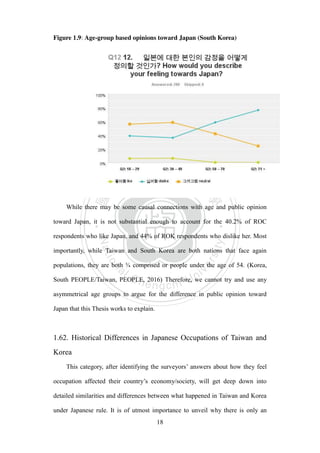
South Korean poll. As we look at the figure below, we see that only 5.68% of
ROK respondents between the ages of 18 – 29 ―like‖ Japan, and 5.97% of those
aged 30 – 49 do. 0% of all ROK respondents aged 50 or older chose ―like‖. While,
once again, some differences occur between older and younger generations, the
evidence is blatant that South Korean and Taiwanese public opinions toward
Japan are completely diametric.
‧國
立
政 治
大
學
‧
Nation
al Chengchi Univ
ersity
18
Figure 1.9: Age-group based opinions toward Japan (South Korea)
While there may be some causal connections with age and public opinion
toward Japan, it is not substantial enough to account for the 40.2% of ROC
respondents who like Japan, and 44% of ROK respondents who dislike her. Most
importantly, while Taiwan and South Korea are both nations that face again
populations, they are both ¾ comprised or people under the age of 54. (Korea,
South PEOPLE/Taiwan, PEOPLE, 2016) Therefore, we cannot try and use any
asymmetrical age groups to argue for the difference in public opinion toward
Japan that this Thesis works to explain.
1.62. Historical Differences in Japanese Occupations of Taiwan and
Korea
This category, after identifying the surveyors‘ answers about how they feel
occupation affected their country‘s economy/society, will get deep down into
detailed similarities and differences between what happened in Taiwan and Korea
under Japanese rule. It is of utmost importance to unveil why there is only an
‧國
立
政 治
大
學
‧
Nation
al Chengchi Univ
ersity
19
overwhelmingly negative attitude towards Japan in South Korea, while not
Taiwan. This will all be investigated through the many details about Japanese
administration/education/social policies in colonial Korea and Taiwan. There will
in fact be many references and narratives that show similarities, but it will still in
the end address the key differences that account for the differences in opinion
toward Japan.
1.63. 2/28 and White Terror KMT
While there was lots of bloodshed during both the imperial Japanese and
authoritative KMT regimes, Taiwanese generally seem to view the latter as more
personally horrific. I believe that because of the sudden Republic of China take
over after the Japanese surrendered, the mass killings that ensued on February 28,
1947, and decades of martial law, are all key reasons why Taiwanese may look
back to Japanese occupation as slightly better in the face of Chiang Kai-shek.
This section, however, will have to be examined very carefully, as South
Korea, much like Taiwan, also faced atrocities after the Japanese left. From the
Korean War to the slew of authoritative dictators and decades of martial law they
experienced, it could indeed seem illogical to say that Taiwan has been distracted
from Japan‘s misdeed through those of the post-Pacific War R.O.C. However,
through my data and interviews, I will prove why it is indeed a factor for the
Taiwanese people and their present-day views of Japan
1.64. Contemporary Political Issues
For the Koreans, a major political issue is the Dokdo/Takeshima dispute with
Japan. Surely, this can be a possible reason for the increased likelihood of Koreans
to dislike their neighbor. For Taiwan, we will not look at negative political issues
‧國
立
政 治
大
學
‧
Nation
al Chengchi Univ
ersity
20
with Japan, but rather with China to try to justify why so many Taiwanese are
fond of the Japanese. Just like we will examine 2/28 and White Terror KMT to see
if it counters psychological aggression to the Japanese, we too will look into
Cross-Strait Relations and the China Factor. It is likely that Taiwanese choose to
look more favorably towards Japan in light of their geopolitical battle for
sovereignty from China, as well as the fact that Japan also has her own problems
with the rising superpower; Japan and Taiwan have this negative relationship with
China in common. Of course, it depends on the political views of every ROC
citizens, but because of the higher numbers of anti-unification, general pan-green
people in Taiwan, the opinion polls have the results that they do.
For the Korea – Japan Dokdo/Takeshima section, it will touch upon the
empirical results that I will have found about its level of importance. This section
will give in depth history about both Korea and Japan‘s claims, the islands‘
importance in natural resources, and then dig into whether or not it accounts for
Korean hatred towards Japan. On the contrary, it may prove that the debate on the
islands is itself fueled by an already existing feud. My hypothesis certainly links
to the latter. For Cross-Strait Relations/The China Factor, it will explore the entire
65-year rift of Taiwan (ROC) and the People‘s Republic of China. It will lead up
to current day conflicts such as annexation/independence, the missiles that still
point towards Taiwan, and Taiwan arms purchases for possible defense. This
section will include everything it possibly can about the Taiwan – China
relationship. It will then connect the surveyors‘ answers regarding their opinions
of their neighbor to the West to question and answer if a large reason that
Taiwanese may like Japan is due to a convenient coincidence that they both have
sour relationships with China.
‧國
立
政 治
大
學
‧
Nation
al Chengchi Univ
ersity
21
II. Literature Review
2.1. Establishing the difference in Korean/Taiwanese opinions
This literature includes both publications from popular media, as well as
sources used will be from in-depth scholarly journals and research textbooks. As
the basis for this thesis paper is to acknowledge and then figure out reasons for the
difference between Taiwanese and Koreans‘ views towards to Japan, I have
referenced recent articles and opinion polls. They do not merely scratch the
surface of the issue at large, but also establish the foundation of what I am
researching, and help confirm to the reader early on that this divide in Asian
opinion of Japan exists. Two key articles, titled, ―INSIGHT: Do South Koreans
really hate Japan?‖ from the Asahi Shimbun, and ―The Odd Couple: Japan &
Taiwan‘s Unlikely Friendship‖ by Michal Thim and Mitsato Matusoka of The
Diplomat not only ensures current, important, and credible data about South
Korean and Taiwanese public feelings toward Japan, but also include some
possible independent variables for this difference that I will dissect.
The Asahi Shimbun article questions the relation of current political issues to
the Korean‘s overwhelming level of descent towards Japan. It initially hints at a
spark in the Japanese – Korean rivalry in the last several years because of a larger
emphasis on the Dokdo–Takeshima islets dispute. This very geopolitical conflict
over resources and territory is a large issue to be investigated throughout my paper.
However, a question that I will dig into is whether the political disputes, namely
Dokdo–Takeshima, are what cause the Japanese – Korean conflict, or whether an
already standing negative relationship is what so easily catalyzes heated
arguments over territories like the tiny islands in question. The Asahi Shimbun
article certainly seems to imply that my latter question carries more weight, as he
reports that less than 1% of Korean respondents ―told the Genron-EAI opinion
‧國
立
政 治
大
學
‧
Nation
al Chengchi Univ
ersity
22
poll that they formed their opinions on bilateral relations through information
obtained through direct conversations with people from the other country.‖
(Hiroshima and Shimizu, 2013).
This points to possible evidence that current geopolitical anger that Koreans
feel towards Japan is ultimately fueled by history of the occupation, rather than
recent foreign policy. This article, however, leaves an absence of historical detail.
It rather focuses on the relationship of Japan and Korea since the late 2000s,
without any mention of how it was decades prior. The main purpose of this article,
albeit, is to inform the public of how contemporary Japanese and Koreans feel
towards each other. Because of that, the lack of historical information is somewhat
warranted. My aim, with respective difference, is to inform the public of such
opinions, look at contemporary political issues, but also historical ones. This is
why I am also using articles, books, films, and interviews to explore further than
the Asahi Shimbun article did.
The ―Odd Couple‖ article bout Taiwanese opinions towards Japan, rather
than those of South Koreans, was published by Michael Thim, a research fellow in
the Taiwan Studies Program at the China Policy Institute (CPI) of the University
of Nottingham, and Misato Matusoka, a Associate Fellow at the Institute of
Advanced Study (IAS) at the University of Warwick. This research article was
based on a very extensive survey by the Interchange Association Japan, or the ―de
facto‖ Japanese embassy of Taiwan. The study used a sample of 17, 340
Taiwanese respondents aged from as young as 20, and old as 80. Matusoka
mentions that in the Taiwanese respondents aged 20 –29, there is an even higher
tendency to favor Japan (54%).
‧國
立
政 治
大
學
‧
Nation
al Chengchi Univ
ersity
23
However, it fails to contrast this with results of older generations,
particularly any Taiwanese still alive that were present during the Japanese
occupation. This is something that I did find out in my own research, as I
conducted sociological surveys of my own. Additionally, I conducted personal
interviews with Taiwanese in their 50s, 60s and 70s. This was to avoid any results
of Taiwanese favoritism towards Japan being skewed by younger populations.
2.2. The Japanese Occupation of Korea
While the systems and policies that the Japanese used on colonial Taiwan are
explained, I will then have to compare it with Korea. As one can see, as
thoroughly equipped with information as the previous texts are about Japanese
rule in Taiwan, they do not provide nearly enough about its comparison with the
occupation of Korea. As mentioned throughout my research paper, there must
have been large differences in the colonial periods of Korea and Taiwan to create
the vast difference in the countries‘ opinions of Japan that we see today.
Undoubtedly, there was violence, discrimination, and suffering in both of them.
However, they must have been to certain degrees, quite different in some respects.
It is often argued by scholars that Koreans were treated more inferior by
Japan then, say, Taiwanese were. Japan did not provide colonial Korea with the
same educational and economic care that they did in Formosa. One thing that I
have to do to prove such differences existed, is to dig into the brutal historical
accounts of what many Koreans faced under Japanese rule, to then see if
Taiwanese suffered at the same level. One of many academic works that I will use
to trace the horrific history that Koreans faced under Japanese rule, which is a key
motivating factor in 3/4 of their country sharing a ―disliking‖ towards Japan, are
tales and numbers of comfort women, genocide, marriage prevention, and
‧國
立
政 治
大
學
‧
Nation
al Chengchi Univ
ersity
24
imperial induced poverty that is all told in Kang Hildi‘s ―Under the Black
Umbrella: Voices from Colonial Korea, 1910 – 1945.‖ (Hildi, 2005)
I have traced the depths of this extremely sensitive issue by examining a
sociological scholarly journal article by Pyong Gap Min. Titled ―Korean Comfort
Women: The Intersection of Colonial Power, Gender, and Class‖, it delves in the
details of not only the grossly large numbers of sexual slaves, but also the
psychological effects that took place on the victims and their society. This article
is crucial for understanding the background of a hot contemporary issue that
drives much of the anti-Japan sentiment throughout South Korea.
Unfortunately, the issue of comfort women is something that is going to have
to be discussed a lot in this research paper. It is not only of grave importance to
recognize the pain and suffering of so many forced, trafficked women (Min, 2003),
but, as I will argue, a main reason for the soured relationship of Japan and Korea
70 years later (Toosi, 2015). It was just this past summer, after all, that an 80-year
old Korean man set himself on fire at a Seoul rally for justice in the name of
comfort women (NA, 2015). The heartbreak of Japanese colonial history in Korea
is extremely poignant to the present public opinions that ROK citizens have
toward Japan, as well as the underlying arguments to this research paper.
2.3. The Japanese Occupation of Taiwan
One of the most important lessons to be learned during this research paper is
that both Korea and Taiwan experienced decades of bloodshed under Japanese
rule. It is for this reason that I was so curious in the first place why one former
colony despises Japan, and the other enjoys her proximity. To get a very thorough
view of Japanese rule over Taiwan, I will be using the book put together by Liao
Ping-hui and David Wang.
‧國
立
政 治
大
學
‧
Nation
al Chengchi Univ
ersity
25
Titled ―Taiwan Under Japanese Colonial Rule, 1895 – 1945: History, Culture,
Memory.‖ It examines the hardships that Taiwanese, like Koreans, faced under
Japanese rule. On the contrary, it uncovers some more positive factors of the
colonial rule; these are positive factors that I may or may not be able to find
during the Japanese rule of Korea. Nonetheless, the negatives that took place
because of Imperial Japan are more than studied as well.
What makes this literature different, though, is that it covers all aspects of
the Japanese process. While it delves into the effects of agricultural expertise, like
Ka does, it also highlights the specifics such as land surveys and the census. In
addition to land management under the Japanese, this book takes a deep look into
the realm of education. This is an invaluable topic, as, much like agricultural and
economy, it is almost always brought up as a discussion point to why many
Taiwanese might feel favorable to the period of Japanese rule. When discussing
key alleged benefits of Japanese colonial days, it is extremely important to use
historical and contemporary findings of educational improvements that Taiwan
can thank Japan for.
The economic and educational changes brought under colonialism are not
researched in these articles without an emphasis on the inequalities of the
Taiwanese, Japanese, lower class and elites. While it is often argued that Japanese
gave the Taiwanese much more opportunity and freedom than they did in say,
Korea, many authors of the articles in ―Taiwan Under Japanese Colonial Rule‖ are
very careful to also include the realities of segregation and limitations to certain
groups of native Taiwanese when it came to employment or education. Such
disadvantages still faced by the Taiwanese may seem to impede my argument that
benefits gained under Japanese rule may contribute to a more positive Taiwanese
opinion to it, but it is more useful to me while trying to reveal the real reason the
‧國
立
政 治
大
學
‧
Nation
al Chengchi Univ
ersity
26
sentiment exists. If anything, such findings help eliminate any exaggerated or
false connections between the history of Japanese rule and contemporary
Taiwanese public opinion towards the country. As will be mentioned in my
methodology section, it is important to note that I am further confirming such
feeling that Taiwanese have towards the advantages or disadvantages of Japanese
rule through my own self-conducted surveys.
Additionally important is this book‘s scholarly research on the ethnic and
national identity cleavage that was formed after the Japanese had to leave. While
this particular topic would fit better into this literature reviews next category of
2/28 and White Terror KMT, it does an excellent job to set the tone of what came
after from the Chinese, and how it may very well have lead many Taiwanese to
think less about any violence or inequalities inflicted on them by the Japanese. At
this point, of course, the question as to why Taiwanese favor Japanese is if
anything stronger than any explanation. Because of that, this text alone is not
sufficient, to say the least.
To continue to look for answers through the exploration of Japanese
occupation in Taiwan and how it compares with Korea, I will be heavily
referencing the book titled ―Japanese Colonialism in Taiwan: Land Tenure,
Development, and Dependency, 1895 – 1945.‖ This book surely covers aggressive
measures taken by the Imperial Japanese, but focuses more instead on the
positives that they contributed to Taiwan at that time and, as many argue, that still
exist in contemporary Taiwanese economy and society.
Written by Chi-ming Ka, a research fellowship at Academia Sinica in Taipei,
the text researches and confirms such positives of Japanese colonialism on Taiwan.
He also emphasizes how Taiwan was not a typical colony, not just in comparison
to Korea, but to others all over the world.
‧國
立
政 治
大
學
‧
Nation
al Chengchi Univ
ersity
27
A key reason, as Ka explains, that Taiwan was an exception in the history of
countries victimized by colonization is because of how much she thrived under
Japan in sugar production. Because the island reached such great agricultural and
economic heights in sugar, there is much progress to be attributed to the period of
Japanese colonization, despite how ugly some social factors may have been.
The main goal of Ka is to explore, uncover, and invigorate the feelings of
agricultural and economic achievement that Taiwan gained during the fifty-year
period of colonization. Such a reality, with empirical data to not only confirm how
the island thrived during Japanese rule, but also decades later in capitalism, and
even into its fresh years of democracy, surely help point to my dissertation‘s
emphasis on the fact that Korea and Taiwan had very different periods of Japanese
rule, which may affect the difference in opinion toward the country. What Ka does
not do, contrary to the goal of my thesis paper, is further contrast Taiwan‘s
agricultural benefits of the colonial era to those of Korea. Because Ka‘s text lacks
such an angle, it still makes it impossible to see why Koreans tend to hate Japan.
What Ka‘s text does show is why it is plausible that so many Taiwanese favor
Japan‘s colonial history, but it can say nothing to the reader about why Koreans
usually do the opposite.
Equally confusing as the contrasting views of South Korean and Taiwanese
opinions is the fact that comfort women are not mentioned nearly as much in the
majority of literature about Japanese colonization of Taiwan. Such a vacancy of
information is astonishing, as it is extremely important when researching a topic
such as mine. It is for this reason that I have included the very recent publication
from The Diplomat article titled ―China, Taiwan Apply Pressure to Japan Over
‗Comfort Women‘ Issue‖.
‧國
立
政 治
大
學
‧
Nation
al Chengchi Univ
ersity
28
This article addresses the fact that an estimated 2,000 Taiwanese females
were forced into some type of sexual slavery during the Japanese rule. (Tiezzi,
2016) While it is roughly 10% the size of the estimated Korean comfort women
population, it is a key reminder of a horrible part of history that is seemingly
contradictory to a large percentage of ROC citizens‘ opinions toward Japan.
2.4. The Korean War and Martial Law
Since I am spending a significant portion of this thesis paper harping on the
cruelty and oppression of the Taiwanese period of martial law and how it may
affect the topic at hand, I also have to recognize the fact that South Korea faced a
very similar situation at pretty much the same exact time. The ROK faced her fair
share of ―tanks and soldiers guard[ing] the entrances to most government
buildings and many universities and newspaper offices.‖ (Tharp, 1981)
A very challenging question of this thesis topic regard the fact that through
such political unrest as military coups and the assassination of a president, the
evils of Korean domestic governance still did not outweigh any hatred towards
Japan like it did in Taiwan. A large part of this difference might have to do with
the fact that Park Chung-hee, the dictator of South Korea for nearly two decades
until his assassination, is still regarded by many Koreans as having been a positive
leader. (Yi, 2013) His reign over the ROK is arguably the longest and most harsh
period of Korean martial law, yet the overall opinion of him is still up for debate.
Nonetheless, Chun Doo-hwan continued a very similar trend of
authoritarianism and violence when he replaced the late Park. He wasted barely
any time at all quashing his people with an iron fist like Park, and the ROC‘s very
own Chiang Kai-shek; he instilled martial law in the spring of 1980. When student
protests swarmed the peninsula in response, hundreds were slain by the troops that
‧國
立
政 治
大
學
‧
Nation
al Chengchi Univ
ersity
29
Chun sent in. (Breen, 2011) Known as the Kwangju Massacre, others argue that as
many as 2,000 were murdered by South Korean troops. (Gonzalez, 2005) Once
again, it becomes hard to believe that Koreans of today do not view this period of
authoritarianism as badly as Taiwanese view their own. Where the dictators were
from may prove to be the reason for such stark differences.
For instance, unlike Chiang Kai Shek or his son Ching Kuo, both Park
Chung-hee and Chun Doo Hwan were from the country over which they reigned.
The fact that the Kuomintang and White Terror policies came from Mainland
China to Taiwan may be the reason why Taiwanese express more ill will towards
their martial law period than Koreans. The 2/28 Incident of 1947 was and is
viewed by many Taiwanese not just as a massacre, but one committed through a
foreign invasion. (Chen, 2015) This could be parallel, say, to how Koreans view
the Japanese occupation.
2.5. Post-war Taiwan and Martial Law
As I turn to another section of theories, I will focus on the push for the
possibility of KMT and White Terror overshadowing a Taiwanese hatred for
Imperial Japan. This is a very fair angle to take to explain why Taiwanese,
whether having been alive during Japan‘s colonial era, or being part of the new
generation, do not resent the Japanese. It can be very possible that there is a
higher level of anger towards the more recent, and in the eyes of many Taiwanese,
more horrifying rule of the Kuomintang during the White Terror Era (Chen, 2008,
187 – 190). An academic work that will point towards this theory is ―Disciplining
Taiwan: The Kuomintang‘s Methods of Control during the White Terror Era
(1947 – 1987)‖. This article, written by Ketty W. Chen, can certainly help mold
the argument that Taiwanese forget about Japan‘s methods in light of the tragic
‧國
立
政 治
大
學
‧
Nation
al Chengchi Univ
ersity
30
dictatorship that they faced under Chiang Kai-shek. It paints a very convincing
picture that Chiang was and still is seen as the greatest villain in Taiwanese
history.
Through this depiction, the image of Japan playing second fiddle to the
authoritative ROC government that replaced it is alive and well, similarly to how
the situation is portrayed in the famous 1989 film A City of Sadness. When I first
watched this film, I began to understand the picture of how many Taiwanese felt
in 1945 after the Japan left. While excited and proud to no longer be a colony,
they expressed apprehension at the arrival of the Chinese (Chu and Wu, film,
1989). This apprehension soon turned into hatred, and through the 2/28 incident
and other atrocities that followed, there is forever a greater scar that seems to be
left by the invading ROC than by its colonial predecessor. Chen‘s article digs
deeper into such a story that can explain contemporary Taiwanese political views
of Japan and the KMT. Nonetheless, he fails to make this connection. It is my
duty throughout this section of my thesis paper, to do so. This will help dig to the
bottom of whether or not it is the most convincing argument about why Taiwanese
favor the Japanese when the Koreans do not.
Reasons that Taiwanese may have positive opinions of colonial and
present-day Japan due to a bigger hatred for Nationalist China are further
prevalent in Chuang Ya-Chung‘s book titled Democracy on Trial: Social
Movements and Cultural Politics in Postauthoritarian Taiwan. While this book‘s
primary focus is to cover the democratization of Taiwan, rather than any
historically differences which lead to a split in South Korean and Taiwanese
public opinions of Japan, it does further cement some arguments that Chen made.
Chuang explicitly states that ―Formosans [he] met, however, regardless of age,
social classes, of other differences, all cited the comparative virtues of Japanese
‧國
立
政 治
大
學
‧
Nation
al Chengchi Univ
ersity
31
rule…not because they were pro-Japanese, but to emphasize their dislike for the
Nationalists.‖ (Chuang, 2013)
This particular quote, a microcosm of a large argument that he makes in the
book to explain the power necessitated to fight against the Kuomintang majority
in post-war to Taiwan and all through martial law to one day attain democracy, is
well suited for one of the reasons that I believe Taiwanese tend to have a more
favorable opinion of Japanese than Koreans do: the horrors of Imperial Japan
being cancelled out by those of the KMT White Terror Period. The connection
between the two is more clearly connected than in Chen‘s collection of scholarly
articles.
2.6. Contemporary Political Issues
After looking at the aforementioned historical factors, it will then be time to
consider the contemporary political issues that both Taiwan and Korea have with
Japan and even China. Such present-day situations will, nonetheless, still relate to
historical issues, but the question that I will ask in this section is how relevant the
current issues are to the current public opinions of Japan. The research in
importance of these affairs will undoubtedly point to a large relation to the polls.
2.61. Japan - Korea: Dokdo/Takeshima Islands
For this reason of questioning, I will first look at a heated political issue that
has been and continues to be one of the first topics that scholars or the general
public think of when Japan and Korea are mentioned – territorial disputes over the
Dokdo/Takeshima islands. This is historical in itself, as the debate began over six
decades ago after the Second World War, but it is alive more than ever right now.
(Bowman, 2013, 434) A fairly recent scholarly journal articlewhich examines the
‧國
立
政 治
大
學
‧
Nation
al Chengchi Univ
ersity
32
background and current environment in which the island dispute is debated in
George Bowman‘s ―Why Now is the Time to Resolve the Dokdo/Takeshima
Dispute.‖
2.62. Japan – Taiwan: Diaoyutai Islands
While I have used my empirical data about Taiwanese people‘s opinions,
and an expert interview on the Diaoyutai Islands Dispute, I felt that it was very
important to reference an article in The Washington Times that was written last
summer by former ROC President Ma Ying-jeou. Why these islands are often
seen to be fought over by the PRC and Japan, it would be irrevocably
irresponsible of me as an Asia – Pacific Studies scholar to condone the role that
Taiwan plays in this triangular conflict over these very valuable islets.
I will directly refer to Ma‘s written statement concerning Taiwan‘s right to
the Diaoyutai islands, as well as his rebuttal to other former ROC President Lee
Teng-hui‘s statement that they in fact belong to Japan. This article serves as an
excellent counter to any misleading popular belief that many observers have that
most Taiwanese are content with the Diaoyutai islands belonging to Japan, and it
will illustrate how varied the opinions are when the words are shown in
combination with my survey results.
2.63. China – Taiwan: Cross-strait Relations& Unification
Since I looked at contemporary political issues and how they affect Koreans‘
negative attitudes towards Japan, I also must then look at the same for how they
affect such opinions of the Taiwanese. In relation to politics, the opposite occurs
for Formosa. In the chapter titled ―Japan‖ for Susan L. Shirk‘s book titled China:
Fragile Superpower, the cross strait relations issue is viewed as an indirect reason
‧國
立
政 治
大
學
‧
Nation
al Chengchi Univ
ersity
33
for Taiwanese to view Japan so positively. This issue, of course, pits the PRC and
ROC against each other. Moreover, because of the negative relationship between
Japan and the PRC, it causes Taiwan to cling to her giant neighbor to the East,
while increasing her fear of her other to the West. (Shirk, 2007)
While this book chapter focuses more on the rivalry of China and Japan, it
builds a very convenient bridge to a shared fear of China that both Japan and
Taiwan have. In turn, this leads Taiwan, during increased level of Cross-strait
tension, to support Japan even further. As Kirk clearly explains, ―The Taiwan
issue and the Japan issues are closely intertwined. Today‘s Chinese can‘t forgive
Japan for dismembering China and ruling Taiwan as a colony until the end of
World War II.‖ (Shirk, 2007)
While this seems to bring us back to historical issues as being a reason for
public opinion poll results, it is ever present in the contemporary political
conflicts of China and Japan, and China and Taiwan. Kirk continues to say that
―Many older Taiwanese, including former president Lee Teng-hui, feel a close
affinity to Japan and speak better Japanese than Mandarin, a fact that any
Mainland Chinese taxi drivers will tell you bitterly.‖ (Shirk, 2007)
This reality not only illustrates that Taiwan and Japan share their negative
feelings towards China, but also eliminates the earlier mentioned question about
the favorable opinions of Japan only stemming from the younger Taiwanese
generations. This connection of political issues, combined with the fact that
Taiwan and Japan have geopolitical problems with China in common, combined
with the fact that Chinese judged Taiwanese while under Japanese rule and lost
trust for them, all seem to fit like puzzle pieces to form a very cohesive argument
to why Taiwan is different than Korea in her attitudes towards Japan. For this
reason, the section of Contemporary Political Issues will be broken into one about
‧國
立
政 治
大
學
‧
Nation
al Chengchi Univ
ersity
34
Korea, and one about Taiwan. As Shirk‘s book illustrates in the ―Japan‖ chapter,
Taiwan‘s political issues with China, in connection with her bad blood and
constant threats to Taiwanese sovereignty, in connection with Japan‘s own
political issues with China, may very well cause over 65% of Taiwanese to have a
liking towards Japan. This article may very well be one of the highest value, and
may very well prove that the reason Taiwanese do not despise Japan like Korea
does is due to a shared disliking with Japan towards China. Such viewpoints,
however, can be dangerous to make in that they do not reflect the feelings of all
Taiwanese people.
To make sure that this point is legitimate, I am using an extremely credible,
and casually effective article titled ―Say Goodbye Taiwan‖, which references
several opinion polls by the Election Study Center of National Chengchi
University, as well as the Taiwan National Security Survey. Published in The
National Interest by John Mearsheimer, this article it shows that the ESC
conducted a poll in June 2013 which drew 90% respondents who wanted to at the
very least maintain the status quo, and were opposed to move towards
reunification. (Mearhseimer, 2014)
Secondary sociological data such as this is directly aligned to my argument
that Taiwanese people‘s opinions toward Japan are affected by their political
attitude toward China. While this may seem indirect at this point in the paper,
through my own surveys, interviews, and other secondary surveys, I will show a
very convincing, clear connection. Due to a secondary sociological survey about
South Koreans and their views on reunification with North Korea that I am going
to reference in this next section, the causality becomes more obvious.
‧國
立
政 治
大
學
‧
Nation
al Chengchi Univ
ersity
35
2.64. South Korea – North Korea: Border Disputes & Unification
This section will analyze South Korea‘s on border disputes with her
neighbor North Korea. If roughly 2/3 of Taiwanese people are distracted by
Japan‘s hegemony because of a Mainland Chinese hegemony, then I have to
explain why the same does not occur with South Korean people in light of the
North Korea threat. It is because of the difference in how many people in South
Korea, despite their military conflicts with the North, actually want unification
with them. Less Koreans also view the DPRK as a military threat than Taiwanese
do with PRC. The following article titled ―South Korean Attitudes toward North
Korea and Reunification‖ by Kang Chung Ku, Lee Eui Cheol, Karl Friedhoff, and
Kim Jyoon, was an Asan Report research project through the Public Opinion
Studies Program, where they are all program officers or Research Fellows.
While this study traces the differing trends of ROK citizen attitudes towards
reunification over the last several years, it shows that more than 80% of South
Koreans in 2014 still want some form of reunification, which is strikingly
different than what data shows for Taiwanese toward China. Since South Korean
people are still much more tolerant of North Korea than Taiwanese people are of
China, they do not have a reason to want or need Japan as a military ally. Through
this research paper, such data will be inspected, confirmed, and then re-confirmed
through my own self-conducted surveys that ask very specific questions about
South Korea and Taiwanese people‘s opinions toward reunification.
‧國
立
政 治
大
學
‧
Nation
al Chengchi Univ
ersity
36
III. Authoritarian Regimes and Their Effects on Public
Opinions
3.1. Post-War Taiwan: The Japanese surrender, the KMT Takeover
This section will further explore and emphasize the feelings of Taiwanese
after Japan surrendered and the Kuomintang Chinese began to invade. The
feelings and events during this four-year period are crucial to how Taiwanese of
then and now view such a history.
Such history, in fact, has been especially debated as of late. While This
chapter will touch upon Taiwanese people who were affected by the post-war
period, it is also the younger generation of ROC citizens whose public opinion
toward Japan is correlated to mid-twentieth century history on the island. It is not
merely because of what their parents experienced, but what many feel is a
growing level de-Taiwanization, soon to be replaced by a Chinese-favored culture
at large.
Just this past summer, for instance, we saw over 30 ROC citizens, many of
them in twenties or teens, arrested for barricading the Ministry of Education
(MOE). This was in response to recent alterations that had been made to history
textbooks, allegedly understating the aggressive role that was played by the KMT
during their reign of White Terror. It is exactly this style of historical debate,
which marks the divide between Taiwanese people who are more neutral or
favorable to Japan, and those who are resentful. Due to rising number of young
ROC citizens like these, the former feeling tends to be more popular. (Cole, 2015)
In order to fully understand this contemporary debate, and how it relates to
Taiwanese public opinion toward Japan, the history itself must be understood and
well analyzed. This has to take place before looking into any perception that ROC
citizens, young or old, have of their Taiwanese, Chinese or Japanese history. For
‧國
立
政 治
大
學
‧
Nation
al Chengchi Univ
ersity
37
such reasons, the next several sections will thoroughly examine the historical
events that took place in Taiwan after the Japanese surrendered, and then look at it
from different ROC citizens‘ perspectives.
3.11. February 28, 1947 : The 2/28 Incident
―In Japan, seven decades after the end of World War II, the prime minister is
under fire from neighboring countries, which say he is playing down Japan‘s
wartime atrocities, including its use of sex slaves.
Taiwan is different. Here, the most painful event in the island‘s modern history is
on display in two museums and a park in Taipei devoted to what is called ‗the 228
Incident.‘ They are named, as are so many historical events in the Chinese
language, by the month and day it took place.‖ (Forsythe, 2015)
This tragic 2/28 incident may very well prove to be a key reason why
Taiwanese do not look at Japan as negatively, since it happened just two years
after her surrender. This incident, which marked the true beginning of the
Kuomintang‘s White Terror Period, was and continues to be a very politically and
historically divisive factor among Taiwanese people of the benshengren (本省人)
and waishengren 外省人. The entire purpose of this research paper is to prove that
the difference between Taiwanese and Korean public opinions toward Japan is
based on a very adhesive combination of historical and political differences.
Because this sensitive issue affects Taiwan on both a historical and contemporary
political scale, it is of the utmost importance to dissect it thoroughly and see how
it relates to the public opinions that ROC citizens have toward Japan. (Yuan,
2015)
‧國
立
政 治
大
學
‧
Nation
al Chengchi Univ
ersity
38
This past Thanksgiving, I was fortunate enough to sit down with
International Relations professor Dr. Yuan I of National Chengchi University. Dr.
Yuan, like me, is an alumni of the University of Wisconsin – Madison. As he
specializes in cross-strait relations, his opinion towards the Taiwan – China –
Japan triangle is of an inestimable value. Dr. Yuan strongly feels that what
occurred between the waishengren and baishengren on February 28, 1947 is a
clear motivating factor for why many Taiwanese people of today have more
neutral or positive feelings toward Japan. He curiously asks the question ―If there
was no such 2/28 Incident, would the narrative be different?‖
He is of course asking how different Taiwanese people‘s views toward Japan
may be if this massacre had not taken place two years after their surrender and
forced departure. It is an answer we will never know for certain, but if one thing is
certain, this incident certainly makes many Taiwanese people feel that what
happened after the Japanese left was far worse than what happened while they
were still in control. (Yuan, 2015)
―What has happened in February 1947 here also created something different that
is a great psychological feeling of the local population. They always use this event
to stage a comparison –Taiwan under Japanese versus Taiwan under Kuomintang
as the way to portray their inclination more toward the Japanese rule. This is
important.‖ (Yuan, 2015)
The self-conducted surveys that I distributed throughout the island of Taiwan
are extremely consistent with the statements that Dr. Yuan made regarding the
relationship of the 2/28 Incident to Taiwanese people‘s opinions toward Japan.
While 83.3% of survey respondents said that they 2/28 incident incited feeling of
sorrow or anger, only 20.56% said the same about the Tapani Incident which
‧國
立
政 治
大
學
‧
Nation
al Chengchi Univ
ersity
39
happened under Japanese rule. This indicates that Taiwanese people, in the grand
scheme of political history, remember and regard the more recent violent incident
in 1947 as having been much more detrimental. This says quite a lot about ROC
citizens‘ opinion towards Taiwanese resistance to Japanese colonial rule in
comparison to that of the Nationalist Chinese authoritarian rule.
Figure 3: Historical Incidents in Taiwan
Furthermore, my self-conducted surveys showed that an overwhelming
95.33% of the ROC respondents who answered that 2/28 incites feelings of
sorrow or anger also answered that they have either neutral or positive opinions
toward Japan. To be specific, 49.33% of these ROC respondents answered that
they have ―neutral‖ feelings towards Japan, and 46% answered that they have
―like‖ her. Only 4.67% of these respondents answered that they have a negative
opinion toward Japan. This paints a rather clear picture of a direct correlation to
historical importance behind Taiwanese people‘s public opinions toward Japan.
‧國
立
政 治
大
學
‧
Nation
al Chengchi Univ
ersity
40
Figure 3.1: 2/28-based Opinions Toward Japan
3.2.The History of Ethnic Cleavage: Waishengren & benshengren
While the deeper roots of ethnic cleavage in Taiwan will be examined in
Chapter 6, it is important to have a clear idea on its historical background. In very
broad terms, the Han Chinese of Taiwan are split into two different groups – those
who came before the end of the Pacific War, and those came after. Those who
came before are often referred to as benshengren 本省人, while those came after
are often referred to as waishengren 外省人. There are of course many sub ethnic
groups within the Han Chinese ethnic group, including the Hakka 客家人, who
make up roughly 15% of the Taiwanese population, and the Fulao, who make up
most of the people who claim to be native Taiwanese. (Chuang, 2013)
Nonetheless, the main divide when it comes to ethnic cleavage in
contemporary Taiwan is in relation to the post-1945 migrations of waishengren 外
省人, and those who migrated from China as far back as the 16th
century, or
‧國
立
政 治
大
學
‧
Nation
al Chengchi Univ
ersity
41
benshengren 本省人. The term Chinese term ―ben‖ 本 means original, while
―wai‖ 外translates to outside. (Chuang, 2013) As the post-war Chinese came over
with Chiang Kai-shek, they did not experience Japanese rule over Taiwan, but
rather the Japanese invasions of Mainland China, most notably in Nanjing. It is
because of this that the waishengren 外省人 and their offspring tend to hold more
animosity toward Japan. Ironically, the descendants of benshengren 本省人 are
more likely to be more favorable to Japan, as they believe that their parents or
grandparents were in better condition before the Japanese left were replaced by
Chiang Kai-shek and the KMT. Because of this, the two different Han Chinese
migration groups, amongst many other topics, are often on the contrary to the
issue of opinions toward Japan. (Jia-ge, 2016)
In the very beginning of this year, I had the most interesting pleasure of
meeting a prime example of a benshengren 本省人 who feels more favorable
toward Japan. At the age of 70, born the same year that the Japanese left Taiwan,
this individual asked to only be identified as Mr. Lai.
Mr. Lai explained to me that during the wave of waishengren who came with
Chiang Kai-shek in the late 1940s, there was a clash between them and the
benshengren, who had been living under Japanese rule for the past 50 years. Mr.
Lai claims that because they had been under Japanese rule, they were more
modernized, and had a difficult time accepting the more traditional Chinese
methods of the Kuomintang (KMT).
‧國
立
政 治
大
學
‧
Nation
al Chengchi Univ
ersity
42
He goes so far as to say that the ―Taiwanese standard of living [was] four
times greater than [that of] the Chinese‖, and that the Chinese who arrived in
Taiwan after the Pacific War were one hundred years behind the ―original
Taiwanese‖ who had been inhabiting the island before the arrival of the KMT. In a
quite dumbfounded manner, Mr. Lai turned to me and asked, ―How [could] the
Chinese try to rule Taiwan?‖
(Lai, 2016)
Wu Xuan-Liang 吳宣亮, the head of a camera equipment sales company, and
an avid volunteer for the DPP, is also heavily influenced by what he feels was a
dangerous mid-twentieth century transfer of power from Japanese colonizers to
the authoritative, National Chinese government. As he is 60 years old, his
narrative of the KMT first arriving in Taiwan is clearly more from that of his
parents‘ generation, but it has nonetheless played a large role in his political
preference for his part identification, and opinions toward both China and Japan.
The referenced quotation certainly once again touches upon the issues of
ethnic cleavage, with the benshengren pitted against the waishengren. This
identity battle, though, was the beginning of the four-decade period of martial law
in Taiwan. Mr. Wu spent his first 20 years of life under the authoritative Chiang
Kai-shek regime, and recalls very distinctly that during the suffocating White
Terror Period, he was often warned by his parents ―to think, but not to talk.‖
(Wu, 2016)
There are many Taiwanese people on the other side of the political fence who
would argue that Mr. Wu‘s perception of Taiwanese history is flawed and
exaggerated. They may also argue, in fact, that what occurred under Japanese rule
was far worse than anything that Mr. Wu thinks happened at the hands of the
White Terror KMT. Nonetheless, the opinions of people such as Mr. Wu are alive
‧國
立
政 治
大
學
‧
Nation
al Chengchi Univ
ersity
43
and well on this island, and as shown through my sample of respondents, cause
ROC citizens to have a more neutral or positive feeling toward their former
imperial colonizer.
While pro-independence views such as Mr. Wu‘s and Mr. Lai‘s may be on
the rise, it is hardly fair to say that it generalizes the ROC population. To create a
strong, consistent and balanced Thesis, I also interviewed an individual who has a
perspective on Taiwanese politics and history that is completely asymmetrical to
that of Mr. Lai. For more than three years, I have had the very convenient fortune
of living across the street from a Northern Chinese, or Bei-fang 北方 restaurant.
I have eaten at this fine establishment more times than I could possibly count, and
have over the years become more and more close to the family owners. While I
never got involved in any political discussions with them, I remember seeing a
gigantic endorsement for New Taipei City KMT politician Guo Lin-Chwen 國林
春 hanging above the front entrance during the local election in the Fall of 2014.
It was for this reason that I chose to interview the boss of the restaurant, as I
figured that he would be a very fair choice to outweigh the extremely pro-Japan,
pro-independence opinions that I have referred to in this Thesis Paper. The only
way that I can get a true grasp on the historical and geopolitical factors that affect
Taiwanese people‘s opinions toward Japan is by reading about and interviewing
ROC citizens from different backgrounds and perspectives. For this reason, my
friendly, locally famous neighborhood restaurant seemed like an excellent choice
for an interview.
The boss of the restaurant prefers to be called Jia-ge 賈哥. a combination of
his family name ―Jia‖, and the term of endearment ―ge‖, which means older
brother. It is very important to establish the familial history of Jia-ge before I
explain his political views towards Taiwan, China, and of course, Japan.
‧國
立
政 治
大
學
‧
Nation
al Chengchi Univ
ersity
44
While his mother is Taiwanese, his father is from Mainland China. He served
in Chiang Kai-shek‘s Nationalist Kuomintang (KMT) Army, and arrived in
Taiwan in 1949 after being overthrown by the Chinese Communist Party. The
father of Jia-ge, therefore, was a waishengren, making him the first-generation
Taiwanese on his paternal side. Jia-ge says that his father, like many other
Mainland Chinese, despised Japan. (Jia-ge, 2016) Both Sino – Japanese wars
account for this, and the infamous Nanjing Massacre, or Rape of Nanjing (1937)
is perhaps the most brutally noted incident; hundreds of thousands of Chinese
were said to have been killed by the Imperial Japanese army, and anywhere from
20,000 to 80,000 Chinese women were sexually assaulted. (Nanjing Massacre,
2016)
Jia-ge was very clear and quick to admit that his paternal linkage and
narrative is responsible for his own geopolitical views. He also recognizes the
reason why more Taiwanese people whose bloodline has inhabited the island for
much longer are more favorable toward Japan. He agreed that the Japanese ruling
and that of the KMT were quite different.
Just like Jia-ge has grown up with the negative narrative of Japanese
aggression from his father, he says that many descendants of benshengren grew up
with the narrative from their parents that security was far better when the Japanese
government was in charge. Tales of not having to lock the doors were said to have
disappeared when the KMT came into power. To break down the political and
historical stances, descendants of waishengren tend to dislike Japan more, because
their families were in Mainland China during the height of Japanese aggression.
Descendants of benshengren tend to be more neutral or positive to Japan, because
families were in Taiwan during what many feel were positive attributes of the
colonial period. (Jia-ge, 2016)
‧國
立
政 治
大
學
‧
Nation
al Chengchi Univ
ersity
45
There does, nonetheless, seem to be an ironic situation at hand – while it
makes perfect sense that those Taiwanese people whose families suffered from
Japanese violence in Mainland China would have more negative views toward
Japan, it seems illogical that those Taiwanese people whose families were
suppressed under Japanese colonial rule would not have similar feelings.
Advantages or not, Japanese colonial rule was still responsible for floods of
violence and discrimination throughout the island. Jia-ge also explained the
reasons behind such seemingly ironic viewpoints, and those reasons will be
touched upon in later sections. (Jia-ge, 2016)
3.3. The Korean War and Martial Law
This period of time is crucial to look at to understand how life was after the
Japanese surrendered and left Korea at the end of the Pacific War. What began as
celebratory bonfires, ―tears and laughter, guns and flags, confusion and hope‖
(Kang, 2001) soon turned into a whirlwind of political instability. In one of the
books that I refer to in my literature review, Under the Black Umbrella: Voices
from Colonial Korea, Kang Sanguk, a physicist from North P‘yongan Province,
who was only ten at the time, explains his experience:
―In the north part of the country, when the Japanese packed up to leave, no one
really knew how to rule in their place. People tried to police themselves and in
some areas it worked better than others. Where we lived, in Chongju, it was calm
and orderly. Much later I learned that terrible things happened in some places,
especially in Hamgyong Province to the northeast near the Russian border.
Anti-Japanese nationalists let out all their frustrations, and also the Korean
communists, who had been biding their time, became militant. Cruel guerilla
‧國
立
政 治
大
學
‧
Nation
al Chengchi Univ
ersity
46
attacks made everyone nervous. Nobody really knew who was in charge.‖
(Kang, 2001)
Such reflections only sum up the mere beginning of a trying time for
Koreans to bounce back from the 35 years of Japanese occupation. It is important
to remind readers that while anecdotes such as Kang Sanguk‘s are from the
northern half of the Korean peninsula, many people like him ended up fleeing to
the South, so such negative history undoubtedly made its way to Republic of
Korea that we know today. Such history worsens, of course, with the growing
civil war between the communists and anti-communists.
The mid-late 1940s were so similar in so many ways in both Korea and the
Republic of China. It is for this reason that I have to explore not only the Korean
War of 1950 – 1953, but also the days that led up to it. Since I am using the
element of post-war anti-communist infused KMT authoritarianism to create a
causal effect of Taiwanese people‘s opinions toward China affecting their opinions
toward Japan, I also have to question why Korean people of today do not have one
from what happened in their country. Just like the Taiwanese were brought under
the iron fist of Chiang Kai-shek after Japan surrendered, Korea was soon
controlled by Synghman Rhee, a man who then ruled for over a decade and
earned an infamous legacy, to say the least. In this next section, I compare the
Korean feelings toward Ree with those of the Taiwanese and their feelings toward
Chiang. I will then get to the bottom of why it does not play a role in ROK
citizens‘ opinions towards Japan in the same way that it does for ROC citizens.
‧國
立
政 治
大
學
‧
Nation
al Chengchi Univ
ersity
47
3.4. Synghman Ree
First off, as mentioned with Chun doo-hwan and the Kwangju incident.
Synghman Ree was a Korean man. He was the first president of the Republic of
Korea, like Chiang Kai-shek was to the Republic of China. Unlike Chiang, though,
Ree did not travel across the strait to begin his era of domineering governance.
Nonetheless, he was involved in several political scandals, and set a rather strong
precedent for the 20th
century authoritarian regimes of South Korea. (Sibilla, 2013)
Ree in fact has some large similarities with Chiang Kai-shek, as he was also an
anti-communist leader who was supported by the US government.
Over the years, though, particularly through the 1950s, Ree was associated
with many political scandals, and his overall support of the people consequently
plummeted. It was at the turn the decade and his re-election approaching when
Ree suddenly had a slew of politicians arrested, after which he miraculously
emerged victorious with 74% of the Korean people‘s vote. (Sibilla, 2013) Such
outrage eventually led to protests and bloody repression, and it is because of this
that he has a quite awful reputation in the line of Korean strongmen of the 20th
century. According to my own data, 26.29% of ROK citizens have feelings of
―sorrow‖ or ―anger‖ in relation to Ree‘s election corruption methods. However,
this is still not a significant amount when compared to the legacy of the Japanese
colonial rule.
3.5. Park Chung-hee
Park Chung-hee is perhaps the most widely debated Korean strongman.
There are said to be large differences with how younger and older generations feel
about his authoritarian regime and military dictatorship. From when he took over
in 1961, until his assassination by his own chief of security in 1979, the country
‧國
立
政 治
大
學
‧
Nation
al Chengchi Univ
ersity
48
went through a series of changes, for both better and worse. His combination of
industrialized economic policies and suffocating human rights laws are what
makes Koreans of today so ambivalent or polarized over their opinions on his rule.
The duality of Park‘s presidency is perhaps best summer up in an excert from
Korean-American analyst Eugene Yi of New America Media below:
―To great success, Park staffed his government with technocrats, and rewarded only
those companies that met high export quotas. His economic council incentivized
the development of industries familiar as Korean wheelhouses: textiles,
wig-making and footwear. It was free market capitalism in name only; an irony,
given what was going on above the 38th Parallel. But South Korea‘s economy
started to boom.‖ (Yi, 2013)
Yi also laments over Park‘s domestic domineering tactics, by reminding readers
that:
―Park‘s relationship with business was cozy—some say too cozy. Park also had
little patience for dissidents, jailing, torturing and even executing those who got in
his way. Spies were everywhere. Anyone who disagreed was a communist. He
engaged in bizarre cultural battles, like outlawing miniskirts and rock and roll (a
move that, according to the South Korean guitar god Shin Joong-hyun, set back the
cause of Korean rock, and opened up the way for the electronic pop music that still
dominates today). He even bribed U.S. officials through the Unification Church —
better known as the Moonies.‖ (Yi, 2013)
‧國
立
政 治
大
學
‧
Nation
al Chengchi Univ
ersity
49
Park‘s legacy was a hot topic of controversy when his daughter, now
President of South Korea Park Geun-hye, was running for election. Nonetheless,
she ended up being elected by a people who were directly or indirectly affected by
her father‘s military dictatorship. Realities such as this would make it very hard for
anyone to believe that the history of Park Chan-hee would distract ROK citizen
from their resentment toward Japan. However, I included this in my research to
make a fair comparison when using historical differences as the reason for this split
in opinions toward Japan. As you can see in figure, 23.2% of ROK citizens are
bothered by his authoritarian regime. This is actually somewhat lower than the
37.78% of ROC citizens who are bothered by that of Chiang Kai-shek, who was of
course Chinese.
3.6. Kwangju Massacre
Since I looked so deeply into the 2/28 incident, an event which took place at
the hand of the ROC government, I of course have to spend just as much time on
the Kwangju Massacre, an event which took place in 1980 at the hands of the
ROK government. This is of course not to be confused with the Kwangju Incident,
which took place between Korean and Japanese students in 1929. (Kang, 2001) It
is important to mention that when the Kwangju Massacre happened, President
Park Chung-hee had just been shot and killed seven months prior. It was after his
assassination that the South Korean military increased their presence and control
over its civilians.
‧國
立
政 治
大
學
‧
Nation
al Chengchi Univ
ersity
50
After a series of protests in response to the martial law period that had
swept up the South Korean peninsula, Major Chun Doo-hwan resorted to sending
in Special Warfare Commandos to try and quash the protests.
(Hoare, Pratt, &Rutt, 2013) The number of casualties are debated to be anywhere
between a couple of hundred to a couple of thousand people – an element that
makes it even more controversial. (Ko, 2008, p. 66 )
A major argument that I make in this thesis paper is that the attitude towards
Mainland China, both historical and contemporary, affects a Taiwanese person‘s
opinion toward Japan. Such an attitude toward China is fueled by the 2/28
Incident, as it was carried out by people from that country. As I have continuously
proved its significance to the public opinions towards Japan, I have to explain
why it does not have this same effect on Koreans.
In the same way that I asked Taiwanese survey respondents whether or not
2/28 incited feelings of sorrow or anger, I asked the same of Korean respondents
about the Kwangju Massacre. 71.65% of the Korean survey respondents answered
that they were emotionally bothered by this event. However, 43.17% of these
same respondents still answered that they had negative feelings towards Japan.
This completely contradicts the 46% of Taiwanese people who were bothered by
2/28 who had positive feelings towards Japan.
‧國
立
政 治
大
學
‧
Nation
al Chengchi Univ
ersity
51
Figure 3.2: Kwangju Massacre-based Feelings Toward Japan
This is especially surprising considering that the Kwangju Massacre
happened just 35 years ago, which would not only make it more fresh in the minds
of ROK citizens, but also more possible that they were alive when it happened.
The number of casualties, though still uncertain, was much lower than that of 2/28,
but it would seem dangerously unconvincing to use that as the reason for this
bizarre contrast between these two authoritarian government slayings and how
they affect Taiwanese and Korean citizens opinions towards Japan. And,
regardless of the lower numbers of casualties in the Kwangju Massacre, this
percentage of Korean respondents still answered that it incited feelings of sorrow
or anger. So, of course, this is the section where I must explain why it does not
cause these same respondents to view Japan in a less harsh light like it does with
Taiwanese and the 2/28 incident.
For one, as horrible as Chun Doo-hwan‘s handling of the Kwangju protests
was, he was still a Korean man. While the 2/28 incident was led by the ruling
Kuomintang of the Republic of China, the very government that rules Taiwan
today, its leaders at that time were all from Mainland China. This difference in the
fact that the Kwangju Massacre having been executed by Korean people in Korea,
‧國
立
政 治
大
學
‧
Nation
al Chengchi Univ
ersity
52
and the 2/28 incident having been executed by Mainland Chinese people in
Taiwan plays a pivotal role in not only this section, but others as well. (Chen,
2015) This is of course very hard to prove, which is why I will look to other
empirical data, which covers other questions that relate to the same topic and
argument. More importantly, as we will in Chapter 5, it is the March 1st
,
Movement, a slaughter at the hands of the Japanese government, is a memory also
loathed by many ROK citizens.
Figure 3.3: Historical Incidents in South Korea
‧國
立
政 治
大
學
‧
Nation
al Chengchi Univ
ersity
53
IV. Historical Differences: Japanese Occupation VS.
Japanese Rule
4.1. Japan and Korea
The goal of this section is to give an entirely unbiased account of history
between these two countries. We have to completely understand the story being
the Japanese colonial rule of Japan in order to fully understand why so many
South Korean people of today still feel that way that they do towards their former
colonizer.
4.11. Korea Under Japanese Rule (1910 – 1945)
This is of course a key component of this thesis paper, as it accounts for half
of the research question. Everything that can possibly be researched and discussed
that occurred during the Japanese occupation of Korea will be in this thesis
section.
It will particularly focus on Japanese government policy. Even if there were
any economic advantages, it needs to be mentioned in order to compare it with the
Japanese-controlled administrative policies of Taiwan. To ensure that all of the
mentioned elements are compared and contrasted, I will break down the
Korea/Taiwan Under Japanese Rule sections into three smaller sections which
cover the administration/education policies, as well as resistance movements. It
will include another expert opinion from Dr. Yuan of National Chengchi
University, an interview with Mr. Kim of Pohang, South Korea, and my own
empirical data about Korean people‘s opinions toward the administrative and
educational policies of Japanese colonial rule.
‧國
立
政 治
大
學
‧
Nation
al Chengchi Univ
ersity
54
Dr. Yuan was very quick to point out that while violence and assimilation
tactics certainly occurred during Japanese colonial rule of both Taiwan and Korea,
such methods were comparatively worse in the latter. (Yuan, 2015)
―Japan took a more forceful policy with South Korea‖, he says. They were not
treated the same as Taiwan, and there were higher numbers of deaths and comfort
women, or forced sex slaves. It is for reasons such as this that Koreans of today,
from information that has been passed down, feel much more negatively toward
Japan than Taiwanese of today. Dr. Yuan‘s input, as well as empirical data that I
retrieved from my own surveys, continue to prove one half of my argument that
due to historical differences, Taiwanese people have more neutral or positive
feelings toward Japan than South Korean people do.
While Dr. Yuan‘s expert analysis was unquestionably instrumental, I also felt
the need to interview an educated South Korean citizen about Japan‘s
domineering presence in colonial Korea. I looked to a trustworthy friend of mine.
In the winter of 2012, just months after I had returned from my two-year teaching
stint in the ROK, I met up with some Korean friends in the predominantly Korean
Queensboro Plaza area of New York. I had only known one of the individuals
from Anseong-si, where I lived, but he was visiting his brother, who was studying
abroad. Tucked away in a cozy Murray Hill apartment, sipping Soju and
gobbling down Samgyeopsal on a portable plug-in grill with several other
Koreans, I met a young man who prefers to go by the name Mr. Kim.
Mr. Kim, 26, is from the east coast port city of Pohang, but still lives in New
York, where he studies Pattern Related Design at the reputable Fashion Institute of
Technology (FIT). As I have stayed in touch with him over these past few years, I
had the great fortune of gaining his perspective on South Korea – North Korea –
‧國
立
政 治
大
學
‧
Nation
al Chengchi Univ
ersity
55
Japan relations, as they relate to both historical and contemporary political issues.
―We, Korean people, are really mad about Japan's behavior and reaction about
Japanese colonial rule and enforced sex slaves. I think cultural issues from the past
contribute a lot to Korean people's mind and let them have a negative opinion. Of
course, some people may like Japan, but many of Korean people have bias and
prejudice,” Mr. Kim explained.
He also acknowledges, nonetheless, how narrow of a channel anti-Japanese
information may travel through on the Korean peninsula, and how his experience in
the United States of America has given him a more varied perspective.
―Before I came to this country, [USA], I had no chance to meet Japanese people and
even I had almost nowhere I could get information about Japan. The only source
was people's mouth-to-mouth. I think that's why most Korean people have a
negative opinion towards Japan. Grandparent's generation was under Japan's
control and people thought that Japan ruined every single Korean cultures.‖
The reasons for such narratives, whether exposed to other parts of the world or
not, will seem more than reasonable through some of the details that the next three
sections will touch upon. It is a reminder that the confusing aspect of the contrast in
ROK and ROC citizen‘s opinions toward Japan is not so much about why the
former have lower levels of acceptance, but rather why the latter has a higher level
of acceptance. In order to understand, this chapter will continue to focus on the
historical differences and similarities between colonial Korea and colonial Japan.
‧國
立
政 治
大
學
‧
Nation
al Chengchi Univ
ersity
56
4.12. Administrative Policies
―In spite of difficulties, Japanese rule did bring material progress to Korea.
The Japanese developed an infrastructure of roads, railroads, and harbors;
modernized schools across the land; upgraded the administrative and judicial
systems; and transformed the economy from agrarian to semi-industrial.‖ (Kang,
2001)
While a rather large aim of this paper is to argue that there are historical
differences between the measures that the Japanese took during in Taiwan and
South Korea, the fact of the matter is that in both colonies, there were great
similarities for better and for worse. As Hildi Kang explains in her book, Under
the Black Umbrella, the Japanese did at times grant the Korean people a certain
level of ―personal choice‖, and employed some of them in both government and
business related jobs. There was even a time, particularly in the 1920s, when
Korean-run newspapers were allowed to run publications and make a living from
it. (Kang, 2001)
There was a period of accommodation, which lasted from 1920 – 1931,
during which Koreans had many more opportunities to not only take part in, but
also begin their own businesses. This was of course, still heavily regulated by the
Japanese government, and many Koreans in other fields of work such as
agriculture, still suffered tremendously. There were very difficult choices to make,
and those who wanted to make ends meet would have to do so sacrificing their
pride to assist the Japanese and adhere to their specific guidelines. By doing so
successfully, Koreans could benefit, but it was the only option besides ―resist[ing]
and end[ing] up dead or in jail.‖ (Kang, 2001)
‧國
立
政 治
大
學
‧
Nation
al Chengchi Univ
ersity
57
For those who did not play by the rules of success under Japanese colonial
rule, there were indeed punishments reminiscent of that previous quote. From
attire to religion, Koreans had to operate on a zero tolerance policy for basic
human rights. They were prohibited from wearing their own traditional white
clothing, and would be doused in dirty water on the spot whenever they were
caught. As many Koreans were of Christian faith, this caused a disruption within
the Shinto religion that the Japanese practiced. Korean churchgoers, when caught
would be arrested and incarcerated. Koreans had to make secret worship sessions,
not just to survive in the business world, but to stay out of jail.
For those Koreans who did abide by the social and business codes, they were
still paid much lower wages for completing the same exact for as the Japanese
employees, who would be given raises and promotions regularly. When Japanese
and Korean merchants applied for permits to start their own shops, the former
would be able to start business within one day. The Koreans, on the other hand,
would usually have to wait weeks, if not months, and by that point they would be
far behind the already flourishing Japanese-run establishments. (Kang, 2001)
Ch‘oe Kilsong, one teacher from Kyonggi Province, sums up the experience
as a ―persistent, hostile feeling [that] always surged inside [her], about the
Japanese being [their] overlords.‖ Because of this, [she] always felt resentful
toward them.‖ She also mentioned that in order ―to survive, most people went
along with the insults, humiliation, and persecution.‖ (Kang, 2001)
One of the main sacrifices that hopeful Koreans had to make in order to have
a chance at economic survival was by changing their last names. This idea was
started in 1939, and while it was technically not the law, those who chose to retain
their Korean names were not permitted to attend school, be employed, or have
access to food rations; they would not even receive their mail.
‧國
立
政 治
大
學
‧
Nation
al Chengchi Univ
ersity
58
When Koreans were not being rid of their everyday needs, they were tortured
in some of the most vicious ways imaginable. To be involved in a number of
student or workers‘ rights organizations warranted being sent to prison, where on
cold winter days, they would be forced to stand in the ―freezing northern wind.‖
During the hot, summer days, they would be positioned in a cell that was
positioned in a way so that the sun would beat down on their entire room and body.
These methods were used, of course, when they were not being brutally beaten.
Worse than any of these drastic administrative tactics, though, took place
behind the barracks doors, where young women who had once been promised jobs
as nurses or factory workers to help in the Voluntary Service Brigade were instead
collecting tallies with chalk or pencil on the wall; each tally represented one
soldier that they had serviced sexually. They collected the tallies in hopes that it
would translate to money, but it never did. (Kang, 2001)
It is said that up to 200,000 Korean women were swindled, lied to, and
systematically raped for the pleasure of Japanese soldiers. (Min, 2003). This is by
far the most sensitive and infuriating topic for Koreans when they think back to
the policies during the Japanese colonial rule. Though Japanese Prime Minister
Shinzo Abe and South Korean President Park Geun-hye just recently reached a
long awaited agreement, which involved an official apology and $8.3 million
(Sang-hun, 2015), it is unlikely to simmer the seas of ROK citizens‘ anger. While
the money will go to psychologically healing the surviving comfort women, there
are only 46 left, which is why it still does not seem like justice to many. Because
of these 70 year-old wounds that still feel fresh to Koreans of all ages, the
recollections and narrations of Japanese colonial rule are usually painful.
‧國
立
政 治
大
學
‧
Nation
al Chengchi Univ
ersity
59
When such history is linked to any business opportunities that may have been
available, it is more connected with the understanding that Koreans had to ―work
like dogs all day break [their] backs, and the Japanese [took] most of what [they
made] back to Japan. There [was] nothing left for [them] to feed [their] family.‖
(Kang, 2001)
4.13. Educational Policies
In terms of educational policies, whether or not it in the end helped Korea
flourish or at the very least improve can indeed be up for to debate. Primary
school was newly introduced to many Korean teenagers who had not yet been
schooled. Korean teachers often worked alongside Japanese principals, and it was
said that there was not always a superiority complex. One teacher turned
businessman, by the name of Hong Ulsu recounts such an observation:
―I do not believe the principal looked down on us Koreans as inferior. He was an
educator, very interested in educating Koreans.‖ (Kang, 2001)
It was this type of notion, mixed with the limited options of many Koreans
during that time, that actually prompted many students to travel to Japan and study,
much like in Taiwan. A housewife by the name of Kim Sobun also offered a
benign narrative of her educational experience under Japanese colonial rule, by
saying that she her teacher, a Japanese man, ―influenced [them] greatly.‖ She does
admit some skepticism that she and her friends had, though, about him taking an
interest in their learning so that he could improve his Korean and receive better
pay. In the end, though, ―he really put himself out for [them], and she and her
friends were ―delighted to have [a] reunion with him‖ when they were in their
sixties. (Kang, 2001)
‧國
立
政 治
大
學
‧
Nation
al Chengchi Univ
ersity
60
Despite any educational improvements that may or may not have taken
place under Japanese colonial rule, there were of course limits on intellectual
freedom of Korean students. Those who were sent for higher learning in Japan or
to advanced schools were still among the privileged, and they sometimes became
aware of the ―different treatment‖ that they were given. This sometimes led to
their own suspicions turned anti-Japanese sentiments that did not go unnoticed. At
the drop of a hat, these schools were closed down. (Kang, 2001)
Cases such as these, of course, are quite mild when compared to students
who were jailed for joining what were considered to be anti-government
conspiracy groups, or ―circles‖. In the narration of one student, Yi Hajon, he tells
about the aftermath of his fascination with Korean literature and political martyrs
such as Mr. Ahn Ch‘angho. As he and his friends began meeting to read and
engage in anti-Japanese government conversations, they were eventually
disbanded, and he was sent to prison for three years. He was fed bowls of salt
water, and became frost-bitten.
Contrasting narratives could be exchanged all day in the realm of
educational policies of the Japanese colonial era, but on the peninsula of South
Korea, empirical data including my own show that people remember it more for
those who suffered, and see through a transparency of Japanese exploitation in the
times when Korean students did benefit. The feeling seems to go in alignment
with the following quote: ―If one finds [in the colonial period] enlightenment and
progress, one also finds national subjugation, shame and betrayal, political
authoritarianism and violence, and profound human suffering.‖ (Kang, 2001)
Indeed, when I posed the statement – ―There were not any educational or
economic benefits from Japanese colonization,‖ 25.13% agreed, and 46.23%
strongly agreed.
‧國
立
政 治
大
學
‧
Nation
al Chengchi Univ
ersity
61
Therefore, we can conclude from my sample, that over 70% of my South
Korean respondents feel that the Japanese did not bring any benefits from their
colonial rule. Tied to my exact logic of thinking, 61.96% of those who strongly
agree with the statement also ―dislike‖ Japan, and 36% who agree with the
statement dislike her. If we meet halfway at those two percentages, we get 48.98%,
which is just about 5 percentage points over 44%, our percentage of Korean
respondents who answered that they dislike Japan. This makes a direct causal
connection to my argument that historical differences affect South Korean and
Taiwanese people‘s opinions toward their former colonizer. As we will see in
section 4.26, the very different answers to the same question of educational and
economic policies of Japan during colonial rule have an even more telling causal
effect on Taiwanese people‘s views.
Figure 4: Japanese Colonial Rule –Education & Economy (South Korea)
Figure 4.1: Colonial Rules-based Opinions Toward Japan (South Korea)
‧國
立
政 治
大
學
‧
Nation
al Chengchi Univ
ersity
62
4.14. Resistance
As was discussed in the previous sections on Japanese colonial rule in Korea,
the violence and violations of human rights tend to overshadow any benefits that
there may have been during this heavily resented period of time for ROK citizens.
The resistance movements, especially the March 1st
Movement of 1919, are what
many people think of at the forefront of their country‘s history with Japan. It is
quite similar, in fact, to how Taiwanese think of the 2/28 Incident as the dominant
event that shaped the entire history of the White Terror era. If you look at Figure,
you can see that 70.1% of my Korean respondents answered that the casualties of
3/1/1919 incited sorrow or anger.
In the beginning still several years before that infamous March day,
‧國
立
政 治
大
學
‧
Nation
al Chengchi Univ
ersity
63
Koreans were not as uniform in their will to fight of the Japanese, seemingly like
the Taiwanese. After 33 Korean representatives met, read a declaration of
independence, and turned themselves into the police, that all would change.
The politically charged emotions became contagious, soon enough, the revolt was
terminated by the Japanese police and military, taking over 45,000 people to
prison, nearly 16,000 to the hospital, and over 7,500 to their graves.
Figure 4.2: Opinions on Violence of Japanese Colonial Rule (South Korea)
‧國
立
政 治
大
學
‧
Nation
al Chengchi Univ
ersity
64
4.2. Japan and Taiwan
This section will look at the entire history and relationship of Japan and
Taiwan. It is painfully important to consider every detail to understand the current
Taiwanese public opinions towards the Land of the Rising Sun. The historical and
contemporary factors will both be closely examined to connect to my hypothesis
that Taiwanese people overall tend to be more neutral of favorable toward Japan
because of historical differences, and their political attitude toward China.
4.21. Paradox attitude
In the very beginning of my interview with Dr. Yuan, he made it very clear
that Taiwanese people of yesterday and today have a very paradox attitude toward
Japan. (Yuan, 2015) This, to me, is the very essence of the complexity behind my
research topic. As will be discussed in this entire chapter, there were levels of
violence and forced assimilation, as well as educational and economic
improvements. The theme of this paradox history and sentiment is alive and well
throughout Taiwanese history, contemporary politics, literature, and cinema. From
the 1945 autobiographical novel Orphan of Asia, for example, such struggles and
temptations from Japanese rule are both examined. (Chuang, 2013)
When the Taiwanese protagonist Hu Taiming grows up in the Japanese
colonial era, he witnesses firsthand the brutality of the Japanese police during the
Flower Welcoming festivity, where his own grandfather is injured. While Taiming
develops a deep attraction to his Japanese co-worker, Naito Hisako, she
shamelessly assumes that he has ―never taken a bath in [his] whole life‖, since
―people on the island just don‘t.‖ (Wu, 2006)
‧國
立
政 治
大
學
‧
Nation
al Chengchi Univ
ersity
65
These incidents discourage Taiming, as he laments over the fact that ―she is
Japanese and [he] is Taiwanese‖, and how ―no one can change it!‖ His struggle
with being inferior in the eyes of the Japanese only leads to a greater yearning to
be accepted by them, and ―the more [Hisako] arouse[s] him, the more depressed
he felt and deeper he slid down into the unbridgeable abyss that separate[s] them,
he Taiwanese and she Japanese.‖ (Wu, 2006)
Hisako Naito can certainly be used as a metaphor of Japanese rule, and the
assimilation tactics of the ruling Japanese seem to be hinted at when Taiming is
given sashimi during a lunch in her household. As he reluctantly eats it, he thinks
to himself how ―they seem not to doubt for a moment that what was delicious to
them also must be delicious to him.‖ (Wu, 2006)
Such struggles and discrimination, however blatant, do not stop from
Taiming from leaving for Tokyo to study physics. The same inferiority complex
that he feels at the hands of the Japanese motivates him further to play their game
in hopes to bring advantages to his future. Many Taiwanese such as him had to do
such things, and, for better or for worse, it plays a role in political opinions of
today. This chapter will look at concrete examples of how Taiwanese people
resisted, adapted, or even took solace in having stability in order. There is no
simple answer for how everybody felt. This very crucial part of the Thesis Paper
will address the paradox circumstances in great detail.
4.22. Taiwan Under Japanese Rule
―The Japanese were surely exploitative overseers during the decades when they
controlled the island, from 1895 to 1945, but they also brought education,
‧國
立
政 治
大
學
‧
Nation
al Chengchi Univ
ersity
66
sanitation, vaccinations and civilization to Taiwan, Ms. Hong said, pointing out
that the cream of the island‘s society clamored to enter Japanese universities.
By 1935, Taiwan was very prosperous, with the second-highest standard of
living in Asia,‖ she said. ―The Taiwan people were patriotic, and expected the
Kuomintang to preserve that prosperity.‖ (Forsythe, 2015)
The reason for this section is to understand why so many Taiwanese may feel
that the Japanese had some positive accomplishments for the colony. If there are
differences in how Taiwan thrived under Japanese rule and Korea did not, it could
be the reason for such divisiveness in public opinions towards Japan. I will also
ask the necessary question, though, about how violent and suppressive the
Japanese government was to Taiwan. While the level of violence is said to have
been much lower in Taiwan, there were still outrageous human rights violations
that took place.
In the darkest depths of these crushed rebellions and violent exploitations of
Taiwanese under the Japanese rule are the forced sex slaves, often referred to as
―comfort women‖. While they are much more often researched and debated in
relation to Korea and Mainland China, this grotesque military practice of
kidnapping or tricking mostly young, unmarried women into involuntary sex with
Japanese soldiers was by no means absent from this island. (Tiezzi, 2016)
While only four of these unfortunate females are still alive to tell the story of
their abuse and hardship, nearly 60 have come forward over the years to petition
for an apology from the Japanese government. It is estimated that a total of 2,000
Taiwanese women were victims of this system of unspeakable horrors and
violations. (Tiezzi, 2016)
‧國
立
政 治
大
學
‧
Nation
al Chengchi Univ
ersity
67
That being said, in order to fairly compare contemporary South Korean and
Taiwanese people‘s opinions towards Japan, I will look at the administrative and
educational policies of the Japanese, as well as resistance movements against
them, just as I did with the previous section about Korea Under Japanese rule.
4.23. Administrative Policies
From the Treaty of Shimonoseki, the reward of Taiwan that Japan won
from The Chinese Qing Dynasty is argued to have been their prized possession of
a stepping stone to South Asia.Whether it is argued if Japan treated the Taiwan as
a colony, or like a country of their own will always be debated, but, what cannot
be denied is that ―Taiwan became a focal point of competition between the
colonial government and the central government of Japan. To embrace trade with
‗the South‘, the government-general had to restructure Taiwan. On the one hand,
to pursue the goal of total-war mobilization, the unification of administration had
to be maximized, or rationalized, thus making Taiwan a potential part of Japan
proper.‖ (Liao, Wang, 2006)
While it is somewhat easy to make the argument that Taiwan, while treated
better than Korea, was still exploited for the gains of the Japanese, the fact
remains that because of the unique geographical location, and agricultural
potential, there was a lot at stake for their economic and industrial future.
Infrastructure is an upside that you will often hear many Taiwanese refer to when
they talk about administrative policies during the Japanese colonial rule. The
island-wise development was began very early on in the occupation of Taiwan. It
also must be remembered that there higher numbers of certain local Formosans
who were invited to be part of the elite class and assist them in not only advancing
‧國
立
政 治
大
學
‧
Nation
al Chengchi Univ
ersity
68
the island‘s infrastructure, but also ―diffus[ing] modern Western civilization.‖
(Liao, Wang, 2006)
One of these elites, by the name of Lim Bo-seng, was ironically the son of a
teacher who was converted to Christianity by British missionaries. Bo-seng, while
born in Tainan, was one complete his undergraduate studies at the prominent
Tokyo Imperial University, and earned a PhD at Columbia university in New York.
To make a long, very fascinating story short, Lim Bo-seng is a prime example of
the paradox that is the Taiwanese – Japanese relationship. He undoubtedly thrived
under the Japanese colonial rule, but also grew increasingly frustrated through
assimilation tactics that were used, such as name changing and the elimination of
Taiwanese language from school curriculums. It is an attitude that still seems to be
prevalent in many ROC citizens minds of today, but it is an attitude that,
according to much data, including my own, quickly gives way to the overall
aspect of economic improvement under Japanese rule. After looking at two
conflicting views on the administrative policies used by Japan during their control
of Taiwan, I will then examine and analyze the educational policies, after which I
will present my empirical data on Taiwanese opinions of both.
Once again, there were many administrative policies that the Japanese used
in colonial Taiwan that can be construed as either harmful or beneficial to the
island and its people. A large mitigating factor that affects contemporary ROC
citizens‘ opinions toward Japan rests on their perspective on this issue. When
looking at my self-conducted surveys, 72% of Taiwanese respondents agree that
the Japanese rule of Formosa brought at least some economic and educational
benefits.
‧國
立
政 治
大
學
‧
Nation
al Chengchi Univ
ersity
69
Mr. Lai of the DPP is certainly among these Taiwanese people who feel this
way. He feels that under Japanese rule, Taiwanese people were much more
included in society, and given far more opportunity than, say, under Chiang
Kai-shek and the KMT. While he just missed the days of Japanese rule, being
born into the world right after it came to and end, he grew up under the newer,
authoritarian principles of the Nationalist Chinese, and wastes no time comparing
it to what he had been told used to be better.
―Japan treated Taiwanese the same…like the U.S. did to the Philippines, and
France did to Vietnam.‖ Mr. Lai is a concrete example of a Taiwanese person who
lived through martial law and democracy, gained a negative perception of the
authoritarian KMT regime, and in turn favors Japan. As will be discussed later, it
not only plays a role in molding such opinions about Taiwanese history, but also
contemporary political ideologies. (Lai, 2016)
It is important to repeat that the fact that many narratives such as Mr. Lai‘s
exist and effect Taiwanese public opinion polls do not by any means make it the
only way to look at the situation. Jia-ge 賈哥 has a completely opposite
perspective on the colonization of the Japanese that took place from 1895 – 1945.
Unlike Mr, Lai, Jia-ge feels that the ruling Japanese took economic measures to
improve infrastructure and the use of Taiwanese resources as a means of
exploitation rather humanitarianism.
‧國
立
政 治
大
學
‧
Nation
al Chengchi Univ
ersity
70
He completely understands why many Taiwanese people of today are
grateful for some of the results that were left behind from colonial rule, but he was
very intent on telling me that any economic benefits brought by the imperial
Japanese were strictly for their own advantage; he described the actions of the
Japanese as elf-indulgent, and told me that ―The Japanese government treated
Taiwan as a colony, not as her own country; they took Taiwan‘s resources, like
wood and minerals, and used them.‖ (Jia-ge, 2016)
4.24. Educational Policies
―Taiwanese intellectuals of the period often used Japanese as a means to acquire
skills and knowledge for modernization, while at the same time cultivating their
Chinese identities in order to resist Japanese influences. Sometimes the partial
hybridization of the two modernity projects ended up producing morally
ambivalent sentiments in the colonizers as well as in the colonized, as in the cases
of many artists discussed in this volume.‖ (Liao, Wang, 2006)
Indeed, the term ―ambivalence‖ truly describes how many native Taiwanese
of that time felt whilst trying to get a solid education under the rule of the
Japanese. There was an outpour of Taiwanese students who went to study in
Tokyo between the years of 1915 and 1935. Surely the plans seem familiar to
some of the colonial Korea students that we read about earlier, but the movement
of Taiwanese intellectuals was much more prevalent than that of Korea. While a
lot of these same intellectuals, Lim Bo-seng included, were partially torn apart by
the replacement of Taiwanese or even Chinese languages by Japanese, they
needed to stay on course to rise, or let their anti-Japanese sentiment get the best of
them and fall.
‧國
立
政 治
大
學
‧
Nation
al Chengchi Univ
ersity
71
By 1930, it was even more clear which side was wiser to be on, and while
Taiwanese of today can choose to look back on history and shudder at the
intensity of some of these Japanese assimilation tactics, particularly when they
completely stopped publishing any Chinese in newspapers in the early 1940s,
what people seem to remember are milestones like the year of 1930, when Taiwan
was second place in literacy in Asia. First, of course, was Japan. As in Korea,
even the best and the brightest were still prevented from becoming as wealthy, or
attending the most prestigious schools in the shadow of true Japanese, but they
then had the option of going east. (Liao, Wang, 2006)
It is perhaps because of the overall improvement of Taiwanese education,
and that newspapers, regardless of language imitations, had been accounting for
42.9% of Japan‘s imports, that many ROC citizens are still alive and remember, or
hear such narrations from their older kin. While they may know that it was done
through exploitative means, and that some of the measures taken to reach this
academic success was still discriminatory in many ways, data continues to show
that those feelings take a back seat to the big picture. What is more, many ROC
citizens, much like with the violence and resistance, do not look at it as badly in
comparison to what came after it. Out of the 200 Taiwanese respondents who I
surveyed, 72% disagreed or strongly disagreed with the statement – ―There were
not any educational or economic benefits from Japanese colonization.‖
‧國
立
政 治
大
學
‧
Nation
al Chengchi Univ
ersity
72
Figure 4.3: Japanese Colonial Rule - Education & Economy (Taiwan)
Directly in line with my argument about historical differences affecting
people‘s opinions toward Japan, 94.74% of those respondents who disagreed with
the statement answered ―neutral‖ or ―like‖ about their feelings toward Japan,
while 100% of the respondents who strongly disagreed with the statement
answered ―neutral‖ or ―like‖. This shows an extremely confident causal
connection between historical differences, and Taiwanese people‘s more neutral
or positive views toward Japan.
‧國
立
政 治
大
學
‧
Nation
al Chengchi Univ
ersity
73
Figure 4.4: Colonial-based Opinions Toward Japan (Taiwan)
It is clear that an individual such as Mr. Lai would fit in with the figures that
I have shown regarding educational and administrative policies of the Japanese
colonial rule. Not surprisingly, he also told me that Japan brought an abundance
of education to Taiwan, and that it put her on track to flourish and become more
advanced. Falling into the same narrative, he once again blames the Waishengren
for coming into Taiwan and turning back the clock on education through their
obsolete, traditional methods. This once again falls in line with my survey
question about Japanese rule bringing or not bringing educational or economic
advantages to Taiwan. Mr. Lai indeed plays the part of one of many ROC citizens
who feel that Japan brought both, and therefore looks at her in a more favorable
light. (Lai, 2016)
‧國
立
政 治
大
學
‧
Nation
al Chengchi Univ
ersity
74
In line with his views toward Japanese administrative policies in colonial
Taiwan, and in direct contrast with Mr. Lai, Jia-ge acknowledges that the
Japanese brought many educational improvements to the island, but argued that it
was for their own imperialistic advantage. Just as the ruling Japanese improved
Taiwanese infrastructure, it was by default through their own economic and
domineering strategy. In order for Japan to thrive as a colonial ruler, Taiwanese
people also needed to be more educated. (Jia-ge, 2016)
4.3. Resistance
The uprisings upon Japanese colonization by no means took a long time to
get underway. They began in 1895, just after the island of Taiwan, then often
referred to as Formosa, had been ceded from China to Japan. (MacKay, 1911)
While many native Formosans abandoned their land and headed towards
Mainland China with obedience and tranquility, there was a collection of twelve
battalions ready to stand their ground against the new imperial government. They
were, however, quickly disposed of in the outskirts of Keelung. This battle was
hardly a contest for the Japanese troops, and it led to a low level of rebellion
among the Taiwanese. (MacKay, 1911)
It was not just a declined level of fighting, but also an increased level of
acceptance among Chinese-Taiwanese. The reason for this was in terms of relief
at the end of an anarchic realm of chaos. Ever since the collapse of the Chinese
rule, Taiwan had been left in violence and disarray. It was because of this that the
new imperialistic yet law-restoring presence of the Japanese appeared to be more
favorable for many of Taiwan‘s inhabitants. (Liao, Wang, 2006)
‧國
立
政 治
大
學
‧
Nation
al Chengchi Univ
ersity
75
Less opposition, however, did not mean zero opposition. There was still a
contingent, regardless of how small, that was adamant about fighting for the
control of its island. While Japan may have appeared to be a better option than the
Chinese empire, or a forbidden banana republic, it was still not good enough for
certain Formosans.
This turned serious very quickly, as the Formosan Republic was created by a
determined group of Chinese officials. This coalition was led by former Chinese
governor Tang. He appointed local war hero and pirate Lin-Yung-fu to command
his soldiers. (Mackay, 1911)
Despite the expertise and vigilance displayed by the Republic, they were no
match for the Japanese, who had an army of nearly 26,000 men. The Formosans
may have had the Lin-Yung-fu the ―Black Flag Chief‖, but Japan was under the
guidance of General Nogi. He soon ran the Black Flag Chief all the way to China,
and within a matter of weeks the Japanese were victorious. A total of 164
Japanese were killed in battle, compared with an overwhelming 10,000
Chinese-Taiwanese. (Mackay, 1911) The Japanese government referred to such
victims as ―bandits‖. (Liao, Wang, 2006)
This hardly marked the end of Taiwanese uprisings against the Japanese. A
large fraction of the Hakka people of Taiwan became very resilient and fought
against Japanese rule. Their women were just as determined and trained as their
men, and stopped at nothing to defend their freedom. Entire families grouped
together to ward off Japanese militants. This not only led to not only bloodshed
between the Hakka and Japanese, but also innocent civilians who were not even
part of the rebellion. (Mackay, 1911)
‧國
立
政 治
大
學
‧
Nation
al Chengchi Univ
ersity
76
The film 1895 is a strong representation of not only the violence that
occurred between the Hakka people and the Japanese colonizers, but also the
strong sentimental attachment that the invaded had to Taiwan – the land that they
felt was being robbed from them and their ancestors who inhabited it long before
the arrival of Imperial Japan. (Chu and Wu, 2008)
Despite early resistance movements such as these, there was still no
collective opposition to the colonization. Many Formosans continued to not only
tolerate, but even seek solace in the now stabilized control of the Japanese. The
loss of non-involved civilian life did result in these people joining the fight
against the Japanese. However, others blamed such accidents on the Hakka
resistance just as much if not more than the Japanese soldiers. For reasons such as
this, there was often this Formosan preference for undisturbed, Japanese control
of the island. (Mackay, 1911)
Such a feeling only continued when these very rebels took this opportunity to
wreak havoc of their own on the same people whom they were apparently trying
to give freedom. There was a spree of looting that put fellow Formosans in danger
and further increased their desire to keep the Japanese overwhelmingly in power.
Once again, this did not by any means eliminate resistance movements or
battles against the well-trained, outnumbering forces of Japan. Han – Chinese and
aboriginals combined tried to fight in what is infamously known as the Tapani
Incident. This uprising, in the city of Tainan, is said to have claimed the lives of
1,412 Taiwanese, and imprisoned 1,424. (Taiwan Today, 2015) It was during this
incident, in the year of 1915, that an anti-resistance effort could finally be called
collective. While many throughout the island were still split on what was best for
Taiwan‘s future, the mix of ethnicities fighting together was certainly unique in
comparison to not only the rebellions prior to Tapani, but also after. Also known
‧國
立
政 治
大
學
‧
Nation
al Chengchi Univ
ersity
77
as the Seiraian Incident (西來庵),it was in fact the ―largest millenarian rebellion
the Japanese had ever seen in Taiwan‖. (Liao, Wang, 2006)
It should be noted, though, for the sake of one of my major causal arguments
behind the difference in Korean and Taiwanese people‘s opinions toward Japan,
that only 20.56% of my survey respondents hold feelings of ―sorrow or anger‖ in
relation to this incident. This completely contrasts with the 70.1% of Korean
respondents who had feelings of ―sorrow or anger‖ in relation to the March 1st
Incident. Because so many fewer Taiwanese respondents were resentful about 西
來庵, and so many Koreans were resentful about 3.1, we can argue that historical
differences during Japanese rule of Korea and Taiwan play a pivotal difference in
contemporary public opinions.
However, we also have to ask why Taiwanese would not be as angry about
such bloody incidents that took place at the hands of the Japanese. This in fact
points to the more powerful argument about political attitude towards China
shaping Taiwanese people‘s opinions toward Japan, both historically and
contemporarily. To highlight this argument, I will first continue through the
plethora of anti-Japanese resistance movements that were led by Taiwanese
people.
Just a decade and a half after this powerful yet often condoned 西來庵
tragedy was the last true standoff between natives of the island and the Japanese
forces. This monumental civilian uprising was the Wushe Incident. This time,
though, it was strictly between aborigines and Japanese, as members of the Seediq
went on the offensive and waged war on a Japanese village, only to be defeated by
multiples of ten. While the Seediq did slaughter close to 150 Japanese, the result
was over 1,000 Seediq people dead. (Liao, Wang, 2006)
‧國
立
政 治
大
學
‧
Nation
al Chengchi Univ
ersity
78
Much like the efforts of the Republic of Formosa in the late 1890s, the Hakka
people in the early 1900s, and the mixed army during the Tapani, the Wushe
incident was a Taiwanese civilian uprising that resulted in horrific numbers of
injury and death. (Liao, Wang, 2006)
In alignment with these numbers, though, was the sub-par level of popularity
that that these movements had behind them. Because of such high numbers of
casualties, many opinions of anti-rebellion were sustained or even further
increased after each defeat at the hands of the Japanese. Moreover, with any
reminder of how awful the attacks by imperial forces were also comes the
reminder of atrocities committed by rebels to their own countrymen. (Liao, Wang,
2006)
It was not just violent uprisings that did not have overwhelming Taiwanese
support. For the last thirty years of Japanese rule, there were a plethora of
non-violent political movements for improvements on domestic laws put in
motion by Japan. Taiwanese protested for mixed marriage rights, economic
equality, and free speech. Domestic rights organizations such as the League for
the Establishment of a Formosan Parliament and the Taiwan Cultural Association
were even formed as a result of these movements. (Guo, 2013)
Despite such progress, though, many citizens chose not to become involved.
Formosans were nervous to disrupt the status quo and lose some of the valuable
liberties that they already had. Due to this situation, movements by the LEFP and
TCA were generally dismissed by the public. (Guo, 2013)
‧國
立
政 治
大
學
‧
Nation
al Chengchi Univ
ersity
79
Figure 4.5: Opinions on Violence of Japanese Colonial Rule (Taiwan)
Jia-ge spoke of the very bloodshed in the early years of the Japanese
occupation which many Taiwanese people seem to forget. He informed me that
the reason behind this relates it to a general problem in Taiwanese society of
quickly forgetting tragedies, and even linked it to the aftermath of the Cheng
Chieh 鄭捷 MRT stabbing in 2014. While there was heavily increased security in
the weeks after the murders, we soon saw a return to normalcy, and very minimal
police officers riding on public transportation. (Jia-ge, 2016)
Jia-ge does mention, however, that it is not only the societal pattern of
neglecting tragedies which causes a lack of remembrance of Japanese aggression
in colonial Taiwan. He said that during the turn of the century, the media was not
nearly as effective as it was by the mid-1900s, and used the term mei-yo pu-pian
沒有普遍, or “not widespread.‖ Reflecting off of the same phrase, he also said
that it was also the nature of the late 19th
century and early 20th
century uprisings
that do not upset the Taiwanese today.
Because the roughly 10,000 ―bandits‖ were dispersed from different
movements throughout the island, many Taiwanese people do not take it as
personally. The uprisings, according to Jia-ge, were not exactly a collective
‧國
立
政 治
大
學
‧
Nation
al Chengchi Univ
ersity
80
movement, and because of that, it is not remembered the same way as February 28,
1947 – an incident that Taiwanese people never forget. (Jia-ge, 2016)
V. Contemporary Political Issues
5.1. Japan and Korea
The contemporary issues between Japan and Korea are almost as hostile as
their historical issues. In fact, most of the contemporary issues are still about the
historical misdoings of Japan. The current geopolitical feud between Japan and
Korea directly relates to the overwhelmingly negative public opinions that
Koreans have towards Japan. Thus, the contemporary issues are researched and
documented thoroughly to make such a connection more clear.
I once again interviewed an ROK citizen to make things even more clear.
Whilst living and working in Anseong-si, Kyunggi-do, South Korea, I had the
pleasure of befriending many local residents. One of those individuals was Won
Jong Eem, a housewife who is fluent in both English and Japanese. Originally
from the pottery and natural hot spring town of Icheon, Mrs. Won has a very
interesting perspective on Japan. While there are more than a few ROK citizens
like Mr. Kim explained who have never been to Japan but absolutely despise her,
Mrs. Won is certainly not one of these people. She has traveled to Japan several
times, and has a Japanese Language Proficiency Test certificate.
“Frankly speaking, I don't like Japan much in the light of politics and history..but
when I went there for travelling I felt Japanese were so kind and honest. Hmm..a
little bit complicated..I think it depends on [the] person. Sometimes I hear from
someone who doesn't like Japan, (s)he says (s)he doesn't want to learn Japanese
language because (s)he hates Japan. I don't agree with that opinion.” (Won, 2015)
‧國
立
政 治
大
學
‧
Nation
al Chengchi Univ
ersity
81
Once again, given Mrs. Won’s exposure to both Japanese language and
society, she can think more outside of the box of geopolitical tension and historical
agony. Nonetheless, she still has her own resentment towards the government, and
tells a very familiar tale of her compatriots’ hatred towards not only the Japanese
government, but the entire culture at large.
Since the second half of my hypothesis argues that Taiwanese people‘s
political attitudes toward Mainland China are the reason for their much lower
levels of negativity toward Japan, I have to address why South Korean people‘s
political attitudes toward North Korea do not cause a similar reaction. Dr. Yuan
pointed out to me some seemingly simplified, yet crucial differences that explain
this.
When I mentioned to him that while South Koreans generally do fear North
Korea, it in no way seems to distract them from their negative opinions toward
Japan, to which he immediately agreed. When I asked him what the difference is,
he responded as follows:
―I think that the fundamental difference rests on the unification mindsets of both
the Koreas, like both of the Germans. There [was] a very strong consensus to
unify one Germany, just like there is to unify one Korea…I think that the
unification issue differs drastically, simply because the sheer size of the two
divided nations.
To reflect off of what Dr. Yuan stated, most South Korean people do not
view Japan as the ―military safeguard‖ that she is viewed as in Taiwan. South
Korea is much bigger than Taiwan, roughly the same size as Germany. The ROK
already has the U.S. as a strong military ally. While Taiwan can say the same
about the U.S., she is roughly the same size as the state of Maryland, which is far
‧國
立
政 治
大
學
‧
Nation
al Chengchi Univ
ersity
82
smaller than South Korea. To be exact, the ROK (99,720 sq km) is three times
larger in physical size than the ROC (35, 980 sq km), so its citizens do not in any
way feel that an alliance with Japan is necessary for any future military
confrontation with the DPRK. (Korea, South, 2016) This comes despite the fact
that, as will be mentioned later, the ROK and DPRK have had countless conflicts
and are technically still at war. To put matters simply, South Korea does not need
Japan‘s help in the same way that the Taiwan does. Because of this, according to
Dr. Yuan, the level of resentment toward Japan is in no way deflated in the face of
North Korean aggression. (Yuan, 2015)
To further confirm the truth behind Dr. Yuan‘s statement, I have provided two
figures below that show Korean respondents‘ answers to key questions regarding
their geopolitical opinions toward both Japan and North Korea. As the data shows,
there are hardly any circumstances where a conflict with North Korea would
outweigh resentment toward Japan. This is despite the fact that 75% of ROK
citizens view the DPRK as a military threat.
Figure 5: Geopolitical Opinions (South Korea)
‧國
立
政 治
大
學
‧
Nation
al Chengchi Univ
ersity
83
Figure 5.1: Choosing Sides (South Korea)
5.11. The Dokdo/Takeshima Islands Dispute
This is one of the most important historical and contemporary debates
among Japanese and Koreans, and incites regional arguments on a daily basis.
This Thesis Paper aims to discover just how much of a factor it plays in Koreans‘
negative public opinions towards Japan. I am using this more as an intervening
variable, and to draw up a comparison to how Taiwanese feel about their own
Diaoyutai dispute with Japan and China. As my data will show, like all situations
in the field of study, there is no comparison between how angered the Koreans are
in their dispute with the Japanese over this territory, and how much more neutral
the Taiwanese are with theirs. To officially draw up the comparison, I have begun
by placing a figure below that illustrates the 95% of ROK citizens who feel that
Dokdo belongs to their country, and the 95% who agree or strongly agree that the
issue is of great importance.
‧國
立
政 治
大
學
‧
Nation
al Chengchi Univ
ersity
84
Figure 5.2: Island Disputes (South Korea)
Figure 5.3: Island Disputes II (South Korea)
‧國
立
政 治
大
學
‧
Nation
al Chengchi Univ
ersity
85
5.2. Japan and Taiwan
The current relationship of Japan and Taiwan is a direct link to the Taiwanese
public opinions towards Japan. For this reason, the contemporary geopolitical
situation of these two countries must be explored and explained. It is also
important to once again touch upon the dramatic contrast between this
relationship, and that of Japan – South Korea.
We must, however, take into account that ROC citizens share different views
about their country‘s relationship with the Mainland, which is why I ask detailed
questions in my polls, and conduct in-depth interviews with Taiwanese people
form different political backgrounds.
As mentioned in this chapter, the historical views of Mr. Lai in no way waver
from his contemporary political views. He is in complete favor of a Taiwan -
Japan alliance in the eyes of what he considers to be expansionism and aggression
from Mainland China. He has absolutely no patience for the more
accommodating practices of the KMT.
―The KMT tries to bring Taiwan and China together to hate the Japanese…no
way!‖ He is very adamant on maintain a friendship with his country‘s former
colonizer, and told me repeatedly that ―Taiwan and Japan are harmony[sic]!‖ (Lai,
2016)
5.21. The Diayutai/Senkaku Islands Dispute
―It is my solemn duty, as president of the Republic of China, to protect our
sovereignty and fishing rights with regard to the Diaoyutai Islands. The 2013
signing of the Taiwan-Japan Fisheries Agreement created a win-win situation by
not giving ground on sovereignty while making progress on fishing rights. Former
‧國
立
政 治
大
學
‧
Nation
al Chengchi Univ
ersity
86
or future presidents should not be cavalier about, or forsake, our national
sovereignty.‖ – Former Republic of China (ROC) President, Ma Ying-jeou, August
23, 2015.
This issue needs to be closely examined in order to consider the Taiwan –
Japan relationship. Like many aspects of this situation, political ideology can play
a large role in one‘s opinion on it. Lee Teng-hui incited anger from many
Taiwanese, including former ROC President Ma Ying-jeou, by saying that the
islands were Japanese territory. (Ma, 2015)
In order to get a more well-rounded answer to how Taiwanese people feel
the Diaoyutai Islands belong to, and how important the issue is, I included this
topic as one of the questions in my survey. This is also essential for my research
topic as a comparison to the feelings of South Korean people toward their
Diaoyutai Islands dispute with Japan. In order to understand the historical and
geopolitical reasons behind the difference in South Korean and Taiwanese
opinions toward Japan, we have to inspect the details of both conflicts. The
empirical data shows that, similarly to South Korea, the majority of Taiwanese
citizens feel that it belongs to them. However, much unlike the data retrieved from
the ROK respondents, 22% also feel that it belongs to Japan, and 13.5% feel that
it belongs to China. Respondents had the option of choosing more than once
country on both the Taiwanese and South Korean survey, but on the latter, a
measly 2% answered that it belonged to Japan, and 3% answered both.
‧國
立
政 治
大
學
‧
Nation
al Chengchi Univ
ersity
87
Figure 5.4: Island Disputes (Taiwan)
The fact that China is involved in this dispute also makes it very different
from the Dokdo/Takeshima dispute with Japan and South Korea. As half of my
hypothesis is that Taiwanese political attitudes toward Mainland China account
for a more neutral or positive approach toward Japan, the fact that this triple threat
ordeal over this land may even increase anti-Chinese sentiment just as much as it
might anti-Japanese. An additional difference in the Diaoyutai/Senkaku and
Dokdo/Takeshima conflicts is that while an overwhelming percentage of
Taiwanese feel that the islands belong to them, there is a lower percentage who
feel that it is as important of an issue. While roughly 2/3 of Taiwanese feel that it
is, about 1/3 are neutral on its level of significance.
This is not to say that these are not impressive numbers, and as evidenced
by Ma Ying-jeou‘s earlier statement, as well as examples that Professor Yuan will
give in the next section, it is still a sensitive and strong issue in the Republic of
China (ROC). However, it is still not nearly as popular as the Dokdo/Takeshima
spat. Therefore, it is treated as an intervening variable.
‧國
立
政 治
大
學
‧
Nation
al Chengchi Univ
ersity
88
Figure 5.5: Island Disputes II (Taiwan)
When I brought up the topic of the Diaoyutai/Senkaku Islands dispute, Dr.
Yuan did emphasize that while the general population of Taiwanese may not feel
that it is as important as South Koreans do with the Dokdo/Takeshima dispute, it
should in no way be condoned as valuable issue. There are many Taiwanese
fishermen who are deeply affected by this dispute on a daily basis, and it is
because of the oil, mineral, and fishery resources that they are very passionate
about Taiwan having access to or possession of this area. Nonetheless, this is a
geopolitical battle over the islands not only between Taiwan and Japan, but a
triangular conflict between the ROC, Japan, and the PRC. While it certainly pits
Taiwan against Japan, it simultaneously catalyzes hostility between the ROC and
PRC. If any Taiwanese resentment towards Japan is fueled by this quarrel, it may
be balance out by similar feelings toward Mainland China. (Yuan, 2015)
‧國
立
政 治
大
學
‧
Nation
al Chengchi Univ
ersity
89
5.22. Cross – strait Relations: The China Factor & Ethnic Cleavage
The Taiwanese and Japanese relationships are quite dependent on their own
relationships with China. The fact that many Taiwanese people fear the looming
threat of the Chinese Communist Party may prove to be a reason that they turn to
Japan as an ally. Earlier in the paper, the trend to look at Japan more favorably in
the face of the old Nationalist China was discussed; in this section the
contemporary geopolitical strife that both Japan and Taiwan face with the CCP
needs to be looked at as a possible reason for positive Taiwanese public opinion
towards Japan.
As discussed, Taiwanese people and their public opinions towards China may
very well tend to prove their more positive opinions towards Japan. A large part of
this should connect to the ―ethnic cleavage‖ problem in Taiwan; people are often
divided between those who identify themselves as Chinese, and those who
identify themselves as Taiwanese. Due to this culturally sensitive and very active
conflict, many Taiwanese find themselves favoring Japan in the face of Mainland
China. This, of course, is a belief that has been examined and concluded from my
surveys.
It is of great importance to note that this does not implicate any lack of
sincere admiration that Taiwanese people may have for Japanese culture, but
rather a reason that stops them from resenting Japan for her history of
colonization like many Koreans do.
Quite similarly, many Japanese people favor Taiwan as a potential ally. In a
Japanese Foreign Ministry Report conducted in the summer of 2013, 67% of
Japanese respondents answered that they have a ―close‖ or ―very close‖
relationship with Taiwan. (Matsuoka, Thim, 2014) Such a sentiment seemed to
grow two years ago, when hundreds of millions of Taiwanese protesters took to
‧國
立
政 治
大
學
‧
Nation
al Chengchi Univ
ersity
90
the streets and Legislative Yuan during the now famous Sun Flower Movement –
a mass demonstration in resistance to the Cross-straits Service Trade Agreement
(CSSTA) with the PRC. As many of these protesters felt that such a deal would
threaten their democracy and increase closeness with the CCP, many Japanese
people expressed empathy and political admiration. Their media, in fact, covered
the month-long event more than any other country in the world. (Fukuda, 2014)
The overall strong relationship that is seen between Taiwan and Japan
justifies the more than $31 million in donations that so many ROC citizens made
to Japan after the 2011 earthquake and tsunami. (NA, 2013) While public opinions
toward each other indeed stem from personal perceptions of history, and political
ideologies, there is undoubtedly a common concern between mainstream Japan
and Taiwan, and her name is Mainland China. For this reason, a growing bilateral
relationship remains evident between (Matsuoka, Thim, 2014). Even when
President Ma Ying-jeou, now fully branded by his opposition as a pan-blue, China
sympathizer, came into office in 2008, he proudly referred to the ROC – Japan
relationship as a ―special partnership,‖ and said in 2012 that they ―[had] achieved
significant progress in [their] bilateral relationship.‖ (Ma, 2012) With a fervidly
pro-independent Tsai Ing-Wen gearing up to replace President Ma, it is more than
expected that this bilateral relationship with Japan and Taiwan will be
strengthened exponentially. (NA, 2016)
Such causal connections are further proven in question 8 of my Taiwan
survey, which asks whether or not Mainland China is a dangerous military threat.
As you can see below, 28.64% of ROC respondents strongly agreed with the
statement, and 41.71% agreed. This illustrates a pretty unanimous public opinion
that the PRC is a potential enemy, which makes it more than plausible that Japan
could be viewed as a potential ally.
‧國
立
政 治
大
學
‧
Nation
al Chengchi Univ
ersity
91
Admittedly, Figure 6.8 in relation to question 10 is less convincing, but more
ROC respondents still chose Japan in a maritime dispute with Mainland China by
a score of 25% to 18.5%. Once again, it is not as overwhelming than the previous
figure, but it still shows an overall tendency to favor Japan instead of the PRC.
In addition, the maritime dispute question is used as further evidence to an
already convincing argument that Taiwanese citizens who oppose the
―One-country, two systems‖ are more likely to have neutral or positive opinions
toward Japan. As mentioned, 77% of ROC citizens answered that they disagreed
or strongly disagreed with such a policy. The unification issue, in combination
with any sentiment that China is a military threat, provides causal evidence to
neutral or favorable feelings toward Japan.
Interestingly enough, such serious issues as sovereignty and possible
war-time are parallel to studies about East Asian countries and their citizens‘
likelihood to root for against certain neighbors in the Olympics. Similarly to the
case of Taiwanese people and their political ideologies toward Mainland China
affecting their public opinions toward Japan, whether ROC citizens support or
oppose unification with the Mainland also draws a direct correlation to their
chances of rooting for against the PRC in an Olympic sporting event. (Kelman,
2008) This trend, in combination with the public opinion on unification and
feelings toward Japan, is very cohesive.
‧國
立
政 治
大
學
‧
Nation
al Chengchi Univ
ersity
92
Figure 5.6: Geopolitical Opinions (Taiwan)
Figure 5.7: Choosing Sides (Taiwan)
―South Korea had been under the Korean empire until the Japanese colonization.
Whereas, Taiwan has a unique relation vis-à-vis China.‖
‧國
立
政 治
大
學
‧
Nation
al Chengchi Univ
ersity
93
Dr. Yuan emphasizes the fact that Taiwan‘s history with the Mainland
happened long before the Japanese took over, dating back to the Ming and Qing
dynasties. He made the important distinction between the history of Koreans, who
were only ruled by Koreans and Japanese, as opposed to Taiwan, who has been
through several periods of both Chinese and Japanese rule.
―Another angle [is] be from the angle of identity. It‘s a rather distinct identity
vis-à-vis Mainland Chinese…whereas; South Korea has only one identity – Korea.
She has never had any separate, distinct identity.‖
It is because of Taiwan‘s very different identity conflict with different
Chinese who migrated to the island during different generations that causes such a
split in the geopolitical opinions of today. As will be mentioned in sections 6.4
and 6.42, the lack of such a complex historical identity in South Korea is what
causes them to still want reunification with North Korea. There has never been the
same sense of ethnic clashing as there has been in Formosa, which makes the
opinions toward Japan quite different. The only ethnic clashing, in fact, that
Koreans tend to think of, is them versus the Japanese. Taiwanese cannot say the
same because of the same history which Dr. Yuan refers to.
5.3. China – Taiwan: Cross-strait Relations and Unification
This section analyzes a causal connection to the number of people who are
opposed to the ―One Country, two systems‖ policy, and how it relates to their
neutral or positive feelings toward Japan. As mentioned in my literature review,
the article ―Say Goodbye To Taiwan‖ uses Election Study Center (National
‧國
立
政 治
大
學
‧
Nation
al Chengchi Univ
ersity
94
Chengchi University) data that shows the percentages of Taiwanese people who
oppose or support unification. I will draw a line from these numbers to the
number of Taiwanese who have neutral or positive opinions toward Japan, first
through the secondary data from ―Say Goodbye‖ , and also draw similar numbers
from the self-conducted surveys.
Jia-ge understands why a lot of Taiwanese people want independence, but
told me that it is virtually impossible for it to actually happen. He listed Tibet,
Hong Kong, and Macau as other Chinese states that would then follow suit and
demand independence from the Mainland. As the PRC is well aware of this trend
that would be set, he is very fixed on his belief that such a possibility of complete
sovereignty is no more than a pipe dream of many ROC citizens.
Jia-ge acknowledged that these same citizens who make up more than half
of Taiwan (Nylander, 2015), are often more supportive of Japan. When I asked
him why South Koreans do not lean toward Japan in the line of a North Korean
conflict, he re-confirmed one of my leading arguments that Korean people, despite
their own military conflicts, consider themselves to be more closely aligned than
many Taiwanese and Mainland Chinese. He went on to emphasize the
psychological and physical geographical difference that the Taiwan – China strait
plays in their tension, as opposed to the border that North and South Korea share
on the same peninsula.
Since we looked at the views of a pro-unification Taiwanese man, Jia-ge,
we must now revert back to the reality that many Taiwanese people do not feel the
same way. The second half of my hypothesis argues that because nearly 2/3 of
ROC citizens oppose the ―One party, two systems‖ policy, they have
overwhelmingly neutral or positive opinions toward Japan. These feelings, as I
‧國
立
政 治
大
學
‧
Nation
al Chengchi Univ
ersity
95
have continuously proved in this Thesis Paper, are fueled by a more cautious
political attitude towards Mainland China. This is an attitude that Jia-ge more than
acknowledged, though he personally disagrees with it.
During my interview with Professor Yuan of the International Relations
department, he was once again able to precisely break down this political attitude
that affects so many ROC citizens‘ views toward not only China, but in turn Japan.
He explained that many Taiwanese people fear a hegemonic China, but not a
hegemonic Japan. It is when looking at the two neighbors that the latter becomes a
much more desirable country to use an ally. This is perfectly aligned with the
arguments that I make about the geopolitical conflict drawing Taiwanese people
closer to Japan.
I had to bring into question why Taiwanese people were not equally as
scared of becoming too close to a former colonizer like Japan. Since both the
ROK and the PRC, two other countries who were once invaded and dominated by
Japan, are apprehensive about her regaining military power, then I had to wonder
why many ROC citizens do not feel the same way. In more simple terms, I asked
Dr. Yuan why so many Taiwanese people are afraid of a hegemonic China, but not
a hegemonic Japan. His answer was that Japan has no hegemonic intentions, while
China, by contrast is an expansionist. (Yuan, 2015)
5.4. South Korea – North Korea: Border Disputes and Unification
Since the previous section just argued the hypothesis of this research paper
that a Taiwanese person‘s political attitude towards Mainland China effects his
public opinion of Japan, the question of South Korean people‘s political attitude
toward their own communist neighbor North Korea must be thoroughly analyzed.
If the military threat, or looming unification of China and Taiwan can cause
‧國
立
政 治
大
學
‧
Nation
al Chengchi Univ
ersity
96
Taiwanese people to neglect any historically or contemporary fears of a
hegemonic Japan, then we have to see if similar fears about North Korea can
cause South Korean people have more neutral or even positive public opinions
towards Japan.
After all, North and South Korea are technically still at war. The cease-fire
agreement from 1953 has not ultimately succeeded. The last two decades alone
have seen numerous deadly encounters between both sides of the Demilitarized
Zone. From the maritime clash in 2002, to the sinking of the USS Cheonan and
shelling on Yeonpyeong Island in 2010, right up to the landmine incident and
artillery exchange this past summer. (Lavelle, 2015) As I was living in Korea
during the Cheonan and Yeonpyeong incidents, I can remember very clearly an
environment that was anything but calm. On the streets of Seoul, conservative
protesters chanted ―kill our enemy‖. My Korean co-worker walked into the
classroom where I was teaching, and informed me that―the war [would] happen.‖
Such recent military confrontations between the ROK and the DPRK make
the Cross-strait relation scenario look very mild. North Korea has attacked South
Korea on more occasions than can be counted on two hands. At a conference in
Rangoon, Myanmar, there was even an assassination attempt of ROK President
Chun Doo-hwan in 1983. In turn, it killed at least 19 people, six of whom were
South Korean cabinet members. (Haberman, 1983).Just a few years later, Kim
Jhong-il forcibly hired Kim HyonHui to put a bomb on a South Korean airliner; it
ended up killing all 115 passengers. (Willard, 2013) Such horrific events paint a
pretty clear picture of a bloody border rivalrly, and that is without even
mentioning the Korean War in the 1950s.
‧國
立
政 治
大
學
‧
Nation
al Chengchi Univ
ersity
97
If Taiwanese people fear the military power of China much more than a
hegemonic Japan, then South Korean people would seemingly have to fear the
military power of North Korea and become distracted from their geopolitical
problems with the Japanese government. However, the relationship of the ROK
and DPRK, despite the much larger numbers of violence between the two than the
ROC and PRC, do not have the same causal effect on South Korean citizens when
it comes to their opinions on Japan.
One of the reasons for this can be seen in a Korean survey conducted by
Kim Jiyoon, Karl Friedhoff, Kang Chunghu, and Lee Euicheol. From a sample
survey of over 1,500 South Koreans over the age of 19, it is shown that 82.6% of
ROK citizens ―are interested‖ in unification with North Korea. (Chunghu,
Euicheol, et. al. 2015) This is a direct contrast from the numbers of Taiwanese
who are not interested in unification with Mainland China. This is why South
Koreans are not distracted by North Korea in the line of their hatred towards
Japan.
The question is not why South Koreans hate Japan, that seems very
understandable The question, rather, is why Taiwanese do not, and the one of the
two main answers is because of their fear of reunifying with China. While South
Koreans may not like North Korea, they do not have the fear of reunification to
distract from their negative feelings toward Japan. South Koreans democracy is
not threatened like Taiwanese democracy, and this is a humongous difference.
As my Thesis Paper continues to argue that one of the key reasons for so many
ROC citizen‘s neutral or positive opinions toward Japan is because of their
defiance toward a unification with the PRC, I had to ask Mr. Kim of Pohang about
ROK citizens‘ views towards a unification with the DPRK. If I am going to argue
that Taiwanese political attitudes toward China cause a better relationship with
‧國
立
政 治
大
學
‧
Nation
al Chengchi Univ
ersity
98
Japan, then I had to find out why South Korean political attitudes toward North
Korea did not do the same. While Mr. Kim did mention that many ROK citizens
exercise caution when discussing a future unification with the North, it was clear
that they are more open-minded about the possibility than many ROC citizens are
to the PRC.
“The war is not finished and it is just stopped. Therefore, many people think NK as
a threat, especially old people and men who had army service.As you know, even
few month ago, SK soldier lost this leg because NK put mine near SK soldier area.
But I guess many women and young people don't care about NK; even my friends
say that reunite can be happened but they don't want soon....and they take an
example of Germany. Even though they reunite[d], they had a very difficult time
because of a gap between the two sides. Reunite is needed but we need to carefully
prepare both financially and cultural differences..” (Kim, 2015)
The main difference between Taiwanese and South Korean people’s opinions
that I gained from not only this conversation with Mr. Kim, but through other
empirical research, including my own, as well as other interviews, is what he says
below:
“I think if South Korea unify with North Korea, we assume that SK absorb (I don't
know it's appropriate word, but you may know what I want to say) NK, therefore, it
would be democratic.‖ (Kim, 2015)
‧國
立
政 治
大
學
‧
Nation
al Chengchi Univ
ersity
99
Among many Taiwanese who oppose unification with China are the fears of
losing their democracy. (Pesek, 2014) This is a major reason why they have the
political attitudes that they do toward the PRC, which, as I argue in this paper, leads
to a warmer political attitude toward Japan. Since many South Koreans feel that
unification with North Korea would be on democratic terms, it makes more sense
that they would not turn to their loathed former colonizer, Japan as an ally. While I
previously referenced the Asan Report from 2014 that shows an 82.6% South
Korean interest in reunification with North Korea, as well as the Director of
Foreign Policy in Focus John Feffer‘s article which confirms over 80%, I am
providing my own empirical data below, which shows that 70% of South Korean
respondents were neutral or in agreement with a future reunification.
Regardless of which of these surveys gages the most accurate number, they are
all more than counter the much lower 10 – 20% of Taiwanese respondents who
favor unification. Just to clarify, according to my own empirical data, only 17.5% of
Taiwanese respondents favor unification with Mainland China, and according to the
Election Study Center of NCCU, only 10 % have that opinion. Either way, the
strikingly low numbers of positive political attitudes toward Mainland China
support the second half of my hypothesis that Taiwanese people‘s political attitudes
toward Mainland China cause them to have higher levels of neutral or positive
feelings toward Japan. Below our my figures which show the differences in ROK
and ROC citizen‘s support of reunification with their communist neighbors – the
DPRK and the PRC.
‧國
立
政 治
大
學
‧
Nation
al Chengchi Univ
ersity
100
Figure 5.8: Opinions on Unification (South Korea)
Figure 5.9: Opinions on Unification (Taiwan)
‧國
立
政 治
大
學
‧
Nation
al Chengchi Univ
ersity
101
5.41. South Korea and Germany: A game-changing comparison
Much like Mr. Kim explained me to me in the previous section, Dr. Yuan
agreed that many South Koreans are hopeful for a future reunification with the
North because it is assumed that it would be democratic. He once again made the
comparison with Germany, and illustrated parallel with the DPRK and the
German Democratic Republic (GDR).
The neutral or supportive feelings of so many South Koreans to a future
reunification with North Korea are in direct contrast with the neutral or supportive
feelings of so many Taiwanese to a future reunification with Mainland China. It is
because of the assumption that it will not be democratic, and the fact that unlike
the PRC, the DPRK is an economically struggling bastion of poverty and global
criticism. She is not by any means an expansionist like China, and therefore does
not have the same strength to control the ROK economically. It is for this reason
that many South Korean people are less hesitant to one day have the two Koreas
come together. (Yuan, 2015)
Now that I have completely tackled the concept that South Korean and
Taiwanese respondents have very different views toward reunification with North
Korea and Mainland China, I need to show the direct casual effect that it has on
their opinions toward Japan. Therefore, I will place my data below to show that
38 – 44% of ROK respondents who are neutral or in support of future
reunification with the DPRK dislike Japan, while less than 3% of the ROC
respondents who oppose future reunification with the PRC dislike Japan.
‧國
立
政 治
大
學
‧
Nation
al Chengchi Univ
ersity
102
Figure 5.91: Unification-based Opinions Toward Japan (South Korea)
Figure 5.92: Unification-based Opinions Toward Japan (Taiwan)
‧國
立
政 治
大
學
‧
Nation
al Chengchi Univ
ersity
103
VI. Conclusion & Further Study
After looking deeply through my collection of secondary sociological data,
self-conducted empirical data, and a diverse collection of personal interviews, I
remain true to my deepest belief that it is because of a combination of historical
differences, and Taiwanese people‘s political attitudes toward Mainland China that
there is such a sharp contrast in South Korean and Taiwanese people‘s opinions
toward Japan.
While it is very tempting to narrow down a research topic such as this to
one major causal argument instead of two, I have been thoroughly convinced too
many times during this academic journey to neglect either of them. By this point
in time, after having lived in both Taiwan and South Korea, having spoken to so
many of their citizens, read so many scholarly texts related to this political
difference, and finally conducted and studied my own sociological surveys, it
would be inaccurate and irresponsible of me to argue any differently than I have
throughout this Thesis.
After having presented credible, accurate empirical evidence on both
qualitative and quantitative scales, I have proven that South Korean citizens who
feel that the Japanese colonial period was pointless violence and lacked any
educational or economic benefits are extremely are much more likely to dislike
Japan than Taiwanese citizens who feel that there were in fact educational and
economic advantages from the Japanese colonial period. I have proven that
Taiwanese respondents who become angry or sad when hearing about the 2/28
Incident are far more likely to have neutral or positive feelings toward Japan than
South Korean respondents who have similar feelings to the Kwangju Incident.
‧國
立
政 治
大
學
‧
Nation
al Chengchi Univ
ersity
104
More importantly, I have proven that ROK citizens, when it comes to
historical tragedies, are most affected by the March 1st
Movement, which was
committed by Japan. I have shown a direct relation to this, as well as the
likelihood to dislike Japan. I have also shown that, on the contrary, ROC citizens
are not as heavily affected by the Tapani Incident, which was carried out by Japan.
All of these sub-arguments make the first half of my hypothesis accurate that the
two different population groups have differing views of Japan because of
historical differences in the 20th
century.
In terms of my second causal argument of Taiwanese political attitudes
toward Mainland China being the independent variable for more neutral or
positive opinions toward Japan, the evidence stands strong. I have explained and
confirmed the clear-cut difference that Taiwan and China relations have with
South Korea and North Korea relations. I have documented through both
secondary and self-conducted data, that many more South Koreans are open to
unification with North Korea, than Taiwanese are with China. I have then
illustrated that such ROK citizens who are more supportive of unification with the
DPRK are much, much more likely to dislike Japan than such ROC citizens who
oppose unification with the PRC.
I have also proven that within the realm of geopolitical strategy, many
Taiwanese people see Japan as a potential ally in the face of an expansionist China.
I have proven, that while this is not the attitude of all ROC citizens, the overall
number makes it more likely that such attitudes play a pivotal role in shaping their
overall neutral or positive opinions toward Japan.
‧國
立
政 治
大
學
‧
Nation
al Chengchi Univ
ersity
105
I have made it unmistakably understandable that because South Korea is
much larger than Taiwan, that a U.S. ally is a sufficient military safeguard, and
that, unlike Taiwan, ROK citizens do not feel the need for one in Japan. I have
lastly proven that due to these different geopolitical circumstances, South Korean
people are still much, much more likely than Taiwanese people to hold a grudge
against Japan for her historically rooted violence.
The chosen and proven reasons for why there is such a difference in South
Korean and Taiwanese public opinions toward Japan have all been highlighted,
supported, and proven with unflinching evidence. Any possible challenges to the
answer have been eliminated, and the reader should have a powerful statement to
tell his colleagues when discussing this issue between South Korea, Taiwan, and
their former colonizer Japan.
Regardless of my confidence that I have proven my causal arguments, the
sky is the limit for discussions that can take place about the future public opinions,
historical narratives, and geopolitical hemisphere of Taiwan, South Korea, North
Korea, China, and Japan. Only time will tell if events such as the recent comfort
women deal will improve or exacerbate relations between ROK citizens and Japan.
With the newly elected first woman President Tsai Ing Wen of Taiwan, relations
with Mainland China may dwindle, or see a new light at the end of a diplomatic
tunnel. With the recent Hydrogen bomb testing of North Korea, the border may
become more fragile than ever, calling for a stubborn but alternative South Korean
security dialogue with Japan. Regardless of the ROC – PRC future, or the
ROK – DPRK future, it will be interesting to see how those relationships continue
to affect both of these Tigers while they wallow in the sun.
‧國
立
政 治
大
學
‧
Nation
al Chengchi Univ
ersity
106
VII. Self-conducted Surveys:
台灣 – 日本調查:2015 國立政治大學
以下調查是做為台灣國立政治大學 – 亞太研究所專題論文收集資料用,此學
術研究目的為比較及對照韓國人民與台灣人民對於日本的民意。由衷感謝您
的參予。謝謝!
Taiwan – Japan Survey: 2015 National Chengchi University
The following survey is being used to gather information for an International
Master’s in Asia – Pacific Studies Thesis Dissertation at National Chengchi
University of Taipei, Taiwan (ROC). The purpose of this research project is to
compare and contrast the South Korean and Taiwanese public opinions
toward Japan. Your participation is greatly appreciated. Thank you so much!
1) 您是台灣公民嗎?Are you a Taiwanese citizen?
[ ] 是 Yes
[ ] 否 No
2) 您的是在哪個年齡層?Which age group are you in?
[ ] 20 – 29
[ ] 30 – 49;
[ ] 50 – 70
[ ] 71 +
‧國
立
政 治
大
學
‧
Nation
al Chengchi Univ
ersity
107
3) 日本殖民統治是一段極端且無意義的暴力行為。
Japanese colonization was a period of extreme, pointless violence.
[ ] 強烈同意 Strongly agree
[ ] 同意 Agree
[ ] 中立 Neutral
[ ] 不同意 Disagree
[ ] 強烈不同意 Strongly disagree
4) 日本殖民統治時並沒有帶來任何教育或經濟利益。
There were not any educational or economic benefits from Japanese colonization.
[ ] 強烈同意 Strongly agree
[ ] 同意 Agree
[ ] 中立 Neutral
[ ] 不同意 Disagree
[ ] 強烈不同意 Strongly disagree
5) 您認為釣魚台列嶼歸屬於誰?(可複選)Who do you feel that the
Diaoyutai/Senkaku islands belong to? (Check all that apply)
[ ] 日本 Japan
[ ] 中國 China
[ ] 台灣 Taiwan
‧國
立
政 治
大
學
‧
Nation
al Chengchi Univ
ersity
108
6) 釣魚台列嶼爭議是非常重要的。
The Diaoyutai/Senkaku islands issue is of great importance.
[ ] 強烈同意 Strongly agree
[ ] 同意 Agree
[ ] 中立 Neutral
[ ] 不同意 Disagree
[ ] 強烈不同意 Strongly disagree
7) 中國提出的"一國兩制"是可以接受的。The ―One-country, two systems‖
policy with Mainland China is acceptable.
[ ] 強烈同意 Strongly agree
[ ] 同意 Agree
[ ] 中立 Neutral
[ ] 不同意 Disagree
[ ] 強烈不同意 Strongly disagree
8) 中國大陸是危險的軍事威脅。Mainland China is a dangerous military threat.
[ ] 強烈同意 Strongly agree
[ ] 同意 Agree
[ ] 中立 Neutral
[ ] 不同意 Disagree
[ ] 強烈不同意 Strongly disagree
‧國
立
政 治
大
學
‧
Nation
al Chengchi Univ
ersity
109
9) 您支持的政黨為?With which political party do you affiliate yourself?
[ ] 國民黨 Kuomintang (KMT)
[ ] 民進黨 Democratic Progressive Party (DPP)
[ ] 台聯 Taiwan Solidarity Union (TSU)
[ ] 新黨 New Party (NP)
[ ] 親民黨 People First Party (PFP)
[ ] 其他 Other (please specify):________
10) 日本和中國發生海事衝突時,您會支持哪一方?In the event of a Japan –
Mainland China maritime clash, which country would you support?
[ ] 中國 China
[ ] 日本 Japan
[ ] 都不支持 Neither one
11) 下列事件激發悲痛或憤怒。(可複選) The following names or incidents
incite sorrow or anger. (Check all that apply)
[ ] 西來庵事件 (1915) The Tapani Incident (1915)
[ ] 二二八事件 (1947) The 2/28 Incident (1947)
[ ] 明治天皇和大正天皇年間 (1867 – 1926) The reign of Emperors Meiji and
Taisho
[ ] 蔣介石的專制政權 (1928 – 1975) Chiang Kai-shek‘s authoritarian regime
12) 您會怎麼形容您對日本的感覺? How would you describe your feeling
towards Japan?
[ ] 喜歡 like
[ ] 不喜歡 dislike
[ ] 中立 neutral
‧國
立
政 治
大
學
‧
Nation
al Chengchi Univ
ersity
110
다음은 National Chengchi University of Taipei, Taiwan(ROC) 아시아 -
태평양 연구 논문의 국제 석사학위를 위한 정보를 자료를 수집하기 위한
설문지입니다. 본 연구는 한국과 대만 사람들의 일본에 대한 태도를
비교 및 대조 분석을 하는 것을 목적으로 합니다. 연구에 도움을 주셔서
감사합니다. 잘 부탁 드립니다!
South Korea - Japan Questionnaire: 2015 National Chengchi University
The following survey is being used to gather information for an International
Master’s in Asia – Pacific Studies Thesis Dissertation at National Chengchi
University of Taipei, Taiwan (ROC). The purpose of this research project is to
compare and contrast the South Korean and Taiwanese public opinions
toward Japan. Your participation is greatly appreciated. Thank you so much!
1) 한국 시민권자인가? Are you a Korean citizen?
[ ] 네 Yes
[ ] 아니오 No
2) 다음 연령대 중 본인이 속하는 그룹을 선택하시오.
Please select your age group.
[ ] 18 – 29
[ ] 30 – 49;
[ ] 50 – 70
[ ] 71 +
‧國
立
政 治
大
學
‧
Nation
al Chengchi Univ
ersity
111
3) 다음 중 본인이 정치적으로 지지하는 정당을 선택하시오.
With which politically party do you affiliate yourself?
[ ] 새누리당 Saenuri Party (SP)
[ ] 민준텅합당 Democratic United Party (DUP)
[ ] 텅합진보당 Unified Progressive Party (UPP)
[ ] 자유선진 Liberty Forward Party (LFP)
[ ] 기타(구체적으로 서술하시오) Other (please specify):
4) 일본 식민지 시절은 극단적이고도 무의미한 폭력의 시기였다.
Japanese colonization was a period of extreme, pointless violence.
[ ] 매우 동의한다 Strongly agree
[ ] 동의한다 Agree
[ ] 그저 그렇다 Neutral
[ ] 동의하지 않는다 Disagree
[ ] 매우 동의하지 않는다 Strongly disagree
5) 일본의 식민지 지배로 인해 대한민국은 어떠한 교육적, 경제적
특혜도 입지 않았다.
There were not any educational or economic benefits from Japanese colonization.
[ ] 매우 동의한다 Strongly agree
[ ] 동의한다 Agree
[ ] 그저 그렇다 Neutral
[ ] 동의하지 않는다 Disagree
[ ] 매우 동의하지 않는다 Strongly disagree
6) 독도 / 다카시마 섬이 누구에게 속한다고 생각하는가?
Who do you feel that the Dokdo/Takeshima Islands belong to?
[ ] 일본 Japan
[ ] 대한민국 Korea
[ ] 둘다 Both
‧國
立
政 治
大
學
‧
Nation
al Chengchi Univ
ersity
112
7) 도 / 다카시마 섬의 소유권 문제는 굉장히 중요한 사안이다.
The Dokdo/Takeshima Islands issue is of great importance.
[ ] 매우 동의한다 Strongly agree
[ ] 동의한다 Agree
[ ] 그저 그렇다 Neutral
[ ] 동의하지 않는다 Disagree
[ ] 매우 동의하지 않는다 Strongly disagree
8) 나는 미래에 남한과 북한의 통일이 일어나기를 원치 않는다.
I am opposed to any future unification of North and South Korea.
[ ] 매우 동의한다 Strongly agree
[ ] 동의한다 Agree
[ ] 그저 그렇다 Neutral
[ ] 동의하지 않는다 Disagree
[ ] 매우 동의하지 않는다 Strongly disagree
9) 북한은 강력한 군사적 위협 대상이다. North Korea is a dangerous
military threat.
[ ] 매우 동의한다 Strongly agree
[ ] 동의한다 Agree
[ ] 그저 그렇다 Neutral
[ ] 동의하지 않는다 Disagree
[ ] 매우 동의하지 않는다 Strongly disagree
‧國
立
政 治
大
學
‧
Nation
al Chengchi Univ
ersity
113
10) 북한과 일본 사이 전쟁이 발발할 경우, 어느쪽을 지지할 것인가?
In the event of a North Korea – Japan war, which country would you support?
[ ] 일본 Japan
[ ] 북한 North Korea
[ ] 둘다 아님 Neither one
11) 나는 다음의 사건들을 떠올릴 시, 분노나 슬픔이 일어나는 것을
느낀다. (해당되는 모든 항목을 선택하시오.) The following names or
incidents incite sorrow or anger. (Check all that apply)
[ ] 3.1 운동 The casualties of the March 1st
Movement (3/1/1919)
[ ] 이승만 전 대통령의 부정선거 The election corruption methods of Rhee
Syngman (1948 – 1960)
[ ] 광주 대학살 The Kwangju Massacre (5/18/1980)
[ ] 박정희 전 대통령의 The authoritarian rule of Park Chung-hee (1962 – 1979)
[ ] 군사 독재 His military dictatorship
12) 일본에 대한 본인의 감정을 어떻게 정의할 것인가?
How would you describe your feeling towards Japan?
[ ] 좋아함 like
[ ] 싫어함 dislike
[ ] 그저그럼 neutral
‧國
立
政 治
大
學
‧
Nation
al Chengchi Univ
ersity
114
VIII. References
Books:
Chuang, Ya-Chung. Democracy on Trial: Social Movements and Cultural Politics
in Postauthoritarian Taiwan.
Hong Kong, China: The Chinese University Press, 2013.
Goh, Evelyn. The Struggle for Order: Hegemony, Hierarchy, and Transition in
Post-Cold War East Asia. Oxford, UK: Oxford University Press, 2013.
Hildi, Kang. Under the Black Umbrella: Voices from Colonial Korea, 1910 – 1945.
Ithaca, NY: Cornell University College, 2005.
Hoare, James, Pratt, Kieth, and. Rutt, Richard. Korea: A Historical and Cultural
Dictionary. London, England, UK/New York, NY: Routledge, 2013.
Hyong, Euny. The Birth of Korean Cool: How One Nation is Conquering the
World Through Pop Culture. New York, NY: Picador Publishing, 2014.
Ka, Chi-ming. Japanese Colonialism in Taiwan: Land Tenure, Development, and
Dependency, 1895 – 1945.Boulder, CO: Westview Press, Inc., 1995.
Liao, Ping-hui, Wang, Der-wei, David. Taiwan Under Japanese Colonial Rule,
1895 – 1945: History, Culture, Memory. New York, NY: Columbia University
Press, 2006.
‧國
立
政 治
大
學
‧
Nation
al Chengchi Univ
ersity
115
Nahm, Andrew C. Introduction to Korean History and Culture. Seoul, South
Korea: Hollym, 1993.
Shirk, Susan L. China: Fragile Superpower. New York, NY:
Oxford University Press, 2007.
Wu, Zhuo-liu. Orphan of Asia. New York, NY: Columbia University Press, 2006.
Periodicals:
Bowman, Garret.―Why Now is the Time to Resolve the Dokdo/Takeshima
Dispute.‖ Case Western Reserve Journal of International Law, Vol. 46: No. 1-2
(Fall 2013): 434 – 461
Breen, Michael. ―Chun Doo-hwan: last dictator.‖ The Korea Times
(Seoul, South Korea), Nov. 23, 2011.
Chen, Ketty W. ―Disciplining Taiwan: The Kuomintang‘s Methods of Control
during the White Terror Era (1947 – 1987).‖ Taiwan International Studies
Quarterly, Vol. 4, No. 4 (2008): 185 – 208
Chungku, Kang, Euicheol, Lee, Friedhoff, &Jiyoon, Kim. ―South Korean
Attitudes toward North Korea and Reunification.‖
Public Opinion Studies Program, Asan Report (Feb. 2015): 29 – 35
Cole, Michael J. “Taiwanese Students Occupy Education Ministry Over Textbook
Controversy.‖ The Diplomat, Jul. 24, 2015.
‧國
立
政 治
大
學
‧
Nation
al Chengchi Univ
ersity
116
Curtis, Gerry. ―Abe treads a fine line on WWII.‖ East Asian Forum,
Aug. 20, 2015.
Feffer, John. ―Korean Reunification: The View From the North.‖ The Huffington
Post (New York, NY), Jun. 16, 2015.
―Former ‗comfort woman‘ calls on Abe to apologize on U.S. trip.‖
The Asahi Shimbun (Tokyo, Japan), Apr. 24, 2015.
Forsythe, Michael. ―Taiwan Turns Light on 1947 Slaughter by Chiang Kai-shek‘s
Troops.‖ The New York Times (New York, NY), Jul. 14, 2015.
Fukuda, Madoka. ―Japan – China – Taiwan Relations After Taiwan‘s Sunflower
Movement.‖ East – West Center (Honolulu, HI), May 22, 2014.
Gonzalez, Juan. ―25 Years Ago: The Kwangju Massacre in South
Korea.‖Democracy Now (New York, NY), May 17, 2005.
Guo, Mira. (2013, February 12). Japan‘s era in Taiwan: Effects of Assimilation.
TACPA: Taiwanese American Computer Professional Association.
Haberman, Clyde. ―BOMB KILLS 19, INCLUDING 6 KEY KOREANS.‖
The New York Times (New York, NY), Oct. 10, 1983.
Hiroshima, Atsushi and Shimizu, Daisuke. ―INSIGHT: Do South Koreans really
hate Japan?‖ The Asahi Shimbun (Tokyo, Japan), Jun. 21, 2013.
‧國
立
政 治
大
學
‧
Nation
al Chengchi Univ
ersity
117
Hsiao, Allison. ―KMT pans Lee Teng-hui Japan remarks.‖ Taipei Times
(Taipei, Taiwan), Aug. 22, 2015
―Japan congratulates Taiwan‘s Tsai Ing-wen on victory. ‖ The Straits Times
(Singapore), Jan. 17, 2016
Kelman, Steve. ―The Lectern: The Olympics seen from Taiwan.‖ FCW: The
Business of Federal Technology
(Vienna, VA), Aug. 21, 2008
Ko, Rosa Sochin. ―Political Context and Collective Action: Student Movement
Networks‘Alliance with the Middle-class in the Democratization of Korea.‖
The Catholic University of America: A Dissertation, (2008): 66
―Korean Man Badly Hurt After Self-Immolation at Japan Protest.‖
The New York Times (New York, NY), Aug. 12, 2015.
Lavelle, Moira. ―A brief history of border conflict between North and South
Korea.‖ PRI’s The World, Aug. 20, 2015.
Ma, Ying-jeou. ―The Diaoyutai Islands: ROC Territory.‖ The Washington Times,
Aug. 23, 2015.
Mackay, George W. ―Japanese Administration in Formosa.‖ The Journal of Race
Development, Vol. 2, No. 2 (1911): 172 – 176, 178 – 179, 181 – 185, 187
‧國
立
政 治
大
學
‧
Nation
al Chengchi Univ
ersity
118
Matsuoko, Misato and Thim, Michal. ―The Odd Couple: Japan & Taiwan‘s
Unlikely Friendship.‖ The Diplomat, May 15, 2014.
Mearsheimer, John J. ―Say Goodbye to Taiwan.‖ The National Interest,
March-April 2014.
Min, Pyong Gap. ―Korean Comfort Women: The Intersection of Colonial Comfort,
Gender, and Power.‖ GENDER & SOCIETY, Vol. 17, No. 6 (2003) New York, NY:
938 – 957
Nylander, Johan. ―Strong Support For Independence in Taiwan.‖ Forbes/Asia,
Feb. 14, 2015.
Olds, Kelly (2008, March 16). The Economic History of Taiwan.
EH.Net Encyclopedia.
Pesek, William. ―Is China Losing Taiwan?‖ Bloomberg View, March 31, 2014.
Sang-hun, Choe. ―Japan and South Korea Settle Dispute Over Wartime ‗Comfort
Women.‘ The New York Times (New York, NY), Dec. 28, 2015.
Sibilla, Chris. ―Fall of South Korea Strongman Synghman Ree – April 26, 1960
Association For Diplomatic Studies and Training (Arlington, VA), Apr. 2013
―Tapani Incident centennial marked by Tainan city.‖ Taiwan Today (Ministry of
Foreign Affairs, Republic of China), Jun, 9, 2015
Tharp, Mike. ―South Korean Leader ends 456 Days of Martial Law.‖
The New York Times(New York, NY), Jan. 25, 1981.
‧國
立
政 治
大
學
‧
Nation
al Chengchi Univ
ersity
119
Tiezzi, Shannon. ―China, Taiwan Apply Pressure to Japan Over ‗Comfort Women‘
Issue.‖ The Diplomat, January 6, 2016
―U.S., Taiwan top donors in 3/11 relief through Red Cross.‖ The Asahi Shimbun,
Apr. 03, 2013.
Toosi, Nahal. ―Japanese leader sidesteps apology for WWII ‗comfort women‘.‖
Politico Magazine, Apr. 28, 2015.
Yi, Eugene. ―Why Late South Korean Dictator Park Chung-hee Is the Most
Popular President Ever.‖ KoreaAm Journal, Mar. 13, 2013.
Film and Television:
Chu, Tien-wen and Wu, Nien-jien. A City of Sadness. Online. Directed by
Hsiao-hsienHou. Taiwan: 3-H Films/ERA International, 1989.
Kao, Miao-hui and Li, Chiao, 1895, Lecture. Directed by Chih-yu Hung. Taiwan:
Green Film Production, 2008.
Electronic Sources:
Korea, South – Is – 3 Times bigger than Taiwan. Country Size Comparison Tool.
Accessed January 12, 2016.
http://www.mylifeelsewhere.com/country-size-comparison/south-korea/Taiwan
Korea, South PEOPLE 2016/Taiwan, PEOPLE 2016. Age structure.
Accessed February 24, 2016. http://www.theodora.com/
‧國
立
政 治
大
學
‧
Nation
al Chengchi Univ
ersity
120
Ma, Ying-jeou. Remarks by President Ma Ying-jeou at the Opening Ceremony of
the Special Exhibition on the 60th
Anniversary of the Coming into Force of the
Treaty of Peace between the Republic of China and Japan.
Posted: Oct. 18, 2012. Accessed February 29, 2016.
http://www.roc-taiwan.org/GR/fp.asp?xItem=319723&ctNode=8128&mp=527
Nanjing Massacre. History. Accessed January 15, 2016.
http://www.history.com/topics/nanjing-massacre
Willard, Mark. Australian Broadcasting Corporation, North Korean Super Spy,
News Report, 11:49. Oct. 04, 2013. Accessed Jan. 17, 2016.
http://www.abc.net.au/7.30/content/2013/s3734332.htm
Personal Interviews:
Jia-ge (Taiwanese restaurateur and Kuomintang endorser) in discussion with the
author, January 2016
Kelvin Chen (Master of Asia – Pacific Studies, National Chengchi University,
Master‘s Thesis: AComparative Analysis of US Weapons Sales and UN Strategy in
Taiwan from 1990-2014) in discussion with the author, August 2015
Mr. Kim (Korean Pattern Related Design student) in discussion with the author,
November 2015
Mr. Lai (Taiwanese Democratic Progressive Party volunteer) in discussion with
the author, January 2016
‧國
立
政 治
大
學
‧
Nation
al Chengchi Univ
ersity
121
Won, Jong Eem (Korean housewife, English and Japanese linguist) in discussion
with the author, November 2015
Wu, Xuan Liang (Taiwanese camera equipment business owner and Democratic
Progressive Party volunteer) in discussion with the author, January 2016
Dr. Yuan I (Taiwanese professor of International Relations, National Chengchi
University) in discussion with the author, November 2015

Thesis Paper

  • 1.
    ‧國 立 政 治 大 學 ‧ Nation al ChengchiUniv ersity 國立政治大學亞太研究英語碩士學位學程 International Master‘s Program in Asia-Pacific Studies College of Social Sciences National Chengchi University 碩士論文 Master‘s Thesis Tigers in the sun: South Korean and Taiwanese people‘s opinions toward Japan 旭日下的雙龍: 南韓與台灣人對日本整體觀感研究 Student: Daniel Josephson 林文森 Advisor: Dr. Ming Lee 李明 中華民國 105 年 3 月 March 2016
  • 2.
    ‧國 立 政 治 大 學 ‧ Nation al ChengchiUniv ersity i Table of Contents List of Figures………………………………………………v Preface………………………………………………………vi Acknowledgements…………………………………………vii Abstract……………………………………………………..x CHAPTER 1: Introduction…………………………………1 1.1. Tigers in the Sun………………...………………1 1.2. Background of South Korean and Taiwanese Public Opinions Toward Japan……………………………………..1 1.3. Personal Motivations……………………………..3 1.4. Research Objectives………………………………5 1.5. Methodology……………………………………..7 1.51. Hypothesis………………………………….…..14 1.6. Theoretical Framework………………………….15 1.61. Age Group……………………………………..16 1.62. Historical Differences in Japanese Occupations of Taiwan and Korea………………………………………….18 1.63. 2/28 and White Terror KMT………………….19 1.64. Contemporary Political Issues…………..…….19
  • 3.
    ‧國 立 政 治 大 學 ‧ Nation al ChengchiUniv ersity ii CHAPTER 2: Literature Review…………………………….21 2.1. Establishing the difference in Korean/Taiwanese opinions………………………………………………………..21 2.2. The Japanese Occupation of Korea……………….23 2.3. The Japanese Occupation of Taiwan……………...24 2.4. Martial Law in Korea……………………………..28 2.5. Martial Law in Taiwan……………………………29 2.6. Contemporary Political Issues……………………31 2.61. Japan – Korea: Dokdo/Takeshima Islands………31 2.62. Japan – Taiwan: Diaoyutai Islands………………32 2.63. China – Taiwan: Cross-strait Relations & Unification……………………………………………………32 2.64. South Korea – North Korea: Border Disputes & Unification……………………………………………………35 CHAPTER 3: Historical Differences (I): Authoritarian Regimes……………………………………………………….36 3.1. Post-war Taiwan: The Japanese surrender, the KMT takeover……………………………………………………….36 3.11. February 28, 1947: The 2/28 Incident……………37
  • 4.
    ‧國 立 政 治 大 學 ‧ Nation al ChengchiUniv ersity iii 3.2. Ethnic Cleavage: Waishengren & benshengren……40 3.3.The Korean War and Martial Law………………….45 3.4. Synghman Rhee……………………………………47 3.5. Park Chung-Hee……………………………………47 3.6. Kwangju Massacre………………………………....49 CHAPTER 4: Historical Differences (II): Japanese colonial rule…………………………………………53 4.1. Japan and Korea……………………………………53 4.11. Korea Under Japanese Rule (1910 – 1945)...…….53 4.12. Administrative Policies…………………………...56 4.13. Educational Policies………………………………59 4.14. Resistance………………………………………...62 4.2. Japan and Taiwan………………………………….64 4.21. Paradox Attitude………………………………….64 4.22. Taiwan Under Japanese Rule (1895 – 1945)……..65 4.23. Administrative Policies…………………………...67 4.24. Educational Policies………………………………70 4.3. Resistance………………………………………….74
  • 5.
    ‧國 立 政 治 大 學 ‧ Nation al ChengchiUniv ersity iv CHAPTER 5: Contemporary Political Issues………………..80 5.1. Japan and Korea…………………………………..80 5.11. The Dokdo/Takeshima Islands Dispute…………83 5.2. Japan and Taiwan…………………………………85 5.21. Diaoyutai Islands Dispute……………………….85 5.22. Cross – strait Relations: The China Factor & Ethnic Cleavage………………………………………………………89 5.3. China – Taiwan: Cross-strait Relations & Unification…………………………………………………….93 5.4. South Korea – North Korea: Border Disputes & Unification…………………………………………………….95 5.41. South Korea and Germany: A game-changing comparison…………………………………………………...101 CHAPTER 6: Conclusion………………………………103 Self-conducted Surveys………………………………….......106 REFERENCES………………………………………………114
  • 6.
    ‧國 立 政 治 大 學 ‧ Nation al ChengchiUniv ersity v List of Figures Figure 1: Taiwanese Public Opinions Toward Japan………………………………………………...…..2 Figure 1.1: South Korean Public Opinions Toward Japan…………….……....……………………...….3 Figure 1.2: Citizenship (Taiwan)………………………………………………………...………………9 Figure 1.3: Citizenship (South Korea)………………….……………......................................................9 Figure 1.4: Korean Age Groups.…………………………….………………………………………….10 Figure 1.5: Taiwanese Age Groups …………...……………………………………..............................10 Figure 1.6: Korean Political Party Identification …………………………………................................10 Figure 1.7: Taiwanese Political Party Identification …………………………………………………..10 Figure 1.8: Age-group based opinions toward Japan (Taiwan)………………………………………...17 Figure 1.9: Age-group based opinions toward Japan (South Korea)…………………………………...18 Figure 3: Historical Incidents in Taiwan…………………………………..............................................39 Figure 3.1: 2/28-based Opinions Toward Japan………………………………………………………..40 Figure 3.2: Kwangju Massacre-based Feelings Toward Japan…………………………………………51 Figure 3.3: Historical Incidents in South Korea………………………………………………………..52 Figure 4: Japanese Colonial Rule –Education & Economy (South Korea)…….……………………....61 Figure 4.1: Colonial Rules-based Opinions Toward Japan (South Korea)………..................................62 Figure 4.2: Opinions on Violence of Japanese Colonial Rule (South Korea)….....................................63 Figure 4.3: Japanese Colonial Rule - Education & Economy (Taiwan)..................................................72 Figure 4.4: Colonial-based Opinion Toward Japan (Taiwan)…………………………………………..73 Figure 4.5: Opinions on Violence of Japanese Colonial Rule (Taiwan)……………………………… 79 Figure 5: Geopolitical Opinions (South Korea)………………………………………………………...82 Figure 5.1: Choosing Sides (South Korea)…………………………..…………………………………83 Figure 5.2: Island Disputes (South Korea)……………………………………..………………………84 Figure 5.3: Island Disputes II (South Korea)…………………………………………………………..84 Figure 5.4: Island Disputes (Taiwan)…………………………………………………………………..87 Figure 5.5: Island Disputes II (Taiwan)…………………..…………………………………………….88 Figure 5.6: Geopolitical Opinions (Taiwan)……………….…………………………………………...92 Figure 5.7: Choosing Sides (Taiwan)…………………………………………………………………..92 Figure 5.8: Opinions on Unification (South Korea)…………………….…………………………….100 Figure 5.9: Opinions on Unification (Taiwan)………………………….……………………………..100 Figure 5.91: Unification-based Opinions Toward Japan (South Korea)...………………………...….102 Figure 5.92: Unification-based Opinions Toward Japan (Taiwan)…..……………………….…..…..102
  • 7.
    ‧國 立 政 治 大 學 ‧ Nation al ChengchiUniv ersity vi Preface This Thesis is based on a conglomeration of secondary empirical data conducted from sociological surveys, empirical data self-conducted through my own sociological surveys, and several personal interviews that I conducted with both Taiwanese and South Korean people. As this is still a qualitative research paper, I have used an extensive amount of scholarly textbooks, journals, and articles. Some of these texts include excerpts from personal interviews that were conducted by the authors. Despite the fact that this is a qualitative research paper, there is still a lengthy amount of quantitative data that I have used to support my arguments that both historical differences and Taiwanese people‘s political attitudes toward Mainland China account for the difference between South Korean and Taiwanese public opinions toward Japan. The use of both qualitative and quantitative data is used to ensure that a balanced and in-depth perspective is given to take into account all considerations for the reasons of this split in the Republic of Korea (ROK) and the Republic of Chine (ROC) public opinions.
  • 8.
    ‧國 立 政 治 大 學 ‧ Nation al ChengchiUniv ersity vii Acknowledgements First and foremost, I have to thank my professor and advisor, Dr. Ming Lee of the Department of Diplomacy at National Chengchi University in Taipei, Taiwan. Upon taking his course titled International Status of Mainland China, my interest in both historically and geopolitically based opinions of East Asian people and their opinions toward their neighbors grew significantly. I was especially interested in Dr. Lee‘s outlook on my particular study of South Korean and Taiwanese public opinions, as he is an expert in Korean studies. I could not have had the resources, motivation, or proper research techniques without Dr. Lee‘s guidance and inspiration, and because of this I will forever be indebted to him and his scholarly accomplishments. I need to express my gratitude to Won Jong Eem for her generosity in distributing South Korean surveys, and explaining her personal perception of Japan. I am also intensely lucky to have had the opportunities to interview Dr. Yuan I, Kelvin Chen, Jia-ge, Mr. Kim, Mr. Lai, and Wu Xuan Liang in regards to their own perspectives on South Korean and Taiwanese public opinions toward Japan. I thank them for their patience and precision regarding such a sensitive topic of discussion. I need to extend my unwavering gratefulness to Wu Yi-Ying for her help with translations, interpretations, and distribution of Taiwanese surveys. I also deeply appreciate both Eo Yoon Kyung Walters and Jerrel Lai for their assistance with meticulous translations. Esther Yuna Liu was also heavily instrumental in distributing and translating South Korean surveys. For this, I am immensely thankful.
  • 9.
    ‧國 立 政 治 大 學 ‧ Nation al ChengchiUniv ersity viii In no particular order, I have to praise Aaron Lee Crossen, Steven Mantovani, Yoon-Young Lee Mantovani, Annalisa Feiden, Freya Chou, Caroline Chan, Lee Jia Yan, and Wu Li-Ying for their unyielding support through survey distribution. I could not have completed my research without the help of any of these outstanding individuals, and their hard work is reflected on every page of this Thesis. My father, Sanford, was stationed at Fort Zama, the headquarters for the US Army in Sagamihara Prefecture, Japan from 1965 – 1967, where he worked as a journalist for the Red Cross. In the summer of 1983, he and my mother, Linda, visited Tokyo, where she, like my father, fell in absolute love with the country‘s culture and scenery. Growing up in their household, I was showered with my parents‘ magical stories and photos from their valued experiences in Japan. From a very early age, I was using chopsticks and watching specials on Kabuki theatre. I owe this childhood influence turned long-term passion for Asia – Pacific Studies to both of them. While Japan may not be portrayed in the most positive light throughout this Thesis, it means so much to me have her included as one of my key academic subjects for this study. 2009 was the year that I made the most important decision of my life to move to South Korea and teach English, where I would spend two years soaking in every aspect of the culture, and realize that I was hungry for more knowledge about the entire East Asia region. I continued my teaching career in Taiwan, where I also enrolled in the International Master‘s of Asia – Pacific Studies (IMAS) program at National Chengchi University (NCCU). These past six years have molded my life in a way that I never could have imagined.
  • 10.
    ‧國 立 政 治 大 學 ‧ Nation al ChengchiUniv ersity ix In the months leading up to my decision to leave my home country, the United States, and depart for South Korea, my brother Alex and his wonderful wife, Rebecca, were extremely encouraging for me to take on this exceptional opportunity. I must thank them for their support, which was the stepping stone to a social and academic journey that has forever changed my life, and I look forward to watching their beautiful children – my niece, Reese, and nephew Riley, grow up. I would also like to give thanks to Ramona Sojacy, who always took a specific interest in my time abroad. My dear Aunt Mona, an avid Korean soap opera fan, would always pick my brain about very different familial concepts that she would notice in these television series. Through our countless conversations, her curiosity kept me on my toes, and I urged myself to dig deeper into such anthropological Korean topics. I need to bow down to the fine people of South Korea and Taiwan, including my students, who have made their countries a home for me over all of these years. Without their acceptance and perspective, I would not have been able to enjoy and learn from this ex-patriot life, which has given me the chance to write this very Thesis. I will always consider both the Republic of Korea (ROK) and Republic of China (ROC) to be my homes away from home. Thank you for giving me this most precious option. Finally, this work is dedicated to my old friend, Jeffrey Diebold, who left our world this past December at the tender age of 28. Once upon a time, he inspired me to be on a ―quest for knowledge, not grades.‖ From the musty billiards halls of North Jersey, to the steamy rechao 熱炒 (hot-fry) restaurants of Taipei, I take Jeff‘s brilliant words with me everywhere I go.
  • 11.
    ‧國 立 政 治 大 學 ‧ Nation al ChengchiUniv ersity x Abstract Over the past few years, numerous survey polls have shown empirical data that suggests that the majority South Korean adults have negative views toward Japan, while the majority of Taiwanese adults have neutral or positive views toward her. This is despite the fact that Taiwan was under Japanese control for 15 years longer than Korea was. There are many theories behind the drastic difference between the two former Japanese colonies and their citizens‘ public opinions towards Japan today. It is the purpose of this Thesis Paper to prove that the reason for this difference in Taiwanese and South Korean people‘s public opinions toward Japan is a combination of historical differences during and after Japanese occupation in Taiwan and Korea, as well as Taiwanese people‘s political attitudes towards their neighbor to the west, Mainland China. In this paper, I will show a very visible link between events in Korea and Taiwan in the 20th century, and public opinions toward Japan. I will also show a very visible link between Taiwanese people‘s political attitudes towards Mainland China, and their public opinions toward Japan. Key words: Japanese colonial rule, The 2/28 Incident, The Tapani Incident, March 1st Movement, The Kwangju Massacre, Authoritarian Rule, Administrative Policies, Educational Policies, Dokdo/Takeshima Islands, Diaoyutai/Senkaku Islands, Authoritarian Regime, Unification, Democratic Progressive Party (DPP), Kuomintang (KMT)
  • 12.
    ‧國 立 政 治 大 學 ‧ Nation al ChengchiUniv ersity 1 Introduction 1.1. Tigers in the Sun The term ―tigers‖ is often used to describe the four East Asian countries who accelerated their economies in the 1970s, a decade where many of their neighbors, with an exception of Japan, severely struggled. These tigers – Hong Kong, Singapore, South Korea, and Taiwan, are constantly referred to in scholarly Asian articles and texts, especially in the light of economic studies. While all four of these tigers were at some point occupied by the once rising sun of the Japanese empire, only two of the four underwent long-term Japanese colonial periods. It is these same two tigers, in fact, that went through the trials and tribulations of martial law in the mid-twentieth century, only to rise to prominent democracies by the 1990s. It is these same two tigers – South Korea and Taiwan, which are now so often compared in virtually every category, from economics to democratization, that will be investigated throughout this research paper to determine the reason for their heavily differing public opinions toward their former colonial master – Japan. 1.2. Background of Korean and Taiwanese Public Opinions Toward Japan In 2013, a Japanese – South Korean joint poll from Genron –EAI showed that 76.6% of South Koreans ―held ‗unfavorable‘ or ‗relatively unfavorable‘ views of Japan.‖ (Hiroshima, Shimizu, 2013) By contrast, a 2012 Interchange Association Japan (IAJ) survey found that ―65 percent of Taiwanese feel either ‗close‘ or ‗really close‘ to Japan.‖ (Thim, Matusoka, 2014). These are just two of many data collections that show the bizarre divide in how these two former Japanese colonies feel towards the country who once dominated them. Scholars
  • 13.
    ‧國 立 政 治 大 學 ‧ Nation al ChengchiUniv ersity 2 can search far and wide, and they will always find results that show a heavy skew of Taiwanese who appreciate Japan, and Koreans who despise her. During the late autumn of 2015, and early winter of 2016, I conducted my own opinion polls among both Taiwanese and South Korean respondents about their views toward Japan, as well as other demographically, historically, and politically driven questions to try to find out the reasons for such differing opinions toward Japan from two places who were once colonized by her. My results were not terribly close to those of the Genron-EAI or IAJ, but certainly continued the trend of reaching higher numbers of Taiwanese people who like Japan (40.2%), and South Korean people who dislike her (44%). It is my mission through this research paper, my self-conducted surveys, secondary sociological data, and personal interviews to prove exactly why there is such an opposite general public opinion toward Japan between two of her former colonies - South Korea and Taiwan. Figure 1: Taiwanese Public Opinions Toward Japan
  • 14.
    ‧國 立 政 治 大 學 ‧ Nation al ChengchiUniv ersity 3 Figure 1.1: South Korean Public Opinions Toward Japan 1.3. Personal Motivations In the Fall of 2009, to say that I was adapting to my new surroundings would be an understatement. I was a fresh fish in the post-college working world, and had chosen to do it on the other side of the planet – the Republic of Korea. Aside from Puerto Rico, England, and Ireland, I had never even spent any time off of the shores of my home country – the United Stated States of America. So, as one might imagine, embarking on my first ever full-time white-collar job in a country whose language, food, and traditions I was quite unfamiliar with was quite an overwhelming experience. That first month or two in this Far Eastern peninsula were especially unlike anything I had ever encountered. I saw, tasted, and heard some of the most interesting elements of culture that I could have hoped for – I was stared at from all angles when I walked down the street; as I was living in a smaller city over an hour outside of the more international Seoul, residents were not very used to seeing Western men. I ate delicious, spicy barbecue, but we had to do every step
  • 15.
    ‧國 立 政 治 大 學 ‧ Nation al ChengchiUniv ersity 4 of the cooking process ourselves on a wok at the restaurant table; my legs also often fell asleep from having to sit cross-legged on the floor. Neon lights enveloped the torn up streets at an even higher rate than the booming metropolis of Manhattan that I had grown up so close to; Korean Pop songs blared out of the speakers of almost every coffee, eye glass, and cell phone shop in sight as pedestrians went on with their days in what were usually stylish outfits that made me feel dangerously underdressed and unsophisticated. Amongst all of the mind-blowing every day aspects of this new life, though, one moment will always stay particularly tattooed to my brain; it was a quote from one of my seven-year old students, as I was working in this country as an English teacher. ―Why [did] the Japanese people take the Koreans?‖ In English that was miraculously barely broken, this kindergartener had unmistakably inquired about the humiliating years of the Japanese occupation of Korea. He proceeded to explain to me that he had heard about this from his mother, and it had not taken long to also make him upset. As this was very early on in my Korean life, I was still taken aback by the forwardness of this child who had not even been alive a decade ago, let alone during the period of Japanese colonization. It did not take me long to find out that this student‘s negative impression turned opinion of the giant island to the East was by no means an exception. From students expressing their feelings during many of my lectures, to locals in the bars rooting for whichever team was playing against Japan in a soccer match, the disdain for the former colonizer was in full affect, even more so than the looming threat of North Korea. Korean Studies scholars explain such situations as key examples of Koreans expressing their ―han‖ or inner rage; such
  • 16.
    ‧國 立 政 治 大 學 ‧ Nation al ChengchiUniv ersity 5 feelings can be fueled by history such as Japanese war crimes. (Hyong, 2014) During the two years that I lived in the ROK, such a sentiment in no way wavered. It was in 2011, after all, that a South Korean friend of mine compared Japan and the ROK‘s contemporary geopolitical situation to that of Israel and Palestine. It was for these reasons that I wondered, when moving to former Japanese colony Taiwan, if I would encounter similar feelings. Soon after arriving there, though, I found out that, despite the shared colonial history, many feelings towards Japan do not replicate those that I had experienced in South Korea. For the four years of my Taiwanese life, this has truly been a topic that I have tried to dig to the bottom of. I have been back to visit the ROK twice, and this difference in Japanese feelings still creates a web of confusion not just for me, but other friends of mine who are from or live there. Not only was Taiwan also a Japanese colony, but for fifteen years longer. The Republic of China was the very first colony of Japan, and completely controlled by her for a whopping five decades. I have now lived, worked, and studied in South Korea and Taiwan for a total of six years. My experiences in both countries have been incredible, but at the same time quite different. I find this topic to be especially interesting since Korea and Taiwan are so often compared in fields such as economics, politics, and technology. Their relationships with Japan, though, could not be any more on the contrary. It is my aim, through this thesis paper, to find out exactly why. 1.4. Research Objectives The purpose of this paper is to find out why so many Taiwanese like Japan, and why so many Koreans hate her, despite their shared colonial history with the superpower. While this Thesis paper is undoubtedly geared toward Asia – Pacific studies, the specific focus within this subject is that of Area Studies.
  • 17.
    ‧國 立 政 治 大 學 ‧ Nation al ChengchiUniv ersity 6 The aim of this paper, like most of my academic research, is to gather answers that allow us to distinguish key differences within East Asia. It is forever my goal to establish and explain the reasons behind geopolitical relationships and socio-cultural differences within the Asia – Pacific region. We live in an age where, 70 years after the end of the Pacific War, governmental and cultural relationships within East Asian neighbors are tenser than ever. East Asia continues to struggle to achieve regional strength, due to painstaking differences among different nations in the region. (Goh, 2013) Japan still stands as a historical, yet contemporary piece that does not fit to the puzzle when dealing with Korean and Chinese diplomatic strategy. She is one of the key agitators in the line of hopeful progress and peace in Asia – Pacific relations, due in a large part to her violent role in the Pacific War and what many Chinese and Korean citizens feel is an insincere approach to apologize. (Curtis, 2015) Quite differently, as this Thesis will very often reflect, Taiwanese people, and typically the soon to be ruling Democratic Progressive Party (DPP), tend to be more favorable to Japan. They focus their tension towards Mainland China in relation to a struggle for sovereignty, and fear of annexation. Through any of these geopolitical and cultural wars, it is important for us to understand the differences between the people, and understand the sociological concepts why. In an effort to master Area Studies, despite the fact that such problems may indeed continue for quite some time, we cannot make any hint of progress without first grasping the meaning behind such quarrels. With recent empirical data, I will first confirm the striking differences in opinion towards Japan. Such data will not only be secondary, but also my own. I will then dissect several possible motivations, and come to a conclusion.
  • 18.
    ‧國 立 政 治 大 學 ‧ Nation al ChengchiUniv ersity 7 It is very easy to detect the contrast in public opinions towards Japan after visiting, reading, or watching media on Taiwan or South Korea. However, not many people can answer why such a contrast exists. Moreover, not many scholars have published a work like mine that actually digs beneath the possible reasons for why. There are an infinite number of academic textbooks, articles, and journals that explain why South Korea and Mainland Chinese have a disdain for the Japanese. This is researched and discussed almost regularly in East Asian academic circles. There seem to be just as many publications and dialogue in regards to the Taiwanese and their more positive opinions of their former imperial tyrant. Nonetheless, it is extremely difficult to identify work which touches base on the interest in and mystery behind why the two former colonies to the west of Japan hold such differing images of her. More importantly, in an academic world where Taiwan and South Korea are regularly compared in almost every other category, be it economics, history of democratization, or technology, they are not in their psychological approaches to the Land of the Rising Sun. Because of this absence of information, and what I have experienced in my years in both the ROC and ROK, I plan to deliver on this topic with both accuracy and depth. 1.5. Methodology Despite the plethora of information that confirms the fact that Taiwanese and South Korean public opinions toward Japan are quite different, I have also conducted my own sociological surveys. This is not only to further cement the differences in this Northeast Asian triangle‘s opinions of each other, but to also dig deeper and clarify such reasons for this. For example, I have asked the general question in regards to the surveyors‘ feelings towards Japan (like/dislike/neutral).
  • 19.
    ‧國 立 政 治 大 學 ‧ Nation al ChengchiUniv ersity 8 This has allowed me to gather the percentages of Taiwanese and South Koreans who feel a certain way towards their neighbor to the East. In addition, each survey contained questions about age, importance of political issues, historical events, and how they feel that the overall Japanese occupation has affected the education and economies of their countries. This allowed me to deduce the key factor(s) as to why there is such a difference in opinion between the two former colonies. The surveys for South Koreans and Taiwanese have some different questions pertaining to their own historical events and political issues with Japan. I have distributed a total of 400 surveys – 200 in both South Korea, and 200 in Taiwan. The surveys each asked 12 questions in relation to Japan in the countries‘ respective languages. I truly feel that I was able to get a very well-rounded pool of respondents from different age groups and backgrounds. Below I have posted the graphs to show confirmation of my respondents being ROK and ROC citizens, as well as the percentages of each age group and party identification. This is to first establish credibility and show that my sample was not skewed by an overwhelming amount of respondents from a particular generation or party affiliation. As one can see, many respondents actually identified themselves as independents.
  • 20.
    ‧國 立 政 治 大 學 ‧ Nation al ChengchiUniv ersity 9 Figure 1.2: Citizenship (Taiwan) Figure 1.3: Citizenship (South Korea)
  • 21.
    ‧國 立 政 治 大 學 ‧ Nation al ChengchiUniv ersity 10 Figure 1.4: Korean Age Groups Figure 1.5: Taiwanese Age Groups Figure 1.6: Korean Political Party Identification Figure 1.7: Taiwanese Political Party Identification The details of how these particular survey questions relate to arguments behind the reason for such differences in public opinions toward Japan will be explained in my theoretical framework section. Since I have been in Taiwan, I have had the opportunity to distribute surveys in a wide range of places - from libraries, to offices, from city parks to the school that I work in. I also had the help of many great Taiwanese friends, who helped distribute surveys to their family members, some of whom were in their 70s and 80s. As I used to live in South Korea, I was fortunate enough to have an excellent research team distribute many of my surveys in office and classroom settings, as well as senior citizen
  • 22.
    ‧國 立 政 治 大 學 ‧ Nation al ChengchiUniv ersity 11 communities. Out of my Taiwanese sample, 43/200 surveys were distributed online. Out of my Korean sample, 11/200 surveys were distributed online. The rest were all manually distributed. As this is still a qualitative research paper, I have conducted several interviews from a varied group of Taiwanese and South Korean people in regards to their opinions on Japan. My Taiwanese interviewees include an established professor from the International Relations Department at National Chengchi University (NCCU), a first generation restaurateur who actively supports both the Kuomintang (KMT) and the New Party (NP), and a camera equipment company boss who actively supports the Democratic Progressive Party (DPP). My Korean interviewees include a well-traveled housewife who is tri-lingual with fluencies in both English and Japanese, and a Pattern Related Design student at the Fashion Institute of Technology (FIT). All in all, my interviewees‘ ages range from as young as 26, and as old as 70 years. Because this Thesis is on the subject of public opinion, I purposely chose interviewees from a wide range of backgrounds. Typically, the credibility of a Thesis rises with a larger amount of expert opinions and interviews. However, the goal of my particular research is not to only unveil the public opinions of South Korean and Taiwanese professors toward Japan, but all types of citizens. Surely, self-conducted and secondary sociological data that I have collected, analyzed, and reported on are not limited to ROC and ROK citizens of certain categories. For this reason, to fulfill my scholarly responsibility to use sociological methods to answer questions regarding the vast difference in South Korean and Taiwanese public opinions toward Japan, I interviewed the diverse group of people that I did. This is quite similar to the fact that I distributed my surveys in many different types of atmospheres.
  • 23.
    ‧國 立 政 治 大 學 ‧ Nation al ChengchiUniv ersity 12 In addition to my self-conducted surveys and interviews, as I will mention in my literature, I have gathered, analyzed, and reflected on a massive amount of secondary sociological data from scholarly articles, books, films, and journals. Once again, such secondary sociological data is gathered from studies on perspectives from South Korean and Taiwanese people from all different wakes of life in order to have a fair understanding of where such public opinion towards Japan comes from. By using quantitative methods such as self-conducted and secondary sociological data, I was able to establish a lot of credibility from numbers that do not lie. There are many parts to this study, first having to confirm the statistic that show that many more South Korean people hold negative views toward Japan, and many more Taiwanese people hold positive views toward her. After clarifying that, it of course becomes important to gain statistics that explain exactly why such a difference in public opinion occurs. Due to the complexity and sensitivity of the issue, I felt that it was indeed necessary to use quantitative data to illustrate a level of objectivity in regards to how big the difference is, as well as the reasons behind it. As crucial as quantitative data is, though, I also found it necessary to use qualitative methods such as interviews and scholarly articles. These are equally as valuable, because as accurate and telling as numbers can be, an issue such as public opinion toward Japan requires much background information, whether it be political ideologies, historical perspectives, or cultural identification. By also utilizing qualitative data, I was able to provide a backbone to the quantitative data, and provide logical, personal answers to the numbers at hand. Through the voices of many scholarly authors, and members of my subject population group, this Thesis provides deeper questions, theories, and closure while simultaneously resting on some very convincing data.
  • 24.
    ‧國 立 政 治 大 學 ‧ Nation al ChengchiUniv ersity 13 I strongly believe that both qualitative and quantitative data are needed to get to the root of many research questions. In this Thesis, my quantitative and qualitative data complement each other, rather than contradict each other. Moreover, they give additional coatings of truth, rather than take the risk of plunging into a deep sea of generalizations. It is my scholarly responsibility to make sure that this does not happen, especially in the light of such an emotionally acute topic such as Japanese occupation, or cross-strait relations. There are only so many interviews that one can have without them merely being regarded as anecdotal, and there are only so many graphs and dots that one can use without them being regarded as junk science. However, when they are used together, with the consistency that is displayed in this Thesis, the value of both is quite strong. The answers in my interviews, and scholarly information in the articles that I used go in complete alignment with the quantitative data that I retrieved from my self-conducted and secondary sociological data. The answers, both qualitative and quantitative, do an unwavering job of informing the reader of why the societies of South Korea and Taiwan have the public opinion toward Japan that they do. The data is sociological because it shows how a certain number of people feel the way they due in relation to the historical and contemporary events of their local and surrounding governments. This public opinion Thesis, with its use of the aforementioned data, succeeds in interpreting how society affects the people being studied. It is the most effective way to truly answer such sociological questions as to why public opinion toward Japan differs amongst Taiwanese and South Koreans.
  • 25.
    ‧國 立 政 治 大 學 ‧ Nation al ChengchiUniv ersity 14 1.51. Hypothesis Based on my empirical data and sociological evidence, I have reason to believe that the reasons for the differences in South Korean and Taiwanese opinions towards Japan are politically and historically motivated. My hypothesis, to be exact, is that South Korean and Taiwanese people have very contrasting opinions toward Japan due to a combination of historical differences, and Taiwanese people‘s political attitudes toward Mainland China. Specifically speaking, I believe that the Japanese occupation of Taiwan, while extraordinarily violent, is viewed by many Taiwanese as more economically and educationally beneficial than in South Korea. I also believe that it is not merely a difference of historical differences during Japanese rule, but also immediately after it. The February 28, 1947 incident, which will be explained in great detail throughout this paper, accounts for a large part of why so any ROC citizens decrease their level of animosity toward Japan, and rather focus it towards the Mainland Chinese. Equally as effective, the fact that roughly 2/3 of ROC citizens oppose unification causes them to have neutral or positive feelings toward Japan. Since, by contrast, roughly 80% of South Koreans want unification with North Korea (Feffer, 2015), they are not detracted from their negative feelings toward Japan, and therefore still have a higher level of people who ―dislike‖ her.
  • 26.
    ‧國 立 政 治 大 學 ‧ Nation al ChengchiUniv ersity 15 Independent variable (1): Overall effects of Japanese occupation dependent variable: opinion towards Japan Independent variable (2):Opinions toward 2/28 & White Terror KMT/Kwangju Massacre & Authoritative Korean/Taiwan Regimes dependent variable: opinion towards Japan independent variable (3): Political attitude towards unification with China/North Korea dependent variable: opinion towards Japan 1.6. Theoretical Framework The thesis paper will be divided into several sections to cover the two main theories that I am exploring. I will mention additional intervening variables. Some of these intervening variables will prove to have been weak, while others will still fall into the same two categories of historical differences, and political attitudes toward China or North Korea. The theory, once again, ties a lower level of negativity from Taiwanese people toward Japan because of a more negative political attitude toward China, as well and a different historical outlook on the Japanese rule and what followed it. I am taking the approach from a historically and contemporarily based theory; this theory involves the effects of mid-twentieth century history, in combination with an international relations based theory which is tied to ideologies surrounding reunification with China or North Korea. Every element of this theory will be argued through my secondary data, self-conducted data, and personal interviews.
  • 27.
    ‧國 立 政 治 大 學 ‧ Nation al ChengchiUniv ersity 16 1.61. Age Group When I tell some friends in Korea how people here in Taiwan tend to be more favorable to Japan, one reaction is that it might be more of the new generations, while the older generations may still have hatred. Because of this, the age has to be addressed as an intervening variable. However, as I will show from my data, it proves to be somewhat insignificant for explaining the reason why more Taiwanese people have neutral or positive feelings toward Japan. While differences in public opinion toward Japan are certainly illustrated among different age groups of both the ROC and ROK, it still does not explain why there is such an overall contrast in the public opinions between the populations of both places. In addition, according to my interviews, younger Taiwanese or South Korean people of today are still influenced by what happened during their parents or grandparents‘ lives, so the fact that they were not alive during the Japanese occupation does not necessarily rid them of a relevant opinion towards it. To be specific about the effects I encountered, and why I am eliminating age group as a prime independent variable, I will calculate and share that according to my self-conducted surveys, 55.93% of Taiwanese citizens between the ages of 18 – 29 answered that they ―like‖ Japan. This admittedly does largely outweigh the 29.47% of those aged 30 – 49 who answered the same, but 61.05% of that same age group selected the choice ―neutral‖ for their feelings toward Japan. Furthermore, 42.86% of Taiwanese between the ages of 50 – 70 years old answered ―like‖, as did 40% of respondents who were 71 or older; the latter group was actually alive during the period of Japanese rule.
  • 28.
    ‧國 立 政 治 大 學 ‧ Nation al ChengchiUniv ersity 17 Figure 1.8: Age-group based opinions toward Japan (Taiwan) When looking at the above figure, it should be strongly noted that while differences in public opinion toward Japan surely show amongst different generations, there is still a much higher level of positive or neutral feelings and a much lower level of resentment when in comparison to the respondents from my South Korean poll. As we look at the figure below, we see that only 5.68% of ROK respondents between the ages of 18 – 29 ―like‖ Japan, and 5.97% of those aged 30 – 49 do. 0% of all ROK respondents aged 50 or older chose ―like‖. While, once again, some differences occur between older and younger generations, the evidence is blatant that South Korean and Taiwanese public opinions toward Japan are completely diametric.
  • 29.
    ‧國 立 政 治 大 學 ‧ Nation al ChengchiUniv ersity 18 Figure 1.9: Age-group based opinions toward Japan (South Korea) While there may be some causal connections with age and public opinion toward Japan, it is not substantial enough to account for the 40.2% of ROC respondents who like Japan, and 44% of ROK respondents who dislike her. Most importantly, while Taiwan and South Korea are both nations that face again populations, they are both ¾ comprised or people under the age of 54. (Korea, South PEOPLE/Taiwan, PEOPLE, 2016) Therefore, we cannot try and use any asymmetrical age groups to argue for the difference in public opinion toward Japan that this Thesis works to explain. 1.62. Historical Differences in Japanese Occupations of Taiwan and Korea This category, after identifying the surveyors‘ answers about how they feel occupation affected their country‘s economy/society, will get deep down into detailed similarities and differences between what happened in Taiwan and Korea under Japanese rule. It is of utmost importance to unveil why there is only an
  • 30.
    ‧國 立 政 治 大 學 ‧ Nation al ChengchiUniv ersity 19 overwhelmingly negative attitude towards Japan in South Korea, while not Taiwan. This will all be investigated through the many details about Japanese administration/education/social policies in colonial Korea and Taiwan. There will in fact be many references and narratives that show similarities, but it will still in the end address the key differences that account for the differences in opinion toward Japan. 1.63. 2/28 and White Terror KMT While there was lots of bloodshed during both the imperial Japanese and authoritative KMT regimes, Taiwanese generally seem to view the latter as more personally horrific. I believe that because of the sudden Republic of China take over after the Japanese surrendered, the mass killings that ensued on February 28, 1947, and decades of martial law, are all key reasons why Taiwanese may look back to Japanese occupation as slightly better in the face of Chiang Kai-shek. This section, however, will have to be examined very carefully, as South Korea, much like Taiwan, also faced atrocities after the Japanese left. From the Korean War to the slew of authoritative dictators and decades of martial law they experienced, it could indeed seem illogical to say that Taiwan has been distracted from Japan‘s misdeed through those of the post-Pacific War R.O.C. However, through my data and interviews, I will prove why it is indeed a factor for the Taiwanese people and their present-day views of Japan 1.64. Contemporary Political Issues For the Koreans, a major political issue is the Dokdo/Takeshima dispute with Japan. Surely, this can be a possible reason for the increased likelihood of Koreans to dislike their neighbor. For Taiwan, we will not look at negative political issues
  • 31.
    ‧國 立 政 治 大 學 ‧ Nation al ChengchiUniv ersity 20 with Japan, but rather with China to try to justify why so many Taiwanese are fond of the Japanese. Just like we will examine 2/28 and White Terror KMT to see if it counters psychological aggression to the Japanese, we too will look into Cross-Strait Relations and the China Factor. It is likely that Taiwanese choose to look more favorably towards Japan in light of their geopolitical battle for sovereignty from China, as well as the fact that Japan also has her own problems with the rising superpower; Japan and Taiwan have this negative relationship with China in common. Of course, it depends on the political views of every ROC citizens, but because of the higher numbers of anti-unification, general pan-green people in Taiwan, the opinion polls have the results that they do. For the Korea – Japan Dokdo/Takeshima section, it will touch upon the empirical results that I will have found about its level of importance. This section will give in depth history about both Korea and Japan‘s claims, the islands‘ importance in natural resources, and then dig into whether or not it accounts for Korean hatred towards Japan. On the contrary, it may prove that the debate on the islands is itself fueled by an already existing feud. My hypothesis certainly links to the latter. For Cross-Strait Relations/The China Factor, it will explore the entire 65-year rift of Taiwan (ROC) and the People‘s Republic of China. It will lead up to current day conflicts such as annexation/independence, the missiles that still point towards Taiwan, and Taiwan arms purchases for possible defense. This section will include everything it possibly can about the Taiwan – China relationship. It will then connect the surveyors‘ answers regarding their opinions of their neighbor to the West to question and answer if a large reason that Taiwanese may like Japan is due to a convenient coincidence that they both have sour relationships with China.
  • 32.
    ‧國 立 政 治 大 學 ‧ Nation al ChengchiUniv ersity 21 II. Literature Review 2.1. Establishing the difference in Korean/Taiwanese opinions This literature includes both publications from popular media, as well as sources used will be from in-depth scholarly journals and research textbooks. As the basis for this thesis paper is to acknowledge and then figure out reasons for the difference between Taiwanese and Koreans‘ views towards to Japan, I have referenced recent articles and opinion polls. They do not merely scratch the surface of the issue at large, but also establish the foundation of what I am researching, and help confirm to the reader early on that this divide in Asian opinion of Japan exists. Two key articles, titled, ―INSIGHT: Do South Koreans really hate Japan?‖ from the Asahi Shimbun, and ―The Odd Couple: Japan & Taiwan‘s Unlikely Friendship‖ by Michal Thim and Mitsato Matusoka of The Diplomat not only ensures current, important, and credible data about South Korean and Taiwanese public feelings toward Japan, but also include some possible independent variables for this difference that I will dissect. The Asahi Shimbun article questions the relation of current political issues to the Korean‘s overwhelming level of descent towards Japan. It initially hints at a spark in the Japanese – Korean rivalry in the last several years because of a larger emphasis on the Dokdo–Takeshima islets dispute. This very geopolitical conflict over resources and territory is a large issue to be investigated throughout my paper. However, a question that I will dig into is whether the political disputes, namely Dokdo–Takeshima, are what cause the Japanese – Korean conflict, or whether an already standing negative relationship is what so easily catalyzes heated arguments over territories like the tiny islands in question. The Asahi Shimbun article certainly seems to imply that my latter question carries more weight, as he reports that less than 1% of Korean respondents ―told the Genron-EAI opinion
  • 33.
    ‧國 立 政 治 大 學 ‧ Nation al ChengchiUniv ersity 22 poll that they formed their opinions on bilateral relations through information obtained through direct conversations with people from the other country.‖ (Hiroshima and Shimizu, 2013). This points to possible evidence that current geopolitical anger that Koreans feel towards Japan is ultimately fueled by history of the occupation, rather than recent foreign policy. This article, however, leaves an absence of historical detail. It rather focuses on the relationship of Japan and Korea since the late 2000s, without any mention of how it was decades prior. The main purpose of this article, albeit, is to inform the public of how contemporary Japanese and Koreans feel towards each other. Because of that, the lack of historical information is somewhat warranted. My aim, with respective difference, is to inform the public of such opinions, look at contemporary political issues, but also historical ones. This is why I am also using articles, books, films, and interviews to explore further than the Asahi Shimbun article did. The ―Odd Couple‖ article bout Taiwanese opinions towards Japan, rather than those of South Koreans, was published by Michael Thim, a research fellow in the Taiwan Studies Program at the China Policy Institute (CPI) of the University of Nottingham, and Misato Matusoka, a Associate Fellow at the Institute of Advanced Study (IAS) at the University of Warwick. This research article was based on a very extensive survey by the Interchange Association Japan, or the ―de facto‖ Japanese embassy of Taiwan. The study used a sample of 17, 340 Taiwanese respondents aged from as young as 20, and old as 80. Matusoka mentions that in the Taiwanese respondents aged 20 –29, there is an even higher tendency to favor Japan (54%).
  • 34.
    ‧國 立 政 治 大 學 ‧ Nation al ChengchiUniv ersity 23 However, it fails to contrast this with results of older generations, particularly any Taiwanese still alive that were present during the Japanese occupation. This is something that I did find out in my own research, as I conducted sociological surveys of my own. Additionally, I conducted personal interviews with Taiwanese in their 50s, 60s and 70s. This was to avoid any results of Taiwanese favoritism towards Japan being skewed by younger populations. 2.2. The Japanese Occupation of Korea While the systems and policies that the Japanese used on colonial Taiwan are explained, I will then have to compare it with Korea. As one can see, as thoroughly equipped with information as the previous texts are about Japanese rule in Taiwan, they do not provide nearly enough about its comparison with the occupation of Korea. As mentioned throughout my research paper, there must have been large differences in the colonial periods of Korea and Taiwan to create the vast difference in the countries‘ opinions of Japan that we see today. Undoubtedly, there was violence, discrimination, and suffering in both of them. However, they must have been to certain degrees, quite different in some respects. It is often argued by scholars that Koreans were treated more inferior by Japan then, say, Taiwanese were. Japan did not provide colonial Korea with the same educational and economic care that they did in Formosa. One thing that I have to do to prove such differences existed, is to dig into the brutal historical accounts of what many Koreans faced under Japanese rule, to then see if Taiwanese suffered at the same level. One of many academic works that I will use to trace the horrific history that Koreans faced under Japanese rule, which is a key motivating factor in 3/4 of their country sharing a ―disliking‖ towards Japan, are tales and numbers of comfort women, genocide, marriage prevention, and
  • 35.
    ‧國 立 政 治 大 學 ‧ Nation al ChengchiUniv ersity 24 imperial induced poverty that is all told in Kang Hildi‘s ―Under the Black Umbrella: Voices from Colonial Korea, 1910 – 1945.‖ (Hildi, 2005) I have traced the depths of this extremely sensitive issue by examining a sociological scholarly journal article by Pyong Gap Min. Titled ―Korean Comfort Women: The Intersection of Colonial Power, Gender, and Class‖, it delves in the details of not only the grossly large numbers of sexual slaves, but also the psychological effects that took place on the victims and their society. This article is crucial for understanding the background of a hot contemporary issue that drives much of the anti-Japan sentiment throughout South Korea. Unfortunately, the issue of comfort women is something that is going to have to be discussed a lot in this research paper. It is not only of grave importance to recognize the pain and suffering of so many forced, trafficked women (Min, 2003), but, as I will argue, a main reason for the soured relationship of Japan and Korea 70 years later (Toosi, 2015). It was just this past summer, after all, that an 80-year old Korean man set himself on fire at a Seoul rally for justice in the name of comfort women (NA, 2015). The heartbreak of Japanese colonial history in Korea is extremely poignant to the present public opinions that ROK citizens have toward Japan, as well as the underlying arguments to this research paper. 2.3. The Japanese Occupation of Taiwan One of the most important lessons to be learned during this research paper is that both Korea and Taiwan experienced decades of bloodshed under Japanese rule. It is for this reason that I was so curious in the first place why one former colony despises Japan, and the other enjoys her proximity. To get a very thorough view of Japanese rule over Taiwan, I will be using the book put together by Liao Ping-hui and David Wang.
  • 36.
    ‧國 立 政 治 大 學 ‧ Nation al ChengchiUniv ersity 25 Titled ―Taiwan Under Japanese Colonial Rule, 1895 – 1945: History, Culture, Memory.‖ It examines the hardships that Taiwanese, like Koreans, faced under Japanese rule. On the contrary, it uncovers some more positive factors of the colonial rule; these are positive factors that I may or may not be able to find during the Japanese rule of Korea. Nonetheless, the negatives that took place because of Imperial Japan are more than studied as well. What makes this literature different, though, is that it covers all aspects of the Japanese process. While it delves into the effects of agricultural expertise, like Ka does, it also highlights the specifics such as land surveys and the census. In addition to land management under the Japanese, this book takes a deep look into the realm of education. This is an invaluable topic, as, much like agricultural and economy, it is almost always brought up as a discussion point to why many Taiwanese might feel favorable to the period of Japanese rule. When discussing key alleged benefits of Japanese colonial days, it is extremely important to use historical and contemporary findings of educational improvements that Taiwan can thank Japan for. The economic and educational changes brought under colonialism are not researched in these articles without an emphasis on the inequalities of the Taiwanese, Japanese, lower class and elites. While it is often argued that Japanese gave the Taiwanese much more opportunity and freedom than they did in say, Korea, many authors of the articles in ―Taiwan Under Japanese Colonial Rule‖ are very careful to also include the realities of segregation and limitations to certain groups of native Taiwanese when it came to employment or education. Such disadvantages still faced by the Taiwanese may seem to impede my argument that benefits gained under Japanese rule may contribute to a more positive Taiwanese opinion to it, but it is more useful to me while trying to reveal the real reason the
  • 37.
    ‧國 立 政 治 大 學 ‧ Nation al ChengchiUniv ersity 26 sentiment exists. If anything, such findings help eliminate any exaggerated or false connections between the history of Japanese rule and contemporary Taiwanese public opinion towards the country. As will be mentioned in my methodology section, it is important to note that I am further confirming such feeling that Taiwanese have towards the advantages or disadvantages of Japanese rule through my own self-conducted surveys. Additionally important is this book‘s scholarly research on the ethnic and national identity cleavage that was formed after the Japanese had to leave. While this particular topic would fit better into this literature reviews next category of 2/28 and White Terror KMT, it does an excellent job to set the tone of what came after from the Chinese, and how it may very well have lead many Taiwanese to think less about any violence or inequalities inflicted on them by the Japanese. At this point, of course, the question as to why Taiwanese favor Japanese is if anything stronger than any explanation. Because of that, this text alone is not sufficient, to say the least. To continue to look for answers through the exploration of Japanese occupation in Taiwan and how it compares with Korea, I will be heavily referencing the book titled ―Japanese Colonialism in Taiwan: Land Tenure, Development, and Dependency, 1895 – 1945.‖ This book surely covers aggressive measures taken by the Imperial Japanese, but focuses more instead on the positives that they contributed to Taiwan at that time and, as many argue, that still exist in contemporary Taiwanese economy and society. Written by Chi-ming Ka, a research fellowship at Academia Sinica in Taipei, the text researches and confirms such positives of Japanese colonialism on Taiwan. He also emphasizes how Taiwan was not a typical colony, not just in comparison to Korea, but to others all over the world.
  • 38.
    ‧國 立 政 治 大 學 ‧ Nation al ChengchiUniv ersity 27 A key reason, as Ka explains, that Taiwan was an exception in the history of countries victimized by colonization is because of how much she thrived under Japan in sugar production. Because the island reached such great agricultural and economic heights in sugar, there is much progress to be attributed to the period of Japanese colonization, despite how ugly some social factors may have been. The main goal of Ka is to explore, uncover, and invigorate the feelings of agricultural and economic achievement that Taiwan gained during the fifty-year period of colonization. Such a reality, with empirical data to not only confirm how the island thrived during Japanese rule, but also decades later in capitalism, and even into its fresh years of democracy, surely help point to my dissertation‘s emphasis on the fact that Korea and Taiwan had very different periods of Japanese rule, which may affect the difference in opinion toward the country. What Ka does not do, contrary to the goal of my thesis paper, is further contrast Taiwan‘s agricultural benefits of the colonial era to those of Korea. Because Ka‘s text lacks such an angle, it still makes it impossible to see why Koreans tend to hate Japan. What Ka‘s text does show is why it is plausible that so many Taiwanese favor Japan‘s colonial history, but it can say nothing to the reader about why Koreans usually do the opposite. Equally confusing as the contrasting views of South Korean and Taiwanese opinions is the fact that comfort women are not mentioned nearly as much in the majority of literature about Japanese colonization of Taiwan. Such a vacancy of information is astonishing, as it is extremely important when researching a topic such as mine. It is for this reason that I have included the very recent publication from The Diplomat article titled ―China, Taiwan Apply Pressure to Japan Over ‗Comfort Women‘ Issue‖.
  • 39.
    ‧國 立 政 治 大 學 ‧ Nation al ChengchiUniv ersity 28 This article addresses the fact that an estimated 2,000 Taiwanese females were forced into some type of sexual slavery during the Japanese rule. (Tiezzi, 2016) While it is roughly 10% the size of the estimated Korean comfort women population, it is a key reminder of a horrible part of history that is seemingly contradictory to a large percentage of ROC citizens‘ opinions toward Japan. 2.4. The Korean War and Martial Law Since I am spending a significant portion of this thesis paper harping on the cruelty and oppression of the Taiwanese period of martial law and how it may affect the topic at hand, I also have to recognize the fact that South Korea faced a very similar situation at pretty much the same exact time. The ROK faced her fair share of ―tanks and soldiers guard[ing] the entrances to most government buildings and many universities and newspaper offices.‖ (Tharp, 1981) A very challenging question of this thesis topic regard the fact that through such political unrest as military coups and the assassination of a president, the evils of Korean domestic governance still did not outweigh any hatred towards Japan like it did in Taiwan. A large part of this difference might have to do with the fact that Park Chung-hee, the dictator of South Korea for nearly two decades until his assassination, is still regarded by many Koreans as having been a positive leader. (Yi, 2013) His reign over the ROK is arguably the longest and most harsh period of Korean martial law, yet the overall opinion of him is still up for debate. Nonetheless, Chun Doo-hwan continued a very similar trend of authoritarianism and violence when he replaced the late Park. He wasted barely any time at all quashing his people with an iron fist like Park, and the ROC‘s very own Chiang Kai-shek; he instilled martial law in the spring of 1980. When student protests swarmed the peninsula in response, hundreds were slain by the troops that
  • 40.
    ‧國 立 政 治 大 學 ‧ Nation al ChengchiUniv ersity 29 Chun sent in. (Breen, 2011) Known as the Kwangju Massacre, others argue that as many as 2,000 were murdered by South Korean troops. (Gonzalez, 2005) Once again, it becomes hard to believe that Koreans of today do not view this period of authoritarianism as badly as Taiwanese view their own. Where the dictators were from may prove to be the reason for such stark differences. For instance, unlike Chiang Kai Shek or his son Ching Kuo, both Park Chung-hee and Chun Doo Hwan were from the country over which they reigned. The fact that the Kuomintang and White Terror policies came from Mainland China to Taiwan may be the reason why Taiwanese express more ill will towards their martial law period than Koreans. The 2/28 Incident of 1947 was and is viewed by many Taiwanese not just as a massacre, but one committed through a foreign invasion. (Chen, 2015) This could be parallel, say, to how Koreans view the Japanese occupation. 2.5. Post-war Taiwan and Martial Law As I turn to another section of theories, I will focus on the push for the possibility of KMT and White Terror overshadowing a Taiwanese hatred for Imperial Japan. This is a very fair angle to take to explain why Taiwanese, whether having been alive during Japan‘s colonial era, or being part of the new generation, do not resent the Japanese. It can be very possible that there is a higher level of anger towards the more recent, and in the eyes of many Taiwanese, more horrifying rule of the Kuomintang during the White Terror Era (Chen, 2008, 187 – 190). An academic work that will point towards this theory is ―Disciplining Taiwan: The Kuomintang‘s Methods of Control during the White Terror Era (1947 – 1987)‖. This article, written by Ketty W. Chen, can certainly help mold the argument that Taiwanese forget about Japan‘s methods in light of the tragic
  • 41.
    ‧國 立 政 治 大 學 ‧ Nation al ChengchiUniv ersity 30 dictatorship that they faced under Chiang Kai-shek. It paints a very convincing picture that Chiang was and still is seen as the greatest villain in Taiwanese history. Through this depiction, the image of Japan playing second fiddle to the authoritative ROC government that replaced it is alive and well, similarly to how the situation is portrayed in the famous 1989 film A City of Sadness. When I first watched this film, I began to understand the picture of how many Taiwanese felt in 1945 after the Japan left. While excited and proud to no longer be a colony, they expressed apprehension at the arrival of the Chinese (Chu and Wu, film, 1989). This apprehension soon turned into hatred, and through the 2/28 incident and other atrocities that followed, there is forever a greater scar that seems to be left by the invading ROC than by its colonial predecessor. Chen‘s article digs deeper into such a story that can explain contemporary Taiwanese political views of Japan and the KMT. Nonetheless, he fails to make this connection. It is my duty throughout this section of my thesis paper, to do so. This will help dig to the bottom of whether or not it is the most convincing argument about why Taiwanese favor the Japanese when the Koreans do not. Reasons that Taiwanese may have positive opinions of colonial and present-day Japan due to a bigger hatred for Nationalist China are further prevalent in Chuang Ya-Chung‘s book titled Democracy on Trial: Social Movements and Cultural Politics in Postauthoritarian Taiwan. While this book‘s primary focus is to cover the democratization of Taiwan, rather than any historically differences which lead to a split in South Korean and Taiwanese public opinions of Japan, it does further cement some arguments that Chen made. Chuang explicitly states that ―Formosans [he] met, however, regardless of age, social classes, of other differences, all cited the comparative virtues of Japanese
  • 42.
    ‧國 立 政 治 大 學 ‧ Nation al ChengchiUniv ersity 31 rule…not because they were pro-Japanese, but to emphasize their dislike for the Nationalists.‖ (Chuang, 2013) This particular quote, a microcosm of a large argument that he makes in the book to explain the power necessitated to fight against the Kuomintang majority in post-war to Taiwan and all through martial law to one day attain democracy, is well suited for one of the reasons that I believe Taiwanese tend to have a more favorable opinion of Japanese than Koreans do: the horrors of Imperial Japan being cancelled out by those of the KMT White Terror Period. The connection between the two is more clearly connected than in Chen‘s collection of scholarly articles. 2.6. Contemporary Political Issues After looking at the aforementioned historical factors, it will then be time to consider the contemporary political issues that both Taiwan and Korea have with Japan and even China. Such present-day situations will, nonetheless, still relate to historical issues, but the question that I will ask in this section is how relevant the current issues are to the current public opinions of Japan. The research in importance of these affairs will undoubtedly point to a large relation to the polls. 2.61. Japan - Korea: Dokdo/Takeshima Islands For this reason of questioning, I will first look at a heated political issue that has been and continues to be one of the first topics that scholars or the general public think of when Japan and Korea are mentioned – territorial disputes over the Dokdo/Takeshima islands. This is historical in itself, as the debate began over six decades ago after the Second World War, but it is alive more than ever right now. (Bowman, 2013, 434) A fairly recent scholarly journal articlewhich examines the
  • 43.
    ‧國 立 政 治 大 學 ‧ Nation al ChengchiUniv ersity 32 background and current environment in which the island dispute is debated in George Bowman‘s ―Why Now is the Time to Resolve the Dokdo/Takeshima Dispute.‖ 2.62. Japan – Taiwan: Diaoyutai Islands While I have used my empirical data about Taiwanese people‘s opinions, and an expert interview on the Diaoyutai Islands Dispute, I felt that it was very important to reference an article in The Washington Times that was written last summer by former ROC President Ma Ying-jeou. Why these islands are often seen to be fought over by the PRC and Japan, it would be irrevocably irresponsible of me as an Asia – Pacific Studies scholar to condone the role that Taiwan plays in this triangular conflict over these very valuable islets. I will directly refer to Ma‘s written statement concerning Taiwan‘s right to the Diaoyutai islands, as well as his rebuttal to other former ROC President Lee Teng-hui‘s statement that they in fact belong to Japan. This article serves as an excellent counter to any misleading popular belief that many observers have that most Taiwanese are content with the Diaoyutai islands belonging to Japan, and it will illustrate how varied the opinions are when the words are shown in combination with my survey results. 2.63. China – Taiwan: Cross-strait Relations& Unification Since I looked at contemporary political issues and how they affect Koreans‘ negative attitudes towards Japan, I also must then look at the same for how they affect such opinions of the Taiwanese. In relation to politics, the opposite occurs for Formosa. In the chapter titled ―Japan‖ for Susan L. Shirk‘s book titled China: Fragile Superpower, the cross strait relations issue is viewed as an indirect reason
  • 44.
    ‧國 立 政 治 大 學 ‧ Nation al ChengchiUniv ersity 33 for Taiwanese to view Japan so positively. This issue, of course, pits the PRC and ROC against each other. Moreover, because of the negative relationship between Japan and the PRC, it causes Taiwan to cling to her giant neighbor to the East, while increasing her fear of her other to the West. (Shirk, 2007) While this book chapter focuses more on the rivalry of China and Japan, it builds a very convenient bridge to a shared fear of China that both Japan and Taiwan have. In turn, this leads Taiwan, during increased level of Cross-strait tension, to support Japan even further. As Kirk clearly explains, ―The Taiwan issue and the Japan issues are closely intertwined. Today‘s Chinese can‘t forgive Japan for dismembering China and ruling Taiwan as a colony until the end of World War II.‖ (Shirk, 2007) While this seems to bring us back to historical issues as being a reason for public opinion poll results, it is ever present in the contemporary political conflicts of China and Japan, and China and Taiwan. Kirk continues to say that ―Many older Taiwanese, including former president Lee Teng-hui, feel a close affinity to Japan and speak better Japanese than Mandarin, a fact that any Mainland Chinese taxi drivers will tell you bitterly.‖ (Shirk, 2007) This reality not only illustrates that Taiwan and Japan share their negative feelings towards China, but also eliminates the earlier mentioned question about the favorable opinions of Japan only stemming from the younger Taiwanese generations. This connection of political issues, combined with the fact that Taiwan and Japan have geopolitical problems with China in common, combined with the fact that Chinese judged Taiwanese while under Japanese rule and lost trust for them, all seem to fit like puzzle pieces to form a very cohesive argument to why Taiwan is different than Korea in her attitudes towards Japan. For this reason, the section of Contemporary Political Issues will be broken into one about
  • 45.
    ‧國 立 政 治 大 學 ‧ Nation al ChengchiUniv ersity 34 Korea, and one about Taiwan. As Shirk‘s book illustrates in the ―Japan‖ chapter, Taiwan‘s political issues with China, in connection with her bad blood and constant threats to Taiwanese sovereignty, in connection with Japan‘s own political issues with China, may very well cause over 65% of Taiwanese to have a liking towards Japan. This article may very well be one of the highest value, and may very well prove that the reason Taiwanese do not despise Japan like Korea does is due to a shared disliking with Japan towards China. Such viewpoints, however, can be dangerous to make in that they do not reflect the feelings of all Taiwanese people. To make sure that this point is legitimate, I am using an extremely credible, and casually effective article titled ―Say Goodbye Taiwan‖, which references several opinion polls by the Election Study Center of National Chengchi University, as well as the Taiwan National Security Survey. Published in The National Interest by John Mearsheimer, this article it shows that the ESC conducted a poll in June 2013 which drew 90% respondents who wanted to at the very least maintain the status quo, and were opposed to move towards reunification. (Mearhseimer, 2014) Secondary sociological data such as this is directly aligned to my argument that Taiwanese people‘s opinions toward Japan are affected by their political attitude toward China. While this may seem indirect at this point in the paper, through my own surveys, interviews, and other secondary surveys, I will show a very convincing, clear connection. Due to a secondary sociological survey about South Koreans and their views on reunification with North Korea that I am going to reference in this next section, the causality becomes more obvious.
  • 46.
    ‧國 立 政 治 大 學 ‧ Nation al ChengchiUniv ersity 35 2.64. South Korea – North Korea: Border Disputes & Unification This section will analyze South Korea‘s on border disputes with her neighbor North Korea. If roughly 2/3 of Taiwanese people are distracted by Japan‘s hegemony because of a Mainland Chinese hegemony, then I have to explain why the same does not occur with South Korean people in light of the North Korea threat. It is because of the difference in how many people in South Korea, despite their military conflicts with the North, actually want unification with them. Less Koreans also view the DPRK as a military threat than Taiwanese do with PRC. The following article titled ―South Korean Attitudes toward North Korea and Reunification‖ by Kang Chung Ku, Lee Eui Cheol, Karl Friedhoff, and Kim Jyoon, was an Asan Report research project through the Public Opinion Studies Program, where they are all program officers or Research Fellows. While this study traces the differing trends of ROK citizen attitudes towards reunification over the last several years, it shows that more than 80% of South Koreans in 2014 still want some form of reunification, which is strikingly different than what data shows for Taiwanese toward China. Since South Korean people are still much more tolerant of North Korea than Taiwanese people are of China, they do not have a reason to want or need Japan as a military ally. Through this research paper, such data will be inspected, confirmed, and then re-confirmed through my own self-conducted surveys that ask very specific questions about South Korea and Taiwanese people‘s opinions toward reunification.
  • 47.
    ‧國 立 政 治 大 學 ‧ Nation al ChengchiUniv ersity 36 III. Authoritarian Regimes and Their Effects on Public Opinions 3.1. Post-War Taiwan: The Japanese surrender, the KMT Takeover This section will further explore and emphasize the feelings of Taiwanese after Japan surrendered and the Kuomintang Chinese began to invade. The feelings and events during this four-year period are crucial to how Taiwanese of then and now view such a history. Such history, in fact, has been especially debated as of late. While This chapter will touch upon Taiwanese people who were affected by the post-war period, it is also the younger generation of ROC citizens whose public opinion toward Japan is correlated to mid-twentieth century history on the island. It is not merely because of what their parents experienced, but what many feel is a growing level de-Taiwanization, soon to be replaced by a Chinese-favored culture at large. Just this past summer, for instance, we saw over 30 ROC citizens, many of them in twenties or teens, arrested for barricading the Ministry of Education (MOE). This was in response to recent alterations that had been made to history textbooks, allegedly understating the aggressive role that was played by the KMT during their reign of White Terror. It is exactly this style of historical debate, which marks the divide between Taiwanese people who are more neutral or favorable to Japan, and those who are resentful. Due to rising number of young ROC citizens like these, the former feeling tends to be more popular. (Cole, 2015) In order to fully understand this contemporary debate, and how it relates to Taiwanese public opinion toward Japan, the history itself must be understood and well analyzed. This has to take place before looking into any perception that ROC citizens, young or old, have of their Taiwanese, Chinese or Japanese history. For
  • 48.
    ‧國 立 政 治 大 學 ‧ Nation al ChengchiUniv ersity 37 such reasons, the next several sections will thoroughly examine the historical events that took place in Taiwan after the Japanese surrendered, and then look at it from different ROC citizens‘ perspectives. 3.11. February 28, 1947 : The 2/28 Incident ―In Japan, seven decades after the end of World War II, the prime minister is under fire from neighboring countries, which say he is playing down Japan‘s wartime atrocities, including its use of sex slaves. Taiwan is different. Here, the most painful event in the island‘s modern history is on display in two museums and a park in Taipei devoted to what is called ‗the 228 Incident.‘ They are named, as are so many historical events in the Chinese language, by the month and day it took place.‖ (Forsythe, 2015) This tragic 2/28 incident may very well prove to be a key reason why Taiwanese do not look at Japan as negatively, since it happened just two years after her surrender. This incident, which marked the true beginning of the Kuomintang‘s White Terror Period, was and continues to be a very politically and historically divisive factor among Taiwanese people of the benshengren (本省人) and waishengren 外省人. The entire purpose of this research paper is to prove that the difference between Taiwanese and Korean public opinions toward Japan is based on a very adhesive combination of historical and political differences. Because this sensitive issue affects Taiwan on both a historical and contemporary political scale, it is of the utmost importance to dissect it thoroughly and see how it relates to the public opinions that ROC citizens have toward Japan. (Yuan, 2015)
  • 49.
    ‧國 立 政 治 大 學 ‧ Nation al ChengchiUniv ersity 38 This past Thanksgiving, I was fortunate enough to sit down with International Relations professor Dr. Yuan I of National Chengchi University. Dr. Yuan, like me, is an alumni of the University of Wisconsin – Madison. As he specializes in cross-strait relations, his opinion towards the Taiwan – China – Japan triangle is of an inestimable value. Dr. Yuan strongly feels that what occurred between the waishengren and baishengren on February 28, 1947 is a clear motivating factor for why many Taiwanese people of today have more neutral or positive feelings toward Japan. He curiously asks the question ―If there was no such 2/28 Incident, would the narrative be different?‖ He is of course asking how different Taiwanese people‘s views toward Japan may be if this massacre had not taken place two years after their surrender and forced departure. It is an answer we will never know for certain, but if one thing is certain, this incident certainly makes many Taiwanese people feel that what happened after the Japanese left was far worse than what happened while they were still in control. (Yuan, 2015) ―What has happened in February 1947 here also created something different that is a great psychological feeling of the local population. They always use this event to stage a comparison –Taiwan under Japanese versus Taiwan under Kuomintang as the way to portray their inclination more toward the Japanese rule. This is important.‖ (Yuan, 2015) The self-conducted surveys that I distributed throughout the island of Taiwan are extremely consistent with the statements that Dr. Yuan made regarding the relationship of the 2/28 Incident to Taiwanese people‘s opinions toward Japan. While 83.3% of survey respondents said that they 2/28 incident incited feeling of sorrow or anger, only 20.56% said the same about the Tapani Incident which
  • 50.
    ‧國 立 政 治 大 學 ‧ Nation al ChengchiUniv ersity 39 happened under Japanese rule. This indicates that Taiwanese people, in the grand scheme of political history, remember and regard the more recent violent incident in 1947 as having been much more detrimental. This says quite a lot about ROC citizens‘ opinion towards Taiwanese resistance to Japanese colonial rule in comparison to that of the Nationalist Chinese authoritarian rule. Figure 3: Historical Incidents in Taiwan Furthermore, my self-conducted surveys showed that an overwhelming 95.33% of the ROC respondents who answered that 2/28 incites feelings of sorrow or anger also answered that they have either neutral or positive opinions toward Japan. To be specific, 49.33% of these ROC respondents answered that they have ―neutral‖ feelings towards Japan, and 46% answered that they have ―like‖ her. Only 4.67% of these respondents answered that they have a negative opinion toward Japan. This paints a rather clear picture of a direct correlation to historical importance behind Taiwanese people‘s public opinions toward Japan.
  • 51.
    ‧國 立 政 治 大 學 ‧ Nation al ChengchiUniv ersity 40 Figure 3.1: 2/28-based Opinions Toward Japan 3.2.The History of Ethnic Cleavage: Waishengren & benshengren While the deeper roots of ethnic cleavage in Taiwan will be examined in Chapter 6, it is important to have a clear idea on its historical background. In very broad terms, the Han Chinese of Taiwan are split into two different groups – those who came before the end of the Pacific War, and those came after. Those who came before are often referred to as benshengren 本省人, while those came after are often referred to as waishengren 外省人. There are of course many sub ethnic groups within the Han Chinese ethnic group, including the Hakka 客家人, who make up roughly 15% of the Taiwanese population, and the Fulao, who make up most of the people who claim to be native Taiwanese. (Chuang, 2013) Nonetheless, the main divide when it comes to ethnic cleavage in contemporary Taiwan is in relation to the post-1945 migrations of waishengren 外 省人, and those who migrated from China as far back as the 16th century, or
  • 52.
    ‧國 立 政 治 大 學 ‧ Nation al ChengchiUniv ersity 41 benshengren 本省人. The term Chinese term ―ben‖ 本 means original, while ―wai‖ 外translates to outside. (Chuang, 2013) As the post-war Chinese came over with Chiang Kai-shek, they did not experience Japanese rule over Taiwan, but rather the Japanese invasions of Mainland China, most notably in Nanjing. It is because of this that the waishengren 外省人 and their offspring tend to hold more animosity toward Japan. Ironically, the descendants of benshengren 本省人 are more likely to be more favorable to Japan, as they believe that their parents or grandparents were in better condition before the Japanese left were replaced by Chiang Kai-shek and the KMT. Because of this, the two different Han Chinese migration groups, amongst many other topics, are often on the contrary to the issue of opinions toward Japan. (Jia-ge, 2016) In the very beginning of this year, I had the most interesting pleasure of meeting a prime example of a benshengren 本省人 who feels more favorable toward Japan. At the age of 70, born the same year that the Japanese left Taiwan, this individual asked to only be identified as Mr. Lai. Mr. Lai explained to me that during the wave of waishengren who came with Chiang Kai-shek in the late 1940s, there was a clash between them and the benshengren, who had been living under Japanese rule for the past 50 years. Mr. Lai claims that because they had been under Japanese rule, they were more modernized, and had a difficult time accepting the more traditional Chinese methods of the Kuomintang (KMT).
  • 53.
    ‧國 立 政 治 大 學 ‧ Nation al ChengchiUniv ersity 42 He goes so far as to say that the ―Taiwanese standard of living [was] four times greater than [that of] the Chinese‖, and that the Chinese who arrived in Taiwan after the Pacific War were one hundred years behind the ―original Taiwanese‖ who had been inhabiting the island before the arrival of the KMT. In a quite dumbfounded manner, Mr. Lai turned to me and asked, ―How [could] the Chinese try to rule Taiwan?‖ (Lai, 2016) Wu Xuan-Liang 吳宣亮, the head of a camera equipment sales company, and an avid volunteer for the DPP, is also heavily influenced by what he feels was a dangerous mid-twentieth century transfer of power from Japanese colonizers to the authoritative, National Chinese government. As he is 60 years old, his narrative of the KMT first arriving in Taiwan is clearly more from that of his parents‘ generation, but it has nonetheless played a large role in his political preference for his part identification, and opinions toward both China and Japan. The referenced quotation certainly once again touches upon the issues of ethnic cleavage, with the benshengren pitted against the waishengren. This identity battle, though, was the beginning of the four-decade period of martial law in Taiwan. Mr. Wu spent his first 20 years of life under the authoritative Chiang Kai-shek regime, and recalls very distinctly that during the suffocating White Terror Period, he was often warned by his parents ―to think, but not to talk.‖ (Wu, 2016) There are many Taiwanese people on the other side of the political fence who would argue that Mr. Wu‘s perception of Taiwanese history is flawed and exaggerated. They may also argue, in fact, that what occurred under Japanese rule was far worse than anything that Mr. Wu thinks happened at the hands of the White Terror KMT. Nonetheless, the opinions of people such as Mr. Wu are alive
  • 54.
    ‧國 立 政 治 大 學 ‧ Nation al ChengchiUniv ersity 43 and well on this island, and as shown through my sample of respondents, cause ROC citizens to have a more neutral or positive feeling toward their former imperial colonizer. While pro-independence views such as Mr. Wu‘s and Mr. Lai‘s may be on the rise, it is hardly fair to say that it generalizes the ROC population. To create a strong, consistent and balanced Thesis, I also interviewed an individual who has a perspective on Taiwanese politics and history that is completely asymmetrical to that of Mr. Lai. For more than three years, I have had the very convenient fortune of living across the street from a Northern Chinese, or Bei-fang 北方 restaurant. I have eaten at this fine establishment more times than I could possibly count, and have over the years become more and more close to the family owners. While I never got involved in any political discussions with them, I remember seeing a gigantic endorsement for New Taipei City KMT politician Guo Lin-Chwen 國林 春 hanging above the front entrance during the local election in the Fall of 2014. It was for this reason that I chose to interview the boss of the restaurant, as I figured that he would be a very fair choice to outweigh the extremely pro-Japan, pro-independence opinions that I have referred to in this Thesis Paper. The only way that I can get a true grasp on the historical and geopolitical factors that affect Taiwanese people‘s opinions toward Japan is by reading about and interviewing ROC citizens from different backgrounds and perspectives. For this reason, my friendly, locally famous neighborhood restaurant seemed like an excellent choice for an interview. The boss of the restaurant prefers to be called Jia-ge 賈哥. a combination of his family name ―Jia‖, and the term of endearment ―ge‖, which means older brother. It is very important to establish the familial history of Jia-ge before I explain his political views towards Taiwan, China, and of course, Japan.
  • 55.
    ‧國 立 政 治 大 學 ‧ Nation al ChengchiUniv ersity 44 While his mother is Taiwanese, his father is from Mainland China. He served in Chiang Kai-shek‘s Nationalist Kuomintang (KMT) Army, and arrived in Taiwan in 1949 after being overthrown by the Chinese Communist Party. The father of Jia-ge, therefore, was a waishengren, making him the first-generation Taiwanese on his paternal side. Jia-ge says that his father, like many other Mainland Chinese, despised Japan. (Jia-ge, 2016) Both Sino – Japanese wars account for this, and the infamous Nanjing Massacre, or Rape of Nanjing (1937) is perhaps the most brutally noted incident; hundreds of thousands of Chinese were said to have been killed by the Imperial Japanese army, and anywhere from 20,000 to 80,000 Chinese women were sexually assaulted. (Nanjing Massacre, 2016) Jia-ge was very clear and quick to admit that his paternal linkage and narrative is responsible for his own geopolitical views. He also recognizes the reason why more Taiwanese people whose bloodline has inhabited the island for much longer are more favorable toward Japan. He agreed that the Japanese ruling and that of the KMT were quite different. Just like Jia-ge has grown up with the negative narrative of Japanese aggression from his father, he says that many descendants of benshengren grew up with the narrative from their parents that security was far better when the Japanese government was in charge. Tales of not having to lock the doors were said to have disappeared when the KMT came into power. To break down the political and historical stances, descendants of waishengren tend to dislike Japan more, because their families were in Mainland China during the height of Japanese aggression. Descendants of benshengren tend to be more neutral or positive to Japan, because families were in Taiwan during what many feel were positive attributes of the colonial period. (Jia-ge, 2016)
  • 56.
    ‧國 立 政 治 大 學 ‧ Nation al ChengchiUniv ersity 45 There does, nonetheless, seem to be an ironic situation at hand – while it makes perfect sense that those Taiwanese people whose families suffered from Japanese violence in Mainland China would have more negative views toward Japan, it seems illogical that those Taiwanese people whose families were suppressed under Japanese colonial rule would not have similar feelings. Advantages or not, Japanese colonial rule was still responsible for floods of violence and discrimination throughout the island. Jia-ge also explained the reasons behind such seemingly ironic viewpoints, and those reasons will be touched upon in later sections. (Jia-ge, 2016) 3.3. The Korean War and Martial Law This period of time is crucial to look at to understand how life was after the Japanese surrendered and left Korea at the end of the Pacific War. What began as celebratory bonfires, ―tears and laughter, guns and flags, confusion and hope‖ (Kang, 2001) soon turned into a whirlwind of political instability. In one of the books that I refer to in my literature review, Under the Black Umbrella: Voices from Colonial Korea, Kang Sanguk, a physicist from North P‘yongan Province, who was only ten at the time, explains his experience: ―In the north part of the country, when the Japanese packed up to leave, no one really knew how to rule in their place. People tried to police themselves and in some areas it worked better than others. Where we lived, in Chongju, it was calm and orderly. Much later I learned that terrible things happened in some places, especially in Hamgyong Province to the northeast near the Russian border. Anti-Japanese nationalists let out all their frustrations, and also the Korean communists, who had been biding their time, became militant. Cruel guerilla
  • 57.
    ‧國 立 政 治 大 學 ‧ Nation al ChengchiUniv ersity 46 attacks made everyone nervous. Nobody really knew who was in charge.‖ (Kang, 2001) Such reflections only sum up the mere beginning of a trying time for Koreans to bounce back from the 35 years of Japanese occupation. It is important to remind readers that while anecdotes such as Kang Sanguk‘s are from the northern half of the Korean peninsula, many people like him ended up fleeing to the South, so such negative history undoubtedly made its way to Republic of Korea that we know today. Such history worsens, of course, with the growing civil war between the communists and anti-communists. The mid-late 1940s were so similar in so many ways in both Korea and the Republic of China. It is for this reason that I have to explore not only the Korean War of 1950 – 1953, but also the days that led up to it. Since I am using the element of post-war anti-communist infused KMT authoritarianism to create a causal effect of Taiwanese people‘s opinions toward China affecting their opinions toward Japan, I also have to question why Korean people of today do not have one from what happened in their country. Just like the Taiwanese were brought under the iron fist of Chiang Kai-shek after Japan surrendered, Korea was soon controlled by Synghman Rhee, a man who then ruled for over a decade and earned an infamous legacy, to say the least. In this next section, I compare the Korean feelings toward Ree with those of the Taiwanese and their feelings toward Chiang. I will then get to the bottom of why it does not play a role in ROK citizens‘ opinions towards Japan in the same way that it does for ROC citizens.
  • 58.
    ‧國 立 政 治 大 學 ‧ Nation al ChengchiUniv ersity 47 3.4. Synghman Ree First off, as mentioned with Chun doo-hwan and the Kwangju incident. Synghman Ree was a Korean man. He was the first president of the Republic of Korea, like Chiang Kai-shek was to the Republic of China. Unlike Chiang, though, Ree did not travel across the strait to begin his era of domineering governance. Nonetheless, he was involved in several political scandals, and set a rather strong precedent for the 20th century authoritarian regimes of South Korea. (Sibilla, 2013) Ree in fact has some large similarities with Chiang Kai-shek, as he was also an anti-communist leader who was supported by the US government. Over the years, though, particularly through the 1950s, Ree was associated with many political scandals, and his overall support of the people consequently plummeted. It was at the turn the decade and his re-election approaching when Ree suddenly had a slew of politicians arrested, after which he miraculously emerged victorious with 74% of the Korean people‘s vote. (Sibilla, 2013) Such outrage eventually led to protests and bloody repression, and it is because of this that he has a quite awful reputation in the line of Korean strongmen of the 20th century. According to my own data, 26.29% of ROK citizens have feelings of ―sorrow‖ or ―anger‖ in relation to Ree‘s election corruption methods. However, this is still not a significant amount when compared to the legacy of the Japanese colonial rule. 3.5. Park Chung-hee Park Chung-hee is perhaps the most widely debated Korean strongman. There are said to be large differences with how younger and older generations feel about his authoritarian regime and military dictatorship. From when he took over in 1961, until his assassination by his own chief of security in 1979, the country
  • 59.
    ‧國 立 政 治 大 學 ‧ Nation al ChengchiUniv ersity 48 went through a series of changes, for both better and worse. His combination of industrialized economic policies and suffocating human rights laws are what makes Koreans of today so ambivalent or polarized over their opinions on his rule. The duality of Park‘s presidency is perhaps best summer up in an excert from Korean-American analyst Eugene Yi of New America Media below: ―To great success, Park staffed his government with technocrats, and rewarded only those companies that met high export quotas. His economic council incentivized the development of industries familiar as Korean wheelhouses: textiles, wig-making and footwear. It was free market capitalism in name only; an irony, given what was going on above the 38th Parallel. But South Korea‘s economy started to boom.‖ (Yi, 2013) Yi also laments over Park‘s domestic domineering tactics, by reminding readers that: ―Park‘s relationship with business was cozy—some say too cozy. Park also had little patience for dissidents, jailing, torturing and even executing those who got in his way. Spies were everywhere. Anyone who disagreed was a communist. He engaged in bizarre cultural battles, like outlawing miniskirts and rock and roll (a move that, according to the South Korean guitar god Shin Joong-hyun, set back the cause of Korean rock, and opened up the way for the electronic pop music that still dominates today). He even bribed U.S. officials through the Unification Church — better known as the Moonies.‖ (Yi, 2013)
  • 60.
    ‧國 立 政 治 大 學 ‧ Nation al ChengchiUniv ersity 49 Park‘s legacy was a hot topic of controversy when his daughter, now President of South Korea Park Geun-hye, was running for election. Nonetheless, she ended up being elected by a people who were directly or indirectly affected by her father‘s military dictatorship. Realities such as this would make it very hard for anyone to believe that the history of Park Chan-hee would distract ROK citizen from their resentment toward Japan. However, I included this in my research to make a fair comparison when using historical differences as the reason for this split in opinions toward Japan. As you can see in figure, 23.2% of ROK citizens are bothered by his authoritarian regime. This is actually somewhat lower than the 37.78% of ROC citizens who are bothered by that of Chiang Kai-shek, who was of course Chinese. 3.6. Kwangju Massacre Since I looked so deeply into the 2/28 incident, an event which took place at the hand of the ROC government, I of course have to spend just as much time on the Kwangju Massacre, an event which took place in 1980 at the hands of the ROK government. This is of course not to be confused with the Kwangju Incident, which took place between Korean and Japanese students in 1929. (Kang, 2001) It is important to mention that when the Kwangju Massacre happened, President Park Chung-hee had just been shot and killed seven months prior. It was after his assassination that the South Korean military increased their presence and control over its civilians.
  • 61.
    ‧國 立 政 治 大 學 ‧ Nation al ChengchiUniv ersity 50 After a series of protests in response to the martial law period that had swept up the South Korean peninsula, Major Chun Doo-hwan resorted to sending in Special Warfare Commandos to try and quash the protests. (Hoare, Pratt, &Rutt, 2013) The number of casualties are debated to be anywhere between a couple of hundred to a couple of thousand people – an element that makes it even more controversial. (Ko, 2008, p. 66 ) A major argument that I make in this thesis paper is that the attitude towards Mainland China, both historical and contemporary, affects a Taiwanese person‘s opinion toward Japan. Such an attitude toward China is fueled by the 2/28 Incident, as it was carried out by people from that country. As I have continuously proved its significance to the public opinions towards Japan, I have to explain why it does not have this same effect on Koreans. In the same way that I asked Taiwanese survey respondents whether or not 2/28 incited feelings of sorrow or anger, I asked the same of Korean respondents about the Kwangju Massacre. 71.65% of the Korean survey respondents answered that they were emotionally bothered by this event. However, 43.17% of these same respondents still answered that they had negative feelings towards Japan. This completely contradicts the 46% of Taiwanese people who were bothered by 2/28 who had positive feelings towards Japan.
  • 62.
    ‧國 立 政 治 大 學 ‧ Nation al ChengchiUniv ersity 51 Figure 3.2: Kwangju Massacre-based Feelings Toward Japan This is especially surprising considering that the Kwangju Massacre happened just 35 years ago, which would not only make it more fresh in the minds of ROK citizens, but also more possible that they were alive when it happened. The number of casualties, though still uncertain, was much lower than that of 2/28, but it would seem dangerously unconvincing to use that as the reason for this bizarre contrast between these two authoritarian government slayings and how they affect Taiwanese and Korean citizens opinions towards Japan. And, regardless of the lower numbers of casualties in the Kwangju Massacre, this percentage of Korean respondents still answered that it incited feelings of sorrow or anger. So, of course, this is the section where I must explain why it does not cause these same respondents to view Japan in a less harsh light like it does with Taiwanese and the 2/28 incident. For one, as horrible as Chun Doo-hwan‘s handling of the Kwangju protests was, he was still a Korean man. While the 2/28 incident was led by the ruling Kuomintang of the Republic of China, the very government that rules Taiwan today, its leaders at that time were all from Mainland China. This difference in the fact that the Kwangju Massacre having been executed by Korean people in Korea,
  • 63.
    ‧國 立 政 治 大 學 ‧ Nation al ChengchiUniv ersity 52 and the 2/28 incident having been executed by Mainland Chinese people in Taiwan plays a pivotal role in not only this section, but others as well. (Chen, 2015) This is of course very hard to prove, which is why I will look to other empirical data, which covers other questions that relate to the same topic and argument. More importantly, as we will in Chapter 5, it is the March 1st , Movement, a slaughter at the hands of the Japanese government, is a memory also loathed by many ROK citizens. Figure 3.3: Historical Incidents in South Korea
  • 64.
    ‧國 立 政 治 大 學 ‧ Nation al ChengchiUniv ersity 53 IV. Historical Differences: Japanese Occupation VS. Japanese Rule 4.1. Japan and Korea The goal of this section is to give an entirely unbiased account of history between these two countries. We have to completely understand the story being the Japanese colonial rule of Japan in order to fully understand why so many South Korean people of today still feel that way that they do towards their former colonizer. 4.11. Korea Under Japanese Rule (1910 – 1945) This is of course a key component of this thesis paper, as it accounts for half of the research question. Everything that can possibly be researched and discussed that occurred during the Japanese occupation of Korea will be in this thesis section. It will particularly focus on Japanese government policy. Even if there were any economic advantages, it needs to be mentioned in order to compare it with the Japanese-controlled administrative policies of Taiwan. To ensure that all of the mentioned elements are compared and contrasted, I will break down the Korea/Taiwan Under Japanese Rule sections into three smaller sections which cover the administration/education policies, as well as resistance movements. It will include another expert opinion from Dr. Yuan of National Chengchi University, an interview with Mr. Kim of Pohang, South Korea, and my own empirical data about Korean people‘s opinions toward the administrative and educational policies of Japanese colonial rule.
  • 65.
    ‧國 立 政 治 大 學 ‧ Nation al ChengchiUniv ersity 54 Dr. Yuan was very quick to point out that while violence and assimilation tactics certainly occurred during Japanese colonial rule of both Taiwan and Korea, such methods were comparatively worse in the latter. (Yuan, 2015) ―Japan took a more forceful policy with South Korea‖, he says. They were not treated the same as Taiwan, and there were higher numbers of deaths and comfort women, or forced sex slaves. It is for reasons such as this that Koreans of today, from information that has been passed down, feel much more negatively toward Japan than Taiwanese of today. Dr. Yuan‘s input, as well as empirical data that I retrieved from my own surveys, continue to prove one half of my argument that due to historical differences, Taiwanese people have more neutral or positive feelings toward Japan than South Korean people do. While Dr. Yuan‘s expert analysis was unquestionably instrumental, I also felt the need to interview an educated South Korean citizen about Japan‘s domineering presence in colonial Korea. I looked to a trustworthy friend of mine. In the winter of 2012, just months after I had returned from my two-year teaching stint in the ROK, I met up with some Korean friends in the predominantly Korean Queensboro Plaza area of New York. I had only known one of the individuals from Anseong-si, where I lived, but he was visiting his brother, who was studying abroad. Tucked away in a cozy Murray Hill apartment, sipping Soju and gobbling down Samgyeopsal on a portable plug-in grill with several other Koreans, I met a young man who prefers to go by the name Mr. Kim. Mr. Kim, 26, is from the east coast port city of Pohang, but still lives in New York, where he studies Pattern Related Design at the reputable Fashion Institute of Technology (FIT). As I have stayed in touch with him over these past few years, I had the great fortune of gaining his perspective on South Korea – North Korea –
  • 66.
    ‧國 立 政 治 大 學 ‧ Nation al ChengchiUniv ersity 55 Japan relations, as they relate to both historical and contemporary political issues. ―We, Korean people, are really mad about Japan's behavior and reaction about Japanese colonial rule and enforced sex slaves. I think cultural issues from the past contribute a lot to Korean people's mind and let them have a negative opinion. Of course, some people may like Japan, but many of Korean people have bias and prejudice,” Mr. Kim explained. He also acknowledges, nonetheless, how narrow of a channel anti-Japanese information may travel through on the Korean peninsula, and how his experience in the United States of America has given him a more varied perspective. ―Before I came to this country, [USA], I had no chance to meet Japanese people and even I had almost nowhere I could get information about Japan. The only source was people's mouth-to-mouth. I think that's why most Korean people have a negative opinion towards Japan. Grandparent's generation was under Japan's control and people thought that Japan ruined every single Korean cultures.‖ The reasons for such narratives, whether exposed to other parts of the world or not, will seem more than reasonable through some of the details that the next three sections will touch upon. It is a reminder that the confusing aspect of the contrast in ROK and ROC citizen‘s opinions toward Japan is not so much about why the former have lower levels of acceptance, but rather why the latter has a higher level of acceptance. In order to understand, this chapter will continue to focus on the historical differences and similarities between colonial Korea and colonial Japan.
  • 67.
    ‧國 立 政 治 大 學 ‧ Nation al ChengchiUniv ersity 56 4.12. Administrative Policies ―In spite of difficulties, Japanese rule did bring material progress to Korea. The Japanese developed an infrastructure of roads, railroads, and harbors; modernized schools across the land; upgraded the administrative and judicial systems; and transformed the economy from agrarian to semi-industrial.‖ (Kang, 2001) While a rather large aim of this paper is to argue that there are historical differences between the measures that the Japanese took during in Taiwan and South Korea, the fact of the matter is that in both colonies, there were great similarities for better and for worse. As Hildi Kang explains in her book, Under the Black Umbrella, the Japanese did at times grant the Korean people a certain level of ―personal choice‖, and employed some of them in both government and business related jobs. There was even a time, particularly in the 1920s, when Korean-run newspapers were allowed to run publications and make a living from it. (Kang, 2001) There was a period of accommodation, which lasted from 1920 – 1931, during which Koreans had many more opportunities to not only take part in, but also begin their own businesses. This was of course, still heavily regulated by the Japanese government, and many Koreans in other fields of work such as agriculture, still suffered tremendously. There were very difficult choices to make, and those who wanted to make ends meet would have to do so sacrificing their pride to assist the Japanese and adhere to their specific guidelines. By doing so successfully, Koreans could benefit, but it was the only option besides ―resist[ing] and end[ing] up dead or in jail.‖ (Kang, 2001)
  • 68.
    ‧國 立 政 治 大 學 ‧ Nation al ChengchiUniv ersity 57 For those who did not play by the rules of success under Japanese colonial rule, there were indeed punishments reminiscent of that previous quote. From attire to religion, Koreans had to operate on a zero tolerance policy for basic human rights. They were prohibited from wearing their own traditional white clothing, and would be doused in dirty water on the spot whenever they were caught. As many Koreans were of Christian faith, this caused a disruption within the Shinto religion that the Japanese practiced. Korean churchgoers, when caught would be arrested and incarcerated. Koreans had to make secret worship sessions, not just to survive in the business world, but to stay out of jail. For those Koreans who did abide by the social and business codes, they were still paid much lower wages for completing the same exact for as the Japanese employees, who would be given raises and promotions regularly. When Japanese and Korean merchants applied for permits to start their own shops, the former would be able to start business within one day. The Koreans, on the other hand, would usually have to wait weeks, if not months, and by that point they would be far behind the already flourishing Japanese-run establishments. (Kang, 2001) Ch‘oe Kilsong, one teacher from Kyonggi Province, sums up the experience as a ―persistent, hostile feeling [that] always surged inside [her], about the Japanese being [their] overlords.‖ Because of this, [she] always felt resentful toward them.‖ She also mentioned that in order ―to survive, most people went along with the insults, humiliation, and persecution.‖ (Kang, 2001) One of the main sacrifices that hopeful Koreans had to make in order to have a chance at economic survival was by changing their last names. This idea was started in 1939, and while it was technically not the law, those who chose to retain their Korean names were not permitted to attend school, be employed, or have access to food rations; they would not even receive their mail.
  • 69.
    ‧國 立 政 治 大 學 ‧ Nation al ChengchiUniv ersity 58 When Koreans were not being rid of their everyday needs, they were tortured in some of the most vicious ways imaginable. To be involved in a number of student or workers‘ rights organizations warranted being sent to prison, where on cold winter days, they would be forced to stand in the ―freezing northern wind.‖ During the hot, summer days, they would be positioned in a cell that was positioned in a way so that the sun would beat down on their entire room and body. These methods were used, of course, when they were not being brutally beaten. Worse than any of these drastic administrative tactics, though, took place behind the barracks doors, where young women who had once been promised jobs as nurses or factory workers to help in the Voluntary Service Brigade were instead collecting tallies with chalk or pencil on the wall; each tally represented one soldier that they had serviced sexually. They collected the tallies in hopes that it would translate to money, but it never did. (Kang, 2001) It is said that up to 200,000 Korean women were swindled, lied to, and systematically raped for the pleasure of Japanese soldiers. (Min, 2003). This is by far the most sensitive and infuriating topic for Koreans when they think back to the policies during the Japanese colonial rule. Though Japanese Prime Minister Shinzo Abe and South Korean President Park Geun-hye just recently reached a long awaited agreement, which involved an official apology and $8.3 million (Sang-hun, 2015), it is unlikely to simmer the seas of ROK citizens‘ anger. While the money will go to psychologically healing the surviving comfort women, there are only 46 left, which is why it still does not seem like justice to many. Because of these 70 year-old wounds that still feel fresh to Koreans of all ages, the recollections and narrations of Japanese colonial rule are usually painful.
  • 70.
    ‧國 立 政 治 大 學 ‧ Nation al ChengchiUniv ersity 59 When such history is linked to any business opportunities that may have been available, it is more connected with the understanding that Koreans had to ―work like dogs all day break [their] backs, and the Japanese [took] most of what [they made] back to Japan. There [was] nothing left for [them] to feed [their] family.‖ (Kang, 2001) 4.13. Educational Policies In terms of educational policies, whether or not it in the end helped Korea flourish or at the very least improve can indeed be up for to debate. Primary school was newly introduced to many Korean teenagers who had not yet been schooled. Korean teachers often worked alongside Japanese principals, and it was said that there was not always a superiority complex. One teacher turned businessman, by the name of Hong Ulsu recounts such an observation: ―I do not believe the principal looked down on us Koreans as inferior. He was an educator, very interested in educating Koreans.‖ (Kang, 2001) It was this type of notion, mixed with the limited options of many Koreans during that time, that actually prompted many students to travel to Japan and study, much like in Taiwan. A housewife by the name of Kim Sobun also offered a benign narrative of her educational experience under Japanese colonial rule, by saying that she her teacher, a Japanese man, ―influenced [them] greatly.‖ She does admit some skepticism that she and her friends had, though, about him taking an interest in their learning so that he could improve his Korean and receive better pay. In the end, though, ―he really put himself out for [them], and she and her friends were ―delighted to have [a] reunion with him‖ when they were in their sixties. (Kang, 2001)
  • 71.
    ‧國 立 政 治 大 學 ‧ Nation al ChengchiUniv ersity 60 Despite any educational improvements that may or may not have taken place under Japanese colonial rule, there were of course limits on intellectual freedom of Korean students. Those who were sent for higher learning in Japan or to advanced schools were still among the privileged, and they sometimes became aware of the ―different treatment‖ that they were given. This sometimes led to their own suspicions turned anti-Japanese sentiments that did not go unnoticed. At the drop of a hat, these schools were closed down. (Kang, 2001) Cases such as these, of course, are quite mild when compared to students who were jailed for joining what were considered to be anti-government conspiracy groups, or ―circles‖. In the narration of one student, Yi Hajon, he tells about the aftermath of his fascination with Korean literature and political martyrs such as Mr. Ahn Ch‘angho. As he and his friends began meeting to read and engage in anti-Japanese government conversations, they were eventually disbanded, and he was sent to prison for three years. He was fed bowls of salt water, and became frost-bitten. Contrasting narratives could be exchanged all day in the realm of educational policies of the Japanese colonial era, but on the peninsula of South Korea, empirical data including my own show that people remember it more for those who suffered, and see through a transparency of Japanese exploitation in the times when Korean students did benefit. The feeling seems to go in alignment with the following quote: ―If one finds [in the colonial period] enlightenment and progress, one also finds national subjugation, shame and betrayal, political authoritarianism and violence, and profound human suffering.‖ (Kang, 2001) Indeed, when I posed the statement – ―There were not any educational or economic benefits from Japanese colonization,‖ 25.13% agreed, and 46.23% strongly agreed.
  • 72.
    ‧國 立 政 治 大 學 ‧ Nation al ChengchiUniv ersity 61 Therefore, we can conclude from my sample, that over 70% of my South Korean respondents feel that the Japanese did not bring any benefits from their colonial rule. Tied to my exact logic of thinking, 61.96% of those who strongly agree with the statement also ―dislike‖ Japan, and 36% who agree with the statement dislike her. If we meet halfway at those two percentages, we get 48.98%, which is just about 5 percentage points over 44%, our percentage of Korean respondents who answered that they dislike Japan. This makes a direct causal connection to my argument that historical differences affect South Korean and Taiwanese people‘s opinions toward their former colonizer. As we will see in section 4.26, the very different answers to the same question of educational and economic policies of Japan during colonial rule have an even more telling causal effect on Taiwanese people‘s views. Figure 4: Japanese Colonial Rule –Education & Economy (South Korea) Figure 4.1: Colonial Rules-based Opinions Toward Japan (South Korea)
  • 73.
    ‧國 立 政 治 大 學 ‧ Nation al ChengchiUniv ersity 62 4.14. Resistance As was discussed in the previous sections on Japanese colonial rule in Korea, the violence and violations of human rights tend to overshadow any benefits that there may have been during this heavily resented period of time for ROK citizens. The resistance movements, especially the March 1st Movement of 1919, are what many people think of at the forefront of their country‘s history with Japan. It is quite similar, in fact, to how Taiwanese think of the 2/28 Incident as the dominant event that shaped the entire history of the White Terror era. If you look at Figure, you can see that 70.1% of my Korean respondents answered that the casualties of 3/1/1919 incited sorrow or anger. In the beginning still several years before that infamous March day,
  • 74.
    ‧國 立 政 治 大 學 ‧ Nation al ChengchiUniv ersity 63 Koreans were not as uniform in their will to fight of the Japanese, seemingly like the Taiwanese. After 33 Korean representatives met, read a declaration of independence, and turned themselves into the police, that all would change. The politically charged emotions became contagious, soon enough, the revolt was terminated by the Japanese police and military, taking over 45,000 people to prison, nearly 16,000 to the hospital, and over 7,500 to their graves. Figure 4.2: Opinions on Violence of Japanese Colonial Rule (South Korea)
  • 75.
    ‧國 立 政 治 大 學 ‧ Nation al ChengchiUniv ersity 64 4.2. Japan and Taiwan This section will look at the entire history and relationship of Japan and Taiwan. It is painfully important to consider every detail to understand the current Taiwanese public opinions towards the Land of the Rising Sun. The historical and contemporary factors will both be closely examined to connect to my hypothesis that Taiwanese people overall tend to be more neutral of favorable toward Japan because of historical differences, and their political attitude toward China. 4.21. Paradox attitude In the very beginning of my interview with Dr. Yuan, he made it very clear that Taiwanese people of yesterday and today have a very paradox attitude toward Japan. (Yuan, 2015) This, to me, is the very essence of the complexity behind my research topic. As will be discussed in this entire chapter, there were levels of violence and forced assimilation, as well as educational and economic improvements. The theme of this paradox history and sentiment is alive and well throughout Taiwanese history, contemporary politics, literature, and cinema. From the 1945 autobiographical novel Orphan of Asia, for example, such struggles and temptations from Japanese rule are both examined. (Chuang, 2013) When the Taiwanese protagonist Hu Taiming grows up in the Japanese colonial era, he witnesses firsthand the brutality of the Japanese police during the Flower Welcoming festivity, where his own grandfather is injured. While Taiming develops a deep attraction to his Japanese co-worker, Naito Hisako, she shamelessly assumes that he has ―never taken a bath in [his] whole life‖, since ―people on the island just don‘t.‖ (Wu, 2006)
  • 76.
    ‧國 立 政 治 大 學 ‧ Nation al ChengchiUniv ersity 65 These incidents discourage Taiming, as he laments over the fact that ―she is Japanese and [he] is Taiwanese‖, and how ―no one can change it!‖ His struggle with being inferior in the eyes of the Japanese only leads to a greater yearning to be accepted by them, and ―the more [Hisako] arouse[s] him, the more depressed he felt and deeper he slid down into the unbridgeable abyss that separate[s] them, he Taiwanese and she Japanese.‖ (Wu, 2006) Hisako Naito can certainly be used as a metaphor of Japanese rule, and the assimilation tactics of the ruling Japanese seem to be hinted at when Taiming is given sashimi during a lunch in her household. As he reluctantly eats it, he thinks to himself how ―they seem not to doubt for a moment that what was delicious to them also must be delicious to him.‖ (Wu, 2006) Such struggles and discrimination, however blatant, do not stop from Taiming from leaving for Tokyo to study physics. The same inferiority complex that he feels at the hands of the Japanese motivates him further to play their game in hopes to bring advantages to his future. Many Taiwanese such as him had to do such things, and, for better or for worse, it plays a role in political opinions of today. This chapter will look at concrete examples of how Taiwanese people resisted, adapted, or even took solace in having stability in order. There is no simple answer for how everybody felt. This very crucial part of the Thesis Paper will address the paradox circumstances in great detail. 4.22. Taiwan Under Japanese Rule ―The Japanese were surely exploitative overseers during the decades when they controlled the island, from 1895 to 1945, but they also brought education,
  • 77.
    ‧國 立 政 治 大 學 ‧ Nation al ChengchiUniv ersity 66 sanitation, vaccinations and civilization to Taiwan, Ms. Hong said, pointing out that the cream of the island‘s society clamored to enter Japanese universities. By 1935, Taiwan was very prosperous, with the second-highest standard of living in Asia,‖ she said. ―The Taiwan people were patriotic, and expected the Kuomintang to preserve that prosperity.‖ (Forsythe, 2015) The reason for this section is to understand why so many Taiwanese may feel that the Japanese had some positive accomplishments for the colony. If there are differences in how Taiwan thrived under Japanese rule and Korea did not, it could be the reason for such divisiveness in public opinions towards Japan. I will also ask the necessary question, though, about how violent and suppressive the Japanese government was to Taiwan. While the level of violence is said to have been much lower in Taiwan, there were still outrageous human rights violations that took place. In the darkest depths of these crushed rebellions and violent exploitations of Taiwanese under the Japanese rule are the forced sex slaves, often referred to as ―comfort women‖. While they are much more often researched and debated in relation to Korea and Mainland China, this grotesque military practice of kidnapping or tricking mostly young, unmarried women into involuntary sex with Japanese soldiers was by no means absent from this island. (Tiezzi, 2016) While only four of these unfortunate females are still alive to tell the story of their abuse and hardship, nearly 60 have come forward over the years to petition for an apology from the Japanese government. It is estimated that a total of 2,000 Taiwanese women were victims of this system of unspeakable horrors and violations. (Tiezzi, 2016)
  • 78.
    ‧國 立 政 治 大 學 ‧ Nation al ChengchiUniv ersity 67 That being said, in order to fairly compare contemporary South Korean and Taiwanese people‘s opinions towards Japan, I will look at the administrative and educational policies of the Japanese, as well as resistance movements against them, just as I did with the previous section about Korea Under Japanese rule. 4.23. Administrative Policies From the Treaty of Shimonoseki, the reward of Taiwan that Japan won from The Chinese Qing Dynasty is argued to have been their prized possession of a stepping stone to South Asia.Whether it is argued if Japan treated the Taiwan as a colony, or like a country of their own will always be debated, but, what cannot be denied is that ―Taiwan became a focal point of competition between the colonial government and the central government of Japan. To embrace trade with ‗the South‘, the government-general had to restructure Taiwan. On the one hand, to pursue the goal of total-war mobilization, the unification of administration had to be maximized, or rationalized, thus making Taiwan a potential part of Japan proper.‖ (Liao, Wang, 2006) While it is somewhat easy to make the argument that Taiwan, while treated better than Korea, was still exploited for the gains of the Japanese, the fact remains that because of the unique geographical location, and agricultural potential, there was a lot at stake for their economic and industrial future. Infrastructure is an upside that you will often hear many Taiwanese refer to when they talk about administrative policies during the Japanese colonial rule. The island-wise development was began very early on in the occupation of Taiwan. It also must be remembered that there higher numbers of certain local Formosans who were invited to be part of the elite class and assist them in not only advancing
  • 79.
    ‧國 立 政 治 大 學 ‧ Nation al ChengchiUniv ersity 68 the island‘s infrastructure, but also ―diffus[ing] modern Western civilization.‖ (Liao, Wang, 2006) One of these elites, by the name of Lim Bo-seng, was ironically the son of a teacher who was converted to Christianity by British missionaries. Bo-seng, while born in Tainan, was one complete his undergraduate studies at the prominent Tokyo Imperial University, and earned a PhD at Columbia university in New York. To make a long, very fascinating story short, Lim Bo-seng is a prime example of the paradox that is the Taiwanese – Japanese relationship. He undoubtedly thrived under the Japanese colonial rule, but also grew increasingly frustrated through assimilation tactics that were used, such as name changing and the elimination of Taiwanese language from school curriculums. It is an attitude that still seems to be prevalent in many ROC citizens minds of today, but it is an attitude that, according to much data, including my own, quickly gives way to the overall aspect of economic improvement under Japanese rule. After looking at two conflicting views on the administrative policies used by Japan during their control of Taiwan, I will then examine and analyze the educational policies, after which I will present my empirical data on Taiwanese opinions of both. Once again, there were many administrative policies that the Japanese used in colonial Taiwan that can be construed as either harmful or beneficial to the island and its people. A large mitigating factor that affects contemporary ROC citizens‘ opinions toward Japan rests on their perspective on this issue. When looking at my self-conducted surveys, 72% of Taiwanese respondents agree that the Japanese rule of Formosa brought at least some economic and educational benefits.
  • 80.
    ‧國 立 政 治 大 學 ‧ Nation al ChengchiUniv ersity 69 Mr. Lai of the DPP is certainly among these Taiwanese people who feel this way. He feels that under Japanese rule, Taiwanese people were much more included in society, and given far more opportunity than, say, under Chiang Kai-shek and the KMT. While he just missed the days of Japanese rule, being born into the world right after it came to and end, he grew up under the newer, authoritarian principles of the Nationalist Chinese, and wastes no time comparing it to what he had been told used to be better. ―Japan treated Taiwanese the same…like the U.S. did to the Philippines, and France did to Vietnam.‖ Mr. Lai is a concrete example of a Taiwanese person who lived through martial law and democracy, gained a negative perception of the authoritarian KMT regime, and in turn favors Japan. As will be discussed later, it not only plays a role in molding such opinions about Taiwanese history, but also contemporary political ideologies. (Lai, 2016) It is important to repeat that the fact that many narratives such as Mr. Lai‘s exist and effect Taiwanese public opinion polls do not by any means make it the only way to look at the situation. Jia-ge 賈哥 has a completely opposite perspective on the colonization of the Japanese that took place from 1895 – 1945. Unlike Mr, Lai, Jia-ge feels that the ruling Japanese took economic measures to improve infrastructure and the use of Taiwanese resources as a means of exploitation rather humanitarianism.
  • 81.
    ‧國 立 政 治 大 學 ‧ Nation al ChengchiUniv ersity 70 He completely understands why many Taiwanese people of today are grateful for some of the results that were left behind from colonial rule, but he was very intent on telling me that any economic benefits brought by the imperial Japanese were strictly for their own advantage; he described the actions of the Japanese as elf-indulgent, and told me that ―The Japanese government treated Taiwan as a colony, not as her own country; they took Taiwan‘s resources, like wood and minerals, and used them.‖ (Jia-ge, 2016) 4.24. Educational Policies ―Taiwanese intellectuals of the period often used Japanese as a means to acquire skills and knowledge for modernization, while at the same time cultivating their Chinese identities in order to resist Japanese influences. Sometimes the partial hybridization of the two modernity projects ended up producing morally ambivalent sentiments in the colonizers as well as in the colonized, as in the cases of many artists discussed in this volume.‖ (Liao, Wang, 2006) Indeed, the term ―ambivalence‖ truly describes how many native Taiwanese of that time felt whilst trying to get a solid education under the rule of the Japanese. There was an outpour of Taiwanese students who went to study in Tokyo between the years of 1915 and 1935. Surely the plans seem familiar to some of the colonial Korea students that we read about earlier, but the movement of Taiwanese intellectuals was much more prevalent than that of Korea. While a lot of these same intellectuals, Lim Bo-seng included, were partially torn apart by the replacement of Taiwanese or even Chinese languages by Japanese, they needed to stay on course to rise, or let their anti-Japanese sentiment get the best of them and fall.
  • 82.
    ‧國 立 政 治 大 學 ‧ Nation al ChengchiUniv ersity 71 By 1930, it was even more clear which side was wiser to be on, and while Taiwanese of today can choose to look back on history and shudder at the intensity of some of these Japanese assimilation tactics, particularly when they completely stopped publishing any Chinese in newspapers in the early 1940s, what people seem to remember are milestones like the year of 1930, when Taiwan was second place in literacy in Asia. First, of course, was Japan. As in Korea, even the best and the brightest were still prevented from becoming as wealthy, or attending the most prestigious schools in the shadow of true Japanese, but they then had the option of going east. (Liao, Wang, 2006) It is perhaps because of the overall improvement of Taiwanese education, and that newspapers, regardless of language imitations, had been accounting for 42.9% of Japan‘s imports, that many ROC citizens are still alive and remember, or hear such narrations from their older kin. While they may know that it was done through exploitative means, and that some of the measures taken to reach this academic success was still discriminatory in many ways, data continues to show that those feelings take a back seat to the big picture. What is more, many ROC citizens, much like with the violence and resistance, do not look at it as badly in comparison to what came after it. Out of the 200 Taiwanese respondents who I surveyed, 72% disagreed or strongly disagreed with the statement – ―There were not any educational or economic benefits from Japanese colonization.‖
  • 83.
    ‧國 立 政 治 大 學 ‧ Nation al ChengchiUniv ersity 72 Figure 4.3: Japanese Colonial Rule - Education & Economy (Taiwan) Directly in line with my argument about historical differences affecting people‘s opinions toward Japan, 94.74% of those respondents who disagreed with the statement answered ―neutral‖ or ―like‖ about their feelings toward Japan, while 100% of the respondents who strongly disagreed with the statement answered ―neutral‖ or ―like‖. This shows an extremely confident causal connection between historical differences, and Taiwanese people‘s more neutral or positive views toward Japan.
  • 84.
    ‧國 立 政 治 大 學 ‧ Nation al ChengchiUniv ersity 73 Figure 4.4: Colonial-based Opinions Toward Japan (Taiwan) It is clear that an individual such as Mr. Lai would fit in with the figures that I have shown regarding educational and administrative policies of the Japanese colonial rule. Not surprisingly, he also told me that Japan brought an abundance of education to Taiwan, and that it put her on track to flourish and become more advanced. Falling into the same narrative, he once again blames the Waishengren for coming into Taiwan and turning back the clock on education through their obsolete, traditional methods. This once again falls in line with my survey question about Japanese rule bringing or not bringing educational or economic advantages to Taiwan. Mr. Lai indeed plays the part of one of many ROC citizens who feel that Japan brought both, and therefore looks at her in a more favorable light. (Lai, 2016)
  • 85.
    ‧國 立 政 治 大 學 ‧ Nation al ChengchiUniv ersity 74 In line with his views toward Japanese administrative policies in colonial Taiwan, and in direct contrast with Mr. Lai, Jia-ge acknowledges that the Japanese brought many educational improvements to the island, but argued that it was for their own imperialistic advantage. Just as the ruling Japanese improved Taiwanese infrastructure, it was by default through their own economic and domineering strategy. In order for Japan to thrive as a colonial ruler, Taiwanese people also needed to be more educated. (Jia-ge, 2016) 4.3. Resistance The uprisings upon Japanese colonization by no means took a long time to get underway. They began in 1895, just after the island of Taiwan, then often referred to as Formosa, had been ceded from China to Japan. (MacKay, 1911) While many native Formosans abandoned their land and headed towards Mainland China with obedience and tranquility, there was a collection of twelve battalions ready to stand their ground against the new imperial government. They were, however, quickly disposed of in the outskirts of Keelung. This battle was hardly a contest for the Japanese troops, and it led to a low level of rebellion among the Taiwanese. (MacKay, 1911) It was not just a declined level of fighting, but also an increased level of acceptance among Chinese-Taiwanese. The reason for this was in terms of relief at the end of an anarchic realm of chaos. Ever since the collapse of the Chinese rule, Taiwan had been left in violence and disarray. It was because of this that the new imperialistic yet law-restoring presence of the Japanese appeared to be more favorable for many of Taiwan‘s inhabitants. (Liao, Wang, 2006)
  • 86.
    ‧國 立 政 治 大 學 ‧ Nation al ChengchiUniv ersity 75 Less opposition, however, did not mean zero opposition. There was still a contingent, regardless of how small, that was adamant about fighting for the control of its island. While Japan may have appeared to be a better option than the Chinese empire, or a forbidden banana republic, it was still not good enough for certain Formosans. This turned serious very quickly, as the Formosan Republic was created by a determined group of Chinese officials. This coalition was led by former Chinese governor Tang. He appointed local war hero and pirate Lin-Yung-fu to command his soldiers. (Mackay, 1911) Despite the expertise and vigilance displayed by the Republic, they were no match for the Japanese, who had an army of nearly 26,000 men. The Formosans may have had the Lin-Yung-fu the ―Black Flag Chief‖, but Japan was under the guidance of General Nogi. He soon ran the Black Flag Chief all the way to China, and within a matter of weeks the Japanese were victorious. A total of 164 Japanese were killed in battle, compared with an overwhelming 10,000 Chinese-Taiwanese. (Mackay, 1911) The Japanese government referred to such victims as ―bandits‖. (Liao, Wang, 2006) This hardly marked the end of Taiwanese uprisings against the Japanese. A large fraction of the Hakka people of Taiwan became very resilient and fought against Japanese rule. Their women were just as determined and trained as their men, and stopped at nothing to defend their freedom. Entire families grouped together to ward off Japanese militants. This not only led to not only bloodshed between the Hakka and Japanese, but also innocent civilians who were not even part of the rebellion. (Mackay, 1911)
  • 87.
    ‧國 立 政 治 大 學 ‧ Nation al ChengchiUniv ersity 76 The film 1895 is a strong representation of not only the violence that occurred between the Hakka people and the Japanese colonizers, but also the strong sentimental attachment that the invaded had to Taiwan – the land that they felt was being robbed from them and their ancestors who inhabited it long before the arrival of Imperial Japan. (Chu and Wu, 2008) Despite early resistance movements such as these, there was still no collective opposition to the colonization. Many Formosans continued to not only tolerate, but even seek solace in the now stabilized control of the Japanese. The loss of non-involved civilian life did result in these people joining the fight against the Japanese. However, others blamed such accidents on the Hakka resistance just as much if not more than the Japanese soldiers. For reasons such as this, there was often this Formosan preference for undisturbed, Japanese control of the island. (Mackay, 1911) Such a feeling only continued when these very rebels took this opportunity to wreak havoc of their own on the same people whom they were apparently trying to give freedom. There was a spree of looting that put fellow Formosans in danger and further increased their desire to keep the Japanese overwhelmingly in power. Once again, this did not by any means eliminate resistance movements or battles against the well-trained, outnumbering forces of Japan. Han – Chinese and aboriginals combined tried to fight in what is infamously known as the Tapani Incident. This uprising, in the city of Tainan, is said to have claimed the lives of 1,412 Taiwanese, and imprisoned 1,424. (Taiwan Today, 2015) It was during this incident, in the year of 1915, that an anti-resistance effort could finally be called collective. While many throughout the island were still split on what was best for Taiwan‘s future, the mix of ethnicities fighting together was certainly unique in comparison to not only the rebellions prior to Tapani, but also after. Also known
  • 88.
    ‧國 立 政 治 大 學 ‧ Nation al ChengchiUniv ersity 77 as the Seiraian Incident (西來庵),it was in fact the ―largest millenarian rebellion the Japanese had ever seen in Taiwan‖. (Liao, Wang, 2006) It should be noted, though, for the sake of one of my major causal arguments behind the difference in Korean and Taiwanese people‘s opinions toward Japan, that only 20.56% of my survey respondents hold feelings of ―sorrow or anger‖ in relation to this incident. This completely contrasts with the 70.1% of Korean respondents who had feelings of ―sorrow or anger‖ in relation to the March 1st Incident. Because so many fewer Taiwanese respondents were resentful about 西 來庵, and so many Koreans were resentful about 3.1, we can argue that historical differences during Japanese rule of Korea and Taiwan play a pivotal difference in contemporary public opinions. However, we also have to ask why Taiwanese would not be as angry about such bloody incidents that took place at the hands of the Japanese. This in fact points to the more powerful argument about political attitude towards China shaping Taiwanese people‘s opinions toward Japan, both historically and contemporarily. To highlight this argument, I will first continue through the plethora of anti-Japanese resistance movements that were led by Taiwanese people. Just a decade and a half after this powerful yet often condoned 西來庵 tragedy was the last true standoff between natives of the island and the Japanese forces. This monumental civilian uprising was the Wushe Incident. This time, though, it was strictly between aborigines and Japanese, as members of the Seediq went on the offensive and waged war on a Japanese village, only to be defeated by multiples of ten. While the Seediq did slaughter close to 150 Japanese, the result was over 1,000 Seediq people dead. (Liao, Wang, 2006)
  • 89.
    ‧國 立 政 治 大 學 ‧ Nation al ChengchiUniv ersity 78 Much like the efforts of the Republic of Formosa in the late 1890s, the Hakka people in the early 1900s, and the mixed army during the Tapani, the Wushe incident was a Taiwanese civilian uprising that resulted in horrific numbers of injury and death. (Liao, Wang, 2006) In alignment with these numbers, though, was the sub-par level of popularity that that these movements had behind them. Because of such high numbers of casualties, many opinions of anti-rebellion were sustained or even further increased after each defeat at the hands of the Japanese. Moreover, with any reminder of how awful the attacks by imperial forces were also comes the reminder of atrocities committed by rebels to their own countrymen. (Liao, Wang, 2006) It was not just violent uprisings that did not have overwhelming Taiwanese support. For the last thirty years of Japanese rule, there were a plethora of non-violent political movements for improvements on domestic laws put in motion by Japan. Taiwanese protested for mixed marriage rights, economic equality, and free speech. Domestic rights organizations such as the League for the Establishment of a Formosan Parliament and the Taiwan Cultural Association were even formed as a result of these movements. (Guo, 2013) Despite such progress, though, many citizens chose not to become involved. Formosans were nervous to disrupt the status quo and lose some of the valuable liberties that they already had. Due to this situation, movements by the LEFP and TCA were generally dismissed by the public. (Guo, 2013)
  • 90.
    ‧國 立 政 治 大 學 ‧ Nation al ChengchiUniv ersity 79 Figure 4.5: Opinions on Violence of Japanese Colonial Rule (Taiwan) Jia-ge spoke of the very bloodshed in the early years of the Japanese occupation which many Taiwanese people seem to forget. He informed me that the reason behind this relates it to a general problem in Taiwanese society of quickly forgetting tragedies, and even linked it to the aftermath of the Cheng Chieh 鄭捷 MRT stabbing in 2014. While there was heavily increased security in the weeks after the murders, we soon saw a return to normalcy, and very minimal police officers riding on public transportation. (Jia-ge, 2016) Jia-ge does mention, however, that it is not only the societal pattern of neglecting tragedies which causes a lack of remembrance of Japanese aggression in colonial Taiwan. He said that during the turn of the century, the media was not nearly as effective as it was by the mid-1900s, and used the term mei-yo pu-pian 沒有普遍, or “not widespread.‖ Reflecting off of the same phrase, he also said that it was also the nature of the late 19th century and early 20th century uprisings that do not upset the Taiwanese today. Because the roughly 10,000 ―bandits‖ were dispersed from different movements throughout the island, many Taiwanese people do not take it as personally. The uprisings, according to Jia-ge, were not exactly a collective
  • 91.
    ‧國 立 政 治 大 學 ‧ Nation al ChengchiUniv ersity 80 movement, and because of that, it is not remembered the same way as February 28, 1947 – an incident that Taiwanese people never forget. (Jia-ge, 2016) V. Contemporary Political Issues 5.1. Japan and Korea The contemporary issues between Japan and Korea are almost as hostile as their historical issues. In fact, most of the contemporary issues are still about the historical misdoings of Japan. The current geopolitical feud between Japan and Korea directly relates to the overwhelmingly negative public opinions that Koreans have towards Japan. Thus, the contemporary issues are researched and documented thoroughly to make such a connection more clear. I once again interviewed an ROK citizen to make things even more clear. Whilst living and working in Anseong-si, Kyunggi-do, South Korea, I had the pleasure of befriending many local residents. One of those individuals was Won Jong Eem, a housewife who is fluent in both English and Japanese. Originally from the pottery and natural hot spring town of Icheon, Mrs. Won has a very interesting perspective on Japan. While there are more than a few ROK citizens like Mr. Kim explained who have never been to Japan but absolutely despise her, Mrs. Won is certainly not one of these people. She has traveled to Japan several times, and has a Japanese Language Proficiency Test certificate. “Frankly speaking, I don't like Japan much in the light of politics and history..but when I went there for travelling I felt Japanese were so kind and honest. Hmm..a little bit complicated..I think it depends on [the] person. Sometimes I hear from someone who doesn't like Japan, (s)he says (s)he doesn't want to learn Japanese language because (s)he hates Japan. I don't agree with that opinion.” (Won, 2015)
  • 92.
    ‧國 立 政 治 大 學 ‧ Nation al ChengchiUniv ersity 81 Once again, given Mrs. Won’s exposure to both Japanese language and society, she can think more outside of the box of geopolitical tension and historical agony. Nonetheless, she still has her own resentment towards the government, and tells a very familiar tale of her compatriots’ hatred towards not only the Japanese government, but the entire culture at large. Since the second half of my hypothesis argues that Taiwanese people‘s political attitudes toward Mainland China are the reason for their much lower levels of negativity toward Japan, I have to address why South Korean people‘s political attitudes toward North Korea do not cause a similar reaction. Dr. Yuan pointed out to me some seemingly simplified, yet crucial differences that explain this. When I mentioned to him that while South Koreans generally do fear North Korea, it in no way seems to distract them from their negative opinions toward Japan, to which he immediately agreed. When I asked him what the difference is, he responded as follows: ―I think that the fundamental difference rests on the unification mindsets of both the Koreas, like both of the Germans. There [was] a very strong consensus to unify one Germany, just like there is to unify one Korea…I think that the unification issue differs drastically, simply because the sheer size of the two divided nations. To reflect off of what Dr. Yuan stated, most South Korean people do not view Japan as the ―military safeguard‖ that she is viewed as in Taiwan. South Korea is much bigger than Taiwan, roughly the same size as Germany. The ROK already has the U.S. as a strong military ally. While Taiwan can say the same about the U.S., she is roughly the same size as the state of Maryland, which is far
  • 93.
    ‧國 立 政 治 大 學 ‧ Nation al ChengchiUniv ersity 82 smaller than South Korea. To be exact, the ROK (99,720 sq km) is three times larger in physical size than the ROC (35, 980 sq km), so its citizens do not in any way feel that an alliance with Japan is necessary for any future military confrontation with the DPRK. (Korea, South, 2016) This comes despite the fact that, as will be mentioned later, the ROK and DPRK have had countless conflicts and are technically still at war. To put matters simply, South Korea does not need Japan‘s help in the same way that the Taiwan does. Because of this, according to Dr. Yuan, the level of resentment toward Japan is in no way deflated in the face of North Korean aggression. (Yuan, 2015) To further confirm the truth behind Dr. Yuan‘s statement, I have provided two figures below that show Korean respondents‘ answers to key questions regarding their geopolitical opinions toward both Japan and North Korea. As the data shows, there are hardly any circumstances where a conflict with North Korea would outweigh resentment toward Japan. This is despite the fact that 75% of ROK citizens view the DPRK as a military threat. Figure 5: Geopolitical Opinions (South Korea)
  • 94.
    ‧國 立 政 治 大 學 ‧ Nation al ChengchiUniv ersity 83 Figure 5.1: Choosing Sides (South Korea) 5.11. The Dokdo/Takeshima Islands Dispute This is one of the most important historical and contemporary debates among Japanese and Koreans, and incites regional arguments on a daily basis. This Thesis Paper aims to discover just how much of a factor it plays in Koreans‘ negative public opinions towards Japan. I am using this more as an intervening variable, and to draw up a comparison to how Taiwanese feel about their own Diaoyutai dispute with Japan and China. As my data will show, like all situations in the field of study, there is no comparison between how angered the Koreans are in their dispute with the Japanese over this territory, and how much more neutral the Taiwanese are with theirs. To officially draw up the comparison, I have begun by placing a figure below that illustrates the 95% of ROK citizens who feel that Dokdo belongs to their country, and the 95% who agree or strongly agree that the issue is of great importance.
  • 95.
    ‧國 立 政 治 大 學 ‧ Nation al ChengchiUniv ersity 84 Figure 5.2: Island Disputes (South Korea) Figure 5.3: Island Disputes II (South Korea)
  • 96.
    ‧國 立 政 治 大 學 ‧ Nation al ChengchiUniv ersity 85 5.2. Japan and Taiwan The current relationship of Japan and Taiwan is a direct link to the Taiwanese public opinions towards Japan. For this reason, the contemporary geopolitical situation of these two countries must be explored and explained. It is also important to once again touch upon the dramatic contrast between this relationship, and that of Japan – South Korea. We must, however, take into account that ROC citizens share different views about their country‘s relationship with the Mainland, which is why I ask detailed questions in my polls, and conduct in-depth interviews with Taiwanese people form different political backgrounds. As mentioned in this chapter, the historical views of Mr. Lai in no way waver from his contemporary political views. He is in complete favor of a Taiwan - Japan alliance in the eyes of what he considers to be expansionism and aggression from Mainland China. He has absolutely no patience for the more accommodating practices of the KMT. ―The KMT tries to bring Taiwan and China together to hate the Japanese…no way!‖ He is very adamant on maintain a friendship with his country‘s former colonizer, and told me repeatedly that ―Taiwan and Japan are harmony[sic]!‖ (Lai, 2016) 5.21. The Diayutai/Senkaku Islands Dispute ―It is my solemn duty, as president of the Republic of China, to protect our sovereignty and fishing rights with regard to the Diaoyutai Islands. The 2013 signing of the Taiwan-Japan Fisheries Agreement created a win-win situation by not giving ground on sovereignty while making progress on fishing rights. Former
  • 97.
    ‧國 立 政 治 大 學 ‧ Nation al ChengchiUniv ersity 86 or future presidents should not be cavalier about, or forsake, our national sovereignty.‖ – Former Republic of China (ROC) President, Ma Ying-jeou, August 23, 2015. This issue needs to be closely examined in order to consider the Taiwan – Japan relationship. Like many aspects of this situation, political ideology can play a large role in one‘s opinion on it. Lee Teng-hui incited anger from many Taiwanese, including former ROC President Ma Ying-jeou, by saying that the islands were Japanese territory. (Ma, 2015) In order to get a more well-rounded answer to how Taiwanese people feel the Diaoyutai Islands belong to, and how important the issue is, I included this topic as one of the questions in my survey. This is also essential for my research topic as a comparison to the feelings of South Korean people toward their Diaoyutai Islands dispute with Japan. In order to understand the historical and geopolitical reasons behind the difference in South Korean and Taiwanese opinions toward Japan, we have to inspect the details of both conflicts. The empirical data shows that, similarly to South Korea, the majority of Taiwanese citizens feel that it belongs to them. However, much unlike the data retrieved from the ROK respondents, 22% also feel that it belongs to Japan, and 13.5% feel that it belongs to China. Respondents had the option of choosing more than once country on both the Taiwanese and South Korean survey, but on the latter, a measly 2% answered that it belonged to Japan, and 3% answered both.
  • 98.
    ‧國 立 政 治 大 學 ‧ Nation al ChengchiUniv ersity 87 Figure 5.4: Island Disputes (Taiwan) The fact that China is involved in this dispute also makes it very different from the Dokdo/Takeshima dispute with Japan and South Korea. As half of my hypothesis is that Taiwanese political attitudes toward Mainland China account for a more neutral or positive approach toward Japan, the fact that this triple threat ordeal over this land may even increase anti-Chinese sentiment just as much as it might anti-Japanese. An additional difference in the Diaoyutai/Senkaku and Dokdo/Takeshima conflicts is that while an overwhelming percentage of Taiwanese feel that the islands belong to them, there is a lower percentage who feel that it is as important of an issue. While roughly 2/3 of Taiwanese feel that it is, about 1/3 are neutral on its level of significance. This is not to say that these are not impressive numbers, and as evidenced by Ma Ying-jeou‘s earlier statement, as well as examples that Professor Yuan will give in the next section, it is still a sensitive and strong issue in the Republic of China (ROC). However, it is still not nearly as popular as the Dokdo/Takeshima spat. Therefore, it is treated as an intervening variable.
  • 99.
    ‧國 立 政 治 大 學 ‧ Nation al ChengchiUniv ersity 88 Figure 5.5: Island Disputes II (Taiwan) When I brought up the topic of the Diaoyutai/Senkaku Islands dispute, Dr. Yuan did emphasize that while the general population of Taiwanese may not feel that it is as important as South Koreans do with the Dokdo/Takeshima dispute, it should in no way be condoned as valuable issue. There are many Taiwanese fishermen who are deeply affected by this dispute on a daily basis, and it is because of the oil, mineral, and fishery resources that they are very passionate about Taiwan having access to or possession of this area. Nonetheless, this is a geopolitical battle over the islands not only between Taiwan and Japan, but a triangular conflict between the ROC, Japan, and the PRC. While it certainly pits Taiwan against Japan, it simultaneously catalyzes hostility between the ROC and PRC. If any Taiwanese resentment towards Japan is fueled by this quarrel, it may be balance out by similar feelings toward Mainland China. (Yuan, 2015)
  • 100.
    ‧國 立 政 治 大 學 ‧ Nation al ChengchiUniv ersity 89 5.22. Cross – strait Relations: The China Factor & Ethnic Cleavage The Taiwanese and Japanese relationships are quite dependent on their own relationships with China. The fact that many Taiwanese people fear the looming threat of the Chinese Communist Party may prove to be a reason that they turn to Japan as an ally. Earlier in the paper, the trend to look at Japan more favorably in the face of the old Nationalist China was discussed; in this section the contemporary geopolitical strife that both Japan and Taiwan face with the CCP needs to be looked at as a possible reason for positive Taiwanese public opinion towards Japan. As discussed, Taiwanese people and their public opinions towards China may very well tend to prove their more positive opinions towards Japan. A large part of this should connect to the ―ethnic cleavage‖ problem in Taiwan; people are often divided between those who identify themselves as Chinese, and those who identify themselves as Taiwanese. Due to this culturally sensitive and very active conflict, many Taiwanese find themselves favoring Japan in the face of Mainland China. This, of course, is a belief that has been examined and concluded from my surveys. It is of great importance to note that this does not implicate any lack of sincere admiration that Taiwanese people may have for Japanese culture, but rather a reason that stops them from resenting Japan for her history of colonization like many Koreans do. Quite similarly, many Japanese people favor Taiwan as a potential ally. In a Japanese Foreign Ministry Report conducted in the summer of 2013, 67% of Japanese respondents answered that they have a ―close‖ or ―very close‖ relationship with Taiwan. (Matsuoka, Thim, 2014) Such a sentiment seemed to grow two years ago, when hundreds of millions of Taiwanese protesters took to
  • 101.
    ‧國 立 政 治 大 學 ‧ Nation al ChengchiUniv ersity 90 the streets and Legislative Yuan during the now famous Sun Flower Movement – a mass demonstration in resistance to the Cross-straits Service Trade Agreement (CSSTA) with the PRC. As many of these protesters felt that such a deal would threaten their democracy and increase closeness with the CCP, many Japanese people expressed empathy and political admiration. Their media, in fact, covered the month-long event more than any other country in the world. (Fukuda, 2014) The overall strong relationship that is seen between Taiwan and Japan justifies the more than $31 million in donations that so many ROC citizens made to Japan after the 2011 earthquake and tsunami. (NA, 2013) While public opinions toward each other indeed stem from personal perceptions of history, and political ideologies, there is undoubtedly a common concern between mainstream Japan and Taiwan, and her name is Mainland China. For this reason, a growing bilateral relationship remains evident between (Matsuoka, Thim, 2014). Even when President Ma Ying-jeou, now fully branded by his opposition as a pan-blue, China sympathizer, came into office in 2008, he proudly referred to the ROC – Japan relationship as a ―special partnership,‖ and said in 2012 that they ―[had] achieved significant progress in [their] bilateral relationship.‖ (Ma, 2012) With a fervidly pro-independent Tsai Ing-Wen gearing up to replace President Ma, it is more than expected that this bilateral relationship with Japan and Taiwan will be strengthened exponentially. (NA, 2016) Such causal connections are further proven in question 8 of my Taiwan survey, which asks whether or not Mainland China is a dangerous military threat. As you can see below, 28.64% of ROC respondents strongly agreed with the statement, and 41.71% agreed. This illustrates a pretty unanimous public opinion that the PRC is a potential enemy, which makes it more than plausible that Japan could be viewed as a potential ally.
  • 102.
    ‧國 立 政 治 大 學 ‧ Nation al ChengchiUniv ersity 91 Admittedly, Figure 6.8 in relation to question 10 is less convincing, but more ROC respondents still chose Japan in a maritime dispute with Mainland China by a score of 25% to 18.5%. Once again, it is not as overwhelming than the previous figure, but it still shows an overall tendency to favor Japan instead of the PRC. In addition, the maritime dispute question is used as further evidence to an already convincing argument that Taiwanese citizens who oppose the ―One-country, two systems‖ are more likely to have neutral or positive opinions toward Japan. As mentioned, 77% of ROC citizens answered that they disagreed or strongly disagreed with such a policy. The unification issue, in combination with any sentiment that China is a military threat, provides causal evidence to neutral or favorable feelings toward Japan. Interestingly enough, such serious issues as sovereignty and possible war-time are parallel to studies about East Asian countries and their citizens‘ likelihood to root for against certain neighbors in the Olympics. Similarly to the case of Taiwanese people and their political ideologies toward Mainland China affecting their public opinions toward Japan, whether ROC citizens support or oppose unification with the Mainland also draws a direct correlation to their chances of rooting for against the PRC in an Olympic sporting event. (Kelman, 2008) This trend, in combination with the public opinion on unification and feelings toward Japan, is very cohesive.
  • 103.
    ‧國 立 政 治 大 學 ‧ Nation al ChengchiUniv ersity 92 Figure 5.6: Geopolitical Opinions (Taiwan) Figure 5.7: Choosing Sides (Taiwan) ―South Korea had been under the Korean empire until the Japanese colonization. Whereas, Taiwan has a unique relation vis-à-vis China.‖
  • 104.
    ‧國 立 政 治 大 學 ‧ Nation al ChengchiUniv ersity 93 Dr. Yuan emphasizes the fact that Taiwan‘s history with the Mainland happened long before the Japanese took over, dating back to the Ming and Qing dynasties. He made the important distinction between the history of Koreans, who were only ruled by Koreans and Japanese, as opposed to Taiwan, who has been through several periods of both Chinese and Japanese rule. ―Another angle [is] be from the angle of identity. It‘s a rather distinct identity vis-à-vis Mainland Chinese…whereas; South Korea has only one identity – Korea. She has never had any separate, distinct identity.‖ It is because of Taiwan‘s very different identity conflict with different Chinese who migrated to the island during different generations that causes such a split in the geopolitical opinions of today. As will be mentioned in sections 6.4 and 6.42, the lack of such a complex historical identity in South Korea is what causes them to still want reunification with North Korea. There has never been the same sense of ethnic clashing as there has been in Formosa, which makes the opinions toward Japan quite different. The only ethnic clashing, in fact, that Koreans tend to think of, is them versus the Japanese. Taiwanese cannot say the same because of the same history which Dr. Yuan refers to. 5.3. China – Taiwan: Cross-strait Relations and Unification This section analyzes a causal connection to the number of people who are opposed to the ―One Country, two systems‖ policy, and how it relates to their neutral or positive feelings toward Japan. As mentioned in my literature review, the article ―Say Goodbye To Taiwan‖ uses Election Study Center (National
  • 105.
    ‧國 立 政 治 大 學 ‧ Nation al ChengchiUniv ersity 94 Chengchi University) data that shows the percentages of Taiwanese people who oppose or support unification. I will draw a line from these numbers to the number of Taiwanese who have neutral or positive opinions toward Japan, first through the secondary data from ―Say Goodbye‖ , and also draw similar numbers from the self-conducted surveys. Jia-ge understands why a lot of Taiwanese people want independence, but told me that it is virtually impossible for it to actually happen. He listed Tibet, Hong Kong, and Macau as other Chinese states that would then follow suit and demand independence from the Mainland. As the PRC is well aware of this trend that would be set, he is very fixed on his belief that such a possibility of complete sovereignty is no more than a pipe dream of many ROC citizens. Jia-ge acknowledged that these same citizens who make up more than half of Taiwan (Nylander, 2015), are often more supportive of Japan. When I asked him why South Koreans do not lean toward Japan in the line of a North Korean conflict, he re-confirmed one of my leading arguments that Korean people, despite their own military conflicts, consider themselves to be more closely aligned than many Taiwanese and Mainland Chinese. He went on to emphasize the psychological and physical geographical difference that the Taiwan – China strait plays in their tension, as opposed to the border that North and South Korea share on the same peninsula. Since we looked at the views of a pro-unification Taiwanese man, Jia-ge, we must now revert back to the reality that many Taiwanese people do not feel the same way. The second half of my hypothesis argues that because nearly 2/3 of ROC citizens oppose the ―One party, two systems‖ policy, they have overwhelmingly neutral or positive opinions toward Japan. These feelings, as I
  • 106.
    ‧國 立 政 治 大 學 ‧ Nation al ChengchiUniv ersity 95 have continuously proved in this Thesis Paper, are fueled by a more cautious political attitude towards Mainland China. This is an attitude that Jia-ge more than acknowledged, though he personally disagrees with it. During my interview with Professor Yuan of the International Relations department, he was once again able to precisely break down this political attitude that affects so many ROC citizens‘ views toward not only China, but in turn Japan. He explained that many Taiwanese people fear a hegemonic China, but not a hegemonic Japan. It is when looking at the two neighbors that the latter becomes a much more desirable country to use an ally. This is perfectly aligned with the arguments that I make about the geopolitical conflict drawing Taiwanese people closer to Japan. I had to bring into question why Taiwanese people were not equally as scared of becoming too close to a former colonizer like Japan. Since both the ROK and the PRC, two other countries who were once invaded and dominated by Japan, are apprehensive about her regaining military power, then I had to wonder why many ROC citizens do not feel the same way. In more simple terms, I asked Dr. Yuan why so many Taiwanese people are afraid of a hegemonic China, but not a hegemonic Japan. His answer was that Japan has no hegemonic intentions, while China, by contrast is an expansionist. (Yuan, 2015) 5.4. South Korea – North Korea: Border Disputes and Unification Since the previous section just argued the hypothesis of this research paper that a Taiwanese person‘s political attitude towards Mainland China effects his public opinion of Japan, the question of South Korean people‘s political attitude toward their own communist neighbor North Korea must be thoroughly analyzed. If the military threat, or looming unification of China and Taiwan can cause
  • 107.
    ‧國 立 政 治 大 學 ‧ Nation al ChengchiUniv ersity 96 Taiwanese people to neglect any historically or contemporary fears of a hegemonic Japan, then we have to see if similar fears about North Korea can cause South Korean people have more neutral or even positive public opinions towards Japan. After all, North and South Korea are technically still at war. The cease-fire agreement from 1953 has not ultimately succeeded. The last two decades alone have seen numerous deadly encounters between both sides of the Demilitarized Zone. From the maritime clash in 2002, to the sinking of the USS Cheonan and shelling on Yeonpyeong Island in 2010, right up to the landmine incident and artillery exchange this past summer. (Lavelle, 2015) As I was living in Korea during the Cheonan and Yeonpyeong incidents, I can remember very clearly an environment that was anything but calm. On the streets of Seoul, conservative protesters chanted ―kill our enemy‖. My Korean co-worker walked into the classroom where I was teaching, and informed me that―the war [would] happen.‖ Such recent military confrontations between the ROK and the DPRK make the Cross-strait relation scenario look very mild. North Korea has attacked South Korea on more occasions than can be counted on two hands. At a conference in Rangoon, Myanmar, there was even an assassination attempt of ROK President Chun Doo-hwan in 1983. In turn, it killed at least 19 people, six of whom were South Korean cabinet members. (Haberman, 1983).Just a few years later, Kim Jhong-il forcibly hired Kim HyonHui to put a bomb on a South Korean airliner; it ended up killing all 115 passengers. (Willard, 2013) Such horrific events paint a pretty clear picture of a bloody border rivalrly, and that is without even mentioning the Korean War in the 1950s.
  • 108.
    ‧國 立 政 治 大 學 ‧ Nation al ChengchiUniv ersity 97 If Taiwanese people fear the military power of China much more than a hegemonic Japan, then South Korean people would seemingly have to fear the military power of North Korea and become distracted from their geopolitical problems with the Japanese government. However, the relationship of the ROK and DPRK, despite the much larger numbers of violence between the two than the ROC and PRC, do not have the same causal effect on South Korean citizens when it comes to their opinions on Japan. One of the reasons for this can be seen in a Korean survey conducted by Kim Jiyoon, Karl Friedhoff, Kang Chunghu, and Lee Euicheol. From a sample survey of over 1,500 South Koreans over the age of 19, it is shown that 82.6% of ROK citizens ―are interested‖ in unification with North Korea. (Chunghu, Euicheol, et. al. 2015) This is a direct contrast from the numbers of Taiwanese who are not interested in unification with Mainland China. This is why South Koreans are not distracted by North Korea in the line of their hatred towards Japan. The question is not why South Koreans hate Japan, that seems very understandable The question, rather, is why Taiwanese do not, and the one of the two main answers is because of their fear of reunifying with China. While South Koreans may not like North Korea, they do not have the fear of reunification to distract from their negative feelings toward Japan. South Koreans democracy is not threatened like Taiwanese democracy, and this is a humongous difference. As my Thesis Paper continues to argue that one of the key reasons for so many ROC citizen‘s neutral or positive opinions toward Japan is because of their defiance toward a unification with the PRC, I had to ask Mr. Kim of Pohang about ROK citizens‘ views towards a unification with the DPRK. If I am going to argue that Taiwanese political attitudes toward China cause a better relationship with
  • 109.
    ‧國 立 政 治 大 學 ‧ Nation al ChengchiUniv ersity 98 Japan, then I had to find out why South Korean political attitudes toward North Korea did not do the same. While Mr. Kim did mention that many ROK citizens exercise caution when discussing a future unification with the North, it was clear that they are more open-minded about the possibility than many ROC citizens are to the PRC. “The war is not finished and it is just stopped. Therefore, many people think NK as a threat, especially old people and men who had army service.As you know, even few month ago, SK soldier lost this leg because NK put mine near SK soldier area. But I guess many women and young people don't care about NK; even my friends say that reunite can be happened but they don't want soon....and they take an example of Germany. Even though they reunite[d], they had a very difficult time because of a gap between the two sides. Reunite is needed but we need to carefully prepare both financially and cultural differences..” (Kim, 2015) The main difference between Taiwanese and South Korean people’s opinions that I gained from not only this conversation with Mr. Kim, but through other empirical research, including my own, as well as other interviews, is what he says below: “I think if South Korea unify with North Korea, we assume that SK absorb (I don't know it's appropriate word, but you may know what I want to say) NK, therefore, it would be democratic.‖ (Kim, 2015)
  • 110.
    ‧國 立 政 治 大 學 ‧ Nation al ChengchiUniv ersity 99 Among many Taiwanese who oppose unification with China are the fears of losing their democracy. (Pesek, 2014) This is a major reason why they have the political attitudes that they do toward the PRC, which, as I argue in this paper, leads to a warmer political attitude toward Japan. Since many South Koreans feel that unification with North Korea would be on democratic terms, it makes more sense that they would not turn to their loathed former colonizer, Japan as an ally. While I previously referenced the Asan Report from 2014 that shows an 82.6% South Korean interest in reunification with North Korea, as well as the Director of Foreign Policy in Focus John Feffer‘s article which confirms over 80%, I am providing my own empirical data below, which shows that 70% of South Korean respondents were neutral or in agreement with a future reunification. Regardless of which of these surveys gages the most accurate number, they are all more than counter the much lower 10 – 20% of Taiwanese respondents who favor unification. Just to clarify, according to my own empirical data, only 17.5% of Taiwanese respondents favor unification with Mainland China, and according to the Election Study Center of NCCU, only 10 % have that opinion. Either way, the strikingly low numbers of positive political attitudes toward Mainland China support the second half of my hypothesis that Taiwanese people‘s political attitudes toward Mainland China cause them to have higher levels of neutral or positive feelings toward Japan. Below our my figures which show the differences in ROK and ROC citizen‘s support of reunification with their communist neighbors – the DPRK and the PRC.
  • 111.
    ‧國 立 政 治 大 學 ‧ Nation al ChengchiUniv ersity 100 Figure 5.8: Opinions on Unification (South Korea) Figure 5.9: Opinions on Unification (Taiwan)
  • 112.
    ‧國 立 政 治 大 學 ‧ Nation al ChengchiUniv ersity 101 5.41. South Korea and Germany: A game-changing comparison Much like Mr. Kim explained me to me in the previous section, Dr. Yuan agreed that many South Koreans are hopeful for a future reunification with the North because it is assumed that it would be democratic. He once again made the comparison with Germany, and illustrated parallel with the DPRK and the German Democratic Republic (GDR). The neutral or supportive feelings of so many South Koreans to a future reunification with North Korea are in direct contrast with the neutral or supportive feelings of so many Taiwanese to a future reunification with Mainland China. It is because of the assumption that it will not be democratic, and the fact that unlike the PRC, the DPRK is an economically struggling bastion of poverty and global criticism. She is not by any means an expansionist like China, and therefore does not have the same strength to control the ROK economically. It is for this reason that many South Korean people are less hesitant to one day have the two Koreas come together. (Yuan, 2015) Now that I have completely tackled the concept that South Korean and Taiwanese respondents have very different views toward reunification with North Korea and Mainland China, I need to show the direct casual effect that it has on their opinions toward Japan. Therefore, I will place my data below to show that 38 – 44% of ROK respondents who are neutral or in support of future reunification with the DPRK dislike Japan, while less than 3% of the ROC respondents who oppose future reunification with the PRC dislike Japan.
  • 113.
    ‧國 立 政 治 大 學 ‧ Nation al ChengchiUniv ersity 102 Figure 5.91: Unification-based Opinions Toward Japan (South Korea) Figure 5.92: Unification-based Opinions Toward Japan (Taiwan)
  • 114.
    ‧國 立 政 治 大 學 ‧ Nation al ChengchiUniv ersity 103 VI. Conclusion & Further Study After looking deeply through my collection of secondary sociological data, self-conducted empirical data, and a diverse collection of personal interviews, I remain true to my deepest belief that it is because of a combination of historical differences, and Taiwanese people‘s political attitudes toward Mainland China that there is such a sharp contrast in South Korean and Taiwanese people‘s opinions toward Japan. While it is very tempting to narrow down a research topic such as this to one major causal argument instead of two, I have been thoroughly convinced too many times during this academic journey to neglect either of them. By this point in time, after having lived in both Taiwan and South Korea, having spoken to so many of their citizens, read so many scholarly texts related to this political difference, and finally conducted and studied my own sociological surveys, it would be inaccurate and irresponsible of me to argue any differently than I have throughout this Thesis. After having presented credible, accurate empirical evidence on both qualitative and quantitative scales, I have proven that South Korean citizens who feel that the Japanese colonial period was pointless violence and lacked any educational or economic benefits are extremely are much more likely to dislike Japan than Taiwanese citizens who feel that there were in fact educational and economic advantages from the Japanese colonial period. I have proven that Taiwanese respondents who become angry or sad when hearing about the 2/28 Incident are far more likely to have neutral or positive feelings toward Japan than South Korean respondents who have similar feelings to the Kwangju Incident.
  • 115.
    ‧國 立 政 治 大 學 ‧ Nation al ChengchiUniv ersity 104 More importantly, I have proven that ROK citizens, when it comes to historical tragedies, are most affected by the March 1st Movement, which was committed by Japan. I have shown a direct relation to this, as well as the likelihood to dislike Japan. I have also shown that, on the contrary, ROC citizens are not as heavily affected by the Tapani Incident, which was carried out by Japan. All of these sub-arguments make the first half of my hypothesis accurate that the two different population groups have differing views of Japan because of historical differences in the 20th century. In terms of my second causal argument of Taiwanese political attitudes toward Mainland China being the independent variable for more neutral or positive opinions toward Japan, the evidence stands strong. I have explained and confirmed the clear-cut difference that Taiwan and China relations have with South Korea and North Korea relations. I have documented through both secondary and self-conducted data, that many more South Koreans are open to unification with North Korea, than Taiwanese are with China. I have then illustrated that such ROK citizens who are more supportive of unification with the DPRK are much, much more likely to dislike Japan than such ROC citizens who oppose unification with the PRC. I have also proven that within the realm of geopolitical strategy, many Taiwanese people see Japan as a potential ally in the face of an expansionist China. I have proven, that while this is not the attitude of all ROC citizens, the overall number makes it more likely that such attitudes play a pivotal role in shaping their overall neutral or positive opinions toward Japan.
  • 116.
    ‧國 立 政 治 大 學 ‧ Nation al ChengchiUniv ersity 105 I have made it unmistakably understandable that because South Korea is much larger than Taiwan, that a U.S. ally is a sufficient military safeguard, and that, unlike Taiwan, ROK citizens do not feel the need for one in Japan. I have lastly proven that due to these different geopolitical circumstances, South Korean people are still much, much more likely than Taiwanese people to hold a grudge against Japan for her historically rooted violence. The chosen and proven reasons for why there is such a difference in South Korean and Taiwanese public opinions toward Japan have all been highlighted, supported, and proven with unflinching evidence. Any possible challenges to the answer have been eliminated, and the reader should have a powerful statement to tell his colleagues when discussing this issue between South Korea, Taiwan, and their former colonizer Japan. Regardless of my confidence that I have proven my causal arguments, the sky is the limit for discussions that can take place about the future public opinions, historical narratives, and geopolitical hemisphere of Taiwan, South Korea, North Korea, China, and Japan. Only time will tell if events such as the recent comfort women deal will improve or exacerbate relations between ROK citizens and Japan. With the newly elected first woman President Tsai Ing Wen of Taiwan, relations with Mainland China may dwindle, or see a new light at the end of a diplomatic tunnel. With the recent Hydrogen bomb testing of North Korea, the border may become more fragile than ever, calling for a stubborn but alternative South Korean security dialogue with Japan. Regardless of the ROC – PRC future, or the ROK – DPRK future, it will be interesting to see how those relationships continue to affect both of these Tigers while they wallow in the sun.
  • 117.
    ‧國 立 政 治 大 學 ‧ Nation al ChengchiUniv ersity 106 VII. Self-conducted Surveys: 台灣 – 日本調查:2015 國立政治大學 以下調查是做為台灣國立政治大學 – 亞太研究所專題論文收集資料用,此學 術研究目的為比較及對照韓國人民與台灣人民對於日本的民意。由衷感謝您 的參予。謝謝! Taiwan – Japan Survey: 2015 National Chengchi University The following survey is being used to gather information for an International Master’s in Asia – Pacific Studies Thesis Dissertation at National Chengchi University of Taipei, Taiwan (ROC). The purpose of this research project is to compare and contrast the South Korean and Taiwanese public opinions toward Japan. Your participation is greatly appreciated. Thank you so much! 1) 您是台灣公民嗎?Are you a Taiwanese citizen? [ ] 是 Yes [ ] 否 No 2) 您的是在哪個年齡層?Which age group are you in? [ ] 20 – 29 [ ] 30 – 49; [ ] 50 – 70 [ ] 71 +
  • 118.
    ‧國 立 政 治 大 學 ‧ Nation al ChengchiUniv ersity 107 3) 日本殖民統治是一段極端且無意義的暴力行為。 Japanese colonization was a period of extreme, pointless violence. [ ] 強烈同意 Strongly agree [ ] 同意 Agree [ ] 中立 Neutral [ ] 不同意 Disagree [ ] 強烈不同意 Strongly disagree 4) 日本殖民統治時並沒有帶來任何教育或經濟利益。 There were not any educational or economic benefits from Japanese colonization. [ ] 強烈同意 Strongly agree [ ] 同意 Agree [ ] 中立 Neutral [ ] 不同意 Disagree [ ] 強烈不同意 Strongly disagree 5) 您認為釣魚台列嶼歸屬於誰?(可複選)Who do you feel that the Diaoyutai/Senkaku islands belong to? (Check all that apply) [ ] 日本 Japan [ ] 中國 China [ ] 台灣 Taiwan
  • 119.
    ‧國 立 政 治 大 學 ‧ Nation al ChengchiUniv ersity 108 6) 釣魚台列嶼爭議是非常重要的。 The Diaoyutai/Senkaku islands issue is of great importance. [ ] 強烈同意 Strongly agree [ ] 同意 Agree [ ] 中立 Neutral [ ] 不同意 Disagree [ ] 強烈不同意 Strongly disagree 7) 中國提出的"一國兩制"是可以接受的。The ―One-country, two systems‖ policy with Mainland China is acceptable. [ ] 強烈同意 Strongly agree [ ] 同意 Agree [ ] 中立 Neutral [ ] 不同意 Disagree [ ] 強烈不同意 Strongly disagree 8) 中國大陸是危險的軍事威脅。Mainland China is a dangerous military threat. [ ] 強烈同意 Strongly agree [ ] 同意 Agree [ ] 中立 Neutral [ ] 不同意 Disagree [ ] 強烈不同意 Strongly disagree
  • 120.
    ‧國 立 政 治 大 學 ‧ Nation al ChengchiUniv ersity 109 9) 您支持的政黨為?With which political party do you affiliate yourself? [ ] 國民黨 Kuomintang (KMT) [ ] 民進黨 Democratic Progressive Party (DPP) [ ] 台聯 Taiwan Solidarity Union (TSU) [ ] 新黨 New Party (NP) [ ] 親民黨 People First Party (PFP) [ ] 其他 Other (please specify):________ 10) 日本和中國發生海事衝突時,您會支持哪一方?In the event of a Japan – Mainland China maritime clash, which country would you support? [ ] 中國 China [ ] 日本 Japan [ ] 都不支持 Neither one 11) 下列事件激發悲痛或憤怒。(可複選) The following names or incidents incite sorrow or anger. (Check all that apply) [ ] 西來庵事件 (1915) The Tapani Incident (1915) [ ] 二二八事件 (1947) The 2/28 Incident (1947) [ ] 明治天皇和大正天皇年間 (1867 – 1926) The reign of Emperors Meiji and Taisho [ ] 蔣介石的專制政權 (1928 – 1975) Chiang Kai-shek‘s authoritarian regime 12) 您會怎麼形容您對日本的感覺? How would you describe your feeling towards Japan? [ ] 喜歡 like [ ] 不喜歡 dislike [ ] 中立 neutral
  • 121.
    ‧國 立 政 治 大 學 ‧ Nation al ChengchiUniv ersity 110 다음은 National Chengchi University of Taipei, Taiwan(ROC) 아시아 - 태평양 연구 논문의 국제 석사학위를 위한 정보를 자료를 수집하기 위한 설문지입니다. 본 연구는 한국과 대만 사람들의 일본에 대한 태도를 비교 및 대조 분석을 하는 것을 목적으로 합니다. 연구에 도움을 주셔서 감사합니다. 잘 부탁 드립니다! South Korea - Japan Questionnaire: 2015 National Chengchi University The following survey is being used to gather information for an International Master’s in Asia – Pacific Studies Thesis Dissertation at National Chengchi University of Taipei, Taiwan (ROC). The purpose of this research project is to compare and contrast the South Korean and Taiwanese public opinions toward Japan. Your participation is greatly appreciated. Thank you so much! 1) 한국 시민권자인가? Are you a Korean citizen? [ ] 네 Yes [ ] 아니오 No 2) 다음 연령대 중 본인이 속하는 그룹을 선택하시오. Please select your age group. [ ] 18 – 29 [ ] 30 – 49; [ ] 50 – 70 [ ] 71 +
  • 122.
    ‧國 立 政 治 大 學 ‧ Nation al ChengchiUniv ersity 111 3) 다음 중 본인이 정치적으로 지지하는 정당을 선택하시오. With which politically party do you affiliate yourself? [ ] 새누리당 Saenuri Party (SP) [ ] 민준텅합당 Democratic United Party (DUP) [ ] 텅합진보당 Unified Progressive Party (UPP) [ ] 자유선진 Liberty Forward Party (LFP) [ ] 기타(구체적으로 서술하시오) Other (please specify): 4) 일본 식민지 시절은 극단적이고도 무의미한 폭력의 시기였다. Japanese colonization was a period of extreme, pointless violence. [ ] 매우 동의한다 Strongly agree [ ] 동의한다 Agree [ ] 그저 그렇다 Neutral [ ] 동의하지 않는다 Disagree [ ] 매우 동의하지 않는다 Strongly disagree 5) 일본의 식민지 지배로 인해 대한민국은 어떠한 교육적, 경제적 특혜도 입지 않았다. There were not any educational or economic benefits from Japanese colonization. [ ] 매우 동의한다 Strongly agree [ ] 동의한다 Agree [ ] 그저 그렇다 Neutral [ ] 동의하지 않는다 Disagree [ ] 매우 동의하지 않는다 Strongly disagree 6) 독도 / 다카시마 섬이 누구에게 속한다고 생각하는가? Who do you feel that the Dokdo/Takeshima Islands belong to? [ ] 일본 Japan [ ] 대한민국 Korea [ ] 둘다 Both
  • 123.
    ‧國 立 政 治 大 學 ‧ Nation al ChengchiUniv ersity 112 7) 도 / 다카시마 섬의 소유권 문제는 굉장히 중요한 사안이다. The Dokdo/Takeshima Islands issue is of great importance. [ ] 매우 동의한다 Strongly agree [ ] 동의한다 Agree [ ] 그저 그렇다 Neutral [ ] 동의하지 않는다 Disagree [ ] 매우 동의하지 않는다 Strongly disagree 8) 나는 미래에 남한과 북한의 통일이 일어나기를 원치 않는다. I am opposed to any future unification of North and South Korea. [ ] 매우 동의한다 Strongly agree [ ] 동의한다 Agree [ ] 그저 그렇다 Neutral [ ] 동의하지 않는다 Disagree [ ] 매우 동의하지 않는다 Strongly disagree 9) 북한은 강력한 군사적 위협 대상이다. North Korea is a dangerous military threat. [ ] 매우 동의한다 Strongly agree [ ] 동의한다 Agree [ ] 그저 그렇다 Neutral [ ] 동의하지 않는다 Disagree [ ] 매우 동의하지 않는다 Strongly disagree
  • 124.
    ‧國 立 政 治 大 學 ‧ Nation al ChengchiUniv ersity 113 10) 북한과 일본 사이 전쟁이 발발할 경우, 어느쪽을 지지할 것인가? In the event of a North Korea – Japan war, which country would you support? [ ] 일본 Japan [ ] 북한 North Korea [ ] 둘다 아님 Neither one 11) 나는 다음의 사건들을 떠올릴 시, 분노나 슬픔이 일어나는 것을 느낀다. (해당되는 모든 항목을 선택하시오.) The following names or incidents incite sorrow or anger. (Check all that apply) [ ] 3.1 운동 The casualties of the March 1st Movement (3/1/1919) [ ] 이승만 전 대통령의 부정선거 The election corruption methods of Rhee Syngman (1948 – 1960) [ ] 광주 대학살 The Kwangju Massacre (5/18/1980) [ ] 박정희 전 대통령의 The authoritarian rule of Park Chung-hee (1962 – 1979) [ ] 군사 독재 His military dictatorship 12) 일본에 대한 본인의 감정을 어떻게 정의할 것인가? How would you describe your feeling towards Japan? [ ] 좋아함 like [ ] 싫어함 dislike [ ] 그저그럼 neutral
  • 125.
    ‧國 立 政 治 大 學 ‧ Nation al ChengchiUniv ersity 114 VIII. References Books: Chuang, Ya-Chung. Democracy on Trial: Social Movements and Cultural Politics in Postauthoritarian Taiwan. Hong Kong, China: The Chinese University Press, 2013. Goh, Evelyn. The Struggle for Order: Hegemony, Hierarchy, and Transition in Post-Cold War East Asia. Oxford, UK: Oxford University Press, 2013. Hildi, Kang. Under the Black Umbrella: Voices from Colonial Korea, 1910 – 1945. Ithaca, NY: Cornell University College, 2005. Hoare, James, Pratt, Kieth, and. Rutt, Richard. Korea: A Historical and Cultural Dictionary. London, England, UK/New York, NY: Routledge, 2013. Hyong, Euny. The Birth of Korean Cool: How One Nation is Conquering the World Through Pop Culture. New York, NY: Picador Publishing, 2014. Ka, Chi-ming. Japanese Colonialism in Taiwan: Land Tenure, Development, and Dependency, 1895 – 1945.Boulder, CO: Westview Press, Inc., 1995. Liao, Ping-hui, Wang, Der-wei, David. Taiwan Under Japanese Colonial Rule, 1895 – 1945: History, Culture, Memory. New York, NY: Columbia University Press, 2006.
  • 126.
    ‧國 立 政 治 大 學 ‧ Nation al ChengchiUniv ersity 115 Nahm, Andrew C. Introduction to Korean History and Culture. Seoul, South Korea: Hollym, 1993. Shirk, Susan L. China: Fragile Superpower. New York, NY: Oxford University Press, 2007. Wu, Zhuo-liu. Orphan of Asia. New York, NY: Columbia University Press, 2006. Periodicals: Bowman, Garret.―Why Now is the Time to Resolve the Dokdo/Takeshima Dispute.‖ Case Western Reserve Journal of International Law, Vol. 46: No. 1-2 (Fall 2013): 434 – 461 Breen, Michael. ―Chun Doo-hwan: last dictator.‖ The Korea Times (Seoul, South Korea), Nov. 23, 2011. Chen, Ketty W. ―Disciplining Taiwan: The Kuomintang‘s Methods of Control during the White Terror Era (1947 – 1987).‖ Taiwan International Studies Quarterly, Vol. 4, No. 4 (2008): 185 – 208 Chungku, Kang, Euicheol, Lee, Friedhoff, &Jiyoon, Kim. ―South Korean Attitudes toward North Korea and Reunification.‖ Public Opinion Studies Program, Asan Report (Feb. 2015): 29 – 35 Cole, Michael J. “Taiwanese Students Occupy Education Ministry Over Textbook Controversy.‖ The Diplomat, Jul. 24, 2015.
  • 127.
    ‧國 立 政 治 大 學 ‧ Nation al ChengchiUniv ersity 116 Curtis, Gerry. ―Abe treads a fine line on WWII.‖ East Asian Forum, Aug. 20, 2015. Feffer, John. ―Korean Reunification: The View From the North.‖ The Huffington Post (New York, NY), Jun. 16, 2015. ―Former ‗comfort woman‘ calls on Abe to apologize on U.S. trip.‖ The Asahi Shimbun (Tokyo, Japan), Apr. 24, 2015. Forsythe, Michael. ―Taiwan Turns Light on 1947 Slaughter by Chiang Kai-shek‘s Troops.‖ The New York Times (New York, NY), Jul. 14, 2015. Fukuda, Madoka. ―Japan – China – Taiwan Relations After Taiwan‘s Sunflower Movement.‖ East – West Center (Honolulu, HI), May 22, 2014. Gonzalez, Juan. ―25 Years Ago: The Kwangju Massacre in South Korea.‖Democracy Now (New York, NY), May 17, 2005. Guo, Mira. (2013, February 12). Japan‘s era in Taiwan: Effects of Assimilation. TACPA: Taiwanese American Computer Professional Association. Haberman, Clyde. ―BOMB KILLS 19, INCLUDING 6 KEY KOREANS.‖ The New York Times (New York, NY), Oct. 10, 1983. Hiroshima, Atsushi and Shimizu, Daisuke. ―INSIGHT: Do South Koreans really hate Japan?‖ The Asahi Shimbun (Tokyo, Japan), Jun. 21, 2013.
  • 128.
    ‧國 立 政 治 大 學 ‧ Nation al ChengchiUniv ersity 117 Hsiao, Allison. ―KMT pans Lee Teng-hui Japan remarks.‖ Taipei Times (Taipei, Taiwan), Aug. 22, 2015 ―Japan congratulates Taiwan‘s Tsai Ing-wen on victory. ‖ The Straits Times (Singapore), Jan. 17, 2016 Kelman, Steve. ―The Lectern: The Olympics seen from Taiwan.‖ FCW: The Business of Federal Technology (Vienna, VA), Aug. 21, 2008 Ko, Rosa Sochin. ―Political Context and Collective Action: Student Movement Networks‘Alliance with the Middle-class in the Democratization of Korea.‖ The Catholic University of America: A Dissertation, (2008): 66 ―Korean Man Badly Hurt After Self-Immolation at Japan Protest.‖ The New York Times (New York, NY), Aug. 12, 2015. Lavelle, Moira. ―A brief history of border conflict between North and South Korea.‖ PRI’s The World, Aug. 20, 2015. Ma, Ying-jeou. ―The Diaoyutai Islands: ROC Territory.‖ The Washington Times, Aug. 23, 2015. Mackay, George W. ―Japanese Administration in Formosa.‖ The Journal of Race Development, Vol. 2, No. 2 (1911): 172 – 176, 178 – 179, 181 – 185, 187
  • 129.
    ‧國 立 政 治 大 學 ‧ Nation al ChengchiUniv ersity 118 Matsuoko, Misato and Thim, Michal. ―The Odd Couple: Japan & Taiwan‘s Unlikely Friendship.‖ The Diplomat, May 15, 2014. Mearsheimer, John J. ―Say Goodbye to Taiwan.‖ The National Interest, March-April 2014. Min, Pyong Gap. ―Korean Comfort Women: The Intersection of Colonial Comfort, Gender, and Power.‖ GENDER & SOCIETY, Vol. 17, No. 6 (2003) New York, NY: 938 – 957 Nylander, Johan. ―Strong Support For Independence in Taiwan.‖ Forbes/Asia, Feb. 14, 2015. Olds, Kelly (2008, March 16). The Economic History of Taiwan. EH.Net Encyclopedia. Pesek, William. ―Is China Losing Taiwan?‖ Bloomberg View, March 31, 2014. Sang-hun, Choe. ―Japan and South Korea Settle Dispute Over Wartime ‗Comfort Women.‘ The New York Times (New York, NY), Dec. 28, 2015. Sibilla, Chris. ―Fall of South Korea Strongman Synghman Ree – April 26, 1960 Association For Diplomatic Studies and Training (Arlington, VA), Apr. 2013 ―Tapani Incident centennial marked by Tainan city.‖ Taiwan Today (Ministry of Foreign Affairs, Republic of China), Jun, 9, 2015 Tharp, Mike. ―South Korean Leader ends 456 Days of Martial Law.‖ The New York Times(New York, NY), Jan. 25, 1981.
  • 130.
    ‧國 立 政 治 大 學 ‧ Nation al ChengchiUniv ersity 119 Tiezzi, Shannon. ―China, Taiwan Apply Pressure to Japan Over ‗Comfort Women‘ Issue.‖ The Diplomat, January 6, 2016 ―U.S., Taiwan top donors in 3/11 relief through Red Cross.‖ The Asahi Shimbun, Apr. 03, 2013. Toosi, Nahal. ―Japanese leader sidesteps apology for WWII ‗comfort women‘.‖ Politico Magazine, Apr. 28, 2015. Yi, Eugene. ―Why Late South Korean Dictator Park Chung-hee Is the Most Popular President Ever.‖ KoreaAm Journal, Mar. 13, 2013. Film and Television: Chu, Tien-wen and Wu, Nien-jien. A City of Sadness. Online. Directed by Hsiao-hsienHou. Taiwan: 3-H Films/ERA International, 1989. Kao, Miao-hui and Li, Chiao, 1895, Lecture. Directed by Chih-yu Hung. Taiwan: Green Film Production, 2008. Electronic Sources: Korea, South – Is – 3 Times bigger than Taiwan. Country Size Comparison Tool. Accessed January 12, 2016. http://www.mylifeelsewhere.com/country-size-comparison/south-korea/Taiwan Korea, South PEOPLE 2016/Taiwan, PEOPLE 2016. Age structure. Accessed February 24, 2016. http://www.theodora.com/
  • 131.
    ‧國 立 政 治 大 學 ‧ Nation al ChengchiUniv ersity 120 Ma, Ying-jeou. Remarks by President Ma Ying-jeou at the Opening Ceremony of the Special Exhibition on the 60th Anniversary of the Coming into Force of the Treaty of Peace between the Republic of China and Japan. Posted: Oct. 18, 2012. Accessed February 29, 2016. http://www.roc-taiwan.org/GR/fp.asp?xItem=319723&ctNode=8128&mp=527 Nanjing Massacre. History. Accessed January 15, 2016. http://www.history.com/topics/nanjing-massacre Willard, Mark. Australian Broadcasting Corporation, North Korean Super Spy, News Report, 11:49. Oct. 04, 2013. Accessed Jan. 17, 2016. http://www.abc.net.au/7.30/content/2013/s3734332.htm Personal Interviews: Jia-ge (Taiwanese restaurateur and Kuomintang endorser) in discussion with the author, January 2016 Kelvin Chen (Master of Asia – Pacific Studies, National Chengchi University, Master‘s Thesis: AComparative Analysis of US Weapons Sales and UN Strategy in Taiwan from 1990-2014) in discussion with the author, August 2015 Mr. Kim (Korean Pattern Related Design student) in discussion with the author, November 2015 Mr. Lai (Taiwanese Democratic Progressive Party volunteer) in discussion with the author, January 2016
  • 132.
    ‧國 立 政 治 大 學 ‧ Nation al ChengchiUniv ersity 121 Won, Jong Eem (Korean housewife, English and Japanese linguist) in discussion with the author, November 2015 Wu, Xuan Liang (Taiwanese camera equipment business owner and Democratic Progressive Party volunteer) in discussion with the author, January 2016 Dr. Yuan I (Taiwanese professor of International Relations, National Chengchi University) in discussion with the author, November 2015