LEAN ENTREPRENEURSHIP 
PROJECT 
WORKSPORTS 
Alizée Toison 
Francisco Campos 
Iiro Vuorinen 
Nataly Quiroga
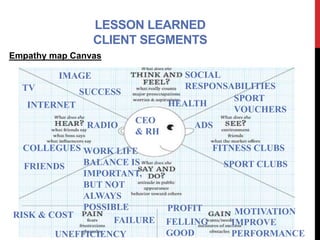
LESSON LEARNED 
CLIENT SEGMENTS 
Empathy map Canvas 
IMAGE 
SUCCESS 
SOCIAL 
TV RESPONSABILITIES 
INTERNET 
RADIO 
COLLEGUES 
FRIENDS 
WORK LIFE 
BALANCE IS 
IMPORTANT, 
BUT NOT 
ALWAYS 
POSSIBLE 
ADS 
SPORT 
VOUCHERS 
FITNESS CLUBS 
SPORT CLUBS 
RISK & COST 
FAILURE 
UNEFFICIENCY 
PROFIT 
IMPROVE 
PERFORMANCE 
FELLING 
GOOD 
CEO 
& RH 
MOTIVATION 
HEALTH
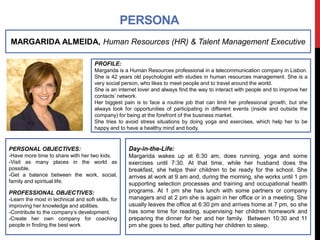
PERSONA 
MARGARIDA ALMEIDA, Human Resources (HR) & Talent Management Executive 
PROFILE: 
Margarida is a Human Resources professional in a telecommunication company in Lisbon. 
She is 42 years old psychologist with studies in human resources management. She is a 
very social person, who likes to meet people and to travel around the world. 
She is an internet lover and always find the way to interact with people and to improve her 
contacts’ network. 
Her biggest pain is to face a routine job that can limit her professional growth, but she 
always look for opportunities of participating in different events (inside and outside the 
company) for being at the forefront of the business market. 
She tries to avoid stress situations by doing yoga and exercises, which help her to be 
happy and to have a healthy mind and body. 
PERSONAL OBJECTIVES: 
-Have more time to share with her two kids. 
-Visit as many places in the world as 
possible. 
-Get a balance between the work, social, 
family and spiritual life. 
PROFESSIONAL OBJECTIVES: 
-Learn the most in technical and soft skills, for 
improving her knowledge and abilities. 
-Contribute to the company’s development. 
-Create her own company for coaching 
people in finding the best work 
Day-in-the-Life: 
Margarida wakes up at 6:30 am, does running, yoga and some 
exercises until 7:30. At that time, while her husband does the 
breakfast, she helps their children to be ready for the school. She 
arrives at work at 9 am and, during the morning, she works until 1 pm 
supporting selection processes and training and occupational health 
programs. At 1 pm she has lunch with some partners or company 
managers and at 2 pm she is again in her office or in a meeting. She 
usually leaves the office at 6:30 pm and arrives home at 7 pm, so she 
has some time for reading, supervising her children homework and 
preparing the dinner for her and her family. Between 10:30 and 11 
pm she goes to bed, after putting her children to sleep.
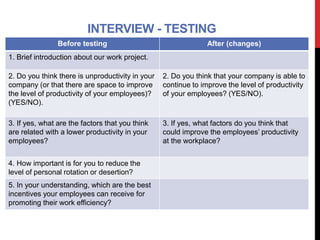
INTERVIEW - TESTING 
Before testing After (changes) 
1. Brief introduction about our work project. 
2. Do you think there is unproductivity in your 
company (or that there are space to improve 
the level of productivity of your employees)? 
(YES/NO). 
2. Do you think that your company is able to 
continue to improve the level of productivity 
of your employees? (YES/NO). 
3. If yes, what are the factors that you think 
are related with a lower productivity in your 
employees? 
3. If yes, what factors do you think that 
could improve the employees’ productivity 
at the workplace? 
4. How important is for you to reduce the 
level of personal rotation or desertion? 
5. In your understanding, which are the best 
incentives your employees can receive for 
promoting their work efficiency?
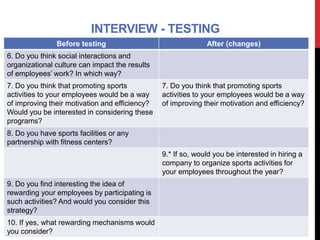
INTERVIEW - TESTING 
Before testing After (changes) 
6. Do you think social interactions and 
organizational culture can impact the results 
of employees’ work? In which way? 
7. Do you think that promoting sports 
activities to your employees would be a way 
of improving their motivation and efficiency? 
Would you be interested in considering these 
programs? 
7. Do you think that promoting sports 
activities to your employees would be a way 
of improving their motivation and efficiency? 
8. Do you have sports facilities or any 
partnership with fitness centers? 
9.* If so, would you be interested in hiring a 
company to organize sports activities for 
your employees throughout the year? 
9. Do you find interesting the idea of 
rewarding your employees by participating is 
such activities? And would you consider this 
strategy? 
10. If yes, what rewarding mechanisms would 
you consider?

Presentation13

  • 1.
    LEAN ENTREPRENEURSHIP PROJECT WORKSPORTS Alizée Toison Francisco Campos Iiro Vuorinen Nataly Quiroga
  • 2.
    LESSON LEARNED CLIENTSEGMENTS Empathy map Canvas IMAGE SUCCESS SOCIAL TV RESPONSABILITIES INTERNET RADIO COLLEGUES FRIENDS WORK LIFE BALANCE IS IMPORTANT, BUT NOT ALWAYS POSSIBLE ADS SPORT VOUCHERS FITNESS CLUBS SPORT CLUBS RISK & COST FAILURE UNEFFICIENCY PROFIT IMPROVE PERFORMANCE FELLING GOOD CEO & RH MOTIVATION HEALTH
  • 3.
    PERSONA MARGARIDA ALMEIDA,Human Resources (HR) & Talent Management Executive PROFILE: Margarida is a Human Resources professional in a telecommunication company in Lisbon. She is 42 years old psychologist with studies in human resources management. She is a very social person, who likes to meet people and to travel around the world. She is an internet lover and always find the way to interact with people and to improve her contacts’ network. Her biggest pain is to face a routine job that can limit her professional growth, but she always look for opportunities of participating in different events (inside and outside the company) for being at the forefront of the business market. She tries to avoid stress situations by doing yoga and exercises, which help her to be happy and to have a healthy mind and body. PERSONAL OBJECTIVES: -Have more time to share with her two kids. -Visit as many places in the world as possible. -Get a balance between the work, social, family and spiritual life. PROFESSIONAL OBJECTIVES: -Learn the most in technical and soft skills, for improving her knowledge and abilities. -Contribute to the company’s development. -Create her own company for coaching people in finding the best work Day-in-the-Life: Margarida wakes up at 6:30 am, does running, yoga and some exercises until 7:30. At that time, while her husband does the breakfast, she helps their children to be ready for the school. She arrives at work at 9 am and, during the morning, she works until 1 pm supporting selection processes and training and occupational health programs. At 1 pm she has lunch with some partners or company managers and at 2 pm she is again in her office or in a meeting. She usually leaves the office at 6:30 pm and arrives home at 7 pm, so she has some time for reading, supervising her children homework and preparing the dinner for her and her family. Between 10:30 and 11 pm she goes to bed, after putting her children to sleep.
  • 4.
    INTERVIEW - TESTING Before testing After (changes) 1. Brief introduction about our work project. 2. Do you think there is unproductivity in your company (or that there are space to improve the level of productivity of your employees)? (YES/NO). 2. Do you think that your company is able to continue to improve the level of productivity of your employees? (YES/NO). 3. If yes, what are the factors that you think are related with a lower productivity in your employees? 3. If yes, what factors do you think that could improve the employees’ productivity at the workplace? 4. How important is for you to reduce the level of personal rotation or desertion? 5. In your understanding, which are the best incentives your employees can receive for promoting their work efficiency?
  • 5.
    INTERVIEW - TESTING Before testing After (changes) 6. Do you think social interactions and organizational culture can impact the results of employees’ work? In which way? 7. Do you think that promoting sports activities to your employees would be a way of improving their motivation and efficiency? Would you be interested in considering these programs? 7. Do you think that promoting sports activities to your employees would be a way of improving their motivation and efficiency? 8. Do you have sports facilities or any partnership with fitness centers? 9.* If so, would you be interested in hiring a company to organize sports activities for your employees throughout the year? 9. Do you find interesting the idea of rewarding your employees by participating is such activities? And would you consider this strategy? 10. If yes, what rewarding mechanisms would you consider?