All you need to know about…
CAREER ADVANCEMENT,
DEVELOPMENT AND
PROGRESSION
London HR and Training
July 2016
Introduction
Page 2
Intro - London HR and Training
• London HR and Training is a specialist human
resources and training consultancy headed by Timothy
Holden
• 10 years in banking
• 20 years in training and human resources
• Business owner since 2007
• The core services provided by London HR and Training
are:
- Reducing costs and saving time through bespoke HR
initiatives and projects
- Training course design and delivery
- Services for job seekers
Page 3
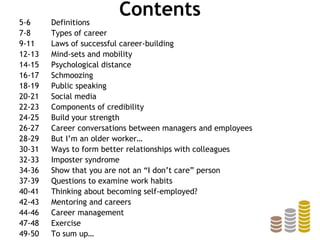
Contents5-6 Definitions
7-8 Types of career
9-11 Laws of successful career-building
12-13 Mind-sets and mobility
14-15 Psychological distance
16-17 Schmoozing
18-19 Public speaking
20-21 Social media
22-23 Components of credibility
24-25 Build your strength
26-27 Career conversations between managers and employees
28-29 But I’m an older worker…
30-31 Ways to form better relationships with colleagues
32-33 Imposter syndrome
34-36 Show that you are not an “I don’t care” person
37-39 Questions to examine work habits
40-41 Thinking about becoming self-employed?
42-43 Mentoring and careers
44-46 Career management
47-48 Exercise
49-50 To sum up…
Definitions
Page 5
Definitions
• Career advancement
• Career development
• Career progression
Page 6
Types of career
Types of career
• Traditional career
• New career
Page 8
Laws of successful
career-building
Laws of successful
career-building 1 of 2
• The perfect job does not exist
• All promotions are not equal
• No career ever turns out exactly as
planned
• No two careers are exactly alike
• All careers have peaks and valleys
• Career-building isn’t always like
climbing a ladder
Page 10
Laws of successful
career-building 2 of 2
• Values and passion are what keep a
career on track
• A career happens on its own time
• It’s not a career unless you care
• Optimists have better careers
• Career-building never ends
• You career is not your life
Page 11
Mind-sets and mobility
Page 13
Perceived
probability
(physical
mobility)
Low willingness
High probability
FORCED
MINDSET
High willingness
High probability
BOUNDARYLESS
MINDSET
Willingness
(psychological
mobility)
Low willingness
Low probability
SEDENTARY
MINDSET
High willingness
Low probability
BOUNDED
MINDSET
Psychological distance
• Social
• Temporal
• Spatial
• Experiential
Page 15
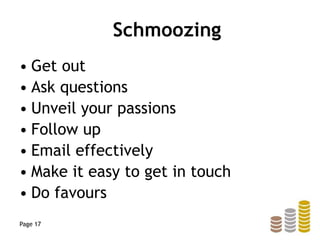
Schmoozing
Schmoozing
• Get out
• Ask questions
• Unveil your passions
• Follow up
• Email effectively
• Make it easy to get in touch
• Do favours
Page 17
Public speaking
Public speaking
• Deliver quality content
• Omit the sales pitch
• Customize
• Focus on entertaining
• Tell stories
• Circulate in the audience beforehand
• Control what you can
• Practice and speak all the time
Page 19
Social media
Social media
• Offer value
• Be interesting
• Take chances
• Keep it brief
• Be a mensch
• Add drama
• Tempt with headlines
• Use hashtags
• Stay active
Page 21
Components of credibility
• Values
• Behaviours
• Reputation
Page 23
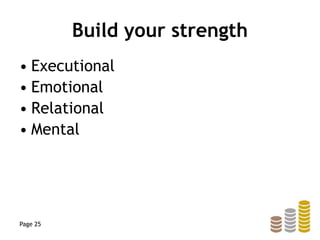
Build your strength
Build your strength
• Executional
• Emotional
• Relational
• Mental
Page 25
Career conversations
between managers and
employees
Career conversations between
managers and employees
• Reasons why such conversations are
important
• Barriers facing managers
• Barriers facing employees
• Adopting a more robust approach
• The structure of career conversations
• Avoid one size fits all
• How to make career management stick
Page 27
But I’m an older worker…
ENHANCING YOUR CAREER…
• Keep up to date with technology
• Put your hand up to go on a course
• Consider buying a franchise
• Look into packaging your skills and
talents then marketing them to small
businesses
Page 29
Ways to forge better
relationships with colleagues
Ways to form better
relationships with colleagues
• Always confront a co-worker in private
• Go out of your way to help people
when they are in trouble
• Always break bad news face-to-face
• Do not be threatened by experts-select
and use them wisely
Page 31
Imposter syndrome
Imposter syndrome
• Definition
• Symptoms of Imposter syndrome
• The ripple effect
Ways to break free of Imposter syndrome
• Focus on the facts
• Challenge your limiting beliefs
• Get clear on your strengths
• Talk about it
Page 43
Show that you are not an
“I don’t care” person
Show that you are not an
“I don’t care” person 1 of 2
• You aren’t proactive with updates
• You’re not responsive to calls or emails
• You put the burden of the last minute on
others
• You do the bare minimum and leave loose
ends
• You make holidays to be (somewhat)
dreaded
Page 35
Show that you are not an
“I don’t care” person 2 of 2
• You’re stingy with thanks and
compliments
• You multitask during important
conversations
• You get involved with inappropriate
water cooler conversations
• You keep it all business, all the time
• Your tone is overly harsh
Page 36
Questions to ask to examine
individual work habits
Questions to ask to examine
work habits 1 of 2
• Do you phone in sick less than three times a
year?
• Do you work reasonable hours and have
outside interests?
• Do you dress for success, even in uniform?
• Do you avert crises, rather than create
them?
• Does your organisation have high employee
retention?
Page 38
Questions to ask to examine
work habits 2 of 2
• Do your colleagues willingly handle problems
in your absence?
• Do you know your priorities and manage by
them each day?
• Do you support your team up, down and
across?
• Do you analyse problems deeply and propose
solutions?
• Do you feel loyal to your company?
Page 39
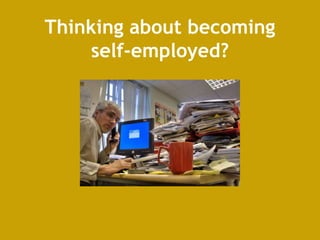
Thinking about becoming
self-employed?
Thinking about becoming self-
employed?
• Start with a vision, plan and strategy
• Make it easy to work with you
• Charge what you’re worth
• Get paid up front, if possible
• Understand the difference between revenue
and profit
• Create processes that work for you
• Know where and when you need help
• Earn money whilst you sleep
• Find a trusted confidante or business advisor
Page 41
Mentoring and careers
• Definition of mentoring
• What should a good mentor be able to
do
• Formal and informal mentoring
Page 43
Career management
Career management 1 of 2
• Definition of career management
• Why is it important to employers and
employees?
• Barriers felt by employers regarding
career management
• A strategy for career management
Page 46
Career management 2 of 2
A foundation for career management
• Career framework
• Scaled competencies and technical
skills
• Enabling experiences and
opportunities
Page 46
Exercise
Exercise
Page 48
To sum up…
To sum up…
• Conclusion
• Summary
• Videos
• Useful links
Page 50

Career July 2016

  • 1.
    All you needto know about… CAREER ADVANCEMENT, DEVELOPMENT AND PROGRESSION London HR and Training July 2016
  • 2.
  • 3.
    Intro - LondonHR and Training • London HR and Training is a specialist human resources and training consultancy headed by Timothy Holden • 10 years in banking • 20 years in training and human resources • Business owner since 2007 • The core services provided by London HR and Training are: - Reducing costs and saving time through bespoke HR initiatives and projects - Training course design and delivery - Services for job seekers Page 3
  • 4.
    Contents5-6 Definitions 7-8 Typesof career 9-11 Laws of successful career-building 12-13 Mind-sets and mobility 14-15 Psychological distance 16-17 Schmoozing 18-19 Public speaking 20-21 Social media 22-23 Components of credibility 24-25 Build your strength 26-27 Career conversations between managers and employees 28-29 But I’m an older worker… 30-31 Ways to form better relationships with colleagues 32-33 Imposter syndrome 34-36 Show that you are not an “I don’t care” person 37-39 Questions to examine work habits 40-41 Thinking about becoming self-employed? 42-43 Mentoring and careers 44-46 Career management 47-48 Exercise 49-50 To sum up…
  • 5.
  • 6.
    Definitions • Career advancement •Career development • Career progression Page 6
  • 7.
  • 8.
    Types of career •Traditional career • New career Page 8
  • 9.
  • 10.
    Laws of successful career-building1 of 2 • The perfect job does not exist • All promotions are not equal • No career ever turns out exactly as planned • No two careers are exactly alike • All careers have peaks and valleys • Career-building isn’t always like climbing a ladder Page 10
  • 11.
    Laws of successful career-building2 of 2 • Values and passion are what keep a career on track • A career happens on its own time • It’s not a career unless you care • Optimists have better careers • Career-building never ends • You career is not your life Page 11
  • 12.
  • 13.
    Mind-sets and mobility Page13 Perceived probability (physical mobility) Low willingness High probability FORCED MINDSET High willingness High probability BOUNDARYLESS MINDSET Willingness (psychological mobility) Low willingness Low probability SEDENTARY MINDSET High willingness Low probability BOUNDED MINDSET
  • 14.
  • 15.
    Psychological distance • Social •Temporal • Spatial • Experiential Page 15
  • 16.
  • 17.
    Schmoozing • Get out •Ask questions • Unveil your passions • Follow up • Email effectively • Make it easy to get in touch • Do favours Page 17
  • 18.
  • 19.
    Public speaking • Deliverquality content • Omit the sales pitch • Customize • Focus on entertaining • Tell stories • Circulate in the audience beforehand • Control what you can • Practice and speak all the time Page 19
  • 20.
  • 21.
    Social media • Offervalue • Be interesting • Take chances • Keep it brief • Be a mensch • Add drama • Tempt with headlines • Use hashtags • Stay active Page 21
  • 22.
  • 23.
    Components of credibility •Values • Behaviours • Reputation Page 23
  • 24.
  • 25.
    Build your strength •Executional • Emotional • Relational • Mental Page 25
  • 26.
  • 27.
    Career conversations between managersand employees • Reasons why such conversations are important • Barriers facing managers • Barriers facing employees • Adopting a more robust approach • The structure of career conversations • Avoid one size fits all • How to make career management stick Page 27
  • 28.
    But I’m anolder worker…
  • 29.
    But I’m anolder worker… ENHANCING YOUR CAREER… • Keep up to date with technology • Put your hand up to go on a course • Consider buying a franchise • Look into packaging your skills and talents then marketing them to small businesses Page 29
  • 30.
    Ways to forgebetter relationships with colleagues
  • 31.
    Ways to formbetter relationships with colleagues • Always confront a co-worker in private • Go out of your way to help people when they are in trouble • Always break bad news face-to-face • Do not be threatened by experts-select and use them wisely Page 31
  • 32.
  • 33.
    Imposter syndrome • Definition •Symptoms of Imposter syndrome • The ripple effect Ways to break free of Imposter syndrome • Focus on the facts • Challenge your limiting beliefs • Get clear on your strengths • Talk about it Page 43
  • 34.
    Show that youare not an “I don’t care” person
  • 35.
    Show that youare not an “I don’t care” person 1 of 2 • You aren’t proactive with updates • You’re not responsive to calls or emails • You put the burden of the last minute on others • You do the bare minimum and leave loose ends • You make holidays to be (somewhat) dreaded Page 35
  • 36.
    Show that youare not an “I don’t care” person 2 of 2 • You’re stingy with thanks and compliments • You multitask during important conversations • You get involved with inappropriate water cooler conversations • You keep it all business, all the time • Your tone is overly harsh Page 36
  • 37.
    Questions to askto examine individual work habits
  • 38.
    Questions to askto examine work habits 1 of 2 • Do you phone in sick less than three times a year? • Do you work reasonable hours and have outside interests? • Do you dress for success, even in uniform? • Do you avert crises, rather than create them? • Does your organisation have high employee retention? Page 38
  • 39.
    Questions to askto examine work habits 2 of 2 • Do your colleagues willingly handle problems in your absence? • Do you know your priorities and manage by them each day? • Do you support your team up, down and across? • Do you analyse problems deeply and propose solutions? • Do you feel loyal to your company? Page 39
  • 40.
  • 41.
    Thinking about becomingself- employed? • Start with a vision, plan and strategy • Make it easy to work with you • Charge what you’re worth • Get paid up front, if possible • Understand the difference between revenue and profit • Create processes that work for you • Know where and when you need help • Earn money whilst you sleep • Find a trusted confidante or business advisor Page 41
  • 42.
  • 43.
    Mentoring and careers •Definition of mentoring • What should a good mentor be able to do • Formal and informal mentoring Page 43
  • 44.
  • 45.
    Career management 1of 2 • Definition of career management • Why is it important to employers and employees? • Barriers felt by employers regarding career management • A strategy for career management Page 46
  • 46.
    Career management 2of 2 A foundation for career management • Career framework • Scaled competencies and technical skills • Enabling experiences and opportunities Page 46
  • 47.
  • 48.
  • 49.
  • 50.
    To sum up… •Conclusion • Summary • Videos • Useful links Page 50