Organize personal work priorities and development (OPWPD)
This presentation focuses on the skills and knowledge required to organize one's work schedules, monitor and obtain feedback on work performance, and maintain the necessary levels of competence.
INTRODUCTION
• This unitdescribes the performance
outcomes, skills and knowledge required to
organise work schedules, monitor and
obtain feedback on work performance, and
maintain required levels of competence. In
order to meet personal work objectives, and
the goals and objectives of your
organization, you will need to improve your
work routine and apply time management
strategies to work tasks.
3.
INTRODUCTION
• There isan old proverb which states that ‘Work
expands so as to fill the time available’. This
seems to be the case when working in an office.
There never seems to be enough time to
complete all your work tasks and unless you
organise your own work schedule you will find
that you are going in to work earlier in the
morning and leaving later in the evening. You
never seem to catch up with reducing your
workload and you begin to show symptoms of
work-related stress.
4.
1. Organise andcomplete own work schedule
• 1.1. Ensure that work goals and objectives are
understood, negotiated and agreed in accordance
with organisational requirements
• 1.2. Assess and prioritise workload to ensure tasks
are completed within identified timeframes
• 1.3. Identify factors affecting the achievement of
work objectives and incorporate contingencies
into work plans
• 1.4. Use business technology efficiently and
effectively to manage and monitor scheduling and
completion of tasks
5.
Assessing and prioritisingworkload ensuring
timely completion of tasks
Part of your responsibility as an employee is to
effectively organise and manage your own
time to ensure tasks are completed as required.
In some situations, you may also have
responsibility for organising some of the tasks
and time of others in your team. You will need
to consider the tasks to be done and how
important each one is to the
overall functioning of your team.
6.
Assessing and prioritisingworkload ensuring
timely completion of tasks
Your work team and your manager will expect
you can:
•ƒidentify the tasks to be completed
•ƒassess the time and resources needed to
complete the tasks in line with organisational
•parameters such as work procedures and
quality manuals
7.
Assessing and prioritisingworkload ensuring
timely completion of tasks
• prioritise tasks in order of importance
• ƒestimate and continually update your
timelines
• communicate issues relating to your
workload clearly and effectively with
other
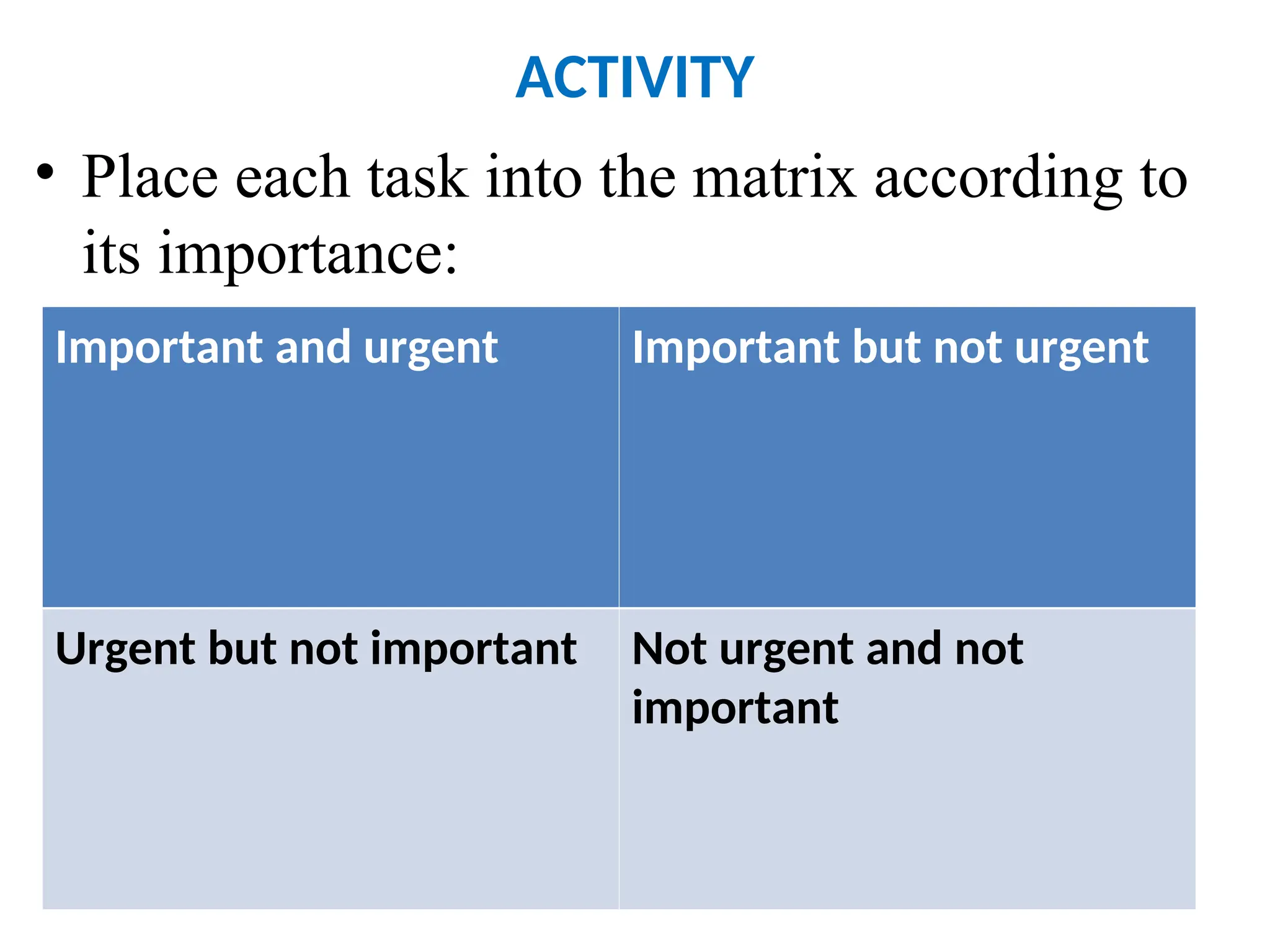
• team members as needed.
8.
Identifying and assessingwork tasks
Work tasks are often recorded in a schedule or planning
tool of some sort. Your first step is to identify the tasks
to be done. Often a simple checklist or set of notes will
help you identify work tasks. For example, Sue wrote
this note to herself this morning:
Tasks for today:
•ƒReturn phone calls
•Organise taxi to airport
•ƒBook manager on 2.00 pm flight to Sydney
•Draft phone call procedure and distribute for comments
9.
Identifying and assessingwork tasks
Sometimes workplaces will have a set procedure for
recording work tasks and making schedules. There
may be a template available for you to use to make
identifying and assessing your work tasks easier.
Developing a work schedule is an important
component of assessing and keeping track of your
work tasks. A work schedule lets you see at a glance
the tasks you are required to do over a specific
period. You can use a diary or a wall planning
calendar to keep track of these tasks and their
completion dates.
10.
Identifying and assessingwork tasks
A comprehensive work schedule might include on-
going administrative tasks such as organising
meetings, following up client calls, filing and
ordering new supplies.
One of these tasks, organising a meeting, involves
a number of smaller jobs such as booking a
meeting room, organising agendas and contacting
those who are to attend. The work schedule will
summarise the major job to be done and the work
plan will include all the fine detail.
11.
Goal: Tasks Keyresults Priority
Provide
on-going
support
to
Business
Operatio
ns.
Organise
weekly staff
meetings
Meetings organised
successfully and follow-up
completed
On-going
Maintain files Organisation’s documents
filed accurately and on time
On-going
Prepare
corresponden
ce
All correspondence
completed accurately
and in accordance with
requirements
On-going
Maintain
customer
database
Customer database is
accurate and up to date
On-going
Design
promotional
flyer
Marketing flyer prepared
on time
2
September
12.
Area Team
goal
My goalTasks Time Result
Marketi
ng
Increase
customer
awareness
Design
promotion
al
flyer
Liaise with leader to
identify key points
of content
Design format
Prepare draft and
submit for approval
Make amendments
and submit
Arrange printing at
Speedy Print
Due 2
September
Marketing
flyer
prepared
on time
example of a more detailed work plan
13.
Estimating your time
Onceyou have some experience, you should be
able to estimate the time it takes to complete a
task without rushing too much. Take into
account necessary interruptions to your work
schedule, such as staff meetings. Allow for
unforeseen delays and
interruptions. A carefully planned schedule
could be thrown off track by an unexpected
company-wide meeting. In a busy workplace
interruptions are inevitable.
14.
Estimating your time
•Don’t forget to allow time for other
unplanned tasks that might come up – for
example a manager may ask you to do some
research or prepare a brief report. When
estimating how long a task will take, make
sure enough time is allowed for all activities
associated with the job. If it will take an
hour to type the agenda for a meeting,
don’t forget to allow time for printing,
photocopying and distribution.
15.
Estimating your time
Thekey to task estimation is to give
yourself a bit of leeway – not too much
and not too little. As you gain experience
you will get better at estimating task
times. For example, Becky estimates the
time she will need for the following
tasks:
16.
Estimating your time
•Procrastination
• Many people put off doing the tasks
they dislike. This only complicates their
time management problem as they
end up doing the tasks they like least at
the end when they are often under a
lot of pressure. Try to complete tasks
that you dislike early in the schedule!
17.
Estimating your time
TaskTime needed
•Type meeting minutes
from staff meeting 45 minutes
•Send emails to new
customers 30 minutes
•Photocopy new staff
member induction packs 30 minutes
•Book meeting room for
induction session 10 minutes
18.
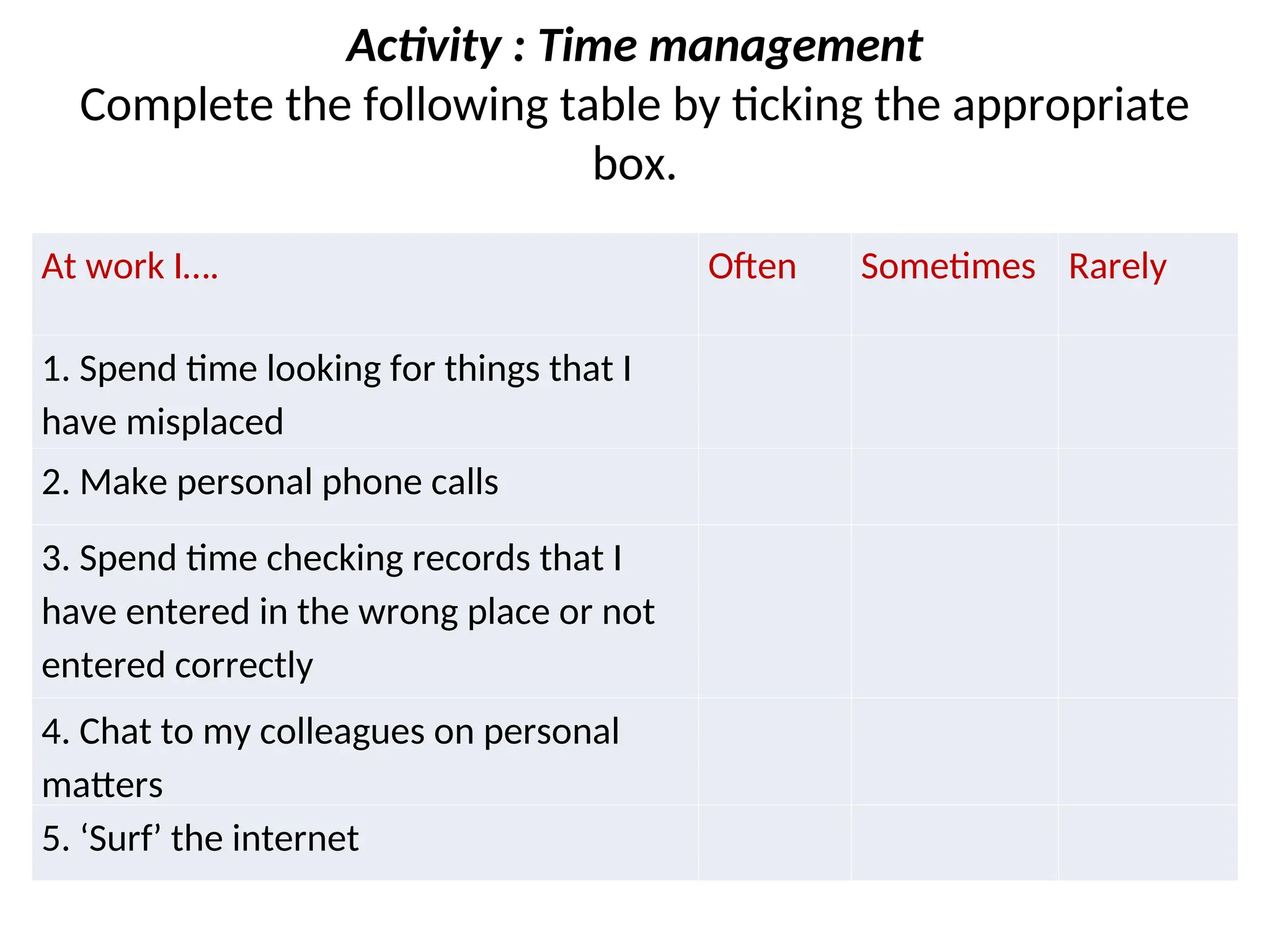
Activity : Timemanagement
Complete the following table by ticking the appropriate
box.
At work I…. Often Sometimes Rarely
1. Spend time looking for things that I
have misplaced
2. Make personal phone calls
3. Spend time checking records that I
have entered in the wrong place or not
entered correctly
4. Chat to my colleagues on personal
matters
5. ‘Surf’ the internet
19.
Feedback on activity
Mostpeople spend some time at work on personal
matters and most of us have spent time looking for
things which we have misplaced. However, if you
answered ‘often’ for questions 1 and 3 you will need
to look at ways to make your work practice more
efficient. You may need to keep your work area
better organised with information correctly stored
and filed. If you answered ‘often’ for questions 2, 4
and 5 you are spending too much of your work time
on personal matters and it is likely to be affecting
both the quality of your work and your ability to
complete your work on time.
20.
work goals andobjectives
• A goal can be very simply defined as an
end towards which some efforts are
directed. In a game of Soccer, each team
tries to push the ball into the opponent’s
goal area in a team effort. A goal is what
the business aims to achieve and is usually
based on the businesses vision and
mission. It is the purpose of the business.
21.
work goals andobjectives
In organizations the goal is to achieve a
predetermined target, by determining the
objectives to achieve the desired results. A goal
is not an objective or a mission statement. Very
often Goals, Objectives and Missions are mixed
up leading to confusion. Goals are specific and
always measurable; missions are a statement of
intent and objectives are of a strategic nature.
22.
work goals andobjectives
• Goals are specific and always measurable.
Usually, goals are broad ranging and Continuous
or long term. For example, a business might aim
to become financially viable within the next 12
months.
• A goal should be defined and in writing;
• It should be measurable;
• It should be achieved in a specific time frame; and
• It should be achieved at the lowest possible cost.
23.
work goals andobjectives
A goal should answer the following
questions:
• What?
• Why?
• Who?
• Where?
• How?
24.
work goals andobjectives
Finally setting goals is not enough. The
organization should be geared up to
achieve them. The leader has to do the
following:
• Implement the action plan.
• Monitor the progress periodically.
25.
work goals andobjectives
• Objectives are more specific. They are
the measurable targets associated with
achieving the goal.
• These targets may relate to budgetary
targets, production targets, sales targets,
and other areas.
• For example, the same business may set
an objective to increase sales profits by
15% within 6 months.
26.
work goals andobjectives
Some business may also have objectives
relating to:
• Ethical, environmental and social
responsibility.
• Compliance.
• Education and training.
• Specific beliefs or missions, especially for
charity or not-for-profit organizations.
27.
KEY PERFORMANCE INDICATORS
•KPIs are created based on business objectives and
are usually associated with a specific process.
Sometimes objectives are translated into
measurable KPIs.
• KPIs are often represented by a numerical value. It
may have a target and allowable margins. For
example, a KPI for the business may be to obtain
40-50% of its income from return customers.
• When we talk about objectives and KPIs, we often
talk about them being SMART.
28.
• This meansthat when negotiating and
agreeing on your business objectives
and KPIs they must be: SMART
• Specific.
• Measurable/ meaningful, motivational.
• Attainable/ achievable.
• Realistic/. relevant
• Time specific.
29.
• A specificgoal has a much greater chance of being
accomplished than a general goal.
• To set a specific goal you must answer the six
‘W’ questions:
• Who: Who is involved?
• What: What do I want to accomplish?
• Where: Identify a location.
• When: Establish a time frame.
• Which: Identify requirements and constraints.
• Why: Specific reasons, purpose or benefits of
accomplishing the goal.
30.
• SMART Goalsare Measurable:
• Establish concrete criteria for measuring
progress toward the attainment of each goal
you set. When you measure your progress,
you stay on track, reach your target dates, and
experience the exhilaration of achievement
that spurs you on to continued effort required
to reach your goal.
• To determine if your goal is measurable, ask
questions such as......”How much?”, “How
many?”, “How will I know when it is
accomplished?”
31.
• SMART Goalsare Attainable:
• When you identify goals that are most
important to you, you begin to figure
out ways you can make them come
true. You develop the attitudes,
abilities, skills, and financial capacity to
reach them. You begin seeing
previously overlooked opportunities to
bring yourself closer to the
achievement of your goals.
32.
• You canattain most/any goal you set
when you plan your steps wisely and
establish a time frame that allows you
to carry out those steps. Goals that
may have seemed far away and out of
reach eventually move closer and
become attainable, not because your
goals shrink, but because you grow and
expand to match them.
33.
• When youlist your goals you
build your self-image. You see
yourself as worthy of these
goals, and develop the traits and
personality that allow you to
possess them.
34.
• SMART Goalsare Realistic:
• To be realistic, a goal must represent
an objective toward which you are
both willing and able to work. A goal
can be both high and realistic; you are
the only one who can decide just how
high your goal should be. But be sure
that every goal represents substantial
progress.
35.
• A highgoal is frequently easier to
reach than a low one because a low
goal exerts low motivational force.
Some of the hardest jobs you ever
accomplished actually seem easy
simply because they were a labour
of love.
36.
• Your goalis probably realistic if you
truly believe that it can be
accomplished. Additional ways to
know if your goal is realistic is to
determine if you have
accomplished anything similar in
the past or ask yourself what
conditions would have to exist to
accomplish this goal.
37.
• SMART Goalsare Tangible:
• A goal is tangible when you can
experience it with one of the senses,
that is, taste, touch, smell, sight or
hearing. When your goal is tangible,
or when you tie a tangible goal to an
intangible goal, you have a better
chance of making it specific and
measurable and thus attainable.
38.
• Intangible goalsare your goals for the
internal changes required to reach more
tangible goals. They are the personality
characteristics, and the behaviour patterns
you must develop to pave the way to
success in your career or for reaching some
other long-term goal. Since intangible goals
are vital for improving your effectiveness,
give close attention to tangible ways for
measuring them.
39.
work goals andobjectives
• Smart goals allow you to keep your
eyes on the ultimate goal, no matter
what stands in your way.
• Now that we understand some of the
essentials of goal setting, let's look at
the actual process that you can use to
set a set of goals.
40.
Setting Goals -The Process
1. Step: IDENTIFY A KEY JOB OR TASK.
• Description: Goal setting should begin by
defining exactly what it is you want to
accomplish. The best source of this
information is looking at your job
description. This will detail the jobs that you
are required to perform, how these tasks are
to be done and what outcomes you are
responsible for achieving.
41.
Setting Goals -The Process
2. Step: ESTABLISH SPECIFIC AND
CHALLENGING GOALS FOR EACH TASK.
•Description: This is fairly self
explanatory. We will add that these
goals should be made public where
possible. This allows you to be more
committed to their achievement.
42.
Setting Goals -The Process
3. SPECIFY DEADLINES FOR EACH GOAL.
•Goals should include specific time limits for
their accomplishment.
4. PRIORITIES GOALS.
•When you have set yourself more than one
goal, it is important to rank these goals in
order of importance. The purpose of this step
is to encourage yourself to take action and
expend some effort on each goal, in
proportion to the importance of that goal.
43.
Setting Goals -The Process
5. RATE GOALS FOR DIFFICULTY AND
IMPORTANCE.
•Goal setting should not encourage people to
choose easy goals in order to ensure success. Goal
setting needs to take into account the difficulty of
the goals selected and whether you are emphasising
the right goals. When these ratings are combined
with the actual level of goal achievement, you will
have a more comprehensive assessment of your
overall goal performance.
44.
Setting Goals -The Process
6. BUILD IN FEEDBACK MECHANISMS.
•Ideally, feedback on goal progress
should be self-generated rather than
provided externally. When you are able
to monitor your own progress, the
feedback is likely to be less threatening
and less likely to be perceived as being
part of a control system by management.
45.
Work goals andobjectives are agreed in
accordance with organisational requirements
An organisation’s Work goals and objectives may
include:
•Meeting budgetary targets
•Meeting production targets
•reporting deadlines
•Meeting sales targets
•team and individual learning goals
•team participation.
•Learning new skills
46.
WORK GOALS ANDOBJECTIVES ARE AGREED IN
ACCORDANCE WITH ORGANISATIONAL REQUIREMENTS
The most important of these is the budgetary target.
Budgets are statements of financial resources
allocated to the business over a given period of time,
usually a year. Budgets control an organisation’s
activities through itemising income and expenditure
and providing targets for:
• production and sales
• departmental expenses
• new investments
• research and development.
47.
WORK GOALS ANDOBJECTIVES ARE AGREED IN ACCORDANCE
WITH ORGANISATIONAL REQUIREMENTS
• A budget is a fundamental part of any business
program, as it controls the amount of money
available for purchasing equipment, hiring and
training employees, advertising, production and
sales, and accounting and administrative systems.
Therefore, whatever department you work in, the
budget controls your work goals and your
objectives, as your work will be scheduled to the
achievement of the sales targets, production
targets and reporting deadlines.
48.
WORK GOALS ANDOBJECTIVES ARE AGREED IN ACCORDANCE
WITH ORGANISATIONAL REQUIREMENTS
Corporate budgets control the activities and
ultimately the goals of the business.
•A personal budget can also control your work
priorities and the development of your
personal goals linked to your company goals.
49.
Organisational requirements
Your workgoals and objectives are agreed (with
your supervisor) in accordance with organisational
requirements. This means that your work
standards and targets are linked to the
organisational requirements which include:
• business and performance plans
• organisational goals, objectives, plans, systems
and processes
• legal and organisational policies, guidelines and
requirements
• OHS policies, procedures and programs
50.
ORGANISATIONAL REQUIREMENTS
• qualityand continuous improvement
processes and standards
• quality assurance within defined
resource parameters
• ethical standards and equity principles
and practice.
All these organisational requirements
should be outlined in the policies and
procedures manual of the company.
51.
Assess and prioritiseworkload to ensure
tasks are completed within time frames
• It is very easy to take on lots of
exciting tasks or projects, only to
end up with too much to do and not
enough time to do it. In order to
avoid the stress of being
overwhelmed by your workload you
should always prioritise your tasks.
52.
Assess and prioritiseworkload to ensure
tasks are completed within time frames
• One way to ensure you keep up with all the
tasks you need to do is to prioritise – that is,
you need to distinguish between the urgent
and important tasks.
• When attempting to prioritise your tasks
you will need to look at the work goals and
objectives that you have identified and
agreed upon.
53.
Assess and prioritiseworkload to ensure
tasks are completed within time frames
• Urgent tasks are those that need to be completed
quickly or there will be a negative impact.
• Important tasks are those that contribute directly
to the achievement of your objectives. They may
have short, medium or long-term deadlines..
54.
Assess and prioritiseworkload to ensure
tasks are completed within time frames
• Tasks that are urgent are often quick to complete
and are regularly prioritised as a higher
importance. This is not necessarily the best
option.
• Failing to complete important tasks can mean
these soon become urgent.
55.
Assess and prioritiseworkload to ensure
tasks are completed within time frames
• Performance = individual attributes × work
effort × organisational support
• One way to determine which tasks to
complete first is to place them in the
following table. Ask yourself, “Will this task
lead to me fulfilling my goals and
objectives?” and “What impact does this
task have on the business?”
56.
• Urgent NotUrgent
• Not Important
Urgent Not Urgent
Important Priority 1
Crisis tasks.
Deadlines.
Pressing problems.
Priority 2
Prevention.
Relationship building.
New opportunities.
Planning.
Not
Important
Priority 3
Interruptions.
Phone calls.
Meetings.
Priority 4
Time wasters.
Pleasant activities.
Mail.
Trivial work.
If the task directly contributes to completing your goals
and objectives then it is important. If not completing
the task quickly will have a negative impact on the
business, then it is urgent.
57.
• URGENT ANDIMPORTANT
These tasks are the first priority. They are
both urgent and important steps in
achieving your goals and objectives.
• IMPORTANT BUT NOT URGENT
These tasks may not seem urgent but they
are still crucial to achieving your
objectives. Failure to complete these
tasks has the potential to lead to a crisis
situation.
58.
• URGENT BUTNOT IMPORTANT
Often tasks in this category may seem urgent
as they may cause a disruption if not dealt
with quickly. However, someone else often
sets the urgency and they are not critical to
achieving your objectives.
59.
• NOT IMPORTANTAND NOT URGENT
Tasks in this category are not an essential part
of your job and will not have a significant
impact on the business. Assessing and
prioritising your workload is an essential
step in ensuring your tasks are completed
within identified timeframes, and according
to your goals and objectives.
60.
Example
Suniti was askedto send out a memo advising staff
about new shipping times. In the previous week it
had been ‘urgent but not important’, but she has
just been told that today is the deadline for letting
warehouse staff know about the changes.
Suniti uses her priority matrix to move the memo
to the new slot. She then has two urgent jobs
competing for her attention. Later in the morning,
the customer service manager tells Suniti he needs
the updated client database for his report by the
afternoon. Suniti moves the task to the new
priority.
61.
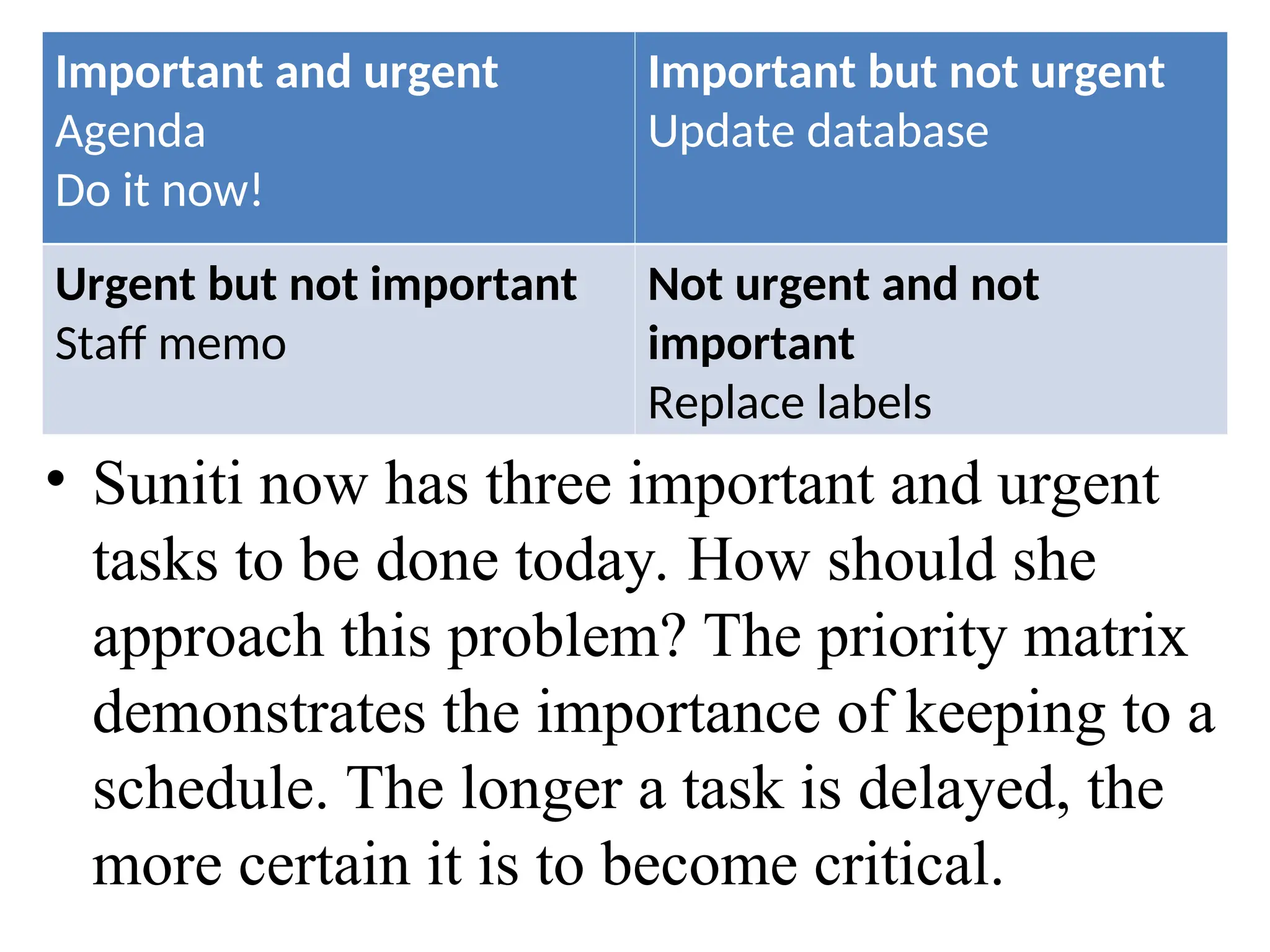
• Suniti nowhas three important and urgent
tasks to be done today. How should she
approach this problem? The priority matrix
demonstrates the importance of keeping to a
schedule. The longer a task is delayed, the
more certain it is to become critical.
Important and urgent
Agenda
Do it now!
Important but not urgent
Update database
Urgent but not important
Staff memo
Not urgent and not
important
Replace labels
62.
Suniti must nowdecide which urgent task
she should do first and whether she needs
to delegate the work she can’t do in the
time available. Although her schedule has
been completely revised, she still has an
overview of the work to be done and its
importance.
63.
Developing a workplan
• How do you plan your work schedule?
Do you write a list of the tasks you need
to complete each day? How do you
decide the order that you will complete
tasks in?
64.
Developing a workplan
High priority tasks
Tasks with high priority would include:
•tasks that must be completed before other
tasks can be completed
•tasks that must be completed before other
people can continue their work
•tasks that have been requested as a matter
of urgency.
65.
Developing a workplan
Medium priority tasks
•Medium priority tasks need to be completed by the
end of the day.
Low priority tasks
•Low priority tasks can be completed when other
work is done.
•Other factors that may determine the order that
tasks are completed are:
•instructions from the supervisor
•emergencies requiring rescheduling of tasks
66.
Developing a workplan
Low priority tasks cont’d
•rotation of tasks for OHS reasons
•rotation of tasks to avoid boredom/fatigue
•completion of tasks when resources/equipment
are available
•completion of tasks when assistance is available
•completion of tasks according to the time that they
take e.g. completion of short tasks before tasks that
take longer.
67.
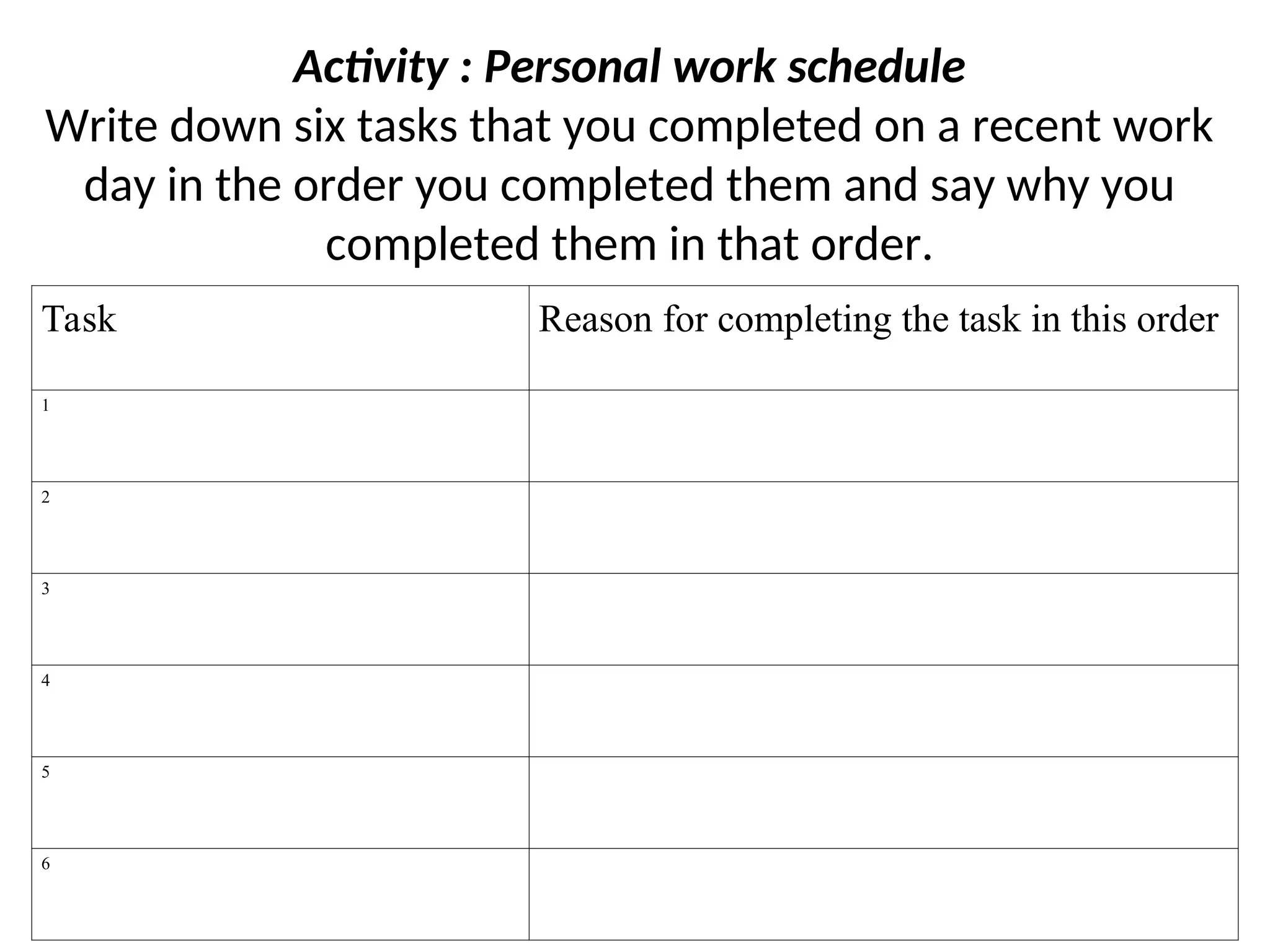
Activity : Personalwork schedule
Write down six tasks that you completed on a recent work
day in the order you completed them and say why you
completed them in that order.
Task Reason for completing the task in this order
1
2
3
4
5
6
68.
ACTIVITY
Consider these worktasks that might be done in any
office environment:
•Preparing an agenda for a meeting this afternoon
•Restocking the stationery cupboard with the
supplies that have just arrived and been left in the
front reception area
•Ordering more photocopy paper, as there is only
one packet left
•Answering customer phone calls about a new sale
which has started today
69.
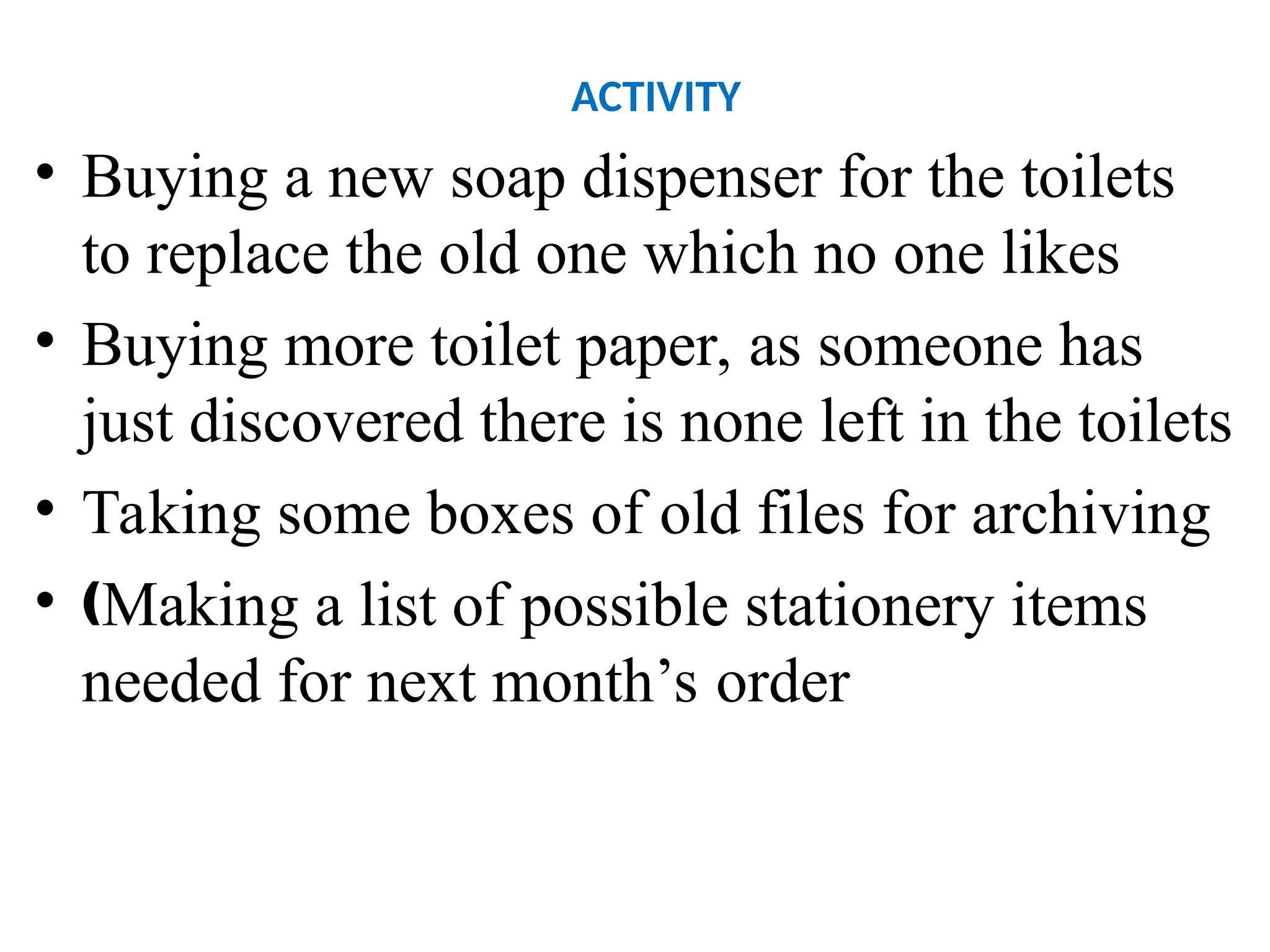
• Buying anew soap dispenser for the toilets
to replace the old one which no one likes
• Buying more toilet paper, as someone has
just discovered there is none left in the toilets
• Taking some boxes of old files for archiving
• Making a list of possible stationery items
‚
needed for next month’s order
ACTIVITY
70.
• Place eachtask into the matrix according to
its importance:
Important and urgent Important but not urgent
Urgent but not important Not urgent and not
important
ACTIVITY
71.
Assess and prioritiseworkload to ensure
tasks are completed within time frames
Work effort
•Working efficiently is assuming that
your work objectives/goals are correct
and achieving them with the minimum
effort and resources.
72.
Assess and prioritiseworkload to ensure
tasks are completed within time frames
Work effort
•Working effectively is choosing the right
objectives/goals from a number of
alternatives and reaching those
objectives/goals in the time allocated.
73.
Assess and prioritiseworkload to ensure
tasks are completed within time frames
Work effort
•In other words, you may be typing
documents neatly, filing your documents in
the correct way, and performing other tasks
correctly, but it may be taking you too long to
do them so that other tasks are not being
completed in time to meet the organisation’s
goals and objectives.
74.
Identifying factors affectingthe achievement
of work objectives
Despite people’s best efforts, things don’t
always go according to plan. Things can go
wrong, problems can arise, or priorities can
alter. It is important you understand the
things that can affect your ability and others
in your team to achieve work objectives.
Allowance often needs to be made for
changes to the original plan in a workplace. It
is easy to get flustered and upset when things
go wrong
75.
Identifying factors affectingthe achievement
of work objectives
But having a clear focus on the tasks to be
achieved and the skills to manage changes to
tasks and time will help you get the job done.
As hard as we may try to reach our goals, there
are likely to be some factors that will always
conspire against us. These factors however
should be identified early so that contingency
plans can be developed to stop these problems
from occurring.
76.
Identify factors affectingthe achievement of work
objectives
Even employees who have the correct
attributes and motivation might not perform
well because of the organisation’s lack of
support, such as:
• inadequate tools and equipment
• unclear instructions
• unfair levels of expected performance
77.
Identify factors affectingthe achievement of
work objectives
• lack of leadership and poor work methods
and procedures
• budget constraints
• competing work demands
•environmental factors such as time/delays,
rain, hot or cold weather
• illness of self or co-workers
• technology/equipment breakdowns
78.
Identify factors affectingthe achievement of
work objectives
• unforeseen incidents such as unplanned
phone call or fire drill
• workplace hazards, risks and controls. such
as faulty machines/equipment or accidents
resource and materials availability
When creating your work plans, you will need to consider
each of these factors and how they may affect the
objectives you are trying to fulfil.
79.
Identify factors affectingthe achievement of
work objectives
Budget constraints
•These include things such as late delivery of supplies,
company downsizing and cutbacks in your budgets.
Departments within organisations are usually allocated
funds for their projects. Once the budget has been used
it may not be possible to obtain more money for the
job. For example, you know you can work more
efficiently with an upgraded version of your machine,
but your manager points out that to upgrade the whole
organisation would cost many thousands of dollars.
80.
Identify factors affectingthe achievement of
work objectives
Budget constraints
•A contingency plan might involve allowing
extra time to complete tasks using the old
software, or consulting the manual or a more
experienced team member about how to use
the software more effectively.
81.
Identify factors affectingthe achievement of
work objectives
Environmental factors
Areas such as workplace hazards, controls and
risks are an everyday part of your job, and you
need to know how to deal with these and what
you can do to prevent them from becoming a
problem. Some of your tasks may depend on
the weather. For example, you may be
involved in an outdoor function that has to be
delayed because of the rain.
82.
Identify factors affectingthe achievement of
work objectives
Environmental factors
Alternatively, extremely hot weather may
force an organisation to relocate its event.
Delays such as these may put your whole
work plan out of order. Some tasks may be
better suited to a particular time of day. For
example, a photo shoot for a new product
catalogue may be best done early in the
morning using good, natural outdoor light.
83.
Identify factors affectingthe achievement of work
objectives
Environmental factors
•If the light in the morning is not suitable, a
contingency plan could be to move the task to
another location (such as indoors) or delay the task
until the lighting is better.
Competing work demands
•Sometimes you may have responsibilities to more
than one person or department within your
organisation. There may be times when you are
given tasks that compete with each other for your
time.
84.
Identify factors affectingthe achievement of
work objectives
Competing work demands
•It importance of knowing what your job
involves by examining your job description.
This is important because it allows you to see
which work demands you are facing that are
important and which are not. It is also
important to know when to say ‘no’ to tasks
that are not always a part of your job when
you have more important priorities you have
to meet.
85.
Identify factors affectingthe achievement of
work objectives
Competing work demands
•If you are in a situation where two managers
are both demanding tasks which conflict with
each other, you need to raise the issue with
both of them and explain clearly what the
problem is. Be clear about your tasks and
responsibilities and try to estimate your time
as accurately as possible.
86.
Identify factors affectingthe achievement of
work objectives
Competing work demands
•A contingency plan for dealing with
competing work demands might be to think
ahead about the likely tasks that will be
required. Suggest a meeting ahead of any
potential problem times and identify conflicts
and issues, along with some possible
solutions.
87.
Identify factors affectingthe achievement of
work objectives
Resources and materials not available
•This is often the cause of interruptions to tasks. For
example, you have been asked to make 50 copies of
a large business report, but the photocopier runs out
of toner (a physical resource) when you have
completed only 20 copies. Paper supplies are
running low and the nearest paper point is on the
fifteenth floor. Permission is required to use this
paper, but the administrative officer for this area is
in a meeting for the next two hours.
88.
Identify factors affectingthe achievement of
work objectives
Resources and materials not available
•Staff members (a human resource) being
unexpectedly away sick can place pressure on other
team members if they are relying on the person who
is away to complete a task. An empty petty cash tin
(a financial resource) may limit the ability of a
staff member to pay for a parking ticket when they
go to another work location in a work vehicle.
89.
Identify factors affectingthe achievement of
work objectives
Resources and materials not available
•A useful contingency plan for resources and
materials is to always have some spare ‘high use’
items on hand and easily accessible. Then anyone
within the organisation who needs supplies
urgently is able to access them.
90.
Identify factors affectingthe achievement of
work objectives
Business Technology/equipment breakdown
Technology can help or hinder your work. Not only
can you waste a lot of time when machinery breaks
down, but not being competent in computer
applications can lead to frustration and time wasted.
However, technology can also be a boon. It can
allow you to better plan your time, and work
towards your goals.Delays caused by failure of
technology or equipment are usually referred to as
‘downtime’.
91.
Identify factors affectingthe achievement of
work objectives
Business Technology/equipment breakdown
•Business Technology include modems, personal
schedulers, Electronic Diaries, email,
internet/extranet/intranet, photocopiers, scanners,
facsimile machines, printers, computers, etc.
Power failures, computer problems and network
problems may all interrupt the flow of work and
cause schedules to be revised. Planning and
allowing for technology breakdowns is important.
92.
Identify factors affectingthe achievement of
work objectives
Business Technology/equipment breakdown
•Ensure you have a contingency plan for
critical tasks (such as having USB flash drive
with current working files on it that can be
used on a laptop if needed). In some
organisations, backing up your files will be
your own responsibility, and you will need to
ensure you do this often and store information
in a safe and secure location.
93.
Identify factors affectingthe achievement of
work objectives
Unforeseen incidents
Unforeseen incidents could include anything
from fire drills to unplanned phone calls.
There is a good chance that unforeseen
incidents will crop up at critical moments. Be
flexible in your attitude to everyday problems.
Take occurrences such as these into
consideration when you are preparing your
work plan.
94.
Identify factors affectingthe achievement of
work objectives
Unforeseen incidents
Always allow a little extra time in case something
unusual happens.
Think about other ways tasks could be completed.
Perhaps they could be completed in a different way,
in a different location, or by different people.
95.
Identify factors affectingthe achievement of
work objectives
Workplace hazards, risks and controls
•Tasks may be delayed due to hazards such as
faulty machinery and equipment, or accidents and
emergencies. Your organisation’s occupational
health and safety (OHS) guidelines will alert you to
risks and hazards that are associated with your
particular job. For example, you may have planned
to do a stocktake, but find you cannot access some
of the stores without special safety equipment.
96.
Workplace hazards, risksand controls
•Make yourself familiar with the OHS requirements of
your organisation, and how these might affect your
work tasks from time to time. For example: ƒ. areas of
the building which might be restricted to certain
people ƒ. equipment which can only be used after
training has been provided ƒ. tasks which can only be
performed by certain staff members ƒ. manual
handling policies and procedures ƒ. first aid policies
and procedures ƒ. fire or evacuation drills or real
events ƒ. equipment that has been identified as
hazardous and is awaiting repair or has been taken out
of use.
97.
Workplace hazards, risksand controls. Example
•David works for a transport company. He drives
many kilometres each week doing deliveries and
keeping sales appointments. David knows his
workplace has a strict policy on hours worked, as
they do not want someone to fall asleep while
driving. But he also wants to achieve his target of
$15 000 sales for the month. He has one more
meeting to go to in Mildura tomorrow. His work
policy says he has already driven too many hours for
the week, but he wants to go anyway. If David
makes the trip, he will put himself and others at risk.
98.
Workplace hazards, risksand controls Example
•He will also be breaking the OHS policies of his
workplace. He should talk to his boss about
resetting the sales targets and reschedule the trip
for another day, or deal with the people in Mildura
via email or phone. There is always another way to
achieve the tasks that are needed. It would also be
helpful for David to raise the issue of a conflict
between sales targets and OHS policies at a staff
meeting, in a discussion with his manager, or
through a note in a continuous improvement log.
99.
Occupational health andsafety should be a
top priority in the workplace. Even if you
know it will delay a task being completed,
it is still more important to adhere to OHS
requirements than to take a risk that could
put someone in danger.
This example illustrates how tasks might be
changed or delayed due to occupational
health and safety requirements.
Workplace hazards, risks and controls Example
100.
PROJECT MANAGEMENT
• Yourgoals can often be treated as projects. You
may have a goal that you wish to achieve and in
order to organise your efforts - computer
applications such as Microsoft Project can be
used. You can create Gantt Charts that allow you
to determine the steps that you need to follow to
reach your goals. These can be given specific time
frames and you can use these as the basis for your
goal setting. In the example below, the stages to
the goal of opening a new business have been
outlined.
102.
Identify factors affectingthe achievement
of work objectives
• Role ambiguity occurs when you are
uncertain about your role expectations.
To do your job well you need to know
what is expected of you, however
sometimes these expectations may be
unclear, or you may not have listened
effectively when they have been
communicated to you.
103.
Identify factors affectingthe achievement
of work objectives
• Role conflict can occur when role
expectations are understood but they
cannot be complied with because of
conflicting messages received from
different members of your workgroup. You
should only be receiving instructions from
your supervisor, and not from other
employees in other sections or other
departments.
104.
Identify factors affectingthe achievement of
work objectives
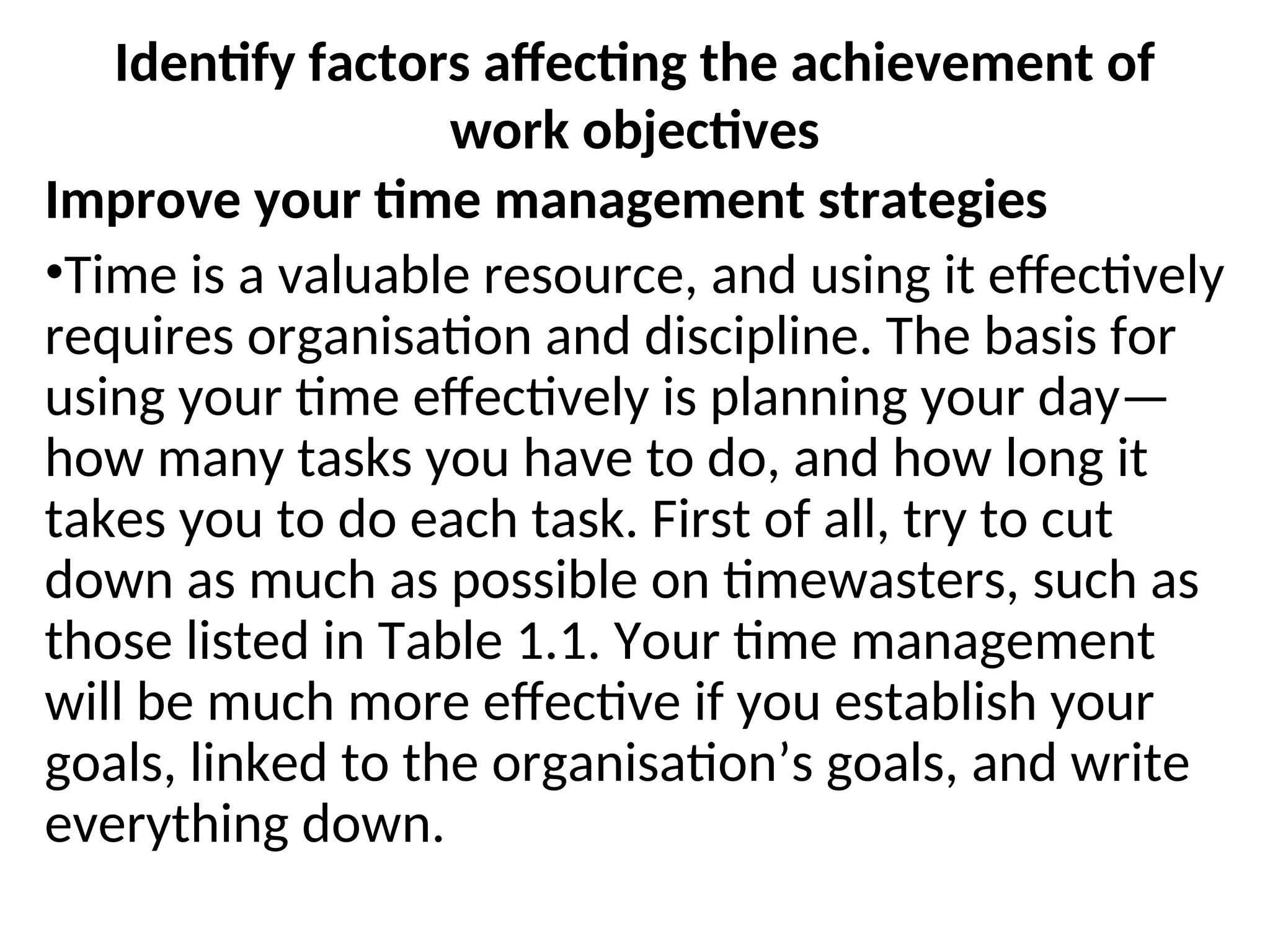
Improve your time management strategies
•Time is a valuable resource, and using it effectively
requires organisation and discipline. The basis for
using your time effectively is planning your day—
how many tasks you have to do, and how long it
takes you to do each task. First of all, try to cut
down as much as possible on timewasters, such as
those listed in Table 1.1. Your time management
will be much more effective if you establish your
goals, linked to the organisation’s goals, and write
everything down.
105.
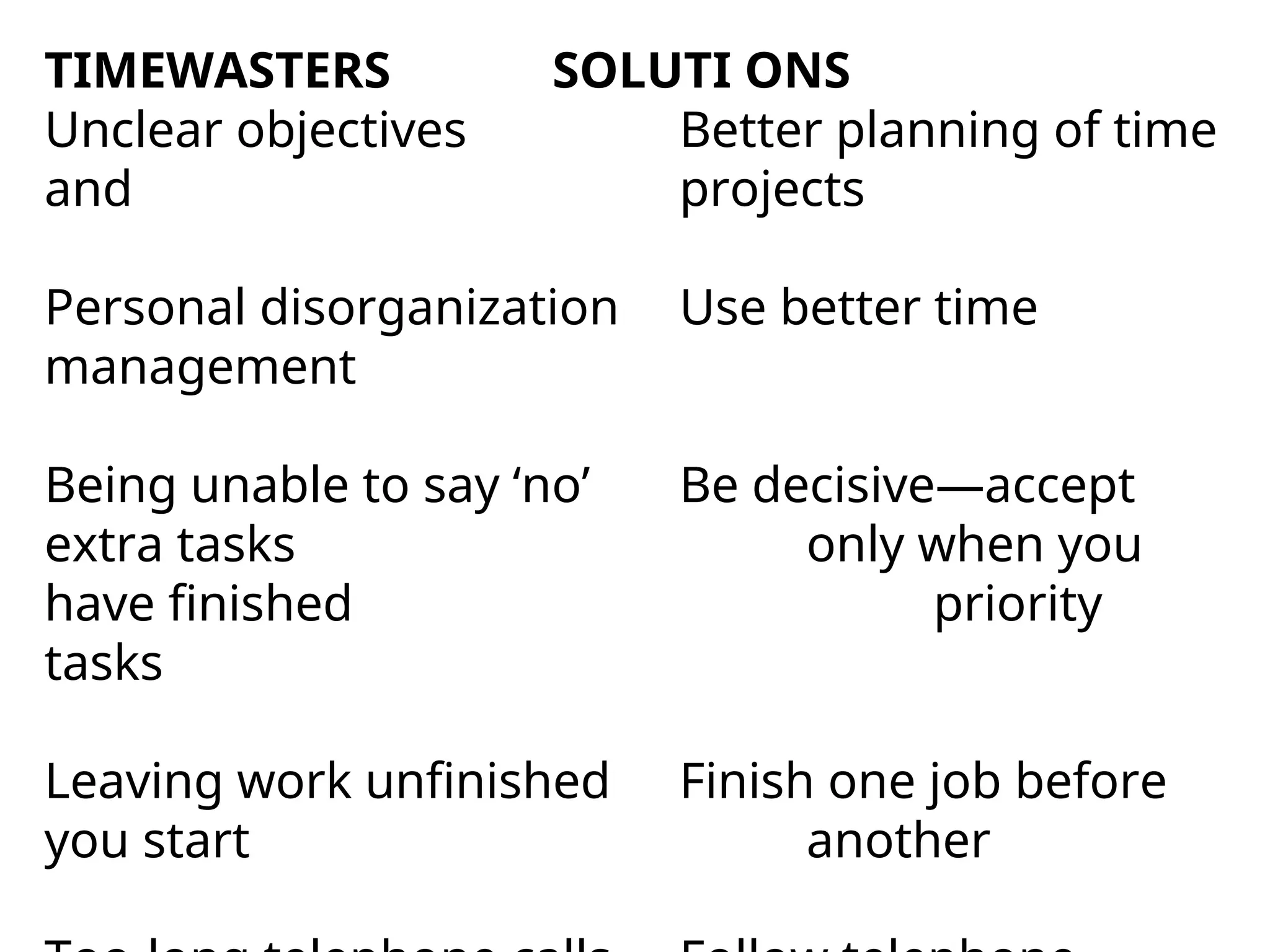
TIMEWASTERS SOLUTI ONS
Unclearobjectives Better planning of time
and projects
Personal disorganization Use better time
management
Being unable to say ‘no’ Be decisive—accept
extra tasks only when you
have finished priority
tasks
Leaving work unfinished Finish one job before
you start another
106.
TIMEWASTERS SOLUTIONS
Lack ofself-discipline:Make sure instructions have
been carried out.
not following up Do things right the first time,
or you will have to
carelessness do them again
Postponing tasks you Do the unpleasant jobs
first to dislike doing get them out of the
way
Not listening effectively Ask for clarification if
you are not sure what
someone has said
107.
Identifying factors affectingthe achievement
of work objectives
• To help reduce the impact of these
factors on your workload, it is a good
idea to develop a contingency plan. A
contingency plan identifies what can go
wrong and how you will manage it.
• You do not have to plan every single
contingency, but you do need to
consider the major ones.
108.
Identifying factors affectingthe achievement
of work objectives
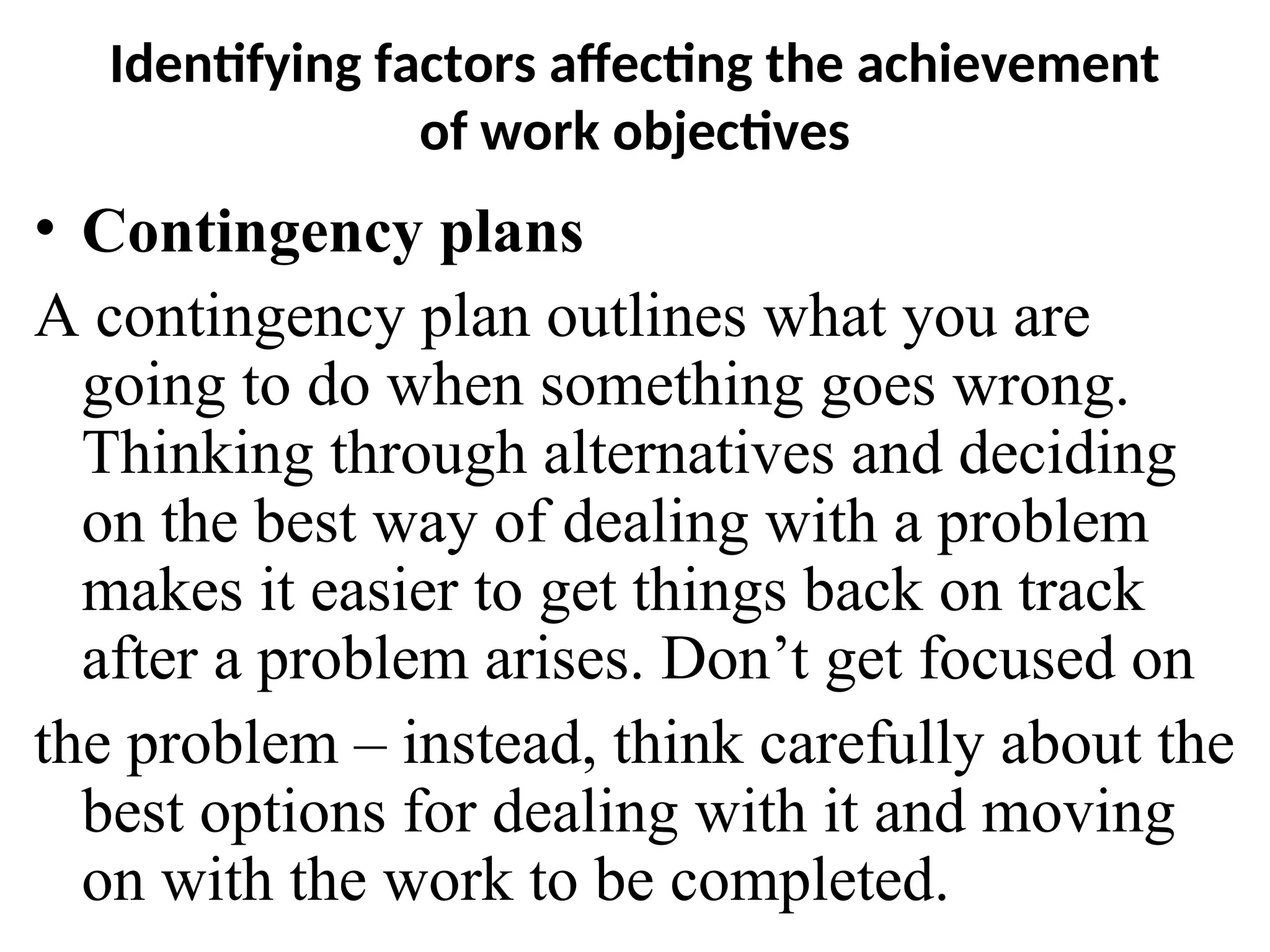
• Contingency plans
A contingency plan outlines what you are
going to do when something goes wrong.
Thinking through alternatives and deciding
on the best way of dealing with a problem
makes it easier to get things back on track
after a problem arises. Don’t get focused on
the problem – instead, think carefully about the
best options for dealing with it and moving
on with the work to be completed.
109.
CONTINGENCY PLANS
Questions tohelp identify major contingencies:
•What events could occur that would require a
response?
•What disasters might happen while trying to fulfil
my goals and objectives?
•What is the worst-case scenario of these events
occurring?
•What would cause the greatest disruption to my
current activities?
110.
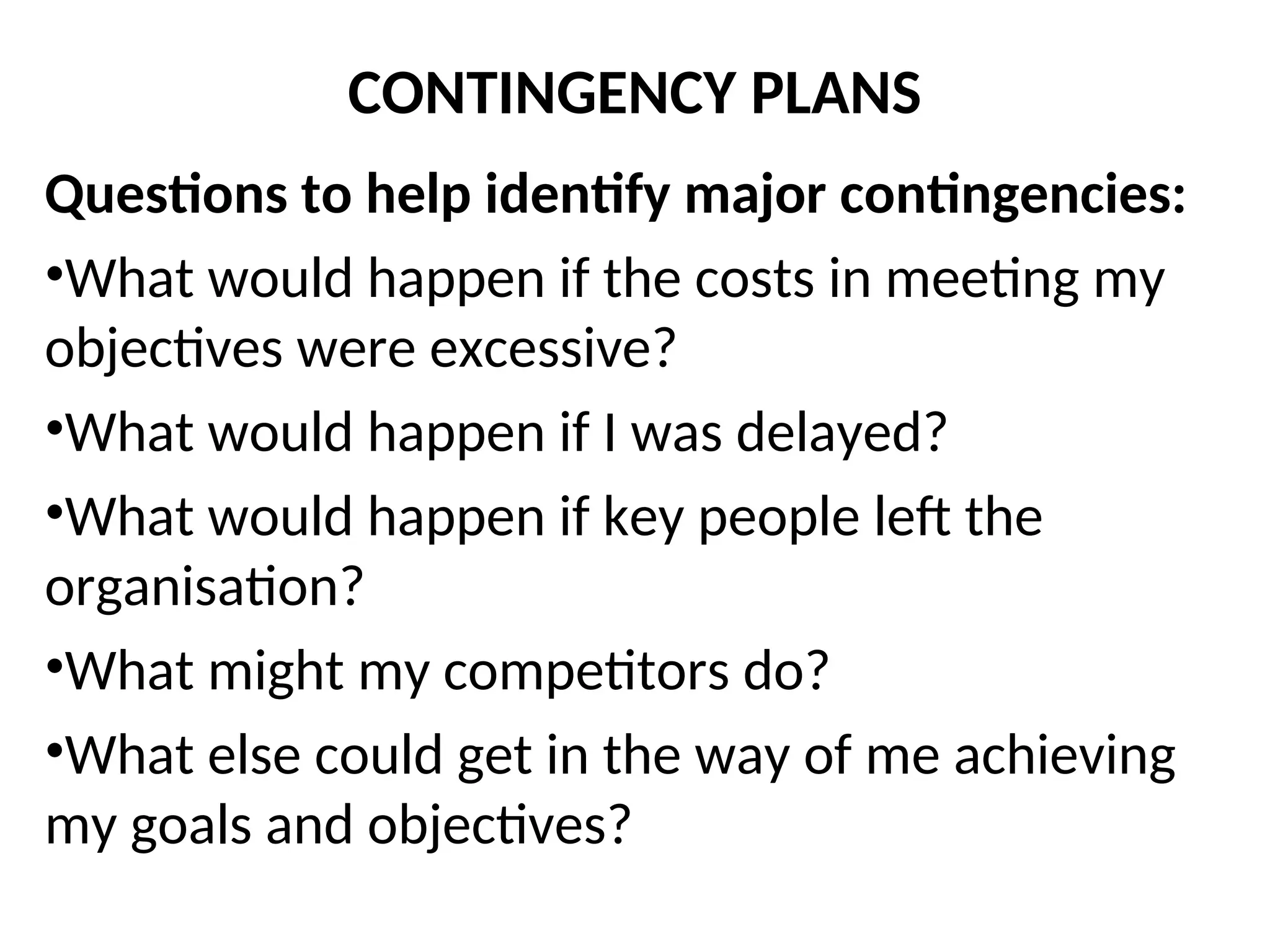
CONTINGENCY PLANS
Questions tohelp identify major contingencies:
•What would happen if the costs in meeting my
objectives were excessive?
•What would happen if I was delayed?
•What would happen if key people left the
organisation?
•What might my competitors do?
•What else could get in the way of me achieving
my goals and objectives?
111.
MANAGE WORK SCHEDULING
•Once you have planned out your tasks and
prioritised them, you will need to develop a
schedule. Scheduling is where the objectives
you set are placed on a timeline and given
expected completion dates.
• You need to look at the time you have
available and plan how you will use it to meet
your objectives. To be most effective, you
should schedule at the start of every week.
112.
MANAGE WORK SCHEDULING
Schedulingshould be completed in the following
order:
•Identify the time you have available.
•Block in the actions you have to do.
•Review your tasks and add in your high-priority
items.
•Block in some contingency time.
•Leave the remaining time as discretionary time,
which can be used to present work or follow-up on
activities.
113.
MANAGE WORK SCHEDULING
•Effective scheduling will help you to
understand what you can realistically
achieve, and assist you to make the best
use of your time. It can also help you to:
• Leave enough time to meet you highest
priorities.
• Leave enough time to manage
contingencies.
• Minimize stress.
114.
SCHEDULING TOOLS
• Electronicaids to better time management
• There are many types of planners that will help
you plan your time, such as computer packages
incorporating daily planning, appointments and
reminder systems. Electronic organisers store
addresses, appointments, to-do items, email
messages and other applications.
• Personal Digital Assistants (PDAs).
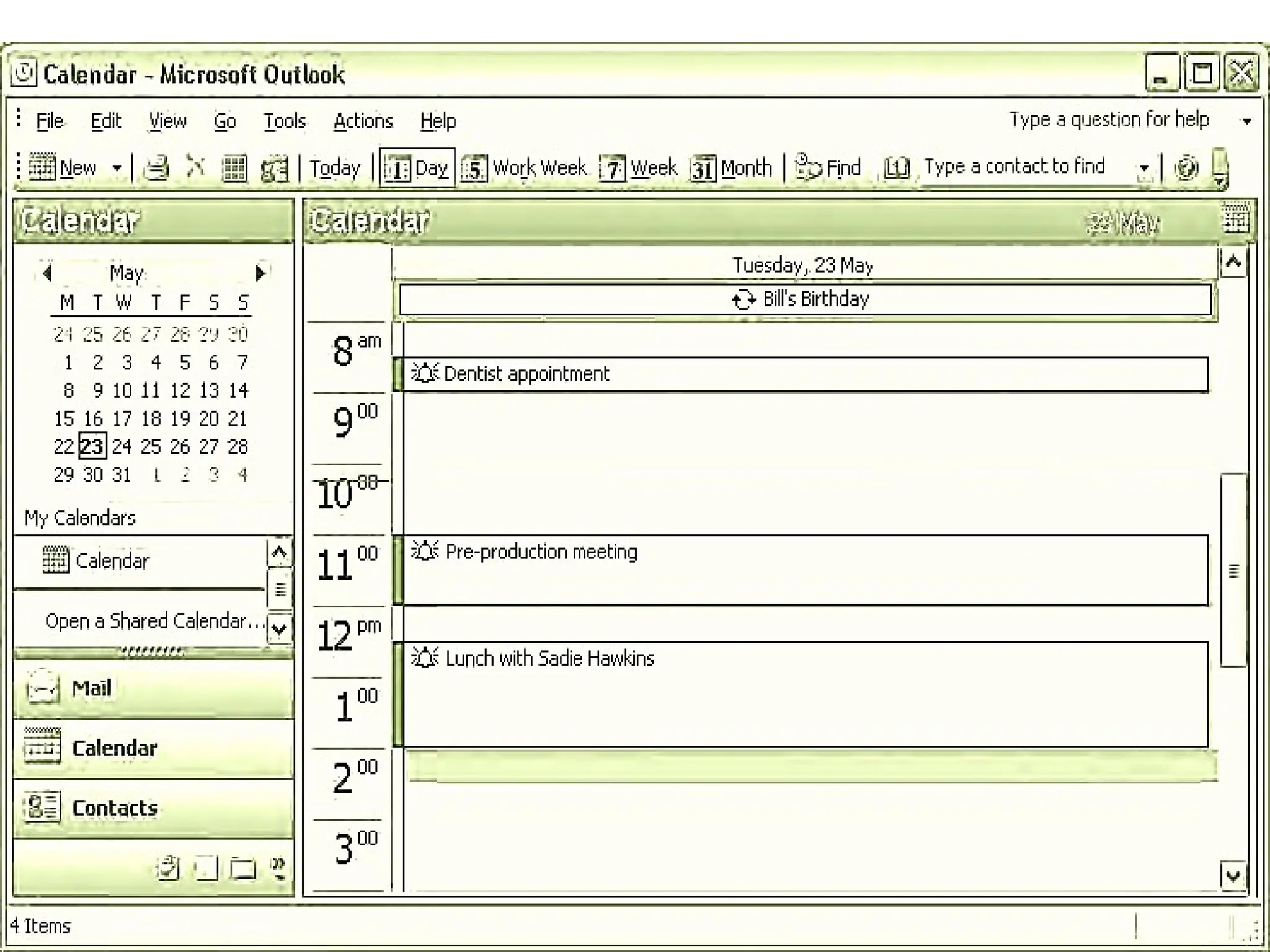
• Computer-based applications and programs such
as Microsoft Outlook and GoalPro6.
115.
SCHEDULING TOOLS
• Paper-basedaids to better time
management
• There are a number of practices you can
adopt in a paper-based system/organizers
to organise your working day and become
more effective. These include using wall
planners, desk diaries, ‘to-do today’ lists
and desk calendars.
116.
Use business technologyefficiently and
effectively
• The standard of work produced in an office has
greatly improved since the introduction of
technology such as email, the Internet, data
processing, and programs such as Microsoft Word,
Excel and PowerPoint. Many hours can be wasted
if you are not fully conversant with these software
packages. You should undertake professional
training in the specific software packages you use
at work so that you are completely confident, and
know how to get out of trouble if any problems
arise.
118.
Use business technologyefficiently and
effectively
Business technology may include:
• computer applications
• computers
• email
• facsimile machines
• internet/extranet/intranet
• modems
• personal schedulers
• photocopiers
• printers
• scanners
119.
2. MONITOR OWNWORK PERFORMANCE
• 2.1. Accurately monitor and adjust personal work
performance through self-assessment to ensure
achievement of tasks
• 2.2. Ensure that feedback on performance is
actively sought and evaluated from colleagues
and clients in the context of individual and group
requirements
• 2.3. Routinely identify and report on variations in
the quality of service and products in accordance
with organisational requirements
120.
2. MONITOR OWNWORK PERFORMANCE
• 2.4. Identify signs of stress and effects on
personal wellbeing
• 2.5. Identify sources of stress and access
appropriate supports and resolution
strategies
121.
MONITOR OWN WORKPERFORMANCE
There are many ways to monitor your performance,
including:
• Appraisal by superiors is usually an official
appraisal by your supervisor or manager.
There are drawbacks to appraisals by a superior:
• The employee may feel threatened.
• Evaluation is often a one-way process.
• The superior may not have the right interpersonal
skills to give good feedback.
122.
MONITOR OWN WORKPERFORMANCE
• Self-appraisal is a very useful tool and
involves an employee in the evaluation
process. It helps to clarify an employee’s role
and reduces role conflict.
• Peer appraisal can be useful when used
with coaching and mentoring programs, and
when used as part of periodic group appraisal
programs which contribute to team building.
123.
FEEDBACK ON PERFORMANCE
•formal/informal performance appraisals
• obtaining feedback from clients
• obtaining feedback from supervisors and
colleagues
• personal, reflective behaviour strategies
• routine organisational methods for
monitoring service delivery
124.
SIGNS OF STRESSMAY INCLUDE:
• absence from work
• alcohol or other substance abuse
• conflict
• poor work performance
125.
Effect of stresson Personal wellbeing
may include
• cultural
• emotional
• social
• spiritual
126.
Sources of stressmay include:
• complex tasks
• cultural issues
• work and family conflict
• workloads
127.
Supports and resolutionstrategies for dealing with
stress may include
• awareness raising
• counselling
• employee assistance programs (EAP)
• family support
• group activities
• job design
• mediation
• sharing load
• time off
• training
128.
3. Coordinate personalskill development and
learning
• 3.1. Identify personal learning needs and
skill gaps using self-assessment and advice
from colleagues and clients in relation to
role and organisational requirements
• 3.2. Identify, prioritise and plan
opportunities for undertaking personal skill
development activities in liaison with work
groups and relevant personnel
129.
3. Coordinate personalskill development and
learning
• 3.3. Access, complete and record
professional development opportunities
to facilitate continuous learning and
career development
• 3.4. Incorporate formal and informal
feedback into review of further learning
needs
130.
IDENTIFY PERSONAL LEARNINGAND
PROFESSIONAL DEVELOPMENT NEEDS
• The first step in planning any
personal learning and
professional development is to
identify the skills that may be
lacking or that you may need to
improve on.
131.
SKILLS GAP ANALYSIS
•You will need to determine what skills are required
and what skills you already have. Any skills that are
needed that you don’t yet have are the “gap”. These
are the skills you will need to learn.
• To perform a skills gap analysis, the first step is to
determine the required skill levels. To do this:
1.Identify and write down all the required skills in
categories.
2.Under each skill, write a description of the desired
level. They can be low, medium or high, or on a
rating scale of 1 to 10.
3.Record the skills needed and the required levels.
132.
SKILLS GAP ANALYSIS
•Next you will need to determine your
current skill level. To do this:
1.Write down all the relevant skills that
you already have.
2.Rate your current level of competence
using the same scale.
3.Record your responses.
133.
SKILLS GAP ANALYSIS
•Finally, you will need to determine the
gap. To do this:
1.Compare the required skill levels to the
current skill levels in a table.
2.Highlight any areas where your current
level is less than required.
134.
SKILLS GAP ANALYSIS
•When determining the skills gap, consider the feedback
you have obtained from clients and colleagues in
relation to your role and performance. You may need to
seek further feedback on any areas where you are
unsure.
• Your self-management skills are essential when
performing a skills gap analysis to determine your
personal learning and professional development needs.
• These skills include self-awareness and the ability to
reflect and self-appraise, monitoring skills, time
management and planning
135.
COMPETENCY STANDARDS
• Reviewingcompetency standards can help you to
determine the skill levels that you require to
perform your work tasks.
• A competency standard is a document that
specifies how people should complete their job.
• Competency standards are used by organisations
to:
1.Nominate how they expect work roles to be
performed.
2.Judge how competent individuals are in their job
role.
136.
PLAN PERSONAL SKILLDEVELOPMENT
• It is important that you take responsibility for
your own learning and development. This is not
as difficult as you may think.
• Traditionally, professional development has been
thought of in terms of formal learning and
training programs. This is certainly one aspect of
it.
• Today professional development is also
considered to include a range of options to
develop knowledge, skills and attributes.
137.
PLAN PERSONAL SKILLDEVELOPMENT
These include:
• Supervision.
• Mentoring and coaching.
• On-the-job training.
• Leadership training.
• Recognition of current skills.
• Work experience.
138.
PLAN PERSONAL SKILLDEVELOPMENT
• Secondments.
• Performance appraisals.
• Quality assessments.
• Study groups.
• Planning days.
• Journals.
• Online discussion groups.
• Professional association memberships.
139.
PLAN PERSONAL SKILLDEVELOPMENT
• You need to plan learning that is relevant to
you and the skills you want to develop. The
first step is to review your skills gap
analysis. You may also want to consult with
your work groups or teams and other
relevant personnel/workers.
• It may not be possible to learn all of the
necessary skills at once. For this reason you
may need to prioritise your learning needs.
140.
PLAN PERSONAL SKILLDEVELOPMENT
• Choose the learning needs where there are the
biggest gaps or the greatest urgency to work on
first.
• If you have several skills with large gaps, pick the
ones that seem most important to the objective
you are trying to fulfil to start with.
• You will then need to seek out suitable
opportunities. If the method you have chosen is
something you can organise at work, such as
mentoring, you might want to discuss it with
your employer or human resource manager.
141.
PLAN PERSONAL SKILLDEVELOPMENT
• For external opportunities, a great
place to start is the Internet.
• There are many websites related to
professional development
opportunities.
142.
Professional development opportunitiesmay
include:
• career planning/development
• coaching, mentoring and/or supervision
• formal/informal learning programs
• internal/external training provision
• performance appraisals
• personal study
• quality assurance assessments and
recommendations
• recognition of current competence/skills recognition
• work experience/exchange/opportunities
• workplace skills assessment
143.
RECORD PROFESSIONAL DEVELOPMENT
•Once you have accessed and completed
the professional development
activities, you should keep a record of
it. Completing regular professional
development will facilitate continuous
learning and help in your career
development.
144.
RECORD PROFESSIONAL DEVELOPMENT
•Your record should include detailed
notes from the activity, the date
completed, certificates, work
completed, statements of results,
feedback obtained and your own
review of the activity.
• One way to keep records is to keep a
journal of all your professional
development activities.
145.
FEEDBACK:REVIEW FURTHER LEARNINGNEEDS
• You should seek both formal and informal
feedback from your professional
development activities in the same way you
sought feedback on your work
performance.
• On the completion of your activity,
consider the feedback received and revisit
your skill gap analysis.
146.
FEEDBACK:REVIEW FURTHER LEARNINGNEEDS
Consider the following questions:
• Have you achieved the skill level you
needed?
• Was the skill you learned right for the
objective you are trying to fulfil?
• Are there any additional skills you need
to learn that weren’t covered in this
activity?
147.
FEEDBACK:REVIEW FURTHER LEARNINGNEEDS
Consider the following questions:
• Do you need to undertake refresher
training for this skill at a later stage?
• Is there legislative, technology or other
industry changes occurring that may affect
the skill you have learned?
148.
FOR REFLECTION
• Successfulsupervisors are those who plan
their work and work to their plan. A plan
needs to be based on specified work goals
and objectives. In order to achieve these
goals and objectives, you must know clearly
what they are. This involves a solid
understanding not only of them, but also, the
way in which they meet your organisation’s
requirements.
149.
FOR REFLECTION
A goaldescribes what you want to achieve
overall. Objectives provide clear measuring
posts as you proceed towards your goal. The
best objectives are measurable and time-
framed. Once you have determined your
goals and objectives you should communicate
them to the people in your organisation who
will be involved in the process so that they
can be negotiated and agreed upon in line
with your organisation’s requirements.
150.
FOR REFLECTION
• Doyou know what objectives you need to
achieve in your supervisory role?
• Do you know how to set realistic goals to
meet these objectives?
• How will you determine realistic
timeframes?
• What will you use to measure your level of
performance?