Human System Presentation
    Nathan Heilman
        SCI 230
Purpose of the Muscular-Skeletal System

• Bones and muscles work together to make body parts or the
  whole body move
• Muscles control many automatic functions of the body such
  as pumping blood through the veins or passing food through
  the digestive system
• Bones produce blood cells , protect vital organs in the body,
  support the body, and store minerals
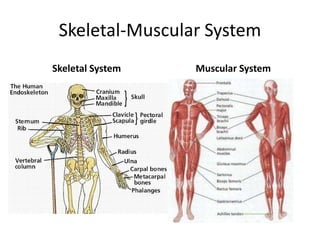
Skeletal-Muscular System
Skeletal System   Muscular System
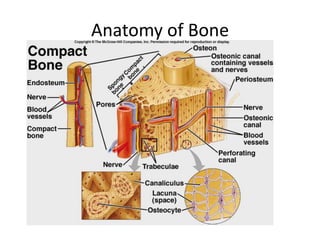
Anatomy of Bone
    • Bone
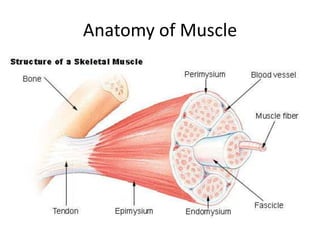
Anatomy of Muscle
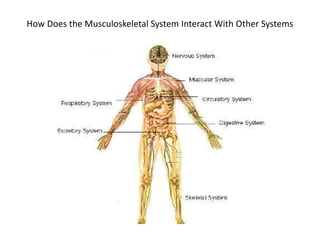
How Does the Musculoskeletal System Interact With Other Systems
• "Muscle Anatomy & Physiology." Phil Davies' Sports Fitness Advisor - Get
  Fit for Sport & Life. Web. 18 July 2011. <http://www.sport-fitness-
  advisor.com/muscle-anatomy.html>.
• "What Is The Purpose Of The Muscular System? | LIVESTRONG.COM."
  LIVESTRONG.COM - Lose Weight & Get Fit with Diet, Nutrition & Fitness
  Tools. Web. 18 July 2011. <http://www.livestrong.com/article/131565-
  what-is-purpose-muscular-system/>.
• "The Skeletal and Muscular System." Scribd. Web. 18 July 2011.
  <http://www.scribd.com/doc/4966304/The-Skeletal-and-Muscular-
  System>.
• "Neuroscience Resources for Kids - Body System Interaction." UW Faculty
  Web Server. Web. 18 July 2011.
  <http://faculty.washington.edu/chudler/organ.html>.
• "Skeletal-Muscular System: Text, Images, Music, Video | Glogster EDU -
  21st Century Multimedia Tool for Educators, Teachers and Students."
  Ssepfce's Profile | Glogster EDU - 21st Century Multimedia Tool for
  Educators, Teachers and Students. Web. 18 July 2011.
  <http://ssepfce.edu.glogster.com/amanda-lilly-and-shreyas-glog/>.

Presentation1

  • 1.
    Human System Presentation Nathan Heilman SCI 230
  • 2.
    Purpose of theMuscular-Skeletal System • Bones and muscles work together to make body parts or the whole body move • Muscles control many automatic functions of the body such as pumping blood through the veins or passing food through the digestive system • Bones produce blood cells , protect vital organs in the body, support the body, and store minerals
  • 3.
  • 4.
  • 5.
  • 6.
    How Does theMusculoskeletal System Interact With Other Systems
  • 7.
    • "Muscle Anatomy& Physiology." Phil Davies' Sports Fitness Advisor - Get Fit for Sport & Life. Web. 18 July 2011. <http://www.sport-fitness- advisor.com/muscle-anatomy.html>. • "What Is The Purpose Of The Muscular System? | LIVESTRONG.COM." LIVESTRONG.COM - Lose Weight & Get Fit with Diet, Nutrition & Fitness Tools. Web. 18 July 2011. <http://www.livestrong.com/article/131565- what-is-purpose-muscular-system/>. • "The Skeletal and Muscular System." Scribd. Web. 18 July 2011. <http://www.scribd.com/doc/4966304/The-Skeletal-and-Muscular- System>. • "Neuroscience Resources for Kids - Body System Interaction." UW Faculty Web Server. Web. 18 July 2011. <http://faculty.washington.edu/chudler/organ.html>. • "Skeletal-Muscular System: Text, Images, Music, Video | Glogster EDU - 21st Century Multimedia Tool for Educators, Teachers and Students." Ssepfce's Profile | Glogster EDU - 21st Century Multimedia Tool for Educators, Teachers and Students. Web. 18 July 2011. <http://ssepfce.edu.glogster.com/amanda-lilly-and-shreyas-glog/>.

Editor's Notes

  • #3 The human body contains 206 bones and over 600 muscles that all work together to move the body, maintain posture, and many other processes that are vital to being alive. Many people look at each system individually but others believe that the two systems rely so heavily upon one another that they should be considered one system, the musculoskeletal system.
  • #4 The two major parts that make up the musculoskeletal system are muscle and bone. There are several types of muscle in the muscular system and each serves a different purpose. Skeletal muscle makes up about 40% of the average human being’s body weight and is mainly responsible maintaining good posture and moving things. Skeletal muscle is also extremely important in producing heat and maintaining the body’s temperature.
  • #5 The skeletal system makes up the framework of the body and allows us to move when our muscles contract. It stores minerals (e.g. calcium, phosphorous) and releases them into the body when they are needed. The skeletal system also protects internal organs and produces blood cells. Bones come in a lot of various shapes sizes and forms and have a very complex structure both internally and externally. Some of the major parts that make up bone are osseous tissue, which gives bone its rigidity and shape. There are many other tissues found in bone such as marrow, nerves, blood vessels, cartilage, and endosteum.
  • #6 The muscular system helps us to do a variety of different things. Different types of muscles enable motion, generate heat to maintain body temperature, move food through digestive tract and contract the heart. Muscles are generally found on the outside of bone attached to it by connective tissue like tendons and cartilage found between the joints. When the muscles contract they move the bones which move various parts of the body. Although most muscle in the body can be moved voluntarily, some muscles move automatically, controlled by hormones chemicals, or signals deep from the brain. Smooth muscle is often called involuntary or visceral muscle, makes up many of the body’s internal organs. With smooth muscle, your brain controls the muscle without any conscious thought from you. Smooth muscle help control the flow of blood through the body and also the passage of food through the digestive system. Smooth muscle helps with the elimination of waste such as the passing of urine through the bladder. One other type of muscle is cardiac muscle which makes up the walls of the heart. Just like smooth muscle you have no control over this how this muscle contracts and relaxes, it is all done involuntarily.
  • #7 The skeletal system helps provide protection for most of the major organs in the human body. Take for instance the skull, which protects the brain which is a major part of the nervous system. Or the heart, which is a muscle that provides the pumping pressure to make our blood flow throughout the human body. Speaking of blood, bones in the body are responsible for producing the blood cells that carry oxygen through our circulatory systems. The brain (nervous system) sends signals to the muscles in our digestive tract making them contract and relax which helps us digest food and eliminate waste. Muscles are also responsible for contracting and forcing waste out of the body. Vertebrae in the spine protect the spinal cord which is a vital part of the nervous system.