SKELETAL AND
MUSCULAR SYSTEM
SKELETAL SYSTEM
The skeletal system works as a support structure
for your body. It gives the body its shape, allows
movement, makes blood cells, provides protection
for organs and stores minerals. The skeletal
system is also called the musculoskeletal system.
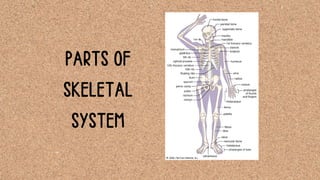
PARTS OF
SKELETAL
SYSTEM
~The skeletal system functions as the
basic framework of a body and the
entire body are built around the hard
framework of Skeleton. It is the
combination of all the bones and
tissues associated with cartilages and
joints. Almost all the rigid or solid
parts of the body are the main
components of the skeletal system.
What is the skeletal system of the body?
The skeletal system is the body system
composed of bones and cartilage and
performs the following critical functions
for the human body:
supports the body.
facilitates movement.
protects internal organs.
produces blood cells.
stores and releases minerals and fat.
The adult human skeleton usually
consists of 206 named bones. These
bones can be grouped in two divisions:
axial skeleton and appendicular
skeleton. The 80 bones of the axial
skeleton form the vertical axis of the
body. They include the bones of the head,
vertebral column, ribs and breastbone or
sternum.
206 bones The adult human
skeleton is made up of 206 bones.
These include the bones of the
skull, spine (vertebrae), ribs, arms
and legs. Bones are made of
connective tissue reinforced with
calcium and specialised bone cells.
MUSCULAR SYSTEM
-is a bodily system that consists of
muscle tissue and cells that can
change shape and contract.
3 Types of Muscle
SKELETAL/STRIPED OR VOLUNTARY MUSCLE
1.
SMOOTH OR INVOLUNTARY MUSCLE
2.
CARDIAC MUSCLE
3.
SKELETAL OR VOLUNTARY MUSCLE
ARE THE MUSCLES THAT WE CAN
CONSCIOUSLY CONTROL. THEY ARE
ATTACHED TO BONES AND ARE
RESPONSIBLE FOR THE MOVEMENT OF THE
LIMBS, HEAD, NECK, AND BODY.
SMOOTH OR INVOLUNTARY MUSCLE
which is found in the internal
organs and blood vessels, and is
controlled by the autonomic
nervous system.
CARDIAC MUSCLE
which is found only in the
heart, and acts like
rhythmic smooth muscle.
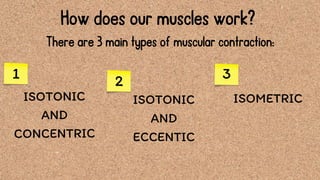
How does our muscles work?
ISOTONIC
AND
ECCENTIC
ISOTONIC
AND
CONCENTRIC
1 2 3
There are 3 main types of muscular contraction:
ISOMETRIC
ISOTONIC AND
CONCENTRIC
1.
~is a type of muscle
contraction that causes the
muscle to shorten as it
contracts. It occurs when the
force generated by the muscle
is greater than the resistance
applied to it.
2. ISOTONIC AND
ECCENTIC
~is a type of isotonic
contraction where the muscle
lengthens whilst it is under
tension. The origin and the
insertion move further away
from each other
3. Isometric
~is a type of muscle contraction
where the muscle does not
change its length or cause any
joint movement. It is common in
the muscles of the hand and
forearm responsible for grip.
Conclusion
The skeletal and muscular
systems work together to
provide the body with
support and movement.
Without one, the other would
not be able to function.
THANK
YOU!
Presented by: Galvez, Marla
Pulido, Chelsea

skeletal-muscular-system.pdf a presentation

  • 1.
  • 2.
    SKELETAL SYSTEM The skeletalsystem works as a support structure for your body. It gives the body its shape, allows movement, makes blood cells, provides protection for organs and stores minerals. The skeletal system is also called the musculoskeletal system.
  • 3.
  • 4.
    ~The skeletal systemfunctions as the basic framework of a body and the entire body are built around the hard framework of Skeleton. It is the combination of all the bones and tissues associated with cartilages and joints. Almost all the rigid or solid parts of the body are the main components of the skeletal system. What is the skeletal system of the body?
  • 5.
    The skeletal systemis the body system composed of bones and cartilage and performs the following critical functions for the human body: supports the body. facilitates movement. protects internal organs. produces blood cells. stores and releases minerals and fat.
  • 6.
    The adult humanskeleton usually consists of 206 named bones. These bones can be grouped in two divisions: axial skeleton and appendicular skeleton. The 80 bones of the axial skeleton form the vertical axis of the body. They include the bones of the head, vertebral column, ribs and breastbone or sternum.
  • 7.
    206 bones Theadult human skeleton is made up of 206 bones. These include the bones of the skull, spine (vertebrae), ribs, arms and legs. Bones are made of connective tissue reinforced with calcium and specialised bone cells.
  • 8.
    MUSCULAR SYSTEM -is abodily system that consists of muscle tissue and cells that can change shape and contract.
  • 9.
    3 Types ofMuscle SKELETAL/STRIPED OR VOLUNTARY MUSCLE 1. SMOOTH OR INVOLUNTARY MUSCLE 2. CARDIAC MUSCLE 3.
  • 10.
    SKELETAL OR VOLUNTARYMUSCLE ARE THE MUSCLES THAT WE CAN CONSCIOUSLY CONTROL. THEY ARE ATTACHED TO BONES AND ARE RESPONSIBLE FOR THE MOVEMENT OF THE LIMBS, HEAD, NECK, AND BODY.
  • 11.
    SMOOTH OR INVOLUNTARYMUSCLE which is found in the internal organs and blood vessels, and is controlled by the autonomic nervous system.
  • 12.
    CARDIAC MUSCLE which isfound only in the heart, and acts like rhythmic smooth muscle.
  • 13.
    How does ourmuscles work? ISOTONIC AND ECCENTIC ISOTONIC AND CONCENTRIC 1 2 3 There are 3 main types of muscular contraction: ISOMETRIC
  • 14.
    ISOTONIC AND CONCENTRIC 1. ~is atype of muscle contraction that causes the muscle to shorten as it contracts. It occurs when the force generated by the muscle is greater than the resistance applied to it. 2. ISOTONIC AND ECCENTIC ~is a type of isotonic contraction where the muscle lengthens whilst it is under tension. The origin and the insertion move further away from each other
  • 15.
    3. Isometric ~is atype of muscle contraction where the muscle does not change its length or cause any joint movement. It is common in the muscles of the hand and forearm responsible for grip.
  • 16.
    Conclusion The skeletal andmuscular systems work together to provide the body with support and movement. Without one, the other would not be able to function.
  • 17.
    THANK YOU! Presented by: Galvez,Marla Pulido, Chelsea