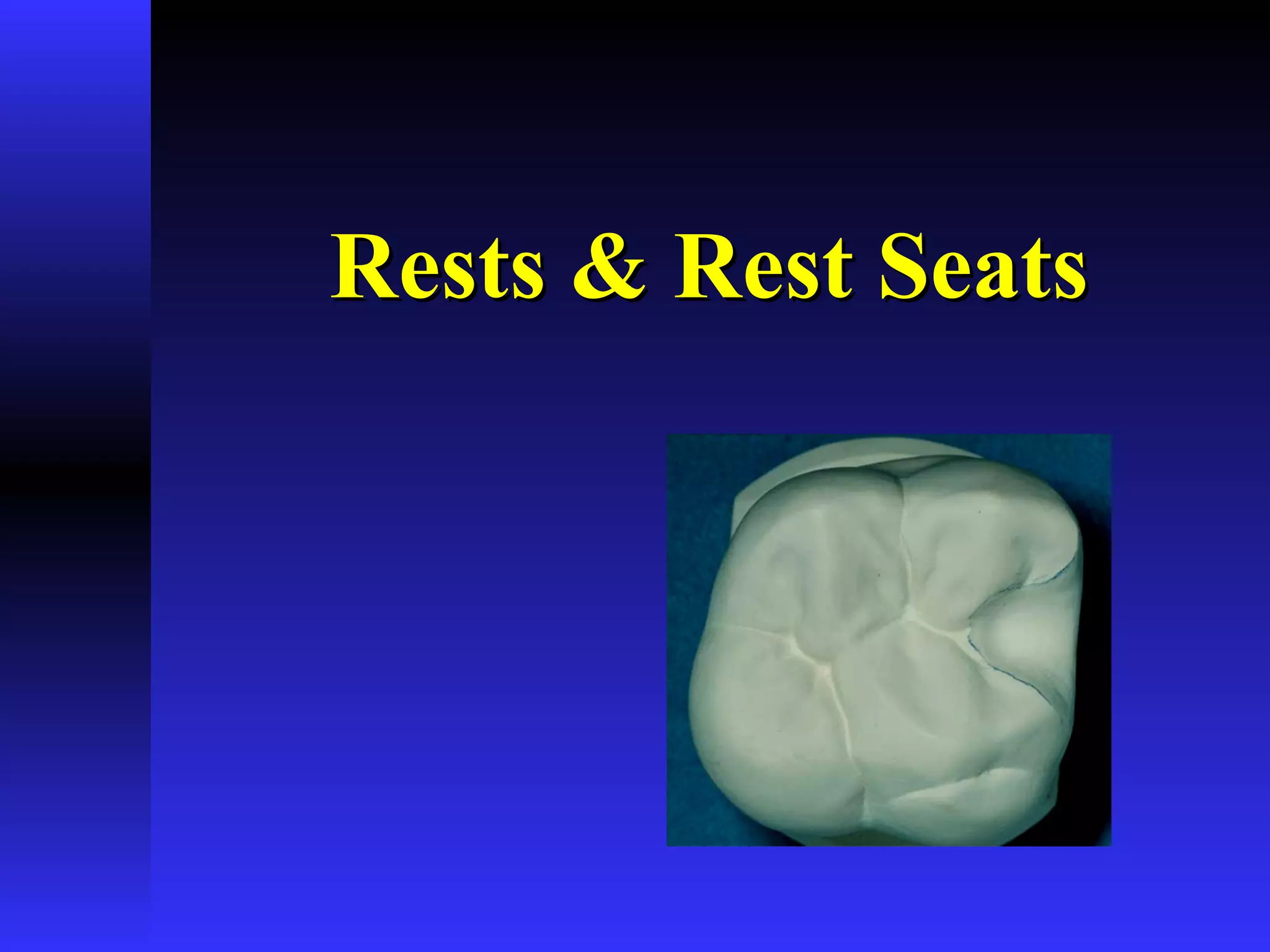
Rests & Rest SeatsRests & Rest Seats
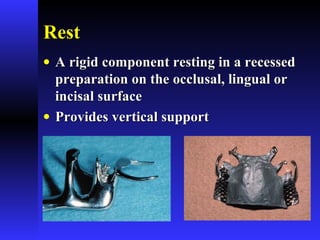
RestRest
• A rigid component resting in a recessedA rigid component resting in a recessed
preparation on the occlusal, lingual orpreparation on the occlusal, lingual or
incisal surfaceincisal surface
• Provides vertical supportProvides vertical support
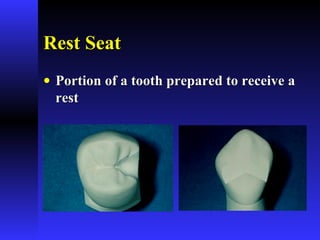
Rest SeatRest Seat
• Portion of a tooth prepared to receive aPortion of a tooth prepared to receive a
restrest
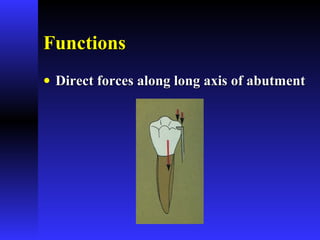
FunctionsFunctions
• Direct forces along long axis of abutmentDirect forces along long axis of abutment
FunctionsFunctions
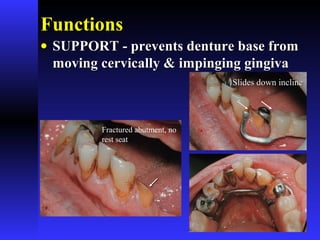
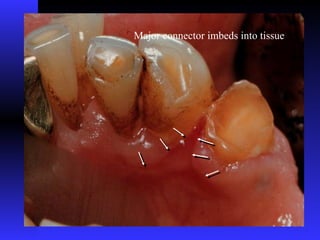
• SUPPORT - prevents denture base fromSUPPORT - prevents denture base from
moving cervically & impinging gingivamoving cervically & impinging gingiva
Slides down inclineSlides down incline
Fractured abutment, no
rest seat
Major connector imbeds into tissue
FunctionsFunctions
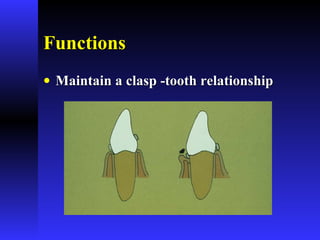
• Maintain a clasp -tooth relationshipMaintain a clasp -tooth relationship
FunctionsFunctions
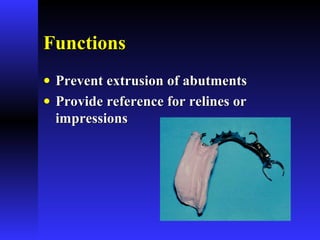
• Prevent extrusion of abutmentsPrevent extrusion of abutments
• Provide reference for relines orProvide reference for relines or
impressionsimpressions
FunctionsFunctions
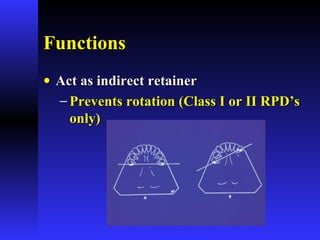
• Act as indirect retainerAct as indirect retainer
− Prevents rotation (Class I or II RPD’sPrevents rotation (Class I or II RPD’s
only)only)
Preparation of Rest SeatsPreparation of Rest Seats
• Light pressureLight pressure
• High-speed handpieceHigh-speed handpiece
• +/- Waterspray+/- Waterspray
• Minimal heat is generatedMinimal heat is generated
Preparation of Rest SeatsPreparation of Rest Seats
• Keep in enamelKeep in enamel
• No anesthesiaNo anesthesia
Preparation of Rest SeatsPreparation of Rest Seats
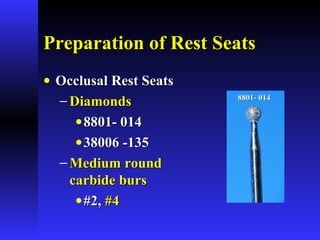
• Occlusal Rest SeatsOcclusal Rest Seats
− DiamondsDiamonds
•8801- 0148801- 014
•38006 -13538006 -135
− Medium roundMedium round
carbide burscarbide burs
•#2,#2, #4#4
8801- 0148801- 014
Preparation of Rest SeatsPreparation of Rest Seats
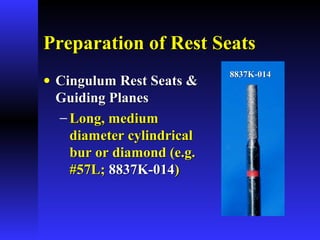
• Cingulum Rest Seats &Cingulum Rest Seats &
Guiding PlanesGuiding Planes
− Long, mediumLong, medium
diameter cylindricaldiameter cylindrical
bur or diamond (e.g.bur or diamond (e.g.
#57L;#57L; 8837K-0148837K-014))
8837K-0148837K-014
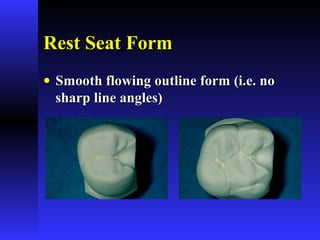
Rest Seat FormRest Seat Form
• Smooth flowing outline form (i.e. noSmooth flowing outline form (i.e. no
sharp line angles)sharp line angles)
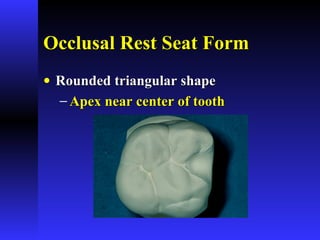
Occlusal Rest Seat FormOcclusal Rest Seat Form
• Rounded triangular shapeRounded triangular shape
− Apex near center of toothApex near center of tooth
Occlusal Rest Seat FormOcclusal Rest Seat Form
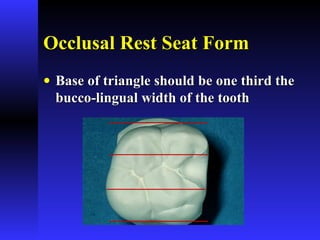
• Base of triangle should be one third theBase of triangle should be one third the
bucco-lingual width of the toothbucco-lingual width of the tooth
Occlusal Rest Seat FormOcclusal Rest Seat Form
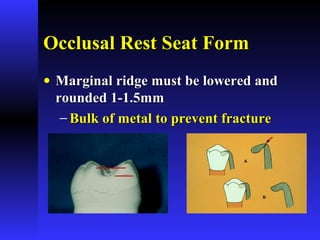
• Marginal ridge must be lowered andMarginal ridge must be lowered and
rounded 1-1.5mmrounded 1-1.5mm
− Bulk of metal to prevent fractureBulk of metal to prevent fracture
Occlusal Rest Seat FormOcclusal Rest Seat Form
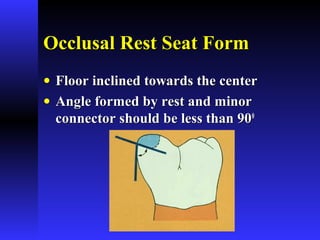
• Floor inclined towards the centerFloor inclined towards the center
• Angle formed by rest and minorAngle formed by rest and minor
connector should be less than 90connector should be less than 9000
Occlusal Rest Seat FormOcclusal Rest Seat Form
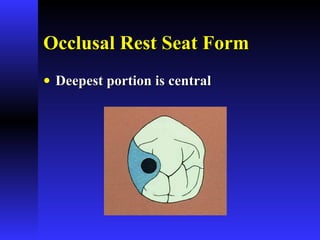
• Deepest portion is centralDeepest portion is central
Occlusal Rest Seat FormOcclusal Rest Seat Form
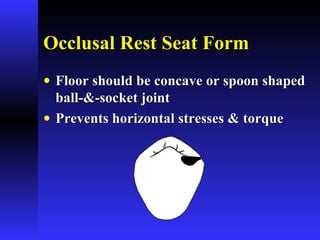
• Floor should be concave or spoon shapedFloor should be concave or spoon shaped
ball-&-socket jointball-&-socket joint
• Prevents horizontal stresses & torquePrevents horizontal stresses & torque
Occlusal Rest Seat FormOcclusal Rest Seat Form
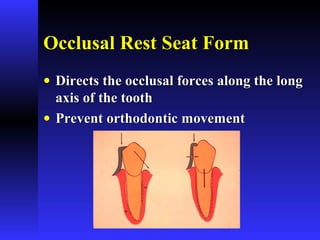
• Directs the occlusal forces along the longDirects the occlusal forces along the long
axis of the toothaxis of the tooth
• Prevent orthodontic movementPrevent orthodontic movement
““Positive” Rest SeatsPositive” Rest Seats
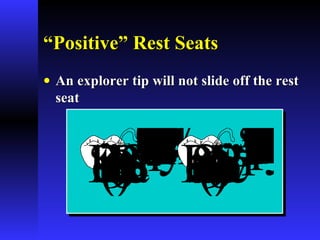
• An explorer tip will not slide off the restAn explorer tip will not slide off the rest
seatseat
ExplorerwillNOTslipoffrestseatifpulledproximallly ExplorerWILLslipoffrestseatifpulledproximallly‘Positive’RestSeat(<90°) RestSeatnot‘Positive’(>90°)
Occlusal Rest Seat FormOcclusal Rest Seat Form
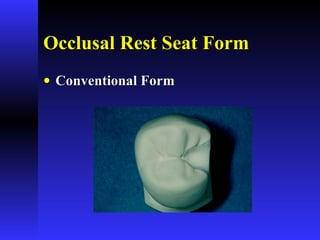
• Conventional FormConventional Form
Occlusal Rest Seat FormOcclusal Rest Seat Form
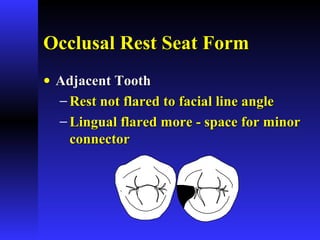
• Adjacent ToothAdjacent Tooth
− Rest not flared to facial line angleRest not flared to facial line angle
− Lingual flared more - space for minorLingual flared more - space for minor
connectorconnector
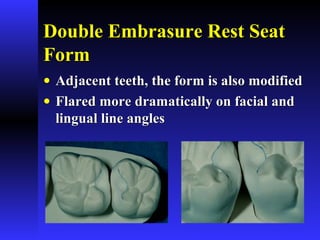
Double Embrasure Rest SeatDouble Embrasure Rest Seat
FormForm
• Adjacent teeth, the form is also modifiedAdjacent teeth, the form is also modified
• Flared more dramatically on facial andFlared more dramatically on facial and
lingual line angleslingual line angles
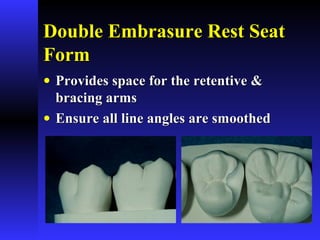
Double Embrasure Rest SeatDouble Embrasure Rest Seat
FormForm
• Provides space for the retentive &Provides space for the retentive &
bracing armsbracing arms
• Ensure all line angles are smoothedEnsure all line angles are smoothed
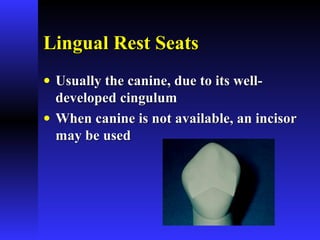
Lingual Rest SeatsLingual Rest Seats
• Usually the canine, due to its well-Usually the canine, due to its well-
developed cingulumdeveloped cingulum
• When canine is not available, an incisorWhen canine is not available, an incisor
may be usedmay be used
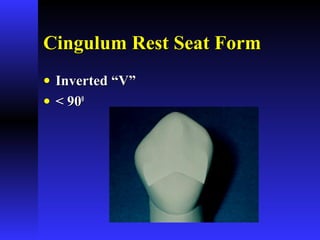
Cingulum Rest Seat FormCingulum Rest Seat Form
• Inverted “V”Inverted “V”
• < 90< 9000
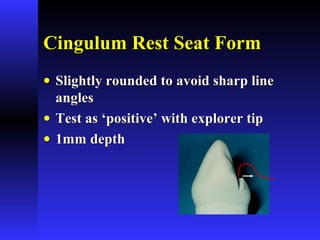
Cingulum Rest Seat FormCingulum Rest Seat Form
• Slightly rounded to avoid sharp lineSlightly rounded to avoid sharp line
anglesangles
• Test as ‘positive’ with explorer tipTest as ‘positive’ with explorer tip
• 1mm depth1mm depth
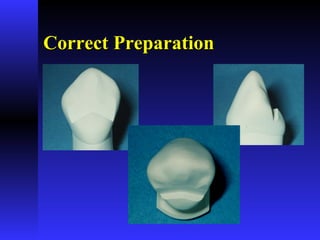
Correct PreparationCorrect Preparation
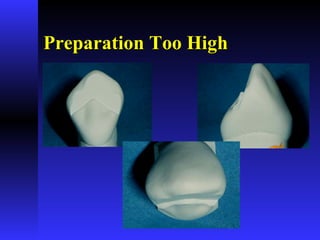
Preparation Too HighPreparation Too High
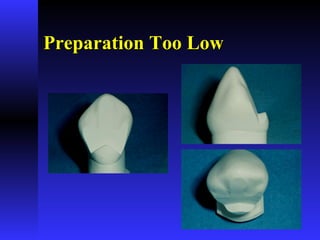
Preparation Too LowPreparation Too Low
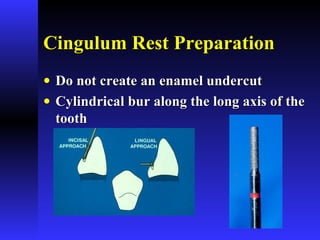
Cingulum Rest PreparationCingulum Rest Preparation
• Do not create an enamel undercutDo not create an enamel undercut
• Cylindrical bur along the long axis of theCylindrical bur along the long axis of the
toothtooth
Cingulum Rest Seat PlacementCingulum Rest Seat Placement
• Place in sound tooth structure orPlace in sound tooth structure or
restorationsrestorations
• Not on amalgam restorationsNot on amalgam restorations
• If not prominent or large pulpIf not prominent or large pulp
− Use different toothUse different tooth
− Bonded rest seatBonded rest seat
− Onlay or crownOnlay or crown
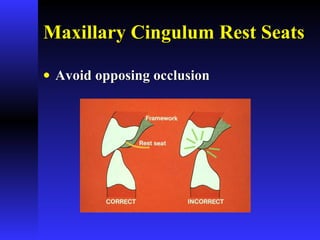
Maxillary Cingulum Rest SeatsMaxillary Cingulum Rest Seats
• Avoid opposing occlusionAvoid opposing occlusion
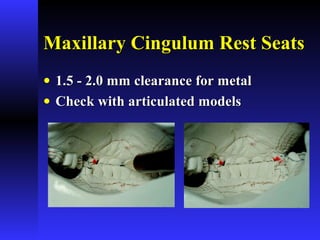
Maxillary Cingulum Rest SeatsMaxillary Cingulum Rest Seats
• 1.5 - 2.0 mm clearance for metal1.5 - 2.0 mm clearance for metal
• Check with articulated modelsCheck with articulated models
Bonded Cingulum RestsBonded Cingulum Rests
• Flat emergence profileFlat emergence profile
• Pumice, rinse, etch, bond using rubberPumice, rinse, etch, bond using rubber
damdam
• Ensure cervical composite well adaptedEnsure cervical composite well adapted
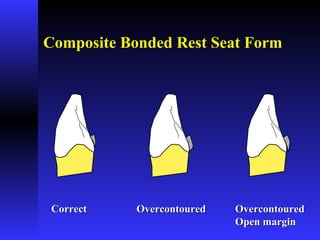
Composite Bonded Rest Seat FormComposite Bonded Rest Seat Form
CorrectCorrect OvercontouredOvercontoured OvercontouredOvercontoured
Open marginOpen margin
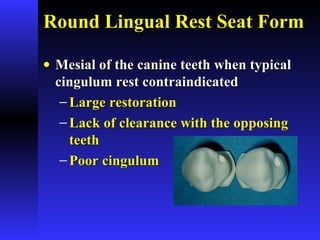
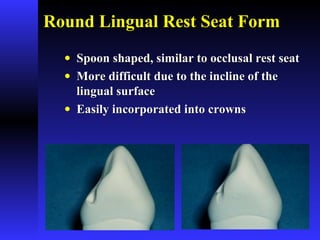
Round Lingual Rest Seat FormRound Lingual Rest Seat Form
• Mesial of the canine teeth when typicalMesial of the canine teeth when typical
cingulum rest contraindicatedcingulum rest contraindicated
− Large restorationLarge restoration
− Lack of clearance with the opposingLack of clearance with the opposing
teethteeth
− Poor cingulumPoor cingulum
Round Lingual Rest Seat FormRound Lingual Rest Seat Form
• Spoon shaped, similar to occlusal rest seatSpoon shaped, similar to occlusal rest seat
• More difficult due to the incline of theMore difficult due to the incline of the
lingual surfacelingual surface
• Easily incorporated into crownsEasily incorporated into crowns
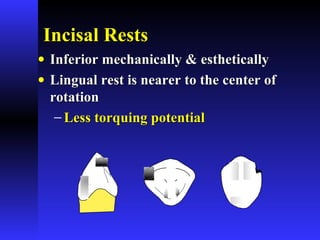
Incisal RestsIncisal Rests
• Inferior mechanically & estheticallyInferior mechanically & esthetically
• Lingual rest is nearer to the center ofLingual rest is nearer to the center of
rotationrotation
− Less torquing potentialLess torquing potential

05. rests & rest seats

  • 1.
    Rests & RestSeatsRests & Rest Seats
  • 2.
    RestRest • A rigidcomponent resting in a recessedA rigid component resting in a recessed preparation on the occlusal, lingual orpreparation on the occlusal, lingual or incisal surfaceincisal surface • Provides vertical supportProvides vertical support
  • 3.
    Rest SeatRest Seat •Portion of a tooth prepared to receive aPortion of a tooth prepared to receive a restrest
  • 4.
    FunctionsFunctions • Direct forcesalong long axis of abutmentDirect forces along long axis of abutment
  • 5.
    FunctionsFunctions • SUPPORT -prevents denture base fromSUPPORT - prevents denture base from moving cervically & impinging gingivamoving cervically & impinging gingiva Slides down inclineSlides down incline Fractured abutment, no rest seat
  • 6.
  • 8.
    FunctionsFunctions • Maintain aclasp -tooth relationshipMaintain a clasp -tooth relationship
  • 9.
    FunctionsFunctions • Prevent extrusionof abutmentsPrevent extrusion of abutments • Provide reference for relines orProvide reference for relines or impressionsimpressions
  • 10.
    FunctionsFunctions • Act asindirect retainerAct as indirect retainer − Prevents rotation (Class I or II RPD’sPrevents rotation (Class I or II RPD’s only)only)
  • 11.
    Preparation of RestSeatsPreparation of Rest Seats • Light pressureLight pressure • High-speed handpieceHigh-speed handpiece • +/- Waterspray+/- Waterspray • Minimal heat is generatedMinimal heat is generated
  • 12.
    Preparation of RestSeatsPreparation of Rest Seats • Keep in enamelKeep in enamel • No anesthesiaNo anesthesia
  • 13.
    Preparation of RestSeatsPreparation of Rest Seats • Occlusal Rest SeatsOcclusal Rest Seats − DiamondsDiamonds •8801- 0148801- 014 •38006 -13538006 -135 − Medium roundMedium round carbide burscarbide burs •#2,#2, #4#4 8801- 0148801- 014
  • 14.
    Preparation of RestSeatsPreparation of Rest Seats • Cingulum Rest Seats &Cingulum Rest Seats & Guiding PlanesGuiding Planes − Long, mediumLong, medium diameter cylindricaldiameter cylindrical bur or diamond (e.g.bur or diamond (e.g. #57L;#57L; 8837K-0148837K-014)) 8837K-0148837K-014
  • 15.
    Rest Seat FormRestSeat Form • Smooth flowing outline form (i.e. noSmooth flowing outline form (i.e. no sharp line angles)sharp line angles)
  • 16.
    Occlusal Rest SeatFormOcclusal Rest Seat Form • Rounded triangular shapeRounded triangular shape − Apex near center of toothApex near center of tooth
  • 17.
    Occlusal Rest SeatFormOcclusal Rest Seat Form • Base of triangle should be one third theBase of triangle should be one third the bucco-lingual width of the toothbucco-lingual width of the tooth
  • 18.
    Occlusal Rest SeatFormOcclusal Rest Seat Form • Marginal ridge must be lowered andMarginal ridge must be lowered and rounded 1-1.5mmrounded 1-1.5mm − Bulk of metal to prevent fractureBulk of metal to prevent fracture
  • 19.
    Occlusal Rest SeatFormOcclusal Rest Seat Form • Floor inclined towards the centerFloor inclined towards the center • Angle formed by rest and minorAngle formed by rest and minor connector should be less than 90connector should be less than 9000
  • 20.
    Occlusal Rest SeatFormOcclusal Rest Seat Form • Deepest portion is centralDeepest portion is central
  • 21.
    Occlusal Rest SeatFormOcclusal Rest Seat Form • Floor should be concave or spoon shapedFloor should be concave or spoon shaped ball-&-socket jointball-&-socket joint • Prevents horizontal stresses & torquePrevents horizontal stresses & torque
  • 22.
    Occlusal Rest SeatFormOcclusal Rest Seat Form • Directs the occlusal forces along the longDirects the occlusal forces along the long axis of the toothaxis of the tooth • Prevent orthodontic movementPrevent orthodontic movement
  • 23.
    ““Positive” Rest SeatsPositive”Rest Seats • An explorer tip will not slide off the restAn explorer tip will not slide off the rest seatseat ExplorerwillNOTslipoffrestseatifpulledproximallly ExplorerWILLslipoffrestseatifpulledproximallly‘Positive’RestSeat(<90°) RestSeatnot‘Positive’(>90°)
  • 24.
    Occlusal Rest SeatFormOcclusal Rest Seat Form • Conventional FormConventional Form
  • 25.
    Occlusal Rest SeatFormOcclusal Rest Seat Form • Adjacent ToothAdjacent Tooth − Rest not flared to facial line angleRest not flared to facial line angle − Lingual flared more - space for minorLingual flared more - space for minor connectorconnector
  • 26.
    Double Embrasure RestSeatDouble Embrasure Rest Seat FormForm • Adjacent teeth, the form is also modifiedAdjacent teeth, the form is also modified • Flared more dramatically on facial andFlared more dramatically on facial and lingual line angleslingual line angles
  • 27.
    Double Embrasure RestSeatDouble Embrasure Rest Seat FormForm • Provides space for the retentive &Provides space for the retentive & bracing armsbracing arms • Ensure all line angles are smoothedEnsure all line angles are smoothed
  • 28.
    Lingual Rest SeatsLingualRest Seats • Usually the canine, due to its well-Usually the canine, due to its well- developed cingulumdeveloped cingulum • When canine is not available, an incisorWhen canine is not available, an incisor may be usedmay be used
  • 29.
    Cingulum Rest SeatFormCingulum Rest Seat Form • Inverted “V”Inverted “V” • < 90< 9000
  • 30.
    Cingulum Rest SeatFormCingulum Rest Seat Form • Slightly rounded to avoid sharp lineSlightly rounded to avoid sharp line anglesangles • Test as ‘positive’ with explorer tipTest as ‘positive’ with explorer tip • 1mm depth1mm depth
  • 31.
  • 32.
  • 33.
  • 34.
    Cingulum Rest PreparationCingulumRest Preparation • Do not create an enamel undercutDo not create an enamel undercut • Cylindrical bur along the long axis of theCylindrical bur along the long axis of the toothtooth
  • 35.
    Cingulum Rest SeatPlacementCingulum Rest Seat Placement • Place in sound tooth structure orPlace in sound tooth structure or restorationsrestorations • Not on amalgam restorationsNot on amalgam restorations • If not prominent or large pulpIf not prominent or large pulp − Use different toothUse different tooth − Bonded rest seatBonded rest seat − Onlay or crownOnlay or crown
  • 36.
    Maxillary Cingulum RestSeatsMaxillary Cingulum Rest Seats • Avoid opposing occlusionAvoid opposing occlusion
  • 37.
    Maxillary Cingulum RestSeatsMaxillary Cingulum Rest Seats • 1.5 - 2.0 mm clearance for metal1.5 - 2.0 mm clearance for metal • Check with articulated modelsCheck with articulated models
  • 38.
    Bonded Cingulum RestsBondedCingulum Rests • Flat emergence profileFlat emergence profile • Pumice, rinse, etch, bond using rubberPumice, rinse, etch, bond using rubber damdam • Ensure cervical composite well adaptedEnsure cervical composite well adapted
  • 39.
    Composite Bonded RestSeat FormComposite Bonded Rest Seat Form CorrectCorrect OvercontouredOvercontoured OvercontouredOvercontoured Open marginOpen margin
  • 40.
    Round Lingual RestSeat FormRound Lingual Rest Seat Form • Mesial of the canine teeth when typicalMesial of the canine teeth when typical cingulum rest contraindicatedcingulum rest contraindicated − Large restorationLarge restoration − Lack of clearance with the opposingLack of clearance with the opposing teethteeth − Poor cingulumPoor cingulum
  • 41.
    Round Lingual RestSeat FormRound Lingual Rest Seat Form • Spoon shaped, similar to occlusal rest seatSpoon shaped, similar to occlusal rest seat • More difficult due to the incline of theMore difficult due to the incline of the lingual surfacelingual surface • Easily incorporated into crownsEasily incorporated into crowns
  • 42.
    Incisal RestsIncisal Rests •Inferior mechanically & estheticallyInferior mechanically & esthetically • Lingual rest is nearer to the center ofLingual rest is nearer to the center of rotationrotation − Less torquing potentialLess torquing potential