Project 2A:
Pavilion at
Kuala Selangor Nature Park
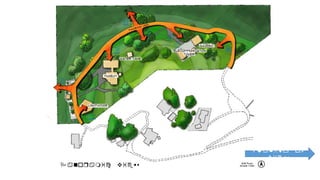
SITE ANALYSIS
CHOSEN SITE: HILL
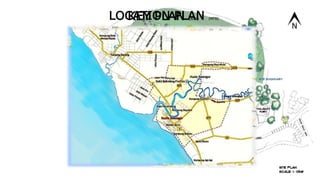
KEY PLAN (NTS)LOCATION PLAN (NTS)
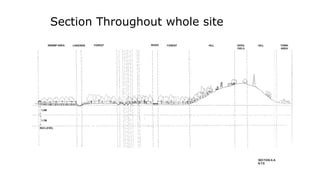
Section Throughout whole site
A
A
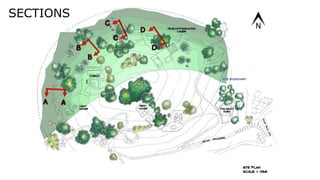
SECTIONS
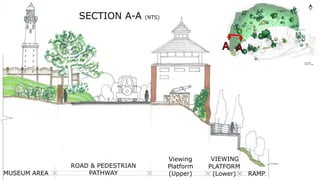
SECTION A-A (NTS)
MUSEUM AREA
ROAD & PEDESTRIAN
PATHWAY
Viewing
Platform
(Upper)
VIEWING
PLATFORM
(Lower) RAMP
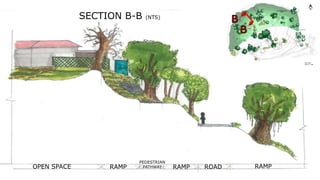
SECTION B-B (NTS)
OPEN SPACE RAMP
PEDESTRIAN
PATHWAY RAMP ROAD RAMP
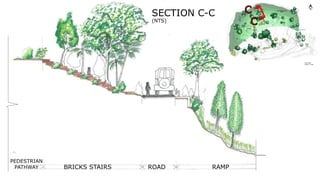
PEDESTRIAN
PATHWAY BRICKS STAIRS ROAD RAMP
SECTION C-C
(NTS)
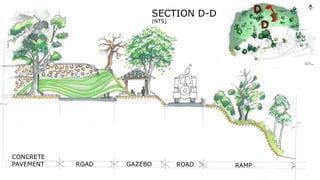
CONCRETE
PAVEMENT ROAD GAZEBO ROAD RAMP
SECTION D-D
(NTS)
EXISTING STRUCTURE
- SIGNIFICANT BUILDINGS
- ARCHITECTURAL LANGUAGES
- STRUCTURE
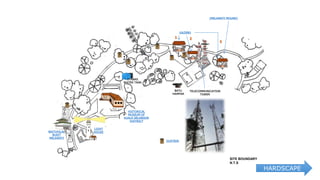
BAITUHILAL
BUKIT
MELAWATI
LIGHT
HOUSE
HISTORICAL
MUSEUM OF
KUALA SELANGOR
DISTRICT
GAZEBO
TELECOMMUNICATION
TOWER
SITE BOUNDARY
N.T.S
DUSTBIN
SYABAS
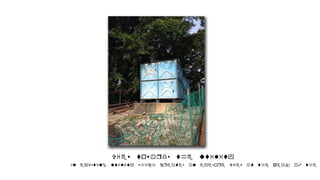
WATER TANK
BATU
HAMPAR
(MELAWATI MOUND)
HARDSCAPE
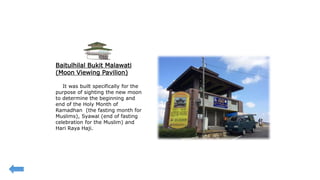
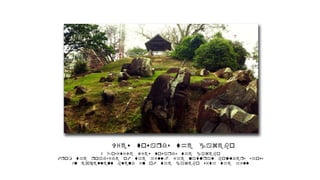
Baitulhilal Bukit Malawati
(Moon Viewing Pavilion)
It was built specifically for the
purpose of sighting the new moon
to determine the beginning and
end of the Holy Month of
Ramadhan (the fasting month for
Muslims), Syawal (end of fasting
celebration for the Muslim) and
Hari Raya Haji.
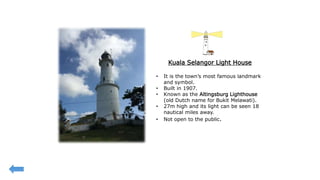
Kuala Selangor Light House
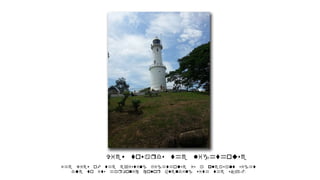
• It is the town’s most famous landmark
and symbol.
• Built in 1907.
• Known as the Altingsburg Lighthouse
(old Dutch name for Bukit Melawati).
• 27m high and its light can be seen 18
nautical miles away.
• Not open to the public.
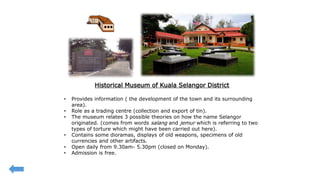
Historical Museum of Kuala Selangor District
• Provides information ( the development of the town and its surrounding
area).
• Role as a trading centre (collection and export of tin).
• The museum relates 3 possible theories on how the name Selangor
originated. (comes from words salang and jemur which is referring to two
types of torture which might have been carried out here).
• Contains some dioramas, displays of old weapons, specimens of old
currencies and other artifacts.
• Open daily from 9.30am- 5.30pm (closed on Monday).
• Admission is free.
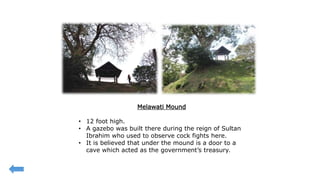
Melawati Mound
• 12 foot high.
• A gazebo was built there during the reign of Sultan
Ibrahim who used to observe cock fights here.
• It is believed that under the mound is a door to a
cave which acted as the government’s treasury.
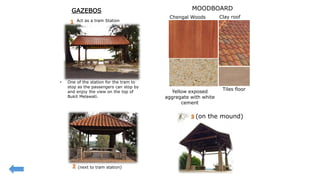
• One of the station for the tram to
stop as the passengers can stop by
and enjoy the view on the top of
Bukit Melawati.
Act as a tram Station
(next to tram station)
(on the mound)
Clay roofChengal Woods
Yellow exposed
aggregate with white
cement
Tiles floor
GAZEBOS MOODBOARD
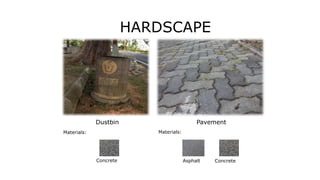
HARDSCAPE
Dustbin Pavement
Asphalt Concrete
Materials:Materials:
Concrete
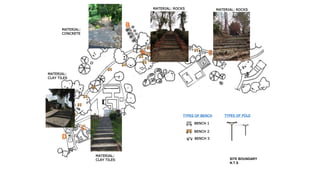
SITE BOUNDARY
N.T.S
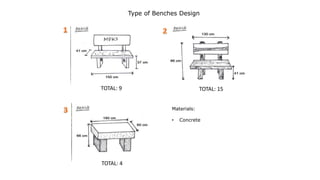
BENCH 1
BENCH 2
BENCH 3
TYPES OF BENCH TYPES OF POLE
MATERIAL: ROCKS
MATERIAL:
CONCRETE
MATERIAL:
CLAY TILES
MATERIAL:
CLAY TILES
MATERIAL: ROCKS
Type of Benches Design
Materials:
• Concrete
TOTAL: 9 TOTAL: 15
TOTAL: 4
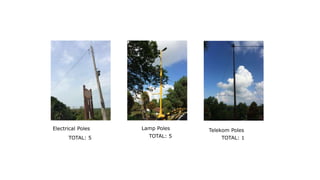
Lamp PolesElectrical Poles Telekom Poles
TOTAL: 5 TOTAL: 5 TOTAL: 1
STRUCTURE TO REMAIN
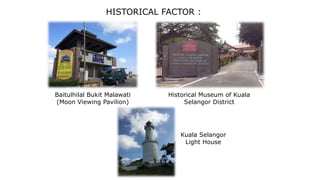
Kuala Selangor
Light House
Baitulhilal Bukit Malawati
(Moon Viewing Pavilion)
Historical Museum of Kuala
Selangor District
HISTORICAL FACTOR :
HISTORICAL FACTOR :
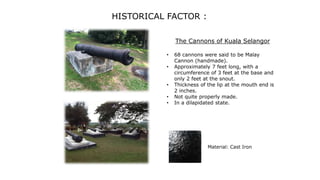
The Cannons of Kuala Selangor
• 68 cannons were said to be Malay
Cannon (handmade).
• Approximately 7 feet long, with a
circumference of 3 feet at the base and
only 2 feet at the snout.
• Thickness of the lip at the mouth end is
2 inches.
• Not quite properly made.
• In a dilapidated state.
Material: Cast Iron
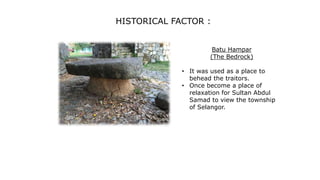
Batu Hampar
(The Bedrock)
• It was used as a place to
behead the traitors.
• Once become a place of
relaxation for Sultan Abdul
Samad to view the township
of Selangor.
HISTORICAL FACTOR :
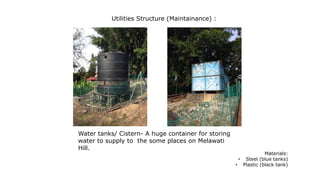
Utilities Structure (Maintainance) :
Water tanks/ Cistern- A huge container for storing
water to supply to the some places on Melawati
Hill.
Materials:
• Steel (blue tanks)
• Plastic (black tank)
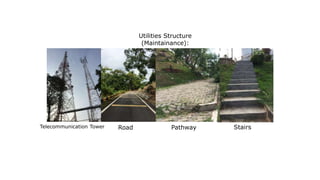
Telecommunication Tower Road Pathway
Utilities Structure
(Maintainance):
Stairs
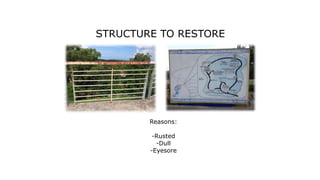
STRUCTURE TO RESTORE
Reasons:
-Rusted
-Dull
-Eyesore
LANDSCAPE
- VEGETATION
- DRAINAGE
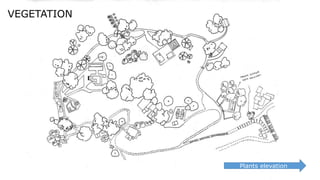
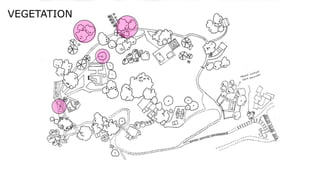
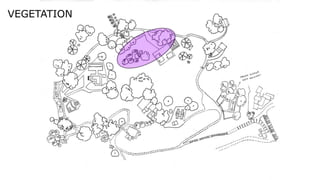
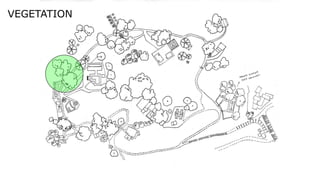
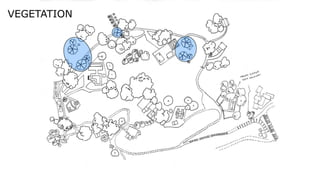
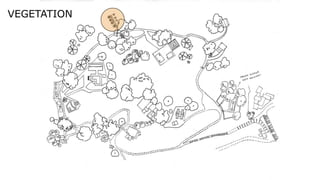
VEGETATION
Plants elevation
VEGETATION
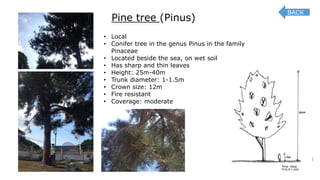
Pine tree (Pinus)
• Local
• Conifer tree in the genus Pinus in the family
Pinaceae
• Located beside the sea, on wet soil
• Has sharp and thin leaves
• Height: 25m-40m
• Trunk diameter: 1-1.5m
• Crown size: 12m
• Fire resistant
• Coverage: moderate
BACK
Palm
Palm
VEGETATION
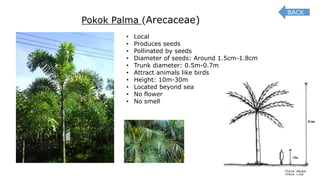
Pokok Palma (Arecaceae)
• Local
• Produces seeds
• Pollinated by seeds
• Diameter of seeds: Around 1.5cm-1.8cm
• Trunk diameter: 0.5m-0.7m
• Attract animals like birds
• Height: 10m-30m
• Located beyond sea
• No flower
• No smell
BACK
Angsana
VEGETATION
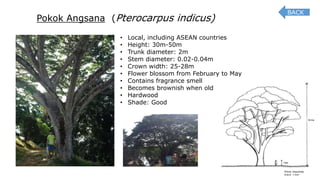
Pokok Angsana (Pterocarpus indicus)
• Local, including ASEAN countries
• Height: 30m-50m
• Trunk diameter: 2m
• Stem diameter: 0.02-0.04m
• Crown width: 25-28m
• Flower blossom from February to May
• Contains fragrance smell
• Becomes brownish when old

• Hardwood
• Shade: Good
BACK
Ara Beringin
VEGETATION
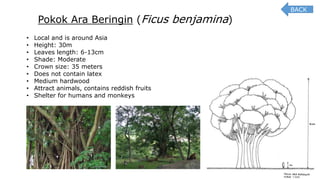
Pokok Ara Beringin (Ficus benjamina)
• Local and is around Asia
• Height: 30m
• Leaves length: 6-13cm

• Shade: Moderate
• Crown size: 35 meters

• Does not contain latex
• Medium hardwood
• Attract animals, contains reddish fruits
• Shelter for humans and monkeys
BACK
VEGETATION
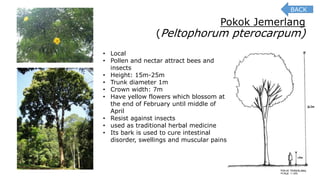
Pokok Jemerlang
(Peltophorum pterocarpum)
• Local
• Pollen and nectar attract bees and
insects
• Height: 15m-25m
• Trunk diameter 1m
• Crown width: 7m
• Have yellow flowers which blossom at
the end of February until middle of
April
• Resist against insects
• used as traditional herbal medicine
• Its bark is used to cure intestinal
disorder, swellings and muscular pains
BACK
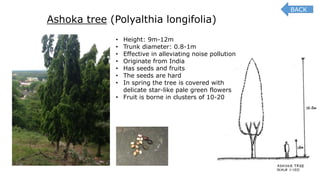
VEGETATION
Ashoka tree (Polyalthia longifolia)
• Height: 9m-12m
• Trunk diameter: 0.8-1m
• Effective in alleviating noise pollution
• Originate from India
• Has seeds and fruits
• The seeds are hard
• In spring the tree is covered with
delicate star-like pale green flowers
• Fruit is borne in clusters of 10-20
BACK
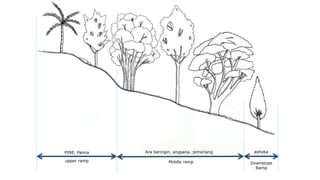
Downslope
Ramp
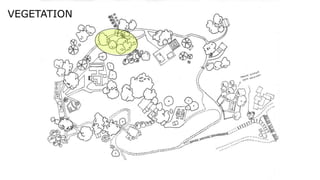
Ara beringin, angsana, jemerlang ashokaPINE, Palma
upper ramp Middle ramp
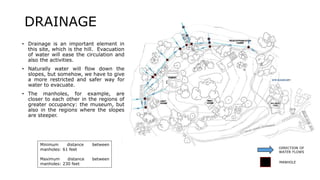
• Drainage is an important element in
this site, which is the hill. Evacuation
of water will ease the circulation and
also the activities.
• Naturally water will flow down the
slopes, but somehow, we have to give
a more restricted and safer way for
water to evacuate.
• The manholes, for example, are
closer to each other in the regions of
greater occupancy: the museum, but
also in the regions where the slopes
are steeper.
DRAINAGE
Minimum distance between
manholes: 61 feet
Maximum distance between
manholes: 230 feet
DIRECTION OF
WATER FLOWS
MANHOLE
DRAINAGE
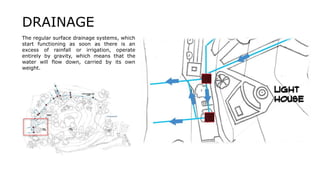
The regular surface drainage systems, which
start functioning as soon as there is an
excess of rainfall or irrigation, operate
entirely by gravity, which means that the
water will flow down, carried by its own
weight.
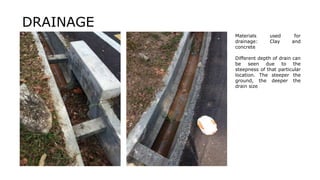
Materials used for
drainage: Clay and
concrete
Different depth of drain can
be seen due to the
steepness of that particular
location. The steeper the
ground, the deeper the
drain size
DRAINAGE
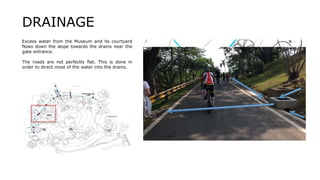
Excess water from the Museum and its courtyard
flows down the slope towards the drains near the
gate entrance.
The roads are not perfectly flat. This is done in
order to direct most of the water into the drains.
DRAINAGE
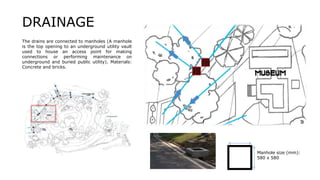
The drains are connected to manholes (A manhole
is the top opening to an underground utility vault
used to house an access point for making
connections or performing maintenance on
underground and buried public utility). Materials:
Concrete and bricks.
Manhole size (mm):
580 x 580
DRAINAGE
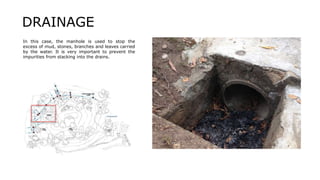
In this case, the manhole is used to stop the
excess of mud, stones, branches and leaves carried
by the water. It is very important to prevent the
impurities from stacking into the drains.
DRAINAGE
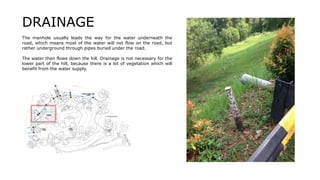
The manhole usually leads the way for the water underneath the
road, which means most of the water will not flow on the road, but
rather underground through pipes buried under the road.
The water then flows down the hill. Drainage is not necessary for the
lower part of the hill, because there is a lot of vegetation which will
benefit from the water supply.
DRAINAGE
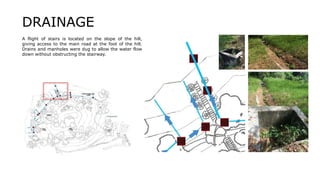
A flight of stairs is located on the slope of the hill,
giving access to the main road at the foot of the hill.
Drains and manholes were dug to allow the water flow
down without obstructing the stairway.
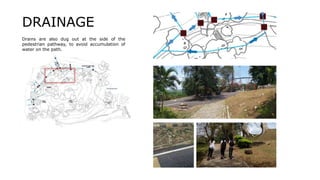
DRAINAGE
Drains are also dug out at the side of the
pedestrian pathway, to avoid accumulation of
water on the path.
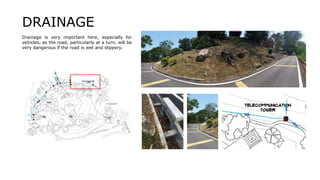
DRAINAGE
Drainage is very important here, especially for
vehicles, as the road, particularly at a turn, will be
very dangerous if the road is wet and slippery.
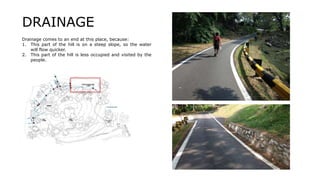
DRAINAGE
Drainage comes to an end at this place, because:
1. This part of the hill is on a steep slope, so the water
will flow quicker.
2. This part of the hill is less occupied and visited by the
people.
DRAINAGE
CLIMATIC STUDIES
- SUN path
- Wind direction
- Temperature & humidity
SouthNorth
Sun Elevation
at Noon on
June 21
85 °
74°
74 °
Sun Elevation
at Noon on
April 20 Sun Elevation
at Noon on
Dec21
June 21
April 20
Latitude : 3° 20' 30.207" N
Longitude : 101° 15' 12.051" E
Sunearthtool.com
Dec 21
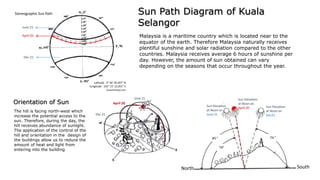
Sun Path Diagram of Kuala
Selangor
Stereographic Sun Path
Malaysia is a maritime country which is located near to the
equator of the earth. Therefore Malaysia naturally receives
plentiful sunshine and solar radiation compared to the other
countries. Malaysia receives average 6 hours of sunshine per
day. However, the amount of sun obtained can vary
depending on the seasons that occur throughout the year.
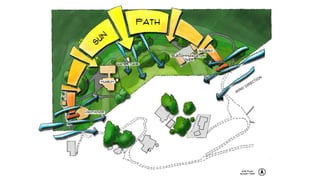
Orientation of Sun
The hill is facing north-west which
increase the potential access to the
sun. Therefore, during the day, the
hill receives abundance of sunlight.
The application of the control of the
hill and orientation in the design of
the buildings allow us to reduce the
amount of heat and light from
entering into the building
April 20
June 21
Dec 21
SOUTH WEST
MONSOON
NORTH EAST
MONSOON
Map of Malaysia
PENINSULAR MALAYSIA
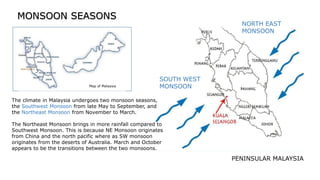
The climate in Malaysia undergoes two monsoon seasons,
the Southwest Monsoon from late May to September, and
the Northeast Monsoon from November to March.
The Northeast Monsoon brings in more rainfall compared to
Southwest Monsoon. This is because NE Monsoon originates
from China and the north pacific where as SW monsoon
originates from the deserts of Australia. March and October
appears to be the transitions between the two monsoons.
MONSOON SEASONS
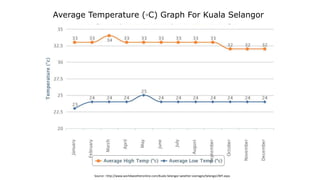
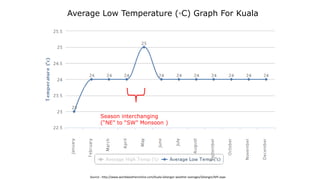
Average Temperature (◦C) Graph For Kuala Selangor
Source : http://www.worldweatheronline.com/Kuala-Selangor-weather-averages/Selangor/MY.aspx
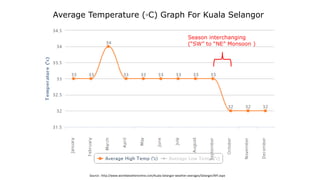
Average Temperature (◦C) Graph For Kuala Selangor
Season interchanging
(“SW” to “NE” Monsoon )
Average Low Temperature (◦C) Graph For Kuala
Selangor
Source : http://www.worldweatheronline.com/Kuala-Selangor-weather-averages/Selangor/MY.aspx
Season interchanging
(“NE” to “SW” Monsoon )
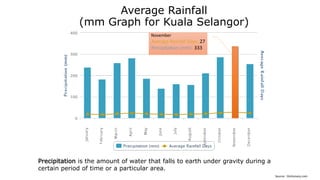
Average Rainfall
(mm Graph for Kuala Selangor)
Precipitation is the amount of water that falls to earth under gravity during a
certain period of time or a particular area.
November
Average Rainfall Days: 27
Percipitation (mm): 333
Source : Dictionary.com
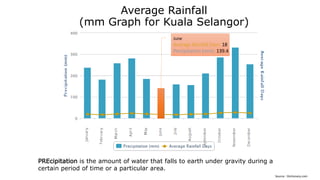
June
Average Rainfall Days: 18
Percipitation (mm): 139.4
PREcipitation is the amount of water that falls to earth under gravity during a
certain period of time or a particular area.
Average Rainfall
(mm Graph for Kuala Selangor)
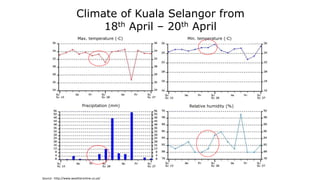
Climate of Kuala Selangor from
18th April – 20th April
Max. temperature (◦C) Min. temperature (◦C)
Source : http://www.weatheronline.co.uk/
Precipitation (mm) Relative humidity (%)
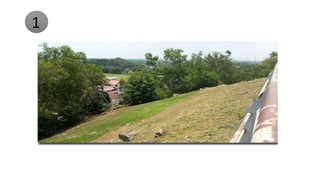
Views into the
site
And
Views from the
1
2
3
4
5
6
7
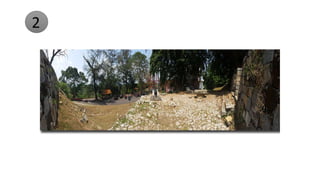
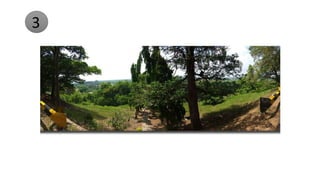
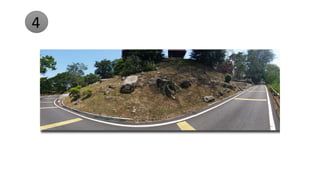
Panoramic views
8
Quality of
views
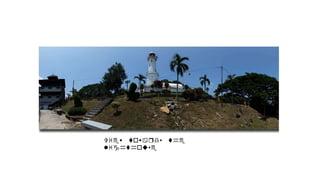
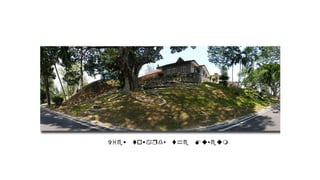
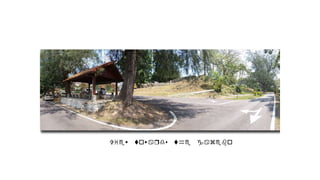
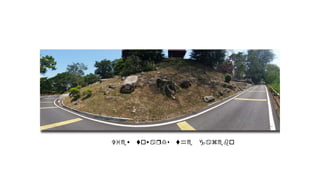
View towards the
lighthouse
View from the cannons
View towards the Museum
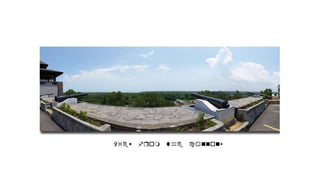
View from the hill
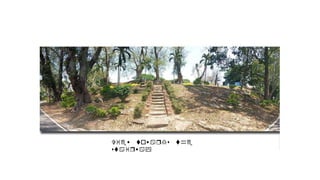
View towards the
stairway
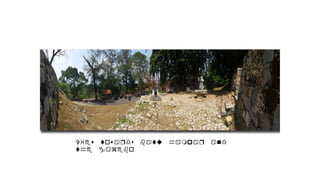
View towards batu hampar and
the gazebo
View towards the gazebo
Positive &
Negative
Quality of views
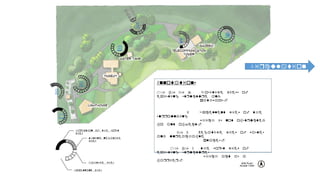
Annotations
1, 4, 5, 7 Positive Views of
existing structure and
pathways.
3 Excellent view of the
surrounding
which is not obstructed
by ant object.
2, 6 Negative view of wastes
and unreachable
places.
1, 4, 5 the worst view of
existing structures
which act as a
barrier.
Direction of the worst
view
Mildly negative
view
Positive view
Excellent view
1
2
3
4
5
6
7
Circulation
View towards the lighthouse
The view of the existing Lighthouse is a pleasant sight
due to its harmonic color blending with the sky.
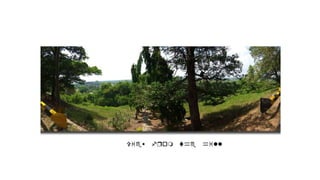
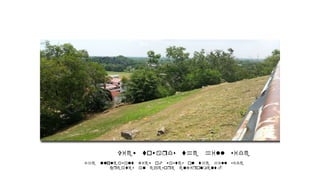
View towards the hill side
The unpleasant view of wastes on the hill side
creates an eyesore environment.
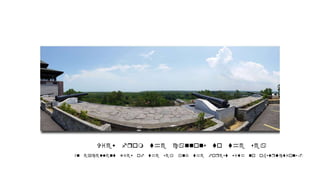
View from the cannons to the sea
An excellent view of the sea and the forest with no obstructions.
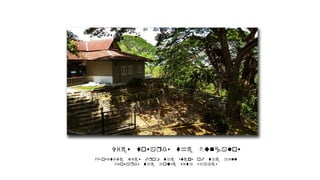
View towards the Bungalow
APositive view from the steps of the hill
ATowards the house with shades
View towards the utility
An existing utility which creates an eyesore view at the peak of the
View from the hill towards a down stairway
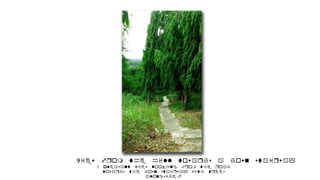
A pleasant view looking from the road
towards the down stairway with trees
alongside.
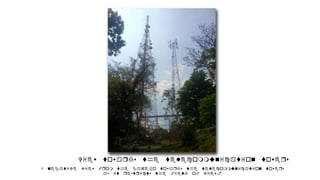
View towards the telecommunication towers
A negative view from the gazebo towards the telecommunication towers
as it restricts the field of view.
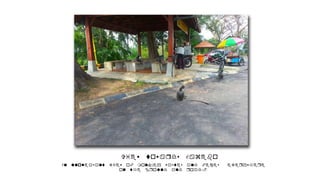
View towards Gazebo
An unpleasant view of monkey wastes and feces everywhere
on the ground and road.
View towards the gazebo
A Positive view towards the gazebo
from the roadside of the hill. The natural boulders shows
An excellent blend in of the gazebo with the hill
CIRCULATION
PATTERN
- Pedestrian
- Vehicular
- Animals
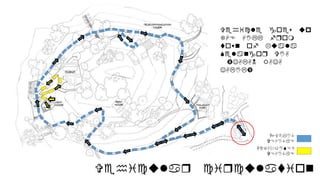
Vehicular circulation
Vehicle goes up
THE HILL from
town of Kuala
Selangor VIA
ALAN RAA
ALIL
• TYPES OF VECHICLE ACCESSIBLE TO THE HILL
WEEKDAYS: ALL
WEEKKENDS: ONLY TRAM AND AUTHORISED
VECHICLE
Vehicular
circulation
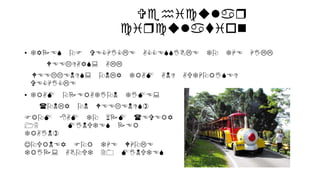
• TRAM OPERATION TIME:
(ONLY ON WEEKENDS)
FROM 8AM TO 6PM (EVERY
15 MINUTES PER
TRAIN)
OURNEY FOR THE WHOLE
TRIP: ABOUT 20 MINUTES
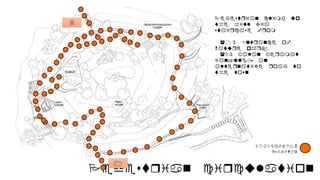
Pedestrian circulation
Pedestrian climb up
the hill via
staircase from
(1) Entrance of
Nature park
(2) alan Keramat
Tanjung, an
alternative road to
the town
1
2
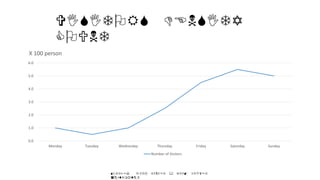
VISITORS DENSITY
COUNT
0.0
1.0
2.0
3.0
4.0
5.0
6.0
Monday Tuesday Wednesday Thursday Friday Saturday Sunday
X 100 person
Number of Visitors
SOURCE: PARK RANGER & TRAM DRIVER
(estimate)
ANIMALS
• MONKEYS
• BRAHMINYKITE*
• WHITE BELLIT SEA EAGLE*
*Can be only seen depends on
season
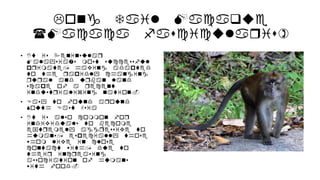
Long Tail Macaque
(Macaca fascicularis)
• It is Peninsular
Malaysias most successful
primate, having adapted
to the rapidly changing
rural and urban land
scape of a recent
industrializing nation.
• Easy to found around
South East Asia
• It is also common for
individuals to become
extremely aggressive to
humans, especially those
whom live in close
contact with, due to
their increasing
association of humans
with food.
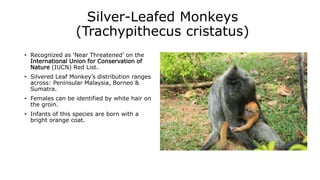
Silver-Leafed Monkeys
(Trachypithecus cristatus)
• Recognized as ‘Near Threatened’ on the
International Union for Conservation of
Nature (IUCN) Red List.
• Silvered Leaf Monkey’s distribution ranges
across: Peninsular Malaysia, Borneo &
Sumatra.
• Females can be identified by white hair on
the groin.
• Infants of this species are born with a
bright orange coat.
ACTIVITIES
- ZONING
- Category
MAIN ACTIVITIES
• TAICHI practicing
• FOOD selling
• TOURISTS SIGHTSEEING
• Jogging & cycling
• MONKEY FEEDING
• TRAM Riding
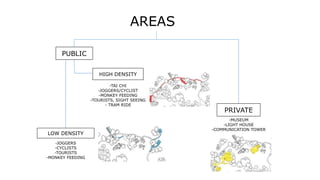
AREAS
PUBLIC
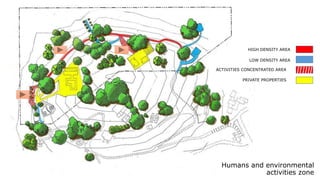
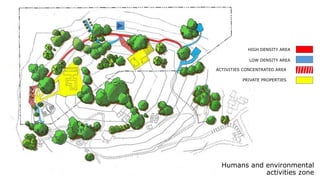
HIGH DENSITY
-TAI CHI
-JOGGERS/CYCLIST
-MONKEY FEEDING
-TOURISTS, SIGHT SEEING
- TRAM RIDE
LOW DENSITY
-JOGGERS
-CYCLISTS
-TOURISTS
-MONKEY FEEDING
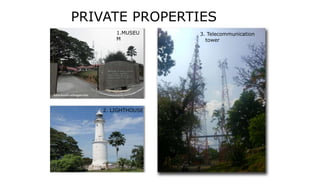
PRIVATE
-MUSEUM
-LIGHT HOUSE
-COMMUNICATION TOWER
Humans and environmental
activities zone
HIGH DENSITY AREA
LOW DENSITY AREA
ACTIVITIES CONCENTRATED AREA
PRIVATE PROPERTIES
Humans and environmental
activities zone
HIGH DENSITY AREA
LOW DENSITY AREA
ACTIVITIES CONCENTRATED AREA
PRIVATE PROPERTIES
1.MUSEU
M
2. LIGHTHOUSE
PRIVATE PROPERTIES
3. Telecommunication
tower
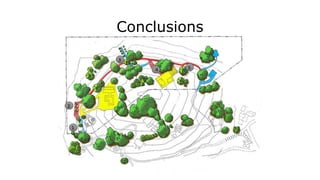
Conclusions
1
2
3
4 5
1
2
3
4

Site Analysis

  • 1.
    Project 2A: Pavilion at KualaSelangor Nature Park SITE ANALYSIS CHOSEN SITE: HILL
  • 2.
  • 3.
  • 4.
  • 5.
    SECTION A-A (NTS) MUSEUMAREA ROAD & PEDESTRIAN PATHWAY Viewing Platform (Upper) VIEWING PLATFORM (Lower) RAMP
  • 6.
    SECTION B-B (NTS) OPENSPACE RAMP PEDESTRIAN PATHWAY RAMP ROAD RAMP
  • 7.
    PEDESTRIAN PATHWAY BRICKS STAIRSROAD RAMP SECTION C-C (NTS)
  • 8.
    CONCRETE PAVEMENT ROAD GAZEBOROAD RAMP SECTION D-D (NTS)
  • 9.
    EXISTING STRUCTURE - SIGNIFICANTBUILDINGS - ARCHITECTURAL LANGUAGES - STRUCTURE
  • 10.
    BAITUHILAL BUKIT MELAWATI LIGHT HOUSE HISTORICAL MUSEUM OF KUALA SELANGOR DISTRICT GAZEBO TELECOMMUNICATION TOWER SITEBOUNDARY N.T.S DUSTBIN SYABAS WATER TANK BATU HAMPAR (MELAWATI MOUND) HARDSCAPE
  • 11.
    Baitulhilal Bukit Malawati (MoonViewing Pavilion) It was built specifically for the purpose of sighting the new moon to determine the beginning and end of the Holy Month of Ramadhan (the fasting month for Muslims), Syawal (end of fasting celebration for the Muslim) and Hari Raya Haji.
  • 12.
    Kuala Selangor LightHouse • It is the town’s most famous landmark and symbol. • Built in 1907. • Known as the Altingsburg Lighthouse (old Dutch name for Bukit Melawati). • 27m high and its light can be seen 18 nautical miles away. • Not open to the public.
  • 13.
    Historical Museum ofKuala Selangor District • Provides information ( the development of the town and its surrounding area). • Role as a trading centre (collection and export of tin). • The museum relates 3 possible theories on how the name Selangor originated. (comes from words salang and jemur which is referring to two types of torture which might have been carried out here). • Contains some dioramas, displays of old weapons, specimens of old currencies and other artifacts. • Open daily from 9.30am- 5.30pm (closed on Monday). • Admission is free.
  • 14.
    Melawati Mound • 12foot high. • A gazebo was built there during the reign of Sultan Ibrahim who used to observe cock fights here. • It is believed that under the mound is a door to a cave which acted as the government’s treasury.
  • 15.
    • One ofthe station for the tram to stop as the passengers can stop by and enjoy the view on the top of Bukit Melawati. Act as a tram Station (next to tram station) (on the mound) Clay roofChengal Woods Yellow exposed aggregate with white cement Tiles floor GAZEBOS MOODBOARD
  • 16.
  • 17.
    SITE BOUNDARY N.T.S BENCH 1 BENCH2 BENCH 3 TYPES OF BENCH TYPES OF POLE MATERIAL: ROCKS MATERIAL: CONCRETE MATERIAL: CLAY TILES MATERIAL: CLAY TILES MATERIAL: ROCKS
  • 18.
    Type of BenchesDesign Materials: • Concrete TOTAL: 9 TOTAL: 15 TOTAL: 4
  • 19.
    Lamp PolesElectrical PolesTelekom Poles TOTAL: 5 TOTAL: 5 TOTAL: 1
  • 20.
  • 21.
    Kuala Selangor Light House BaitulhilalBukit Malawati (Moon Viewing Pavilion) Historical Museum of Kuala Selangor District HISTORICAL FACTOR :
  • 22.
    HISTORICAL FACTOR : TheCannons of Kuala Selangor • 68 cannons were said to be Malay Cannon (handmade). • Approximately 7 feet long, with a circumference of 3 feet at the base and only 2 feet at the snout. • Thickness of the lip at the mouth end is 2 inches. • Not quite properly made. • In a dilapidated state. Material: Cast Iron
  • 23.
    Batu Hampar (The Bedrock) •It was used as a place to behead the traitors. • Once become a place of relaxation for Sultan Abdul Samad to view the township of Selangor. HISTORICAL FACTOR :
  • 24.
    Utilities Structure (Maintainance): Water tanks/ Cistern- A huge container for storing water to supply to the some places on Melawati Hill. Materials: • Steel (blue tanks) • Plastic (black tank)
  • 25.
    Telecommunication Tower RoadPathway Utilities Structure (Maintainance): Stairs
  • 26.
  • 27.
  • 28.
  • 29.
  • 30.
    Pine tree (Pinus) •Local • Conifer tree in the genus Pinus in the family Pinaceae • Located beside the sea, on wet soil • Has sharp and thin leaves • Height: 25m-40m • Trunk diameter: 1-1.5m • Crown size: 12m • Fire resistant • Coverage: moderate BACK
  • 31.
  • 32.
    Pokok Palma (Arecaceae) •Local • Produces seeds • Pollinated by seeds • Diameter of seeds: Around 1.5cm-1.8cm • Trunk diameter: 0.5m-0.7m • Attract animals like birds • Height: 10m-30m • Located beyond sea • No flower • No smell BACK
  • 33.
  • 34.
    Pokok Angsana (Pterocarpusindicus) • Local, including ASEAN countries • Height: 30m-50m • Trunk diameter: 2m • Stem diameter: 0.02-0.04m • Crown width: 25-28m • Flower blossom from February to May • Contains fragrance smell • Becomes brownish when old • Hardwood • Shade: Good BACK
  • 35.
  • 36.
    Pokok Ara Beringin(Ficus benjamina) • Local and is around Asia • Height: 30m • Leaves length: 6-13cm • Shade: Moderate • Crown size: 35 meters • Does not contain latex • Medium hardwood • Attract animals, contains reddish fruits • Shelter for humans and monkeys BACK
  • 37.
  • 38.
    Pokok Jemerlang (Peltophorum pterocarpum) •Local • Pollen and nectar attract bees and insects • Height: 15m-25m • Trunk diameter 1m • Crown width: 7m • Have yellow flowers which blossom at the end of February until middle of April • Resist against insects • used as traditional herbal medicine • Its bark is used to cure intestinal disorder, swellings and muscular pains BACK
  • 39.
  • 40.
    Ashoka tree (Polyalthialongifolia) • Height: 9m-12m • Trunk diameter: 0.8-1m • Effective in alleviating noise pollution • Originate from India • Has seeds and fruits • The seeds are hard • In spring the tree is covered with delicate star-like pale green flowers • Fruit is borne in clusters of 10-20 BACK
  • 41.
    Downslope Ramp Ara beringin, angsana,jemerlang ashokaPINE, Palma upper ramp Middle ramp
  • 42.
    • Drainage isan important element in this site, which is the hill. Evacuation of water will ease the circulation and also the activities. • Naturally water will flow down the slopes, but somehow, we have to give a more restricted and safer way for water to evacuate. • The manholes, for example, are closer to each other in the regions of greater occupancy: the museum, but also in the regions where the slopes are steeper. DRAINAGE Minimum distance between manholes: 61 feet Maximum distance between manholes: 230 feet DIRECTION OF WATER FLOWS MANHOLE
  • 43.
    DRAINAGE The regular surfacedrainage systems, which start functioning as soon as there is an excess of rainfall or irrigation, operate entirely by gravity, which means that the water will flow down, carried by its own weight.
  • 44.
    Materials used for drainage:Clay and concrete Different depth of drain can be seen due to the steepness of that particular location. The steeper the ground, the deeper the drain size DRAINAGE
  • 45.
    Excess water fromthe Museum and its courtyard flows down the slope towards the drains near the gate entrance. The roads are not perfectly flat. This is done in order to direct most of the water into the drains. DRAINAGE
  • 46.
    The drains areconnected to manholes (A manhole is the top opening to an underground utility vault used to house an access point for making connections or performing maintenance on underground and buried public utility). Materials: Concrete and bricks. Manhole size (mm): 580 x 580 DRAINAGE
  • 47.
    In this case,the manhole is used to stop the excess of mud, stones, branches and leaves carried by the water. It is very important to prevent the impurities from stacking into the drains. DRAINAGE
  • 48.
    The manhole usuallyleads the way for the water underneath the road, which means most of the water will not flow on the road, but rather underground through pipes buried under the road. The water then flows down the hill. Drainage is not necessary for the lower part of the hill, because there is a lot of vegetation which will benefit from the water supply. DRAINAGE
  • 49.
    A flight ofstairs is located on the slope of the hill, giving access to the main road at the foot of the hill. Drains and manholes were dug to allow the water flow down without obstructing the stairway. DRAINAGE
  • 50.
    Drains are alsodug out at the side of the pedestrian pathway, to avoid accumulation of water on the path. DRAINAGE
  • 51.
    Drainage is veryimportant here, especially for vehicles, as the road, particularly at a turn, will be very dangerous if the road is wet and slippery. DRAINAGE
  • 52.
    Drainage comes toan end at this place, because: 1. This part of the hill is on a steep slope, so the water will flow quicker. 2. This part of the hill is less occupied and visited by the people. DRAINAGE
  • 53.
    CLIMATIC STUDIES - SUNpath - Wind direction - Temperature & humidity
  • 55.
    SouthNorth Sun Elevation at Noonon June 21 85 ° 74° 74 ° Sun Elevation at Noon on April 20 Sun Elevation at Noon on Dec21 June 21 April 20 Latitude : 3° 20' 30.207" N Longitude : 101° 15' 12.051" E Sunearthtool.com Dec 21 Sun Path Diagram of Kuala Selangor Stereographic Sun Path Malaysia is a maritime country which is located near to the equator of the earth. Therefore Malaysia naturally receives plentiful sunshine and solar radiation compared to the other countries. Malaysia receives average 6 hours of sunshine per day. However, the amount of sun obtained can vary depending on the seasons that occur throughout the year. Orientation of Sun The hill is facing north-west which increase the potential access to the sun. Therefore, during the day, the hill receives abundance of sunlight. The application of the control of the hill and orientation in the design of the buildings allow us to reduce the amount of heat and light from entering into the building April 20 June 21 Dec 21
  • 56.
    SOUTH WEST MONSOON NORTH EAST MONSOON Mapof Malaysia PENINSULAR MALAYSIA The climate in Malaysia undergoes two monsoon seasons, the Southwest Monsoon from late May to September, and the Northeast Monsoon from November to March. The Northeast Monsoon brings in more rainfall compared to Southwest Monsoon. This is because NE Monsoon originates from China and the north pacific where as SW monsoon originates from the deserts of Australia. March and October appears to be the transitions between the two monsoons. MONSOON SEASONS
  • 57.
    Average Temperature (◦C)Graph For Kuala Selangor Source : http://www.worldweatheronline.com/Kuala-Selangor-weather-averages/Selangor/MY.aspx
  • 58.
    Source : http://www.worldweatheronline.com/Kuala-Selangor-weather-averages/Selangor/MY.aspx AverageTemperature (◦C) Graph For Kuala Selangor Season interchanging (“SW” to “NE” Monsoon )
  • 59.
    Average Low Temperature(◦C) Graph For Kuala Selangor Source : http://www.worldweatheronline.com/Kuala-Selangor-weather-averages/Selangor/MY.aspx Season interchanging (“NE” to “SW” Monsoon )
  • 60.
    Average Rainfall (mm Graphfor Kuala Selangor) Precipitation is the amount of water that falls to earth under gravity during a certain period of time or a particular area. November Average Rainfall Days: 27 Percipitation (mm): 333 Source : Dictionary.com
  • 61.
    Source : Dictionary.com June AverageRainfall Days: 18 Percipitation (mm): 139.4 PREcipitation is the amount of water that falls to earth under gravity during a certain period of time or a particular area. Average Rainfall (mm Graph for Kuala Selangor)
  • 62.
    Climate of KualaSelangor from 18th April – 20th April Max. temperature (◦C) Min. temperature (◦C) Source : http://www.weatheronline.co.uk/ Precipitation (mm) Relative humidity (%)
  • 63.
  • 64.
  • 65.
  • 66.
  • 67.
  • 68.
  • 69.
  • 70.
    View towards batuhampar and the gazebo
  • 71.
  • 72.
  • 73.
  • 74.
    Annotations 1, 4, 5,7 Positive Views of existing structure and pathways. 3 Excellent view of the surrounding which is not obstructed by ant object. 2, 6 Negative view of wastes and unreachable places. 1, 4, 5 the worst view of existing structures which act as a barrier. Direction of the worst view Mildly negative view Positive view Excellent view 1 2 3 4 5 6 7 Circulation
  • 75.
    View towards thelighthouse The view of the existing Lighthouse is a pleasant sight due to its harmonic color blending with the sky.
  • 76.
    View towards thehill side The unpleasant view of wastes on the hill side creates an eyesore environment.
  • 77.
    View from thecannons to the sea An excellent view of the sea and the forest with no obstructions.
  • 78.
    View towards theBungalow APositive view from the steps of the hill ATowards the house with shades
  • 79.
    View towards theutility An existing utility which creates an eyesore view at the peak of the
  • 80.
    View from thehill towards a down stairway A pleasant view looking from the road towards the down stairway with trees alongside.
  • 81.
    View towards thetelecommunication towers A negative view from the gazebo towards the telecommunication towers as it restricts the field of view.
  • 82.
    View towards Gazebo Anunpleasant view of monkey wastes and feces everywhere on the ground and road.
  • 83.
    View towards thegazebo A Positive view towards the gazebo from the roadside of the hill. The natural boulders shows An excellent blend in of the gazebo with the hill
  • 84.
  • 85.
    Vehicular circulation Vehicle goesup THE HILL from town of Kuala Selangor VIA ALAN RAA ALIL
  • 86.
    • TYPES OFVECHICLE ACCESSIBLE TO THE HILL WEEKDAYS: ALL WEEKKENDS: ONLY TRAM AND AUTHORISED VECHICLE Vehicular circulation • TRAM OPERATION TIME: (ONLY ON WEEKENDS) FROM 8AM TO 6PM (EVERY 15 MINUTES PER TRAIN) OURNEY FOR THE WHOLE TRIP: ABOUT 20 MINUTES
  • 87.
    Pedestrian circulation Pedestrian climbup the hill via staircase from (1) Entrance of Nature park (2) alan Keramat Tanjung, an alternative road to the town 1 2
  • 88.
    VISITORS DENSITY COUNT 0.0 1.0 2.0 3.0 4.0 5.0 6.0 Monday TuesdayWednesday Thursday Friday Saturday Sunday X 100 person Number of Visitors SOURCE: PARK RANGER & TRAM DRIVER (estimate)
  • 89.
    ANIMALS • MONKEYS • BRAHMINYKITE* •WHITE BELLIT SEA EAGLE* *Can be only seen depends on season
  • 90.
    Long Tail Macaque (Macacafascicularis) • It is Peninsular Malaysias most successful primate, having adapted to the rapidly changing rural and urban land scape of a recent industrializing nation. • Easy to found around South East Asia • It is also common for individuals to become extremely aggressive to humans, especially those whom live in close contact with, due to their increasing association of humans with food.
  • 91.
    Silver-Leafed Monkeys (Trachypithecus cristatus) •Recognized as ‘Near Threatened’ on the International Union for Conservation of Nature (IUCN) Red List. • Silvered Leaf Monkey’s distribution ranges across: Peninsular Malaysia, Borneo & Sumatra. • Females can be identified by white hair on the groin. • Infants of this species are born with a bright orange coat.
  • 92.
  • 93.
    MAIN ACTIVITIES • TAICHIpracticing • FOOD selling • TOURISTS SIGHTSEEING • Jogging & cycling • MONKEY FEEDING • TRAM Riding
  • 94.
    AREAS PUBLIC HIGH DENSITY -TAI CHI -JOGGERS/CYCLIST -MONKEYFEEDING -TOURISTS, SIGHT SEEING - TRAM RIDE LOW DENSITY -JOGGERS -CYCLISTS -TOURISTS -MONKEY FEEDING PRIVATE -MUSEUM -LIGHT HOUSE -COMMUNICATION TOWER
  • 95.
    Humans and environmental activitieszone HIGH DENSITY AREA LOW DENSITY AREA ACTIVITIES CONCENTRATED AREA PRIVATE PROPERTIES
  • 99.
    Humans and environmental activitieszone HIGH DENSITY AREA LOW DENSITY AREA ACTIVITIES CONCENTRATED AREA PRIVATE PROPERTIES
  • 101.
  • 102.
  • 103.
  • 104.
  • 105.
  • 106.

Editor's Notes

  • #22 Each of these buildings have their own historical values.
  • #23 The Cannons of Kuala Selangor 68 cannons were said to be Malay Cannon made by hand. These cannons of the Malay Government are approximately 7 feet long with a circumference of 3 feet at the base and only 2 feet at the snout. The thickness of the lip at the mouth end is 2 inches. The cannons were not quite properly made and currently all of them are in a dilapidated state.
  • #24 Batu Hampar (The Bedrock) There is an opinion that the stone was used as a place to behead the traitors and also once become a place of relaxation for Sultan Abdul Samad to view the township of Kuala Selangor