Presenter: Jecoberth Kendiga
14013009
①What is VALUE CHAIN
②What is Value Chain Analysis
③Why use Value Chain Analysis
④Value Chain Model
⑤Benefits
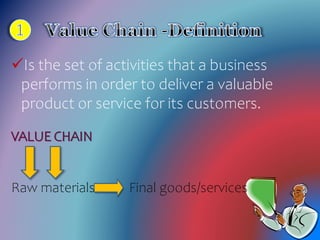
Is the set of activities that a business
performs in order to deliver a valuable
product or service for its customers.
VALUE CHAIN
Raw materials Final goods/services
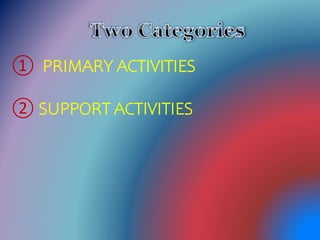
① PRIMARY ACTIVITIES
② SUPPORT ACTIVITIES
Value Chain analysis looks at every step a
business goes through, from raw materials
to the eventual end-user.
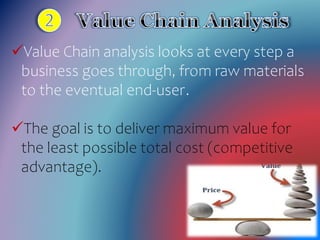
The goal is to deliver maximum value for
the least possible total cost (competitive
advantage).
helps identify the ways in which you create
value for your customers
helps you think through how you can
maximize this value: whether through superb
products, great services
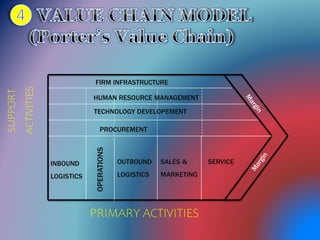
SUPPORT
ACTIVITIES
PRIMARY ACTIVITIES
OPERATIONS
OUTBOUND
LOGISTICS
SALES &
MARKETING
SERVICE
PROCUREMENT
INBOUND
LOGISTICS
TECHNOLOGY DEVELOPEMENT
HUMAN RESOURCE MANAGEMENT
FIRM INFRASTRUCTURE
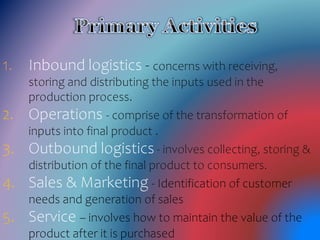
1. Inbound logistics - concerns with receiving,
storing and distributing the inputs used in the
production process.
2. Operations - comprise of the transformation of
inputs into final product .
3. Outbound logistics - involves collecting, storing &
distribution of the final product to consumers.
4. Sales & Marketing - Identification of customer
needs and generation of sales
5. Service – involves how to maintain the value of the
product after it is purchased
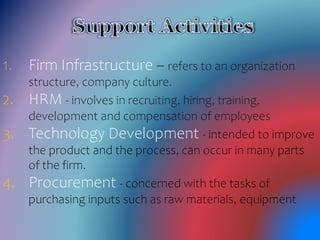
1. Firm Infrastructure – refers to an organization
structure, company culture.
2. HRM - involves in recruiting, hiring, training,
development and compensation of employees
3. Technology Development - intended to improve
the product and the process, can occur in many parts
of the firm.
4. Procurement - concerned with the tasks of
purchasing inputs such as raw materials, equipment
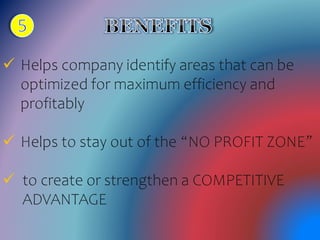
 Helps company identify areas that can be
optimized for maximum efficiency and
profitably
 Helps to stay out of the “NO PROFIT ZONE”
 to create or strengthen a COMPETITIVE
ADVANTAGE
Value_Chain_Analysis.pptx

Value_Chain_Analysis.pptx

  • 1.
  • 2.
    ①What is VALUECHAIN ②What is Value Chain Analysis ③Why use Value Chain Analysis ④Value Chain Model ⑤Benefits
  • 3.
    Is the setof activities that a business performs in order to deliver a valuable product or service for its customers. VALUE CHAIN Raw materials Final goods/services
  • 4.
    ① PRIMARY ACTIVITIES ②SUPPORT ACTIVITIES
  • 5.
    Value Chain analysislooks at every step a business goes through, from raw materials to the eventual end-user. The goal is to deliver maximum value for the least possible total cost (competitive advantage).
  • 6.
    helps identify theways in which you create value for your customers helps you think through how you can maximize this value: whether through superb products, great services
  • 7.
  • 8.
    1. Inbound logistics- concerns with receiving, storing and distributing the inputs used in the production process. 2. Operations - comprise of the transformation of inputs into final product . 3. Outbound logistics - involves collecting, storing & distribution of the final product to consumers. 4. Sales & Marketing - Identification of customer needs and generation of sales 5. Service – involves how to maintain the value of the product after it is purchased
  • 9.
    1. Firm Infrastructure– refers to an organization structure, company culture. 2. HRM - involves in recruiting, hiring, training, development and compensation of employees 3. Technology Development - intended to improve the product and the process, can occur in many parts of the firm. 4. Procurement - concerned with the tasks of purchasing inputs such as raw materials, equipment
  • 10.
     Helps companyidentify areas that can be optimized for maximum efficiency and profitably  Helps to stay out of the “NO PROFIT ZONE”  to create or strengthen a COMPETITIVE ADVANTAGE

Editor's Notes

  • #4 - Dr Michael Eugene Porter is a Professor (economist) -> developed the value chain tool Activities such as design, production, marketing & distribution The value chain is concentrating on the activities starting with raw materials till the conversion into final goods or services. Eg; wood pulp converted into paper (manufactured based) Law firm – Lawyer (prosecutor) carries out a case for someone
  • #5 business's activities could be split into two categories: primary activities and support activities Primary Activities (Operations, distributions, sales) Support Activities (R&D, Human Resources)
  • #6 Competitive advantage -> an advantage over competitors gained by offering consumers greater value, either by means of lower prices or by providing greater benefits and service that justifies higher prices.
  • #8 Porter’s Value Chain is categorized into 2 activities Primary ->relate directly to the physical creation, sale, maintenance & support of a product/service.  Support –> these activities merely supports the primary activities Primary comprises of Inbound Logistics, Ops, Outbound Logistics, Sales & Marketing and Service Support Activities comprises of Procurement, Technological Dev, HRM, Infrastructure Margin -> is the difference between the total value (Total Revenue) and the total cost of performing all of the firm’s activities Equ: Value Created & captured – Cost of Creating that Value = Margin The more value an org creates, the more profitable it is likely to be. And when you provide more value to your customers, u build competitive advantages.
  • #9 eg; handling of raw materials, warehousing or inventory control eg; production, assembly and packaging eg; processing of orders, warehousing of finished goods & delivery eg; advertising, promotion, pricing, selling eg; installation, repair, maintenance, warranty, upgrading
  • #10 eg; accounting, planning, legal, public affairs, quality management eg; eg; such as Research & Development, Process automation, design. eg; servicing, spare parts, buildings, machines, etc.
  • #11 Thru analyzing the value chain activities, a company can ensure that the value it’s creating exceeds the cost to create that value.