ANALYSIS & DESIGN OF CABLE
STAYED BACKWARDBRIDGE
INTRODUCTION
 Midas Civil is a Bridge Design & Analysis software that combines
powerful pre-and post-processing features with an extremely fast solver,
which makes bridge modelling and analysis simple, quick, and effective.
Also, there are several easy parameter modification tools available that
can be used for parametric analysis leading to optimized and economical
design.
 Midas Civil enables us to readily create nodes and elements as if we were
drawing drawings using the major functions of CAD programs. Powerful
automatic modelling functions such as Auto Mesh Generation and various
Bridge Wizards are introduced. The Bridge Wizards can create a complete
bridge model for you in a blink of an eye and you are able to make any
modification to the model to match with the real structure as much as
possible. Other modelling approaches such as CAD import, table format
modeling, and code format modelling are also available.
 Midas Civil has powerful design code checking and load rating features.
AASHTO LRFD & LRFR, CHBDC CSA, EUROCODE, and other codes
are available. The codes are constantly updated to make sure the users can
best take advantage of the code checking and rating features in the
program. The automatic report generation features give the users an
organized and detailed report that includes formulas and code references
and it gives the users the confidence in their result.
2
Suspension bridges can generally be classified as long span structures. Suspension
bridges comprise longitudinal deck (main girders) supported by hangers suspended
from cables. The cables are connected to anchors at each end. The analysis of a
suspension bridge is divided into completed state analysis and construction stage
analysis.
What is a Cable-Stayed Bridge?
A cable-stayed bridge is a cable supported bridge in which one or multiple pylons are
installed in the middle of the bridge and girder segments are connected to the pylons by
a cable. In cable-stayed bridges, the shape of pylons,the shape of girders, and the cable
arrangement can be freely designed; therefore, various structural systems can be
applied. For example, adjusting thetension of the cable forces can reduce the size of the
bending moment of the girder. This allows for a more economical design. Furthermore,
different cable arrangements and shapes for pylons can be planned for a more aesthetic
bridgedesign suitable for the surrounding environment. However, even with various
structural advantages, only a small number of cable-stayed bridges were designed and
built in the past due to limitations in materials and construction methods. Today, the
emergence of high-strength cables, the advancement of structural analysis software, the
establishment of wind-resistant design methodsthrough wind tunnel tests, and the
development of construction technology haveplaced cable-stayed bridges, along side
with suspension bridges, responsible forthe future of long-span bridges
Components of a Cable-Stayed Bridge
The main components of a cable-stayed bridge are as follows:
1.Pylon/Tower
2.Girder/Deck
3.Cable stay
4.Cable Anchorage
5.Support system.
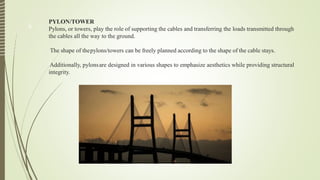
PYLON/TOWER
Pylons, or towers, play the role of supporting the cables and transferring the loads transmitted through
the cables all the way to the ground.
The shape of thepylons/towers can be freely planned according to the shape of the cable stays.
Additionally, pylonsare designed in various shapes to emphasize aesthetics while providing structural
integrity.
6
GIRDER/DECK
Girders or decks of cable-stayed bridges can be designed using various shapes and
materials. Typical examples are steel girders, steel composite girders, and concrete girders.
Alternatively, there can be different types of girders for the main span and the approach
span
The shape of the girder should be carefully planned because the cable arrangement method,
spacing, anchorage design, analysis technique, and construction method are determined by
what kind of girder is planned.
7
8
TYPES OF GIRDERS
1. STEEL GIRDER
2. BOX GIRDER
3. TWIN BOX GIRDER
4. STEEL COMPOSITE GIRDER
5. EDGE I GIRDER
6. TRUSS GIRDER
7. CONCRETE GIRDER
CABLE STAY
Cables used on cable-stayed bridges are tension members that cannot resist bending or
compression, such as ropes, wires, and chains, and can only supportaxial tension. The
tensile strength of the cables is usually around 1,600 to 1,860MPa, but with advances in
technology, cables with higher tensile strength are being developed.
TYPES
1. LCS (Locked Coil Strand)
9
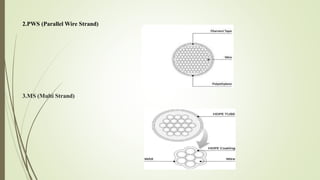
2.PWS (Parallel Wire Strand)
3.MS (Multi Strand)
- CABLE ANCHORAGES
1. Cable Anchorages at Girders
2. Cable Anchorages at Pylons
3. Steel Pylon Anchorage
Saddle type ; Anchor girder type ; Bearing plate type ; Pin socket type
4 Concrete Pylon Anchorage
Saddle type ; Overlapped type ; Inside type ; Insider with bracket & link type
11
Support System
The boundary conditions between the crossbeams of a pylon and the stiffened
girders affect the behavior of the entire bridge structure. The boundary
conditions are classified into three categories: a floating system without a
support, a support system, and a frame system with stiffened girders and
pylons.
1. Floating System
2. . Shoe System
3. Frame System
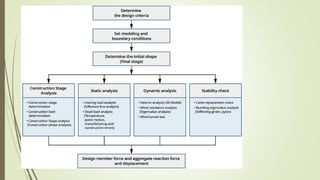
- Design of Cable-Stayed Bridges
The design of a cable-stayed bridge requires considerable insight as there are many
factors to be considered during design, including the many irregularities of the bridge
itself. The conceptual review items required for design are as follows:
1. Structural Analysis of Cable-Stayed Bridges
2. Structural Analysis for the Initial Shape
Zero Displacement Method
Force Equilibrium Method
Force Method
3. Construction Stage Analysis
13
14
Efficiency and Economy
1. Cable-stayed bridges are efficient in cost, materials, and construction time.
2. Theyhave better efficiency than other bridge systems
3.An additional advantage of cable-stayed bridges is their larger efficient span
range from 100-meter spans (328 feet) to over 1,000-meter spans(3,280 feet).
4.Cable-stayed bridges have a combination of elegance, slenderness, and a
feelingof robustness.
5.The national infrastructure’s demand for more bridges requires the priority of
efficiency and economy.
The main system advantages are:
Fast and relatively easy construction, requiring
less time to build:-
1.Less expensive
2.Multiple design options
3.Large efficient span range
4.Strong and resilient structures
5.Attractive appearance
The main system disadvantages are:
 1.Still inferior to suspension bridges for super-long spans
 2.Requires checking deformations at all conditions
 3.Requires experience in both design and construction.
4.Cable-stayed bridges do have a maximum length to consider.
5.This design option can become unstable in specific environments.
Presentation title
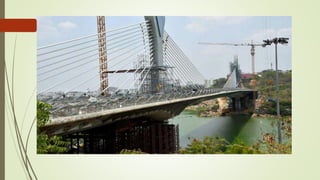
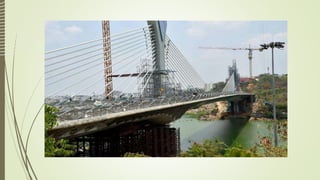
DURGAM CHERUVU CABLE STAYED BRIDGE
The city experienced a boom in traffic due to the increasing number of cars owned, and the Jubilee Hills
to Madhapur commute, which historically took 30minutes, began to take 40–60 minutes. The
Government of Telangana then put forward a proposal of a bridge through DURGAM CHERUVU to
ease traffic inthe area and cut down travel time to 10 minutes.
CONSTRUCTION
According to the original plan, the bridge was supposed to have 3-5 pillars holding the road but due to
some environmental concerns, the government wasforced to settle for a cable-suspension bridge with 2
pillars holding the cables. Construction tenders were opened in early 2019 and L&T (Larson and
Toubro)ended up winning the contract and the construction began on 9 March 2019.
 ANALYSIS OF BRIDGE
 Cable-stayed bridges are structural systems effectively composing cables, main girders and
towers. This bridge form has a beautiful appearance and easily fits in with the surrounding
environment due to the fact that various structural systems can be created by changing the
tower shapes and cable arrangements.
 Cable-stayed bridges are structures that require a high degree of technology for both design
and construction, and hence demand sophisticated structural analysis and design techniques
when compared with other types of conventionalbridges.
 In addition to static analysis for dead and live loads, a dynamic analysis must also be
performed to determine eigenvalues. Also moving load, earthquake load and wind load
analyses are essentially required for designing a cable-stayed bridge.
 BACKGROUND OF BRIDGE
 The city experienced a boom in traffic due to the increasing number of cars owned, and the
Jubilee Hills to Madhapur commute, which historically took 30 minutes, began to take 40–60
minutes. The Government of Telangana then put forward a proposal of a bridge through
Durgam Cheruvu to ease traffic in the area and cut down travel time to 10 minutes.
 CONCLUSION
 The overall introduction about the CABLE STAYED BRIDGE, component parts,
Methodologies, and an Overview of Brief Historical Development is done.
 Introduction to an existed structure which is constructed a cable stayed bridge in Hyderabad
called DURGAM CHERUVU BRIDGE and its overview is recorded in this paper
 The next analysis of this CABLE BRIDGE going to done for Next review by using the
software MIDAS CIVIL.
THANK YOU

Presentation PPT.pdf

  • 1.
    ANALYSIS & DESIGNOF CABLE STAYED BACKWARDBRIDGE
  • 2.
    INTRODUCTION  Midas Civilis a Bridge Design & Analysis software that combines powerful pre-and post-processing features with an extremely fast solver, which makes bridge modelling and analysis simple, quick, and effective. Also, there are several easy parameter modification tools available that can be used for parametric analysis leading to optimized and economical design.  Midas Civil enables us to readily create nodes and elements as if we were drawing drawings using the major functions of CAD programs. Powerful automatic modelling functions such as Auto Mesh Generation and various Bridge Wizards are introduced. The Bridge Wizards can create a complete bridge model for you in a blink of an eye and you are able to make any modification to the model to match with the real structure as much as possible. Other modelling approaches such as CAD import, table format modeling, and code format modelling are also available.  Midas Civil has powerful design code checking and load rating features. AASHTO LRFD & LRFR, CHBDC CSA, EUROCODE, and other codes are available. The codes are constantly updated to make sure the users can best take advantage of the code checking and rating features in the program. The automatic report generation features give the users an organized and detailed report that includes formulas and code references and it gives the users the confidence in their result. 2
  • 3.
    Suspension bridges cangenerally be classified as long span structures. Suspension bridges comprise longitudinal deck (main girders) supported by hangers suspended from cables. The cables are connected to anchors at each end. The analysis of a suspension bridge is divided into completed state analysis and construction stage analysis. What is a Cable-Stayed Bridge? A cable-stayed bridge is a cable supported bridge in which one or multiple pylons are installed in the middle of the bridge and girder segments are connected to the pylons by a cable. In cable-stayed bridges, the shape of pylons,the shape of girders, and the cable arrangement can be freely designed; therefore, various structural systems can be applied. For example, adjusting thetension of the cable forces can reduce the size of the bending moment of the girder. This allows for a more economical design. Furthermore, different cable arrangements and shapes for pylons can be planned for a more aesthetic bridgedesign suitable for the surrounding environment. However, even with various structural advantages, only a small number of cable-stayed bridges were designed and built in the past due to limitations in materials and construction methods. Today, the emergence of high-strength cables, the advancement of structural analysis software, the establishment of wind-resistant design methodsthrough wind tunnel tests, and the development of construction technology haveplaced cable-stayed bridges, along side with suspension bridges, responsible forthe future of long-span bridges
  • 5.
    Components of aCable-Stayed Bridge The main components of a cable-stayed bridge are as follows: 1.Pylon/Tower 2.Girder/Deck 3.Cable stay 4.Cable Anchorage 5.Support system.
  • 6.
    PYLON/TOWER Pylons, or towers,play the role of supporting the cables and transferring the loads transmitted through the cables all the way to the ground. The shape of thepylons/towers can be freely planned according to the shape of the cable stays. Additionally, pylonsare designed in various shapes to emphasize aesthetics while providing structural integrity. 6
  • 7.
    GIRDER/DECK Girders or decksof cable-stayed bridges can be designed using various shapes and materials. Typical examples are steel girders, steel composite girders, and concrete girders. Alternatively, there can be different types of girders for the main span and the approach span The shape of the girder should be carefully planned because the cable arrangement method, spacing, anchorage design, analysis technique, and construction method are determined by what kind of girder is planned. 7
  • 8.
    8 TYPES OF GIRDERS 1.STEEL GIRDER 2. BOX GIRDER 3. TWIN BOX GIRDER 4. STEEL COMPOSITE GIRDER 5. EDGE I GIRDER 6. TRUSS GIRDER 7. CONCRETE GIRDER
  • 9.
    CABLE STAY Cables usedon cable-stayed bridges are tension members that cannot resist bending or compression, such as ropes, wires, and chains, and can only supportaxial tension. The tensile strength of the cables is usually around 1,600 to 1,860MPa, but with advances in technology, cables with higher tensile strength are being developed. TYPES 1. LCS (Locked Coil Strand) 9
  • 10.
    2.PWS (Parallel WireStrand) 3.MS (Multi Strand)
  • 11.
    - CABLE ANCHORAGES 1.Cable Anchorages at Girders 2. Cable Anchorages at Pylons 3. Steel Pylon Anchorage Saddle type ; Anchor girder type ; Bearing plate type ; Pin socket type 4 Concrete Pylon Anchorage Saddle type ; Overlapped type ; Inside type ; Insider with bracket & link type 11
  • 12.
    Support System The boundaryconditions between the crossbeams of a pylon and the stiffened girders affect the behavior of the entire bridge structure. The boundary conditions are classified into three categories: a floating system without a support, a support system, and a frame system with stiffened girders and pylons. 1. Floating System 2. . Shoe System 3. Frame System
  • 13.
    - Design ofCable-Stayed Bridges The design of a cable-stayed bridge requires considerable insight as there are many factors to be considered during design, including the many irregularities of the bridge itself. The conceptual review items required for design are as follows: 1. Structural Analysis of Cable-Stayed Bridges 2. Structural Analysis for the Initial Shape Zero Displacement Method Force Equilibrium Method Force Method 3. Construction Stage Analysis 13
  • 14.
  • 15.
    Efficiency and Economy 1.Cable-stayed bridges are efficient in cost, materials, and construction time. 2. Theyhave better efficiency than other bridge systems 3.An additional advantage of cable-stayed bridges is their larger efficient span range from 100-meter spans (328 feet) to over 1,000-meter spans(3,280 feet). 4.Cable-stayed bridges have a combination of elegance, slenderness, and a feelingof robustness. 5.The national infrastructure’s demand for more bridges requires the priority of efficiency and economy.
  • 16.
    The main systemadvantages are: Fast and relatively easy construction, requiring less time to build:- 1.Less expensive 2.Multiple design options 3.Large efficient span range 4.Strong and resilient structures 5.Attractive appearance
  • 17.
    The main systemdisadvantages are:  1.Still inferior to suspension bridges for super-long spans  2.Requires checking deformations at all conditions  3.Requires experience in both design and construction. 4.Cable-stayed bridges do have a maximum length to consider. 5.This design option can become unstable in specific environments. Presentation title
  • 18.
    DURGAM CHERUVU CABLESTAYED BRIDGE The city experienced a boom in traffic due to the increasing number of cars owned, and the Jubilee Hills to Madhapur commute, which historically took 30minutes, began to take 40–60 minutes. The Government of Telangana then put forward a proposal of a bridge through DURGAM CHERUVU to ease traffic inthe area and cut down travel time to 10 minutes. CONSTRUCTION According to the original plan, the bridge was supposed to have 3-5 pillars holding the road but due to some environmental concerns, the government wasforced to settle for a cable-suspension bridge with 2 pillars holding the cables. Construction tenders were opened in early 2019 and L&T (Larson and Toubro)ended up winning the contract and the construction began on 9 March 2019.
  • 20.
     ANALYSIS OFBRIDGE  Cable-stayed bridges are structural systems effectively composing cables, main girders and towers. This bridge form has a beautiful appearance and easily fits in with the surrounding environment due to the fact that various structural systems can be created by changing the tower shapes and cable arrangements.  Cable-stayed bridges are structures that require a high degree of technology for both design and construction, and hence demand sophisticated structural analysis and design techniques when compared with other types of conventionalbridges.  In addition to static analysis for dead and live loads, a dynamic analysis must also be performed to determine eigenvalues. Also moving load, earthquake load and wind load analyses are essentially required for designing a cable-stayed bridge.
  • 21.
     BACKGROUND OFBRIDGE  The city experienced a boom in traffic due to the increasing number of cars owned, and the Jubilee Hills to Madhapur commute, which historically took 30 minutes, began to take 40–60 minutes. The Government of Telangana then put forward a proposal of a bridge through Durgam Cheruvu to ease traffic in the area and cut down travel time to 10 minutes.  CONCLUSION  The overall introduction about the CABLE STAYED BRIDGE, component parts, Methodologies, and an Overview of Brief Historical Development is done.  Introduction to an existed structure which is constructed a cable stayed bridge in Hyderabad called DURGAM CHERUVU BRIDGE and its overview is recorded in this paper  The next analysis of this CABLE BRIDGE going to done for Next review by using the software MIDAS CIVIL.
  • 22.