SEPSIS/MULTIPLE ORGAN
FAILURE
DR SULEIMAN OTARU S.
ANAESTHESIA DEPT
UATH, GWAGWALADA
INTRODUCTION
 Sepsis describes the host response syndrome to an infectious insult. It is characterised by a pro-
inflammatory, pro-coagulant state and is frequently accompanied by organ dysfunction resulting from
organ hypoxia.
 Sepsis is one of the most frequent causes of death worldwide, but there are challenges in collecting
reliable data at the population level
 From data published in 2020, there were 48.9 million cases and 11 million sepsis-related deaths
worldwide, representing 20% of all global deaths
 Almost half (20 million) of all estimated sepsis cases worldwide occurred in children under 5 years of
age.
 For every 1000 hospitalized patients, an estimated 15 patients will develop sepsis as a complication
of receiving health care.
 While sepsis can affect any individual worldwide, significant regional disparities in incidence and
mortality exist with the highest rates in lower-middle-income countries
 Sepsis is costly; the average hospital-wide cost of sepsis was estimated to be more than US$ 32 000
per patient in high-income countries
PATHOPHYSIOLOGY
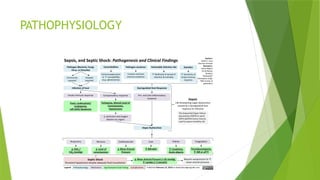
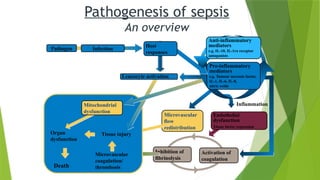
Pathogenesis of sepsis
An overview
Activation of
coagulation
Inhibition of
fibrinolysis
Endothelial
dysfunction
Tissue factor expression
Microvascular
flow
redistribution
Inflammation
Tissue injury
Microvascular
coagulation/
thrombosis
Organ
dysfunction
Death
Mitochondrial
dysfunction
Leucocyte activation
Anti-inflammatory
mediators
e.g. IL-10, IL-1ra receptor
antagonists
Pro-inflammatory
mediators
e.g. Tumour necrosis factor,
IL-1, IL-6, IL-8,
nitric oxide
Pathogen Infection
Host
responses
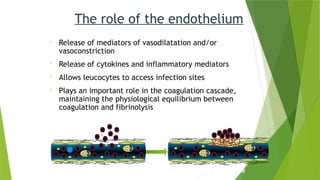
• Release of mediators of vasodilatation and/or
vasoconstriction
• Release of cytokines and inflammatory mediators
• Allows leucocytes to access infection sites
• Plays an important role in the coagulation cascade,
maintaining the physiological equilibrium between
coagulation and fibrinolysis
The role of the endothelium
Tissue injury Formation of fibrin clot
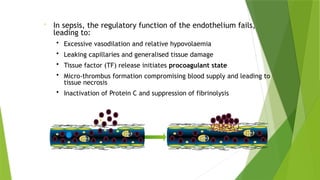
• In sepsis, the regulatory function of the endothelium fails,
leading to:
• Excessive vasodilation and relative hypovolaemia
• Leaking capillaries and generalised tissue damage
• Tissue factor (TF) release initiates procoagulant state
• Micro-thrombus formation compromising blood supply and leading to
tissue necrosis
• Inactivation of Protein C and suppression of fibrinolysis
Tissue injury Formation of fibrin clot
WHO IS AT RISK
 older persons
 pregnant or recently pregnant women
 neonates
 hospitalized patients
 patients in intensive care units
 people with weakened immune systems (for example HIV, cancer)
 people with chronic medical conditions (for example kidney disease,
cirrhosis).
SYMPTOMS AND SIGNS
 fever or low temperature and shivering
 confusion
 difficulty breathing
 clammy and sweaty skin
 extreme body pain or discomfort
 high heart rate, weak pulse or low blood pressure
 low urine output.
Symptoms in children include:
•fast breathing
•convulsions
•pale skin
•lethargy
•difficulty waking up
•feeling cold to the touch.
In children under 5 years old, it can cause difficulty feeding, frequent
vomiting or lack of urination.
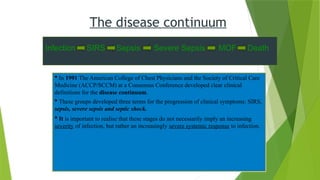
 In 1991 The American College of Chest Physicians and the Society of Critical Care
Medicine (ACCP/SCCM) at a Consensus Conference developed clear clinical
definitions for the disease continuum.
 These groups developed three terms for the progression of clinical symptoms: SIRS,
sepsis, severe sepsis and septic shock.
 It is important to realise that these stages do not necessarily imply an increasing
severity of infection, but rather an increasingly severe systemic response to infection.
The disease continuum
Infection SIRS Sepsis Severe Sepsis MOF Death
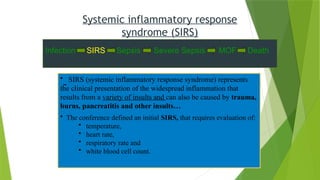
• SIRS (systemic inflammatory response syndrome) represents
the clinical presentation of the widespread inflammation that
results from a variety of insults and can also be caused by trauma,
burns, pancreatitis and other insults…
• The conference defined an initial SIRS, that requires evaluation of:
• temperature,
• heart rate,
• respiratory rate and
• white blood cell count.
Systemic inflammatory response
syndrome (SIRS)
Infection SIRS Sepsis Severe Sepsis MOF Death
Systemic Inflammatory Response Syndrome
Diagnosis comprises 2 or more of the following:
• Tachycardia >90 bpm
• Core temperature <36°C or >38°C
• Tachypnoea >20 bpm or PaCO2 <4.2 kPa
• WCC >12,000 or <4,000 or
>10% immature neutrophils
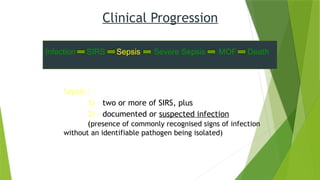
Clinical Progression
Sepsis :
1) - two or more of SIRS, plus
2) - documented or suspected infection
(presence of commonly recognised signs of infection
without an identifiable pathogen being isolated)
Infection SIRS Sepsis Severe Sepsis MOF Death
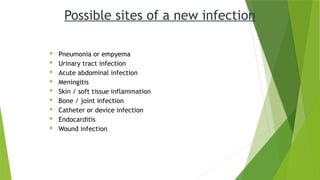
Possible sites of a new infection
 Pneumonia or empyema
 Urinary tract infection
 Acute abdominal infection
 Meningitis
 Skin / soft tissue inflammation
 Bone / joint infection
 Catheter or device infection
 Endocarditis
 Wound infection
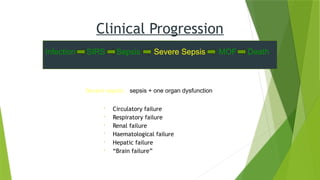
Clinical Progression
• Circulatory failure
• Respiratory failure
• Renal failure
• Haematological failure
• Hepatic failure
• “Brain failure”
Severe sepsis: sepsis + one organ dysfunction
Infection SIRS Sepsis Severe Sepsis MOF Death
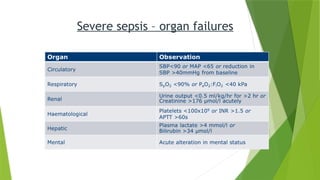
Severe sepsis – organ failures
 Circulatory Systolic BP <90mmHg or MAP <65mmHg or
reduction in SBP 40 mmHg from baseline

Respiratory O2 saturation <90% on air or oxygen or
PaO2:FiO2 <40 kPa
 Renal Urine output <0.5 ml/kg/hr for >2 hrs or
Creatinine >176 µmol/l acutely
 Haematological Platelets <100x109
or INR >1.5 or APTT >60s
 Hepatic Plasma lactate >4 mmol/l or
Bilirubin >34 µmol/l
 Mental Acute alteration in mental status
Clinical Progression
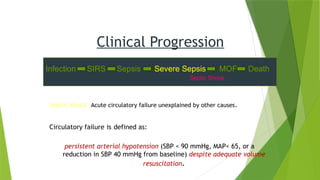
Septic shock: Acute circulatory failure unexplained by other causes.
Circulatory failure is defined as:
persistent arterial hypotension (SBP < 90 mmHg, MAP< 65, or a
reduction in SBP 40 mmHg from baseline) despite adequate volume
resuscitation.
Infection SIRS Sepsis Severe Sepsis MOF Death
Septic Shock
Septic Shock
Initially is suggested by evidence of end organ hypoperfusion:
• haemodynamic instability
• mottled skin
• decreased urine output
• altered level of consciousness
• lactic and metabolic acidosis
Later - circulatory failure leading to multi-organ failure:
• reduced SVR, leaking capillaries
• slightly increased, followed by decreased Cardiac Output
• coagulopathy with thrombocytopenia
• ARDS, ARF, liver failure, hypoglycaemia
Although most patients in shock will be hypotensive, some patients
will have preserved systolic pressure early in shock as a result of
excessive catecholamine release.
MANAGEMENT
 Initially resuscitate the patient by assessment of the airway, breathing and
circulation (ABC).
SEPSIS CAMPAIGN BUNDLE
 Oxygen
 Antibiotics
 Culture
 Fluid
 Urine output
 Lactate measurements

Presentation Package on Sepsis & MULTIPLE ORGAN FAILURE.pptx

  • 1.
    SEPSIS/MULTIPLE ORGAN FAILURE DR SULEIMANOTARU S. ANAESTHESIA DEPT UATH, GWAGWALADA
  • 2.
    INTRODUCTION  Sepsis describesthe host response syndrome to an infectious insult. It is characterised by a pro- inflammatory, pro-coagulant state and is frequently accompanied by organ dysfunction resulting from organ hypoxia.  Sepsis is one of the most frequent causes of death worldwide, but there are challenges in collecting reliable data at the population level  From data published in 2020, there were 48.9 million cases and 11 million sepsis-related deaths worldwide, representing 20% of all global deaths  Almost half (20 million) of all estimated sepsis cases worldwide occurred in children under 5 years of age.  For every 1000 hospitalized patients, an estimated 15 patients will develop sepsis as a complication of receiving health care.  While sepsis can affect any individual worldwide, significant regional disparities in incidence and mortality exist with the highest rates in lower-middle-income countries  Sepsis is costly; the average hospital-wide cost of sepsis was estimated to be more than US$ 32 000 per patient in high-income countries
  • 3.
  • 4.
    Pathogenesis of sepsis Anoverview Activation of coagulation Inhibition of fibrinolysis Endothelial dysfunction Tissue factor expression Microvascular flow redistribution Inflammation Tissue injury Microvascular coagulation/ thrombosis Organ dysfunction Death Mitochondrial dysfunction Leucocyte activation Anti-inflammatory mediators e.g. IL-10, IL-1ra receptor antagonists Pro-inflammatory mediators e.g. Tumour necrosis factor, IL-1, IL-6, IL-8, nitric oxide Pathogen Infection Host responses
  • 5.
    • Release ofmediators of vasodilatation and/or vasoconstriction • Release of cytokines and inflammatory mediators • Allows leucocytes to access infection sites • Plays an important role in the coagulation cascade, maintaining the physiological equilibrium between coagulation and fibrinolysis The role of the endothelium Tissue injury Formation of fibrin clot
  • 6.
    • In sepsis,the regulatory function of the endothelium fails, leading to: • Excessive vasodilation and relative hypovolaemia • Leaking capillaries and generalised tissue damage • Tissue factor (TF) release initiates procoagulant state • Micro-thrombus formation compromising blood supply and leading to tissue necrosis • Inactivation of Protein C and suppression of fibrinolysis Tissue injury Formation of fibrin clot
  • 7.
    WHO IS ATRISK  older persons  pregnant or recently pregnant women  neonates  hospitalized patients  patients in intensive care units  people with weakened immune systems (for example HIV, cancer)  people with chronic medical conditions (for example kidney disease, cirrhosis).
  • 8.
    SYMPTOMS AND SIGNS fever or low temperature and shivering  confusion  difficulty breathing  clammy and sweaty skin  extreme body pain or discomfort  high heart rate, weak pulse or low blood pressure  low urine output.
  • 9.
    Symptoms in childreninclude: •fast breathing •convulsions •pale skin •lethargy •difficulty waking up •feeling cold to the touch. In children under 5 years old, it can cause difficulty feeding, frequent vomiting or lack of urination.
  • 10.
     In 1991The American College of Chest Physicians and the Society of Critical Care Medicine (ACCP/SCCM) at a Consensus Conference developed clear clinical definitions for the disease continuum.  These groups developed three terms for the progression of clinical symptoms: SIRS, sepsis, severe sepsis and septic shock.  It is important to realise that these stages do not necessarily imply an increasing severity of infection, but rather an increasingly severe systemic response to infection. The disease continuum Infection SIRS Sepsis Severe Sepsis MOF Death
  • 11.
    • SIRS (systemicinflammatory response syndrome) represents the clinical presentation of the widespread inflammation that results from a variety of insults and can also be caused by trauma, burns, pancreatitis and other insults… • The conference defined an initial SIRS, that requires evaluation of: • temperature, • heart rate, • respiratory rate and • white blood cell count. Systemic inflammatory response syndrome (SIRS) Infection SIRS Sepsis Severe Sepsis MOF Death
  • 12.
    Systemic Inflammatory ResponseSyndrome Diagnosis comprises 2 or more of the following: • Tachycardia >90 bpm • Core temperature <36°C or >38°C • Tachypnoea >20 bpm or PaCO2 <4.2 kPa • WCC >12,000 or <4,000 or >10% immature neutrophils
  • 13.
    Clinical Progression Sepsis : 1)- two or more of SIRS, plus 2) - documented or suspected infection (presence of commonly recognised signs of infection without an identifiable pathogen being isolated) Infection SIRS Sepsis Severe Sepsis MOF Death
  • 14.
    Possible sites ofa new infection  Pneumonia or empyema  Urinary tract infection  Acute abdominal infection  Meningitis  Skin / soft tissue inflammation  Bone / joint infection  Catheter or device infection  Endocarditis  Wound infection
  • 15.
    Clinical Progression • Circulatoryfailure • Respiratory failure • Renal failure • Haematological failure • Hepatic failure • “Brain failure” Severe sepsis: sepsis + one organ dysfunction Infection SIRS Sepsis Severe Sepsis MOF Death
  • 16.
    Severe sepsis –organ failures  Circulatory Systolic BP <90mmHg or MAP <65mmHg or reduction in SBP 40 mmHg from baseline  Respiratory O2 saturation <90% on air or oxygen or PaO2:FiO2 <40 kPa  Renal Urine output <0.5 ml/kg/hr for >2 hrs or Creatinine >176 µmol/l acutely  Haematological Platelets <100x109 or INR >1.5 or APTT >60s  Hepatic Plasma lactate >4 mmol/l or Bilirubin >34 µmol/l  Mental Acute alteration in mental status
  • 17.
    Clinical Progression Septic shock:Acute circulatory failure unexplained by other causes. Circulatory failure is defined as: persistent arterial hypotension (SBP < 90 mmHg, MAP< 65, or a reduction in SBP 40 mmHg from baseline) despite adequate volume resuscitation. Infection SIRS Sepsis Severe Sepsis MOF Death Septic Shock
  • 18.
    Septic Shock Initially issuggested by evidence of end organ hypoperfusion: • haemodynamic instability • mottled skin • decreased urine output • altered level of consciousness • lactic and metabolic acidosis Later - circulatory failure leading to multi-organ failure: • reduced SVR, leaking capillaries • slightly increased, followed by decreased Cardiac Output • coagulopathy with thrombocytopenia • ARDS, ARF, liver failure, hypoglycaemia Although most patients in shock will be hypotensive, some patients will have preserved systolic pressure early in shock as a result of excessive catecholamine release.
  • 19.
    MANAGEMENT  Initially resuscitatethe patient by assessment of the airway, breathing and circulation (ABC). SEPSIS CAMPAIGN BUNDLE  Oxygen  Antibiotics  Culture  Fluid  Urine output  Lactate measurements