Virtual Private
Network
prepared by
Rachna Agrawal
Lixia Hou
Virtual Private Network
(VPN)
VPNs are private data networks over public
network – usually the Internet.
VPNs extend corporate networks to remote
offices, mobile users, telecommuters and
other extranet partners.
VPNs use advanced encryption and
‘tunneling’ technology to establish secure,
end-to-end private network connections over
Internet.
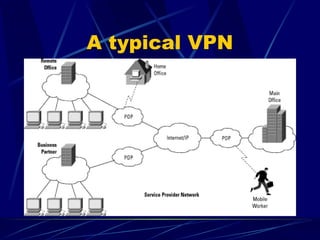
A typical VPN
VPN Solutions
Remote access VPNs establish secure,
encrypted connections between mobile or
remote users and their corporate networks via
a third-party network, such as a Internet
Service Provider(ISP)
- VPN client – software, hardware as well as
router, or firewall based solutions available.
- Reduced cost of long distance access calls
and internal equipment inventory
VPN Solutions
Site-to-Site VPNs are an alternative WAN
infrastructure that used to connect branch offices,
home offices, or business partners' sites to all or
portions of a company's network.
- Intranet VPNs provide full access to company’s
network
- Extranet VPNS provide business partners with
limited access to a company’s network
VPN Technology
Trusted VPNs – companies lease
circuits from communication providers
and use them in the same manner they
use physical cables in a private LAN
- Communication provider is ‘trusted’ for
data integrity and security.
- Used before Internet became universal
VPN Technology
Secure VPNs use Internet as a
corporate communication medium. Data
is encrypted before sending, moved
over to Internet, and then decrypted at
the receiving end.
- Encryption creates a security ‘tunnel’
that can’t be attacked
- More desirable than Trusted VPNs
VPN Technology
Hybrid VPNs – A secure VPN is created
as part of the trusted VPN thus creating
a ‘hybrid’ VPN. Secure part of the VPN
is usually administered by customer
(using VPN equipments).
Secure VPNs that are administered by
ISPs are called provider-provisioned
VPNs.
VPN Building Blocks
Security is built around authentication,
authorization, and accounting
capabilities.
Network, data, and addresses are
encrypted so they are understood by
right sender and receiver only.
VPN Building Blocks
Quality of Service addresses two fundamental
requirements – predictable performance and
policy implementation
QoS capabilities allow users to prioritize
service classes, manage bandwidth, and
avoid congestion.
Pkt. classification based on IP address,
TCP/UDP port no, IP precedence(3bits in the
ToS field of IP header), MAC address, URLs
& sub-URLs
VPN Building Blocks
Management of devices – ‘simpler is
better’
Element-based – less expensive. adequate
for managing & monitoring small setup
Policy-based – centralized for larger
networks, policies established and push
them to all applicable devices
Outsource VPN management to the ISP
or SASP
VPN Building Blocks
VPNs provide reliable access to network
VPN software allows transmitted data
packets to transparently switch over to a
different path in case of a device failure
Redundancy in hardware components
reduces the risk of downtime
VPN: making choices
Do-it-Yourself VPNs - four basic areas
of consideration:
- Internet Service
- Security Policy Server
- A Public Key Infrastructure (PKI)
system
- VPN gateway solution
VPN Gateways
VPN gateways can be categorized as
Standalone or Integrated.
Standalone VPNs incorporate purpose-built
devices between - the source of data and
WAN link OR between the modem and a data
source in a remote office.
Integrated implementations add VPN
functionality to existing devices such as
routers, firewalls.
Gateway Solutions
Router based VPNs – adding encryption
support to existing router(s) can keep the
upgrade costs of VPN low.
Firewall based VPNs – workable solution for
small networks with low traffic volume.
Software based VPNs – good solution for
better understanding a VPN, software runs on
existing servers and share resources with
them
Gateway Solutions
Internet Security Devices – Standalone
VPN devices specifically designed for
tunneling, encryption, authentication are
easier to setup and make attractive
choice for business looking for ‘turn key’
solutions
Outsourcing
Things to consider before outsourcing -
For connecting remote offices consider an ISP
that also offers POP to connect to Internet as a
local call
Redundancy of equipment, connections, and
people
Provider policies, equipment, employee
qualification to deal with outside hackers and
viruses
On-site consulting assistance
VPN Protocols
IPSec – Internet standard protocol for
tunneling. Encryption, and authentication.
Layer2Tunneling Protocol (L2TP) – Provides
a means for tunneling IP traffic in layer 2,
encloses non-Internet protocols i.e. IPX, SNA,
and AppleTalk inside IP envelope.
Point-to-Point tunneling - proprietary
Microsoft
Benefits of using VPN
Lower costs – remote access costs have
reduced by 80 percent while LAN-to-LAN
connectivity costs is reduced by 20-40
percent. For companies just setting up their
network VPN provides low-cost alternative to
backbone equipment, in-house terminal
equipment and access modems.
Connectivity Improvements – VPN based
links are easy and inexpensive ways to meet
changing business demands.
Benefits of VPN
Anywhere anytime access – ubiquitous public
internet offers transparent access to central
corporate systems i.e. email, directories,
internal-external web-sites.
VPN technology is improving rapidly and
promises a bright future for data
communication, its cost-effective, and high
returns on investment will outweigh any
skittishness in investing in new technology.


VirtualPrivatcxsdfsfsfsdfsfsfsdfeNetwork.ppt

  • 1.
  • 2.
    Virtual Private Network (VPN) VPNsare private data networks over public network – usually the Internet. VPNs extend corporate networks to remote offices, mobile users, telecommuters and other extranet partners. VPNs use advanced encryption and ‘tunneling’ technology to establish secure, end-to-end private network connections over Internet.
  • 3.
  • 4.
    VPN Solutions Remote accessVPNs establish secure, encrypted connections between mobile or remote users and their corporate networks via a third-party network, such as a Internet Service Provider(ISP) - VPN client – software, hardware as well as router, or firewall based solutions available. - Reduced cost of long distance access calls and internal equipment inventory
  • 5.
    VPN Solutions Site-to-Site VPNsare an alternative WAN infrastructure that used to connect branch offices, home offices, or business partners' sites to all or portions of a company's network. - Intranet VPNs provide full access to company’s network - Extranet VPNS provide business partners with limited access to a company’s network
  • 6.
    VPN Technology Trusted VPNs– companies lease circuits from communication providers and use them in the same manner they use physical cables in a private LAN - Communication provider is ‘trusted’ for data integrity and security. - Used before Internet became universal
  • 7.
    VPN Technology Secure VPNsuse Internet as a corporate communication medium. Data is encrypted before sending, moved over to Internet, and then decrypted at the receiving end. - Encryption creates a security ‘tunnel’ that can’t be attacked - More desirable than Trusted VPNs
  • 8.
    VPN Technology Hybrid VPNs– A secure VPN is created as part of the trusted VPN thus creating a ‘hybrid’ VPN. Secure part of the VPN is usually administered by customer (using VPN equipments). Secure VPNs that are administered by ISPs are called provider-provisioned VPNs.
  • 9.
    VPN Building Blocks Securityis built around authentication, authorization, and accounting capabilities. Network, data, and addresses are encrypted so they are understood by right sender and receiver only.
  • 10.
    VPN Building Blocks Qualityof Service addresses two fundamental requirements – predictable performance and policy implementation QoS capabilities allow users to prioritize service classes, manage bandwidth, and avoid congestion. Pkt. classification based on IP address, TCP/UDP port no, IP precedence(3bits in the ToS field of IP header), MAC address, URLs & sub-URLs
  • 11.
    VPN Building Blocks Managementof devices – ‘simpler is better’ Element-based – less expensive. adequate for managing & monitoring small setup Policy-based – centralized for larger networks, policies established and push them to all applicable devices Outsource VPN management to the ISP or SASP
  • 12.
    VPN Building Blocks VPNsprovide reliable access to network VPN software allows transmitted data packets to transparently switch over to a different path in case of a device failure Redundancy in hardware components reduces the risk of downtime
  • 13.
    VPN: making choices Do-it-YourselfVPNs - four basic areas of consideration: - Internet Service - Security Policy Server - A Public Key Infrastructure (PKI) system - VPN gateway solution
  • 14.
    VPN Gateways VPN gatewayscan be categorized as Standalone or Integrated. Standalone VPNs incorporate purpose-built devices between - the source of data and WAN link OR between the modem and a data source in a remote office. Integrated implementations add VPN functionality to existing devices such as routers, firewalls.
  • 15.
    Gateway Solutions Router basedVPNs – adding encryption support to existing router(s) can keep the upgrade costs of VPN low. Firewall based VPNs – workable solution for small networks with low traffic volume. Software based VPNs – good solution for better understanding a VPN, software runs on existing servers and share resources with them
  • 16.
    Gateway Solutions Internet SecurityDevices – Standalone VPN devices specifically designed for tunneling, encryption, authentication are easier to setup and make attractive choice for business looking for ‘turn key’ solutions
  • 17.
    Outsourcing Things to considerbefore outsourcing - For connecting remote offices consider an ISP that also offers POP to connect to Internet as a local call Redundancy of equipment, connections, and people Provider policies, equipment, employee qualification to deal with outside hackers and viruses On-site consulting assistance
  • 18.
    VPN Protocols IPSec –Internet standard protocol for tunneling. Encryption, and authentication. Layer2Tunneling Protocol (L2TP) – Provides a means for tunneling IP traffic in layer 2, encloses non-Internet protocols i.e. IPX, SNA, and AppleTalk inside IP envelope. Point-to-Point tunneling - proprietary Microsoft
  • 19.
    Benefits of usingVPN Lower costs – remote access costs have reduced by 80 percent while LAN-to-LAN connectivity costs is reduced by 20-40 percent. For companies just setting up their network VPN provides low-cost alternative to backbone equipment, in-house terminal equipment and access modems. Connectivity Improvements – VPN based links are easy and inexpensive ways to meet changing business demands.
  • 20.
    Benefits of VPN Anywhereanytime access – ubiquitous public internet offers transparent access to central corporate systems i.e. email, directories, internal-external web-sites. VPN technology is improving rapidly and promises a bright future for data communication, its cost-effective, and high returns on investment will outweigh any skittishness in investing in new technology.