Introduction and
Distribution of
Surplus
Submitted to:
Bipasha Barua
Assistant Professor
Department of Banking & Insurance
Faculty of Business Studies
University of Dhaka
Submitted by:
MD. Rizwanul Hoque
ID: 22-1100
MBA 22nd batch (Insurance)
Department of Banking & Insurance
Faculty of Business Studies
University of Dhaka
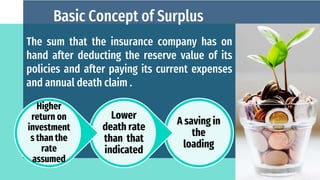
Basic Concept of Surplus
A saving in
the
loading
Lower
death rate
than that
indicated
Higher
return on
investment
s than the
rate
assumed
The sum that the insurance company has on
hand after deducting the reserve value of its
policies and after paying its current expenses
and annual death claim .
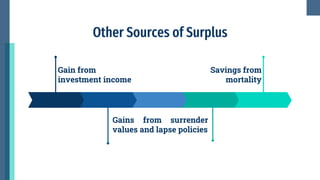
Other Sources of Surplus
Gain from
investment income
Savings from
mortality
Gains from surrender
values and lapse policies
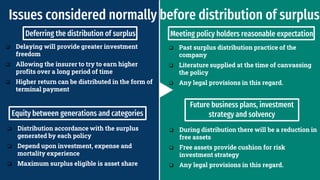
Deferring the distribution of surplus
 Past surplus distribution practice of the
company
 Literature supplied at the time of canvassing
the policy
 Any legal provisions in this regard.
Issues considered normally before distribution of surplus
Meeting policy holders reasonable expectation
Equity between generations and categories
Future business plans, investment
strategy and solvency
 Delaying will provide greater investment
freedom
 Allowing the insurer to try to earn higher
profits over a long period of time
 Higher return can be distributed in the form of
terminal payment
 During distribution there will be a reduction in
free assets
 Free assets provide cushion for risk
investment strategy
 Any legal provisions in this regard.
 Distribution accordance with the surplus
generated by each policy
 Depend upon investment, expense and
mortality experience
 Maximum surplus eligible is asset share
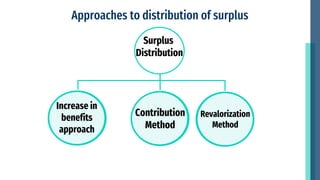
Surplus
Distribution
Approaches to distribution of surplus
Increase in
benefits
approach
Contribution
Method
Revalorization
Method
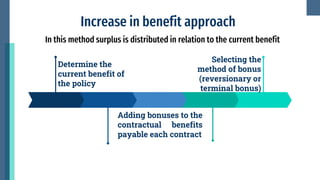
Determine the
current benefit of
the policy
Selecting the
method of bonus
(reversionary or
terminal bonus)
Adding bonuses to the
contractual benefits
payable each contract
Increase in benefit approach
In this method surplus is distributed in relation to the current benefit
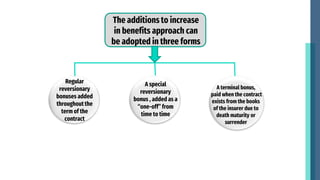
The additions to increase
in benefits approach can
be adopted in three forms
Regular
reversionary
bonuses added
throughout the
term of the
contract
A special
reversionary
bonus , added as a
“one-off” from
time to time
A terminal bonus,
paid when the contract
exists from the books
of the insurer due to
death maturity or
surrender
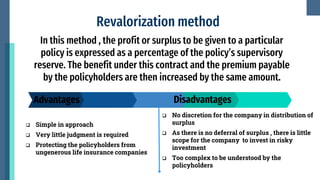
Revalorization method
In this method , the profit or surplus to be given to a particular
policy is expressed as a percentage of the policy’s supervisory
reserve. The benefit under this contract and the premium payable
by the policyholders are then increased by the same amount.
Advantages Disadvantages
 Simple in approach
 Very little judgment is required
 Protecting the policyholders from
ungenerous life insurance companies
 No discretion for the company in distribution of
surplus
 As there is no deferral of surplus , there is little
scope for the company to invest in risky
investment
 Too complex to be understood by the
policyholders
Contribution method
In this method is that the bonus is in proportion of the
contribution made by the policy to the surplus . In this method ,
the bonus is usually declared in proportion of contribution to
surplus. The common term for bonus in this method is dividend.
Thank you
for your attention

Distribution of Surplus in Insurance

  • 1.
  • 2.
    Submitted to: Bipasha Barua AssistantProfessor Department of Banking & Insurance Faculty of Business Studies University of Dhaka Submitted by: MD. Rizwanul Hoque ID: 22-1100 MBA 22nd batch (Insurance) Department of Banking & Insurance Faculty of Business Studies University of Dhaka
  • 3.
    Basic Concept ofSurplus A saving in the loading Lower death rate than that indicated Higher return on investment s than the rate assumed The sum that the insurance company has on hand after deducting the reserve value of its policies and after paying its current expenses and annual death claim .
  • 4.
    Other Sources ofSurplus Gain from investment income Savings from mortality Gains from surrender values and lapse policies
  • 5.
    Deferring the distributionof surplus  Past surplus distribution practice of the company  Literature supplied at the time of canvassing the policy  Any legal provisions in this regard. Issues considered normally before distribution of surplus Meeting policy holders reasonable expectation Equity between generations and categories Future business plans, investment strategy and solvency  Delaying will provide greater investment freedom  Allowing the insurer to try to earn higher profits over a long period of time  Higher return can be distributed in the form of terminal payment  During distribution there will be a reduction in free assets  Free assets provide cushion for risk investment strategy  Any legal provisions in this regard.  Distribution accordance with the surplus generated by each policy  Depend upon investment, expense and mortality experience  Maximum surplus eligible is asset share
  • 6.
    Surplus Distribution Approaches to distributionof surplus Increase in benefits approach Contribution Method Revalorization Method
  • 7.
    Determine the current benefitof the policy Selecting the method of bonus (reversionary or terminal bonus) Adding bonuses to the contractual benefits payable each contract Increase in benefit approach In this method surplus is distributed in relation to the current benefit
  • 8.
    The additions toincrease in benefits approach can be adopted in three forms Regular reversionary bonuses added throughout the term of the contract A special reversionary bonus , added as a “one-off” from time to time A terminal bonus, paid when the contract exists from the books of the insurer due to death maturity or surrender
  • 9.
    Revalorization method In thismethod , the profit or surplus to be given to a particular policy is expressed as a percentage of the policy’s supervisory reserve. The benefit under this contract and the premium payable by the policyholders are then increased by the same amount. Advantages Disadvantages  Simple in approach  Very little judgment is required  Protecting the policyholders from ungenerous life insurance companies  No discretion for the company in distribution of surplus  As there is no deferral of surplus , there is little scope for the company to invest in risky investment  Too complex to be understood by the policyholders
  • 10.
    Contribution method In thismethod is that the bonus is in proportion of the contribution made by the policy to the surplus . In this method , the bonus is usually declared in proportion of contribution to surplus. The common term for bonus in this method is dividend.
  • 11.