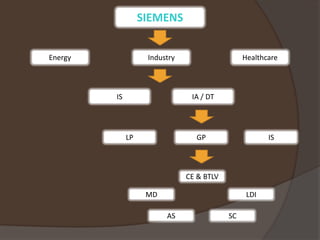
SIEMENS


Energy              Industry                    Healthcare


         IS                     IA / DT


              LP                 GP                    IS


                               CE & BTLV

                    MD                           LDI

                         AS                SC
SIVACON 8PS Bus Bar Trunking System


 LR System(630A to 6300A)
 LX System (800A to 6300A)
 LD System (1100A TO 5000A)
 BD2 System (160A to 1250A)
 BD01 System (40A to 160A)
 CD-K System (25 to 40A)
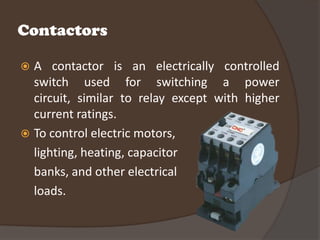
Contactors

 A contactor is an electrically controlled
  switch used for switching a power
  circuit, similar to relay except with higher
  current ratings.
 To control electric motors,
  lighting, heating, capacitor
  banks, and other electrical
  loads.
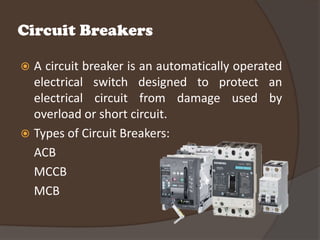
Circuit Breakers

 A circuit breaker is an automatically operated
  electrical switch designed to protect an
  electrical circuit from damage used by
  overload or short circuit.
 Types of Circuit Breakers:
  ACB
  MCCB
  MCB
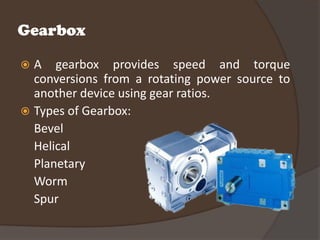
Gearbox

 A gearbox provides speed and torque
  conversions from a rotating power source to
  another device using gear ratios.
 Types of Gearbox:
  Bevel
  Helical
  Planetary
  Worm
  Spur
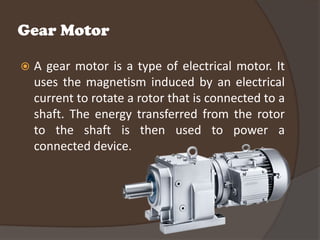
Gear Motor

   A gear motor is a type of electrical motor. It
    uses the magnetism induced by an electrical
    current to rotate a rotor that is connected to a
    shaft. The energy transferred from the rotor
    to the shaft is then used to power a
    connected device.
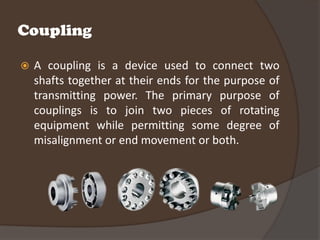
Coupling

   A coupling is a device used to connect two
    shafts together at their ends for the purpose of
    transmitting power. The primary purpose of
    couplings is to join two pieces of rotating
    equipment while permitting some degree of
    misalignment or end movement or both.
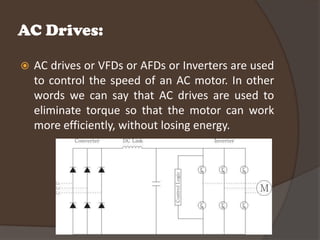
AC Drives:

   AC drives or VFDs or AFDs or Inverters are used
    to control the speed of an AC motor. In other
    words we can say that AC drives are used to
    eliminate torque so that the motor can work
    more efficiently, without losing energy.
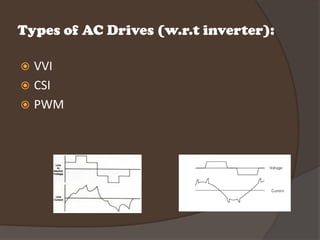
Types of AC Drives (w.r.t inverter):

 VVI
 CSI
 PWM
PLC:

   A programmable logic controller (PLC)
    or programmable controller is a digital
    computer, automation of electromechanical
    processes, such as control of machinery on
    factory assembly lines, amusement rides, or
    lighting fixtures.
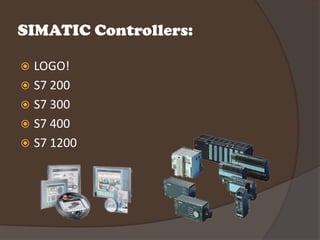
SIMATIC Controllers:

 LOGO!
 S7 200
 S7 300
 S7 400
 S7 1200
Assignment….
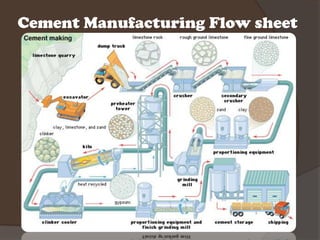
Cement Manufacturing Flow sheet
Cement Manufacturing Process

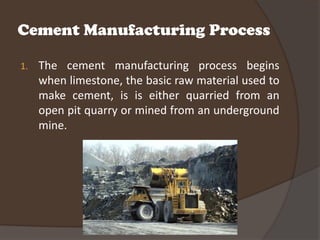
1.   The cement manufacturing process begins
     when limestone, the basic raw material used to
     make cement, is is either quarried from an
     open pit quarry or mined from an underground
     mine.
Cement Manufacturing Process

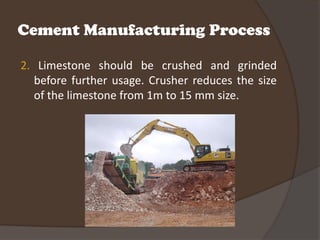
2. Limestone should be crushed and grinded
  before further usage. Crusher reduces the size
  of the limestone from 1m to 15 mm size.
Cement Manufacturing Process

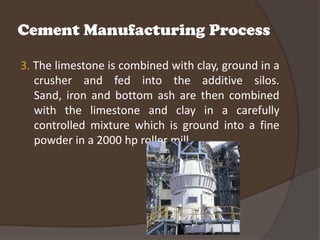
3. The limestone is combined with clay, ground in a
   crusher and fed into the additive silos.
   Sand, iron and bottom ash are then combined
   with the limestone and clay in a carefully
   controlled mixture which is ground into a fine
   powder in a 2000 hp roller mill.
Cement Manufacturing Process

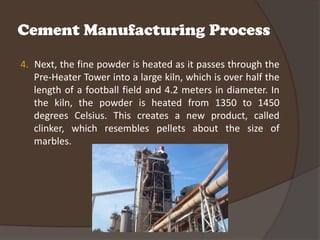
4. Next, the fine powder is heated as it passes through the
   Pre-Heater Tower into a large kiln, which is over half the
   length of a football field and 4.2 meters in diameter. In
   the kiln, the powder is heated from 1350 to 1450
   degrees Celsius. This creates a new product, called
   clinker, which resembles pellets about the size of
   marbles.
Cement Manufacturing Process

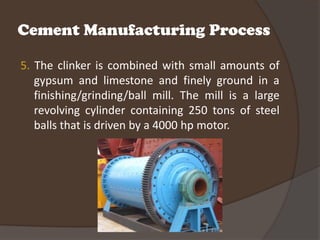
5. The clinker is combined with small amounts of
   gypsum and limestone and finely ground in a
   finishing/grinding/ball mill. The mill is a large
   revolving cylinder containing 250 tons of steel
   balls that is driven by a 4000 hp motor.
Cement Manufacturing Process

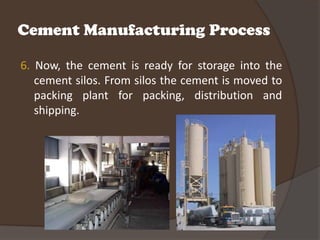
6. Now, the cement is ready for storage into the
   cement silos. From silos the cement is moved to
   packing plant for packing, distribution and
   shipping.
Cement Process Analysis
    CE & BTLV Products:
1.    Air circuit breakers (ACBs) in the low-voltage main
      switchboard ensure the power distribution in a cement plant.
2.    Using SIVACON 8PS bus bar trunking system, space saving
      power distribution for production halls/storage halls is
      possible. BD02 can be used as power backbone (main
      distribution), BD01 for lighting, LD system can also be applied
      power distribution, LR system for rough ambient conditions.
3.    Contractors, overload relays & soft starters can be used for
      motors protection.
4.    Push button units, indicators & signaling columns can be used
      for EMERGENCY-STOP and in the control room for monitoring
      complex procedures.
Cement Process Analysis
    MD Products:
1.   BEVEL-HELICAL GEAR UNITS or HELICAL GEAR
     UNITS can be applied at Conveyor drives & Bucket
     elevator drives.
2.   PLANETARY GEAR UNITS can be applied at Rotary
     kiln drive, Bucket wheel drives, Apron conveyor
     drives.
3.   COUPLINGS can be applied for transmission
     between drives at Conveying
     systems, Mixers, Crushers, Bucket wheel
     excavators.
4.   GEAR MOTORS can also be applied to Conveyor
     drives, Bucket elevator drives.
Cement Process Analysis
    LDI Products:
1.    AC MOTORS can be applicable with the gear units.
2.    AC DRIVES can be applied to
•     Fans
•     Pumps
•     Grinding mills
•     Kilns
•     Crushers
•     Conveyors
•     Mine hoists
Cement Process Analysis

  AS Products:
1. SIMATIC controllers / PLCs can be used for
    controlling machines, exhaust and filtering
    systems, conveyor systems, elevators, Silo
    facilities, vehicle control monitoring, alarm
    systems, level limiting monitoring, baggage
    handling, interior/exterior lighting
    control, door gate control etc.
2. SIPLUS versions for harsh environment.
Cement Process Analysis
  SC Products:
1.  SITRANS family can be applied at various
    processes throughout the cement industry.
    For instance:
2. For flow measurement at silos, grinding
    mills, kiln, clinker cooler etc.
3. For temperature
    limiting, monitoring, measuring preheating
    tower, kiln & clinker cooler.
4. Also for process controlling, level
    monitoring, pressure controlling etc.
Presented by….

presentation on Siemens

  • 2.
    SIEMENS Energy Industry Healthcare IS IA / DT LP GP IS CE & BTLV MD LDI AS SC
  • 4.
    SIVACON 8PS BusBar Trunking System  LR System(630A to 6300A)  LX System (800A to 6300A)  LD System (1100A TO 5000A)  BD2 System (160A to 1250A)  BD01 System (40A to 160A)  CD-K System (25 to 40A)
  • 5.
    Contactors  A contactoris an electrically controlled switch used for switching a power circuit, similar to relay except with higher current ratings.  To control electric motors, lighting, heating, capacitor banks, and other electrical loads.
  • 6.
    Circuit Breakers  Acircuit breaker is an automatically operated electrical switch designed to protect an electrical circuit from damage used by overload or short circuit.  Types of Circuit Breakers: ACB MCCB MCB
  • 8.
    Gearbox  A gearboxprovides speed and torque conversions from a rotating power source to another device using gear ratios.  Types of Gearbox: Bevel Helical Planetary Worm Spur
  • 9.
    Gear Motor  A gear motor is a type of electrical motor. It uses the magnetism induced by an electrical current to rotate a rotor that is connected to a shaft. The energy transferred from the rotor to the shaft is then used to power a connected device.
  • 10.
    Coupling  A coupling is a device used to connect two shafts together at their ends for the purpose of transmitting power. The primary purpose of couplings is to join two pieces of rotating equipment while permitting some degree of misalignment or end movement or both.
  • 12.
    AC Drives:  AC drives or VFDs or AFDs or Inverters are used to control the speed of an AC motor. In other words we can say that AC drives are used to eliminate torque so that the motor can work more efficiently, without losing energy.
  • 13.
    Types of ACDrives (w.r.t inverter):  VVI  CSI  PWM
  • 15.
    PLC:  A programmable logic controller (PLC) or programmable controller is a digital computer, automation of electromechanical processes, such as control of machinery on factory assembly lines, amusement rides, or lighting fixtures.
  • 16.
    SIMATIC Controllers:  LOGO! S7 200  S7 300  S7 400  S7 1200
  • 17.
  • 18.
  • 19.
    Cement Manufacturing Process 1. The cement manufacturing process begins when limestone, the basic raw material used to make cement, is is either quarried from an open pit quarry or mined from an underground mine.
  • 20.
    Cement Manufacturing Process 2.Limestone should be crushed and grinded before further usage. Crusher reduces the size of the limestone from 1m to 15 mm size.
  • 21.
    Cement Manufacturing Process 3.The limestone is combined with clay, ground in a crusher and fed into the additive silos. Sand, iron and bottom ash are then combined with the limestone and clay in a carefully controlled mixture which is ground into a fine powder in a 2000 hp roller mill.
  • 22.
    Cement Manufacturing Process 4.Next, the fine powder is heated as it passes through the Pre-Heater Tower into a large kiln, which is over half the length of a football field and 4.2 meters in diameter. In the kiln, the powder is heated from 1350 to 1450 degrees Celsius. This creates a new product, called clinker, which resembles pellets about the size of marbles.
  • 23.
    Cement Manufacturing Process 5.The clinker is combined with small amounts of gypsum and limestone and finely ground in a finishing/grinding/ball mill. The mill is a large revolving cylinder containing 250 tons of steel balls that is driven by a 4000 hp motor.
  • 24.
    Cement Manufacturing Process 6.Now, the cement is ready for storage into the cement silos. From silos the cement is moved to packing plant for packing, distribution and shipping.
  • 25.
    Cement Process Analysis  CE & BTLV Products: 1. Air circuit breakers (ACBs) in the low-voltage main switchboard ensure the power distribution in a cement plant. 2. Using SIVACON 8PS bus bar trunking system, space saving power distribution for production halls/storage halls is possible. BD02 can be used as power backbone (main distribution), BD01 for lighting, LD system can also be applied power distribution, LR system for rough ambient conditions. 3. Contractors, overload relays & soft starters can be used for motors protection. 4. Push button units, indicators & signaling columns can be used for EMERGENCY-STOP and in the control room for monitoring complex procedures.
  • 26.
    Cement Process Analysis  MD Products: 1. BEVEL-HELICAL GEAR UNITS or HELICAL GEAR UNITS can be applied at Conveyor drives & Bucket elevator drives. 2. PLANETARY GEAR UNITS can be applied at Rotary kiln drive, Bucket wheel drives, Apron conveyor drives. 3. COUPLINGS can be applied for transmission between drives at Conveying systems, Mixers, Crushers, Bucket wheel excavators. 4. GEAR MOTORS can also be applied to Conveyor drives, Bucket elevator drives.
  • 27.
    Cement Process Analysis  LDI Products: 1. AC MOTORS can be applicable with the gear units. 2. AC DRIVES can be applied to • Fans • Pumps • Grinding mills • Kilns • Crushers • Conveyors • Mine hoists
  • 28.
    Cement Process Analysis  AS Products: 1. SIMATIC controllers / PLCs can be used for controlling machines, exhaust and filtering systems, conveyor systems, elevators, Silo facilities, vehicle control monitoring, alarm systems, level limiting monitoring, baggage handling, interior/exterior lighting control, door gate control etc. 2. SIPLUS versions for harsh environment.
  • 29.
    Cement Process Analysis  SC Products: 1. SITRANS family can be applied at various processes throughout the cement industry. For instance: 2. For flow measurement at silos, grinding mills, kiln, clinker cooler etc. 3. For temperature limiting, monitoring, measuring preheating tower, kiln & clinker cooler. 4. Also for process controlling, level monitoring, pressure controlling etc.
  • 30.