*Presented By
*Muhammad Tariq
*Msc Morning
*Roll no 17
*Sports sciences pu lahore
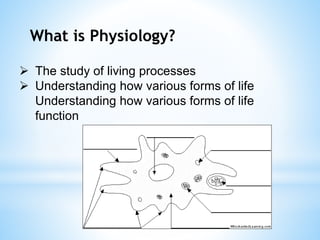
What is Physiology?
 The study of living processes
 Understanding how various forms of life
Understanding how various forms of life
function
What is Exercise Physiology?
 The study of the
function the
function of the
human of the
human body
during body
during and in and
in response to
response to
exercise.
Why is it important we study it?
 To better understand the workings of an
To better understand the workings of an
athlete’s body systems
How can we relate it to our area
of study?
We can apply physiological responses to
exercises exercises
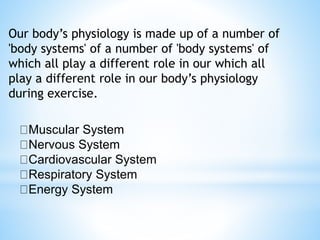
Our body’s physiology is made up of a number of
'body systems' of a number of 'body systems' of
which all play a different role in our which all
play a different role in our body’s physiology
during exercise.
Muscular System
Nervous System
Cardiovascular System
Respiratory System
Energy System
Muscular System
Muscles work by contracting and relaxing
therefore causing movement. therefore causing
movement.
During exercise, muscles are obviously
required to contract and relax more often.
Muscles, which Muscles, which contract to
cause contract to cause movement, require
movement, require energy in order to energy in
order to work. work.
This energy is quickly This energy is quickly
used up unless used up unless oxygen (02) is
oxygen (02) is supplied to the supplied to the
working muscles via working muscles via our
blood stream. our blood stream.
The Heart
The heart is a muscle that contains four The
heart is a muscle that contains four chambers.
chambers.
The upper two chambers are called The upper
two chambers are called atria and the and the
bottom two are called bottom two are called
ventricles. ventricles.
The heart’s job is to pump blood around the
heart’s job is to pump blood around the body
During exercise, the working muscles
require During exercise, the working muscles
require more oxygen. This means that during
exercise the heart has to work faster by
beating more the heart has to work faster by
beating more times a minute and harder by
pumping more blood out with each beat
The Circulatory System
There are two different circulations of There
are two different circulations of blood around
the body;
Pulmonary Circulation Pulmonary
Circulation –
circulation of blood between the heart
and lungs – this system between the heart and lungs – this
system takes deoxygenated blood from the body and
takes deoxygenated blood from the body and gives it
oxygen from the lungs
Systemic Circulation –
circulation of blood circulation of
blood between the heart and the body – this system
between the heart and the body – this system takes
oxygenated blood and sends it around takes oxygenated
blood and sends it around the body.
There are 3 main types of blood vessels in There are 3
main types of blood vessels in the human body; the human
body;
Arteries – Arteries – thick-walled vessels that carry blood
thick-walled vessels that carry blood away from the heart
from the heart
Capillaries – Capillaries – thin walled vessels that oxygen
can thin walled vessels that oxygen can move through to get
to the cells and carbon move through to get to the cells and
carbon dioxide can move into from cells. dioxide can move
into from cells.
Veins – Veins – thin walled vessels which
carry blood thin walled vessels which carry
blood towards the heart – there is no oxygen in
this the heart – there is no oxygen in this blood.
Because the blood is travelling up blood.
Because the blood is travelling up towards heart
it is fighting gravity. Valves are towards heart it is
fighting gravity. Valves are located in the veins
that open and close to keep located in the veins
that open and close to keep blood travelling in
one direction.
General functions of cardiovascular system during
exercise: system during exercise:
Redistributes blood from less active Redistributes
blood from less active regions of the body to muscles
involved in regions of the body to muscles involved in
activity
Increases the volume of blood pumped Increases the
volume of blood pumped out by the heart through an
increased out by the heart through an increased heart
rate (HR) heart rate (HR)
Buffers and removes waste products Buffers and
removes waste products
Aids in temperature regulation
spiratory System
The lungs, mouth, The lungs, mouth, throat
and nose throat and nose make up the make
up the respiratory system. respiratory
system.
The major function The major function of
our respiratory of our respiratory system is to
bring system is to bring oxygen (O2) into the
oxygen (O2) into the body and remove body
and remove carbon dioxide (Co2)
How does it work?
Oxygen (O2) is inhaled (breathed in) Oxygen (O2) is
inhaled (breathed in) down through the down
through the bronchi bronchi and into the and into
the alveoli alveoli of the lungs – from there it is of
the lungs – from there it is transferred into the
blood. transferred into the blood.
Carbon dioxide (CO2) and other wastes Carbon
dioxide (CO2) and other wastes are transferred from
the blood through to are transferred from the blood
through to the lungs and out of the body.
Respiratory system and exercise
When exercising, breathing occurs faster
When exercising, breathing occurs faster and
more deeply, allowing more oxygen to and
more deeply, allowing more oxygen to be
inhaled and transferred to the blood be
inhaled and transferred to the blood and
muscles where the oxygen is used to and
muscles where the oxygen is used to help fuel
exercise.
Major functions of the respiratory
system during exercise:
Increase the rate and Increase the rate and
depth of breathing depth of breathing
Increase oxygen (02) and Increase oxygen
(02) and carbon dioxide (C02) carbon dioxide
(C02) exchange in the lungs exchange in the
lungs
Increase the amount of Increase the amount
of oxygen (02) to the muscles oxygen (02) to
the muscles per unit of blood per unit of blood
Immediate responses to exercise:
Cardiac output (CO) Cardiac output (CO)
Increases (the amount of blood pumped Increases
(the amount of blood pumped out by the heart per
minute) out by the heart per minute)
Stroke volume (SV) Stroke volume (SV)
Increases (volume of blood injected into Increases
(volume of blood injected into aorta per beat of the
heart)
Immediate responses to
exercise:
Heart rate (HR) Heart rate (HR) Increases
(increase due to intensity and Increases
(increase due to intensity and workload)
workload)
Blood pressure (BP) Blood pressure (BP)
Increases
Blood Sent to working muscles
Heart
Increase size Increase size
Increase work capacity
Resting heart rate gets lower
Heart rate during exercise
gets lower
Heart rate (after exercising)
returns to normal faster
Respiratory System
The lungs can breathe in The lungs can
breathe in and out a greater volume of and out a
greater volume of air and with it oxygen air and
with it oxygen
Increase the amount of Increase the amount of
oxygen taken each breathe oxygen taken each
breathe and sent to working muscles and sent to
working muscles
Increased blood flow – more Increased blood
flow – more blood moving around the blood
moving around the body with oxygen attached
Muscular System
Muscles get larger and stronger Muscles
get larger and stronger
Muscles become more flexible Muscles
become more flexible
Muscles gain more blood vessels and
receive more blood and oxygen receive
more blood and oxygen
Muscles can store more energy
Presentation on physiology

Presentation on physiology

  • 2.
    *Presented By *Muhammad Tariq *MscMorning *Roll no 17 *Sports sciences pu lahore
  • 4.
    What is Physiology? The study of living processes  Understanding how various forms of life Understanding how various forms of life function
  • 5.
    What is ExercisePhysiology?  The study of the function the function of the human of the human body during body during and in and in response to response to exercise.
  • 6.
    Why is itimportant we study it?  To better understand the workings of an To better understand the workings of an athlete’s body systems
  • 7.
    How can werelate it to our area of study? We can apply physiological responses to We can apply physiological responses to exercises exercises
  • 8.
    Our body’s physiologyis made up of a number of 'body systems' of a number of 'body systems' of which all play a different role in our which all play a different role in our body’s physiology during exercise. Muscular System Nervous System Cardiovascular System Respiratory System Energy System
  • 9.
    Muscular System Muscles workby contracting and relaxing Muscles work by contracting and relaxing therefore causing movement. therefore causing movement. During exercise, muscles are obviously During exercise, muscles are obviously required to contract and relax more often.
  • 10.
    Muscles, which Muscles,which contract to cause contract to cause movement, require movement, require energy in order to energy in order to work. work. This energy is quickly This energy is quickly used up unless used up unless oxygen (02) is oxygen (02) is supplied to the supplied to the working muscles via working muscles via our blood stream. our blood stream.
  • 11.
    The Heart The heartis a muscle that contains four The heart is a muscle that contains four chambers. chambers. The upper two chambers are called The upper two chambers are called atria and the and the bottom two are called bottom two are called ventricles. ventricles.
  • 12.
    The heart’s jobis to pump blood around the heart’s job is to pump blood around the body During exercise, the working muscles require During exercise, the working muscles require more oxygen. This means that during exercise the heart has to work faster by beating more the heart has to work faster by beating more times a minute and harder by pumping more blood out with each beat
  • 13.
    The Circulatory System Thereare two different circulations of There are two different circulations of blood around the body; Pulmonary Circulation Pulmonary Circulation – circulation of blood between the heart and lungs – this system between the heart and lungs – this system takes deoxygenated blood from the body and takes deoxygenated blood from the body and gives it oxygen from the lungs
  • 14.
    Systemic Circulation – circulationof blood circulation of blood between the heart and the body – this system between the heart and the body – this system takes oxygenated blood and sends it around takes oxygenated blood and sends it around the body.
  • 15.
    There are 3main types of blood vessels in There are 3 main types of blood vessels in the human body; the human body; Arteries – Arteries – thick-walled vessels that carry blood thick-walled vessels that carry blood away from the heart from the heart Capillaries – Capillaries – thin walled vessels that oxygen can thin walled vessels that oxygen can move through to get to the cells and carbon move through to get to the cells and carbon dioxide can move into from cells. dioxide can move into from cells.
  • 16.
    Veins – Veins– thin walled vessels which carry blood thin walled vessels which carry blood towards the heart – there is no oxygen in this the heart – there is no oxygen in this blood. Because the blood is travelling up blood. Because the blood is travelling up towards heart it is fighting gravity. Valves are towards heart it is fighting gravity. Valves are located in the veins that open and close to keep located in the veins that open and close to keep blood travelling in one direction.
  • 17.
    General functions ofcardiovascular system during exercise: system during exercise: Redistributes blood from less active Redistributes blood from less active regions of the body to muscles involved in regions of the body to muscles involved in activity Increases the volume of blood pumped Increases the volume of blood pumped out by the heart through an increased out by the heart through an increased heart rate (HR) heart rate (HR) Buffers and removes waste products Buffers and removes waste products Aids in temperature regulation
  • 18.
    spiratory System The lungs,mouth, The lungs, mouth, throat and nose throat and nose make up the make up the respiratory system. respiratory system. The major function The major function of our respiratory of our respiratory system is to bring system is to bring oxygen (O2) into the oxygen (O2) into the body and remove body and remove carbon dioxide (Co2)
  • 19.
    How does itwork? Oxygen (O2) is inhaled (breathed in) Oxygen (O2) is inhaled (breathed in) down through the down through the bronchi bronchi and into the and into the alveoli alveoli of the lungs – from there it is of the lungs – from there it is transferred into the blood. transferred into the blood. Carbon dioxide (CO2) and other wastes Carbon dioxide (CO2) and other wastes are transferred from the blood through to are transferred from the blood through to the lungs and out of the body.
  • 20.
    Respiratory system andexercise When exercising, breathing occurs faster When exercising, breathing occurs faster and more deeply, allowing more oxygen to and more deeply, allowing more oxygen to be inhaled and transferred to the blood be inhaled and transferred to the blood and muscles where the oxygen is used to and muscles where the oxygen is used to help fuel exercise.
  • 21.
    Major functions ofthe respiratory system during exercise: Increase the rate and Increase the rate and depth of breathing depth of breathing Increase oxygen (02) and Increase oxygen (02) and carbon dioxide (C02) carbon dioxide (C02) exchange in the lungs exchange in the lungs Increase the amount of Increase the amount of oxygen (02) to the muscles oxygen (02) to the muscles per unit of blood per unit of blood
  • 22.
    Immediate responses toexercise: Cardiac output (CO) Cardiac output (CO) Increases (the amount of blood pumped Increases (the amount of blood pumped out by the heart per minute) out by the heart per minute) Stroke volume (SV) Stroke volume (SV) Increases (volume of blood injected into Increases (volume of blood injected into aorta per beat of the heart)
  • 23.
    Immediate responses to exercise: Heartrate (HR) Heart rate (HR) Increases (increase due to intensity and Increases (increase due to intensity and workload) workload) Blood pressure (BP) Blood pressure (BP) Increases Blood Sent to working muscles
  • 24.
    Heart Increase size Increasesize Increase work capacity Resting heart rate gets lower Heart rate during exercise gets lower Heart rate (after exercising) returns to normal faster
  • 25.
    Respiratory System The lungscan breathe in The lungs can breathe in and out a greater volume of and out a greater volume of air and with it oxygen air and with it oxygen Increase the amount of Increase the amount of oxygen taken each breathe oxygen taken each breathe and sent to working muscles and sent to working muscles Increased blood flow – more Increased blood flow – more blood moving around the blood moving around the body with oxygen attached
  • 26.
    Muscular System Muscles getlarger and stronger Muscles get larger and stronger Muscles become more flexible Muscles become more flexible Muscles gain more blood vessels and Muscles gain more blood vessels and receive more blood and oxygen receive more blood and oxygen Muscles can store more energy