NAIP: Engagement for Reforms in
 Organizational Development of
          Indian NARS

           Mruthyunjaya
     Former ND, NAIP, ICAR, India
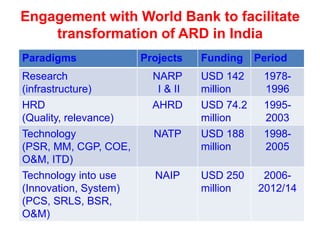
Engagement with World Bank to facilitate
    transformation of ARD in India
Paradigms              Projects    Funding    Period
Research                 NARP      USD 142     1978-
(infrastructure)          I & II   million     1996
HRD                      AHRD      USD 74.2    1995-
(Quality, relevance)               million     2003
Technology               NATP      USD 188     1998-
(PSR, MM, CGP, COE,                million     2005
O&M, ITD)
Technology into use      NAIP      USD 250     2006-
(Innovation, System)               million    2012/14
(PCS, SRLS, BSR,
O&M)
National Agricultural Innovation
                 Project
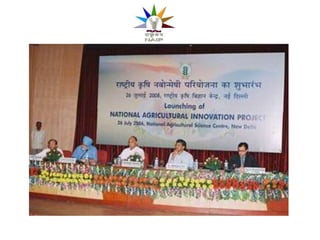
• As a successor to NATP, NAIP was launched in June, 2006 with
  the assistance of USD 250 million credit from the World Bank
• Mega project to demonstrate AIS in practice in NARS,
  Countries are watching and waiting for learnings
• Development objective is to contribute to accelerated and
  sustainable transformation of the Indian agriculture to
  support poverty alleviation and income generation through
  collaborative development and application of agricultural
  innovations by the public organizations in partnership with
  farmers groups, private sector and other stake holders
• Specific objectives are to strengthen scientific capacity,
  market orientation, social inclusion and institutional capacity
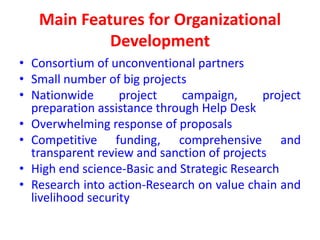
Main Features for Organizational
            Development
• Consortium of unconventional partners
• Small number of big projects
• Nationwide       project   campaign,      project
  preparation assistance through Help Desk
• Overwhelming response of proposals
• Competitive funding, comprehensive and
  transparent review and sanction of projects
• High end science-Basic and Strategic Research
• Research into action-Research on value chain and
  livelihood security
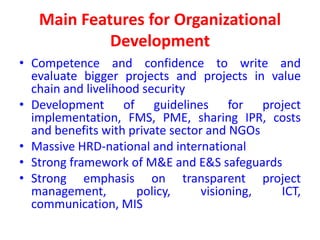
Main Features for Organizational
            Development
• Competence and confidence to write and
  evaluate bigger projects and projects in value
  chain and livelihood security
• Development of guidelines for project
  implementation, FMS, PME, sharing IPR, costs
  and benefits with private sector and NGOs
• Massive HRD-national and international
• Strong framework of M&E and E&S safeguards
• Strong emphasis on transparent project
  management,         policy,     visioning, ICT,
  communication, MIS
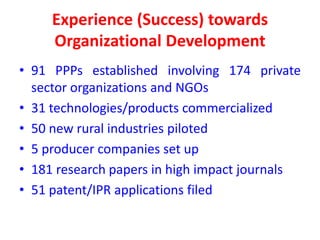
Experience (Success) towards
     Organizational Development
• 91 PPPs established involving 174 private
  sector organizations and NGOs
• 31 technologies/products commercialized
• 50 new rural industries piloted
• 5 producer companies set up
• 181 research papers in high impact journals
• 51 patent/IPR applications filed
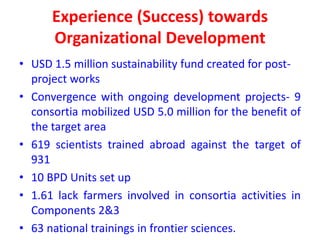
Experience (Success) towards
      Organizational Development
• USD 1.5 million sustainability fund created for post-
  project works
• Convergence with ongoing development projects- 9
  consortia mobilized USD 5.0 million for the benefit of
  the target area
• 619 scientists trained abroad against the target of
  931
• 10 BPD Units set up
• 1.61 lack farmers involved in consortia activities in
  Components 2&3
• 63 national trainings in frontier sciences.
Experience (Progress slow) towards
       Organizational Development
•   Learning across projects
•   Credit utilization
•   Achieving all the key performance indicators
•   Procurement, FMS, M&E
•   Impact assessments
Experience (Progress Slow) towards
    Organizational Development

• Documentation
• Mixed PPP experience
• Mainstreaming successful NAIP project results
  into 12th FYP
Proposed Plan for Sharing of NAIP
  Learnings with other Organizations
• Dissemination      through      print    media-
  Reports, Policy Briefs, Success Stories
• Dissemination through electronic media-
  CDs, Films on Success Stories, TV
  Channels, etc.
• Contributions/presentations/participation in
  national            and            international
  meetings, conferences, project preparation
  and         organizational         development
  exercises, etc.

C2.1. NAIP: Engagement for Reforms in Organizational Development of Indian NARS

  • 1.
    NAIP: Engagement forReforms in Organizational Development of Indian NARS Mruthyunjaya Former ND, NAIP, ICAR, India
  • 2.
    Engagement with WorldBank to facilitate transformation of ARD in India Paradigms Projects Funding Period Research NARP USD 142 1978- (infrastructure) I & II million 1996 HRD AHRD USD 74.2 1995- (Quality, relevance) million 2003 Technology NATP USD 188 1998- (PSR, MM, CGP, COE, million 2005 O&M, ITD) Technology into use NAIP USD 250 2006- (Innovation, System) million 2012/14 (PCS, SRLS, BSR, O&M)
  • 4.
    National Agricultural Innovation Project • As a successor to NATP, NAIP was launched in June, 2006 with the assistance of USD 250 million credit from the World Bank • Mega project to demonstrate AIS in practice in NARS, Countries are watching and waiting for learnings • Development objective is to contribute to accelerated and sustainable transformation of the Indian agriculture to support poverty alleviation and income generation through collaborative development and application of agricultural innovations by the public organizations in partnership with farmers groups, private sector and other stake holders • Specific objectives are to strengthen scientific capacity, market orientation, social inclusion and institutional capacity
  • 5.
    Main Features forOrganizational Development • Consortium of unconventional partners • Small number of big projects • Nationwide project campaign, project preparation assistance through Help Desk • Overwhelming response of proposals • Competitive funding, comprehensive and transparent review and sanction of projects • High end science-Basic and Strategic Research • Research into action-Research on value chain and livelihood security
  • 6.
    Main Features forOrganizational Development • Competence and confidence to write and evaluate bigger projects and projects in value chain and livelihood security • Development of guidelines for project implementation, FMS, PME, sharing IPR, costs and benefits with private sector and NGOs • Massive HRD-national and international • Strong framework of M&E and E&S safeguards • Strong emphasis on transparent project management, policy, visioning, ICT, communication, MIS
  • 7.
    Experience (Success) towards Organizational Development • 91 PPPs established involving 174 private sector organizations and NGOs • 31 technologies/products commercialized • 50 new rural industries piloted • 5 producer companies set up • 181 research papers in high impact journals • 51 patent/IPR applications filed
  • 8.
    Experience (Success) towards Organizational Development • USD 1.5 million sustainability fund created for post- project works • Convergence with ongoing development projects- 9 consortia mobilized USD 5.0 million for the benefit of the target area • 619 scientists trained abroad against the target of 931 • 10 BPD Units set up • 1.61 lack farmers involved in consortia activities in Components 2&3 • 63 national trainings in frontier sciences.
  • 9.
    Experience (Progress slow)towards Organizational Development • Learning across projects • Credit utilization • Achieving all the key performance indicators • Procurement, FMS, M&E • Impact assessments
  • 10.
    Experience (Progress Slow)towards Organizational Development • Documentation • Mixed PPP experience • Mainstreaming successful NAIP project results into 12th FYP
  • 11.
    Proposed Plan forSharing of NAIP Learnings with other Organizations • Dissemination through print media- Reports, Policy Briefs, Success Stories • Dissemination through electronic media- CDs, Films on Success Stories, TV Channels, etc. • Contributions/presentations/participation in national and international meetings, conferences, project preparation and organizational development exercises, etc.