INTERRUPTS CONTROL AND MANAGEMENT
1
ASSIGNMENT WORK IN OPERATING
SYSTEMS
Presented to :
Er Harvinder Singh
(Department of CSE )
Presented By :
Madhur Gupta
1712159
CSE A 5th Sem ( 2012-2016)
• Classification of Interrupts
• Maskable Interrupts (Can be delayed or Rejected)
• Non-Maskable Interrupts (Can not be delayed or Rejected)
• Vectored (the address of the service routine is hard-wired)
• Non-vectored (the address of the service routine needs to be supplied externally by the device)
• What happens when MP is interrupted ?
• Responding to Interrupts
• The 8085 Interrupts
• Multiple Interrupts & Priorities
• How do we allow multiple devices to interrupt using the INTR line?
• The Priority Encoder
• Masking RST 5.5, RST 6.5 and RST 7.5
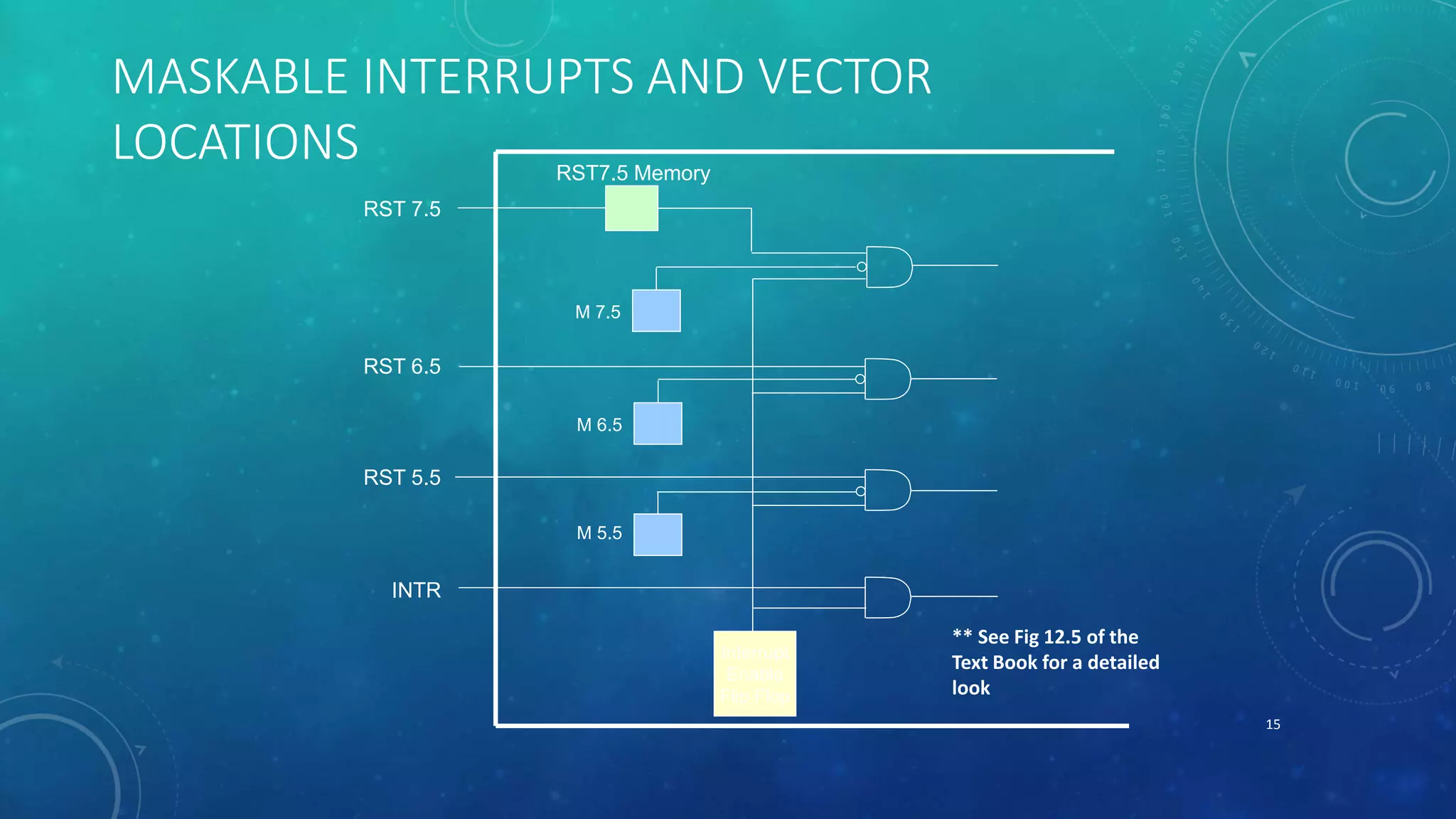
• Maskable Interrupts and vector locations
• The 8085 Maskable/Vectored Interrupt Process
• Manipulating the Masks
• How SIM Interprets the Accumulator
• SIM and the Interrupt Mask
• RIM instruction: Read Interrupt Mask
• TRAP
THE THINGS THAT WILL BE COVERED IN THIS PRESENTATION Alias List of Contents
HIGHLIGHTES
INTERRUPTS
• Interrupt is a process where an external device can get the attention of the microprocessor.
• The process starts from the I/O device
• The process is asynchronous.
• Classification of Interrupts
• Interrupts can be classified into two types:
• Maskable Interrupts (Can be delayed or Rejected)
• Non-Maskable Interrupts (Can not be delayed or Rejected)
• Interrupts can also be classified into:
• Vectored (the address of the service routine is hard-wired)
• Non-vectored (the address of the service routine needs to be supplied externally by the
device)
3
INTERRUPTS
• An interrupt is considered to be an emergency signal that may be serviced.
• The Microprocessor may respond to it as soon as possible.
• What happens when MP is interrupted ?
• When the Microprocessor receives an interrupt signal, it suspends the currently executing program and jumps
to an Interrupt Service Routine (ISR) to respond to the incoming interrupt.
• Each interrupt will most probably have its own ISR.
4
RESPONDING TO INTERRUPTS
• Responding to an interrupt may be immediate or delayed depending on whether the interrupt is
maskable or non-maskable and whether interrupts are being masked or not.
• There are two ways of redirecting the execution to the ISR depending on whether the interrupt is
vectored or non-vectored.
• Vectored: The address of the subroutine is already known to the Microprocessor
• Non Vectored: The device will have to supply the address of the subroutine to the Microprocessor
5
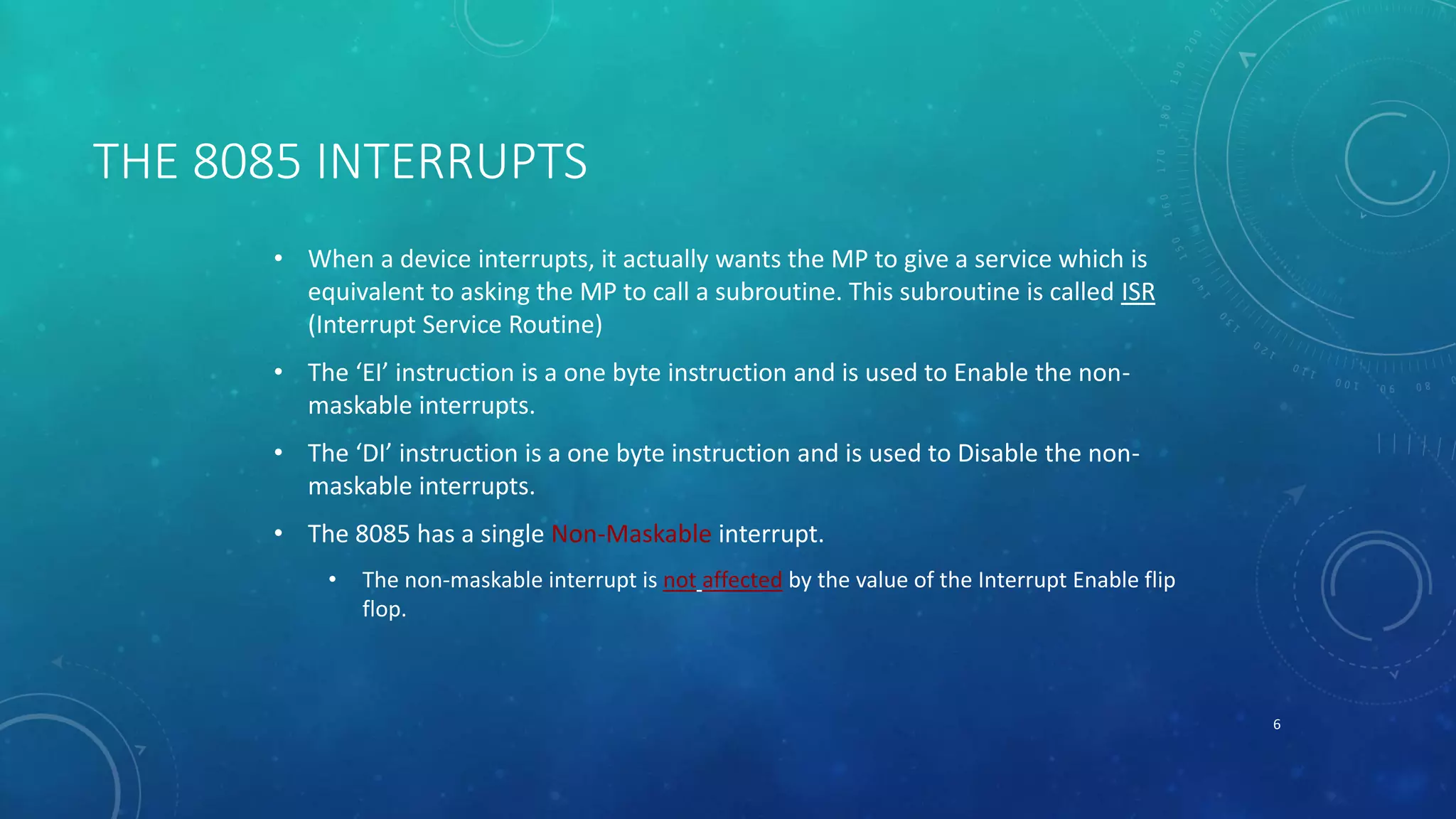
THE 8085 INTERRUPTS
• When a device interrupts, it actually wants the MP to give a service which is
equivalent to asking the MP to call a subroutine. This subroutine is called ISR
(Interrupt Service Routine)
• The ‘EI’ instruction is a one byte instruction and is used to Enable the non-
maskable interrupts.
• The ‘DI’ instruction is a one byte instruction and is used to Disable the non-
maskable interrupts.
• The 8085 has a single Non-Maskable interrupt.
• The non-maskable interrupt is not affected by the value of the Interrupt Enable flip
flop.
6
THE 8085 INTERRUPTS
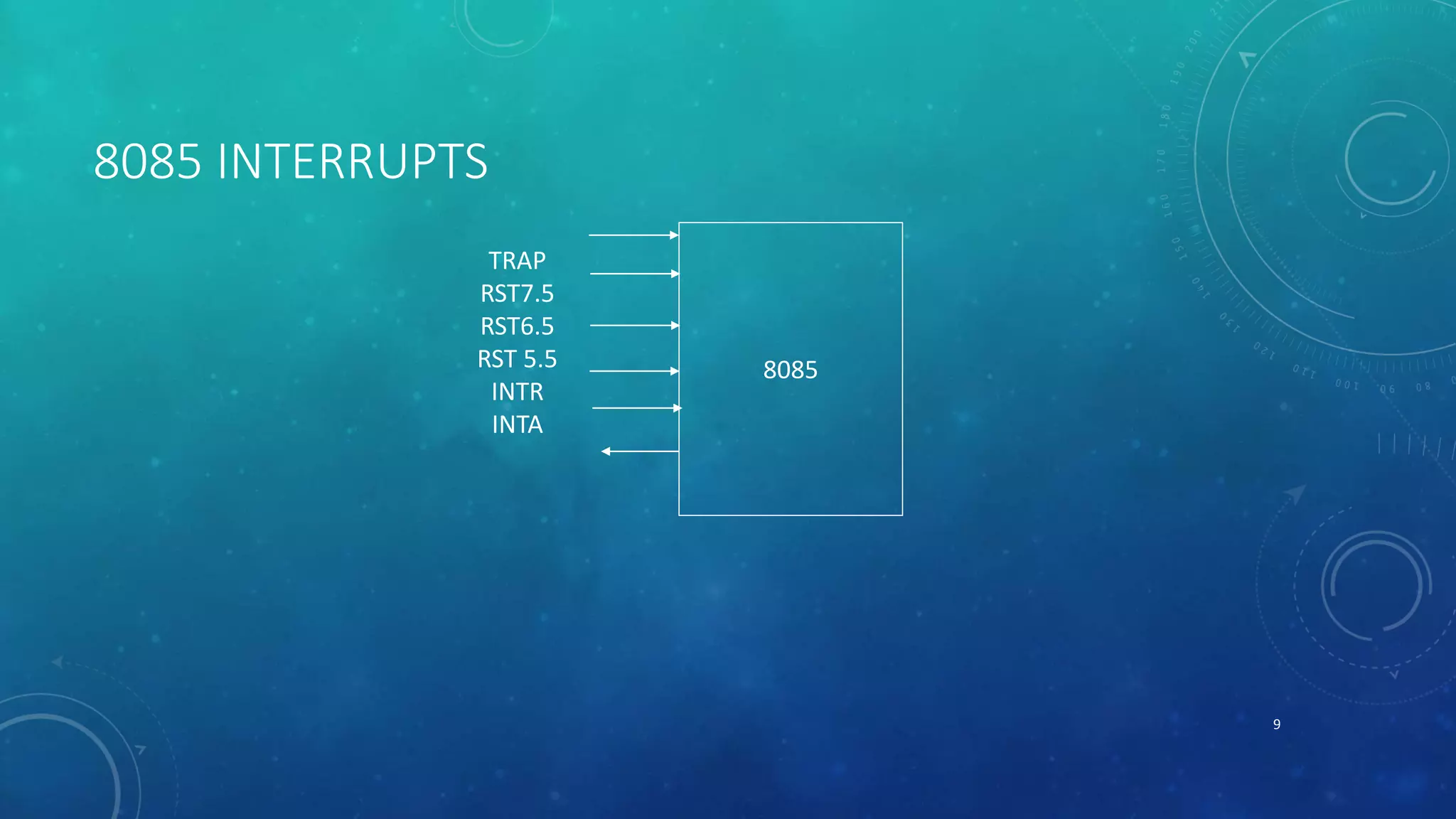
• The 8085 has 5 interrupt inputs.
• The INTR input.
• The INTR input is the only non-vectored interrupt.
• INTR is maskable using the EI/DI instruction pair.
• RST 5.5, RST 6.5, RST 7.5 are all automatically vectored.
• RST 5.5, RST 6.5, and RST 7.5 are all maskable.
• TRAP is the only non-maskable interrupt in the 8085
• TRAP is also automatically vectored
7
THE 8085 INTERRUPTS
Interrupt name Maskable Vectored
INTR Yes No
RST 5.5 Yes Yes
RST 6.5 Yes Yes
RST 7.5 Yes Yes
TRAP No Yes
8
8085 INTERRUPTS
9
8085
TRAP
RST7.5
RST6.5
RST 5.5
INTR
INTA
MULTIPLE INTERRUPTS & PRIORITIES
• How do we allow multiple devices to interrupt using the INTR line?
• The microprocessor can only respond to one signal on INTR at a time.
• Therefore, we must allow the signal from only one of the devices to reach the microprocessor.
• We must assign some priority to the different devices and allow their signals to reach the microprocessor
according to the priority.
10
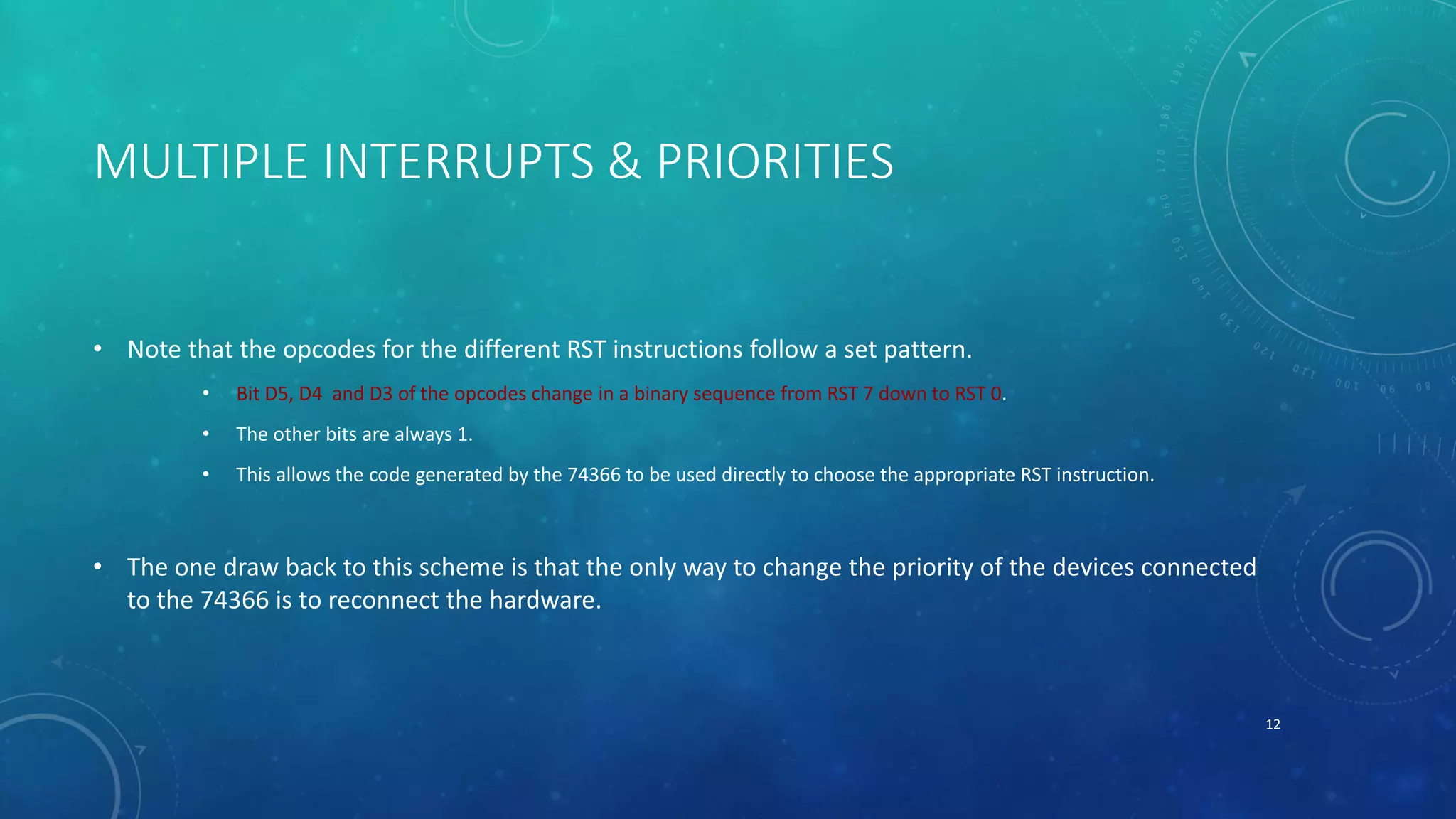
THE PRIORITY ENCODER
• The solution is to use a circuit called the priority encoder (74LS148).
• This circuit has 8 inputs and 3 outputs.
• The inputs are assigned increasing priorities according to the increasing index of the input.
• Input 7 has highest priority and input 0 has the lowest.
• The 3 outputs carry the index of the highest priority active input.
• Figure 12.4 in the book shows how this circuit can be used with a Tri-state buffer to implement an interrupt
priority scheme.
11
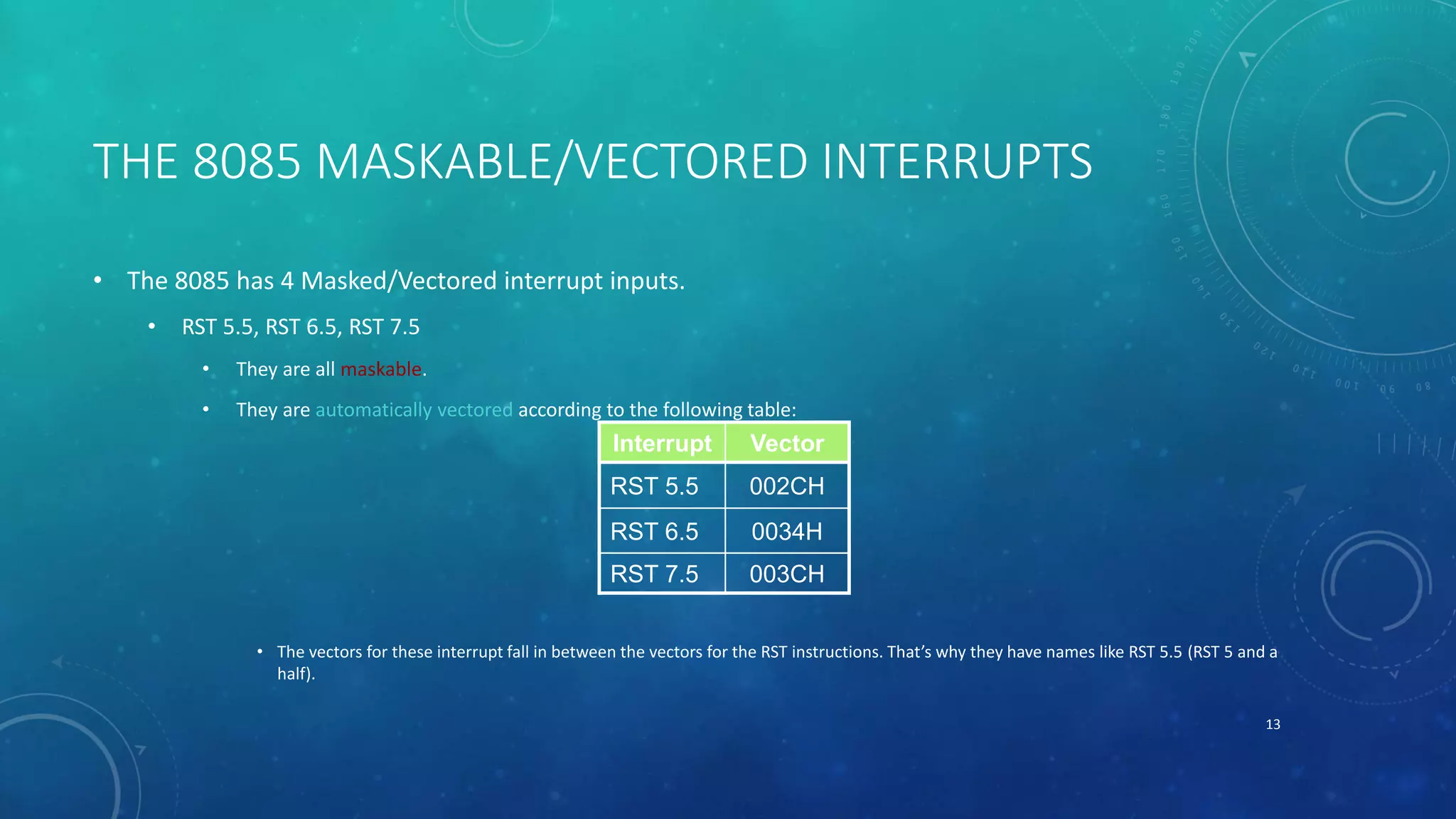
MULTIPLE INTERRUPTS & PRIORITIES
• Note that the opcodes for the different RST instructions follow a set pattern.
• Bit D5, D4 and D3 of the opcodes change in a binary sequence from RST 7 down to RST 0.
• The other bits are always 1.
• This allows the code generated by the 74366 to be used directly to choose the appropriate RST instruction.
• The one draw back to this scheme is that the only way to change the priority of the devices connected
to the 74366 is to reconnect the hardware.
12
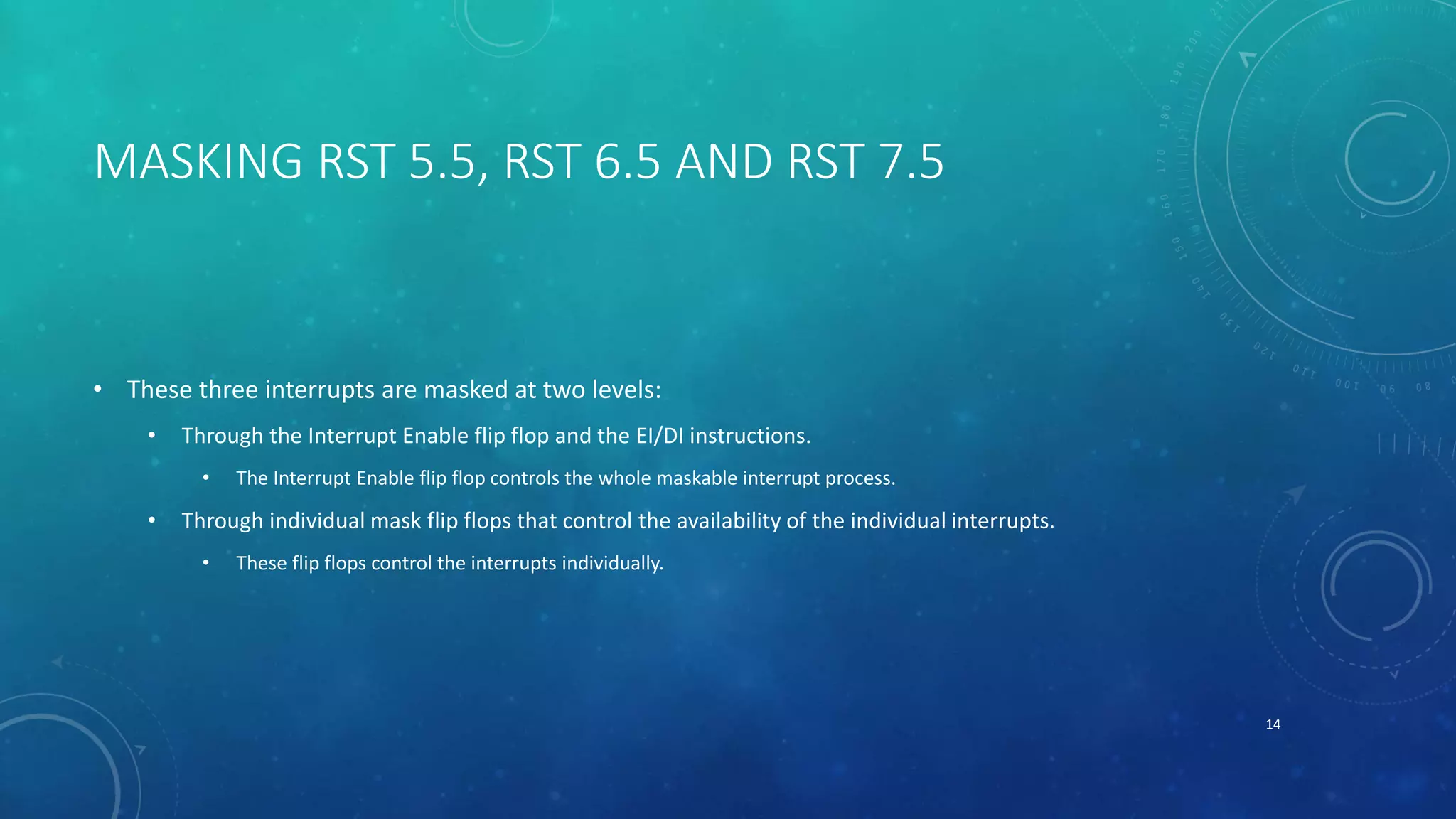
THE 8085 MASKABLE/VECTORED INTERRUPTS
• The 8085 has 4 Masked/Vectored interrupt inputs.
• RST 5.5, RST 6.5, RST 7.5
• They are all maskable.
• They are automatically vectored according to the following table:
• The vectors for these interrupt fall in between the vectors for the RST instructions. That’s why they have names like RST 5.5 (RST 5 and a
half).
13
Interrupt Vector
RST 5.5 002CH
RST 6.5 0034H
RST 7.5 003CH
MASKING RST 5.5, RST 6.5 AND RST 7.5
• These three interrupts are masked at two levels:
• Through the Interrupt Enable flip flop and the EI/DI instructions.
• The Interrupt Enable flip flop controls the whole maskable interrupt process.
• Through individual mask flip flops that control the availability of the individual interrupts.
• These flip flops control the interrupts individually.
14
MASKABLE INTERRUPTS AND VECTOR
LOCATIONS
15
Interrupt
Enable
Flip Flop
INTR
RST 5.5
RST 6.5
RST 7.5
M 5.5
M 6.5
M 7.5
RST7.5 Memory
** See Fig 12.5 of the
Text Book for a detailed
look
THE 8085 MASKABLE/VECTORED INTERRUPT PROCESS
1. The interrupt process should be enabled using the EI instruction.
2. The 8085 checks for an interrupt during the execution of every
instruction.
3. If there is an interrupt, and if the interrupt is enabled using the interrupt
mask, the microprocessor will complete the executing instruction, and
reset the interrupt flip flop.
4. The microprocessor then executes a call instruction that sends the
execution to the appropriate location in the interrupt vector table.
16
THE 8085 MASKABLE/VECTORED INTERRUPT PROCESS
5. When the microprocessor executes the call instruction, it saves the
address of the next instruction on the stack.
6. The microprocessor jumps to the specific service routine.
7. The service routine must include the instruction EI to re-enable the
interrupt process.
8. At the end of the service routine, the RET instruction returns the
execution to where the program was interrupted.
17
MANIPULATING THE MASKS
• The Interrupt Enable flip flop is manipulated using the EI/DI instructions.
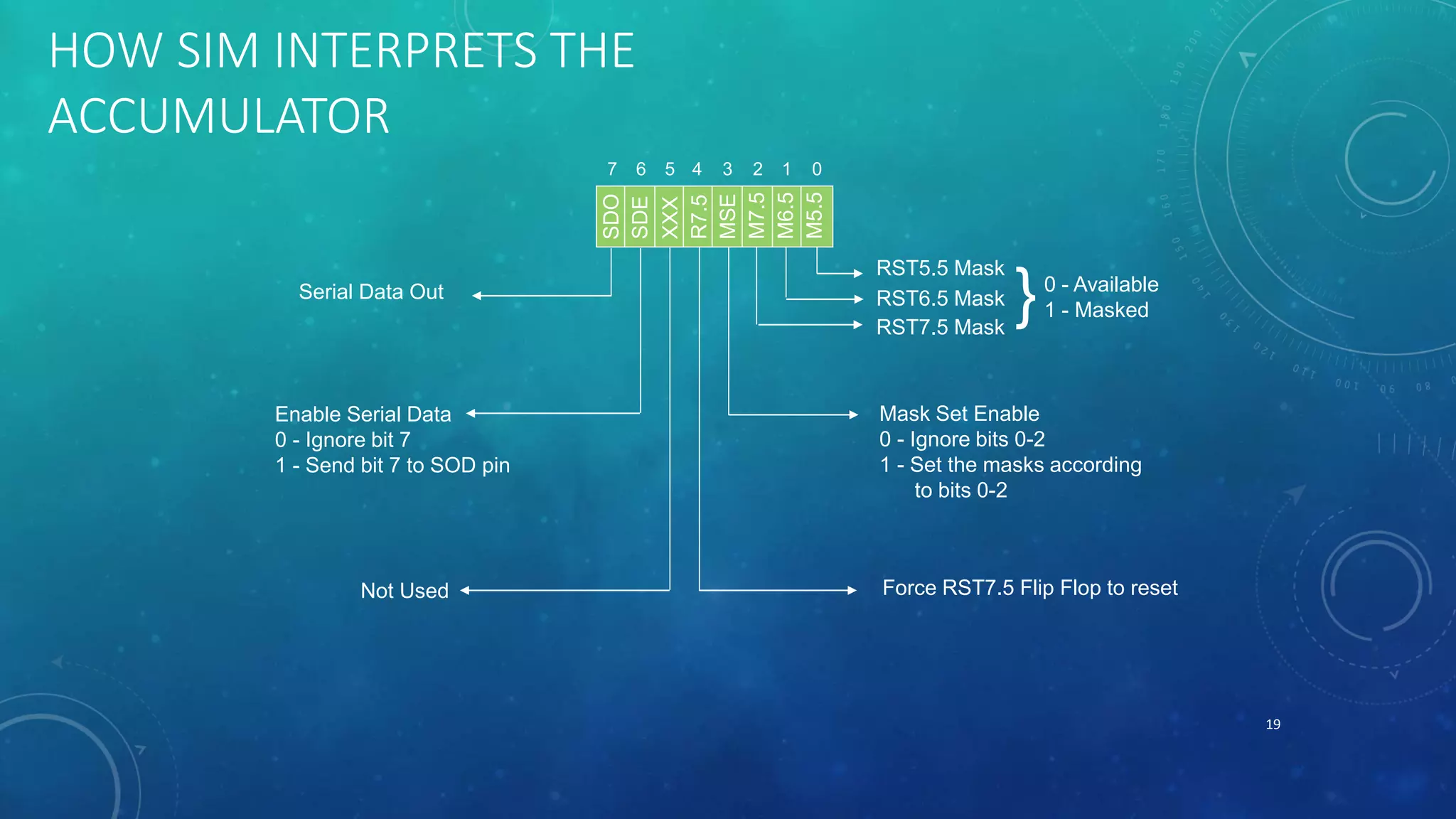
• The individual masks for RST 5.5, RST 6.5 and RST 7.5 are manipulated using the SIM instruction.
• This instruction takes the bit pattern in the Accumulator and applies it to the interrupt mask enabling and
disabling the specific interrupts.
18
HOW SIM INTERPRETS THE
ACCUMULATOR
19
SDO
SDE
XXX
R7.5
MSE
M7.5
M6.5
M5.5
01234567
RST5.5 Mask
RST6.5 Mask
RST7.5 Mask
}0 - Available
1 - Masked
Mask Set Enable
0 - Ignore bits 0-2
1 - Set the masks according
to bits 0-2
Force RST7.5 Flip Flop to resetNot Used
Enable Serial Data
0 - Ignore bit 7
1 - Send bit 7 to SOD pin
Serial Data Out
SIM AND THE INTERRUPT MASK
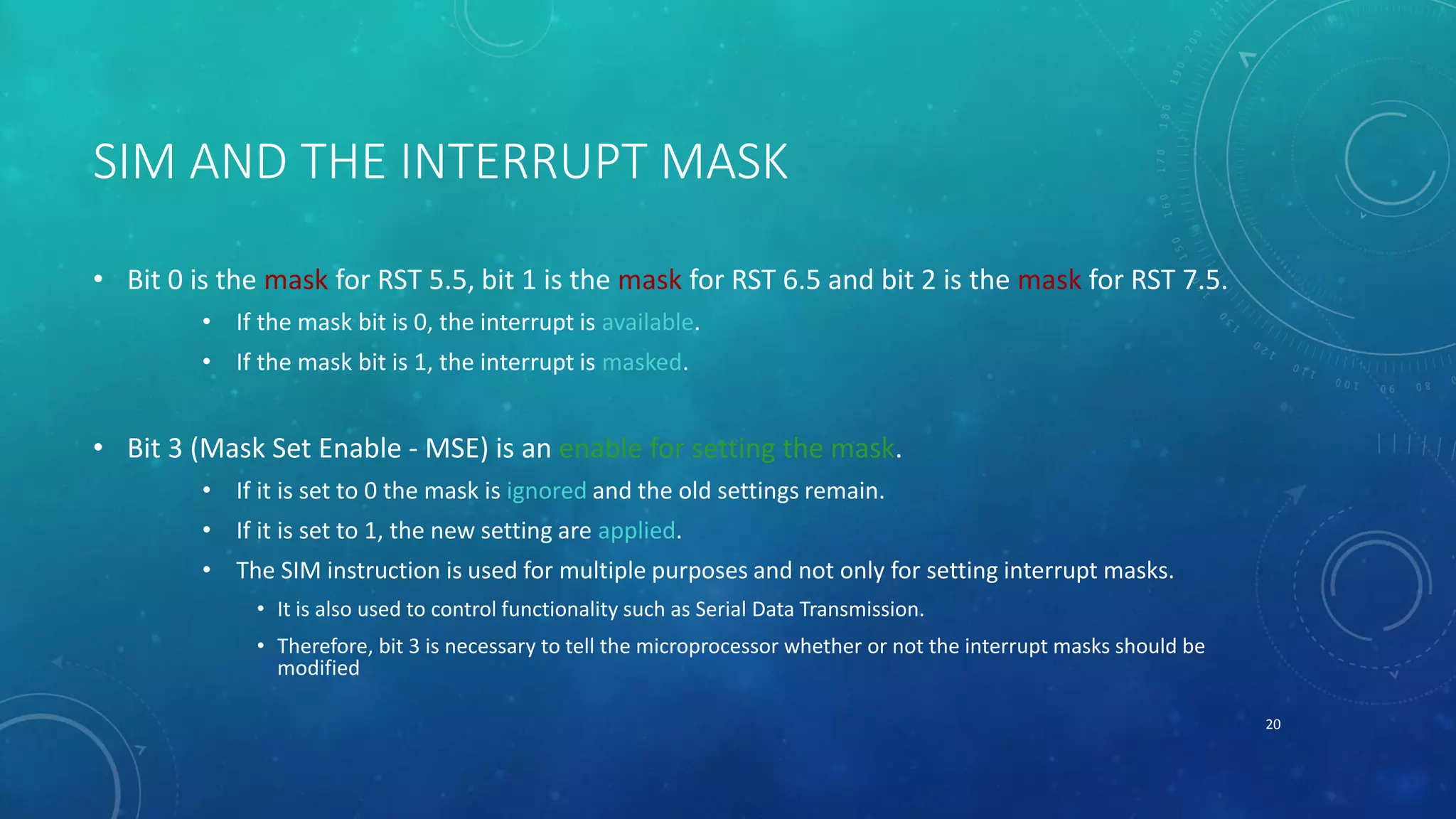
• Bit 0 is the mask for RST 5.5, bit 1 is the mask for RST 6.5 and bit 2 is the mask for RST 7.5.
• If the mask bit is 0, the interrupt is available.
• If the mask bit is 1, the interrupt is masked.
• Bit 3 (Mask Set Enable - MSE) is an enable for setting the mask.
• If it is set to 0 the mask is ignored and the old settings remain.
• If it is set to 1, the new setting are applied.
• The SIM instruction is used for multiple purposes and not only for setting interrupt masks.
• It is also used to control functionality such as Serial Data Transmission.
• Therefore, bit 3 is necessary to tell the microprocessor whether or not the interrupt masks should be
modified
20
SIM AND THE INTERRUPT MASK
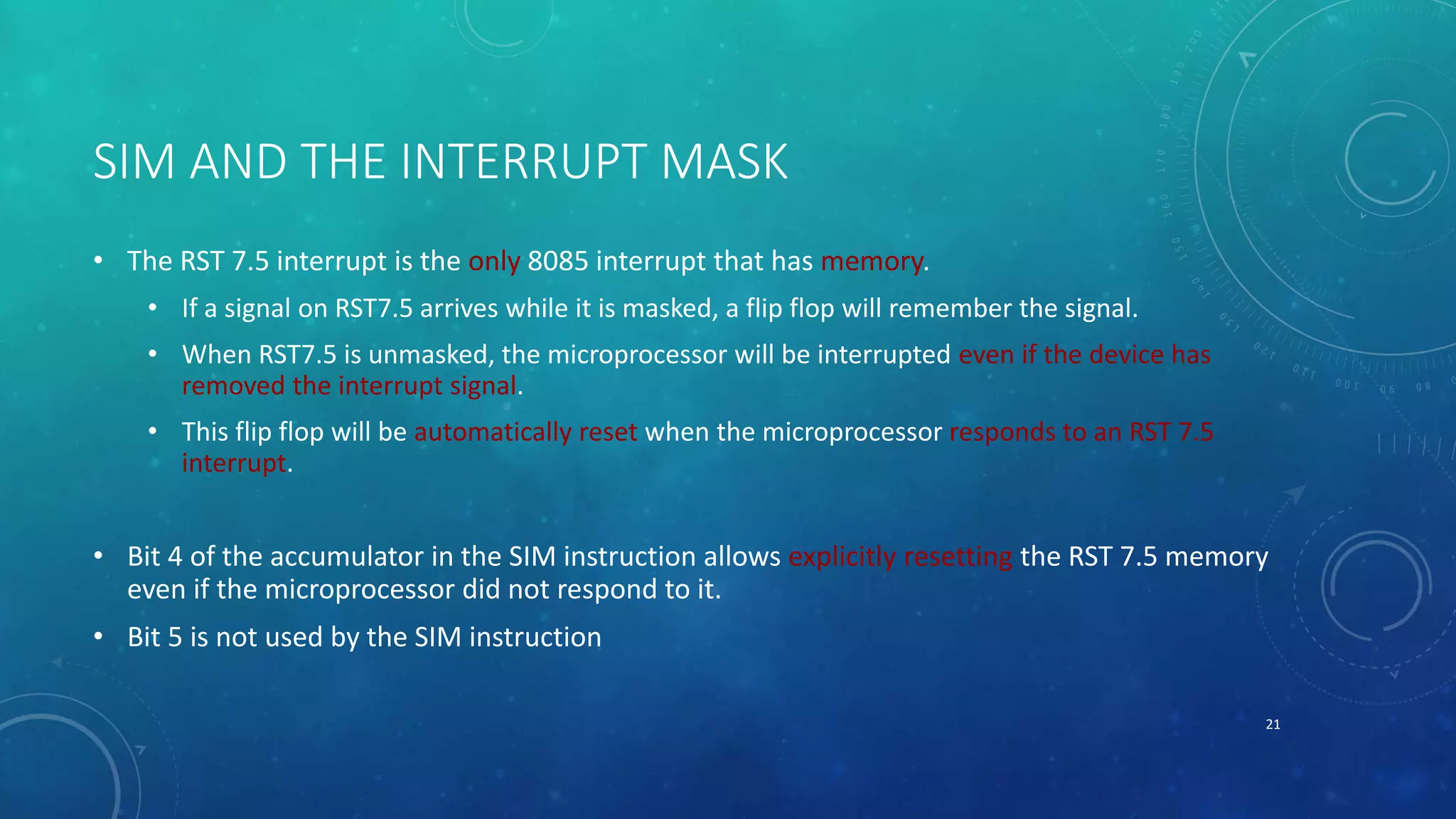
• The RST 7.5 interrupt is the only 8085 interrupt that has memory.
• If a signal on RST7.5 arrives while it is masked, a flip flop will remember the signal.
• When RST7.5 is unmasked, the microprocessor will be interrupted even if the device has
removed the interrupt signal.
• This flip flop will be automatically reset when the microprocessor responds to an RST 7.5
interrupt.
• Bit 4 of the accumulator in the SIM instruction allows explicitly resetting the RST 7.5 memory
even if the microprocessor did not respond to it.
• Bit 5 is not used by the SIM instruction
21
USING THE SIM INSTRUCTION TO MODIFY THE INTERRUPT
MASKS
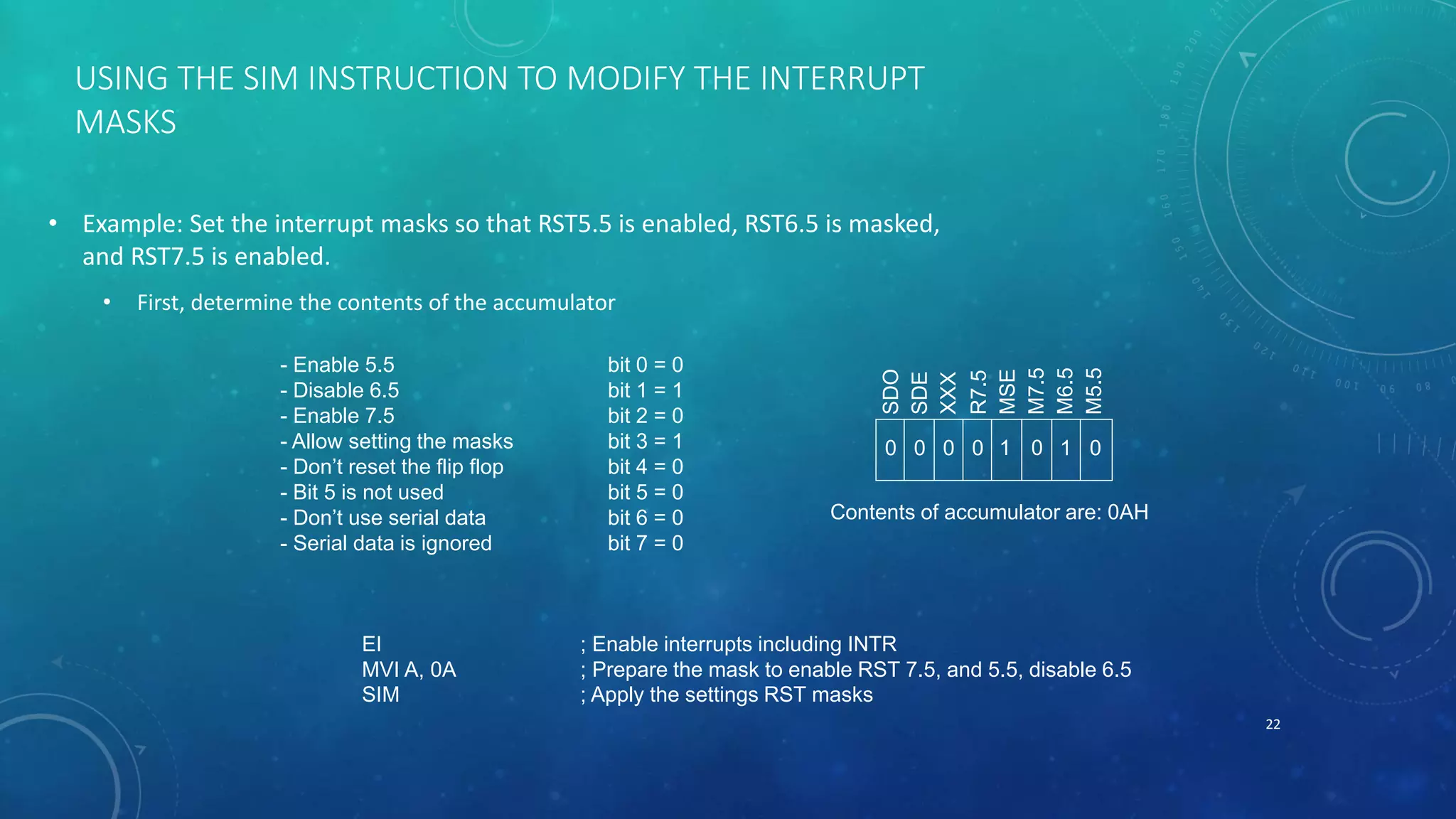
• Example: Set the interrupt masks so that RST5.5 is enabled, RST6.5 is masked,
and RST7.5 is enabled.
• First, determine the contents of the accumulator
22
SDO
SDE
XXX
R7.5
MSE
M7.5
M6.5
M5.5
- Enable 5.5 bit 0 = 0
- Disable 6.5 bit 1 = 1
- Enable 7.5 bit 2 = 0
- Allow setting the masks bit 3 = 1
- Don’t reset the flip flop bit 4 = 0
- Bit 5 is not used bit 5 = 0
- Don’t use serial data bit 6 = 0
- Serial data is ignored bit 7 = 0
0 1 00000 1
Contents of accumulator are: 0AH
EI ; Enable interrupts including INTR
MVI A, 0A ; Prepare the mask to enable RST 7.5, and 5.5, disable 6.5
SIM ; Apply the settings RST masks
TRIGGERING LEVELS
• RST 7.5 is positive edge sensitive.
• When a positive edge appears on the RST7.5 line, a logic 1 is stored in the flip-flop as a “pending” interrupt.
• Since the value has been stored in the flip flop, the line does not have to be high when the microprocessor checks for the
interrupt to be recognized.
• The line must go to zero and back to one before a new interrupt is recognized.
• RST 6.5 and RST 5.5 are level sensitive.
• The interrupting signal must remain present until the microprocessor checks for interrupts.
23
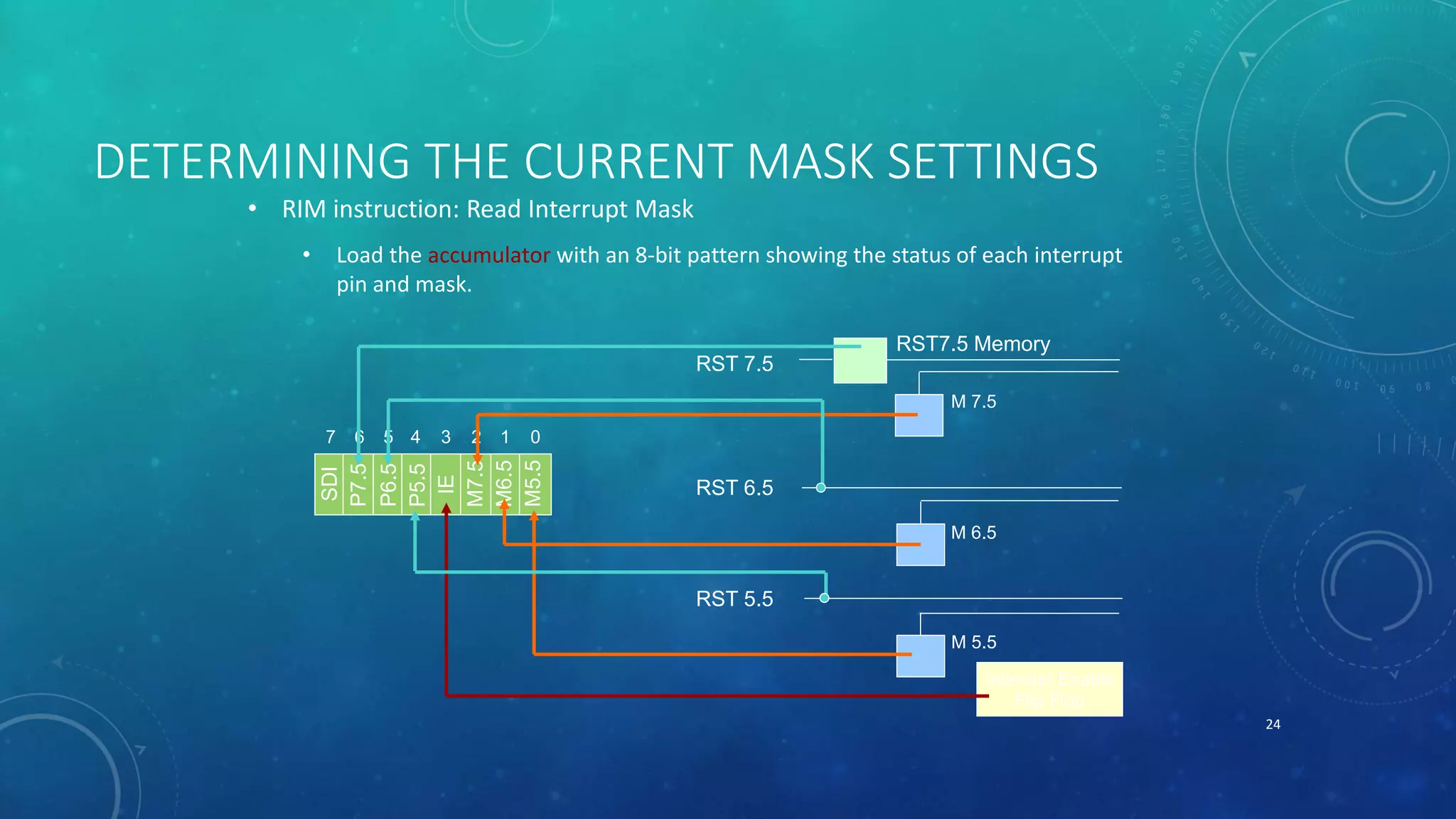
DETERMINING THE CURRENT MASK SETTINGS
• RIM instruction: Read Interrupt Mask
• Load the accumulator with an 8-bit pattern showing the status of each interrupt
pin and mask.
24
Interrupt Enable
Flip Flop
RST 5.5
RST 6.5
RST 7.5
M 5.5
M 6.5
M 7.5
RST7.5 Memory
SDI
P7.5
P6.5
P5.5
IE
M7.5
M6.5
M5.5
01234567
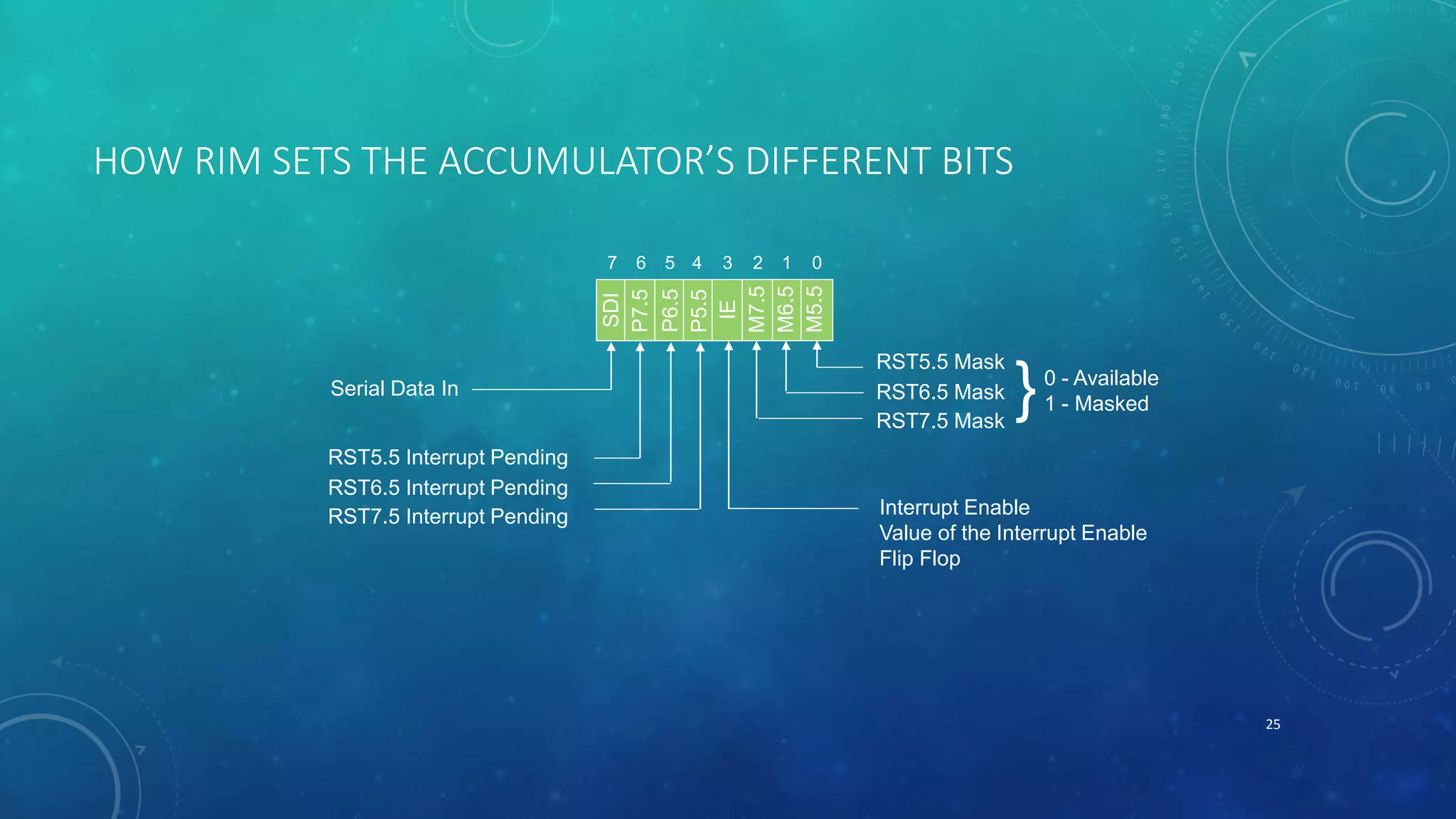
HOW RIM SETS THE ACCUMULATOR’S DIFFERENT BITS
25
SDI
P7.5
P6.5
P5.5
IE
M7.5
M6.5
M5.5
01234567
RST5.5 Mask
RST6.5 Mask
RST7.5 Mask
}0 - Available
1 - Masked
Interrupt Enable
Value of the Interrupt Enable
Flip Flop
Serial Data In
RST5.5 Interrupt Pending
RST6.5 Interrupt Pending
RST7.5 Interrupt Pending
THE RIM INSTRUCTION AND THE MASKS
• Bits 0-2 show the current setting of the mask for each of RST 7.5, RST 6.5 and RST 5.5
• They return the contents of the three mask flip flops.
• They can be used by a program to read the mask settings in order to modify only the right mask.
• Bit 3 shows whether the maskable interrupt process is enabled or not.
• It returns the contents of the Interrupt Enable Flip Flop.
• It can be used by a program to determine whether or not interrupts are enabled.
26
THE RIM INSTRUCTION AND THE MASKS
• Bits 4-6 show whether or not there are pending interrupts on RST 7.5, RST 6.5, and RST 5.5
• Bits 4 and 5 return the current value of the RST5.5 and RST6.5 pins.
• Bit 6 returns the current value of the RST7.5 memory flip flop.
• Bit 7 is used for Serial Data Input.
• The RIM instruction reads the value of the SID pin on the microprocessor and returns it in this bit.
27
PENDING INTERRUPTS
• Since the 8085 has five interrupt lines, interrupts may occur during an ISR and remain pending.
• Using the RIM instruction, it is possible to can read the status of the interrupt lines and find if there are any
pending interrupts.
28
TRAP
• TRAP is the only non-maskable interrupt.
• It does not need to be enabled because it cannot be disabled.
• It has the highest priority amongst interrupts.
• It is edge and level sensitive.
• It needs to be high and stay high to be recognized.
• Once it is recognized, it won’t be recognized again until it goes low, then high again.
• TRAP is usually used for power failure and emergency shutoff.
29
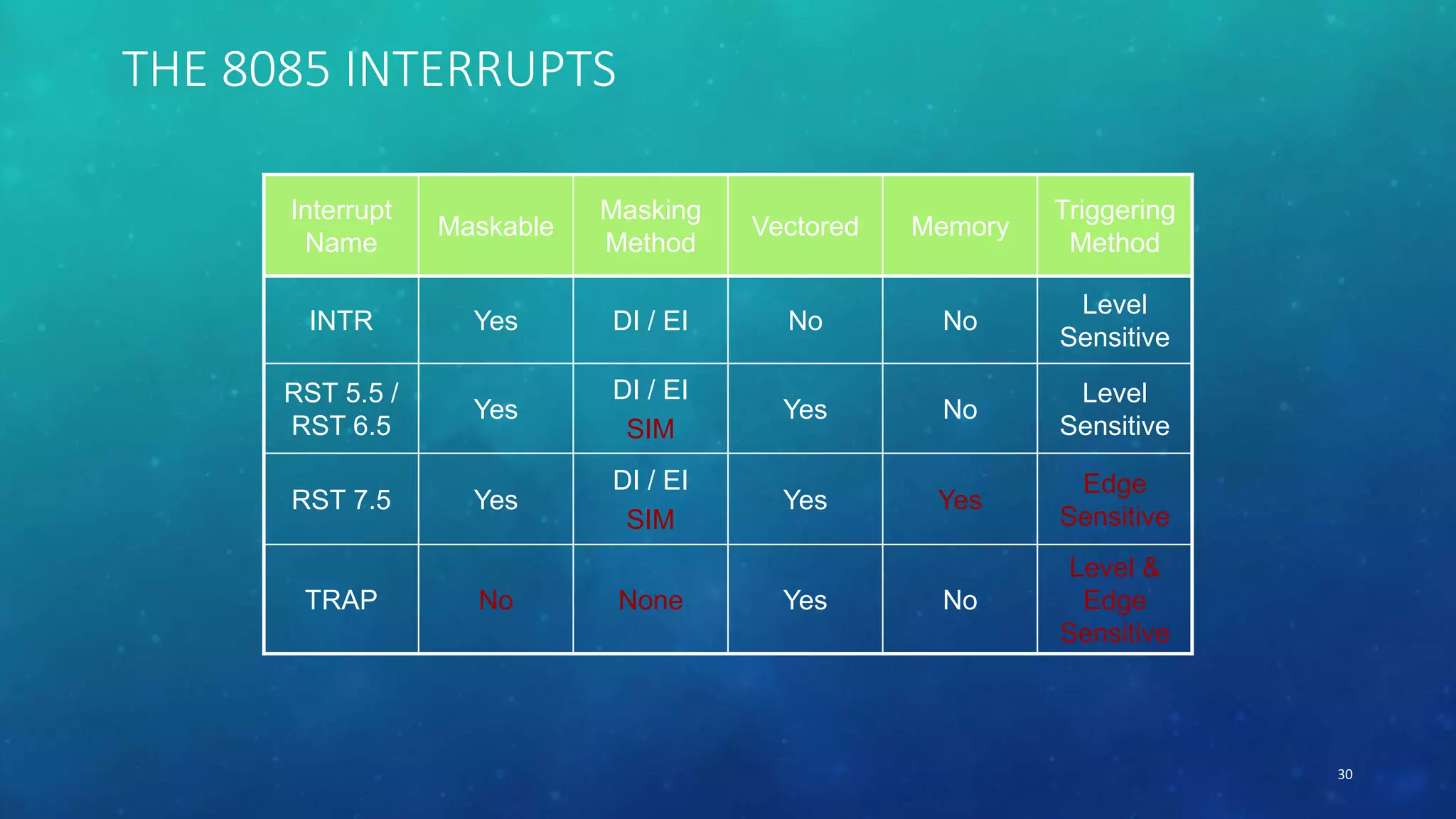
THE 8085 INTERRUPTS
Interrupt
Name
Maskable
Masking
Method
Vectored Memory
Triggering
Method
INTR Yes DI / EI No No
Level
Sensitive
RST 5.5 /
RST 6.5
Yes
DI / EI
SIM
Yes No
Level
Sensitive
RST 7.5 Yes
DI / EI
SIM
Yes Yes
Edge
Sensitive
TRAP No None Yes No
Level &
Edge
Sensitive
30
RESOURCES
http://whatis.techtarget.com/definition/interrupt
http://en.wikibooks.org/wiki/Operating_System_Design/Processes/Interrupt
http://scanftree.com/microprocessor/Interrupts-In-8085
www.cs.toronto.edu/~demke/469F.06/Lectures/Lecture6.pdf
http://faculty.salina.k-state.edu/tim/ossg/Introduction/OSworking.html
http://en.wikipedia.org/wiki/Interrupt
www.dauniv.ac.in/downloads/.../Chap_4Lesson09interruptprorities.pdf
Web Resources :
Book Resources :
Advanced Microprocessors And Peripherals by Ray Ajoy|Author : Bhurchandi K|
Computer System Architecture (3rd Ed) by M Morris Mano

Presentation on Intel 8085 processor

  • 1.
    INTERRUPTS CONTROL ANDMANAGEMENT 1 ASSIGNMENT WORK IN OPERATING SYSTEMS Presented to : Er Harvinder Singh (Department of CSE ) Presented By : Madhur Gupta 1712159 CSE A 5th Sem ( 2012-2016)
  • 2.
    • Classification ofInterrupts • Maskable Interrupts (Can be delayed or Rejected) • Non-Maskable Interrupts (Can not be delayed or Rejected) • Vectored (the address of the service routine is hard-wired) • Non-vectored (the address of the service routine needs to be supplied externally by the device) • What happens when MP is interrupted ? • Responding to Interrupts • The 8085 Interrupts • Multiple Interrupts & Priorities • How do we allow multiple devices to interrupt using the INTR line? • The Priority Encoder • Masking RST 5.5, RST 6.5 and RST 7.5 • Maskable Interrupts and vector locations • The 8085 Maskable/Vectored Interrupt Process • Manipulating the Masks • How SIM Interprets the Accumulator • SIM and the Interrupt Mask • RIM instruction: Read Interrupt Mask • TRAP THE THINGS THAT WILL BE COVERED IN THIS PRESENTATION Alias List of Contents HIGHLIGHTES
  • 3.
    INTERRUPTS • Interrupt isa process where an external device can get the attention of the microprocessor. • The process starts from the I/O device • The process is asynchronous. • Classification of Interrupts • Interrupts can be classified into two types: • Maskable Interrupts (Can be delayed or Rejected) • Non-Maskable Interrupts (Can not be delayed or Rejected) • Interrupts can also be classified into: • Vectored (the address of the service routine is hard-wired) • Non-vectored (the address of the service routine needs to be supplied externally by the device) 3
  • 4.
    INTERRUPTS • An interruptis considered to be an emergency signal that may be serviced. • The Microprocessor may respond to it as soon as possible. • What happens when MP is interrupted ? • When the Microprocessor receives an interrupt signal, it suspends the currently executing program and jumps to an Interrupt Service Routine (ISR) to respond to the incoming interrupt. • Each interrupt will most probably have its own ISR. 4
  • 5.
    RESPONDING TO INTERRUPTS •Responding to an interrupt may be immediate or delayed depending on whether the interrupt is maskable or non-maskable and whether interrupts are being masked or not. • There are two ways of redirecting the execution to the ISR depending on whether the interrupt is vectored or non-vectored. • Vectored: The address of the subroutine is already known to the Microprocessor • Non Vectored: The device will have to supply the address of the subroutine to the Microprocessor 5
  • 6.
    THE 8085 INTERRUPTS •When a device interrupts, it actually wants the MP to give a service which is equivalent to asking the MP to call a subroutine. This subroutine is called ISR (Interrupt Service Routine) • The ‘EI’ instruction is a one byte instruction and is used to Enable the non- maskable interrupts. • The ‘DI’ instruction is a one byte instruction and is used to Disable the non- maskable interrupts. • The 8085 has a single Non-Maskable interrupt. • The non-maskable interrupt is not affected by the value of the Interrupt Enable flip flop. 6
  • 7.
    THE 8085 INTERRUPTS •The 8085 has 5 interrupt inputs. • The INTR input. • The INTR input is the only non-vectored interrupt. • INTR is maskable using the EI/DI instruction pair. • RST 5.5, RST 6.5, RST 7.5 are all automatically vectored. • RST 5.5, RST 6.5, and RST 7.5 are all maskable. • TRAP is the only non-maskable interrupt in the 8085 • TRAP is also automatically vectored 7
  • 8.
    THE 8085 INTERRUPTS Interruptname Maskable Vectored INTR Yes No RST 5.5 Yes Yes RST 6.5 Yes Yes RST 7.5 Yes Yes TRAP No Yes 8
  • 9.
  • 10.
    MULTIPLE INTERRUPTS &PRIORITIES • How do we allow multiple devices to interrupt using the INTR line? • The microprocessor can only respond to one signal on INTR at a time. • Therefore, we must allow the signal from only one of the devices to reach the microprocessor. • We must assign some priority to the different devices and allow their signals to reach the microprocessor according to the priority. 10
  • 11.
    THE PRIORITY ENCODER •The solution is to use a circuit called the priority encoder (74LS148). • This circuit has 8 inputs and 3 outputs. • The inputs are assigned increasing priorities according to the increasing index of the input. • Input 7 has highest priority and input 0 has the lowest. • The 3 outputs carry the index of the highest priority active input. • Figure 12.4 in the book shows how this circuit can be used with a Tri-state buffer to implement an interrupt priority scheme. 11
  • 12.
    MULTIPLE INTERRUPTS &PRIORITIES • Note that the opcodes for the different RST instructions follow a set pattern. • Bit D5, D4 and D3 of the opcodes change in a binary sequence from RST 7 down to RST 0. • The other bits are always 1. • This allows the code generated by the 74366 to be used directly to choose the appropriate RST instruction. • The one draw back to this scheme is that the only way to change the priority of the devices connected to the 74366 is to reconnect the hardware. 12
  • 13.
    THE 8085 MASKABLE/VECTOREDINTERRUPTS • The 8085 has 4 Masked/Vectored interrupt inputs. • RST 5.5, RST 6.5, RST 7.5 • They are all maskable. • They are automatically vectored according to the following table: • The vectors for these interrupt fall in between the vectors for the RST instructions. That’s why they have names like RST 5.5 (RST 5 and a half). 13 Interrupt Vector RST 5.5 002CH RST 6.5 0034H RST 7.5 003CH
  • 14.
    MASKING RST 5.5,RST 6.5 AND RST 7.5 • These three interrupts are masked at two levels: • Through the Interrupt Enable flip flop and the EI/DI instructions. • The Interrupt Enable flip flop controls the whole maskable interrupt process. • Through individual mask flip flops that control the availability of the individual interrupts. • These flip flops control the interrupts individually. 14
  • 15.
    MASKABLE INTERRUPTS ANDVECTOR LOCATIONS 15 Interrupt Enable Flip Flop INTR RST 5.5 RST 6.5 RST 7.5 M 5.5 M 6.5 M 7.5 RST7.5 Memory ** See Fig 12.5 of the Text Book for a detailed look
  • 16.
    THE 8085 MASKABLE/VECTOREDINTERRUPT PROCESS 1. The interrupt process should be enabled using the EI instruction. 2. The 8085 checks for an interrupt during the execution of every instruction. 3. If there is an interrupt, and if the interrupt is enabled using the interrupt mask, the microprocessor will complete the executing instruction, and reset the interrupt flip flop. 4. The microprocessor then executes a call instruction that sends the execution to the appropriate location in the interrupt vector table. 16
  • 17.
    THE 8085 MASKABLE/VECTOREDINTERRUPT PROCESS 5. When the microprocessor executes the call instruction, it saves the address of the next instruction on the stack. 6. The microprocessor jumps to the specific service routine. 7. The service routine must include the instruction EI to re-enable the interrupt process. 8. At the end of the service routine, the RET instruction returns the execution to where the program was interrupted. 17
  • 18.
    MANIPULATING THE MASKS •The Interrupt Enable flip flop is manipulated using the EI/DI instructions. • The individual masks for RST 5.5, RST 6.5 and RST 7.5 are manipulated using the SIM instruction. • This instruction takes the bit pattern in the Accumulator and applies it to the interrupt mask enabling and disabling the specific interrupts. 18
  • 19.
    HOW SIM INTERPRETSTHE ACCUMULATOR 19 SDO SDE XXX R7.5 MSE M7.5 M6.5 M5.5 01234567 RST5.5 Mask RST6.5 Mask RST7.5 Mask }0 - Available 1 - Masked Mask Set Enable 0 - Ignore bits 0-2 1 - Set the masks according to bits 0-2 Force RST7.5 Flip Flop to resetNot Used Enable Serial Data 0 - Ignore bit 7 1 - Send bit 7 to SOD pin Serial Data Out
  • 20.
    SIM AND THEINTERRUPT MASK • Bit 0 is the mask for RST 5.5, bit 1 is the mask for RST 6.5 and bit 2 is the mask for RST 7.5. • If the mask bit is 0, the interrupt is available. • If the mask bit is 1, the interrupt is masked. • Bit 3 (Mask Set Enable - MSE) is an enable for setting the mask. • If it is set to 0 the mask is ignored and the old settings remain. • If it is set to 1, the new setting are applied. • The SIM instruction is used for multiple purposes and not only for setting interrupt masks. • It is also used to control functionality such as Serial Data Transmission. • Therefore, bit 3 is necessary to tell the microprocessor whether or not the interrupt masks should be modified 20
  • 21.
    SIM AND THEINTERRUPT MASK • The RST 7.5 interrupt is the only 8085 interrupt that has memory. • If a signal on RST7.5 arrives while it is masked, a flip flop will remember the signal. • When RST7.5 is unmasked, the microprocessor will be interrupted even if the device has removed the interrupt signal. • This flip flop will be automatically reset when the microprocessor responds to an RST 7.5 interrupt. • Bit 4 of the accumulator in the SIM instruction allows explicitly resetting the RST 7.5 memory even if the microprocessor did not respond to it. • Bit 5 is not used by the SIM instruction 21
  • 22.
    USING THE SIMINSTRUCTION TO MODIFY THE INTERRUPT MASKS • Example: Set the interrupt masks so that RST5.5 is enabled, RST6.5 is masked, and RST7.5 is enabled. • First, determine the contents of the accumulator 22 SDO SDE XXX R7.5 MSE M7.5 M6.5 M5.5 - Enable 5.5 bit 0 = 0 - Disable 6.5 bit 1 = 1 - Enable 7.5 bit 2 = 0 - Allow setting the masks bit 3 = 1 - Don’t reset the flip flop bit 4 = 0 - Bit 5 is not used bit 5 = 0 - Don’t use serial data bit 6 = 0 - Serial data is ignored bit 7 = 0 0 1 00000 1 Contents of accumulator are: 0AH EI ; Enable interrupts including INTR MVI A, 0A ; Prepare the mask to enable RST 7.5, and 5.5, disable 6.5 SIM ; Apply the settings RST masks
  • 23.
    TRIGGERING LEVELS • RST7.5 is positive edge sensitive. • When a positive edge appears on the RST7.5 line, a logic 1 is stored in the flip-flop as a “pending” interrupt. • Since the value has been stored in the flip flop, the line does not have to be high when the microprocessor checks for the interrupt to be recognized. • The line must go to zero and back to one before a new interrupt is recognized. • RST 6.5 and RST 5.5 are level sensitive. • The interrupting signal must remain present until the microprocessor checks for interrupts. 23
  • 24.
    DETERMINING THE CURRENTMASK SETTINGS • RIM instruction: Read Interrupt Mask • Load the accumulator with an 8-bit pattern showing the status of each interrupt pin and mask. 24 Interrupt Enable Flip Flop RST 5.5 RST 6.5 RST 7.5 M 5.5 M 6.5 M 7.5 RST7.5 Memory SDI P7.5 P6.5 P5.5 IE M7.5 M6.5 M5.5 01234567
  • 25.
    HOW RIM SETSTHE ACCUMULATOR’S DIFFERENT BITS 25 SDI P7.5 P6.5 P5.5 IE M7.5 M6.5 M5.5 01234567 RST5.5 Mask RST6.5 Mask RST7.5 Mask }0 - Available 1 - Masked Interrupt Enable Value of the Interrupt Enable Flip Flop Serial Data In RST5.5 Interrupt Pending RST6.5 Interrupt Pending RST7.5 Interrupt Pending
  • 26.
    THE RIM INSTRUCTIONAND THE MASKS • Bits 0-2 show the current setting of the mask for each of RST 7.5, RST 6.5 and RST 5.5 • They return the contents of the three mask flip flops. • They can be used by a program to read the mask settings in order to modify only the right mask. • Bit 3 shows whether the maskable interrupt process is enabled or not. • It returns the contents of the Interrupt Enable Flip Flop. • It can be used by a program to determine whether or not interrupts are enabled. 26
  • 27.
    THE RIM INSTRUCTIONAND THE MASKS • Bits 4-6 show whether or not there are pending interrupts on RST 7.5, RST 6.5, and RST 5.5 • Bits 4 and 5 return the current value of the RST5.5 and RST6.5 pins. • Bit 6 returns the current value of the RST7.5 memory flip flop. • Bit 7 is used for Serial Data Input. • The RIM instruction reads the value of the SID pin on the microprocessor and returns it in this bit. 27
  • 28.
    PENDING INTERRUPTS • Sincethe 8085 has five interrupt lines, interrupts may occur during an ISR and remain pending. • Using the RIM instruction, it is possible to can read the status of the interrupt lines and find if there are any pending interrupts. 28
  • 29.
    TRAP • TRAP isthe only non-maskable interrupt. • It does not need to be enabled because it cannot be disabled. • It has the highest priority amongst interrupts. • It is edge and level sensitive. • It needs to be high and stay high to be recognized. • Once it is recognized, it won’t be recognized again until it goes low, then high again. • TRAP is usually used for power failure and emergency shutoff. 29
  • 30.
    THE 8085 INTERRUPTS Interrupt Name Maskable Masking Method VectoredMemory Triggering Method INTR Yes DI / EI No No Level Sensitive RST 5.5 / RST 6.5 Yes DI / EI SIM Yes No Level Sensitive RST 7.5 Yes DI / EI SIM Yes Yes Edge Sensitive TRAP No None Yes No Level & Edge Sensitive 30
  • 31.