HUMAN
EYE
Prepared by Dhirendra
Thakur
General medicine
Table of contents
S.N. Name of topics.
1. Introduction
2. Structure
3. Anatomy of eye
4. Parts of eye
5. Physiology of sight
6. The accessory organs of eye
7. Muscles of eye
8. Lacrimal apparatus
9. Supplies to eye
Introduction
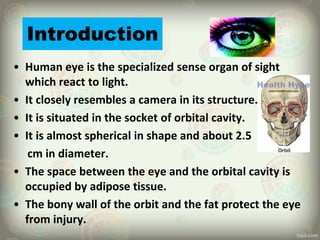
• Human eye is the specialized sense organ of sight
which react to light.
• It closely resembles a camera in its structure.
• It is situated in the socket of orbital cavity.
• It is almost spherical in shape and about 2.5
cm in diameter.
• The space between the eye and the orbital cavity is
occupied by adipose tissue.
• The bony wall of the orbit and the fat protect the eye
from injury.
Structure
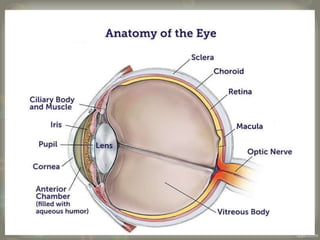
There are three layers of tissue in the wall of the eye.
1. The outer fibrous layer:
- sclera
- cornea
2. The middle vascular layer or uveal tract:
- choroid
- cilliary body
- iris
3. The inner nervous tissue layer:
- Retina
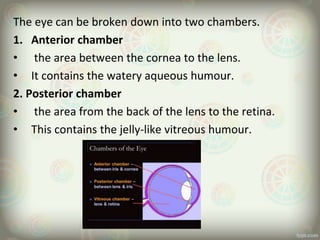
The eye can be broken down into two chambers.
1. Anterior chamber
• the area between the cornea to the lens.
• It contains the watery aqueous humour.
2. Posterior chamber
• the area from the back of the lens to the retina.
• This contains the jelly-like vitreous humour.
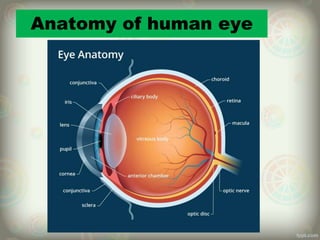
Anatomy of human eye
Parts of eye
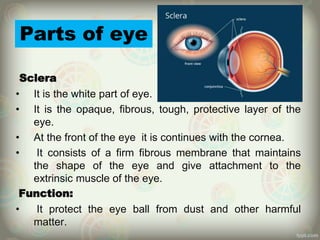
Sclera
• It is the white part of eye.
• It is the opaque, fibrous, tough, protective layer of the
eye.
• At the front of the eye it is continues with the cornea.
• It consists of a firm fibrous membrane that maintains
the shape of the eye and give attachment to the
extrinsic muscle of the eye.
Function:
• It protect the eye ball from dust and other harmful
matter.
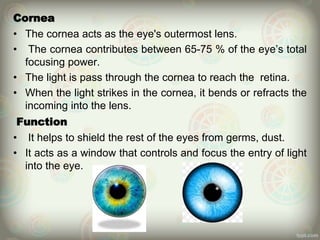
Cornea
• The cornea acts as the eye's outermost lens.
• The cornea contributes between 65-75 % of the eye’s total
focusing power.
• The light is pass through the cornea to reach the retina.
• When the light strikes in the cornea, it bends or refracts the
incoming into the lens.
Function
• It helps to shield the rest of the eyes from germs, dust.
• It acts as a window that controls and focus the entry of light
into the eye.
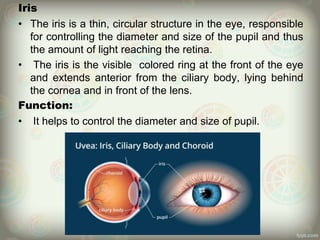
Iris
• The iris is a thin, circular structure in the eye, responsible
for controlling the diameter and size of the pupil and thus
the amount of light reaching the retina.
• The iris is the visible colored ring at the front of the eye
and extends anterior from the ciliary body, lying behind
the cornea and in front of the lens.
Function:
• It helps to control the diameter and size of pupil.
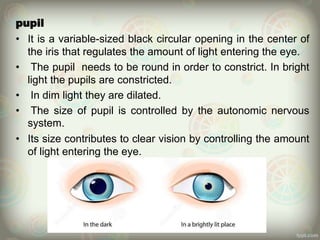
pupil
• It is a variable-sized black circular opening in the center of
the iris that regulates the amount of light entering the eye.
• The pupil needs to be round in order to constrict. In bright
light the pupils are constricted.
• In dim light they are dilated.
• The size of pupil is controlled by the autonomic nervous
system.
• Its size contributes to clear vision by controlling the amount
of light entering the eye.
Choroid
• The choroid lines the posterior five-sixths of the inner
surface of the sclera.
• It is very rich in blood vessels and is deep chocolate
brown in color.
• Light enters the eye through the pupil, stimulates the
sensory receptors in the retina and is then absorbed by
the choroid.
• It is the vascular layer of eye, containing connective
tissue, and lying between retina and sclera.
Function:
• It provide nourishment to the outer layer of the retina
through blood vessels.
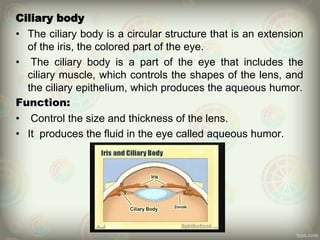
Ciliary body
• The ciliary body is a circular structure that is an extension
of the iris, the colored part of the eye.
• The ciliary body is a part of the eye that includes the
ciliary muscle, which controls the shapes of the lens, and
the ciliary epithelium, which produces the aqueous humor.
Function:
• Control the size and thickness of the lens.
• It produces the fluid in the eye called aqueous humor.
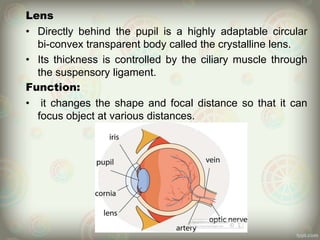
Lens
• Directly behind the pupil is a highly adaptable circular
bi-convex transparent body called the crystalline lens.
• Its thickness is controlled by the ciliary muscle through
the suspensory ligament.
Function:
• it changes the shape and focal distance so that it can
focus object at various distances.
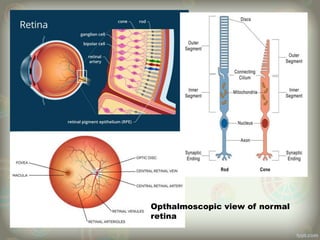
Retina
• The retina is a thin layer of tissue that lines the
back of the eyes on the inside.
• It is located near the optic nerve.
• The purpose of the retina is to receive light that
the lens has focused.
Function:
• It convert image or light into electrical impulses.
• It send this impulses to the brain for visual
recognition.
Opthalmoscopic view of normal
retina
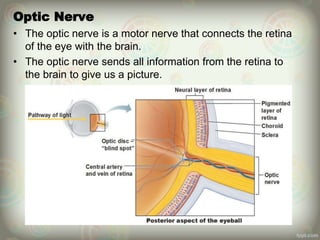
Optic Nerve
• The optic nerve is a motor nerve that connects the retina
of the eye with the brain.
• The optic nerve sends all information from the retina to
the brain to give us a picture.
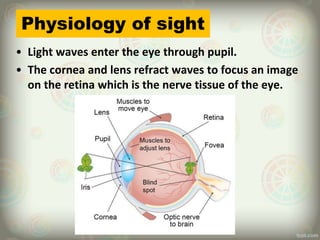
Physiology of sight
• Light waves enter the eye through pupil.
• The cornea and lens refract waves to focus an image
on the retina which is the nerve tissue of the eye.
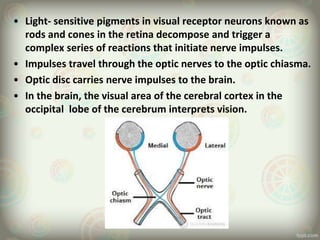
• Light- sensitive pigments in visual receptor neurons known as
rods and cones in the retina decompose and trigger a
complex series of reactions that initiate nerve impulses.
• Impulses travel through the optic nerves to the optic chiasma.
• Optic disc carries nerve impulses to the brain.
• In the brain, the visual area of the cerebral cortex in the
occipital lobe of the cerebrum interprets vision.
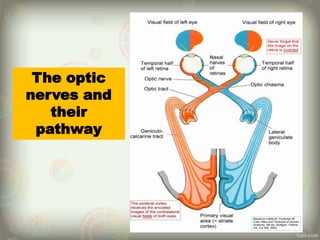
The optic
nerves and
their
pathway
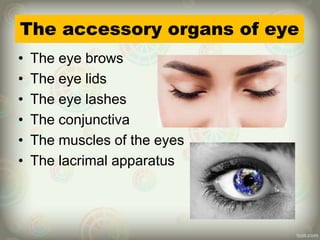
The accessory organs of eye
• The eye brows
• The eye lids
• The eye lashes
• The conjunctiva
• The muscles of the eyes
• The lacrimal apparatus
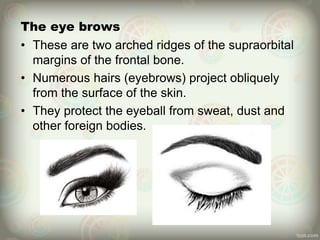
The eye brows
• These are two arched ridges of the supraorbital
margins of the frontal bone.
• Numerous hairs (eyebrows) project obliquely
from the surface of the skin.
• They protect the eyeball from sweat, dust and
other foreign bodies.
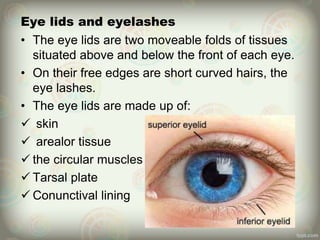
Eye lids and eyelashes
• The eye lids are two moveable folds of tissues
situated above and below the front of each eye.
• On their free edges are short curved hairs, the
eye lashes.
• The eye lids are made up of:
 skin
 arealor tissue
 the circular muscles
 Tarsal plate
 Conunctival lining
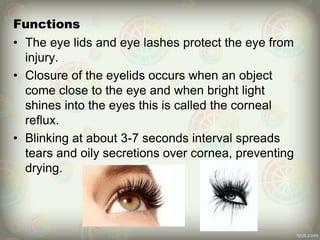
Functions
• The eye lids and eye lashes protect the eye from
injury.
• Closure of the eyelids occurs when an object
come close to the eye and when bright light
shines into the eyes this is called the corneal
reflux.
• Blinking at about 3-7 seconds interval spreads
tears and oily secretions over cornea, preventing
drying.
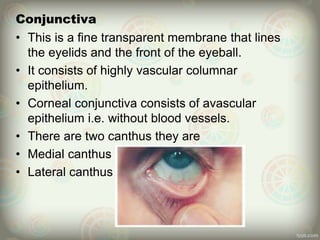
Conjunctiva
• This is a fine transparent membrane that lines
the eyelids and the front of the eyeball.
• It consists of highly vascular columnar
epithelium.
• Corneal conjunctiva consists of avascular
epithelium i.e. without blood vessels.
• There are two canthus they are
• Medial canthus
• Lateral canthus
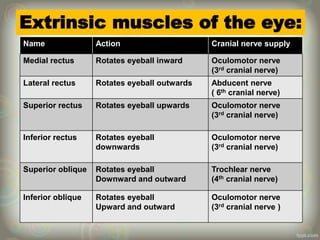
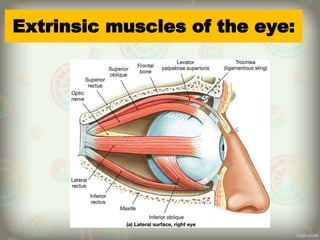
Extrinsic muscles of the eye:
Name Action Cranial nerve supply
Medial rectus Rotates eyeball inward Oculomotor nerve
(3rd cranial nerve)
Lateral rectus Rotates eyeball outwards Abducent nerve
( 6th cranial nerve)
Superior rectus Rotates eyeball upwards Oculomotor nerve
(3rd cranial nerve)
Inferior rectus Rotates eyeball
downwards
Oculomotor nerve
(3rd cranial nerve)
Superior oblique Rotates eyeball
Downward and outward
Trochlear nerve
(4th cranial nerve)
Inferior oblique Rotates eyeball
Upward and outward
Oculomotor nerve
(3rd cranial nerve )
Extrinsic muscles of the eye:
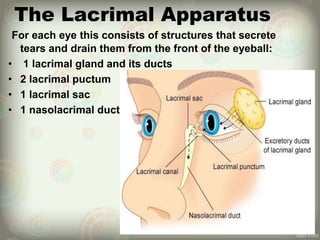
The Lacrimal Apparatus
For each eye this consists of structures that secrete
tears and drain them from the front of the eyeball:
• 1 lacrimal gland and its ducts
• 2 lacrimal puctum
• 1 lacrimal sac
• 1 nasolacrimal duct
Functions
• Provision of oxygen and nutrients to the
avasular corneal conjunctiva and drainage of
waste.
• Washing away irritating material e.g. dust grit
.
• The bactericidal enzymes lysozyme prevents
microbial infections.
• Its oiliness delays evaporation and prevents
friction or drying of the conjunctiva.
Supplies to eye
Nerve supply
• It is supplied by branches of the ophthalmic nerve.
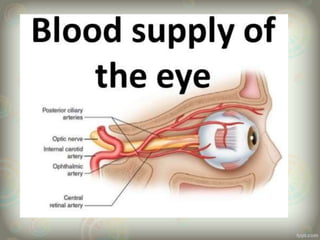
Blood supply
• The eye supplied with arterial blood by the ciliary arteries and
the central retinal artery.
• These are branches of the ophthalmic artery, branch of the
internal carotid artery.
• Venous drainage is by a number of veins, including the central
retinal veins.
Thank you!!

Presentation on eye

  • 1.
  • 2.
    Table of contents S.N.Name of topics. 1. Introduction 2. Structure 3. Anatomy of eye 4. Parts of eye 5. Physiology of sight 6. The accessory organs of eye 7. Muscles of eye 8. Lacrimal apparatus 9. Supplies to eye
  • 3.
    Introduction • Human eyeis the specialized sense organ of sight which react to light. • It closely resembles a camera in its structure. • It is situated in the socket of orbital cavity. • It is almost spherical in shape and about 2.5 cm in diameter. • The space between the eye and the orbital cavity is occupied by adipose tissue. • The bony wall of the orbit and the fat protect the eye from injury.
  • 4.
    Structure There are threelayers of tissue in the wall of the eye. 1. The outer fibrous layer: - sclera - cornea 2. The middle vascular layer or uveal tract: - choroid - cilliary body - iris 3. The inner nervous tissue layer: - Retina
  • 5.
    The eye canbe broken down into two chambers. 1. Anterior chamber • the area between the cornea to the lens. • It contains the watery aqueous humour. 2. Posterior chamber • the area from the back of the lens to the retina. • This contains the jelly-like vitreous humour.
  • 7.
  • 8.
    Parts of eye Sclera •It is the white part of eye. • It is the opaque, fibrous, tough, protective layer of the eye. • At the front of the eye it is continues with the cornea. • It consists of a firm fibrous membrane that maintains the shape of the eye and give attachment to the extrinsic muscle of the eye. Function: • It protect the eye ball from dust and other harmful matter.
  • 9.
    Cornea • The corneaacts as the eye's outermost lens. • The cornea contributes between 65-75 % of the eye’s total focusing power. • The light is pass through the cornea to reach the retina. • When the light strikes in the cornea, it bends or refracts the incoming into the lens. Function • It helps to shield the rest of the eyes from germs, dust. • It acts as a window that controls and focus the entry of light into the eye.
  • 10.
    Iris • The irisis a thin, circular structure in the eye, responsible for controlling the diameter and size of the pupil and thus the amount of light reaching the retina. • The iris is the visible colored ring at the front of the eye and extends anterior from the ciliary body, lying behind the cornea and in front of the lens. Function: • It helps to control the diameter and size of pupil.
  • 11.
    pupil • It isa variable-sized black circular opening in the center of the iris that regulates the amount of light entering the eye. • The pupil needs to be round in order to constrict. In bright light the pupils are constricted. • In dim light they are dilated. • The size of pupil is controlled by the autonomic nervous system. • Its size contributes to clear vision by controlling the amount of light entering the eye.
  • 12.
    Choroid • The choroidlines the posterior five-sixths of the inner surface of the sclera. • It is very rich in blood vessels and is deep chocolate brown in color. • Light enters the eye through the pupil, stimulates the sensory receptors in the retina and is then absorbed by the choroid. • It is the vascular layer of eye, containing connective tissue, and lying between retina and sclera. Function: • It provide nourishment to the outer layer of the retina through blood vessels.
  • 13.
    Ciliary body • Theciliary body is a circular structure that is an extension of the iris, the colored part of the eye. • The ciliary body is a part of the eye that includes the ciliary muscle, which controls the shapes of the lens, and the ciliary epithelium, which produces the aqueous humor. Function: • Control the size and thickness of the lens. • It produces the fluid in the eye called aqueous humor.
  • 14.
    Lens • Directly behindthe pupil is a highly adaptable circular bi-convex transparent body called the crystalline lens. • Its thickness is controlled by the ciliary muscle through the suspensory ligament. Function: • it changes the shape and focal distance so that it can focus object at various distances.
  • 15.
    Retina • The retinais a thin layer of tissue that lines the back of the eyes on the inside. • It is located near the optic nerve. • The purpose of the retina is to receive light that the lens has focused. Function: • It convert image or light into electrical impulses. • It send this impulses to the brain for visual recognition.
  • 16.
  • 17.
    Optic Nerve • Theoptic nerve is a motor nerve that connects the retina of the eye with the brain. • The optic nerve sends all information from the retina to the brain to give us a picture.
  • 18.
    Physiology of sight •Light waves enter the eye through pupil. • The cornea and lens refract waves to focus an image on the retina which is the nerve tissue of the eye.
  • 19.
    • Light- sensitivepigments in visual receptor neurons known as rods and cones in the retina decompose and trigger a complex series of reactions that initiate nerve impulses. • Impulses travel through the optic nerves to the optic chiasma. • Optic disc carries nerve impulses to the brain. • In the brain, the visual area of the cerebral cortex in the occipital lobe of the cerebrum interprets vision.

  • 20.
  • 21.
    The accessory organsof eye • The eye brows • The eye lids • The eye lashes • The conjunctiva • The muscles of the eyes • The lacrimal apparatus
  • 22.
    The eye brows •These are two arched ridges of the supraorbital margins of the frontal bone. • Numerous hairs (eyebrows) project obliquely from the surface of the skin. • They protect the eyeball from sweat, dust and other foreign bodies.
  • 23.
    Eye lids andeyelashes • The eye lids are two moveable folds of tissues situated above and below the front of each eye. • On their free edges are short curved hairs, the eye lashes. • The eye lids are made up of:  skin  arealor tissue  the circular muscles  Tarsal plate  Conunctival lining
  • 24.
    Functions • The eyelids and eye lashes protect the eye from injury. • Closure of the eyelids occurs when an object come close to the eye and when bright light shines into the eyes this is called the corneal reflux. • Blinking at about 3-7 seconds interval spreads tears and oily secretions over cornea, preventing drying.
  • 25.
    Conjunctiva • This isa fine transparent membrane that lines the eyelids and the front of the eyeball. • It consists of highly vascular columnar epithelium. • Corneal conjunctiva consists of avascular epithelium i.e. without blood vessels. • There are two canthus they are • Medial canthus • Lateral canthus
  • 26.
    Extrinsic muscles ofthe eye: Name Action Cranial nerve supply Medial rectus Rotates eyeball inward Oculomotor nerve (3rd cranial nerve) Lateral rectus Rotates eyeball outwards Abducent nerve ( 6th cranial nerve) Superior rectus Rotates eyeball upwards Oculomotor nerve (3rd cranial nerve) Inferior rectus Rotates eyeball downwards Oculomotor nerve (3rd cranial nerve) Superior oblique Rotates eyeball Downward and outward Trochlear nerve (4th cranial nerve) Inferior oblique Rotates eyeball Upward and outward Oculomotor nerve (3rd cranial nerve )
  • 27.
  • 28.
    The Lacrimal Apparatus Foreach eye this consists of structures that secrete tears and drain them from the front of the eyeball: • 1 lacrimal gland and its ducts • 2 lacrimal puctum • 1 lacrimal sac • 1 nasolacrimal duct
  • 29.
    Functions • Provision ofoxygen and nutrients to the avasular corneal conjunctiva and drainage of waste. • Washing away irritating material e.g. dust grit . • The bactericidal enzymes lysozyme prevents microbial infections. • Its oiliness delays evaporation and prevents friction or drying of the conjunctiva.
  • 30.
    Supplies to eye Nervesupply • It is supplied by branches of the ophthalmic nerve. Blood supply • The eye supplied with arterial blood by the ciliary arteries and the central retinal artery. • These are branches of the ophthalmic artery, branch of the internal carotid artery. • Venous drainage is by a number of veins, including the central retinal veins.
  • 32.