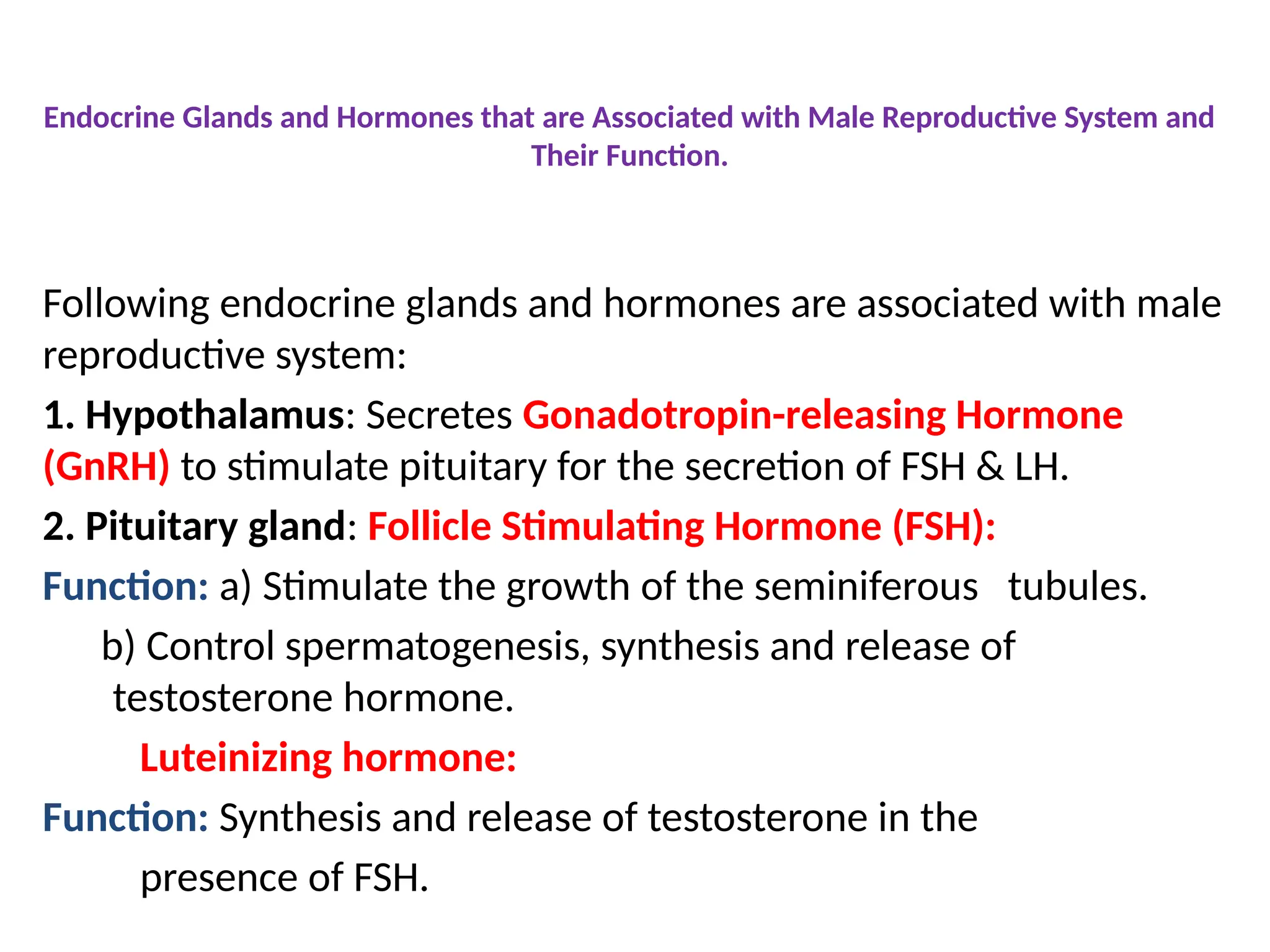
Endocrine Glands and Hormones that are Associated with Male Reproductive System and
Their Function.
Following endocrine glands and hormones are associated with male
reproductive system:
1. Hypothalamus: Secretes Gonadotropin-releasing Hormone
(GnRH) to stimulate pituitary for the secretion of FSH & LH.
2. Pituitary gland: Follicle Stimulating Hormone (FSH):
Function: a) Stimulate the growth of the seminiferous tubules.
b) Control spermatogenesis, synthesis and release of
testosterone hormone.
Luteinizing hormone:
Function: Synthesis and release of testosterone in the
presence of FSH.
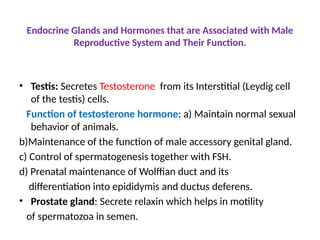
Endocrine Glands and Hormones that are Associated with Male
Reproductive System and Their Function.
• Testis: Secretes Testosterone from its Interstitial (Leydig cell
of the testis) cells.
Function of testosterone hormone: a) Maintain normal sexual
behavior of animals.
b)Maintenance of the function of male accessory genital gland.
c) Control of spermatogenesis together with FSH.
d) Prenatal maintenance of Wolffian duct and its
differentiation into epididymis and ductus deferens.
• Prostate gland: Secrete relaxin which helps in motility
of spermatozoa in semen.
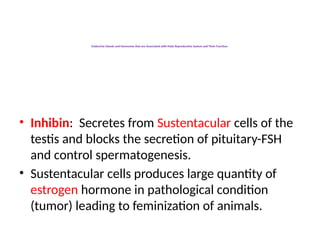
Endocrine Glands and Hormones that are Associated with Male Reproductive System and Their Function.
• Inhibin: Secretes from Sustentacular cells of the
testis and blocks the secretion of pituitary-FSH
and control spermatogenesis.
• Sustentacular cells produces large quantity of
estrogen hormone in pathological condition
(tumor) leading to feminization of animals.
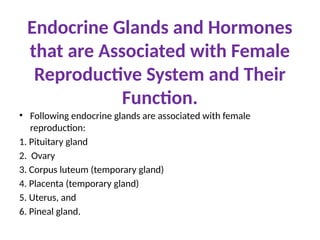
Endocrine Glands and Hormones
that are Associated with Female
Reproductive System and Their
Function.
• Following endocrine glands are associated with female
reproduction:
1. Pituitary gland
2. Ovary
3. Corpus luteum (temporary gland)
4. Placenta (temporary gland)
5. Uterus, and
6. Pineal gland.
Endocrine Gland and their Reproductive Function in Female
Hypothalamus: GnRH, function is similar to male.
Pituitary Gland:
1. Follicle Stimulating Hormone (FSH):
a) Growth and maturation of ovarian follicles.
b) Initiate estrogen (maintain all female sex character)
secretion from granulosa cells.
2. Luteinizing Hormone (LH):
a) Initiate ovulation
b) Initiate corpus luteum (CL) formation and secretion of
progesterone from CL.
3. Prolactin: In rat activates corpus luteum, and in Pigeon
causes production of crop milk.
Endocrine Gland and their
Reproductive Function in Female
Ovary:
 Estrogen: Cause development of mammary
gland, external genitalia (vulva)
development, fat mobilization, axillary hair
development etc.
Endocrine Gland and their Reproductive
Function in Female
Corpus Luteum: Secretes,
1. Progesterone: Maintenance of pregnancy
(decrease tone of uterus, and inhibit FSH).
2. Estrogen: Function already described.
3. Relaxin: Relaxes the cervix, and soften pubic
symphysis and helps in parturition.
Endocrine Gland and their Reproductive Function in
Female
• Placenta:
 Progesterone: Secrete by placenta at late stage
of pregnancy for its maintenance.
• Uterus:
 Secretes Luteolytic factor PGF2α
In case of failure of pregnancy PGF2α cause
luteolysis means regression of corpus luteum.
• Pineal Gland:
Influence gonadotropic functions (like FSH and LH).
Estrous Cycle
The estrous cycle is regulated by intrinsic
hypothalamo-hypophyseal-ovarian rhythm
that is modulated by environmental and
internal neuroendocrine factors. In domestic
animals this cycle is called “Estrous cycle”, and
in primates and human this cycle is called
“menstruation.”
Phases of Estrous Cycle
Total length of estrous cycle in the cow is 21
days.
1. Proestrus: is the period of follicular
maturation and endometrial proliferation
following failure of the corpus luteum of the
previous cycle. During this phase
progesterone level falls while FSH and
estrogen level rise for next estrus stage. This
stage ranges from 18-20 days of estrus cycle.
Phases of Estrous Cycle
2. Estrus: is the period of sexual receptiveness of
animals (female accept male). During this
period ovulation occurs in most animals
followed by increase secretion of LH hormone.
Estrogen hormone declines at the end of this
stage. This stage is at just 21 days of estrous
cycle.
Phases of Estrous Cycle
3. Metestrus: It is the stage of corpus luteum
development and initial phase of progesterone
secretion. This stage is from 1-3 days.
4. Diestrus: It is the phase of active corpus luteum
and action of progesterone on uterus and other
accessory sex gland, e.g. hyperplasia of the
uterine gland. However, if pregnancy fails corpus
luteum regress by the action of Luteolytic factor
PGF2α.
This is the longest period of the estrous cycle
and ranges from 4-17 days.
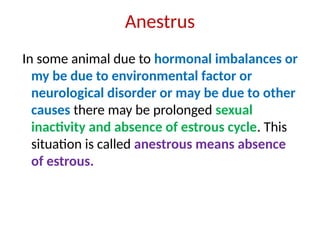
Anestrus
In some animal due to hormonal imbalances or
my be due to environmental factor or
neurological disorder or may be due to other
causes there may be prolonged sexual
inactivity and absence of estrous cycle. This
situation is called anestrous means absence
of estrous.
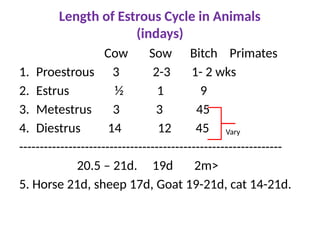
Length of Estrous Cycle in Animals
(indays)
Cow Sow Bitch Primates
1. Proestrous 3 2-3 1- 2 wks
2. Estrus ½ 1 9
3. Metestrus 3 3 45
4. Diestrus 14 12 45
----------------------------------------------------------------
20.5 – 21d. 19d 2m>
5. Horse 21d, sheep 17d, Goat 19-21d, cat 14-21d.
Vary
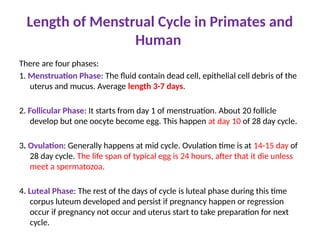
Length of Menstrual Cycle in Primates and
Human
There are four phases:
1. Menstruation Phase: The fluid contain dead cell, epithelial cell debris of the
uterus and mucus. Average length 3-7 days.
2. Follicular Phase: It starts from day 1 of menstruation. About 20 follicle
develop but one oocyte become egg. This happen at day 10 of 28 day cycle.
3. Ovulation: Generally happens at mid cycle. Ovulation time is at 14-15 day of
28 day cycle. The life span of typical egg is 24 hours, after that it die unless
meet a spermatozoa.
4. Luteal Phase: The rest of the days of cycle is luteal phase during this time
corpus luteum developed and persist if pregnancy happen or regression
occur if pregnancy not occur and uterus start to take preparation for next
cycle.
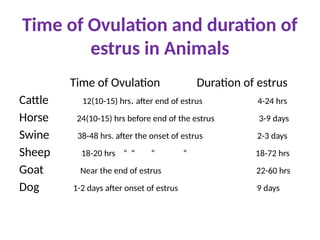
Time of Ovulation and duration of
estrus in Animals
Time of Ovulation Duration of estrus
Cattle 12(10-15) hrs. after end of estrus 4-24 hrs
Horse 24(10-15) hrs before end of the estrus 3-9 days
Swine 38-48 hrs. after the onset of estrus 2-3 days
Sheep 18-20 hrs “ “ “ “ 18-72 hrs
Goat Near the end of estrus 22-60 hrs
Dog 1-2 days after onset of estrus 9 days
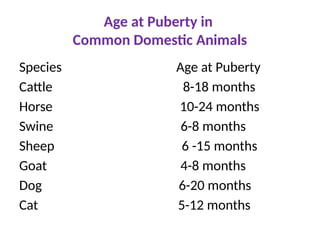
Age at Puberty in
Common Domestic Animals
Species Age at Puberty
Cattle 8-18 months
Horse 10-24 months
Swine 6-8 months
Sheep 6 -15 months
Goat 4-8 months
Dog 6-20 months
Cat 5-12 months
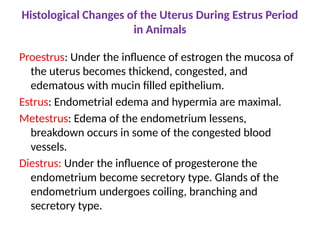
Histological Changes of the Uterus During Estrus Period
in Animals
Proestrus: Under the influence of estrogen the mucosa of
the uterus becomes thickend, congested, and
edematous with mucin filled epithelium.
Estrus: Endometrial edema and hypermia are maximal.
Metestrus: Edema of the endometrium lessens,
breakdown occurs in some of the congested blood
vessels.
Diestrus: Under the influence of progesterone the
endometrium become secretory type. Glands of the
endometrium undergoes coiling, branching and
secretory type.
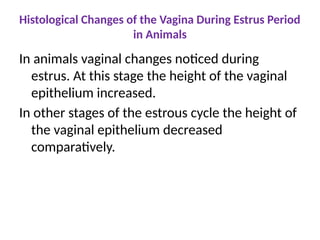
Histological Changes of the Vagina During Estrus Period
in Animals
In animals vaginal changes noticed during
estrus. At this stage the height of the vaginal
epithelium increased.
In other stages of the estrous cycle the height of
the vaginal epithelium decreased
comparatively.
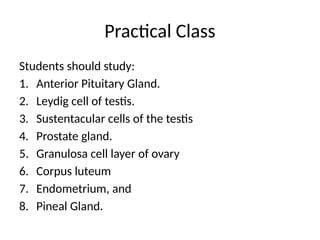
Practical Class
Students should study:
1. Anterior Pituitary Gland.
2. Leydig cell of testis.
3. Sustentacular cells of the testis
4. Prostate gland.
5. Granulosa cell layer of ovary
6. Corpus luteum
7. Endometrium, and
8. Pineal Gland.

endocrine-glands-regulating-reproductive-system.pptx

  • 1.
    Endocrine Glands andHormones that are Associated with Male Reproductive System and Their Function. Following endocrine glands and hormones are associated with male reproductive system: 1. Hypothalamus: Secretes Gonadotropin-releasing Hormone (GnRH) to stimulate pituitary for the secretion of FSH & LH. 2. Pituitary gland: Follicle Stimulating Hormone (FSH): Function: a) Stimulate the growth of the seminiferous tubules. b) Control spermatogenesis, synthesis and release of testosterone hormone. Luteinizing hormone: Function: Synthesis and release of testosterone in the presence of FSH.
  • 2.
    Endocrine Glands andHormones that are Associated with Male Reproductive System and Their Function. • Testis: Secretes Testosterone from its Interstitial (Leydig cell of the testis) cells. Function of testosterone hormone: a) Maintain normal sexual behavior of animals. b)Maintenance of the function of male accessory genital gland. c) Control of spermatogenesis together with FSH. d) Prenatal maintenance of Wolffian duct and its differentiation into epididymis and ductus deferens. • Prostate gland: Secrete relaxin which helps in motility of spermatozoa in semen.
  • 3.
    Endocrine Glands andHormones that are Associated with Male Reproductive System and Their Function. • Inhibin: Secretes from Sustentacular cells of the testis and blocks the secretion of pituitary-FSH and control spermatogenesis. • Sustentacular cells produces large quantity of estrogen hormone in pathological condition (tumor) leading to feminization of animals.
  • 4.
    Endocrine Glands andHormones that are Associated with Female Reproductive System and Their Function. • Following endocrine glands are associated with female reproduction: 1. Pituitary gland 2. Ovary 3. Corpus luteum (temporary gland) 4. Placenta (temporary gland) 5. Uterus, and 6. Pineal gland.
  • 5.
    Endocrine Gland andtheir Reproductive Function in Female Hypothalamus: GnRH, function is similar to male. Pituitary Gland: 1. Follicle Stimulating Hormone (FSH): a) Growth and maturation of ovarian follicles. b) Initiate estrogen (maintain all female sex character) secretion from granulosa cells. 2. Luteinizing Hormone (LH): a) Initiate ovulation b) Initiate corpus luteum (CL) formation and secretion of progesterone from CL. 3. Prolactin: In rat activates corpus luteum, and in Pigeon causes production of crop milk.
  • 6.
    Endocrine Gland andtheir Reproductive Function in Female Ovary:  Estrogen: Cause development of mammary gland, external genitalia (vulva) development, fat mobilization, axillary hair development etc.
  • 7.
    Endocrine Gland andtheir Reproductive Function in Female Corpus Luteum: Secretes, 1. Progesterone: Maintenance of pregnancy (decrease tone of uterus, and inhibit FSH). 2. Estrogen: Function already described. 3. Relaxin: Relaxes the cervix, and soften pubic symphysis and helps in parturition.
  • 8.
    Endocrine Gland andtheir Reproductive Function in Female • Placenta:  Progesterone: Secrete by placenta at late stage of pregnancy for its maintenance. • Uterus:  Secretes Luteolytic factor PGF2α In case of failure of pregnancy PGF2α cause luteolysis means regression of corpus luteum. • Pineal Gland: Influence gonadotropic functions (like FSH and LH).
  • 9.
    Estrous Cycle The estrouscycle is regulated by intrinsic hypothalamo-hypophyseal-ovarian rhythm that is modulated by environmental and internal neuroendocrine factors. In domestic animals this cycle is called “Estrous cycle”, and in primates and human this cycle is called “menstruation.”
  • 10.
    Phases of EstrousCycle Total length of estrous cycle in the cow is 21 days. 1. Proestrus: is the period of follicular maturation and endometrial proliferation following failure of the corpus luteum of the previous cycle. During this phase progesterone level falls while FSH and estrogen level rise for next estrus stage. This stage ranges from 18-20 days of estrus cycle.
  • 11.
    Phases of EstrousCycle 2. Estrus: is the period of sexual receptiveness of animals (female accept male). During this period ovulation occurs in most animals followed by increase secretion of LH hormone. Estrogen hormone declines at the end of this stage. This stage is at just 21 days of estrous cycle.
  • 12.
    Phases of EstrousCycle 3. Metestrus: It is the stage of corpus luteum development and initial phase of progesterone secretion. This stage is from 1-3 days. 4. Diestrus: It is the phase of active corpus luteum and action of progesterone on uterus and other accessory sex gland, e.g. hyperplasia of the uterine gland. However, if pregnancy fails corpus luteum regress by the action of Luteolytic factor PGF2α. This is the longest period of the estrous cycle and ranges from 4-17 days.
  • 13.
    Anestrus In some animaldue to hormonal imbalances or my be due to environmental factor or neurological disorder or may be due to other causes there may be prolonged sexual inactivity and absence of estrous cycle. This situation is called anestrous means absence of estrous.
  • 14.
    Length of EstrousCycle in Animals (indays) Cow Sow Bitch Primates 1. Proestrous 3 2-3 1- 2 wks 2. Estrus ½ 1 9 3. Metestrus 3 3 45 4. Diestrus 14 12 45 ---------------------------------------------------------------- 20.5 – 21d. 19d 2m> 5. Horse 21d, sheep 17d, Goat 19-21d, cat 14-21d. Vary
  • 15.
    Length of MenstrualCycle in Primates and Human There are four phases: 1. Menstruation Phase: The fluid contain dead cell, epithelial cell debris of the uterus and mucus. Average length 3-7 days. 2. Follicular Phase: It starts from day 1 of menstruation. About 20 follicle develop but one oocyte become egg. This happen at day 10 of 28 day cycle. 3. Ovulation: Generally happens at mid cycle. Ovulation time is at 14-15 day of 28 day cycle. The life span of typical egg is 24 hours, after that it die unless meet a spermatozoa. 4. Luteal Phase: The rest of the days of cycle is luteal phase during this time corpus luteum developed and persist if pregnancy happen or regression occur if pregnancy not occur and uterus start to take preparation for next cycle.
  • 16.
    Time of Ovulationand duration of estrus in Animals Time of Ovulation Duration of estrus Cattle 12(10-15) hrs. after end of estrus 4-24 hrs Horse 24(10-15) hrs before end of the estrus 3-9 days Swine 38-48 hrs. after the onset of estrus 2-3 days Sheep 18-20 hrs “ “ “ “ 18-72 hrs Goat Near the end of estrus 22-60 hrs Dog 1-2 days after onset of estrus 9 days
  • 17.
    Age at Pubertyin Common Domestic Animals Species Age at Puberty Cattle 8-18 months Horse 10-24 months Swine 6-8 months Sheep 6 -15 months Goat 4-8 months Dog 6-20 months Cat 5-12 months
  • 18.
    Histological Changes ofthe Uterus During Estrus Period in Animals Proestrus: Under the influence of estrogen the mucosa of the uterus becomes thickend, congested, and edematous with mucin filled epithelium. Estrus: Endometrial edema and hypermia are maximal. Metestrus: Edema of the endometrium lessens, breakdown occurs in some of the congested blood vessels. Diestrus: Under the influence of progesterone the endometrium become secretory type. Glands of the endometrium undergoes coiling, branching and secretory type.
  • 19.
    Histological Changes ofthe Vagina During Estrus Period in Animals In animals vaginal changes noticed during estrus. At this stage the height of the vaginal epithelium increased. In other stages of the estrous cycle the height of the vaginal epithelium decreased comparatively.
  • 20.
    Practical Class Students shouldstudy: 1. Anterior Pituitary Gland. 2. Leydig cell of testis. 3. Sustentacular cells of the testis 4. Prostate gland. 5. Granulosa cell layer of ovary 6. Corpus luteum 7. Endometrium, and 8. Pineal Gland.