PRESENTATION
ON
COLOR INDEX
HELLO!
I am Jayden Smith
I am here because I love to give presentations.
You can find me at @username
2
WHAT IS COLOR INDEX?
3
• Color Index is the most authoritative
way to search your exact requirement of
dyes and pigments from the vast maze
of colorants.
• It is basically a compendium of dyes.
• The chemical names of dyes can be very
confusing and complicated. As a result of this,
the practice of using names that are descriptive
has arisen.
• Generally a dye is to by a simple name which
we can say as a common name.
• But the problem is that it is not uncommon
for a dye to have names that are more than
one.
4
5
For example light green, has also been popularly used to refer
to dye methyl green
• Above cited specific reasons in the confusion
for naming dyes, prompted a need for color
index.
• A C.I. or Color Index Number has a huge
volume of data.
• It was prepared in the UK by the Society of Dyers and
Colourists and in the USA by the American Association of
Textile Chemists and Colourists.
6
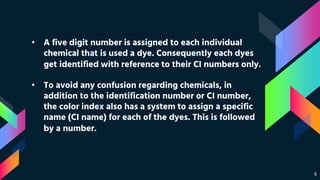
• A five digit number is assigned to each individual
chemical that is used a dye. Consequently each dyes
get identified with reference to their CI numbers only.
• To avoid any confusion regarding chemicals, in
addition to the identification number or CI number,
the color index also has a system to assign a specific
name (CI name) for each of the dyes. This is followed
by a number.
7
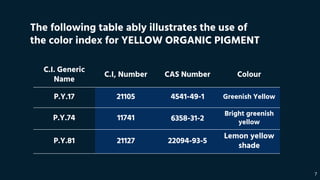
The following table ably illustrates the use of
the color index for YELLOW ORGANIC PIGMENT
C.I. Generic
Name
C.I, Number CAS Number Colour
P.Y.17 21105 4541-49-1 Greenish Yellow
P.Y.74 11741 6358-31-2
Bright greenish
yellow
P.Y.81 21127 22094-93-5
Lemon yellow
shade
▪ Part 1
covers pigments and
solvent dyes. Widely
used in the paints,
plastics, ink and other
colouration industries.
There are currently 2 technical boards
responsible for two specific areas of the Color
Index:
▪ Part 2
covers dye classes
used in a very wide range
of industries.
8
9
• The main Dye classes include
o Acid
o Basic
o Direct
o Disperse
o Food
o Fluorescent
o Brightener
o Mordant
o Reactive
o Sulphur
o Vat
Plus several other classes of minor or
historical impotance
10
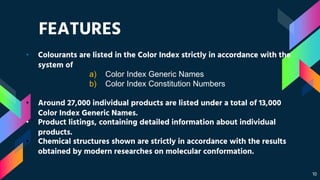
• Colourants are listed in the Color Index strictly in accordance with the
system of
• Around 27,000 individual products are listed under a total of 13,000
Color Index Generic Names.
• Product listings, containing detailed information about individual
products.
• Chemical structures shown are strictly in accordance with the results
obtained by modern researches on molecular conformation.
a) Color Index Generic Names
b) Color Index Constitution Numbers
FEATURES
CLASSIFICATION
The Color Index uses a
dual classification system:
▪ One is the Color Index Generic
Name (CIGN)
▪ The other descriptor is the
Color Index Constitution
Number (CICN)
Color Index Generic Names (CIGN)
› CIGN describes a commercial product by its
recognised usage class, its hue and a serial number
(which simply reflects the chronological order in
which related colorant types have been registerd with
the Color Index).
› This definition enables a particular commercial
product to be classified along with other products
whose essential colorant is of the same chemical
constitution or results from a single chemical reaction.
13
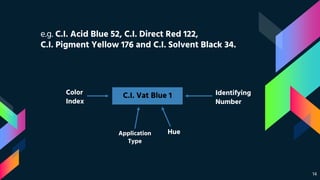
e.g. C.I. Acid Blue 52, C.I. Direct Red 122,
C.I. Pigment Yellow 176 and C.I. Solvent Black 34.
14
C.I. Vat Blue 1Color
Index
Application
Type
Hue
Identifying
Number
Color Index Constitution Numbers (CICN)
› Each essential colorant disclosed for publication
was classified and allocated a separate five-
figure C.I. Constitution number.
› Originally CICN was in multiples of five however
since 1997, new disclosures have been allocated
six figure CICN for certain dyes.
15
16
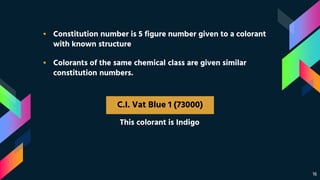
▪ Constitution number is 5 figure number given to a colorant
with known structure
▪ Colorants of the same chemical class are given similar
constitution numbers.
C.I. Vat Blue 1 (73000)
This colorant is Indigo
17
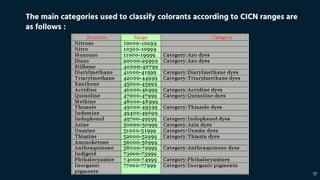
The main categories used to classify colorants according to CICN ranges are
as follows :
COLON NUMBERS
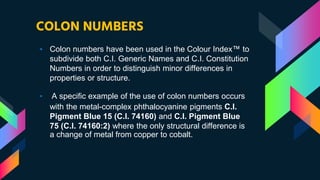
▪ Colon numbers have been used in the Colour Index™ to
subdivide both C.I. Generic Names and C.I. Constitution
Numbers in order to distinguish minor differences in
properties or structure.
▪ A specific example of the use of colon numbers occurs
with the metal-complex phthalocyanine pigments C.I.
Pigment Blue 15 (C.I. 74160) and C.I. Pigment Blue
75 (C.I. 74160:2) where the only structural difference is
a change of metal from copper to cobalt.
19
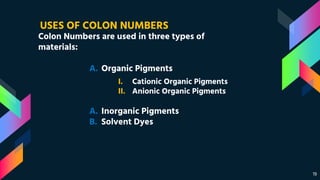
Colon Numbers are used in three types of
materials:
USES OF COLON NUMBERS
A. Organic Pigments
A. Inorganic Pigments
B. Solvent Dyes
I. Cationic Organic Pigments
II. Anionic Organic Pigments
20
A. Colon Numbers and Organic Pigments
• In the organic pigments sections, the use of colon
numbers has mainly been adopted to distinguish between
various toner pigments (‘lakes’ in US terminology) and to
distinguish pigments where crystal modification causes
products with the same chemical structure to have
significantly different colours and/or properties.
21
I. Anionic Organic Pigments
▪ When a new anionic organic pigment is registered for which no C.I. Generic
Name or C.I. Constitution Number already exists, the parent structure will be
given a C.I. Constitution Number without a colon.
▪ The first commercial pigment to be registered, with the Colour Index, which is
derived from the parent structure will be given a C.I. Generic Name ending with
‘:1’ and the chemical constitution will have the same colon number (i.e. in this
case ‘:1’).
▪ Subsequent introductions using other counter-ions will carry colon numbers in
numerical order of registration.
22
II. Cationic Organic Pigments
▪ The situation is similar to that obtaining with anionic organic
pigments.
▪ However, when copper(I) hexacyanoferrate(II) acid has
been used as the precipitating acid, the resulting pigments
have in the past been given a different generic name.
▪ For example, the so-called ‘copper ferrocyanide’ pigment
corresponding to the various C.I. Pigment Red 81 types is
C.I. Pigment Red 169 (C.I. 45160:2).
▪ The Colour Index will only allocate the same C.I. Generic Name
(with different colon numbers as necessary) when the same cationic
dye is used.
Crystal Modifications
23
Sometimes different crystal forms of a pigment exist in
the same sector of the spectrum, although showing very
noticeable differences in hue or even properties. If the
difference is great enough to change the description of the
hue (e.g. yellowish red to bluish red), then a new colon
number would be considered for an existing C.I. Generic
Name.
B. Colon Numbers and Inorganic Pigments
24
• Relatively few colon numbers have been issued in the
inorganic pigments section of the Colour Index™.
• In the case of some extended pigments obtained by a
process of co-precipitation, or physical admixture,
both the C.I. Generic Name and the corresponding
C.I. Constitution Number have been allocated ‘:1’.
• A typical example is the cadmium sulfide pigment C.I.
Pigment Yellow 37 (C.I. 77199) which, when co-
precipitated or admixed with with barium sulfate,
results in C.I. Pigment Yellow 37:1 (C.I. 77199:1).
BACKGROUND:
FUTURE:
There is no intention of introducing
any new colon number usage into
the inorganic pigments section.
25
26
B. Colon Numbers and Solvent Dyes
BACKGROUND:
In the solvent dyes sections of the Colour Index™, the use of colon numbers has
mainly been adopted to distinguish between the different salts of various azo
metal-complex dyes. Other occasional usage relates to the free bases of some
cationic dyes and to groups of structurally very similar dyes.
FUTURE:
In future, (new) similar chemical structures will be allocated appropriate six-figure C.I.
Constitution Numbers without colons.
27
Designed for use by:
▪ Colorant users, manufacturers and suppliers
▪ Textile manufacturers and suppliers
▪ Paint manufacturers and suppliers
▪ Plastics manufacturers and suppliers
▪ Printing ink manufacturers and suppliers
▪ Test houses
▪ Libraries, regulatory authorities and academic institutions
▪ Anybody with an interest in dyes and pigments
Main Applications
▪ Apparel
▪ Automotive fabrics
▪ Carpets
▪ Food
▪ Furnishings
▪ Knitwear
▪ Leather
▪ Paint
▪ Printing inks
28
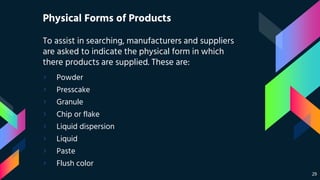
Physical Forms of Products
To assist in searching, manufacturers and suppliers
are asked to indicate the physical form in which
there products are supplied. These are:
› Powder
› Presscake
› Granule
› Chip or flake
› Liquid dispersion
› Liquid
› Paste
› Flush color
29
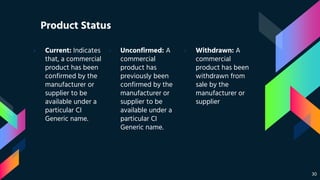
Product Status
› Current: Indicates
that, a commercial
product has been
confirmed by the
manufacturer or
supplier to be
available under a
particular CI
Generic name.
› Unconfirmed: A
commercial
product has
previously been
confirmed by the
manufacturer or
supplier to be
available under a
particular CI
Generic name.
› Withdrawn: A
commercial
product has been
withdrawn from
sale by the
manufacturer or
supplier
30
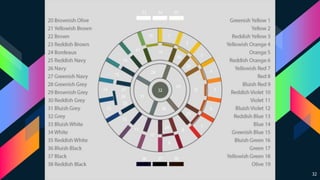
Hue Indication Chart
› The most important property of any colorant is
its hue on a given substrate. The colorants in
each usage section have therefore been
subdivided into the hue groups conventionally
used in the literature: yellow, orange, red,
violet, blue, green, brown and black in that
order, with the addition of white and metals to
the pigments section.
31
32
33
References
• "American Association of Textile Chemists and Colorists". Colour
Index International. Retrieved 8 August 2015.
• Colour Index (Third ed.). The Society of Dyers and Colourists. 1971.
• http://www.colour-index.com/
THANKS!
Any Questions?
34

Presentation on Color Index

  • 1.
  • 2.
    HELLO! I am JaydenSmith I am here because I love to give presentations. You can find me at @username 2 WHAT IS COLOR INDEX?
  • 3.
    3 • Color Indexis the most authoritative way to search your exact requirement of dyes and pigments from the vast maze of colorants. • It is basically a compendium of dyes.
  • 4.
    • The chemicalnames of dyes can be very confusing and complicated. As a result of this, the practice of using names that are descriptive has arisen. • Generally a dye is to by a simple name which we can say as a common name. • But the problem is that it is not uncommon for a dye to have names that are more than one. 4
  • 5.
    5 For example lightgreen, has also been popularly used to refer to dye methyl green • Above cited specific reasons in the confusion for naming dyes, prompted a need for color index. • A C.I. or Color Index Number has a huge volume of data. • It was prepared in the UK by the Society of Dyers and Colourists and in the USA by the American Association of Textile Chemists and Colourists.
  • 6.
    6 • A fivedigit number is assigned to each individual chemical that is used a dye. Consequently each dyes get identified with reference to their CI numbers only. • To avoid any confusion regarding chemicals, in addition to the identification number or CI number, the color index also has a system to assign a specific name (CI name) for each of the dyes. This is followed by a number.
  • 7.
    7 The following tableably illustrates the use of the color index for YELLOW ORGANIC PIGMENT C.I. Generic Name C.I, Number CAS Number Colour P.Y.17 21105 4541-49-1 Greenish Yellow P.Y.74 11741 6358-31-2 Bright greenish yellow P.Y.81 21127 22094-93-5 Lemon yellow shade
  • 8.
    ▪ Part 1 coverspigments and solvent dyes. Widely used in the paints, plastics, ink and other colouration industries. There are currently 2 technical boards responsible for two specific areas of the Color Index: ▪ Part 2 covers dye classes used in a very wide range of industries. 8
  • 9.
    9 • The mainDye classes include o Acid o Basic o Direct o Disperse o Food o Fluorescent o Brightener o Mordant o Reactive o Sulphur o Vat Plus several other classes of minor or historical impotance
  • 10.
    10 • Colourants arelisted in the Color Index strictly in accordance with the system of • Around 27,000 individual products are listed under a total of 13,000 Color Index Generic Names. • Product listings, containing detailed information about individual products. • Chemical structures shown are strictly in accordance with the results obtained by modern researches on molecular conformation. a) Color Index Generic Names b) Color Index Constitution Numbers FEATURES
  • 11.
  • 12.
    The Color Indexuses a dual classification system: ▪ One is the Color Index Generic Name (CIGN) ▪ The other descriptor is the Color Index Constitution Number (CICN)
  • 13.
    Color Index GenericNames (CIGN) › CIGN describes a commercial product by its recognised usage class, its hue and a serial number (which simply reflects the chronological order in which related colorant types have been registerd with the Color Index). › This definition enables a particular commercial product to be classified along with other products whose essential colorant is of the same chemical constitution or results from a single chemical reaction. 13
  • 14.
    e.g. C.I. AcidBlue 52, C.I. Direct Red 122, C.I. Pigment Yellow 176 and C.I. Solvent Black 34. 14 C.I. Vat Blue 1Color Index Application Type Hue Identifying Number
  • 15.
    Color Index ConstitutionNumbers (CICN) › Each essential colorant disclosed for publication was classified and allocated a separate five- figure C.I. Constitution number. › Originally CICN was in multiples of five however since 1997, new disclosures have been allocated six figure CICN for certain dyes. 15
  • 16.
    16 ▪ Constitution numberis 5 figure number given to a colorant with known structure ▪ Colorants of the same chemical class are given similar constitution numbers. C.I. Vat Blue 1 (73000) This colorant is Indigo
  • 17.
    17 The main categoriesused to classify colorants according to CICN ranges are as follows :
  • 18.
    COLON NUMBERS ▪ Colonnumbers have been used in the Colour Index™ to subdivide both C.I. Generic Names and C.I. Constitution Numbers in order to distinguish minor differences in properties or structure. ▪ A specific example of the use of colon numbers occurs with the metal-complex phthalocyanine pigments C.I. Pigment Blue 15 (C.I. 74160) and C.I. Pigment Blue 75 (C.I. 74160:2) where the only structural difference is a change of metal from copper to cobalt.
  • 19.
    19 Colon Numbers areused in three types of materials: USES OF COLON NUMBERS A. Organic Pigments A. Inorganic Pigments B. Solvent Dyes I. Cationic Organic Pigments II. Anionic Organic Pigments
  • 20.
    20 A. Colon Numbersand Organic Pigments • In the organic pigments sections, the use of colon numbers has mainly been adopted to distinguish between various toner pigments (‘lakes’ in US terminology) and to distinguish pigments where crystal modification causes products with the same chemical structure to have significantly different colours and/or properties.
  • 21.
    21 I. Anionic OrganicPigments ▪ When a new anionic organic pigment is registered for which no C.I. Generic Name or C.I. Constitution Number already exists, the parent structure will be given a C.I. Constitution Number without a colon. ▪ The first commercial pigment to be registered, with the Colour Index, which is derived from the parent structure will be given a C.I. Generic Name ending with ‘:1’ and the chemical constitution will have the same colon number (i.e. in this case ‘:1’). ▪ Subsequent introductions using other counter-ions will carry colon numbers in numerical order of registration.
  • 22.
    22 II. Cationic OrganicPigments ▪ The situation is similar to that obtaining with anionic organic pigments. ▪ However, when copper(I) hexacyanoferrate(II) acid has been used as the precipitating acid, the resulting pigments have in the past been given a different generic name. ▪ For example, the so-called ‘copper ferrocyanide’ pigment corresponding to the various C.I. Pigment Red 81 types is C.I. Pigment Red 169 (C.I. 45160:2). ▪ The Colour Index will only allocate the same C.I. Generic Name (with different colon numbers as necessary) when the same cationic dye is used.
  • 23.
    Crystal Modifications 23 Sometimes differentcrystal forms of a pigment exist in the same sector of the spectrum, although showing very noticeable differences in hue or even properties. If the difference is great enough to change the description of the hue (e.g. yellowish red to bluish red), then a new colon number would be considered for an existing C.I. Generic Name.
  • 24.
    B. Colon Numbersand Inorganic Pigments 24 • Relatively few colon numbers have been issued in the inorganic pigments section of the Colour Index™. • In the case of some extended pigments obtained by a process of co-precipitation, or physical admixture, both the C.I. Generic Name and the corresponding C.I. Constitution Number have been allocated ‘:1’. • A typical example is the cadmium sulfide pigment C.I. Pigment Yellow 37 (C.I. 77199) which, when co- precipitated or admixed with with barium sulfate, results in C.I. Pigment Yellow 37:1 (C.I. 77199:1). BACKGROUND:
  • 25.
    FUTURE: There is nointention of introducing any new colon number usage into the inorganic pigments section. 25
  • 26.
    26 B. Colon Numbersand Solvent Dyes BACKGROUND: In the solvent dyes sections of the Colour Index™, the use of colon numbers has mainly been adopted to distinguish between the different salts of various azo metal-complex dyes. Other occasional usage relates to the free bases of some cationic dyes and to groups of structurally very similar dyes. FUTURE: In future, (new) similar chemical structures will be allocated appropriate six-figure C.I. Constitution Numbers without colons.
  • 27.
    27 Designed for useby: ▪ Colorant users, manufacturers and suppliers ▪ Textile manufacturers and suppliers ▪ Paint manufacturers and suppliers ▪ Plastics manufacturers and suppliers ▪ Printing ink manufacturers and suppliers ▪ Test houses ▪ Libraries, regulatory authorities and academic institutions ▪ Anybody with an interest in dyes and pigments
  • 28.
    Main Applications ▪ Apparel ▪Automotive fabrics ▪ Carpets ▪ Food ▪ Furnishings ▪ Knitwear ▪ Leather ▪ Paint ▪ Printing inks 28
  • 29.
    Physical Forms ofProducts To assist in searching, manufacturers and suppliers are asked to indicate the physical form in which there products are supplied. These are: › Powder › Presscake › Granule › Chip or flake › Liquid dispersion › Liquid › Paste › Flush color 29
  • 30.
    Product Status › Current:Indicates that, a commercial product has been confirmed by the manufacturer or supplier to be available under a particular CI Generic name. › Unconfirmed: A commercial product has previously been confirmed by the manufacturer or supplier to be available under a particular CI Generic name. › Withdrawn: A commercial product has been withdrawn from sale by the manufacturer or supplier 30
  • 31.
    Hue Indication Chart ›The most important property of any colorant is its hue on a given substrate. The colorants in each usage section have therefore been subdivided into the hue groups conventionally used in the literature: yellow, orange, red, violet, blue, green, brown and black in that order, with the addition of white and metals to the pigments section. 31
  • 32.
  • 33.
    33 References • "American Associationof Textile Chemists and Colorists". Colour Index International. Retrieved 8 August 2015. • Colour Index (Third ed.). The Society of Dyers and Colourists. 1971. • http://www.colour-index.com/
  • 34.