Classical Approach
PRESENTATION ON
AVISKAR PANDAY 1
AVISKAR PANDAY
Classical approach
 It is the oldest formal school of thought which began
around 1900 and continued into the 1920s.
 It’s mainly concerned with the increasing the efficiency of
worker and organizations based on management practices,
which were an outcome of careful observation.
 Classical approach mainly looks for the universal
principles of operation in the striving for economic
efficiency.
 Classical approach includes scientific, administrative and
bureaucratic management.
AVISKAR PANDAY 2
About F. w. Taylor [1856 – 1915]
Father of scientific management
Joined Cramp shipyard company as mechanic
Joined Midvale steel company as worker, promoted supervisor
and up to the chief engineer
Later he joined Bethlehem steel company as consultant
Scientific Management concentrates on solving two major
problems
1. How to increase the output of the average worker, and
2. How to improve the efficiency of management
AVISKAR PANDAY 3
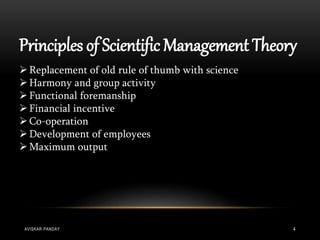
Principles of Scientific Management Theory
Replacement of old rule of thumb with science
Harmony and group activity
Functional foremanship
Financial incentive
Co-operation
Development of employees
Maximum output
AVISKAR PANDAY 4
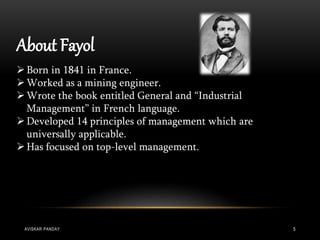
About Fayol
Born in 1841 in France.
Worked as a mining engineer.
Wrote the book entitled General and “Industrial
Management” in French language.
Developed 14 principles of management which are
universally applicable.
Has focused on top-level management.
AVISKAR PANDAY 5
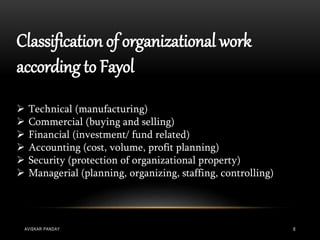
Classification of organizational work
according to Fayol
 Technical (manufacturing)
 Commercial (buying and selling)
 Financial (investment/ fund related)
 Accounting (cost, volume, profit planning)
 Security (protection of organizational property)
 Managerial (planning, organizing, staffing, controlling)
AVISKAR PANDAY 6
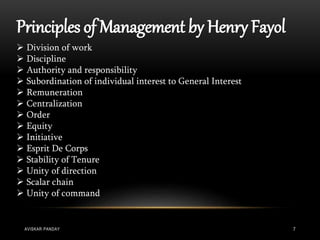
Principles of Management by Henry Fayol
 Division of work
 Discipline
 Authority and responsibility
 Subordination of individual interest to General Interest
 Remuneration
 Centralization
 Order
 Equity
 Initiative
 Esprit De Corps
 Stability of Tenure
 Unity of direction
 Scalar chain
 Unity of command
AVISKAR PANDAY 7
MAX WEBER’s Bureaucratic theory
[ 1864-1920 ]
Weber was a German sociologist
Made a significant contribution to management thought and
development
His book “the theory of social and economic organization”
explain the principle of bureaucracy
Formal system of organization design to ensure efficiency and
effectiveness
He define bureaucracy as, “an ideal form of organization
whose objectives and activities are rationally thought out and
whose division of labor is explicitly spelled out
AVISKAR PANDAY 8
Characteristics of Bureaucratic Theory
 Job specialization
 Authority hierarchy
 Formal selection
 Formal rules and regulation
 Impersonality
AVISKAR PANDAY 9
Principles of bureaucracy theory
Administrative class
Hierarchy
Division of work
Office rules
Impersonal relationship
Official record
AVISKAR PANDAY 10
Criticism of bureaucratic organizations
Bureaucratic organization is criticized because of the following
reasons :
 Emphasis on rules and regulation ,
 Rules and regulation are rigid and inflexible ,
 Involve a lot of paper work ,
 There will be unnecessary delay in decision making due to
formalities and rules .
 Limited scope for human resources
AVISKAR PANDAY 11
Thank
You
AVISKAR PANDAY 12

Presentation on Classical Approach

  • 1.
  • 2.
    Classical approach  Itis the oldest formal school of thought which began around 1900 and continued into the 1920s.  It’s mainly concerned with the increasing the efficiency of worker and organizations based on management practices, which were an outcome of careful observation.  Classical approach mainly looks for the universal principles of operation in the striving for economic efficiency.  Classical approach includes scientific, administrative and bureaucratic management. AVISKAR PANDAY 2
  • 3.
    About F. w.Taylor [1856 – 1915] Father of scientific management Joined Cramp shipyard company as mechanic Joined Midvale steel company as worker, promoted supervisor and up to the chief engineer Later he joined Bethlehem steel company as consultant Scientific Management concentrates on solving two major problems 1. How to increase the output of the average worker, and 2. How to improve the efficiency of management AVISKAR PANDAY 3
  • 4.
    Principles of ScientificManagement Theory Replacement of old rule of thumb with science Harmony and group activity Functional foremanship Financial incentive Co-operation Development of employees Maximum output AVISKAR PANDAY 4
  • 5.
    About Fayol Born in1841 in France. Worked as a mining engineer. Wrote the book entitled General and “Industrial Management” in French language. Developed 14 principles of management which are universally applicable. Has focused on top-level management. AVISKAR PANDAY 5
  • 6.
    Classification of organizationalwork according to Fayol  Technical (manufacturing)  Commercial (buying and selling)  Financial (investment/ fund related)  Accounting (cost, volume, profit planning)  Security (protection of organizational property)  Managerial (planning, organizing, staffing, controlling) AVISKAR PANDAY 6
  • 7.
    Principles of Managementby Henry Fayol  Division of work  Discipline  Authority and responsibility  Subordination of individual interest to General Interest  Remuneration  Centralization  Order  Equity  Initiative  Esprit De Corps  Stability of Tenure  Unity of direction  Scalar chain  Unity of command AVISKAR PANDAY 7
  • 8.
    MAX WEBER’s Bureaucratictheory [ 1864-1920 ] Weber was a German sociologist Made a significant contribution to management thought and development His book “the theory of social and economic organization” explain the principle of bureaucracy Formal system of organization design to ensure efficiency and effectiveness He define bureaucracy as, “an ideal form of organization whose objectives and activities are rationally thought out and whose division of labor is explicitly spelled out AVISKAR PANDAY 8
  • 9.
    Characteristics of BureaucraticTheory  Job specialization  Authority hierarchy  Formal selection  Formal rules and regulation  Impersonality AVISKAR PANDAY 9
  • 10.
    Principles of bureaucracytheory Administrative class Hierarchy Division of work Office rules Impersonal relationship Official record AVISKAR PANDAY 10
  • 11.
    Criticism of bureaucraticorganizations Bureaucratic organization is criticized because of the following reasons :  Emphasis on rules and regulation ,  Rules and regulation are rigid and inflexible ,  Involve a lot of paper work ,  There will be unnecessary delay in decision making due to formalities and rules .  Limited scope for human resources AVISKAR PANDAY 11
  • 12.