presentation on
Ames test
Presentedby:
NongmaithemJeebika Devi
Roll No. 27,
Department Of Biotechnology
Second Semester
Contents
 Some points about Ames test
 History and basic idea
 Procedures of Ames test
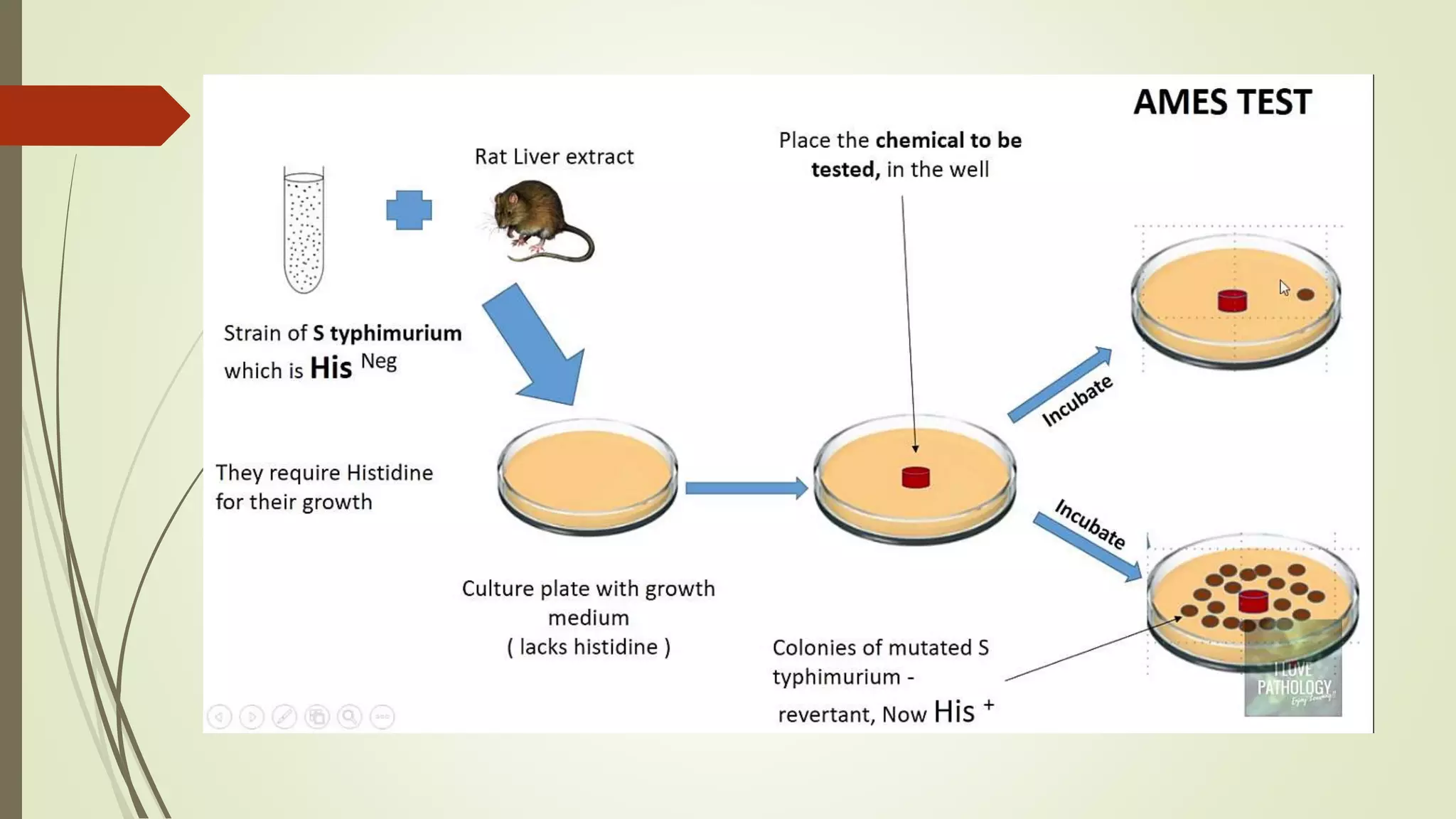
 Pictogram of Ames test
 Some importance and applications of Ames Test
 References
Some points about ames test
 The Ames test is a bacterial short-term test to determine
whether a chemical is mutagenic or not.
 In this test , a particular strain of salmonella typhimurium is
used which is without histidine.This mutant type of salmonella
typhimurium is called His- salmonella typhimurium.
 This His lacking bacterial strain cannot grow on their own.
 The use of Ames test is based on the assumption that any
mutagenic substance may also turn out to be a carcinogen.
Contd….
 The assay is based on reversion of mutations of histidine operon in the genetically
altered tester strains of bacterium salmonella typhimurium.
 According to this test, if the bacterial sample show growth in the media plate having
chemical mutagen, then the test is positive otherwise the test is negative.
 And one of the most important part about this test is that it involves mixing of the test
compound with rat liver enzymes.
History of Ames test
 In 1970’s , Ames test was deviced by Bruce Ames,
Professor of Biochemistry and Molecula r Biology at the
University of California .
 He published his work in a series of paper including
‘’Identifying Environmental Chemicals Causing Mutations And
Cancer’in The Journel Science (volume 204,1979).
 He developed this method because the previous
experiments such as standard carcinogens assays on mice and
rats are expensive and time consuming.
Procedures of Ames test
1. Isolate an auxotrophic strain of Salmonella Typhimurium for histidine. (ie. His-ve).
2. Prepare a test suspension of his-ve Salmonella Typhimurium in a plain buffer with test
chemical (2-aminofluorene). Also add small amount of histidine. (because a small amount of
histidine allows the bacteria to grow for initial time and have the chance to mutate).
3. Also prepare a control suspension of His-ve Salmonella Typhimurium but without test
chemicals.
4. Incubate the suspensions at 37°C for 20 minutes.
Contd…
5. the media culture plate was prepared to which the suspension were inoculated.
6. Incubate the plates at 37°C for 48 hours.
7. After 48 hours count the number of colonies in each plate. The mutagenicity of
chemicals is proportional to number of colonies observed. If large number of colonies on
test plate is observed in comparison to control, then such chemical are said to be
mutagens.
Very few number of colonies can be seen on control plate also. This may be due to
spontaneous point mutation on hisidine encoding gene.
Some applications of Ames test
Contd…
 It can detect suitable mutants in large population of bacteria with high
sensitivity.
 It is also used to screen chemical mutagens that causes mutations and are
carcinogenic to human and animals . Some of the chemicals used as a food
additives(AF-2), flavouring agent (Safrole) are mutagenic as well as
carcinogenic.
references
 Prescott’s Microbiology
 Wikipedia
 Ncbi on applications
 Life sciences fundamental and practice part-II
Presentation on ames test

Presentation on ames test

  • 1.
    presentation on Ames test Presentedby: NongmaithemJeebikaDevi Roll No. 27, Department Of Biotechnology Second Semester
  • 2.
    Contents  Some pointsabout Ames test  History and basic idea  Procedures of Ames test  Pictogram of Ames test  Some importance and applications of Ames Test  References
  • 3.
    Some points aboutames test  The Ames test is a bacterial short-term test to determine whether a chemical is mutagenic or not.  In this test , a particular strain of salmonella typhimurium is used which is without histidine.This mutant type of salmonella typhimurium is called His- salmonella typhimurium.  This His lacking bacterial strain cannot grow on their own.  The use of Ames test is based on the assumption that any mutagenic substance may also turn out to be a carcinogen.
  • 4.
    Contd….  The assayis based on reversion of mutations of histidine operon in the genetically altered tester strains of bacterium salmonella typhimurium.  According to this test, if the bacterial sample show growth in the media plate having chemical mutagen, then the test is positive otherwise the test is negative.  And one of the most important part about this test is that it involves mixing of the test compound with rat liver enzymes.
  • 5.
    History of Amestest  In 1970’s , Ames test was deviced by Bruce Ames, Professor of Biochemistry and Molecula r Biology at the University of California .  He published his work in a series of paper including ‘’Identifying Environmental Chemicals Causing Mutations And Cancer’in The Journel Science (volume 204,1979).  He developed this method because the previous experiments such as standard carcinogens assays on mice and rats are expensive and time consuming.
  • 6.
    Procedures of Amestest 1. Isolate an auxotrophic strain of Salmonella Typhimurium for histidine. (ie. His-ve). 2. Prepare a test suspension of his-ve Salmonella Typhimurium in a plain buffer with test chemical (2-aminofluorene). Also add small amount of histidine. (because a small amount of histidine allows the bacteria to grow for initial time and have the chance to mutate). 3. Also prepare a control suspension of His-ve Salmonella Typhimurium but without test chemicals. 4. Incubate the suspensions at 37°C for 20 minutes.
  • 7.
    Contd… 5. the mediaculture plate was prepared to which the suspension were inoculated. 6. Incubate the plates at 37°C for 48 hours. 7. After 48 hours count the number of colonies in each plate. The mutagenicity of chemicals is proportional to number of colonies observed. If large number of colonies on test plate is observed in comparison to control, then such chemical are said to be mutagens. Very few number of colonies can be seen on control plate also. This may be due to spontaneous point mutation on hisidine encoding gene.
  • 11.
  • 12.
    Contd…  It candetect suitable mutants in large population of bacteria with high sensitivity.  It is also used to screen chemical mutagens that causes mutations and are carcinogenic to human and animals . Some of the chemicals used as a food additives(AF-2), flavouring agent (Safrole) are mutagenic as well as carcinogenic.
  • 13.
    references  Prescott’s Microbiology Wikipedia  Ncbi on applications  Life sciences fundamental and practice part-II