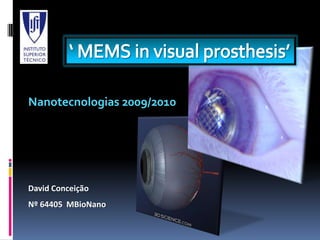
‘ MEMS in visual prosthesis’Nanotecnologias 2009/2010David ConceiçãoNº 64405  MBioNano
Introduction ... A photoreceptor does not have an axon – it does not generate action potentials.
 Ganglion cells generate action potentials. Retina External – pigmented layer – reduces light dispersion
Internal, it responds to light – Neural layer (sensorial retina) –  PHOTORECEPTORES! – Cones and rodsRetinal phototransductionRetinal – Light absorving moleculeThe retinal molecule absorbs different wavelenghts. Different kinds of opsin molecules!
Retinitis pigmentosaA type of progressive retinal dystrophyCauses the loss of up to 95% of the photoreceptor layer, but spares up to 80% of the inner nuclear layer and ~30% of the ganglion celllayerMacular degenerationPatients with age-related macular degeneration (AMD) can lose up to70% of photoreceptors with no loss of other retinal cell typesMedical condition which usually affects older adults that results in a loss of vision in the center of the visual field (the macula) because of damage to the retina
Previousstudies ...Epiretinal implants sit on top of the retina, directly stimulating ganglia using signals sent from the external camera and power sent from an external transmitterSubretinalimplantssit under the retina, stimulating bipolar or ganglion cells from underneathIt has been demonstrated that electrical stimulation of the retina can produce visual percepts in blind patients suffering from macular degeneration and retinitis pigmentosa.
A videocameratransmits640 × 480 pixel images at 25–50 Hz to a pocket PC.The computer processes the data and displays the resulting video on an LCD matrix mounted on goggles worn by the patientThe LCD screen is illuminated with pulsed near-infrared (NIR, 800–900 nm) light, projecting each video image through the eye optics onto the retinaThe NIR light is then received by a  photodiode array on a ∼3 mm implanted chip
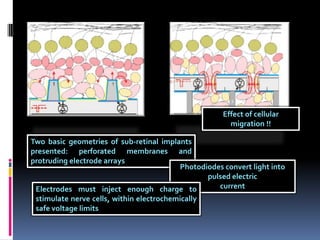
Effect of cellular migration !!Two basic geometries of sub-retinal implants presented: perforated membranes and protruding electrode arraysPhotodiodes convert light into pulsed electriccurrentElectrodes must inject enough charge to stimulate nerve cells, within electrochemically safe voltage limits
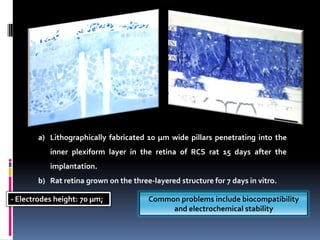
Lithographically fabricated 10 μm wide pillars penetrating into the inner plexiform layer in the retina of RCS rat 15 days after the implantation.Rat retina grown on the three-layered structure for 7 days in vitro. Common problems include biocompatibility and electrochemical stability- Electrodes height: 70 µm;
Carbon Nanotubes as na alternative ...Superior electrochemical propertiesRobustFlexibleBiocompatible?CNT protruding electrodes may be able to provide a safer solution for long-term retinal stimulation and implantationThey could also act as recording units to sense electrical and chemical activities in neural systems for fundamental neuroscience research
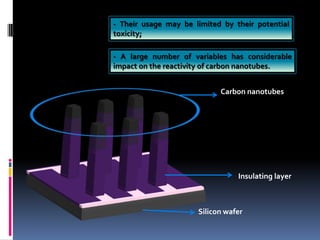
- Their usage may be limited by their potential toxicity;- A large number of variables has considerable impact on the reactivity of carbon nanotubes.Carbon nanotubesInsulating layerSilicon wafer

Presentation Nanotech 2

  • 1.
    ‘ MEMS invisual prosthesis’Nanotecnologias 2009/2010David ConceiçãoNº 64405 MBioNano
  • 2.
    Introduction ... Aphotoreceptor does not have an axon – it does not generate action potentials.
  • 3.
    Ganglion cellsgenerate action potentials. Retina External – pigmented layer – reduces light dispersion
  • 4.
    Internal, it respondsto light – Neural layer (sensorial retina) – PHOTORECEPTORES! – Cones and rodsRetinal phototransductionRetinal – Light absorving moleculeThe retinal molecule absorbs different wavelenghts. Different kinds of opsin molecules!
  • 5.
    Retinitis pigmentosaA typeof progressive retinal dystrophyCauses the loss of up to 95% of the photoreceptor layer, but spares up to 80% of the inner nuclear layer and ~30% of the ganglion celllayerMacular degenerationPatients with age-related macular degeneration (AMD) can lose up to70% of photoreceptors with no loss of other retinal cell typesMedical condition which usually affects older adults that results in a loss of vision in the center of the visual field (the macula) because of damage to the retina
  • 6.
    Previousstudies ...Epiretinal implantssit on top of the retina, directly stimulating ganglia using signals sent from the external camera and power sent from an external transmitterSubretinalimplantssit under the retina, stimulating bipolar or ganglion cells from underneathIt has been demonstrated that electrical stimulation of the retina can produce visual percepts in blind patients suffering from macular degeneration and retinitis pigmentosa.
  • 7.
    A videocameratransmits640 ×480 pixel images at 25–50 Hz to a pocket PC.The computer processes the data and displays the resulting video on an LCD matrix mounted on goggles worn by the patientThe LCD screen is illuminated with pulsed near-infrared (NIR, 800–900 nm) light, projecting each video image through the eye optics onto the retinaThe NIR light is then received by a photodiode array on a ∼3 mm implanted chip
  • 8.
    Effect of cellularmigration !!Two basic geometries of sub-retinal implants presented: perforated membranes and protruding electrode arraysPhotodiodes convert light into pulsed electriccurrentElectrodes must inject enough charge to stimulate nerve cells, within electrochemically safe voltage limits
  • 9.
    Lithographically fabricated 10μm wide pillars penetrating into the inner plexiform layer in the retina of RCS rat 15 days after the implantation.Rat retina grown on the three-layered structure for 7 days in vitro. Common problems include biocompatibility and electrochemical stability- Electrodes height: 70 µm;
  • 10.
    Carbon Nanotubes asna alternative ...Superior electrochemical propertiesRobustFlexibleBiocompatible?CNT protruding electrodes may be able to provide a safer solution for long-term retinal stimulation and implantationThey could also act as recording units to sense electrical and chemical activities in neural systems for fundamental neuroscience research
  • 11.
    - Their usagemay be limited by their potential toxicity;- A large number of variables has considerable impact on the reactivity of carbon nanotubes.Carbon nanotubesInsulating layerSilicon wafer