A Biomedical smart sensor for visually
impaired
Department of Electronics and Instrumentation Engineering
Under the Guidance of :
Prof. N. Gireesh (HOD)
Presented by:
Dinesh Mv (12121a1073)
3rd B.Tech
Outline
 Introduction
 Necessity
 Methods that improve Artificial vision
 Biomedical Sensor Design
 Artificial Retinal Prosthesis
 Retinal Implants
 Cortical Implants
 Computer Communication
 Issues with Smart sensor
 Conclusion
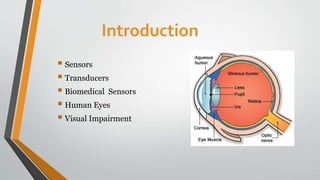
Introduction
 Sensors
 Transducers
 Biomedical Sensors
 Human Eyes
 Visual Impairment
NECESSITY
• Vision is the most important part of human physiology as 83% of information
human being gets from the environment is via sight.
• The statistics by theWorld Health Organization (WHO) in 2011 estimates that
there are 285 billion people in world with visual impairment, 39 billion of people
which are blind and 246 with low vision.
• Traditional mobility aid for persons with visual impairments are the walking stick
and guide dogs.
Methods:
There are Several methods which enhance the visibility in blind or impaired persons
 A Biomedical Smart Sensor for theVisually Impaired
 Fusion of ArtificialVision and GPS to Improve Blind Pedestrian Positioning.
 An ArtificialVision Approach For Blind Human in Emerging Scenario of Neural
Network Using Neurons activity.
 Artificial guidance systems using ultrasonic technology.
Biomedical Smart Sensor Design
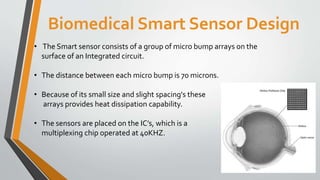
• The Smart sensor consists of a group of micro bump arrays on the
surface of an Integrated circuit.
• The distance between each micro bump is 70 microns.
• Because of its small size and slight spacing's these
arrays provides heat dissipation capability.
• The sensors are placed on the IC’s, which is a
multiplexing chip operated at 40KHZ.
CONTD…
• The circuit has the ability to transmit and receive data although but
not simultaneously
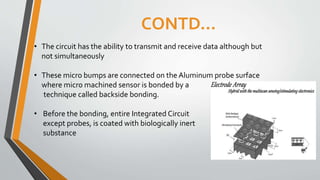
• These micro bumps are connected on the Aluminum probe surface
where micro machined sensor is bonded by a
technique called backside bonding.
• Before the bonding, entire Integrated Circuit
except probes, is coated with biologically inert
substance
Artificial Retinal Prosthesis
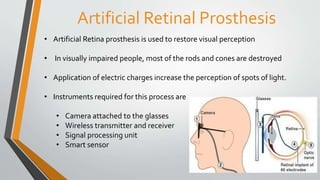
• Artificial Retina prosthesis is used to restore visual perception
• In visually impaired people, most of the rods and cones are destroyed
• Application of electric charges increase the perception of spots of light.
• Instruments required for this process are
• Camera attached to the glasses
• Wireless transmitter and receiver
• Signal processing unit
• Smart sensor
CONTD…
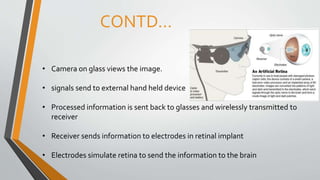
• Camera on glass views the image.
• signals send to external hand held device
• Processed information is sent back to glasses and wirelessly transmitted to
receiver
• Receiver sends information to electrodes in retinal implant
• Electrodes simulate retina to send the information to the brain
Retinal Implants
There are two types of Retinal Implants proposed
• Epi Retinal : Sensors placed on the surface of the Retina
• Sub Retinal: Sensors placed under the surface of the Retina
Sub Retinal Implant:
• Implant fixed in place.
• Simplified processing of information
occurs
Epi Retinal Implant:
• Greater ability to dissipate heat.
• Temperature inside eye is less than the
temperature of the body.
Disadvantage:
• Chronic implantation of sensor inside the eye elevates the temperature inside
the eye which causes infection to the eye.
Cortical Implants
There are two options for cortical implantation:
1. To place the sensors on the surface of the visual cortex.
1. The other option is to use electrodes that extend into the visual cortex.
Working of smart sensor
• The Front side of retina is in contact with the micro sensor array
• Transmission takes places when the surface of the retina is stimulated
electrically via artificial retina prosthesis.
• Electrical signals are converted into chemical signals by the ganglia and the
response is carried via optic nerve to the brain.
• The sensor array is used for both transmission and reception in a feedback
system implanted with in eye.
Computer Communication
•External processing is a fundamental aspect of realizing the potential of retina
•Diagnostics and maintenance operations require transmission of data from sensor
array to computer system.
•The camera on eye glasses combines with laser pointer for automatic focusing
•The DSP then encodes the image into compact format for wireless transmission
into eye.
•The setup uses a wireless transceiver inside body but not wired with in the retina.
CONTD…
•Two way communication is needed between cortical implant and external
computer to provide input to cortical implant.
•Two wayTwo way communication is needed between retinal implant and
external computer to check whether the sensor is working as expected.
•Power must be carefully controlled to avoid damage to retina and tissues.
•Power can be provided to sensor in different ways.
•Using wires ( but we need wireless data communicaiton)
•Inductance provided by RF and IR signals
•Using Photo diode array.
Issues with the Smart Sensor
• The smart sensor package is created through backside bonding of array of
sensors.
• The long term operation of these devices requires the use of a battery-
powered smart sensor.
• High power is consumed to transmit high volume of data.
• Instead, RF inductance devices is used to power the devices but alignment
of two coils- one physically inside and other external is hard to implement.
Conclusion:
The design of a smart sensor implant to
restore vision to persons with diseased retinas or suffering from
other damage to the visual system has tremendous potential for
improving the quality of the life.
REFERENCES
• Office of EngineeringTechnology, Understanding the FCC Regulations for Low-
Power, Non-LicensedTransmitters, OET Bulletin No. 63 October 1993.
• Wang A.Y., Seong Hwan Cho, C. G. Sodini, and A. P. Chandrakasan, Energy Efficient
Modulation and MAC for Asymmetric RF Microsensor System, In Low Power
Electronics and Design, International Symposium pp 106-111, 2001.
• John G. Proakis, Digital Communications, McGraw Hill International 4th edition.
• L. Schwiebert, S. K. S. Gupta, J.Weinmann, et. al., Research Challenges inWireless
Networks of Biomedical Sensors, Proc. Seventh Annual International Conference on
Mobile Computing and Networking (Mobicom’01)., pp 151-165, 2001.
A Biomedical Smart Sensor for Visually impaired

A Biomedical Smart Sensor for Visually impaired

  • 1.
    A Biomedical smartsensor for visually impaired Department of Electronics and Instrumentation Engineering Under the Guidance of : Prof. N. Gireesh (HOD) Presented by: Dinesh Mv (12121a1073) 3rd B.Tech
  • 2.
    Outline  Introduction  Necessity Methods that improve Artificial vision  Biomedical Sensor Design  Artificial Retinal Prosthesis  Retinal Implants  Cortical Implants  Computer Communication  Issues with Smart sensor  Conclusion
  • 3.
    Introduction  Sensors  Transducers Biomedical Sensors  Human Eyes  Visual Impairment
  • 4.
    NECESSITY • Vision isthe most important part of human physiology as 83% of information human being gets from the environment is via sight. • The statistics by theWorld Health Organization (WHO) in 2011 estimates that there are 285 billion people in world with visual impairment, 39 billion of people which are blind and 246 with low vision. • Traditional mobility aid for persons with visual impairments are the walking stick and guide dogs.
  • 5.
    Methods: There are Severalmethods which enhance the visibility in blind or impaired persons  A Biomedical Smart Sensor for theVisually Impaired  Fusion of ArtificialVision and GPS to Improve Blind Pedestrian Positioning.  An ArtificialVision Approach For Blind Human in Emerging Scenario of Neural Network Using Neurons activity.  Artificial guidance systems using ultrasonic technology.
  • 6.
    Biomedical Smart SensorDesign • The Smart sensor consists of a group of micro bump arrays on the surface of an Integrated circuit. • The distance between each micro bump is 70 microns. • Because of its small size and slight spacing's these arrays provides heat dissipation capability. • The sensors are placed on the IC’s, which is a multiplexing chip operated at 40KHZ.
  • 7.
    CONTD… • The circuithas the ability to transmit and receive data although but not simultaneously • These micro bumps are connected on the Aluminum probe surface where micro machined sensor is bonded by a technique called backside bonding. • Before the bonding, entire Integrated Circuit except probes, is coated with biologically inert substance
  • 8.
    Artificial Retinal Prosthesis •Artificial Retina prosthesis is used to restore visual perception • In visually impaired people, most of the rods and cones are destroyed • Application of electric charges increase the perception of spots of light. • Instruments required for this process are • Camera attached to the glasses • Wireless transmitter and receiver • Signal processing unit • Smart sensor
  • 9.
    CONTD… • Camera onglass views the image. • signals send to external hand held device • Processed information is sent back to glasses and wirelessly transmitted to receiver • Receiver sends information to electrodes in retinal implant • Electrodes simulate retina to send the information to the brain
  • 10.
    Retinal Implants There aretwo types of Retinal Implants proposed • Epi Retinal : Sensors placed on the surface of the Retina • Sub Retinal: Sensors placed under the surface of the Retina Sub Retinal Implant: • Implant fixed in place. • Simplified processing of information occurs Epi Retinal Implant: • Greater ability to dissipate heat. • Temperature inside eye is less than the temperature of the body. Disadvantage: • Chronic implantation of sensor inside the eye elevates the temperature inside the eye which causes infection to the eye.
  • 11.
    Cortical Implants There aretwo options for cortical implantation: 1. To place the sensors on the surface of the visual cortex. 1. The other option is to use electrodes that extend into the visual cortex.
  • 12.
    Working of smartsensor • The Front side of retina is in contact with the micro sensor array • Transmission takes places when the surface of the retina is stimulated electrically via artificial retina prosthesis. • Electrical signals are converted into chemical signals by the ganglia and the response is carried via optic nerve to the brain. • The sensor array is used for both transmission and reception in a feedback system implanted with in eye.
  • 13.
    Computer Communication •External processingis a fundamental aspect of realizing the potential of retina •Diagnostics and maintenance operations require transmission of data from sensor array to computer system. •The camera on eye glasses combines with laser pointer for automatic focusing •The DSP then encodes the image into compact format for wireless transmission into eye. •The setup uses a wireless transceiver inside body but not wired with in the retina.
  • 14.
    CONTD… •Two way communicationis needed between cortical implant and external computer to provide input to cortical implant. •Two wayTwo way communication is needed between retinal implant and external computer to check whether the sensor is working as expected. •Power must be carefully controlled to avoid damage to retina and tissues. •Power can be provided to sensor in different ways. •Using wires ( but we need wireless data communicaiton) •Inductance provided by RF and IR signals •Using Photo diode array.
  • 15.
    Issues with theSmart Sensor • The smart sensor package is created through backside bonding of array of sensors. • The long term operation of these devices requires the use of a battery- powered smart sensor. • High power is consumed to transmit high volume of data. • Instead, RF inductance devices is used to power the devices but alignment of two coils- one physically inside and other external is hard to implement.
  • 16.
    Conclusion: The design ofa smart sensor implant to restore vision to persons with diseased retinas or suffering from other damage to the visual system has tremendous potential for improving the quality of the life.
  • 17.
    REFERENCES • Office ofEngineeringTechnology, Understanding the FCC Regulations for Low- Power, Non-LicensedTransmitters, OET Bulletin No. 63 October 1993. • Wang A.Y., Seong Hwan Cho, C. G. Sodini, and A. P. Chandrakasan, Energy Efficient Modulation and MAC for Asymmetric RF Microsensor System, In Low Power Electronics and Design, International Symposium pp 106-111, 2001. • John G. Proakis, Digital Communications, McGraw Hill International 4th edition. • L. Schwiebert, S. K. S. Gupta, J.Weinmann, et. al., Research Challenges inWireless Networks of Biomedical Sensors, Proc. Seventh Annual International Conference on Mobile Computing and Networking (Mobicom’01)., pp 151-165, 2001.