





PRESENTATION
METEOROLOGY (CHP# 2)
NAME
I-D
SULIMAN KHAN
7546
M . MEHRAN
7499
SAJJAD KHAN
7630
METEOROLOGY :
Meteorology is the major branch of earth science
that focuses on the earth’s atmosphere. People
who study meteorology are called
meteorologists. Meteorologists record air
pressure, wind speed and direction,
temperature, humidity, weather patterns and
other information.
Meteorologists use this data to understand
IMPORTANCE & SCOPE OF
METEOROLOGY :
Almost all social, industrial, agricultural,
commercial, transport etc . Activities directly or
indirectly are affected by weather and climate .
The atmosphere affects human life, animals,
micro-organisms, insects, pests, plants, tree’s
forests and marine life at all times during every
stage of growth and development meteorology has
therefore greatest scope and importance. The
1- Safe navigation
2-Safe aviation
3-Industries
4-Fishries
5-Irrigation & water resources
6-Human life
7- Commerce
ATMOSPHERE :
Atmosphere can be define as the gaseous
envelope surrounding the earth. The dynamic
layer surrounding the earth above it’s surface
containing various gases, moisture, aerosols etc.
is called atmosphere. It’s protective layer around
the earth. It extend over about 100km height
and the atmosphere mass is about 5.6*1014
metric tons .
 Atmosphere protects the biological life on the
planet from harmful radiation like ultra violent
rays .
 It supplies the necessary precipitation or
moisture .
 The earth temperature in the absence of
atmosphere would have been +950c (day) and
-1450c (night) .
Atmosphere is big reservoir of nitrogen , some
plants & microbes can fix this nitrogen for
COMPOSITION OF ATMOSPHERE :
The atmosphere consists of water vapor, dry air
and various kinds of salts and dusts .
 Total amount of dry air is greater than 5600
billions tons .
Total amount of water vapor is about 146
billions tons .
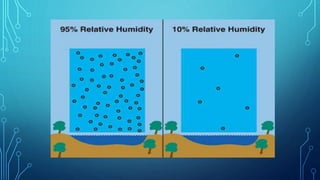
RELATIVE HUMIDITY:
It is the relative measure of the amount of
moisture in the air to the amount needed
to saturate the air at the same
temperature. It is denoted by “f” .
The relative humidity is 100% when the air
is saturated .
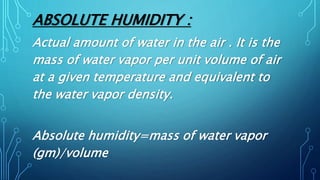
ABSOLUTE HUMIDITY :
Actual amount of water in the air . It is the
mass of water vapor per unit volume of air
at a given temperature and equivalent to
the water vapor density.
Absolute humidity=mass of water vapor
(gm)/volume
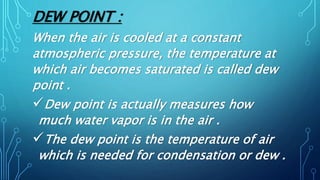
DEW POINT :
When the air is cooled at a constant
atmospheric pressure, the temperature at
which air becomes saturated is called dew
point .
Dew point is actually measures how
much water vapor is in the air .
The dew point is the temperature of air
which is needed for condensation or dew .
THANK YOU

Presentation Meteorology

  • 1.
    PRESENTATION METEOROLOGY (CHP# 2) NAME I-D SULIMANKHAN 7546 M . MEHRAN 7499 SAJJAD KHAN 7630
  • 3.
    METEOROLOGY : Meteorology isthe major branch of earth science that focuses on the earth’s atmosphere. People who study meteorology are called meteorologists. Meteorologists record air pressure, wind speed and direction, temperature, humidity, weather patterns and other information. Meteorologists use this data to understand
  • 4.
    IMPORTANCE & SCOPEOF METEOROLOGY : Almost all social, industrial, agricultural, commercial, transport etc . Activities directly or indirectly are affected by weather and climate . The atmosphere affects human life, animals, micro-organisms, insects, pests, plants, tree’s forests and marine life at all times during every stage of growth and development meteorology has therefore greatest scope and importance. The
  • 5.
    1- Safe navigation 2-Safeaviation 3-Industries 4-Fishries 5-Irrigation & water resources 6-Human life 7- Commerce
  • 7.
    ATMOSPHERE : Atmosphere canbe define as the gaseous envelope surrounding the earth. The dynamic layer surrounding the earth above it’s surface containing various gases, moisture, aerosols etc. is called atmosphere. It’s protective layer around the earth. It extend over about 100km height and the atmosphere mass is about 5.6*1014 metric tons .
  • 8.
     Atmosphere protectsthe biological life on the planet from harmful radiation like ultra violent rays .  It supplies the necessary precipitation or moisture .  The earth temperature in the absence of atmosphere would have been +950c (day) and -1450c (night) . Atmosphere is big reservoir of nitrogen , some plants & microbes can fix this nitrogen for
  • 9.
    COMPOSITION OF ATMOSPHERE: The atmosphere consists of water vapor, dry air and various kinds of salts and dusts .  Total amount of dry air is greater than 5600 billions tons . Total amount of water vapor is about 146 billions tons .
  • 10.
    RELATIVE HUMIDITY: It isthe relative measure of the amount of moisture in the air to the amount needed to saturate the air at the same temperature. It is denoted by “f” . The relative humidity is 100% when the air is saturated .
  • 12.
    ABSOLUTE HUMIDITY : Actualamount of water in the air . It is the mass of water vapor per unit volume of air at a given temperature and equivalent to the water vapor density. Absolute humidity=mass of water vapor (gm)/volume
  • 13.
    DEW POINT : Whenthe air is cooled at a constant atmospheric pressure, the temperature at which air becomes saturated is called dew point . Dew point is actually measures how much water vapor is in the air . The dew point is the temperature of air which is needed for condensation or dew .
  • 15.