air
INTRODUCTION
AIR: Is a common name for the mixture of gases that makes
up the earth’s atmosphere.
ATMOSPHRE : Is a layer of air surrounding our planet earth.
IMPORTANCE OF ATMOSPHERE:
•All living beings on this earth depend
on the atmosphere for their survival.
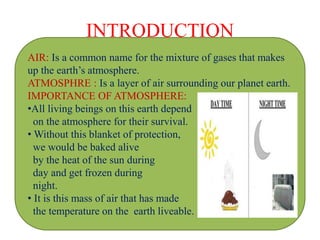
• Without this blanket of protection,
we would be baked alive
by the heat of the sun during
day and get frozen during
night.
• It is this mass of air that has made
the temperature on the earth liveable.
COMPOSITION OF THE
ATMOSPHERE
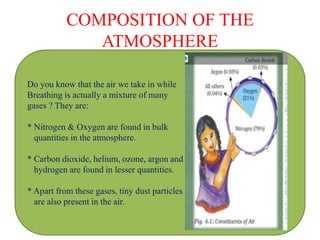
Do you know that the air we take in while
Breathing is actually a mixture of many
gases ? They are:
* Nitrogen & Oxygen are found in bulk
quantities in the atmosphere.
* Carbon dioxide, helium, ozone, argon and
hydrogen are found in lesser quantities.
* Apart from these gases, tiny dust particles
are also present in the air.
COMPOSITION OF THE
ATMOSPHERE( Cont..)
1. NIROGEN:
• Is the most plentiful gas in the air.
• When we inhale, we take some amount of nitrogen in to our lungs
and exhale.
• Nitrogen is essential for plants to survive.
• Plants cannot take nitrogen directly from the air. Bacteria, that live
in the soil and roots of some plants, take nitrogen from the air
and change its form so that plants can use it.
2. OXYGEN:
• Is the second most plentiful gas in the air.
• Humans and animals take oxygen from the air as they breath.
• During photosynthesis, green plants produce oxygen.
• In this way, oxygen remains constant.
COMPOSITION OF THE
ATMOSPHERE( Cont..)
3. CARBON DIOXIDE:
• Is another important gas.
• Green plants use carbon dioxide to make their food and release oxygen.
• Humans and animals use oxygen to breathe.
• Humans or animals release carbon dioxide.
• The amount of carbon dioxide released, by humans or animals seems to
be equal to the amount used by the plants which makes a perfect
balance.
EFFECT OF INCREASE IN THE
AMOUNT OF CARBON-DIOXIDE
 The balance is upset by burning of fuels, such as coal and
oil.
 They add billions of tons of carbon dioxide in to the
atmosphere each
year.
 As a result, the increased volume of carbon dioxide is
affecting the earth’s weather and climate.
STRUCTURE OF THE
ATMOSPHERE
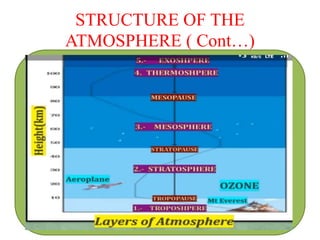
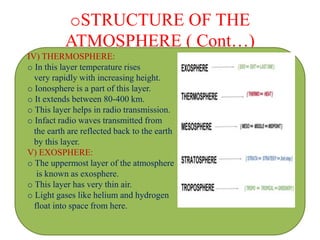
The atmosphere is divided into five layers starting from the earth’s
surface.
These are Troposphere, Stratosphere ,Mesosphere, Thermosphere and
Exosphere.
I. TROPOSPHERE:
o This layer is the most important layer of the atmosphere.
o Its average height is 13 km and the air we breathe exists here.
o In this layer, all- weather phenomena like rainfall, fog and hailstorm
occur in this layer.
STRUCTURE OF THE
ATMOSPHERE ( Cont…)
STRUCTURE OF THE
ATMOSPHERE ( Cont…)
II. STRATOSPHERE:
o Above the troposphere lies the stratosphere.
o It extends up to a height of 50 km.
o This layer is free form clouds and associated weather phenomenon,
which makes it most ideal for flying airplanes. It contains a layer of
Ozone gas which protects us from the harmful effects of the Sunrays.
III. MESOSPHERE:
o This is the 3rd layer of the atmosphere.
o It lies above the stratosphere.
o It extends up to the height of 80 km.
o Meteorites burn up in this layer on entering from the space.
oSTRUCTURE OF THE
ATMOSPHERE ( Cont…)
IV) THERMOSPHERE:
o In this layer temperature rises
very rapidly with increasing height.
o Ionosphere is a part of this layer.
o It extends between 80-400 km.
o This layer helps in radio transmission.
o Infact radio waves transmitted from
the earth are reflected back to the earth
by this layer.
V) EXOSPHERE:
o The uppermost layer of the atmosphere
is known as exosphere.
o This layer has very thin air.
o Light gases like helium and hydrogen
float into space from here.
Development Activity
“ Pollution the major cause of Global
Warming” Write a Short-note
Home Assignment
1. Draw a neat diagram of composition of the
Atmosphere.
2. Solve the Crossword puzzle with the help
of given clues ( Page 28 )
WEATHER & CLIMATE
WEATHER:
Is hour- to – hour, day to day condition of the atmosphere.
CLIMATE:
The average weather condition of a place for a longer period
of time is climate.
TEMPERATURE
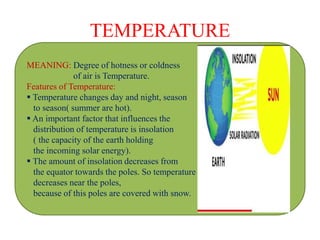
MEANING: Degree of hotness or coldness
of air is Temperature.
Features of Temperature:
 Temperature changes day and night, season
to season( summer are hot).
 An important factor that influences the
distribution of temperature is insolation
( the capacity of the earth holding
the incoming solar energy).
 The amount of insolation decreases from
the equator towards the poles. So temperature
decreases near the poles,
because of this poles are covered with snow.
TEMPERATURE
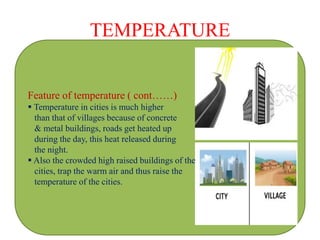
Feature of temperature ( cont……)
 Temperature in cities is much higher
than that of villages because of concrete
& metal buildings, roads get heated up
during the day, this heat released during
the night.
 Also the crowded high raised buildings of the
cities, trap the warm air and thus raise the
temperature of the cities.
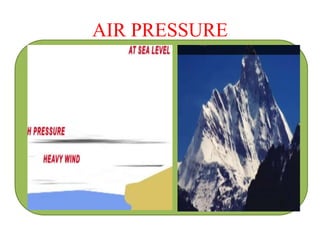
AIR PRESSURE
Defn: The pressure exerted (created / applied) by the weight of air on the
earth’s surface.
Features of Air Pressure:
 The pressure is highest at sea level and decreases with
height.
 Distribution of air pressure is influenced by temperature of air at a
given place.
 Where temperature is high the air gets heated and rises which creates a
low pressure area.
 Low pressure is associated with cloudy skies and wet weather.
 Where temperature is low, the air is cold and therefore, heavy air sinks
and creates a high pressure area.
 High pressure is associated with clear and sunny skies.
 The air always moves from high pressure areas to low pressure areas.
AIR PRESSURE
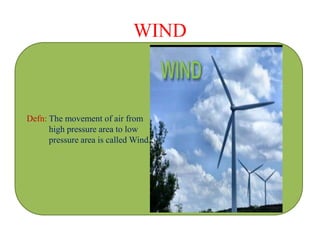
WIND
Defn: The movement of air from
high pressure area to low
pressure area is called Wind.
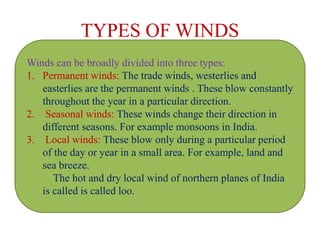
TYPES OF WINDS
Winds can be broadly divided into three types:
1. Permanent winds: The trade winds, westerlies and
easterlies are the permanent winds . These blow constantly
throughout the year in a particular direction.
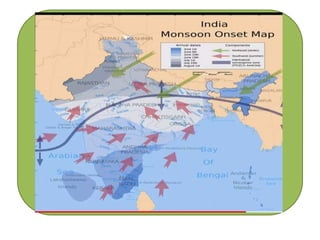
2. Seasonal winds: These winds change their direction in
different seasons. For example monsoons in India.
3. Local winds: These blow only during a particular period
of the day or year in a small area. For example, land and
sea breeze.
The hot and dry local wind of northern planes of India
is called is called loo.
MOISTURE
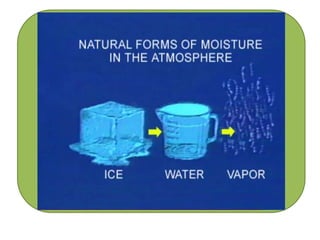
 When water evaporates from land and different water
bodies, it becomes water vapour.
 Moisture in the air at any time, is known as humidity.-
When the air is full of water vapour we call it a humid day.
 As the air gets warmer, its capacity to hold the water
vapour increases and so it becomes more and more humid.
 When the water vapour rises, it starts cooling.
 The water vapour condenses causing formation of droplets
of water. Clouds are just masses of such water droplets.
 When these droplets of water become too heavy to float in
air, then they come down as precipitation.
 Precipitation that comes down to the earth in liquid form is
called rain.
TYPES OF RAINFALL
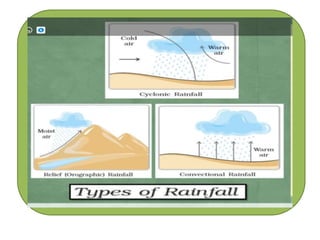
There are three types of rainfall:
~ The convectional rainfall
~ The orographic rainfall
~ The cyclonic rainfall
Importance of Rainfall:
 It is very important for the survival of plants and animals.
 It brings fresh water to the earth’s surface.
 If it rainfall is less- water scarcity and drought occur. On
the other hand if it is more, floods takes place
Development Activity
Give Reasons:
1. Wet clothes take longer time to dry on a
humid day?
2. Amount of insolation decreases from
equator towards poles?
Home Assignment
Make a weather calendar for one week . Use
pictures or symbols to show different types of
weather. You can use more than one symbol in
a day. If weather changes
( Refer page .No 29 )
Sildes on Air

Sildes on Air

  • 1.
  • 2.
    INTRODUCTION AIR: Is acommon name for the mixture of gases that makes up the earth’s atmosphere. ATMOSPHRE : Is a layer of air surrounding our planet earth. IMPORTANCE OF ATMOSPHERE: •All living beings on this earth depend on the atmosphere for their survival. • Without this blanket of protection, we would be baked alive by the heat of the sun during day and get frozen during night. • It is this mass of air that has made the temperature on the earth liveable.
  • 3.
    COMPOSITION OF THE ATMOSPHERE Doyou know that the air we take in while Breathing is actually a mixture of many gases ? They are: * Nitrogen & Oxygen are found in bulk quantities in the atmosphere. * Carbon dioxide, helium, ozone, argon and hydrogen are found in lesser quantities. * Apart from these gases, tiny dust particles are also present in the air.
  • 4.
    COMPOSITION OF THE ATMOSPHERE(Cont..) 1. NIROGEN: • Is the most plentiful gas in the air. • When we inhale, we take some amount of nitrogen in to our lungs and exhale. • Nitrogen is essential for plants to survive. • Plants cannot take nitrogen directly from the air. Bacteria, that live in the soil and roots of some plants, take nitrogen from the air and change its form so that plants can use it. 2. OXYGEN: • Is the second most plentiful gas in the air. • Humans and animals take oxygen from the air as they breath. • During photosynthesis, green plants produce oxygen. • In this way, oxygen remains constant.
  • 5.
    COMPOSITION OF THE ATMOSPHERE(Cont..) 3. CARBON DIOXIDE: • Is another important gas. • Green plants use carbon dioxide to make their food and release oxygen. • Humans and animals use oxygen to breathe. • Humans or animals release carbon dioxide. • The amount of carbon dioxide released, by humans or animals seems to be equal to the amount used by the plants which makes a perfect balance.
  • 6.
    EFFECT OF INCREASEIN THE AMOUNT OF CARBON-DIOXIDE  The balance is upset by burning of fuels, such as coal and oil.  They add billions of tons of carbon dioxide in to the atmosphere each year.  As a result, the increased volume of carbon dioxide is affecting the earth’s weather and climate.
  • 7.
    STRUCTURE OF THE ATMOSPHERE Theatmosphere is divided into five layers starting from the earth’s surface. These are Troposphere, Stratosphere ,Mesosphere, Thermosphere and Exosphere. I. TROPOSPHERE: o This layer is the most important layer of the atmosphere. o Its average height is 13 km and the air we breathe exists here. o In this layer, all- weather phenomena like rainfall, fog and hailstorm occur in this layer.
  • 8.
  • 9.
    STRUCTURE OF THE ATMOSPHERE( Cont…) II. STRATOSPHERE: o Above the troposphere lies the stratosphere. o It extends up to a height of 50 km. o This layer is free form clouds and associated weather phenomenon, which makes it most ideal for flying airplanes. It contains a layer of Ozone gas which protects us from the harmful effects of the Sunrays. III. MESOSPHERE: o This is the 3rd layer of the atmosphere. o It lies above the stratosphere. o It extends up to the height of 80 km. o Meteorites burn up in this layer on entering from the space.
  • 10.
    oSTRUCTURE OF THE ATMOSPHERE( Cont…) IV) THERMOSPHERE: o In this layer temperature rises very rapidly with increasing height. o Ionosphere is a part of this layer. o It extends between 80-400 km. o This layer helps in radio transmission. o Infact radio waves transmitted from the earth are reflected back to the earth by this layer. V) EXOSPHERE: o The uppermost layer of the atmosphere is known as exosphere. o This layer has very thin air. o Light gases like helium and hydrogen float into space from here.
  • 11.
    Development Activity “ Pollutionthe major cause of Global Warming” Write a Short-note
  • 12.
    Home Assignment 1. Drawa neat diagram of composition of the Atmosphere. 2. Solve the Crossword puzzle with the help of given clues ( Page 28 )
  • 13.
    WEATHER & CLIMATE WEATHER: Ishour- to – hour, day to day condition of the atmosphere. CLIMATE: The average weather condition of a place for a longer period of time is climate.
  • 14.
    TEMPERATURE MEANING: Degree ofhotness or coldness of air is Temperature. Features of Temperature:  Temperature changes day and night, season to season( summer are hot).  An important factor that influences the distribution of temperature is insolation ( the capacity of the earth holding the incoming solar energy).  The amount of insolation decreases from the equator towards the poles. So temperature decreases near the poles, because of this poles are covered with snow.
  • 15.
    TEMPERATURE Feature of temperature( cont……)  Temperature in cities is much higher than that of villages because of concrete & metal buildings, roads get heated up during the day, this heat released during the night.  Also the crowded high raised buildings of the cities, trap the warm air and thus raise the temperature of the cities.
  • 16.
    AIR PRESSURE Defn: Thepressure exerted (created / applied) by the weight of air on the earth’s surface. Features of Air Pressure:  The pressure is highest at sea level and decreases with height.  Distribution of air pressure is influenced by temperature of air at a given place.  Where temperature is high the air gets heated and rises which creates a low pressure area.  Low pressure is associated with cloudy skies and wet weather.  Where temperature is low, the air is cold and therefore, heavy air sinks and creates a high pressure area.  High pressure is associated with clear and sunny skies.  The air always moves from high pressure areas to low pressure areas.
  • 17.
  • 18.
    WIND Defn: The movementof air from high pressure area to low pressure area is called Wind.
  • 19.
    TYPES OF WINDS Windscan be broadly divided into three types: 1. Permanent winds: The trade winds, westerlies and easterlies are the permanent winds . These blow constantly throughout the year in a particular direction. 2. Seasonal winds: These winds change their direction in different seasons. For example monsoons in India. 3. Local winds: These blow only during a particular period of the day or year in a small area. For example, land and sea breeze. The hot and dry local wind of northern planes of India is called is called loo.
  • 21.
    MOISTURE  When waterevaporates from land and different water bodies, it becomes water vapour.  Moisture in the air at any time, is known as humidity.- When the air is full of water vapour we call it a humid day.  As the air gets warmer, its capacity to hold the water vapour increases and so it becomes more and more humid.  When the water vapour rises, it starts cooling.  The water vapour condenses causing formation of droplets of water. Clouds are just masses of such water droplets.  When these droplets of water become too heavy to float in air, then they come down as precipitation.  Precipitation that comes down to the earth in liquid form is called rain.
  • 23.
    TYPES OF RAINFALL Thereare three types of rainfall: ~ The convectional rainfall ~ The orographic rainfall ~ The cyclonic rainfall Importance of Rainfall:  It is very important for the survival of plants and animals.  It brings fresh water to the earth’s surface.  If it rainfall is less- water scarcity and drought occur. On the other hand if it is more, floods takes place
  • 25.
    Development Activity Give Reasons: 1.Wet clothes take longer time to dry on a humid day? 2. Amount of insolation decreases from equator towards poles?
  • 26.
    Home Assignment Make aweather calendar for one week . Use pictures or symbols to show different types of weather. You can use more than one symbol in a day. If weather changes ( Refer page .No 29 )