Learning for life? – a brief look at
death education
Orla Keegan, Irish Hospice Foundation
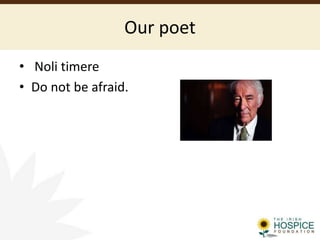
Our poet
• Noli timere
• Do not be afraid.
Death
• Death anxiety
• Terror management
• Death avoidance
• Death denial
• ‘Societies are standardised systems of death
denial’ Ernest Becker
– Consciousness of death and realisation of death
underpinning all human action
– Culture gives us meaning and defence against this;
a symbolic sense we can live forever
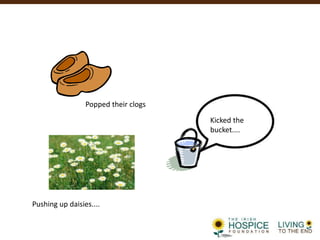
Kicked the
bucket....
Pushing up daisies....
Popped their clogs
Komaromy, C. and Woodthorpe, K. (2011) Investigating mortuary
services in hospital settings.
• An association with death was a potential
barrier to communicating with colleagues
outside of the mortuary, as the APTs found
themselves stigmatised by what they
perceived to be and what would be called
sociologically their literal ‘embodiment’ of
medical failure. This could be isolating for the
APTs, to the point that when they went to
other hospital departments, they were treated
with caution.
Yalom – Staring at the sun
• Fear of death as a primary source of anxiety;
hard-wired
Consequences
• Psychologically defended but
– Less compassionate
– Less balanced
Man’s inhumanity to man....
Yalom – Staring at the sun
• Fear of death as a primary source of anxiety;
hard-wired
• ‘I feel strongly as a man who will himself die
one day... that confronting death allows us not
to open some ... Pandora’s box but to re-enter
life in a richer, more compassionate manner’
Confront death, learn about it... can be a way of
enriching our life
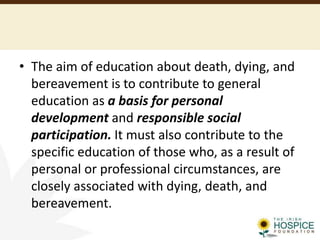
• The aim of education about death, dying, and
bereavement is to contribute to general
education as a basis for personal
development and responsible social
participation. It must also contribute to the
specific education of those who, as a result of
personal or professional circumstances, are
closely associated with dying, death, and
bereavement.
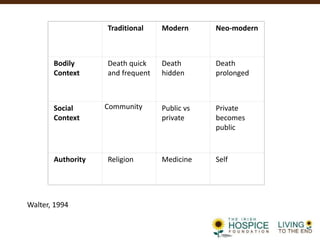
Traditional Modern Neo-modern
Bodily
Context
Death quick
and frequent
Death
hidden
Death
prolonged
Social
Context
Community Public vs
private
Private
becomes
public
Authority Religion Medicine Self
Walter, 1994
• If the tide is turning towards ‘self’ there is a
move towards sense making, meaning
making, control and this is a trend in personal
and professional life.
• One that is amenable to education and
support
– Public
– Professional
– Personal
• Public empowerment – knowledge,
understanding, comfort, language
• Professionals –technical and interpersonal
skills
• Personal learning
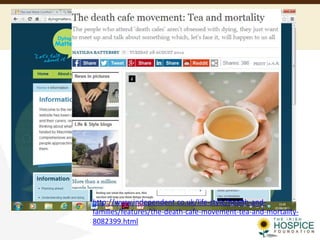
http://www.independent.co.uk/life-style/health-and-
families/features/the-death-cafe-movement-tea-and-mortality-
8082399.html
Community Engagement at 3rd International Public Health and Palliative Care Conference
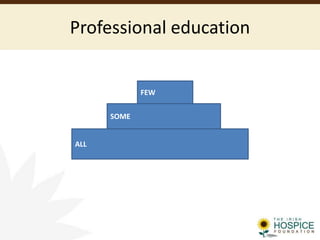
Professional education
ALL
SOME
FEW
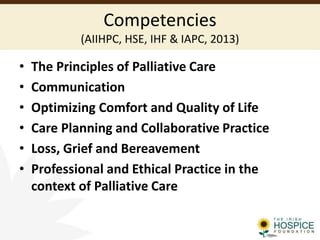
Competencies
(AIIHPC, HSE, IHF & IAPC, 2013)
• The Principles of Palliative Care
• Communication
• Optimizing Comfort and Quality of Life
• Care Planning and Collaborative Practice
• Loss, Grief and Bereavement
• Professional and Ethical Practice in the
context of Palliative Care
Personal
• Self-awareness involves both a combination of
self knowledge and development of dual-
awareness, a stance that permits the clinician
to simultaneously attend to and monitor the
needs of the patient, the work environment,
and his or her own subjective experience.
Kearney et al, Self-care of Physicians Caring for
Patients at the End of Life
Working with death, dying, pain
and loss
• Compassion fatigue has been described as the
“cost of caring” for others in emotional pain
• Compassion satisfaction is pleasure derived
from the work of helping others.
• “To cure sometimes, to relieve
often, to comfort always,”
Model(s) for death education...
Cognitive.... Information....
Experiential
Arts
Lifecycle
a basis for personal development and
responsible social participation.
Conclusion
• Death education... More than just a class
• Context for how students – and staff – are
inducted
• Context for donors’ journeys; and donors’
families’ journeys
• Context for how we approach people who are
bereaved
References
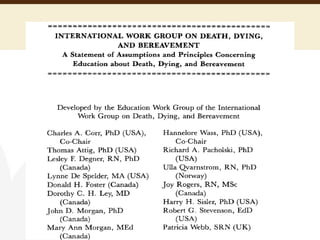
• International work group on death, dying and bereavement (1992)
International work group on death, dying, and bereavement: A statement
of assumptions and principles concerning education about death, dying,
and bereavement, Death Studies, 16:1, 59-65
• Becker, E (1973) The denial of death New York: Free Press
• Kearney, M. K., R. B. Weininger, et al. (2009) "Self-care of Physicians Caring
for Patients at the End of Life: "Being Connected . . . A Key to My
Survival"." JAMA 301(11): 1155-1164.
• Komaromy, C. and Woodthorpe, K. (2011) Investigating mortuary services
in hospital settings. CDAS report http://opus.bath.ac.uk/22612/
• Walter, (1994) The revival of death London; Routledge
• Yalom, Irvin D. 'Staring at the Sun: Overcoming the Terror of Death', The
Humanistic Psychologist, 36:3, 283 – 297
http://hospicefoundation.ie/the-irish-hospice-
foundation-pays-tribute-to-seamus-heaney-2/
• “I was thinking of when a tree is cut down; for a moment
it’s as if the air is shaken and there is a new space in the
world… an emptiness. So that clearances that stood open
when the spirit goes... that’s what I was thinking of.
I think that it’s very important that for the survivors, that
they are there when that clearance happens, when that
tree falls and when the moment of change is registered in
them… it’s very simple, very mysterious, nothing like it
ever happens anywhere else.”

Presentation Institute of anatomical sciences

  • 1.
    Learning for life?– a brief look at death education Orla Keegan, Irish Hospice Foundation
  • 2.
    Our poet • Nolitimere • Do not be afraid.
  • 3.
    Death • Death anxiety •Terror management • Death avoidance • Death denial
  • 4.
    • ‘Societies arestandardised systems of death denial’ Ernest Becker – Consciousness of death and realisation of death underpinning all human action – Culture gives us meaning and defence against this; a symbolic sense we can live forever
  • 5.
    Kicked the bucket.... Pushing updaisies.... Popped their clogs
  • 6.
    Komaromy, C. andWoodthorpe, K. (2011) Investigating mortuary services in hospital settings. • An association with death was a potential barrier to communicating with colleagues outside of the mortuary, as the APTs found themselves stigmatised by what they perceived to be and what would be called sociologically their literal ‘embodiment’ of medical failure. This could be isolating for the APTs, to the point that when they went to other hospital departments, they were treated with caution.
  • 7.
    Yalom – Staringat the sun • Fear of death as a primary source of anxiety; hard-wired
  • 8.
    Consequences • Psychologically defendedbut – Less compassionate – Less balanced Man’s inhumanity to man....
  • 9.
    Yalom – Staringat the sun • Fear of death as a primary source of anxiety; hard-wired • ‘I feel strongly as a man who will himself die one day... that confronting death allows us not to open some ... Pandora’s box but to re-enter life in a richer, more compassionate manner’ Confront death, learn about it... can be a way of enriching our life
  • 11.
    • The aimof education about death, dying, and bereavement is to contribute to general education as a basis for personal development and responsible social participation. It must also contribute to the specific education of those who, as a result of personal or professional circumstances, are closely associated with dying, death, and bereavement.
  • 12.
    Traditional Modern Neo-modern Bodily Context Deathquick and frequent Death hidden Death prolonged Social Context Community Public vs private Private becomes public Authority Religion Medicine Self Walter, 1994
  • 13.
    • If thetide is turning towards ‘self’ there is a move towards sense making, meaning making, control and this is a trend in personal and professional life. • One that is amenable to education and support – Public – Professional – Personal
  • 14.
    • Public empowerment– knowledge, understanding, comfort, language • Professionals –technical and interpersonal skills • Personal learning
  • 15.
  • 17.
    Community Engagement at3rd International Public Health and Palliative Care Conference
  • 19.
  • 20.
    Competencies (AIIHPC, HSE, IHF& IAPC, 2013) • The Principles of Palliative Care • Communication • Optimizing Comfort and Quality of Life • Care Planning and Collaborative Practice • Loss, Grief and Bereavement • Professional and Ethical Practice in the context of Palliative Care
  • 21.
    Personal • Self-awareness involvesboth a combination of self knowledge and development of dual- awareness, a stance that permits the clinician to simultaneously attend to and monitor the needs of the patient, the work environment, and his or her own subjective experience. Kearney et al, Self-care of Physicians Caring for Patients at the End of Life
  • 22.
    Working with death,dying, pain and loss • Compassion fatigue has been described as the “cost of caring” for others in emotional pain • Compassion satisfaction is pleasure derived from the work of helping others.
  • 24.
    • “To curesometimes, to relieve often, to comfort always,”
  • 25.
    Model(s) for deatheducation... Cognitive.... Information.... Experiential Arts Lifecycle a basis for personal development and responsible social participation.
  • 26.
    Conclusion • Death education...More than just a class • Context for how students – and staff – are inducted • Context for donors’ journeys; and donors’ families’ journeys • Context for how we approach people who are bereaved
  • 27.
    References • International workgroup on death, dying and bereavement (1992) International work group on death, dying, and bereavement: A statement of assumptions and principles concerning education about death, dying, and bereavement, Death Studies, 16:1, 59-65 • Becker, E (1973) The denial of death New York: Free Press • Kearney, M. K., R. B. Weininger, et al. (2009) "Self-care of Physicians Caring for Patients at the End of Life: "Being Connected . . . A Key to My Survival"." JAMA 301(11): 1155-1164. • Komaromy, C. and Woodthorpe, K. (2011) Investigating mortuary services in hospital settings. CDAS report http://opus.bath.ac.uk/22612/ • Walter, (1994) The revival of death London; Routledge • Yalom, Irvin D. 'Staring at the Sun: Overcoming the Terror of Death', The Humanistic Psychologist, 36:3, 283 – 297
  • 28.
    http://hospicefoundation.ie/the-irish-hospice- foundation-pays-tribute-to-seamus-heaney-2/ • “I wasthinking of when a tree is cut down; for a moment it’s as if the air is shaken and there is a new space in the world… an emptiness. So that clearances that stood open when the spirit goes... that’s what I was thinking of. I think that it’s very important that for the survivors, that they are there when that clearance happens, when that tree falls and when the moment of change is registered in them… it’s very simple, very mysterious, nothing like it ever happens anywhere else.”