Dying2Learn and
D2KD: A call to action
Deb Rawlings, Jennifer Tieman,
Natasha Tsoupas, Kerrie Noonan
(PCNA 2016)
What will be covered today
• CareSearch MOOC
• Partnership with Groundswell Project
• Dying2Learn to Dying2Know
Introduction
What is a MOOC?
• Massively Open Online Courses (MOOCs) are freely
available, short online courses that are available to
anyone to participate in
• There has been a surge in the popularity of MOOCs and
how they can be used to not only create social networks
and engage participants, but to impart important
messages, provide resources, and facilitate research
opportunities
A CareSearch MOOC?
• There is little known about Australian attitudes to
death and dying and about the role of online
environments in discussions around death and
dying.
• Understanding attitudes to death and dying is
important as it can facilitate community
acceptance of death as a normal part of life and
encourage open discussion about death
preparedness and planning.
Modules
1. How we engage with Death and Dying
• No laughing matter? /How we engage with death and dying through
language /through public mourning / through funerals
2. Representations of Death and Dying
• Death and dying via Art and History / through Film / through
television
3. If death is the problem….is medicine the answer?
• What will we die of / the role of medicine / Prolonging life or
prolonging death
4. Digital Dying
• The web is big / digital legacy / digital access and equity /dying is
personal, dying is public
Theoretical Approach
• Delivered via a sociological approach rather than
a medical one
• Concepts include: Peer to peer social activism
and building social capital
• Community driven, looking at concepts that have
impacted on the participants who are viewed as
contributors not recipients of education
Aimed at the General Public not Health Professionals
Dying2Learn and Dying2KnowDay
• Relationship between CareSearch and the
Groundswell project
• Initial discussions
• Teleconference
• Cross promotion
• Possibility of MOOC informing D2KD
• Ran the Tweetchat together
Promotion: A different approach
• New avenues sought for promotion
• Development of a logo and brand identity
• More of a reliance on social media
• Response and Uptake
• Two ‘Over 60’ blogs
• Two article in online newspapers (InDaily, and The Lead)
• ABC Radio Interview
• Tweets
• Palliative Matters (PCA)
Title Here
Text Content Here
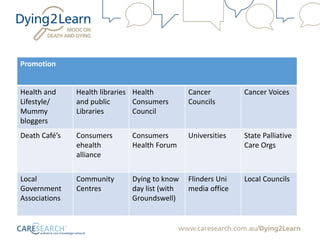
Promotion
Health and
Lifestyle/
Mummy
bloggers
Health libraries
and public
Libraries
Health
Consumers
Council
Cancer
Councils
Cancer Voices
Death Café’s Consumers
ehealth
alliance
Consumers
Health Forum
Universities State Palliative
Care Orgs
Local
Government
Associations
Community
Centres
Dying to know
day list (with
Groundswell)
Flinders Uni
media office
Local Councils
MOOC Community
• The participants became a community
• Dynamic conversations
• Community actions
• Using MOOC for all sorts of reasons – not education
particularly
• Problem solving as a community within the MOOC
• Learning from each other – eg, technical, social
MOOC Community
• 10 special interest groups were formed (128
people)
• Rainbows and teddy bears
• State or regional groups (6)
• Accompanying Death
• Civil celebrants conversations
• Personal experience of death walking
These groups intended to maintain contact after the
closure of the MOOC forming community of practice
and/or community resource groups.
Live Chat
• 2 hours (online within the blog) with Dr Chris
Sanderson and Dr Peter Saul
• “Let’s talk about Death” Peter’s TED talk was part of
the introductory module
• This activity attracted 245 participants, and resulted in 796
comments over the course of two hours, and a total of
2018 page views during the MOOC.
Community Action
I have just enrolled in the 'dying2learn' course because I thought it may
help myself and my friends as we approach the latter part of our lives. I
belong to a local community of mainly retired people approaching and
even experiencing the challenges of the end of life.
I was thinking it would be helpful for us if we could meet in a small
group to discuss the information produced in the course. Many of us are
not users of social media and I was hoping this could be a way of
encouraging conversation among us and contribute to the course with a
summary of these discussions.
Do you think this would be acceptable to the course organisers as I have
read that you want to involve people of all ages and walks of life.
After Completing the MOOC
We are a group of 70 year olds all belonging to a church
community.
I have shared with them some word documents and some videos
each week and have this week prepared them each a USB
containing these items for them to keep as a record of this
material for further reference.
The group have spoken of how helpful this has been and I can
sense that sharing together over 4 weeks has opened up ways for
us to share more openly with each other about situations that
concern us and hopefully be able to continue to be a listening ear
as we all encounter our own and others health issues
Gloria’s thoughts:
What I expected from the course:
1. How to speak to
care for
walk with someone facing death
What I got
1. Use of language and how to understand the huge impact on
patients and loved ones when confronted with death or serious
illness.
2.Importance of Advance care directives (choice is ours)
3. Mourning is a behaviour. Grief is an internal emotional
experience.
AT THE END: Thinking about action
• Getting participants to reflect
• Final Challenge
• Imagine you have just been appointed Health Minister…What
thoughts do you have as to how to improve end of life outcomes
for Australians (and Australia)?
• Suggestions on activities to take away
• Links to Death cafes, AD, Death over Dinner, My Values,
Compassionate cities etc…
• Spreading the word (have you?)
• Any light bulb moments?
So much energy in the group – we wanted to find a way to release it back into the
community
Outcomes: What’s next for participants?
• Have already started to talk to others about
important issues
• Interesting responses to the MOOC content– shock,
horror, fascination, surprise
• Lots of interesting dinner table conversations
• AD completed, wishes made known
• Using products, sharing /taking the message out
• Plans
• Host a Death over Dinner or a Death Café
• Feel more empowered to have conversations
• Off to do the Dementia MOOC
Dying2Learn and D2KD
• The MOOC finished just before D2KD
• Development of products in the MOOC
• 3 words – wordle
• Deathwise communication
• Groundswell, CareSearch tweetchat
Three words
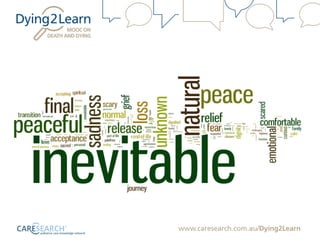
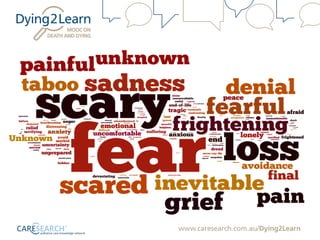
MOOC participants were asked to describe death and
dying.
• First, participants listed the 3 words that best describe
how they personally feel about death and dying (n=679)
• Second, participants listed the 3 words that they think
best describe how OTHERS in the general public feel
about death and dying (n=648)
• Larger words indicate more commonly-mentioned words.
Title Here
Text Content Here
Title Here
Text Content Here
The results show a striking contrast between words that
Dying2Learn MOOC participants used to describe their
feelings around death and dying, and the words they
believed described how others in the general public feel
about it.
Why is there such a difference in perception? Are MOOC
participants more accepting and comfortable with talking
about death and dying? Or is the whole community more
comfortable with death and dying than the MOOC
participants thought?
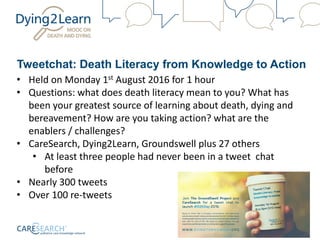
Tweetchat: Death Literacy from Knowledge to Action
• Held on Monday 1st August 2016 for 1 hour
• Questions: what does death literacy mean to you? What has
been your greatest source of learning about death, dying and
bereavement? How are you taking action? what are the
enablers / challenges?
• CareSearch, Dying2Learn, Groundswell plus 27 others
• At least three people had never been in a tweet chat
before
• Nearly 300 tweets
• Over 100 re-tweets
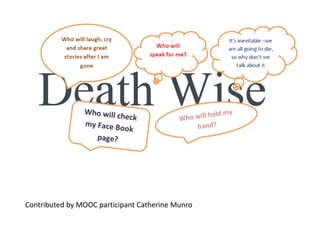
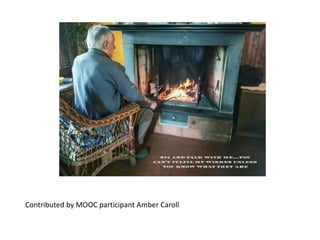
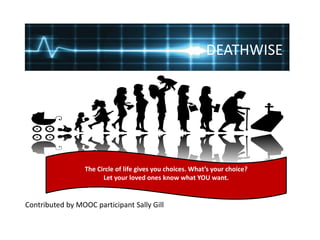
Call to Action: Deathwise
• As one of the MOOC activities, participants were asked
to create a poster to be shared with the community as
part of Dying to Know Day 2016. The message for the
poster needed to be their statement about what being
Deathwise is.
• Here are three of the many posters that were produced.
They outline messages for individuals, communities and
systems about the importance of being Deathwise.
Contributed by MOOC participant Catherine Munro
Contributed by MOOC participant Amber Caroll
Contributed by MOOC participant Sally Gill
DEATHWISE
The Circle of life gives you choices. What’s your choice?
Let your loved ones know what YOU want.
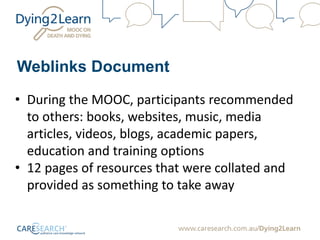
Weblinks Document
• During the MOOC, participants recommended
to others: books, websites, music, media
articles, videos, blogs, academic papers,
education and training options
• 12 pages of resources that were collated and
provided as something to take away
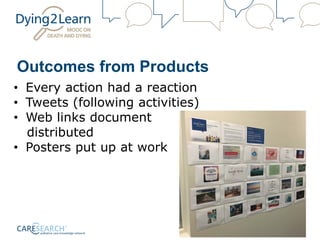
Outcomes from Products
• Every action had a reaction
• Tweets (following activities)
• Web links document
distributed
• Posters put up at work
Conclusion
• A new experience for CareSearch
• Moving onto a different platform
• Talking to the community
• MOOC will be run again in March 2017
• Need to keep a conversation going between now and
then
• Twitter line
• CareSearch page
CareSearch would like to thank the many people who
contribute their time and expertise to the project, including
members of the National Advisory Group and the Knowledge
Network Management Group.
The Groundswell Project and the Open Learning platform
both deserve special mention and acknowledgment
www.caresearch.com.au

Dying2Learn and Dying2KnowDay: A call to action

  • 1.
    Dying2Learn and D2KD: Acall to action Deb Rawlings, Jennifer Tieman, Natasha Tsoupas, Kerrie Noonan (PCNA 2016)
  • 2.
    What will becovered today • CareSearch MOOC • Partnership with Groundswell Project • Dying2Learn to Dying2Know
  • 3.
    Introduction What is aMOOC? • Massively Open Online Courses (MOOCs) are freely available, short online courses that are available to anyone to participate in • There has been a surge in the popularity of MOOCs and how they can be used to not only create social networks and engage participants, but to impart important messages, provide resources, and facilitate research opportunities
  • 4.
    A CareSearch MOOC? •There is little known about Australian attitudes to death and dying and about the role of online environments in discussions around death and dying. • Understanding attitudes to death and dying is important as it can facilitate community acceptance of death as a normal part of life and encourage open discussion about death preparedness and planning.
  • 5.
    Modules 1. How weengage with Death and Dying • No laughing matter? /How we engage with death and dying through language /through public mourning / through funerals 2. Representations of Death and Dying • Death and dying via Art and History / through Film / through television 3. If death is the problem….is medicine the answer? • What will we die of / the role of medicine / Prolonging life or prolonging death 4. Digital Dying • The web is big / digital legacy / digital access and equity /dying is personal, dying is public
  • 6.
    Theoretical Approach • Deliveredvia a sociological approach rather than a medical one • Concepts include: Peer to peer social activism and building social capital • Community driven, looking at concepts that have impacted on the participants who are viewed as contributors not recipients of education Aimed at the General Public not Health Professionals
  • 7.
    Dying2Learn and Dying2KnowDay •Relationship between CareSearch and the Groundswell project • Initial discussions • Teleconference • Cross promotion • Possibility of MOOC informing D2KD • Ran the Tweetchat together
  • 8.
    Promotion: A differentapproach • New avenues sought for promotion • Development of a logo and brand identity • More of a reliance on social media • Response and Uptake • Two ‘Over 60’ blogs • Two article in online newspapers (InDaily, and The Lead) • ABC Radio Interview • Tweets • Palliative Matters (PCA)
  • 9.
    Title Here Text ContentHere Promotion Health and Lifestyle/ Mummy bloggers Health libraries and public Libraries Health Consumers Council Cancer Councils Cancer Voices Death Café’s Consumers ehealth alliance Consumers Health Forum Universities State Palliative Care Orgs Local Government Associations Community Centres Dying to know day list (with Groundswell) Flinders Uni media office Local Councils
  • 10.
    MOOC Community • Theparticipants became a community • Dynamic conversations • Community actions • Using MOOC for all sorts of reasons – not education particularly • Problem solving as a community within the MOOC • Learning from each other – eg, technical, social
  • 11.
    MOOC Community • 10special interest groups were formed (128 people) • Rainbows and teddy bears • State or regional groups (6) • Accompanying Death • Civil celebrants conversations • Personal experience of death walking These groups intended to maintain contact after the closure of the MOOC forming community of practice and/or community resource groups.
  • 12.
    Live Chat • 2hours (online within the blog) with Dr Chris Sanderson and Dr Peter Saul • “Let’s talk about Death” Peter’s TED talk was part of the introductory module • This activity attracted 245 participants, and resulted in 796 comments over the course of two hours, and a total of 2018 page views during the MOOC.
  • 13.
    Community Action I havejust enrolled in the 'dying2learn' course because I thought it may help myself and my friends as we approach the latter part of our lives. I belong to a local community of mainly retired people approaching and even experiencing the challenges of the end of life. I was thinking it would be helpful for us if we could meet in a small group to discuss the information produced in the course. Many of us are not users of social media and I was hoping this could be a way of encouraging conversation among us and contribute to the course with a summary of these discussions. Do you think this would be acceptable to the course organisers as I have read that you want to involve people of all ages and walks of life.
  • 14.
    After Completing theMOOC We are a group of 70 year olds all belonging to a church community. I have shared with them some word documents and some videos each week and have this week prepared them each a USB containing these items for them to keep as a record of this material for further reference. The group have spoken of how helpful this has been and I can sense that sharing together over 4 weeks has opened up ways for us to share more openly with each other about situations that concern us and hopefully be able to continue to be a listening ear as we all encounter our own and others health issues
  • 15.
    Gloria’s thoughts: What Iexpected from the course: 1. How to speak to care for walk with someone facing death What I got 1. Use of language and how to understand the huge impact on patients and loved ones when confronted with death or serious illness. 2.Importance of Advance care directives (choice is ours) 3. Mourning is a behaviour. Grief is an internal emotional experience.
  • 16.
    AT THE END:Thinking about action • Getting participants to reflect • Final Challenge • Imagine you have just been appointed Health Minister…What thoughts do you have as to how to improve end of life outcomes for Australians (and Australia)? • Suggestions on activities to take away • Links to Death cafes, AD, Death over Dinner, My Values, Compassionate cities etc… • Spreading the word (have you?) • Any light bulb moments? So much energy in the group – we wanted to find a way to release it back into the community
  • 17.
    Outcomes: What’s nextfor participants? • Have already started to talk to others about important issues • Interesting responses to the MOOC content– shock, horror, fascination, surprise • Lots of interesting dinner table conversations • AD completed, wishes made known • Using products, sharing /taking the message out • Plans • Host a Death over Dinner or a Death Café • Feel more empowered to have conversations • Off to do the Dementia MOOC
  • 18.
    Dying2Learn and D2KD •The MOOC finished just before D2KD • Development of products in the MOOC • 3 words – wordle • Deathwise communication • Groundswell, CareSearch tweetchat
  • 19.
    Three words MOOC participantswere asked to describe death and dying. • First, participants listed the 3 words that best describe how they personally feel about death and dying (n=679) • Second, participants listed the 3 words that they think best describe how OTHERS in the general public feel about death and dying (n=648) • Larger words indicate more commonly-mentioned words.
  • 20.
  • 21.
  • 22.
    The results showa striking contrast between words that Dying2Learn MOOC participants used to describe their feelings around death and dying, and the words they believed described how others in the general public feel about it. Why is there such a difference in perception? Are MOOC participants more accepting and comfortable with talking about death and dying? Or is the whole community more comfortable with death and dying than the MOOC participants thought?
  • 23.
    Tweetchat: Death Literacyfrom Knowledge to Action • Held on Monday 1st August 2016 for 1 hour • Questions: what does death literacy mean to you? What has been your greatest source of learning about death, dying and bereavement? How are you taking action? what are the enablers / challenges? • CareSearch, Dying2Learn, Groundswell plus 27 others • At least three people had never been in a tweet chat before • Nearly 300 tweets • Over 100 re-tweets
  • 24.
    Call to Action:Deathwise • As one of the MOOC activities, participants were asked to create a poster to be shared with the community as part of Dying to Know Day 2016. The message for the poster needed to be their statement about what being Deathwise is. • Here are three of the many posters that were produced. They outline messages for individuals, communities and systems about the importance of being Deathwise.
  • 25.
    Contributed by MOOCparticipant Catherine Munro
  • 26.
    Contributed by MOOCparticipant Amber Caroll
  • 27.
    Contributed by MOOCparticipant Sally Gill DEATHWISE The Circle of life gives you choices. What’s your choice? Let your loved ones know what YOU want.
  • 28.
    Weblinks Document • Duringthe MOOC, participants recommended to others: books, websites, music, media articles, videos, blogs, academic papers, education and training options • 12 pages of resources that were collated and provided as something to take away
  • 29.
    Outcomes from Products •Every action had a reaction • Tweets (following activities) • Web links document distributed • Posters put up at work
  • 30.
    Conclusion • A newexperience for CareSearch • Moving onto a different platform • Talking to the community • MOOC will be run again in March 2017 • Need to keep a conversation going between now and then • Twitter line • CareSearch page
  • 31.
    CareSearch would liketo thank the many people who contribute their time and expertise to the project, including members of the National Advisory Group and the Knowledge Network Management Group. The Groundswell Project and the Open Learning platform both deserve special mention and acknowledgment www.caresearch.com.au