Md. Shamim Hossain
ID: 153015013
Sub: Computer Architecture
Dept: CSE
Green university of Bangladesh
Welcome To My Presentatio
Presentation
Topics
•Computer Architecture History
HISTORY!!!
One of the first computing devices to come about was . .
The ABACUS!
• Completed:1946
• Programmed: plug board and switches
• Speed:5,000 operations per second
• Input/output: cards, lights, switches, plugs
• Floor space:1,000 square feet
The ENIAC : 1946
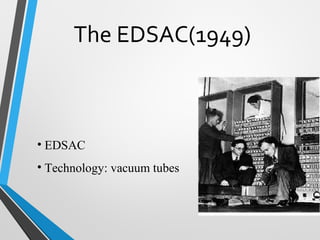
The EDSAC(1949)
• EDSAC
• Technology: vacuum tubes
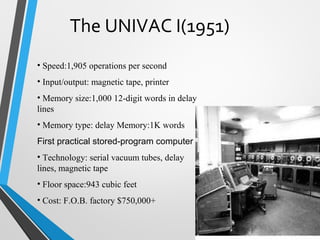
The UNIVAC I(1951)
• Speed:1,905 operations per second
• Input/output: magnetic tape, printer
• Memory size:1,000 12-digit words in delay
lines
• Memory type: delay Memory:1K words
First practical stored-program computer
• Technology: serial vacuum tubes, delay
lines, magnetic tape
• Floor space:943 cubic feet
• Cost: F.O.B. factory $750,000+
Progression of The Architecture
• Vacuum tubes -- 1940 – 1950
• Transistors -- 1950 – 1964
• Integrated circuits -- 1964 – 1971
• Microprocessor chips -- 1971 – present
Current CPU Architecture
Intel Pentium 1 Chip with MMX
Motherboards / Chipsets / Sockets
•Chipset
In charge of:
•Memory Controller
•EIDE Controller
•PCI Bridge
•Real Time Clock
•DMA Controller
•IRDA Controller
•Keyboard
•Mouse
•Secondary Cache
•Low-Power CMOS SRAM
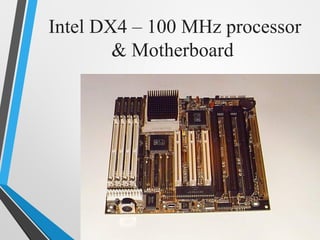
Intel DX4 – 100 MHz processor
& Motherboard
Pentium 4 Architecture
Main Memory
Read Operation
•On a read the CPU will first try to find the data in the
cache, if it is not there the cache will get updated
from the main memory and then return the data to
the CPU.
Serial Port
• Uses DB9 or DB25
connector
• Adheres to RS-232c spec
• Capable of speeds up to
115kb/sec
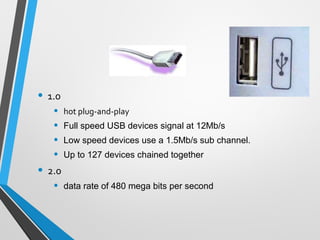
USB
• 1.0
• hot plug-and-play
• Full speed USB devices signal at 12Mb/s
• Low speed devices use a 1.5Mb/s sub channel.
• Up to 127 devices chained together
• 2.0
• data rate of 480 mega bits per second
PS/2 Port
• Mini Din Plug with 6 pins
• Mouse port and keyboard port
• Developed by IBM
Parallel port i.e. “printer port”
• Old type
• Two “new” types
• ECP (extended capabilities port)
and EPP (enhanced parallel port)
• Ten times faster than old parallel port
• Capable of bi-directional
communication.
Game Port
• Uses a db15 port
• Used for joystick connection to the computer
THANKS
Any Question????

Presentation for architecture

  • 1.
    Md. Shamim Hossain ID:153015013 Sub: Computer Architecture Dept: CSE Green university of Bangladesh Welcome To My Presentatio
  • 2.
  • 3.
    HISTORY!!! One of thefirst computing devices to come about was . . The ABACUS!
  • 4.
    • Completed:1946 • Programmed:plug board and switches • Speed:5,000 operations per second • Input/output: cards, lights, switches, plugs • Floor space:1,000 square feet The ENIAC : 1946
  • 5.
    The EDSAC(1949) • EDSAC •Technology: vacuum tubes
  • 6.
    The UNIVAC I(1951) •Speed:1,905 operations per second • Input/output: magnetic tape, printer • Memory size:1,000 12-digit words in delay lines • Memory type: delay Memory:1K words First practical stored-program computer • Technology: serial vacuum tubes, delay lines, magnetic tape • Floor space:943 cubic feet • Cost: F.O.B. factory $750,000+
  • 7.
    Progression of TheArchitecture • Vacuum tubes -- 1940 – 1950 • Transistors -- 1950 – 1964 • Integrated circuits -- 1964 – 1971 • Microprocessor chips -- 1971 – present
  • 8.
  • 9.
    Intel Pentium 1Chip with MMX
  • 10.
    Motherboards / Chipsets/ Sockets •Chipset In charge of: •Memory Controller •EIDE Controller •PCI Bridge •Real Time Clock •DMA Controller •IRDA Controller •Keyboard •Mouse •Secondary Cache •Low-Power CMOS SRAM
  • 11.
    Intel DX4 –100 MHz processor & Motherboard
  • 12.
  • 13.
  • 14.
    Read Operation •On aread the CPU will first try to find the data in the cache, if it is not there the cache will get updated from the main memory and then return the data to the CPU.
  • 15.
    Serial Port • UsesDB9 or DB25 connector • Adheres to RS-232c spec • Capable of speeds up to 115kb/sec
  • 16.
    USB • 1.0 • hotplug-and-play • Full speed USB devices signal at 12Mb/s • Low speed devices use a 1.5Mb/s sub channel. • Up to 127 devices chained together • 2.0 • data rate of 480 mega bits per second
  • 17.
    PS/2 Port • MiniDin Plug with 6 pins • Mouse port and keyboard port • Developed by IBM
  • 18.
    Parallel port i.e.“printer port” • Old type • Two “new” types • ECP (extended capabilities port) and EPP (enhanced parallel port) • Ten times faster than old parallel port • Capable of bi-directional communication.
  • 19.
    Game Port • Usesa db15 port • Used for joystick connection to the computer
  • 20.
  • 21.

Editor's Notes

  • #10 Intel Pentium 1 Chip with MMX
  • #12 This is a Intel DX4 – 100 MHz processor and motherboard.
  • #13 An Overview of a Pentium 4 Architecture.