Objectives
After studying thisunit, you will be able to:
1. Define e-commerce and e-Business;
2. Identify the benefits of e-commerce;
3. Compare e-commerce with traditional commerce; and
4. Explain the business applications of e-commerce
3.
"Your most unhappycustomers are your
greatest source of learning."
- Bill Gates
What is E-commerce?
E-commerce
Isa concept dealing with any form of business transaction or
information exchange executed using Information and
Communication Technology (ICT), between companies,
companies and their customers, or companies and public
administrations.
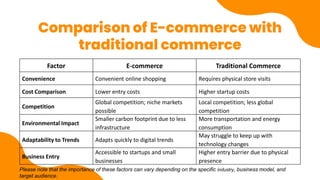
Comparison of E-commercewith
traditional commerce
E-commerce and traditional commerce are two distinct
approaches to conducting business, each with its own
advantages and disadvantages.
8.
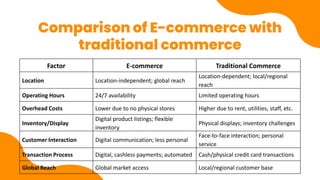
Comparison of E-commercewith
traditional commerce
Factor E-commerce Traditional Commerce
Location Location-independent; global reach
Location-dependent; local/regional
reach
Operating Hours 24/7 availability Limited operating hours
Overhead Costs Lower due to no physical stores Higher due to rent, utilities, staff, etc.
Inventory/Display
Digital product listings; flexible
inventory
Physical displays; inventory challenges
Customer Interaction Digital communication; less personal
Face-to-face interaction; personal
service
Transaction Process Digital, cashless payments; automated Cash/physical credit card transactions
Global Reach Global market access Local/regional customer base
9.
Comparison of E-commercewith
traditional commerce
Factor E-commerce Traditional Commerce
Convenience Convenient online shopping Requires physical store visits
Cost Comparison Lower entry costs Higher startup costs
Competition
Global competition; niche markets
possible
Local competition; less global
competition
Environmental Impact
Smaller carbon footprint due to less
infrastructure
More transportation and energy
consumption
Adaptability to Trends Adapts quickly to digital trends
May struggle to keep up with
technology changes
Business Entry
Accessible to startups and small
businesses
Higher entry barrier due to physical
presence
Please note that the importance of these factors can vary depending on the specific industry, business model, and
target audience.
10.
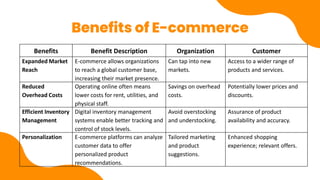
Benefits of E-commerce
BenefitsBenefit Description Organization Customer
Expanded Market
Reach
E-commerce allows organizations
to reach a global customer base,
increasing their market presence.
Can tap into new
markets.
Access to a wider range of
products and services.
Reduced
Overhead Costs
Operating online often means
lower costs for rent, utilities, and
physical staff.
Savings on overhead
costs.
Potentially lower prices and
discounts.
Efficient Inventory
Management
Digital inventory management
systems enable better tracking and
control of stock levels.
Avoid overstocking
and understocking.
Assurance of product
availability and accuracy.
Personalization E-commerce platforms can analyze
customer data to offer
personalized product
recommendations.
Tailored marketing
and product
suggestions.
Enhanced shopping
experience; relevant offers.
11.
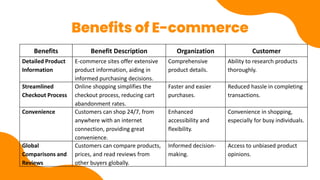
Benefits of E-commerce
BenefitsBenefit Description Organization Customer
Detailed Product
Information
E-commerce sites offer extensive
product information, aiding in
informed purchasing decisions.
Comprehensive
product details.
Ability to research products
thoroughly.
Streamlined
Checkout Process
Online shopping simplifies the
checkout process, reducing cart
abandonment rates.
Faster and easier
purchases.
Reduced hassle in completing
transactions.
Convenience Customers can shop 24/7, from
anywhere with an internet
connection, providing great
convenience.
Enhanced
accessibility and
flexibility.
Convenience in shopping,
especially for busy individuals.
Global
Comparisons and
Reviews
Customers can compare products,
prices, and read reviews from
other buyers globally.
Informed decision-
making.
Access to unbiased product
opinions.
12.
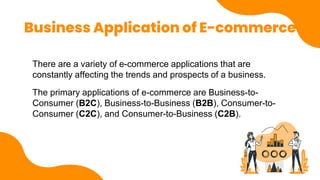
Business Application ofE-commerce
There are a variety of e-commerce applications that are
constantly affecting the trends and prospects of a business.
The primary applications of e-commerce are Business-to-
Consumer (B2C), Business-to-Business (B2B), Consumer-to-
Consumer (C2C), and Consumer-to-Business (C2B).
13.
Business Application ofE-commerce
1. B2C – or Business-to-Consumer, Refers to a type of e-
commerce or business model in which companies or
businesses sell products or services directly to individual
consumers.
e.g., Amazon, Walmart, Apple, Zara
14.
Business Application ofE-commerce
2. B2B – which stands for "Business-to-Business," refers to a
type of commerce or business model in which companies or
businesses sell products or services to other businesses rather
than individual consumers.
- Businesses can purchase raw materials, supplies, and
products in bulk from suppliers and distributors
e.g. Alibaba, Xerox, Intel
15.
Business Application ofE-commerce
3. C2C – stands for "Consumer-to-Consumer," is a business
model where individuals or consumers directly engage in
transactions with each other, typically facilitated by online
platforms or marketplaces.
- consumers act as both sellers and buyers, offering products,
services, or even information to one another
e.g. Online Marketplaces, Home sharing
16.
Business Application ofE-commerce
4. C2B – stands for "Consumer-to-Business," C2B stands for
"Consumer-to-Business," a business model in which consumers
or individuals offer products, services, or ideas to businesses.
- consumers become the initiators of value creation.
e.g. Freelance Platforms, Crowdsourcing, Affiliate Marketing,
Content Creation
17.
Business Application ofE-commerce
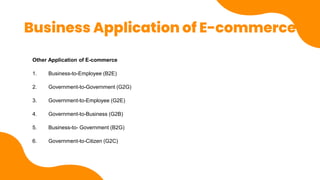
Other Application of E-commerce
1. Business-to-Employee (B2E)
2. Government-to-Government (G2G)
3. Government-to-Employee (G2E)
4. Government-to-Business (G2B)
5. Business-to- Government (B2G)
6. Government-to-Citizen (G2C)
Activity
Identify which ofthe four (4) business application or business
type is referred below.
1. Alibaba - Alibaba is a massive B2B e-commerce platform that
connects businesses with suppliers from around the world.
2. Uber: Uber connects individual consumers with drivers who
provide transportation services through its mobile app.
3. Personalized Products: Some businesses allow consumers to
customize products, such as t-shirts, mugs, or phone cases, by
submitting their own designs or ideas.
20.
Activity
3. Personalized Products:Some businesses allow
consumers to customize products, such as t-shirts, mugs,
or phone cases, by submitting their own designs or ideas.
4. Ride-Sharing: Apps like Uber and Lyft allow individuals
to offer rides to others in exchange for payment.
5. Swapping and Bartering: Websites like Swap.com and
Bunz Trading Zone provide platforms for individuals to
trade items they no longer need with items offered by
others.
21.
Activity
6. Netflix: Netflixoffers a subscription-based streaming
service that allows individual consumers to access a vast
library of movies and TV shows online.
7. Cisco: Cisco manufactures and sells networking
equipment and technology solutions to other businesses
and organizations to support their IT infrastructure.
8. H&M: H&M is a fashion retailer that sells clothing,
accessories, and home goods directly to individual
consumers through physical stores and its online store.
22.
Activity
9. Content Creation:Bloggers, vloggers, and
social media influencers can create content and
monetize it by partnering with businesses for
sponsored posts, reviews, or promotions.
10. Starbucks: Starbucks operates coffee shops
worldwide, where it sells coffee, beverages, and
food directly to individual customers.