the climate data factory
climate	projec-ons	as	you	want	them	
easy	to	look-up,	same	grids,	bias	corrected,	for	any	applica-on
Preparing the data is a struggle
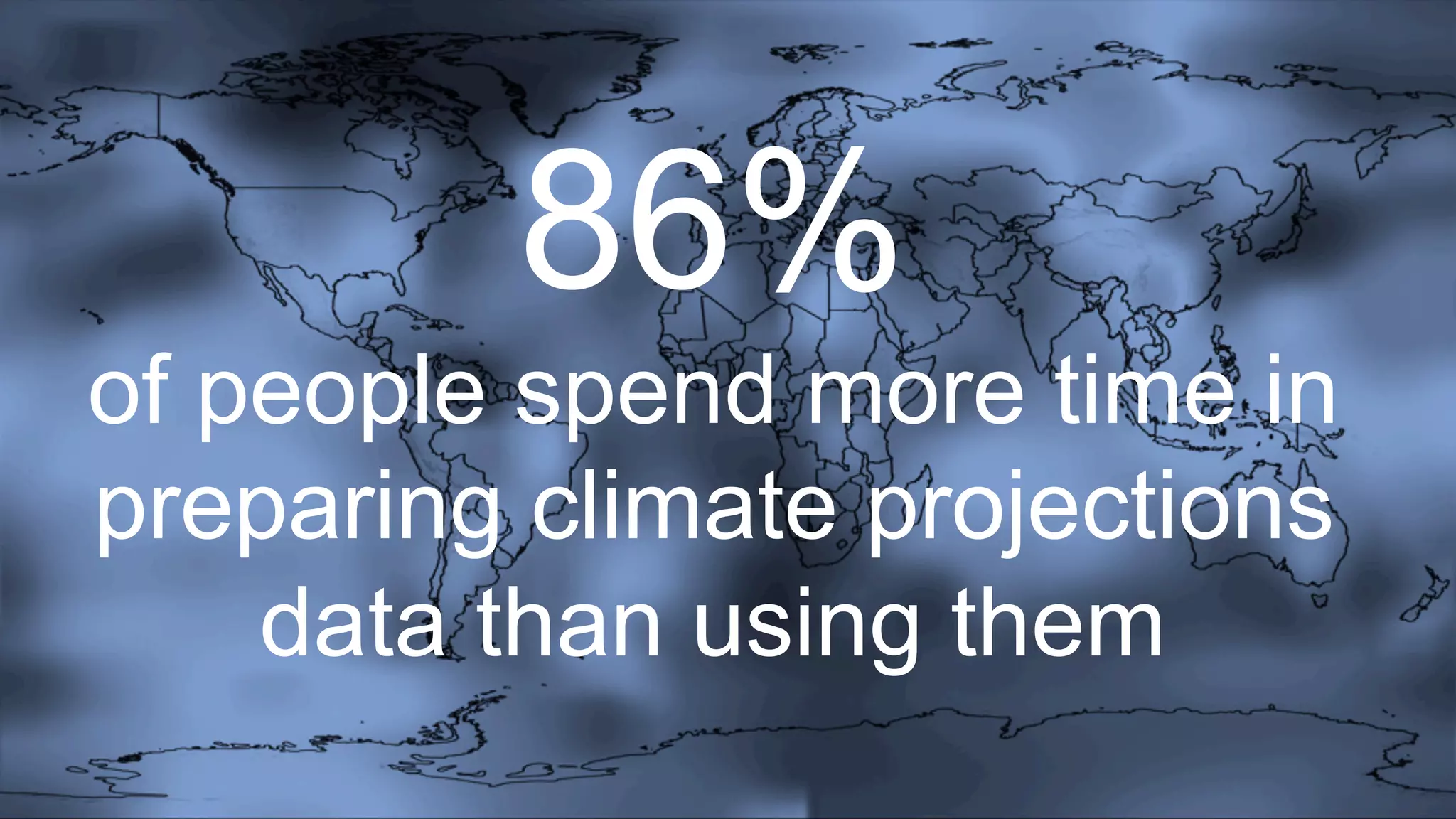
86%
of people spend more time in
preparing climate projections
data than using them
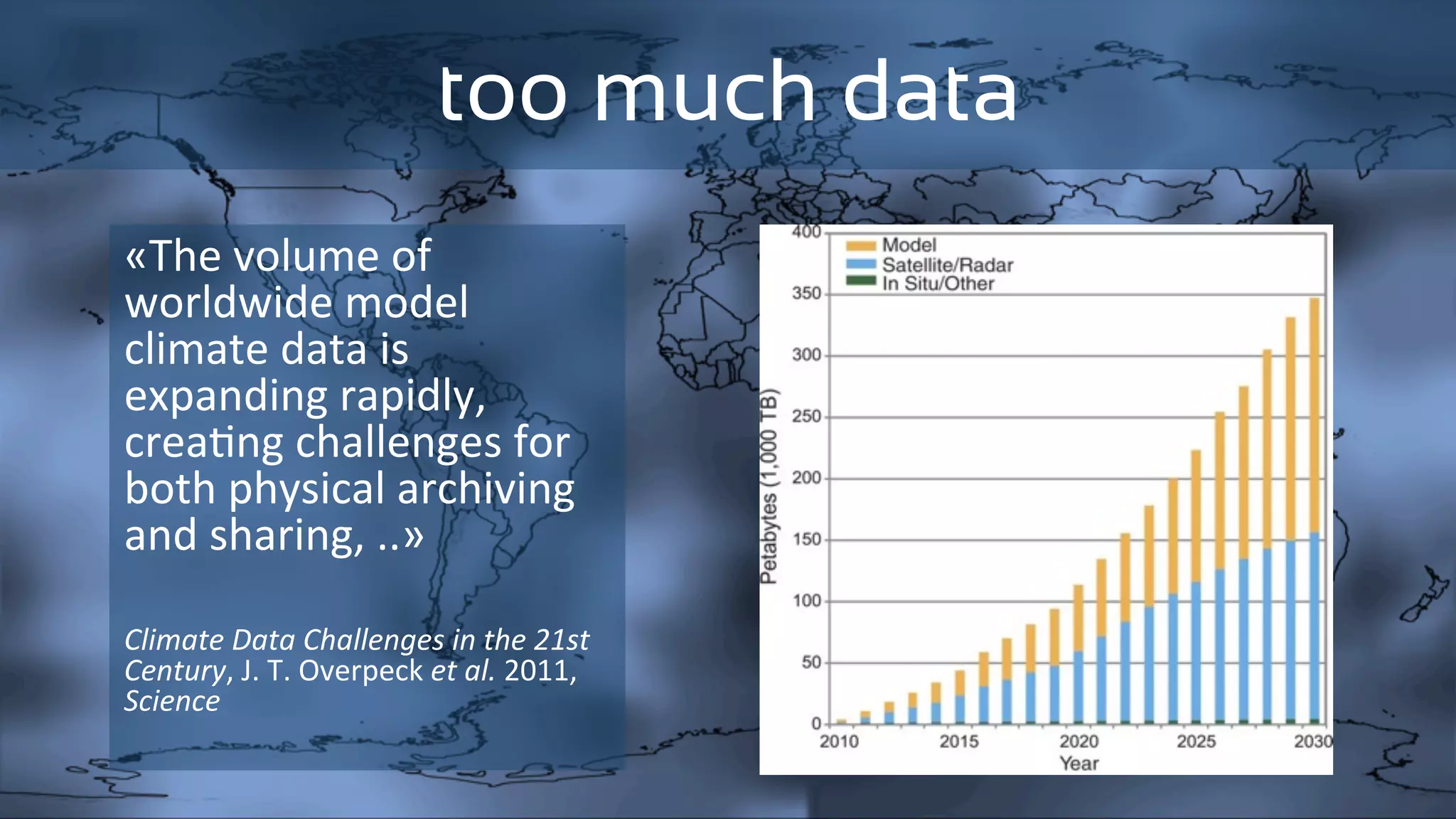
too much data
«The	volume	of	
worldwide	model	
climate	data	is	
expanding	rapidly,	
crea:ng	challenges	for	
both	physical	archiving	
and	sharing,	..»	
	
	
Climate	Data	Challenges	in	the	21st	
Century,	J.	T.	Overpeck	et	al.	2011,	
Science
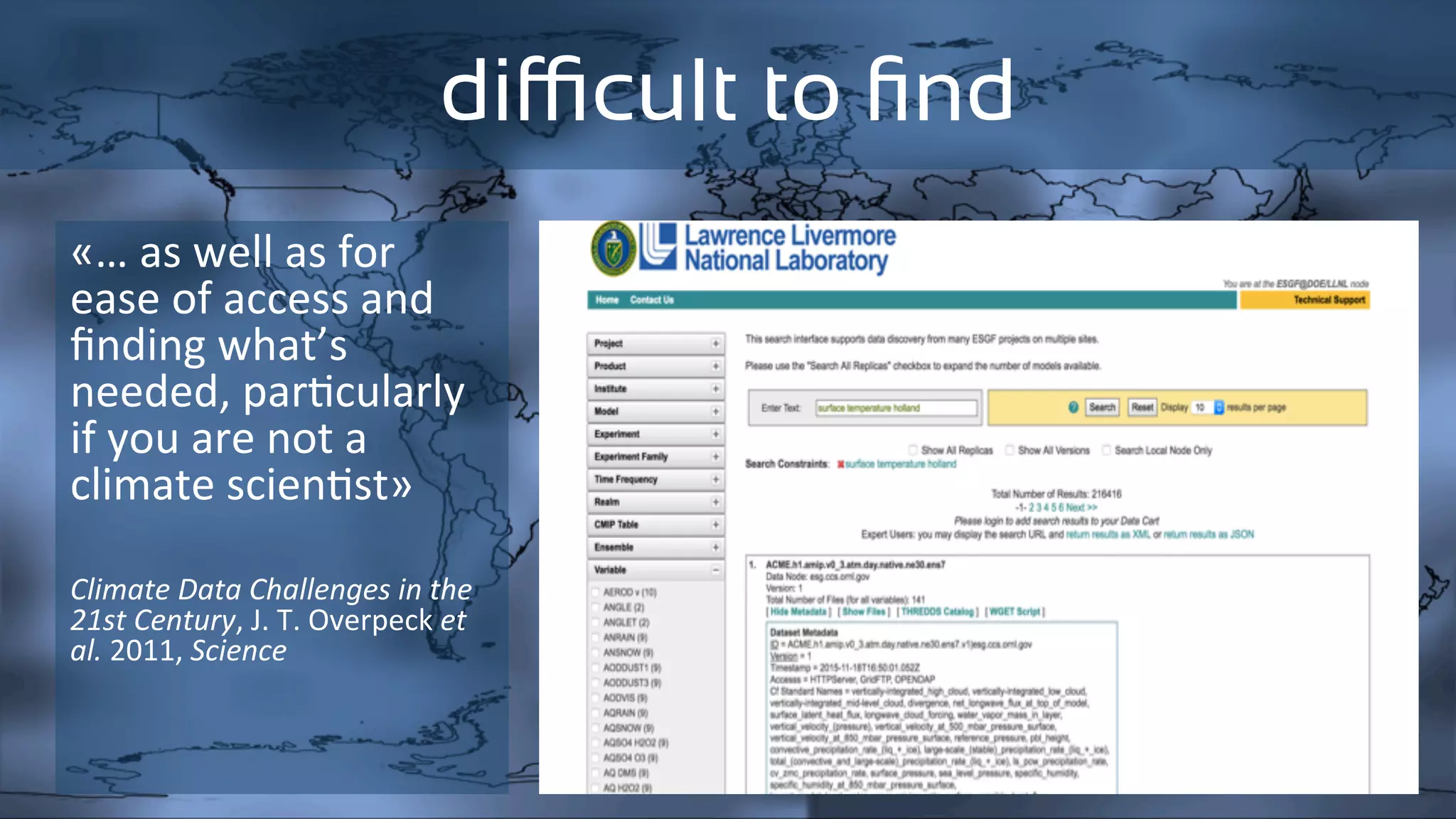
difficult to find
«…	as	well	as	for	
ease	of	access	and	
finding	what’s	
needed,	par:cularly	
if	you	are	not	a	
climate	scien:st»	
	
	
Climate	Data	Challenges	in	the	
21st	Century,	J.	T.	Overpeck	et	
al.	2011,	Science
on different grids
that need bias correction
TCD
9, 3821–3857, 2015
Improved Arctic sea
ice thickness
projections using
bias corrected CMIP5
simulations
N. Melia et al.
Title Page
Abstract Introduction
Conclusions References
Tables Figures
J I
J I
Back Close
Full Screen / Esc
Printer-friendly Version
Interactive Discussion
DiscussionPaper|DiscussionPaper|DiscussionPaper|DiscussionPaper|
The Cryosphere Discuss., 9, 3821–3857, 2015
www.the-cryosphere-discuss.net/9/3821/2015/
doi:10.5194/tcd-9-3821-2015
© Author(s) 2015. CC Attribution 3.0 License.
This discussion paper is/has been under review for the journal The Cryosphere (TC).
Please refer to the corresponding final paper in TC if available.
Improved Arctic sea ice thickness
projections using bias corrected CMIP5
simulations
N. Melia1
, K. Haines2
, and E. Hawkins3
1
Department of Meteorology, University of Reading, Reading, UK
2
National Centre for Earth Observation, Department of Meteorology, University of Reading,
Reading, UK
3
NCAS-Climate, Department of Meteorology, University of Reading, Reading, UK
Received: 26 June 2015 – Accepted: 29 June 2015 – Published: 22 July 2015
Correspondence to: N. Melia (n.melia@pgr.reading.ac.uk)
Published by Copernicus Publications on behalf of the European Geosciences Union.
3821
ESDD
6, 1999–2042, 2015
Ensemble bias
correction
S. Sippel et al.
Title Page
Abstract Introduction
Conclusions References
Tables Figures
J I
DiscussionPaper|DiscussionPaper|Discussio
Earth Syst. Dynam. Discuss., 6, 1999–2042, 2015
www.earth-syst-dynam-discuss.net/6/1999/2015/
doi:10.5194/esdd-6-1999-2015
© Author(s) 2015. CC Attribution 3.0 License.
This discussion paper is/has been under review for the journal Earth System
Dynamics (ESD). Please refer to the corresponding final paper in ESD if available.
A novel bias correction methodology for
climate impact simulations
S. Sippel1,2
, F. E. L. Otto3
, M. Forkel1
, M. R. Allen3
, B. P. Guillod3
, M. Heimann1
,
M. Reichstein
1
, S. I. Seneviratne
2
, K. Thonicke
4
, and M. D. Mahecha
1,5
1
Max Planck Institute for Biogeochemistry, Hans-Knöll-Str. 10, 07745 Jena, Germany
2
Institute for Atmospheric and Climate Science, ETH Zürich, Rämistr. 101,
8075 Zürich, Switzerland
3
Environmental Change Institute, University of Oxford, South Parks Road,
Bias correction of regional climate model simulations for hydrological
climate-change impact studies: Review and evaluation of different methods
Claudia Teutschbein a,⇑
, Jan Seibert a,b,c
a
Department of Physical Geography and Quaternary Geology, Stockholm University, Svante Arrhenius Väg 8, S-10691 Stockholm, Sweden
b
Department of Geography, University of Zurich, Winterthurerstrasse 190, CH-8057 Zurich, Switzerland
c
Department of Earth Sciences, Uppsala University, Villavägen 16, S-75236 Uppsala, Sweden
a r t i c l e i n f o
Article history:
Received 14 March 2012
Received in revised form 14 May 2012
Accepted 26 May 2012
Available online 6 June 2012
This manuscript was handled by
Konstantine P. Georgakakos, Editor-in-Chief,
with the assistance of Ashish Sharma,
Associate Editor
Keywords:
RCM
Bias correction
Downscaling
Hydrology
HBV
Streamflow
s u m m a r y
Despite the increasing use of regional climate model (RCM) simulations in hydrological climate-change
impact studies, their application is challenging due to the risk of considerable biases. To deal with these
biases, several bias correction methods have been developed recently, ranging from simple scaling to
rather sophisticated approaches. This paper provides a review of available bias correction methods and
demonstrates how they can be used to correct for deviations in an ensemble of 11 different RCM-simu-
lated temperature and precipitation series. The performance of all methods was assessed in several ways:
At first, differently corrected RCM data was compared to observed climate data. The second evaluation
was based on the combined influence of corrected RCM-simulated temperature and precipitation on
hydrological simulations of monthly mean streamflow as well as spring and autumn flood peaks for five
catchments in Sweden under current (1961–1990) climate conditions. Finally, the impact on hydrological
simulations based on projected future (2021–2050) climate conditions was compared for the different
bias correction methods. Improvement of uncorrected RCM climate variables was achieved with all bias
correction approaches. While all methods were able to correct the mean values, there were clear differ-
ences in their ability to correct other statistical properties such as standard deviation or percentiles. Sim-
ulated streamflow characteristics were sensitive to the quality of driving input data: Simulations driven
with bias-corrected RCM variables fitted observed values better than simulations forced with uncorrected
RCM climate variables and had more narrow variability bounds.
Ó 2012 Elsevier B.V. All rights reserved.
Journal of Hydrology 456–457 (2012) 12–29
Contents lists available at SciVerse ScienceDirect
Journal of Hydrology
journal homepage: www.elsevier.com/locate/jhydrol
Intercomparison of bias-correction methods for monthly
temperature and precipitation simulated by multiple
climate models
Satoshi Watanabe,1
Shinjiro Kanae,2
Shinta Seto,3
Pat J.-F. Yeh,4
Yukiko Hirabayashi,1
and Taikan Oki3
Received 28 May 2012; revised 20 October 2012; accepted 23 October 2012; published 13 December 2012.
[1] Bias-correction methods applied to monthly temperature and precipitation data
simulated by multiple General Circulation Models (GCMs) are evaluated in this study.
JOURNAL OF GEOPHYSICAL RESEARCH, VOL. 117, D23114, doi:10.1029/2012JD018192, 2012
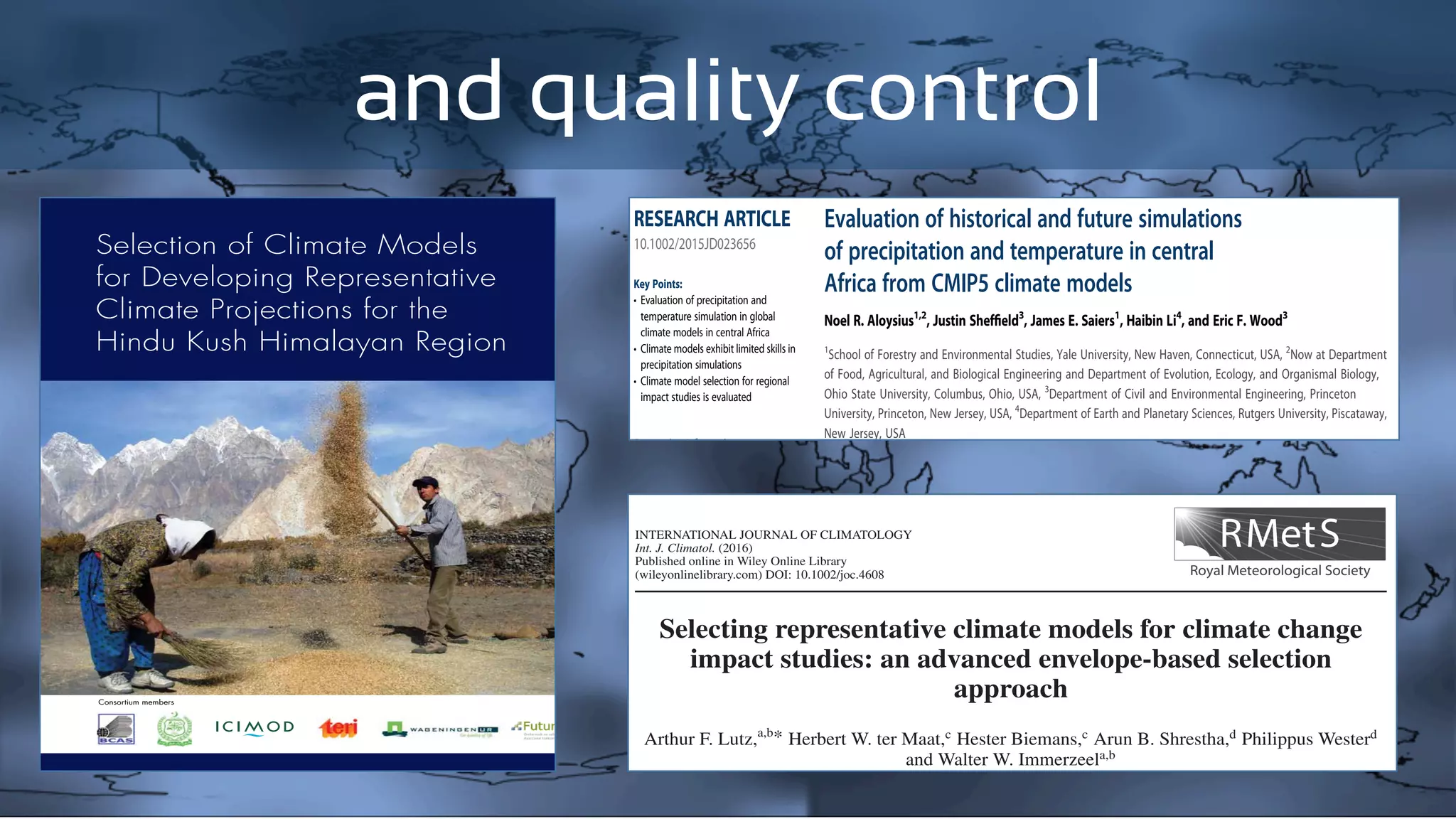
and quality controlHI-AWARE Working Paper 1
Selection of Climate Models
for Developing Representative
Climate Projections for the
Hindu Kush Himalayan Region
Consortium members
Evaluation of historical and future simulations
of precipitation and temperature in central
Africa from CMIP5 climate models
Noel R. Aloysius1,2
, Justin Sheffield3
, James E. Saiers1
, Haibin Li4
, and Eric F. Wood3
1
School of Forestry and Environmental Studies, Yale University, New Haven, Connecticut, USA, 2
Now at Department
of Food, Agricultural, and Biological Engineering and Department of Evolution, Ecology, and Organismal Biology,
Ohio State University, Columbus, Ohio, USA, 3
Department of Civil and Environmental Engineering, Princeton
University, Princeton, New Jersey, USA, 4
Department of Earth and Planetary Sciences, Rutgers University, Piscataway,
New Jersey, USA
Abstract Global and regional climate change assessments rely heavily on the general circulation model
(GCM) outputs such as provided by the Coupled Model Intercomparison Project phase 5 (CMIP5). Here we
evaluate the ability of 25 CMIP5 GCMs to simulate historical precipitation and temperature over central Africa
and assess their future projections in the context of historical performance and intermodel and future emission
scenario uncertainties. We then apply a statistical bias correction technique to the monthly climate fields
and develop monthly downscaled fields for the period of 1948–2099. The bias-corrected and downscaled data
set is constructed by combining a suite of global observation and reanalysis-based data sets, with the monthly
GCM outputs for the 20th century, and 21st century projections for the medium mitigation (representative
concentration pathway (RCP)45) and high emission (RCP85) scenarios. Overall, the CMIP5 models simulate
temperature better than precipitation, but substantial spatial heterogeneity exists. Many models show limited
skill in simulating the seasonality, spatial patterns, and magnitude of precipitation. Temperature projections by
the end of the 21st century (2070–2099) show a robust warming between 2 and 4°C across models, whereas
precipitation projections vary across models in the sign and magnitude of change (À9% to 27%). Projected
increase in precipitation for a subset of models (single model ensemble (SME)) identified based on performance
metrics and causal mechanisms are slightly higher compared to the full multimodel ensemble (MME) mean;
however, temperature projections are similar between the two ensemble means. Forthe near-term (2021–2050),
PUBLICATIONS
Journal of Geophysical Research: Atmospheres
RESEARCH ARTICLE
10.1002/2015JD023656
Key Points:
• Evaluation of precipitation and
temperature simulation in global
climate models in central Africa
• Climate models exhibit limited skills in
precipitation simulations
• Climate model selection for regional
impact studies is evaluated
Supporting Information:
• Figure S1
• Figure S2
• Figure S3
• Figure S4
• Figure S5
• Figure S6
• Figure S7
• Figure S8
• Figure S9
• Figure S10
• Figure S11
• Figure S12
• Figure S13
• Figure S14
• Figure S15
Correspondence to:
N. R. Aloysius,
aloysius.1@osu.edu
Citation:
INTERNATIONAL JOURNAL OF CLIMATOLOGY
Int. J. Climatol. (2016)
Published online in Wiley Online Library
(wileyonlinelibrary.com) DOI: 10.1002/joc.4608
Selecting representative climate models for climate change
impact studies: an advanced envelope-based selection
approach
Arthur F. Lutz,a,b* Herbert W. ter Maat,c Hester Biemans,c Arun B. Shrestha,d Philippus Westerd
and Walter W. Immerzeela,b
a FutureWater, Wageningen, The Netherlands
b
Department of Physical Geography, Utrecht University, The Netherlands
c
Alterra – Wageningen UR, The Netherlands
We take care of the hassle
user friendly search (beta)
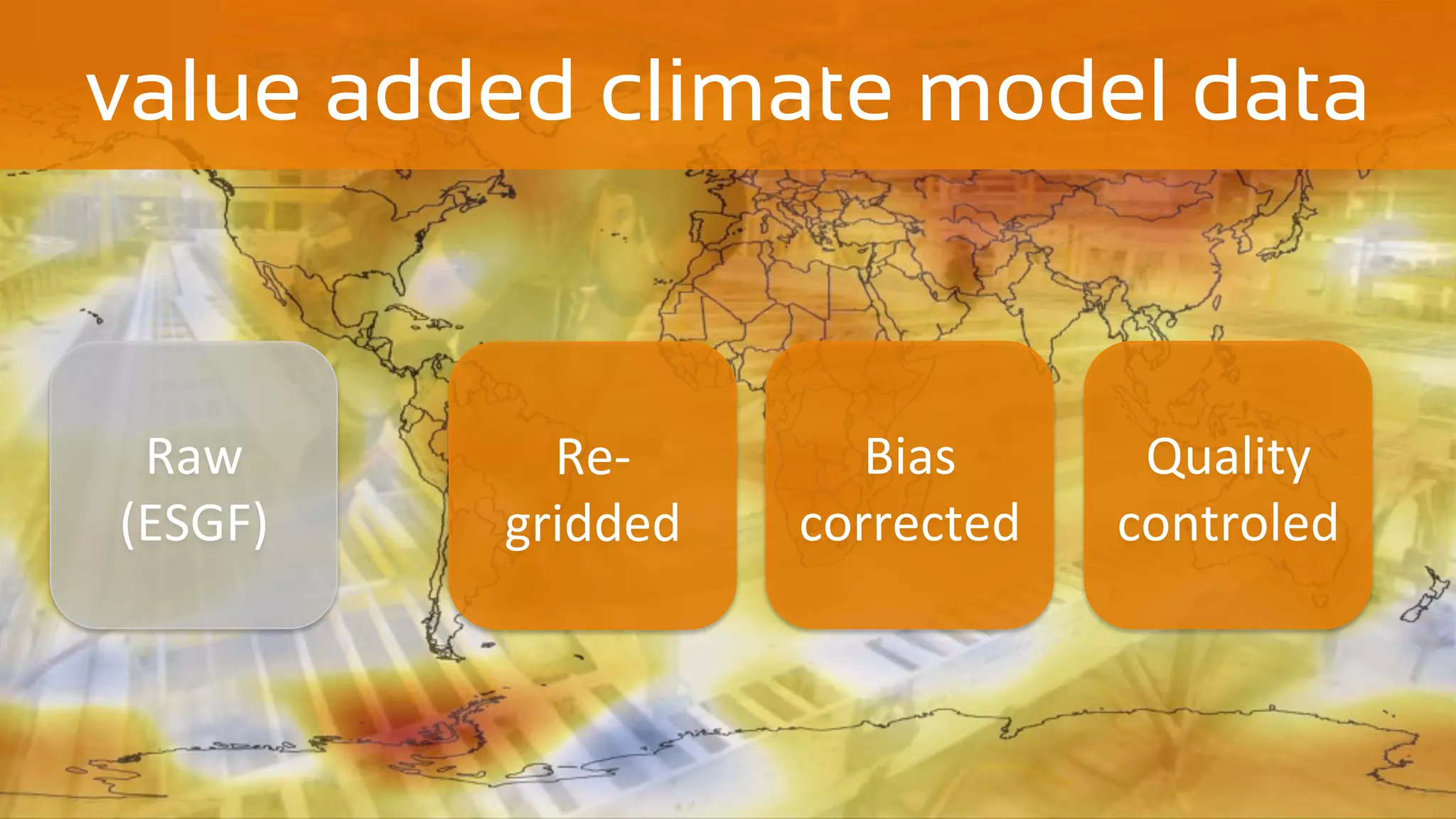
value added climate model data
Re-	
gridded	
Bias	
corrected	
Quality	
controled		
Raw	
(ESGF)
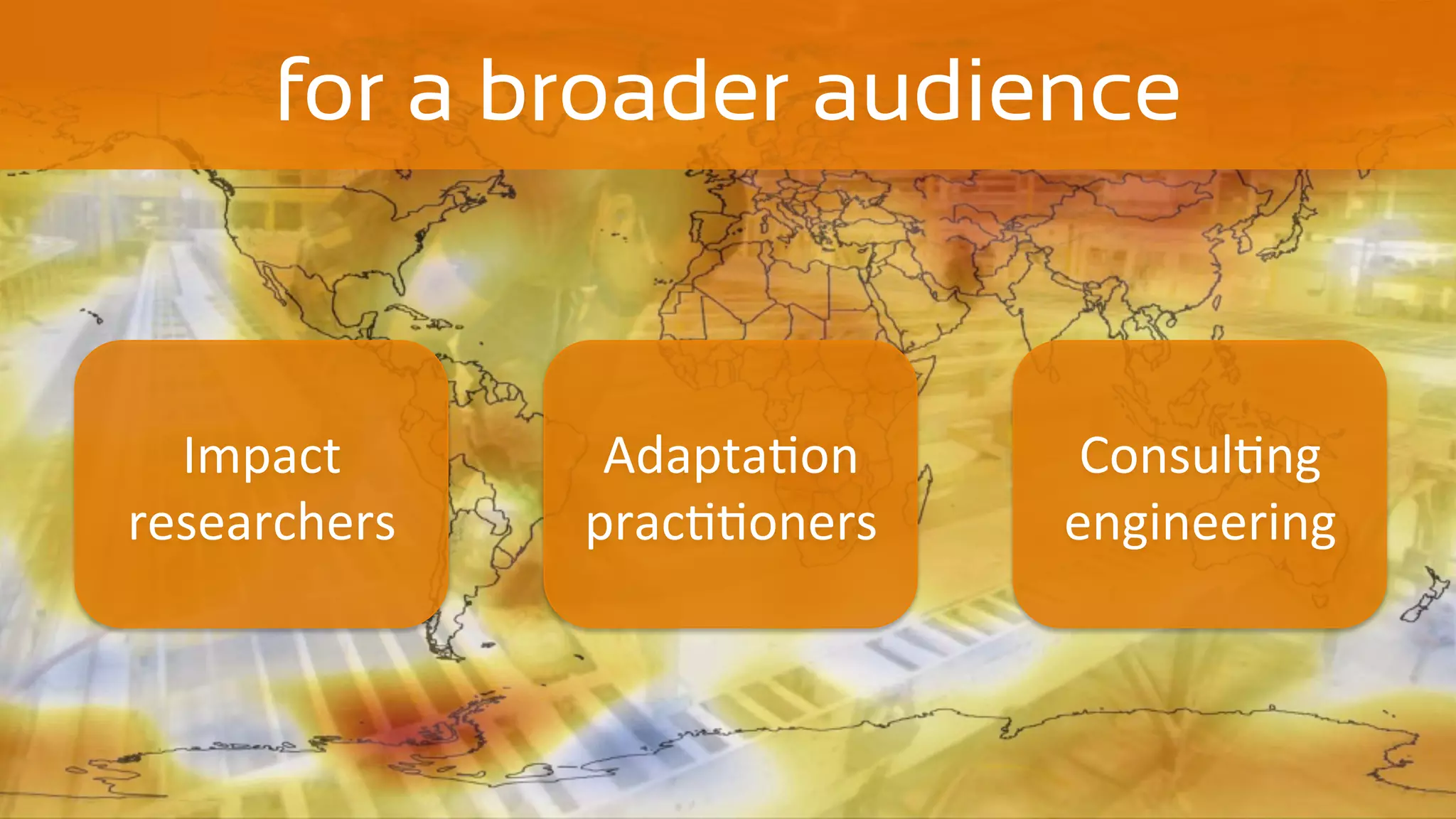
for a broader audience
Impact	
researchers		
Adapta:on	
prac::oners	
Consul:ng	
engineering
an innovative service
To	register	for	early	access	
theclimatedatafactory.com	
just	ask	me	J	
or	visit

Presentation at Adaptation Futures 2016 Conference

  • 1.
    the climate datafactory climate projec-ons as you want them easy to look-up, same grids, bias corrected, for any applica-on
  • 2.
    Preparing the datais a struggle
  • 3.
    86% of people spendmore time in preparing climate projections data than using them
  • 4.
  • 5.
  • 6.
  • 7.
    that need biascorrection TCD 9, 3821–3857, 2015 Improved Arctic sea ice thickness projections using bias corrected CMIP5 simulations N. Melia et al. Title Page Abstract Introduction Conclusions References Tables Figures J I J I Back Close Full Screen / Esc Printer-friendly Version Interactive Discussion DiscussionPaper|DiscussionPaper|DiscussionPaper|DiscussionPaper| The Cryosphere Discuss., 9, 3821–3857, 2015 www.the-cryosphere-discuss.net/9/3821/2015/ doi:10.5194/tcd-9-3821-2015 © Author(s) 2015. CC Attribution 3.0 License. This discussion paper is/has been under review for the journal The Cryosphere (TC). Please refer to the corresponding final paper in TC if available. Improved Arctic sea ice thickness projections using bias corrected CMIP5 simulations N. Melia1 , K. Haines2 , and E. Hawkins3 1 Department of Meteorology, University of Reading, Reading, UK 2 National Centre for Earth Observation, Department of Meteorology, University of Reading, Reading, UK 3 NCAS-Climate, Department of Meteorology, University of Reading, Reading, UK Received: 26 June 2015 – Accepted: 29 June 2015 – Published: 22 July 2015 Correspondence to: N. Melia (n.melia@pgr.reading.ac.uk) Published by Copernicus Publications on behalf of the European Geosciences Union. 3821 ESDD 6, 1999–2042, 2015 Ensemble bias correction S. Sippel et al. Title Page Abstract Introduction Conclusions References Tables Figures J I DiscussionPaper|DiscussionPaper|Discussio Earth Syst. Dynam. Discuss., 6, 1999–2042, 2015 www.earth-syst-dynam-discuss.net/6/1999/2015/ doi:10.5194/esdd-6-1999-2015 © Author(s) 2015. CC Attribution 3.0 License. This discussion paper is/has been under review for the journal Earth System Dynamics (ESD). Please refer to the corresponding final paper in ESD if available. A novel bias correction methodology for climate impact simulations S. Sippel1,2 , F. E. L. Otto3 , M. Forkel1 , M. R. Allen3 , B. P. Guillod3 , M. Heimann1 , M. Reichstein 1 , S. I. Seneviratne 2 , K. Thonicke 4 , and M. D. Mahecha 1,5 1 Max Planck Institute for Biogeochemistry, Hans-Knöll-Str. 10, 07745 Jena, Germany 2 Institute for Atmospheric and Climate Science, ETH Zürich, Rämistr. 101, 8075 Zürich, Switzerland 3 Environmental Change Institute, University of Oxford, South Parks Road, Bias correction of regional climate model simulations for hydrological climate-change impact studies: Review and evaluation of different methods Claudia Teutschbein a,⇑ , Jan Seibert a,b,c a Department of Physical Geography and Quaternary Geology, Stockholm University, Svante Arrhenius Väg 8, S-10691 Stockholm, Sweden b Department of Geography, University of Zurich, Winterthurerstrasse 190, CH-8057 Zurich, Switzerland c Department of Earth Sciences, Uppsala University, Villavägen 16, S-75236 Uppsala, Sweden a r t i c l e i n f o Article history: Received 14 March 2012 Received in revised form 14 May 2012 Accepted 26 May 2012 Available online 6 June 2012 This manuscript was handled by Konstantine P. Georgakakos, Editor-in-Chief, with the assistance of Ashish Sharma, Associate Editor Keywords: RCM Bias correction Downscaling Hydrology HBV Streamflow s u m m a r y Despite the increasing use of regional climate model (RCM) simulations in hydrological climate-change impact studies, their application is challenging due to the risk of considerable biases. To deal with these biases, several bias correction methods have been developed recently, ranging from simple scaling to rather sophisticated approaches. This paper provides a review of available bias correction methods and demonstrates how they can be used to correct for deviations in an ensemble of 11 different RCM-simu- lated temperature and precipitation series. The performance of all methods was assessed in several ways: At first, differently corrected RCM data was compared to observed climate data. The second evaluation was based on the combined influence of corrected RCM-simulated temperature and precipitation on hydrological simulations of monthly mean streamflow as well as spring and autumn flood peaks for five catchments in Sweden under current (1961–1990) climate conditions. Finally, the impact on hydrological simulations based on projected future (2021–2050) climate conditions was compared for the different bias correction methods. Improvement of uncorrected RCM climate variables was achieved with all bias correction approaches. While all methods were able to correct the mean values, there were clear differ- ences in their ability to correct other statistical properties such as standard deviation or percentiles. Sim- ulated streamflow characteristics were sensitive to the quality of driving input data: Simulations driven with bias-corrected RCM variables fitted observed values better than simulations forced with uncorrected RCM climate variables and had more narrow variability bounds. Ó 2012 Elsevier B.V. All rights reserved. Journal of Hydrology 456–457 (2012) 12–29 Contents lists available at SciVerse ScienceDirect Journal of Hydrology journal homepage: www.elsevier.com/locate/jhydrol Intercomparison of bias-correction methods for monthly temperature and precipitation simulated by multiple climate models Satoshi Watanabe,1 Shinjiro Kanae,2 Shinta Seto,3 Pat J.-F. Yeh,4 Yukiko Hirabayashi,1 and Taikan Oki3 Received 28 May 2012; revised 20 October 2012; accepted 23 October 2012; published 13 December 2012. [1] Bias-correction methods applied to monthly temperature and precipitation data simulated by multiple General Circulation Models (GCMs) are evaluated in this study. JOURNAL OF GEOPHYSICAL RESEARCH, VOL. 117, D23114, doi:10.1029/2012JD018192, 2012
  • 8.
    and quality controlHI-AWAREWorking Paper 1 Selection of Climate Models for Developing Representative Climate Projections for the Hindu Kush Himalayan Region Consortium members Evaluation of historical and future simulations of precipitation and temperature in central Africa from CMIP5 climate models Noel R. Aloysius1,2 , Justin Sheffield3 , James E. Saiers1 , Haibin Li4 , and Eric F. Wood3 1 School of Forestry and Environmental Studies, Yale University, New Haven, Connecticut, USA, 2 Now at Department of Food, Agricultural, and Biological Engineering and Department of Evolution, Ecology, and Organismal Biology, Ohio State University, Columbus, Ohio, USA, 3 Department of Civil and Environmental Engineering, Princeton University, Princeton, New Jersey, USA, 4 Department of Earth and Planetary Sciences, Rutgers University, Piscataway, New Jersey, USA Abstract Global and regional climate change assessments rely heavily on the general circulation model (GCM) outputs such as provided by the Coupled Model Intercomparison Project phase 5 (CMIP5). Here we evaluate the ability of 25 CMIP5 GCMs to simulate historical precipitation and temperature over central Africa and assess their future projections in the context of historical performance and intermodel and future emission scenario uncertainties. We then apply a statistical bias correction technique to the monthly climate fields and develop monthly downscaled fields for the period of 1948–2099. The bias-corrected and downscaled data set is constructed by combining a suite of global observation and reanalysis-based data sets, with the monthly GCM outputs for the 20th century, and 21st century projections for the medium mitigation (representative concentration pathway (RCP)45) and high emission (RCP85) scenarios. Overall, the CMIP5 models simulate temperature better than precipitation, but substantial spatial heterogeneity exists. Many models show limited skill in simulating the seasonality, spatial patterns, and magnitude of precipitation. Temperature projections by the end of the 21st century (2070–2099) show a robust warming between 2 and 4°C across models, whereas precipitation projections vary across models in the sign and magnitude of change (À9% to 27%). Projected increase in precipitation for a subset of models (single model ensemble (SME)) identified based on performance metrics and causal mechanisms are slightly higher compared to the full multimodel ensemble (MME) mean; however, temperature projections are similar between the two ensemble means. Forthe near-term (2021–2050), PUBLICATIONS Journal of Geophysical Research: Atmospheres RESEARCH ARTICLE 10.1002/2015JD023656 Key Points: • Evaluation of precipitation and temperature simulation in global climate models in central Africa • Climate models exhibit limited skills in precipitation simulations • Climate model selection for regional impact studies is evaluated Supporting Information: • Figure S1 • Figure S2 • Figure S3 • Figure S4 • Figure S5 • Figure S6 • Figure S7 • Figure S8 • Figure S9 • Figure S10 • Figure S11 • Figure S12 • Figure S13 • Figure S14 • Figure S15 Correspondence to: N. R. Aloysius, aloysius.1@osu.edu Citation: INTERNATIONAL JOURNAL OF CLIMATOLOGY Int. J. Climatol. (2016) Published online in Wiley Online Library (wileyonlinelibrary.com) DOI: 10.1002/joc.4608 Selecting representative climate models for climate change impact studies: an advanced envelope-based selection approach Arthur F. Lutz,a,b* Herbert W. ter Maat,c Hester Biemans,c Arun B. Shrestha,d Philippus Westerd and Walter W. Immerzeela,b a FutureWater, Wageningen, The Netherlands b Department of Physical Geography, Utrecht University, The Netherlands c Alterra – Wageningen UR, The Netherlands
  • 9.
    We take careof the hassle
  • 10.
  • 11.
    value added climatemodel data Re- gridded Bias corrected Quality controled Raw (ESGF)
  • 12.
    for a broaderaudience Impact researchers Adapta:on prac::oners Consul:ng engineering
  • 13.
  • 14.