Effects of different
shielding
gases and electric
field in laser welding
By
Vivek Agrawal
14ME61R16
Guided by
Prof.A.K.Nath
Contents
 Introduction to laser welding
 Types of laser welding and applications
 Formation and effects of plasma on laser welding
 Literature survey
 Problem definition
 Experimental details
 Results and discussions
 Conclusions
 Work to be done in future
 References
Introduction
 Laser welding is a non-
contact unconventional
process of welding two
metal sheets (similar or
dissimilar) by a high
power and focused
radiation.
 The weld is formed as
the intense laser beam
rapidly heats the
material, melts a small
volume of material
which solidifies at very
high cooling rate.
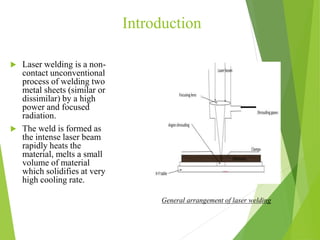
General arrangement of laser welding
Advantages of laser welding
 Doesn’t requires any electrode as in case of metal arc welding.
 Very low heat affected zone.
 Narrow weld bead.
 Autogenous method, i.e. doesn’t requires filler material.
 High power density, can be used for high melting point materials.
 No beam deviation in magnetic field as in case of electron beam and arc
welding processes.
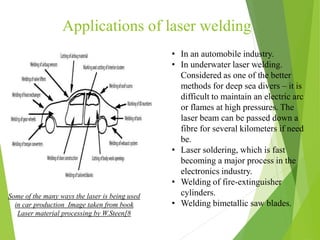
Applications of laser welding
Some of the many ways the laser is being used
in car production Image taken from book
Laser material processing by W.Steen[8
• In an automobile industry.
• In underwater laser welding.
Considered as one of the better
methods for deep sea divers – it is
difficult to maintain an electric arc
or flames at high pressures. The
laser beam can be passed down a
fibre for several kilometers if need
be.
• Laser soldering, which is fast
becoming a major process in the
electronics industry.
• Welding of fire-extinguisher
cylinders.
• Welding bimetallic saw blades.
Continued
 Hermetically sealing Hermetically sealing
electronic capsules, which is possible
owing to the low HAZ, which is possible
owing to the low HAZ
 Welding of polymers and plastics like
welding spectacles, diving suits, waders,
outdoor footwear, tents, parachutes and
soon carpets, bookbinding and injection
moulding.
 Repair of nuclear boiler tubes from the
inside.
 Welding transformer laminates to reduce
hum – the smaller weld zone reduces eddy
losses.
Hermetically sealed electronic capsules [Image link:
http://www.examiner.com/article/electronic-capsule-
prevents-gastrointestinal-disease]
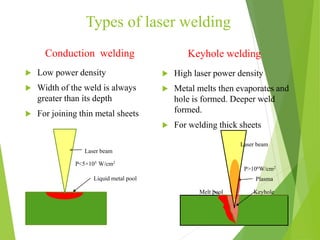
Types of laser welding
Conduction welding
 Low power density
 Width of the weld is always
greater than its depth
 For joining thin metal sheets
Keyhole welding
 High laser power density
 Metal melts then evaporates and
hole is formed. Deeper weld
formed.
 For welding thick sheets
Workpiece
Liquid metal pool
Laser beam
P<5×10⁵ W/cm2
KeyholeMelt pool
Plasma
P>106W/cm2
Laser beam
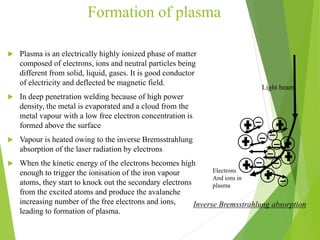
Formation of plasma
 Plasma is an electrically highly ionized phase of matter
composed of electrons, ions and neutral particles being
different from solid, liquid, gases. It is good conductor
of electricity and deflected be magnetic field.
 In deep penetration welding because of high power
density, the metal is evaporated and a cloud from the
metal vapour with a low free electron concentration is
formed above the surface
 Vapour is heated owing to the inverse Bremsstrahlung
absorption of the laser radiation by electrons
 When the kinetic energy of the electrons becomes high
enough to trigger the ionisation of the iron vapour
atoms, they start to knock out the secondary electrons
from the excited atoms and produce the avalanche
increasing number of the free electrons and ions,
leading to formation of plasma.
Light beam
Electrons
And ions in
plasma
Inverse Bremsstrahlung absorption
Effects of plasma
 Absorption
 Scattering
 Defocusing
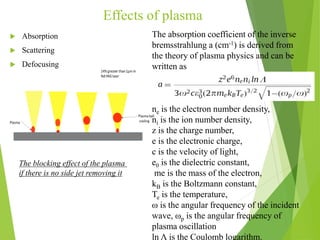
The blocking effect of the plasma
if there is no side jet removing it
The absorption coefficient of the inverse
bremsstrahlung a (cm-1) is derived from
the theory of plasma physics and can be
written as
ne is the electron number density,
ni is the ion number density,
z is the charge number,
e is the electronic charge,
c is the velocity of light,
e0 is the dielectric constant,
me is the mass of the electron,
kB is the Boltzmann constant,
Te is the temperature,
ω is the angular frequency of the incident
wave, ωp is the angular frequency of
plasma oscillation
ln Λ is the Coulomb logarithm.
Literature survey
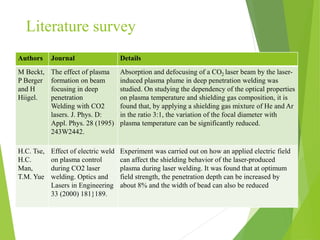
Authors Journal Details
M Beckt,
P Berger
and H
Hiigel.
The effect of plasma
formation on beam
focusing in deep
penetration
Welding with CO2
lasers. J. Phys. D:
Appl. Phys. 28 (1995)
243W2442.
Absorption and defocusing of a CO2 laser beam by the laser-
induced plasma plume in deep penetration welding was
studied. On studying the dependency of the optical properties
on plasma temperature and shielding gas composition, it is
found that, by applying a shielding gas mixture of He and Ar
in the ratio 3:1, the variation of the focal diameter with
plasma temperature can be significantly reduced.
H.C. Tse,
H.C.
Man,
T.M. Yue
Effect of electric weld
on plasma control
during CO2 laser
welding. Optics and
Lasers in Engineering
33 (2000) 181}189.
Experiment was carried out on how an applied electric field
can affect the shielding behavior of the laser-produced
plasma during laser welding. It was found that at optimum
field strength, the penetration depth can be increased by
about 8% and the width of bead can also be reduced
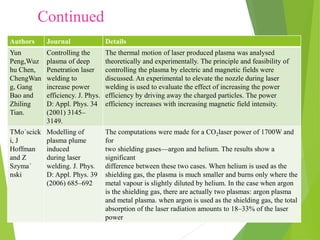
Authors Journal Details
Yun
Peng,Wuz
hu Chen,
ChengWan
g, Gang
Bao and
Zhiling
Tian.
Controlling the
plasma of deep
Penetration laser
welding to
increase power
efficiency. J. Phys.
D: Appl. Phys. 34
(2001) 3145–
3149.
The thermal motion of laser produced plasma was analysed
theoretically and experimentally. The principle and feasibility of
controlling the plasma by electric and magnetic fields were
discussed. An experimental to elevate the nozzle during laser
welding is used to evaluate the effect of increasing the power
efficiency by driving away the charged particles. The power
efficiency increases with increasing magnetic field intensity.
TMo´scick
i, J
Hoffman
and Z
Szyma´
nski
Modelling of
plasma plume
induced
during laser
welding. J. Phys.
D: Appl. Phys. 39
(2006) 685–692
The computations were made for a CO2laser power of 1700W and
for
two shielding gases—argon and helium. The results show a
significant
difference between these two cases. When helium is used as the
shielding gas, the plasma is much smaller and burns only where the
metal vapour is slightly diluted by helium. In the case when argon
is the shielding gas, there are actually two plasmas: argon plasma
and metal plasma. when argon is used as the shielding gas, the total
absorption of the laser radiation amounts to 18–33% of the laser
power
Continued
Continued
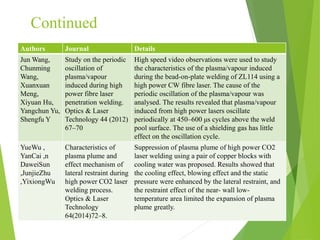
Authors Journal Details
Jun Wang,
Chunming
Wang,
Xuanxuan
Meng,
Xiyuan Hu,
Yangchun Yu,
Shengfu Y
Study on the periodic
oscillation of
plasma/vapour
induced during high
power fibre laser
penetration welding.
Optics & Laser
Technology 44 (2012)
67–70
High speed video observations were used to study
the characteristics of the plasma/vapour induced
during the bead-on-plate welding of ZL114 using a
high power CW fibre laser. The cause of the
periodic oscillation of the plasma/vapour was
analysed. The results revealed that plasma/vapour
induced from high power lasers oscillate
periodically at 450–600 μs cycles above the weld
pool surface. The use of a shielding gas has little
effect on the oscillation cycle.
YueWu ,
YanCai ,n
DaweiSun
,JunjieZhu
,YixiongWu
Characteristics of
plasma plume and
effect mechanism of
lateral restraint during
high power CO2 laser
welding process.
Optics & Laser
Technology
64(2014)72–8.
Suppression of plasma plume of high power CO2
laser welding using a pair of copper blocks with
cooling water was proposed. Results showed that
the cooling effect, blowing effect and the static
pressure were enhanced by the lateral restraint, and
the restraint effect of the near- wall low-
temperature area limited the expansion of plasma
plume greatly.
Continued
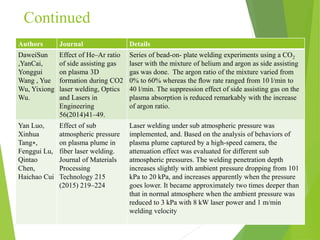
Authors Journal Details
DaweiSun
,YanCai,
Yonggui
Wang , Yue
Wu, Yixiong
Wu.
Effect of He–Ar ratio
of side assisting gas
on plasma 3D
formation during CO2
laser welding, Optics
and Lasers in
Engineering
56(2014)41–49.
Series of bead-on- plate welding experiments using a CO2
laser with the mixture of helium and argon as side assisting
gas was done. The argon ratio of the mixture varied from
0% to 60% whereas the flow rate ranged from 10 l/min to
40 l/min. The suppression effect of side assisting gas on the
plasma absorption is reduced remarkably with the increase
of argon ratio.
Yan Luo,
Xinhua
Tang∗,
Fenggui Lu,
Qintao
Chen,
Haichao Cui
Effect of sub
atmospheric pressure
on plasma plume in
fiber laser welding.
Journal of Materials
Processing
Technology 215
(2015) 219–224
Laser welding under sub atmospheric pressure was
implemented, and. Based on the analysis of behaviors of
plasma plume captured by a high-speed camera, the
attenuation effect was evaluated for different sub
atmospheric pressures. The welding penetration depth
increases slightly with ambient pressure dropping from 101
kPa to 20 kPa, and increases apparently when the pressure
goes lower. It became approximately two times deeper than
that in normal atmosphere when the ambient pressure was
reduced to 3 kPa with 8 kW laser power and 1 m/min
welding velocity
Problem definition
 From above slides we have found out that plasma generated during welding has
a detrimental effect as it reduces the coupling of laser beam with the workpiece.
 So, this work is based on finding how different shielding gases affect the plasma
and thus weld bead
 Also we try to find whether there is any improvement in weld bead when
electric field is applied to the weld zone
Experimental setup
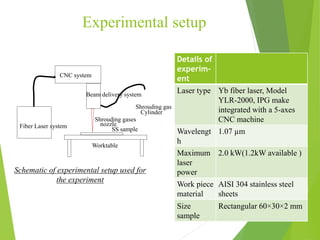
Schematic of experimental setup used for
the experiment
Fiber Laser system
CNC system
Beam delivery system
SS sample
Shrouding gas
Cylinder
Worktable
Shrouding gases
nozzle
Details of
experim-
ent
Laser type Yb fiber laser, Model
YLR-2000, IPG make
integrated with a 5-axes
CNC machine
Wavelengt
h
1.07 µm
Maximum
laser
power
2.0 kW(1.2kW available )
Work piece
material
AISI 304 stainless steel
sheets
Size
sample
Rectangular 60×30×2 mm
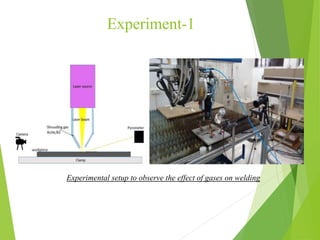
Experiment-1
Experimental setup to observe the effect of gases on welding
Continued
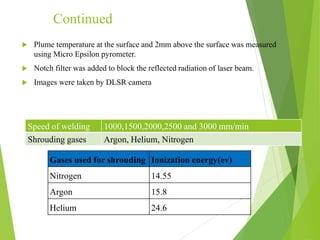
 Plume temperature at the surface and 2mm above the surface was measured
using Micro Epsilon pyrometer.
 Notch filter was added to block the reflected radiation of laser beam.
 Images were taken by DLSR camera
Gases used for shrouding Ionization energy(ev)
Nitrogen 14.55
Argon 15.8
Helium 24.6
Speed of welding 1000,1500,2000,2500 and 3000 mm/min
Shrouding gases Argon, Helium, Nitrogen
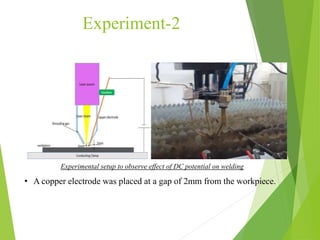
Experiment-2
• A copper electrode was placed at a gap of 2mm from the workpiece.
Experimental setup to observe effect of DC potential on welding
Continued
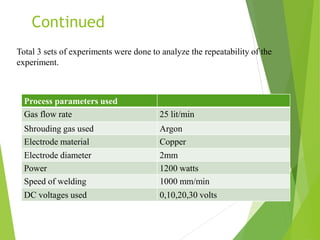
Total 3 sets of experiments were done to analyze the repeatability of the
experiment.
Process parameters used
Gas flow rate 25 lit/min
Shrouding gas used Argon
Electrode material Copper
Electrode diameter 2mm
Power 1200 watts
Speed of welding 1000 mm/min
DC voltages used 0,10,20,30 volts
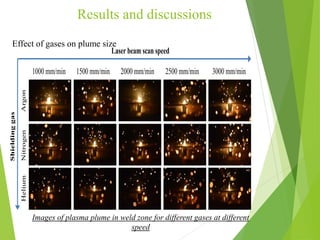
Results and discussions
1000 mm/min 1500 mm/min 2000 mm/min 2500 mm/min 3000 mm/min
ArgonNitrogenHelium
Laser beam scan speed
Shieldinggas
Effect of gases on plume size
Images of plasma plume in weld zone for different gases at different
speed
Continued
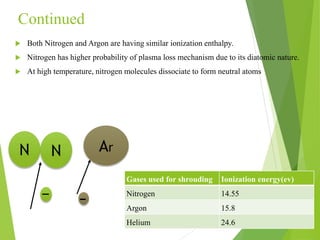
 Both Nitrogen and Argon are having similar ionization enthalpy.
 Nitrogen has higher probability of plasma loss mechanism due to its diatomic nature.
 At high temperature, nitrogen molecules dissociate to form neutral atoms
N N Ar
Gases used for shrouding Ionization energy(ev)
Nitrogen 14.55
Argon 15.8
Helium 24.6
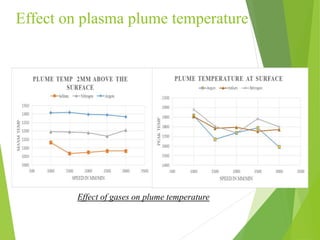
Effect on plasma plume temperature
Effect of gases on plume temperature
Continued
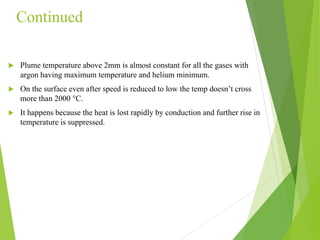
 Plume temperature above 2mm is almost constant for all the gases with
argon having maximum temperature and helium minimum.
 On the surface even after speed is reduced to low the temp doesn’t cross
more than 2000 °C.
 It happens because the heat is lost rapidly by conduction and further rise in
temperature is suppressed.
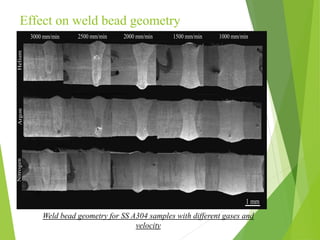
Effect on weld bead geometry
1 mm
3000 mm/min 2500 mm/min 2000 mm/min 1500 mm/min 1000 mm/min
HeliumArgonNitrogen
Weld bead geometry for SS A304 samples with different gases and
velocity
Continued
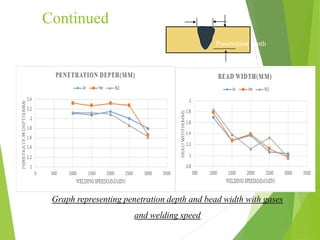
Graph representing penetration depth and bead width with gases
and welding speed
Penetration depth
Bead width
Continued
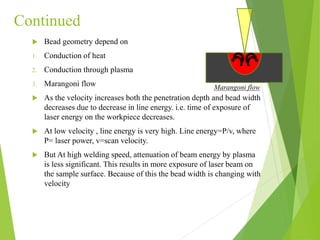
 Bead geometry depend on
1. Conduction of heat
2. Conduction through plasma
3. Marangoni flow
 As the velocity increases both the penetration depth and bead width
decreases due to decrease in line energy. i.e. time of exposure of
laser energy on the workpiece decreases.
 At low velocity , line energy is very high. Line energy=P/v, where
P= laser power, v=scan velocity.
 But At high welding speed, attenuation of beam energy by plasma
is less significant. This results in more exposure of laser beam on
the sample surface. Because of this the bead width is changing with
velocity
Marangoni flow
Continued
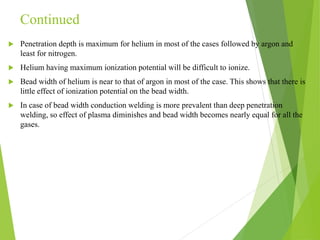
 Penetration depth is maximum for helium in most of the cases followed by argon and
least for nitrogen.
 Helium having maximum ionization potential will be difficult to ionize.
 Bead width of helium is near to that of argon in most of the case. This shows that there is
little effect of ionization potential on the bead width.
 In case of bead width conduction welding is more prevalent than deep penetration
welding, so effect of plasma diminishes and bead width becomes nearly equal for all the
gases.
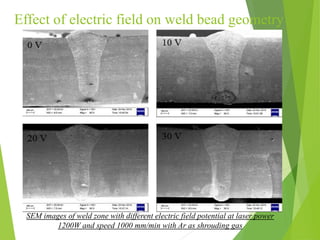
Effect of electric field on weld bead geometry
SEM images of weld zone with different electric field potential at laser power
1200W and speed 1000 mm/min with Ar as shrouding gas
Continued
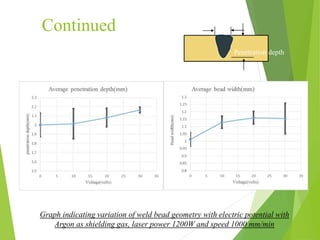
Graph indicating variation of weld bead geometry with electric potential with
Argon as shielding gas, laser power 1200W and speed 1000 mm/min
Penetration depth
Bead width
Continued
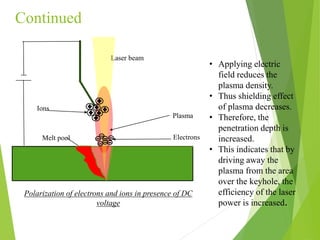
Melt pool
Plasma
Laser beam
Electrons
Ions
Polarization of electrons and ions in presence of DC
voltage
• Applying electric
field reduces the
plasma density.
• Thus shielding effect
of plasma decreases.
• Therefore, the
penetration depth is
increased.
• This indicates that by
driving away the
plasma from the area
over the keyhole, the
efficiency of the laser
power is increased.
Continued
 There is a spread in bead with increase in potential. This can be because of higher
thermal conductivity of electrons which are more near the workpiece as compared
to ions.
Conclusions
 Helium is best in maintaining the penetration depth maximum .i.e. can be used
for thick metal welding.
 Since the cost of helium is very high it is difficult to use helium in commercial
purpose. But for high precision welding helium is the best option.
 The effect of electric field potential is very encouraging. There is gradual
increase in penetration depth with electric field which can improve the
efficiency of the laser system. Depth of penetration by an laser welding can be
increased upto 8% just by applying electric field. Thus saving laser power.
Work plan for future
 Carrying out the experiments further at higher potential.
 Studying the effect of polarity.
 Studying the effect of electric potential under different shielding gases.
 Studying the effects of electrode geometry
 Studying the effect of direction of weld with electrode orientation
References
[1] YueWu , YanCai ,n DaweiSun ,JunjieZhu ,YixiongWu. Characteristics of plasma
plume and effect mechanism of lateral restraint during high power CO2 laser welding
process. Optics & Laser Technology 64(2014)72–8.
[2] M Beckt, P Berger and H Hiigel. The effect of plasma formation on beam
focusing in deep penetration
Welding with CO2 lasers. J. Phys. D: Appl. Phys. 28 (1995) 243W2442.
[3] Yun Peng,Wuzhu Chen, ChengWang, Gang Bao and Zhiling Tian. Controlling the
plasma of deep
Penetration laser welding to increase power efficiency. J. Phys. D: Appl. Phys. 34
(2001) 3145–3149.
[4] H.C. Tse, H.C. Man, T.M. Yue. Effect of electric weld on plasma control during
CO2 laser welding. Optics and Lasers in Engineering 33 (2000) 181}189.
References
[5] Y. Kawahito*, N. Matsumoto, M. Mizutani and S. Katayama. Characterisation
of plasma induced during high power fibre laser welding of stainless steel. Science
and Technology of Welding and Joining 2008 VOL 13 NO 8
[6] DaweiSun ,YanCai, Yonggui Wang , Yue Wu, Yixiong Wu.Effect of He–Ar ratio
of side assisting gas on plasma 3D formation during CO2 laser welding, Optics and
Lasers in Engineering 56(2014)41–49.
[7] 402935-LASERLINE Technical Laser Welding AW.indd. 17/08/2009.
[8] William M. Steen , Jyotirmoy Mazumder. Laser Material Processing. Springer-
Verlag London Limited 2010
[9]Kawahito Yousuke , Mizutani Masami and Katayama Seiji. Optical density
interaction between laser beam and induced plasma in ultra-high power fiber laser
welding of stainless steel, Transactions of JWRI, vol.37 (2008), No.2

presentation

  • 1.
    Effects of different shielding gasesand electric field in laser welding By Vivek Agrawal 14ME61R16 Guided by Prof.A.K.Nath
  • 2.
    Contents  Introduction tolaser welding  Types of laser welding and applications  Formation and effects of plasma on laser welding  Literature survey  Problem definition  Experimental details  Results and discussions  Conclusions  Work to be done in future  References
  • 3.
    Introduction  Laser weldingis a non- contact unconventional process of welding two metal sheets (similar or dissimilar) by a high power and focused radiation.  The weld is formed as the intense laser beam rapidly heats the material, melts a small volume of material which solidifies at very high cooling rate. General arrangement of laser welding
  • 4.
    Advantages of laserwelding  Doesn’t requires any electrode as in case of metal arc welding.  Very low heat affected zone.  Narrow weld bead.  Autogenous method, i.e. doesn’t requires filler material.  High power density, can be used for high melting point materials.  No beam deviation in magnetic field as in case of electron beam and arc welding processes.
  • 5.
    Applications of laserwelding Some of the many ways the laser is being used in car production Image taken from book Laser material processing by W.Steen[8 • In an automobile industry. • In underwater laser welding. Considered as one of the better methods for deep sea divers – it is difficult to maintain an electric arc or flames at high pressures. The laser beam can be passed down a fibre for several kilometers if need be. • Laser soldering, which is fast becoming a major process in the electronics industry. • Welding of fire-extinguisher cylinders. • Welding bimetallic saw blades.
  • 6.
    Continued  Hermetically sealingHermetically sealing electronic capsules, which is possible owing to the low HAZ, which is possible owing to the low HAZ  Welding of polymers and plastics like welding spectacles, diving suits, waders, outdoor footwear, tents, parachutes and soon carpets, bookbinding and injection moulding.  Repair of nuclear boiler tubes from the inside.  Welding transformer laminates to reduce hum – the smaller weld zone reduces eddy losses. Hermetically sealed electronic capsules [Image link: http://www.examiner.com/article/electronic-capsule- prevents-gastrointestinal-disease]
  • 7.
    Types of laserwelding Conduction welding  Low power density  Width of the weld is always greater than its depth  For joining thin metal sheets Keyhole welding  High laser power density  Metal melts then evaporates and hole is formed. Deeper weld formed.  For welding thick sheets Workpiece Liquid metal pool Laser beam P<5×10⁵ W/cm2 KeyholeMelt pool Plasma P>106W/cm2 Laser beam
  • 8.
    Formation of plasma Plasma is an electrically highly ionized phase of matter composed of electrons, ions and neutral particles being different from solid, liquid, gases. It is good conductor of electricity and deflected be magnetic field.  In deep penetration welding because of high power density, the metal is evaporated and a cloud from the metal vapour with a low free electron concentration is formed above the surface  Vapour is heated owing to the inverse Bremsstrahlung absorption of the laser radiation by electrons  When the kinetic energy of the electrons becomes high enough to trigger the ionisation of the iron vapour atoms, they start to knock out the secondary electrons from the excited atoms and produce the avalanche increasing number of the free electrons and ions, leading to formation of plasma. Light beam Electrons And ions in plasma Inverse Bremsstrahlung absorption
  • 9.
    Effects of plasma Absorption  Scattering  Defocusing The blocking effect of the plasma if there is no side jet removing it The absorption coefficient of the inverse bremsstrahlung a (cm-1) is derived from the theory of plasma physics and can be written as ne is the electron number density, ni is the ion number density, z is the charge number, e is the electronic charge, c is the velocity of light, e0 is the dielectric constant, me is the mass of the electron, kB is the Boltzmann constant, Te is the temperature, ω is the angular frequency of the incident wave, ωp is the angular frequency of plasma oscillation ln Λ is the Coulomb logarithm.
  • 10.
    Literature survey Authors JournalDetails M Beckt, P Berger and H Hiigel. The effect of plasma formation on beam focusing in deep penetration Welding with CO2 lasers. J. Phys. D: Appl. Phys. 28 (1995) 243W2442. Absorption and defocusing of a CO2 laser beam by the laser- induced plasma plume in deep penetration welding was studied. On studying the dependency of the optical properties on plasma temperature and shielding gas composition, it is found that, by applying a shielding gas mixture of He and Ar in the ratio 3:1, the variation of the focal diameter with plasma temperature can be significantly reduced. H.C. Tse, H.C. Man, T.M. Yue Effect of electric weld on plasma control during CO2 laser welding. Optics and Lasers in Engineering 33 (2000) 181}189. Experiment was carried out on how an applied electric field can affect the shielding behavior of the laser-produced plasma during laser welding. It was found that at optimum field strength, the penetration depth can be increased by about 8% and the width of bead can also be reduced
  • 11.
    Authors Journal Details Yun Peng,Wuz huChen, ChengWan g, Gang Bao and Zhiling Tian. Controlling the plasma of deep Penetration laser welding to increase power efficiency. J. Phys. D: Appl. Phys. 34 (2001) 3145– 3149. The thermal motion of laser produced plasma was analysed theoretically and experimentally. The principle and feasibility of controlling the plasma by electric and magnetic fields were discussed. An experimental to elevate the nozzle during laser welding is used to evaluate the effect of increasing the power efficiency by driving away the charged particles. The power efficiency increases with increasing magnetic field intensity. TMo´scick i, J Hoffman and Z Szyma´ nski Modelling of plasma plume induced during laser welding. J. Phys. D: Appl. Phys. 39 (2006) 685–692 The computations were made for a CO2laser power of 1700W and for two shielding gases—argon and helium. The results show a significant difference between these two cases. When helium is used as the shielding gas, the plasma is much smaller and burns only where the metal vapour is slightly diluted by helium. In the case when argon is the shielding gas, there are actually two plasmas: argon plasma and metal plasma. when argon is used as the shielding gas, the total absorption of the laser radiation amounts to 18–33% of the laser power Continued
  • 12.
    Continued Authors Journal Details JunWang, Chunming Wang, Xuanxuan Meng, Xiyuan Hu, Yangchun Yu, Shengfu Y Study on the periodic oscillation of plasma/vapour induced during high power fibre laser penetration welding. Optics & Laser Technology 44 (2012) 67–70 High speed video observations were used to study the characteristics of the plasma/vapour induced during the bead-on-plate welding of ZL114 using a high power CW fibre laser. The cause of the periodic oscillation of the plasma/vapour was analysed. The results revealed that plasma/vapour induced from high power lasers oscillate periodically at 450–600 μs cycles above the weld pool surface. The use of a shielding gas has little effect on the oscillation cycle. YueWu , YanCai ,n DaweiSun ,JunjieZhu ,YixiongWu Characteristics of plasma plume and effect mechanism of lateral restraint during high power CO2 laser welding process. Optics & Laser Technology 64(2014)72–8. Suppression of plasma plume of high power CO2 laser welding using a pair of copper blocks with cooling water was proposed. Results showed that the cooling effect, blowing effect and the static pressure were enhanced by the lateral restraint, and the restraint effect of the near- wall low- temperature area limited the expansion of plasma plume greatly.
  • 13.
    Continued Authors Journal Details DaweiSun ,YanCai, Yonggui Wang, Yue Wu, Yixiong Wu. Effect of He–Ar ratio of side assisting gas on plasma 3D formation during CO2 laser welding, Optics and Lasers in Engineering 56(2014)41–49. Series of bead-on- plate welding experiments using a CO2 laser with the mixture of helium and argon as side assisting gas was done. The argon ratio of the mixture varied from 0% to 60% whereas the flow rate ranged from 10 l/min to 40 l/min. The suppression effect of side assisting gas on the plasma absorption is reduced remarkably with the increase of argon ratio. Yan Luo, Xinhua Tang∗, Fenggui Lu, Qintao Chen, Haichao Cui Effect of sub atmospheric pressure on plasma plume in fiber laser welding. Journal of Materials Processing Technology 215 (2015) 219–224 Laser welding under sub atmospheric pressure was implemented, and. Based on the analysis of behaviors of plasma plume captured by a high-speed camera, the attenuation effect was evaluated for different sub atmospheric pressures. The welding penetration depth increases slightly with ambient pressure dropping from 101 kPa to 20 kPa, and increases apparently when the pressure goes lower. It became approximately two times deeper than that in normal atmosphere when the ambient pressure was reduced to 3 kPa with 8 kW laser power and 1 m/min welding velocity
  • 14.
    Problem definition  Fromabove slides we have found out that plasma generated during welding has a detrimental effect as it reduces the coupling of laser beam with the workpiece.  So, this work is based on finding how different shielding gases affect the plasma and thus weld bead  Also we try to find whether there is any improvement in weld bead when electric field is applied to the weld zone
  • 15.
    Experimental setup Schematic ofexperimental setup used for the experiment Fiber Laser system CNC system Beam delivery system SS sample Shrouding gas Cylinder Worktable Shrouding gases nozzle Details of experim- ent Laser type Yb fiber laser, Model YLR-2000, IPG make integrated with a 5-axes CNC machine Wavelengt h 1.07 µm Maximum laser power 2.0 kW(1.2kW available ) Work piece material AISI 304 stainless steel sheets Size sample Rectangular 60×30×2 mm
  • 16.
    Experiment-1 Experimental setup toobserve the effect of gases on welding
  • 17.
    Continued  Plume temperatureat the surface and 2mm above the surface was measured using Micro Epsilon pyrometer.  Notch filter was added to block the reflected radiation of laser beam.  Images were taken by DLSR camera Gases used for shrouding Ionization energy(ev) Nitrogen 14.55 Argon 15.8 Helium 24.6 Speed of welding 1000,1500,2000,2500 and 3000 mm/min Shrouding gases Argon, Helium, Nitrogen
  • 18.
    Experiment-2 • A copperelectrode was placed at a gap of 2mm from the workpiece. Experimental setup to observe effect of DC potential on welding
  • 19.
    Continued Total 3 setsof experiments were done to analyze the repeatability of the experiment. Process parameters used Gas flow rate 25 lit/min Shrouding gas used Argon Electrode material Copper Electrode diameter 2mm Power 1200 watts Speed of welding 1000 mm/min DC voltages used 0,10,20,30 volts
  • 20.
    Results and discussions 1000mm/min 1500 mm/min 2000 mm/min 2500 mm/min 3000 mm/min ArgonNitrogenHelium Laser beam scan speed Shieldinggas Effect of gases on plume size Images of plasma plume in weld zone for different gases at different speed
  • 21.
    Continued  Both Nitrogenand Argon are having similar ionization enthalpy.  Nitrogen has higher probability of plasma loss mechanism due to its diatomic nature.  At high temperature, nitrogen molecules dissociate to form neutral atoms N N Ar Gases used for shrouding Ionization energy(ev) Nitrogen 14.55 Argon 15.8 Helium 24.6
  • 22.
    Effect on plasmaplume temperature Effect of gases on plume temperature
  • 23.
    Continued  Plume temperatureabove 2mm is almost constant for all the gases with argon having maximum temperature and helium minimum.  On the surface even after speed is reduced to low the temp doesn’t cross more than 2000 °C.  It happens because the heat is lost rapidly by conduction and further rise in temperature is suppressed.
  • 24.
    Effect on weldbead geometry 1 mm 3000 mm/min 2500 mm/min 2000 mm/min 1500 mm/min 1000 mm/min HeliumArgonNitrogen Weld bead geometry for SS A304 samples with different gases and velocity
  • 25.
    Continued Graph representing penetrationdepth and bead width with gases and welding speed Penetration depth Bead width
  • 26.
    Continued  Bead geometrydepend on 1. Conduction of heat 2. Conduction through plasma 3. Marangoni flow  As the velocity increases both the penetration depth and bead width decreases due to decrease in line energy. i.e. time of exposure of laser energy on the workpiece decreases.  At low velocity , line energy is very high. Line energy=P/v, where P= laser power, v=scan velocity.  But At high welding speed, attenuation of beam energy by plasma is less significant. This results in more exposure of laser beam on the sample surface. Because of this the bead width is changing with velocity Marangoni flow
  • 27.
    Continued  Penetration depthis maximum for helium in most of the cases followed by argon and least for nitrogen.  Helium having maximum ionization potential will be difficult to ionize.  Bead width of helium is near to that of argon in most of the case. This shows that there is little effect of ionization potential on the bead width.  In case of bead width conduction welding is more prevalent than deep penetration welding, so effect of plasma diminishes and bead width becomes nearly equal for all the gases.
  • 28.
    Effect of electricfield on weld bead geometry SEM images of weld zone with different electric field potential at laser power 1200W and speed 1000 mm/min with Ar as shrouding gas
  • 29.
    Continued Graph indicating variationof weld bead geometry with electric potential with Argon as shielding gas, laser power 1200W and speed 1000 mm/min Penetration depth Bead width
  • 30.
    Continued Melt pool Plasma Laser beam Electrons Ions Polarizationof electrons and ions in presence of DC voltage • Applying electric field reduces the plasma density. • Thus shielding effect of plasma decreases. • Therefore, the penetration depth is increased. • This indicates that by driving away the plasma from the area over the keyhole, the efficiency of the laser power is increased.
  • 31.
    Continued  There isa spread in bead with increase in potential. This can be because of higher thermal conductivity of electrons which are more near the workpiece as compared to ions.
  • 32.
    Conclusions  Helium isbest in maintaining the penetration depth maximum .i.e. can be used for thick metal welding.  Since the cost of helium is very high it is difficult to use helium in commercial purpose. But for high precision welding helium is the best option.  The effect of electric field potential is very encouraging. There is gradual increase in penetration depth with electric field which can improve the efficiency of the laser system. Depth of penetration by an laser welding can be increased upto 8% just by applying electric field. Thus saving laser power.
  • 33.
    Work plan forfuture  Carrying out the experiments further at higher potential.  Studying the effect of polarity.  Studying the effect of electric potential under different shielding gases.  Studying the effects of electrode geometry  Studying the effect of direction of weld with electrode orientation
  • 34.
    References [1] YueWu ,YanCai ,n DaweiSun ,JunjieZhu ,YixiongWu. Characteristics of plasma plume and effect mechanism of lateral restraint during high power CO2 laser welding process. Optics & Laser Technology 64(2014)72–8. [2] M Beckt, P Berger and H Hiigel. The effect of plasma formation on beam focusing in deep penetration Welding with CO2 lasers. J. Phys. D: Appl. Phys. 28 (1995) 243W2442. [3] Yun Peng,Wuzhu Chen, ChengWang, Gang Bao and Zhiling Tian. Controlling the plasma of deep Penetration laser welding to increase power efficiency. J. Phys. D: Appl. Phys. 34 (2001) 3145–3149. [4] H.C. Tse, H.C. Man, T.M. Yue. Effect of electric weld on plasma control during CO2 laser welding. Optics and Lasers in Engineering 33 (2000) 181}189.
  • 35.
    References [5] Y. Kawahito*,N. Matsumoto, M. Mizutani and S. Katayama. Characterisation of plasma induced during high power fibre laser welding of stainless steel. Science and Technology of Welding and Joining 2008 VOL 13 NO 8 [6] DaweiSun ,YanCai, Yonggui Wang , Yue Wu, Yixiong Wu.Effect of He–Ar ratio of side assisting gas on plasma 3D formation during CO2 laser welding, Optics and Lasers in Engineering 56(2014)41–49. [7] 402935-LASERLINE Technical Laser Welding AW.indd. 17/08/2009. [8] William M. Steen , Jyotirmoy Mazumder. Laser Material Processing. Springer- Verlag London Limited 2010 [9]Kawahito Yousuke , Mizutani Masami and Katayama Seiji. Optical density interaction between laser beam and induced plasma in ultra-high power fiber laser welding of stainless steel, Transactions of JWRI, vol.37 (2008), No.2