PULSED MIG WELDING
ILLYAS M K
213118010
INTRODUCTION
 WELDING is a process of joining similar metals by the application of heat with or without the application of pressure
and addition of filer material. It is broadly classified into plastic and fusion welding
MIG WELDING
 Gas Metal Arc Welding (GMAW) is commonly referred to as MIG welding (Metal Inert Gas welding), is one of the fusion
welding process.
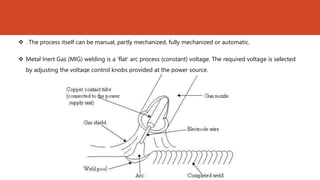
 The basic principle of MIG Welding is, an arc is maintained between the end of the consumable bare wire electrode and
the work piece where the heat source required to melt the parent metal is obtained
 The arc melts the end of the electrode wire, which is transferred to the molten weld pool
 The arc and the weld pool is shielded from the atmospheric contamination by an externally supplied shield gas
 . The process itself can be manual, partly mechanized, fully mechanized or automatic.
 Metal Inert Gas (MIG) welding is a 'flat' arc process (constant) voltage. The required voltage is selected
by adjusting the voltage control knobs provided at the power source.
TYPES OF MIG WELDING
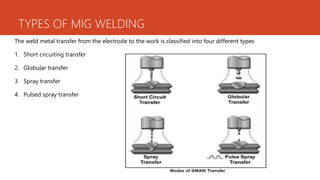
The weld metal transfer from the electrode to the work is classified into four different types
1. Short circuiting transfer
2. Globular transfer
3. Spray transfer
4. Pulsed spray transfer
Short-circuit transfer.
PULSED MIG WELDING
 Modified spray transfer MIG welding
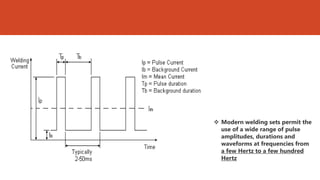
 based on the principle of pulsation of welding current between a high and a low level at regular time intervals
 The low level current also called background current is mainly expected just to maintain welding arc
 high level welding current called peak current is primarily used for
a. melting of faying surfaces with desired penetration of the base metal
b. high melting rate of electrode
c. detachment of molten droplets hanging to the tip of the electrode to facilitate spray transfer
 An optimum combination of pulse parameters results in transfer of one molten metal drop per peak
pulse
 Only if power source is able to supply a pulsed current
 Unlike spray transfer the stream is not continues due to pulsation welding current between low level
and high level current
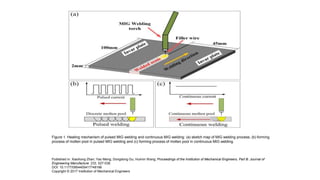
Figure 1. Heating mechanism of pulsed MIG welding and continuous MIG welding: (a) sketch map of MIG welding process, (b) forming
process of molten pool in pulsed MIG welding and (c) forming process of molten pool in continuous MIG welding.
Published in: Xiaohong Zhan; Yao Meng; Dongdong Gu; Huimin Wang; Proceedings of the Institution of Mechanical Engineers, Part B: Journal of
Engineering Manufacture 233, 527-538.
DOI: 10.1177/0954405417748186
Copyright © 2017 Institution of Mechanical Engineers
Figure 15. Mode of droplet transfer in pulsed MIG welding.
Published in: Xiaohong Zhan; Yao Meng; Dongdong Gu; Huimin Wang; Proceedings of the Institution of Mechanical Engineers, Part B: Journal of
Engineering Manufacture 233, 527-538.
DOI: 10.1177/0954405417748186
Copyright © 2017 Institution of Mechanical Engineers
 Modern welding sets permit the
use of a wide range of pulse
amplitudes, durations and
waveforms at frequencies from
a few Hertz to a few hundred
Hertz
ADANTAGES
 WIRE AND GAS SAVINGS
• Since Pulsed MIG machines offer a wider operating range, rather than having two or three different sized
wires, an operator would only require one. Having one wire type minimizes inventory costs and reduces
changeover times.
 SPATTER REDUCTION
 HEAT REDUCTION
• Pulsing offers controlled heat input leading to less distortion
 IMPROVED PRODUCTIVITY
• Pulsed MIG offers high deposition rates. It is easier to weld with pulsed MIG than other transfer methods
with the new machines which are simpler and more adaptive
 OUT OF POSITION WELDING
 LARGER DIAMETER WIRE POSSIBLE
 LOW AND HIGH REACTIVE METALS CAN BE WELDED
 SYNERGIC CONTROL
• Unit current pulse to detach identical molten droplet of predetermined volume from electrode wire,
combined with other parameters necessary for stable wire burn off
synergy: various parts are working together to produce an enhanced result
LIMITATIONS
 Equipment is typically more expensive than conventional step-down
transformer power sources
 Gas blends required are more expensive than the commonly used 100% CO₂
or 75% Argon & 25% CO₂ gas.
 Higher arc energy produces higher levels of radiated heat and a brighter arc,
this requires more protection for the welder (usually gloves with heat shield)
APPLICATIONS
 Structural steel
 Aluminium sections.
 Stainless steel and nickel alloys.
 Some offshore applications
THANK YOU

Pulsed mig welding

  • 1.
  • 2.
    INTRODUCTION  WELDING isa process of joining similar metals by the application of heat with or without the application of pressure and addition of filer material. It is broadly classified into plastic and fusion welding MIG WELDING  Gas Metal Arc Welding (GMAW) is commonly referred to as MIG welding (Metal Inert Gas welding), is one of the fusion welding process.  The basic principle of MIG Welding is, an arc is maintained between the end of the consumable bare wire electrode and the work piece where the heat source required to melt the parent metal is obtained  The arc melts the end of the electrode wire, which is transferred to the molten weld pool  The arc and the weld pool is shielded from the atmospheric contamination by an externally supplied shield gas
  • 3.
     . Theprocess itself can be manual, partly mechanized, fully mechanized or automatic.  Metal Inert Gas (MIG) welding is a 'flat' arc process (constant) voltage. The required voltage is selected by adjusting the voltage control knobs provided at the power source.
  • 4.
    TYPES OF MIGWELDING The weld metal transfer from the electrode to the work is classified into four different types 1. Short circuiting transfer 2. Globular transfer 3. Spray transfer 4. Pulsed spray transfer
  • 5.
  • 6.
    PULSED MIG WELDING Modified spray transfer MIG welding  based on the principle of pulsation of welding current between a high and a low level at regular time intervals  The low level current also called background current is mainly expected just to maintain welding arc  high level welding current called peak current is primarily used for a. melting of faying surfaces with desired penetration of the base metal b. high melting rate of electrode c. detachment of molten droplets hanging to the tip of the electrode to facilitate spray transfer
  • 7.
     An optimumcombination of pulse parameters results in transfer of one molten metal drop per peak pulse  Only if power source is able to supply a pulsed current  Unlike spray transfer the stream is not continues due to pulsation welding current between low level and high level current
  • 8.
    Figure 1. Heatingmechanism of pulsed MIG welding and continuous MIG welding: (a) sketch map of MIG welding process, (b) forming process of molten pool in pulsed MIG welding and (c) forming process of molten pool in continuous MIG welding. Published in: Xiaohong Zhan; Yao Meng; Dongdong Gu; Huimin Wang; Proceedings of the Institution of Mechanical Engineers, Part B: Journal of Engineering Manufacture 233, 527-538. DOI: 10.1177/0954405417748186 Copyright © 2017 Institution of Mechanical Engineers
  • 9.
    Figure 15. Modeof droplet transfer in pulsed MIG welding. Published in: Xiaohong Zhan; Yao Meng; Dongdong Gu; Huimin Wang; Proceedings of the Institution of Mechanical Engineers, Part B: Journal of Engineering Manufacture 233, 527-538. DOI: 10.1177/0954405417748186 Copyright © 2017 Institution of Mechanical Engineers
  • 10.
     Modern weldingsets permit the use of a wide range of pulse amplitudes, durations and waveforms at frequencies from a few Hertz to a few hundred Hertz
  • 11.
    ADANTAGES  WIRE ANDGAS SAVINGS • Since Pulsed MIG machines offer a wider operating range, rather than having two or three different sized wires, an operator would only require one. Having one wire type minimizes inventory costs and reduces changeover times.  SPATTER REDUCTION  HEAT REDUCTION • Pulsing offers controlled heat input leading to less distortion  IMPROVED PRODUCTIVITY • Pulsed MIG offers high deposition rates. It is easier to weld with pulsed MIG than other transfer methods with the new machines which are simpler and more adaptive
  • 12.
     OUT OFPOSITION WELDING  LARGER DIAMETER WIRE POSSIBLE  LOW AND HIGH REACTIVE METALS CAN BE WELDED  SYNERGIC CONTROL • Unit current pulse to detach identical molten droplet of predetermined volume from electrode wire, combined with other parameters necessary for stable wire burn off synergy: various parts are working together to produce an enhanced result
  • 13.
    LIMITATIONS  Equipment istypically more expensive than conventional step-down transformer power sources  Gas blends required are more expensive than the commonly used 100% CO₂ or 75% Argon & 25% CO₂ gas.  Higher arc energy produces higher levels of radiated heat and a brighter arc, this requires more protection for the welder (usually gloves with heat shield)
  • 14.
    APPLICATIONS  Structural steel Aluminium sections.  Stainless steel and nickel alloys.  Some offshore applications
  • 15.