Innovation in the Online
Music Industry: Past,
Present & Future
U1304277
TM6006
The Online Music Economy
Music Industry Management with Media Studies
Word Count: 2,239
An Overview
Over the past twenty years, the music industry has experienced a
world of change. When the Internet, and peer-to-peer file-sharing
services such as LimeWire and most famously, Napster, began their
rise at the turn of the millennium, many critics predicted that the
music industry, among other entertainment sectors, was headed for
impending doom and catastrophic losses in sales. To some degree,
these predictions seemed to become a reality as record sales fell
drastically at least partially due to piracy (El Gamal, 2012, p.3).
However, as technological change continues at a rate never before
seen, the impact of the Internet has been expanded well beyond
illegal downloading to include fundamentally changes in the way
music is produced, distributed, promoted and consumed (Aspray,
2008, p. 451-453). Although the effects of these changes have yet to
be seen in full force, some argue that these revolutionary changes
have been for the better, however, others like Jenner (cited in Rogers,
J, 2013, p.26-27) disagree and argue “digitalisation has totally rattled
the industry” and that “the internet is certainly hurting the industry”.
In saying this, what is certain is that “the Internet, among other
technological advances, led to a full-scale restructuring of the
landscape” of the music industry (El Gamal, 2012, p.5).
The Internet and the Web
The Internet: In short
• The Internet is a worldwide system of
interconnected computer networks.
• A network of networks, today, the Internet
serves as a global data communications system
that links millions of private, public, academic
and business networks via an international
telecommunications backbone that consists of
various electronic and optical networking
technologies.
• Decentralized by design. No one owns the
Internet and it has no central governing
authority.
• The Internet is a vast hardware and software
infrastructure that enables computer
interconnectivity.
The Web: In short
• The Web is a hypermedia database - a myriad
collection of documents and other resources
interconnected by hyperlinks.
• The term ‘Web 2.0’ is given to describe a
second generation of the World Wide Web that
is focused on the ability for people to
collaborate and share information online. Web
resources allow the average user to collaborate
and contribute to Web content. Examples
include social networking, Wikipedia, media-
sharing sites, blogs, hosted services, web
applications and mashups (web application
hybrid).
• Web 2.0 key elements: Interactivity, mass
participation, feedback, user generated
content, rich user experience, collective
intelligence and democracy (arguably).
• Web 2.0 can be described as three concepts,
these are: Rich Internet application (RIA), Social
Web and Web-oriented architecture (WOA).
The terms ‘Internet’ and
‘World Wide Web’ are often
used interchangeably;
however, the Internet and
World Wide Web are not
one and the same.
The Internet: The Rise
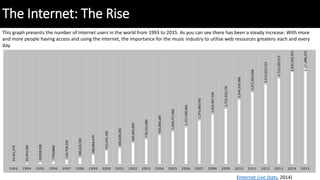
This graph presents the number of Internet users in the world from 1993 to 2015. As you can see there has been a steady increase. With more
and more people having access and using the internet, the importance for the music industry to utilise web resources greatens each and every
day.
(Internet Live Stats, 2014)
14,161,570
25,454,590
44,838,900
77433860
120,758,310
188,023,930
280,866,670
413,425,190
500,609,240
662,663,600
778,555,680
910,060,180
1,029,717,906
1,157,500,065
1,373,040,542
1,562,067,594
1,752,333,178
2,034,259,368
2,272,463,038
2,511,615,523
2,712,239,573
2,925,249,355
3,185,996,155
1993 1994 1995 1996 1997 1998 1999 2000 2001 2002 2003 2004 2005 2006 2007 2008 2009 2010 2011 2012 2013 2014 2015
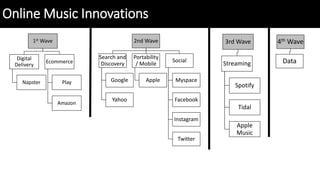
Online Music Innovations
1st
2nd Wave
Search and
Discovery
Google
Yahoo
Portability
/ Mobile
Apple
Social
Myspace
Facebook
Instagram
Twitter
1st Wave
Digital
Delivery
Napster
Ecommerce
Play
Amazon
3rd Wave
Streaming
Spotify
Tidal
Apple
Music
4th Wave
Data
Online Music Innovations
1st
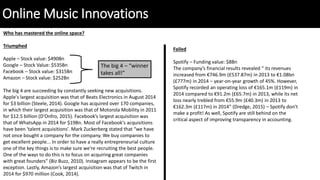
Who has mastered the online space?
Triumphed
Apple – Stock value: $490Bn
Google – Stock Value: $535Bn
Facebook – Stock value: $315Bn
Amazon – Stock value: $252Bn
The big 4 are succeeding by constantly seeking new acquisitions.
Apple's largest acquisition was that of Beats Electronics in August 2014
for $3 billion (Steele, 2014). Google has acquired over 170 companies,
in which their largest acquisition was that of Motorola Mobility in 2011
for $12.5 billion (D'Onfro, 2015). Facebook’s largest acquisition was
that of WhatsApp in 2014 for $19Bn. Most of Facebook's acquisitions
have been 'talent acquisitions'. Mark Zuckerberg stated that “we have
not once bought a company for the company. We buy companies to
get excellent people... In order to have a really entrepreneurial culture
one of the key things is to make sure we're recruiting the best people.
One of the ways to do this is to focus on acquiring great companies
with great founders” (Biz Buzz, 2010). Instagram appears to be the first
exception. Lastly, Amazon’s largest acquisition was that of Twitch in
2014 for $970 million (Cook, 2014).
The big 4 – “winner
takes all!”
Failed
Spotify – Funding value: $8Bn
The company’s financial results revealed “ its revenues
increased from €746.9m (£537.87m) in 2013 to €1.08bn
(£777m) in 2014 – year-on-year growth of 45%. However,
Spotify recorded an operating loss of €165.1m (£119m) in
2014 compared to €91.2m (£65.7m) in 2013, while its net
loss nearly trebled from €55.9m (£40.3m) in 2013 to
€162.3m (£117m) in 2014” (Dredge, 2015) – Spotify don’t
make a profit! As well, Spotify are still behind on the
critical aspect of improving transparency in accounting.
The Importance of Innovation
Martins and Terblanche (2003:64) stated that a company’s “success and survival depend on creativity, innovation, discovery and inventiveness”;
arguing that the business world that was once heavily driven by the commodity of knowledge is now not enough. In regards to obtaining
knowledge, Prior (2010) commented “It’s important to have, because everyone else has it, but ergo, it doesn’t set you apart.” As the music
industry becomes increasingly more competitive, “creativity and innovation have a role to play” in the hope to prosper and survive the industry’s
own creative destruction. A term used to describe the “process of industrial mutation that incessantly revolutionizes the economic structure
from within, incessantly destroying the old one, incessantly creating a new one“ (Schumpeter, 1942). Creativity and innovation are now
positioned the future for business that needs to be embraced. Not only are companies being encouraged to invest in being more creative but
they need to “create an institutional framework in which creativity and innovation will be accepted as basic cultural norms” (Martins and
Terblanche, 2003:64).
Key importance's of innovation
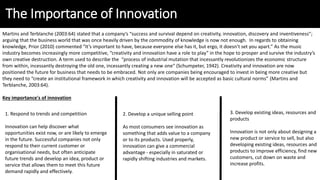
1. Respond to trends and competition
Innovation can help discover what
opportunities exist now, or are likely to emerge
in the future. Successful companies not only
respond to their current customer or
organisational needs, but often anticipate
future trends and develop an idea, product or
service that allows them to meet this future
demand rapidly and effectively.
2. Develop a unique selling point
As most consumers see innovation as
something that adds value to a company
or to its products. Used properly,
innovation can give a commercial
advantage - especially in saturated or
rapidly shifting industries and markets.
3. Develop existing ideas, resources and
products
Innovation is not only about designing a
new product or service to sell, but also
developing existing ideas, resources and
products to improve efficiency, find new
customers, cut down on waste and
increase profits.
An Argument of Technological Innovation
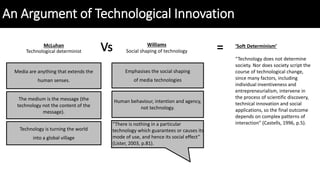
Media are anything that extends the
human senses.
The medium is the message (the
technology not the content of the
message).
Technology is turning the world
into a global village
Emphasises the social shaping
of media technologies
Human behaviour, intention and agency,
not technology.
“There is nothing in a particular
technology which guarantees or causes its
mode of use, and hence its social effect”
(Lister, 2003, p.81).
McLuhan
Technological determinist
Williams
Social shaping of technology
‘Soft Determinism’
“Technology does not determine
society. Nor does society script the
course of technological change,
since many factors, including
individual inventiveness and
entrepreneurialism, intervene in
the process of scientific discovery,
technical innovation and social
applications, so the final outcome
depends on complex patterns of
interaction” (Castells, 1996, p.5).
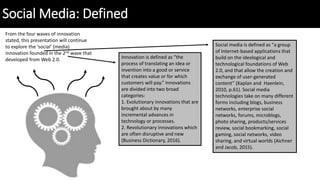
Social Media: Defined
Social media is defined as "a group
of Internet-based applications that
build on the ideological and
technological foundations of Web
2.0, and that allow the creation and
exchange of user-generated
content” (Kaplan and Haenlein,
2010, p.61). Social media
technologies take on many different
forms including blogs, business
networks, enterprise social
networks, forums, microblogs,
photo sharing, products/services
review, social bookmarking, social
gaming, social networks, video
sharing, and virtual worlds (Aichner
and Jacob, 2015).
Innovation is defined as “the
process of translating an idea or
invention into a good or service
that creates value or for which
customers will pay.” Innovations
are divided into two broad
categories:
1. Evolutionary innovations that are
brought about by many
incremental advances in
technology or processes.
2. Revolutionary innovations which
are often disruptive and new
(Business Dictionary, 2016).
From the four waves of innovation
stated, this presentation will continue
to explore the ‘social’ (media)
innovation founded in the 2nd wave that
developed from Web 2.0.
Social Media: Utilisation
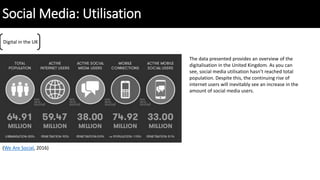
Digital in the UK
The data presented provides an overview of the
digitalisation in the United Kingdom. As you can
see, social media utilisation hasn’t reached total
population. Despite this, the continuing rise of
internet users will inevitably see an increase in the
amount of social media users.
(We Are Social, 2016)
Social Media: Key Players
Facebook is a corporation and online social
networking service. Founded by: Mark Zuckerberg,
Eduardo Saverin, Andrew McCollum, Dustin
Moskovitz and Chris Hughes. Users can create a user
profile, add other users as "friends", create social
groups, exchange messages, post status updates,
photos and videos and share content.
Instagram is an online mobile photo-sharing, video-
sharing, and social networking service. Created by:
Kevin Systrom and Mike Krieger. Instagram enables its
users to take pictures and videos, and share them
either privately or publicly on the app, as well as
through a variety of other social networking
platforms (Frommer, 2010).
Twitter is an online social networking service,.
Founded by Jack Gaffney, Evan Williams, Biz Stone and Noah
Glass. Fuchs (2014, p.180) outlined that Twitter is a microblog. A
term described by Murthy (2013, p.10) as “an internet based
service in which: (1) have a public profile where they broadcast
short public messages/updates […] (2) messages become
publicly aggregated together across users; and (3) users can
decide whose messages they wish to receive, but not
necessarily who can receive their messages.”
Top Active Social Platforms
(We Are Social, 2016)
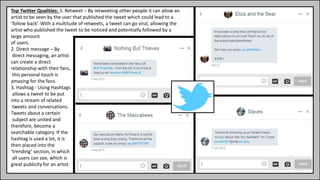
Top Twitter Qualities: 1. Retweet – By retweeting other people it can allow an
artist to be seen by the user that published the tweet which could lead to a
‘follow back’. With a multitude of retweets, a tweet can go viral, allowing the
artist who published the tweet to be noticed and potentially followed by a
large amount
of users.
2. Direct message – By
direct messaging, an artist
can create a direct
relationship with their fans,
this personal touch is
amazing for the fans.
3. Hashtag - Using Hashtags
allows a tweet to be put
into a stream of related
tweets and conversations.
Tweets about a certain
subject are united and
therefore, become a
searchable category. If the
hashtag is used a lot, it is
then placed into the
‘trending’ section, in which
all users can see, which is
great publicity for an artist.
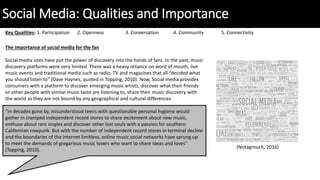
Social Media: Qualities and Importance
Key Qualities: 1. Participation 2. Openness 3. Conversation 4. Community 5. Connectivity
The importance of social media for the fan
Social media sites have put the power of discovery into the hands of fans. In the past, music
discovery platforms were very limited. There was a heavy reliance on word of mouth, live
music events and traditional media such as radio, TV and magazines that all “decided what
you should listen to” (Dave Haynes, quoted in Topping, 2010). Now, Social media provides
consumers with a platform to discover emerging music artists, discover what their friends
or other people with similar music taste are listening to, share their music discovery with
the world as they are not bound by any geographical and cultural differences
“In decades gone by, misunderstood teens with questionable personal hygiene would
gather in cramped independent record stores to share excitement about new music,
enthuse about rare singles and discover other lost souls with a passion for southern
Californian cowpunk. But with the number of independent record stores in terminal decline
and the boundaries of the internet limitless, online music social networks have sprung up
to meet the demands of gregarious music lovers who want to share ideas and loves”
(Topping, 2010).
(Notagrouch, 2016)
Social Media: Importance Continued
The importance of social media for the fan and artist
Social media sites have brought down the barriers between the
fan and the artist. In the past, connectivity and communication
was extremely difficult and limited. In the hope to communicate
with an artist, a fan would have to either meet an artist in person,
write a letter or speak to them on the radio. Now, fans and artists
can communicate free of charge, instantly and at any place in the
world providing that there is internet connection.
The importance of social media for the artist
Social media sites provide a platform for artists to promote and
market their single, album or video. Due to their enormous
network and highly trafficked sites, these social media sites
create an opportunistic environment. What’s best, using social
media sites to distribute, promote and market is free!
The Importance of social media for record labels
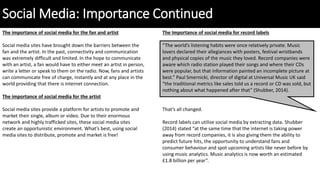
“The world’s listening habits were once relatively private. Music
lovers declared their allegiances with posters, festival wristbands
and physical copies of the music they loved. Record companies were
aware which radio station played their songs and where their CDs
were popular, but that information painted an incomplete picture at
best.” Paul Smernicki, director of digital at Universal Music UK said
“the traditional metrics like sales told us a record or CD was sold, but
nothing about what happened after that” (Shubber, 2014).
That’s all changed.
Record labels can utilise social media by extracting data. Shubber
(2014) stated “at the same time that the internet is taking power
away from record companies, it is also giving them the ability to
predict future hits, the opportunity to understand fans and
consumer behaviour and spot upcoming artists like never before by
using music analytics. Music analytics is now worth an estimated
£1.8 billion per year”.
Music Analytics
MusicMetric – brought by
Apple Inc.
MusicMetric – brought by
Apple Inc.
The Orchard
Audiense
The Echo Nest – brought by
Spotify
Next Big Sound – brought by
Pandora
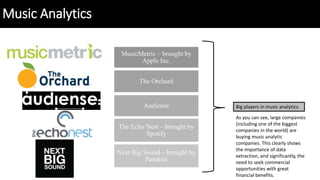
Big players in music analytics.
As you can see, large companies
(including one of the biggest
companies in the world) are
buying music analytic
companies. This clearly shows
the importance of data
extraction, and significantly, the
need to seek commercial
opportunities with great
financial benefits.
Music Analytics: A Visual Snapshot of What They Do…
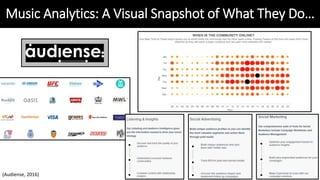
(Audiense, 2016)
Music Analytics: A Visual Snapshot of What They Do…
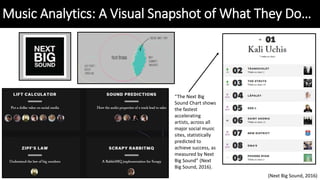
“The Next Big
Sound Chart shows
the fastest
accelerating
artists, across all
major social music
sites, statistically
predicted to
achieve success, as
measured by Next
Big Sound” (Next
Big Sound, 2016).
(Next Big Sound, 2016)
Music Analytics: A Visual Snapshot of What They Do…
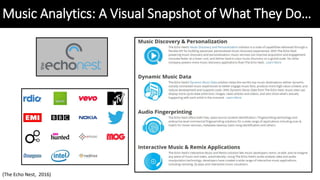
(The Echo Nest, 2016)
Music Analytics: A Visual Snapshot of What They Do…
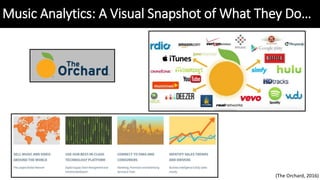
(The Orchard, 2016)
Music Analytics
“In just a short few years, the music industry has woken up to the need to examine social data more rigorously” (Shubber, 2014).
Record companies are increasingly turning to music analytics due to the fact that more and more people listen to music online. Ovenden
(2015) stated that “social media and a plethora of new online platforms on which consumers can play music are opening up new avenues
to scrape information which reveal a variety of factors that impact on their artist’s sales.” He continued, “Whereas previously it was
impossible to gather much information past the point of purchase, companies are now able to see how often a song is listened to, when,
and by who, giving them the capabilities with which they can predict future hit records. The drop off in revenue for record companies
over recent years has been marked. Dogged by piracy and low margins, firms have been looking for another way to maximize their
profits, and they are using the information for all aspects of the business.” As an example, Ovenden (2015) used ticket sales for live
events (one of the industry’s primary sources of revenue) as an example by stating that “ticket sales rose from $1.5bn in 1999, up to
$4.6bn in 2009, and analytics can provide greater insight into the planning of tours.” To summarise, the tools of social media and in
general, the internet, have made it possible to track, test, iterate, and improve marketing to the point where these enormous are
insanely counterproductive. In saying this, a better effort needs to be made by the industry to utilise the data that they have extracted
and use it in real marketing campaigns.
“With robots replacing humans in every sphere of work, who knows how long it will be before the most successful talent scout in the
industry is an algorithm” (Shubber, 2014).
Surveillance Society
The radical change that social media has brought upon Web 2.0 in the way that people interact and
the descending view of what is considered ‘private’ marks a move toward a more interactive, social
and collaborative web but also one that is more and more coming under surveillance (Cascio, 2005
cited in Farinosi, 2009, p.2). Driven by new communication technology, we are now living in a
‘surveillance society’. This sparks a debate on the topic of privacy, utilisation and power. Moreover,
due to the existence of data harvesting and analytics, you could argue that consumers are providing
free labour by their online participation and the information that they share. But if you ignore this
negative assumption and the ideology that users are ‘being used’ in the process of data harvesting
and analytics that occurs online, then it could be perceived that users are extremely vital and are very
powerful. Returning to the idea that we live in a surveillance society whereby we are constantly being
monitored and recorded, users of social media platforms, as well as torrenting and music streaming
sites, are positioned as subjects defined by rigid indicators (information) in which the information of
each user is incredibly crucial. With this being said, our identities are increasingly becoming ‘virtual’
and arguably, our virtual identities are becoming more important to marketers than our ‘real’, physical
self (The Watchful Web, 2001). Moreover, by being active online, users have essentially traded their
privacy, and such privacy has now become a commodity. To conclude, as users produce content, they
are essentially establishing power (without perhaps even knowing they are) – the power is in our
hands. Users and the information they carry is incredibly important to the music industry, and in
general, every other industry.
Reference List
El Gamal, A. (2012) The Evolution of the Music Industry in the Post-Internet Era. PhD Thesis. Claremont McKenna College. Available at:
http://scholarship.claremont.edu/cmc_theses/532 (Accessed: 13 March 2016).
Aspray, W. (2008). “File Sharing and the Music Industry.” The Internet and American business. P. 451-91.
Rogers, J. (2013) The Death and Life of the Music Industry in the Digital Age. London, United Kingdom and New York, America: Bloomsbury Academic.
Internet Live Stats (2014) Internet Users. Available at: http://www.internetlivestats.com/internet-users/#trend (Accessed: 04 March 2016).
Business Dictionary (2016) Innovation. Available at: http://www.businessdictionary.com/definition/innovation.html (Accessed: 10 March 2016).
Kaplan, A and Haenlein, M. (2010). "Users of the world, unite! The challenges and opportunities of social media". Business Horizons 53(1), p. 61.
doi:10.1016/j.bushor.2009.09.003.
Aichner, T. and Jacob, F. ( 2015). "Measuring the Degree of Corporate Social Media Use". International Journal of Market Research 57(2), 257–275.
We Are Social (2016) Digital in 2016. Available at: http://wearesocial.com/uk/special-reports/digital-in-2016 (Accessed: 09 March 2016).
Frommer, D. (2010). Here's How To Use Instagram. Available at: http://www.businessinsider.com/instagram-2010-11?IR=T (Accessed: 22 March 2016).
Fuchs, C. (2014) ‘Twitter and Democracy: A new Public Sphere?’ (Chapter 8) Social Media: A Critical Introduction. London, England: Sage.
Topping, A. (2010) Twitter power: how social networking is revolutionising the music business. Available at: http://www.theguardian.com/media/2010/sep/05/twitter-power-
social-networking-music (Accessed: 22 March 2016).
Shubber, K. (2014) Music analytics is helping the music industry see into the future. Available at: http://www.theguardian.com/technology/2014/apr/09/music-analytics-is-helping-
the-music-industry-see-into-the-future (Accessed: 22 March 2016).
The Orchard (2016) Available at: http://www.theorchard.com/splash/ (Accessed/downloaded: 22 March 2016).
D'Onfro, J. (2015) Google's Ten Biggest Acquisitions. Available at: http://uk.businessinsider.com/googles-ten-biggest-acquisitions-2015-1?r=US&IR=T (Accessed: 18 April 2016).
Castells, M. (1996) Rise of the Network Society, The Information Age: Economy, Society and Culture. Volume 1. Oxford, United Kingdom: Blackwell Publishing.
Reference List
Audiense (2016) Available at: https://www.audiense.com/ (Accessed/downloaded: 22 March 2016).
The Echo Nest (2016) Available at: http://the.echonest.com/ (Accessed/downloaded: 22 March 2016).
Next Big Sound (2016) Available at: https://www.nextbigsound.com/about (Accessed/downloaded: 22 March 2016).
Ovenden, J. (2015) How Is Analytics Changing The Music Industry? Available at: https://channels.theinnovationenterprise.com/articles/how-is-analytics-changing-the-music-
industry (Accessed: 23 March 2016).
'The Watchful Web' (2001) Surveillance, Series 1, Episode 4. 26th August 2001 [DVD]. London, England: World of Wonder.
Farinosi, M. (2009) 'Towards a Postpanopticon perspective: privacy, control and UGC', Prato CIRN Community Informatics Conference 2009: PhD Colloquium. P. 1-5.
Notagrouch (2016) Available at: http://notagrouch.com/social-networking-and-social-media-what-is-it/ (Accessed/downloaded: 22 March 2016).
Schumpeter, J. (1994) [1942]. Capitalism, Socialism and Democracy. London: Routledge. pp. 82–83.
Prior, J. (2010) Soap box: Creativity is the future of business success. Available at: http://www.independent.co.uk/news/business/sme/soap-box-creativity-is-the-future-of-
business-success-2036018.html (Accessed: 06 March 2015).
Martins, E.C. and Terblanche, T. (2003) 'Building organisational culture that stimulates creativity and innovation', European Journal of Innovation Management, 6(1), pp. 64-74.
Dredge, S. (2015) Spotify financial results show struggle to make streaming music profitable. Available at: https://www.theguardian.com/technology/2015/may/11/spotify-
financial-results-streaming-music-profitable (Accessed: 18 April 2016).
Steele, B. (2014) Apple acquires Beats Electronics for $3 billion. Available at: http://www.engadget.com/2014/05/28/apple-acquires-beats-electronics-for-3-billion/ (Accessed: 18
April 2016).
Biz Buzz (2010) Why Facebook Buys Startups. Available at: https://www.youtube.com/watch?v=OlBDyItD0Ak (Accessed: 18 April 2016).
Cook, J. (2014) Here are Amazon’s top 5 biggest acquisitions of all time. Available at: http://www.geekwire.com/2014/amazons-top-5-biggest-acquisitions-time/ (Accessed: 18
April 2016).

Presentation

  • 1.
    Innovation in theOnline Music Industry: Past, Present & Future U1304277 TM6006 The Online Music Economy Music Industry Management with Media Studies Word Count: 2,239
  • 2.
    An Overview Over thepast twenty years, the music industry has experienced a world of change. When the Internet, and peer-to-peer file-sharing services such as LimeWire and most famously, Napster, began their rise at the turn of the millennium, many critics predicted that the music industry, among other entertainment sectors, was headed for impending doom and catastrophic losses in sales. To some degree, these predictions seemed to become a reality as record sales fell drastically at least partially due to piracy (El Gamal, 2012, p.3). However, as technological change continues at a rate never before seen, the impact of the Internet has been expanded well beyond illegal downloading to include fundamentally changes in the way music is produced, distributed, promoted and consumed (Aspray, 2008, p. 451-453). Although the effects of these changes have yet to be seen in full force, some argue that these revolutionary changes have been for the better, however, others like Jenner (cited in Rogers, J, 2013, p.26-27) disagree and argue “digitalisation has totally rattled the industry” and that “the internet is certainly hurting the industry”. In saying this, what is certain is that “the Internet, among other technological advances, led to a full-scale restructuring of the landscape” of the music industry (El Gamal, 2012, p.5).
  • 3.
    The Internet andthe Web The Internet: In short • The Internet is a worldwide system of interconnected computer networks. • A network of networks, today, the Internet serves as a global data communications system that links millions of private, public, academic and business networks via an international telecommunications backbone that consists of various electronic and optical networking technologies. • Decentralized by design. No one owns the Internet and it has no central governing authority. • The Internet is a vast hardware and software infrastructure that enables computer interconnectivity. The Web: In short • The Web is a hypermedia database - a myriad collection of documents and other resources interconnected by hyperlinks. • The term ‘Web 2.0’ is given to describe a second generation of the World Wide Web that is focused on the ability for people to collaborate and share information online. Web resources allow the average user to collaborate and contribute to Web content. Examples include social networking, Wikipedia, media- sharing sites, blogs, hosted services, web applications and mashups (web application hybrid). • Web 2.0 key elements: Interactivity, mass participation, feedback, user generated content, rich user experience, collective intelligence and democracy (arguably). • Web 2.0 can be described as three concepts, these are: Rich Internet application (RIA), Social Web and Web-oriented architecture (WOA). The terms ‘Internet’ and ‘World Wide Web’ are often used interchangeably; however, the Internet and World Wide Web are not one and the same.
  • 4.
    The Internet: TheRise This graph presents the number of Internet users in the world from 1993 to 2015. As you can see there has been a steady increase. With more and more people having access and using the internet, the importance for the music industry to utilise web resources greatens each and every day. (Internet Live Stats, 2014) 14,161,570 25,454,590 44,838,900 77433860 120,758,310 188,023,930 280,866,670 413,425,190 500,609,240 662,663,600 778,555,680 910,060,180 1,029,717,906 1,157,500,065 1,373,040,542 1,562,067,594 1,752,333,178 2,034,259,368 2,272,463,038 2,511,615,523 2,712,239,573 2,925,249,355 3,185,996,155 1993 1994 1995 1996 1997 1998 1999 2000 2001 2002 2003 2004 2005 2006 2007 2008 2009 2010 2011 2012 2013 2014 2015
  • 5.
    Online Music Innovations 1st 2ndWave Search and Discovery Google Yahoo Portability / Mobile Apple Social Myspace Facebook Instagram Twitter 1st Wave Digital Delivery Napster Ecommerce Play Amazon 3rd Wave Streaming Spotify Tidal Apple Music 4th Wave Data
  • 6.
    Online Music Innovations 1st Whohas mastered the online space? Triumphed Apple – Stock value: $490Bn Google – Stock Value: $535Bn Facebook – Stock value: $315Bn Amazon – Stock value: $252Bn The big 4 are succeeding by constantly seeking new acquisitions. Apple's largest acquisition was that of Beats Electronics in August 2014 for $3 billion (Steele, 2014). Google has acquired over 170 companies, in which their largest acquisition was that of Motorola Mobility in 2011 for $12.5 billion (D'Onfro, 2015). Facebook’s largest acquisition was that of WhatsApp in 2014 for $19Bn. Most of Facebook's acquisitions have been 'talent acquisitions'. Mark Zuckerberg stated that “we have not once bought a company for the company. We buy companies to get excellent people... In order to have a really entrepreneurial culture one of the key things is to make sure we're recruiting the best people. One of the ways to do this is to focus on acquiring great companies with great founders” (Biz Buzz, 2010). Instagram appears to be the first exception. Lastly, Amazon’s largest acquisition was that of Twitch in 2014 for $970 million (Cook, 2014). The big 4 – “winner takes all!” Failed Spotify – Funding value: $8Bn The company’s financial results revealed “ its revenues increased from €746.9m (£537.87m) in 2013 to €1.08bn (£777m) in 2014 – year-on-year growth of 45%. However, Spotify recorded an operating loss of €165.1m (£119m) in 2014 compared to €91.2m (£65.7m) in 2013, while its net loss nearly trebled from €55.9m (£40.3m) in 2013 to €162.3m (£117m) in 2014” (Dredge, 2015) – Spotify don’t make a profit! As well, Spotify are still behind on the critical aspect of improving transparency in accounting.
  • 7.
    The Importance ofInnovation Martins and Terblanche (2003:64) stated that a company’s “success and survival depend on creativity, innovation, discovery and inventiveness”; arguing that the business world that was once heavily driven by the commodity of knowledge is now not enough. In regards to obtaining knowledge, Prior (2010) commented “It’s important to have, because everyone else has it, but ergo, it doesn’t set you apart.” As the music industry becomes increasingly more competitive, “creativity and innovation have a role to play” in the hope to prosper and survive the industry’s own creative destruction. A term used to describe the “process of industrial mutation that incessantly revolutionizes the economic structure from within, incessantly destroying the old one, incessantly creating a new one“ (Schumpeter, 1942). Creativity and innovation are now positioned the future for business that needs to be embraced. Not only are companies being encouraged to invest in being more creative but they need to “create an institutional framework in which creativity and innovation will be accepted as basic cultural norms” (Martins and Terblanche, 2003:64). Key importance's of innovation 1. Respond to trends and competition Innovation can help discover what opportunities exist now, or are likely to emerge in the future. Successful companies not only respond to their current customer or organisational needs, but often anticipate future trends and develop an idea, product or service that allows them to meet this future demand rapidly and effectively. 2. Develop a unique selling point As most consumers see innovation as something that adds value to a company or to its products. Used properly, innovation can give a commercial advantage - especially in saturated or rapidly shifting industries and markets. 3. Develop existing ideas, resources and products Innovation is not only about designing a new product or service to sell, but also developing existing ideas, resources and products to improve efficiency, find new customers, cut down on waste and increase profits.
  • 8.
    An Argument ofTechnological Innovation Media are anything that extends the human senses. The medium is the message (the technology not the content of the message). Technology is turning the world into a global village Emphasises the social shaping of media technologies Human behaviour, intention and agency, not technology. “There is nothing in a particular technology which guarantees or causes its mode of use, and hence its social effect” (Lister, 2003, p.81). McLuhan Technological determinist Williams Social shaping of technology ‘Soft Determinism’ “Technology does not determine society. Nor does society script the course of technological change, since many factors, including individual inventiveness and entrepreneurialism, intervene in the process of scientific discovery, technical innovation and social applications, so the final outcome depends on complex patterns of interaction” (Castells, 1996, p.5).
  • 9.
    Social Media: Defined Socialmedia is defined as "a group of Internet-based applications that build on the ideological and technological foundations of Web 2.0, and that allow the creation and exchange of user-generated content” (Kaplan and Haenlein, 2010, p.61). Social media technologies take on many different forms including blogs, business networks, enterprise social networks, forums, microblogs, photo sharing, products/services review, social bookmarking, social gaming, social networks, video sharing, and virtual worlds (Aichner and Jacob, 2015). Innovation is defined as “the process of translating an idea or invention into a good or service that creates value or for which customers will pay.” Innovations are divided into two broad categories: 1. Evolutionary innovations that are brought about by many incremental advances in technology or processes. 2. Revolutionary innovations which are often disruptive and new (Business Dictionary, 2016). From the four waves of innovation stated, this presentation will continue to explore the ‘social’ (media) innovation founded in the 2nd wave that developed from Web 2.0.
  • 10.
    Social Media: Utilisation Digitalin the UK The data presented provides an overview of the digitalisation in the United Kingdom. As you can see, social media utilisation hasn’t reached total population. Despite this, the continuing rise of internet users will inevitably see an increase in the amount of social media users. (We Are Social, 2016)
  • 11.
    Social Media: KeyPlayers Facebook is a corporation and online social networking service. Founded by: Mark Zuckerberg, Eduardo Saverin, Andrew McCollum, Dustin Moskovitz and Chris Hughes. Users can create a user profile, add other users as "friends", create social groups, exchange messages, post status updates, photos and videos and share content. Instagram is an online mobile photo-sharing, video- sharing, and social networking service. Created by: Kevin Systrom and Mike Krieger. Instagram enables its users to take pictures and videos, and share them either privately or publicly on the app, as well as through a variety of other social networking platforms (Frommer, 2010). Twitter is an online social networking service,. Founded by Jack Gaffney, Evan Williams, Biz Stone and Noah Glass. Fuchs (2014, p.180) outlined that Twitter is a microblog. A term described by Murthy (2013, p.10) as “an internet based service in which: (1) have a public profile where they broadcast short public messages/updates […] (2) messages become publicly aggregated together across users; and (3) users can decide whose messages they wish to receive, but not necessarily who can receive their messages.” Top Active Social Platforms (We Are Social, 2016)
  • 12.
    Top Twitter Qualities:1. Retweet – By retweeting other people it can allow an artist to be seen by the user that published the tweet which could lead to a ‘follow back’. With a multitude of retweets, a tweet can go viral, allowing the artist who published the tweet to be noticed and potentially followed by a large amount of users. 2. Direct message – By direct messaging, an artist can create a direct relationship with their fans, this personal touch is amazing for the fans. 3. Hashtag - Using Hashtags allows a tweet to be put into a stream of related tweets and conversations. Tweets about a certain subject are united and therefore, become a searchable category. If the hashtag is used a lot, it is then placed into the ‘trending’ section, in which all users can see, which is great publicity for an artist.
  • 13.
    Social Media: Qualitiesand Importance Key Qualities: 1. Participation 2. Openness 3. Conversation 4. Community 5. Connectivity The importance of social media for the fan Social media sites have put the power of discovery into the hands of fans. In the past, music discovery platforms were very limited. There was a heavy reliance on word of mouth, live music events and traditional media such as radio, TV and magazines that all “decided what you should listen to” (Dave Haynes, quoted in Topping, 2010). Now, Social media provides consumers with a platform to discover emerging music artists, discover what their friends or other people with similar music taste are listening to, share their music discovery with the world as they are not bound by any geographical and cultural differences “In decades gone by, misunderstood teens with questionable personal hygiene would gather in cramped independent record stores to share excitement about new music, enthuse about rare singles and discover other lost souls with a passion for southern Californian cowpunk. But with the number of independent record stores in terminal decline and the boundaries of the internet limitless, online music social networks have sprung up to meet the demands of gregarious music lovers who want to share ideas and loves” (Topping, 2010). (Notagrouch, 2016)
  • 14.
    Social Media: ImportanceContinued The importance of social media for the fan and artist Social media sites have brought down the barriers between the fan and the artist. In the past, connectivity and communication was extremely difficult and limited. In the hope to communicate with an artist, a fan would have to either meet an artist in person, write a letter or speak to them on the radio. Now, fans and artists can communicate free of charge, instantly and at any place in the world providing that there is internet connection. The importance of social media for the artist Social media sites provide a platform for artists to promote and market their single, album or video. Due to their enormous network and highly trafficked sites, these social media sites create an opportunistic environment. What’s best, using social media sites to distribute, promote and market is free! The Importance of social media for record labels “The world’s listening habits were once relatively private. Music lovers declared their allegiances with posters, festival wristbands and physical copies of the music they loved. Record companies were aware which radio station played their songs and where their CDs were popular, but that information painted an incomplete picture at best.” Paul Smernicki, director of digital at Universal Music UK said “the traditional metrics like sales told us a record or CD was sold, but nothing about what happened after that” (Shubber, 2014). That’s all changed. Record labels can utilise social media by extracting data. Shubber (2014) stated “at the same time that the internet is taking power away from record companies, it is also giving them the ability to predict future hits, the opportunity to understand fans and consumer behaviour and spot upcoming artists like never before by using music analytics. Music analytics is now worth an estimated £1.8 billion per year”.
  • 15.
    Music Analytics MusicMetric –brought by Apple Inc. MusicMetric – brought by Apple Inc. The Orchard Audiense The Echo Nest – brought by Spotify Next Big Sound – brought by Pandora Big players in music analytics. As you can see, large companies (including one of the biggest companies in the world) are buying music analytic companies. This clearly shows the importance of data extraction, and significantly, the need to seek commercial opportunities with great financial benefits.
  • 16.
    Music Analytics: AVisual Snapshot of What They Do… (Audiense, 2016)
  • 17.
    Music Analytics: AVisual Snapshot of What They Do… “The Next Big Sound Chart shows the fastest accelerating artists, across all major social music sites, statistically predicted to achieve success, as measured by Next Big Sound” (Next Big Sound, 2016). (Next Big Sound, 2016)
  • 18.
    Music Analytics: AVisual Snapshot of What They Do… (The Echo Nest, 2016)
  • 19.
    Music Analytics: AVisual Snapshot of What They Do… (The Orchard, 2016)
  • 20.
    Music Analytics “In justa short few years, the music industry has woken up to the need to examine social data more rigorously” (Shubber, 2014). Record companies are increasingly turning to music analytics due to the fact that more and more people listen to music online. Ovenden (2015) stated that “social media and a plethora of new online platforms on which consumers can play music are opening up new avenues to scrape information which reveal a variety of factors that impact on their artist’s sales.” He continued, “Whereas previously it was impossible to gather much information past the point of purchase, companies are now able to see how often a song is listened to, when, and by who, giving them the capabilities with which they can predict future hit records. The drop off in revenue for record companies over recent years has been marked. Dogged by piracy and low margins, firms have been looking for another way to maximize their profits, and they are using the information for all aspects of the business.” As an example, Ovenden (2015) used ticket sales for live events (one of the industry’s primary sources of revenue) as an example by stating that “ticket sales rose from $1.5bn in 1999, up to $4.6bn in 2009, and analytics can provide greater insight into the planning of tours.” To summarise, the tools of social media and in general, the internet, have made it possible to track, test, iterate, and improve marketing to the point where these enormous are insanely counterproductive. In saying this, a better effort needs to be made by the industry to utilise the data that they have extracted and use it in real marketing campaigns. “With robots replacing humans in every sphere of work, who knows how long it will be before the most successful talent scout in the industry is an algorithm” (Shubber, 2014).
  • 21.
    Surveillance Society The radicalchange that social media has brought upon Web 2.0 in the way that people interact and the descending view of what is considered ‘private’ marks a move toward a more interactive, social and collaborative web but also one that is more and more coming under surveillance (Cascio, 2005 cited in Farinosi, 2009, p.2). Driven by new communication technology, we are now living in a ‘surveillance society’. This sparks a debate on the topic of privacy, utilisation and power. Moreover, due to the existence of data harvesting and analytics, you could argue that consumers are providing free labour by their online participation and the information that they share. But if you ignore this negative assumption and the ideology that users are ‘being used’ in the process of data harvesting and analytics that occurs online, then it could be perceived that users are extremely vital and are very powerful. Returning to the idea that we live in a surveillance society whereby we are constantly being monitored and recorded, users of social media platforms, as well as torrenting and music streaming sites, are positioned as subjects defined by rigid indicators (information) in which the information of each user is incredibly crucial. With this being said, our identities are increasingly becoming ‘virtual’ and arguably, our virtual identities are becoming more important to marketers than our ‘real’, physical self (The Watchful Web, 2001). Moreover, by being active online, users have essentially traded their privacy, and such privacy has now become a commodity. To conclude, as users produce content, they are essentially establishing power (without perhaps even knowing they are) – the power is in our hands. Users and the information they carry is incredibly important to the music industry, and in general, every other industry.
  • 22.
    Reference List El Gamal,A. (2012) The Evolution of the Music Industry in the Post-Internet Era. PhD Thesis. Claremont McKenna College. Available at: http://scholarship.claremont.edu/cmc_theses/532 (Accessed: 13 March 2016). Aspray, W. (2008). “File Sharing and the Music Industry.” The Internet and American business. P. 451-91. Rogers, J. (2013) The Death and Life of the Music Industry in the Digital Age. London, United Kingdom and New York, America: Bloomsbury Academic. Internet Live Stats (2014) Internet Users. Available at: http://www.internetlivestats.com/internet-users/#trend (Accessed: 04 March 2016). Business Dictionary (2016) Innovation. Available at: http://www.businessdictionary.com/definition/innovation.html (Accessed: 10 March 2016). Kaplan, A and Haenlein, M. (2010). "Users of the world, unite! The challenges and opportunities of social media". Business Horizons 53(1), p. 61. doi:10.1016/j.bushor.2009.09.003. Aichner, T. and Jacob, F. ( 2015). "Measuring the Degree of Corporate Social Media Use". International Journal of Market Research 57(2), 257–275. We Are Social (2016) Digital in 2016. Available at: http://wearesocial.com/uk/special-reports/digital-in-2016 (Accessed: 09 March 2016). Frommer, D. (2010). Here's How To Use Instagram. Available at: http://www.businessinsider.com/instagram-2010-11?IR=T (Accessed: 22 March 2016). Fuchs, C. (2014) ‘Twitter and Democracy: A new Public Sphere?’ (Chapter 8) Social Media: A Critical Introduction. London, England: Sage. Topping, A. (2010) Twitter power: how social networking is revolutionising the music business. Available at: http://www.theguardian.com/media/2010/sep/05/twitter-power- social-networking-music (Accessed: 22 March 2016). Shubber, K. (2014) Music analytics is helping the music industry see into the future. Available at: http://www.theguardian.com/technology/2014/apr/09/music-analytics-is-helping- the-music-industry-see-into-the-future (Accessed: 22 March 2016). The Orchard (2016) Available at: http://www.theorchard.com/splash/ (Accessed/downloaded: 22 March 2016). D'Onfro, J. (2015) Google's Ten Biggest Acquisitions. Available at: http://uk.businessinsider.com/googles-ten-biggest-acquisitions-2015-1?r=US&IR=T (Accessed: 18 April 2016). Castells, M. (1996) Rise of the Network Society, The Information Age: Economy, Society and Culture. Volume 1. Oxford, United Kingdom: Blackwell Publishing.
  • 23.
    Reference List Audiense (2016)Available at: https://www.audiense.com/ (Accessed/downloaded: 22 March 2016). The Echo Nest (2016) Available at: http://the.echonest.com/ (Accessed/downloaded: 22 March 2016). Next Big Sound (2016) Available at: https://www.nextbigsound.com/about (Accessed/downloaded: 22 March 2016). Ovenden, J. (2015) How Is Analytics Changing The Music Industry? Available at: https://channels.theinnovationenterprise.com/articles/how-is-analytics-changing-the-music- industry (Accessed: 23 March 2016). 'The Watchful Web' (2001) Surveillance, Series 1, Episode 4. 26th August 2001 [DVD]. London, England: World of Wonder. Farinosi, M. (2009) 'Towards a Postpanopticon perspective: privacy, control and UGC', Prato CIRN Community Informatics Conference 2009: PhD Colloquium. P. 1-5. Notagrouch (2016) Available at: http://notagrouch.com/social-networking-and-social-media-what-is-it/ (Accessed/downloaded: 22 March 2016). Schumpeter, J. (1994) [1942]. Capitalism, Socialism and Democracy. London: Routledge. pp. 82–83. Prior, J. (2010) Soap box: Creativity is the future of business success. Available at: http://www.independent.co.uk/news/business/sme/soap-box-creativity-is-the-future-of- business-success-2036018.html (Accessed: 06 March 2015). Martins, E.C. and Terblanche, T. (2003) 'Building organisational culture that stimulates creativity and innovation', European Journal of Innovation Management, 6(1), pp. 64-74. Dredge, S. (2015) Spotify financial results show struggle to make streaming music profitable. Available at: https://www.theguardian.com/technology/2015/may/11/spotify- financial-results-streaming-music-profitable (Accessed: 18 April 2016). Steele, B. (2014) Apple acquires Beats Electronics for $3 billion. Available at: http://www.engadget.com/2014/05/28/apple-acquires-beats-electronics-for-3-billion/ (Accessed: 18 April 2016). Biz Buzz (2010) Why Facebook Buys Startups. Available at: https://www.youtube.com/watch?v=OlBDyItD0Ak (Accessed: 18 April 2016). Cook, J. (2014) Here are Amazon’s top 5 biggest acquisitions of all time. Available at: http://www.geekwire.com/2014/amazons-top-5-biggest-acquisitions-time/ (Accessed: 18 April 2016).