@
REASONS
Our Children
Are About To
Miss Out On The
Greatest
Opportunity In
The World
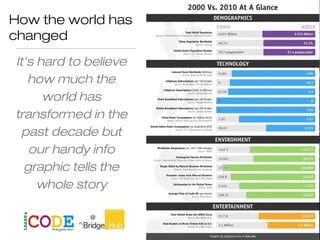
How the world has
changed
It's hard to believe
how much the
world has
transformed in the
past decade but
our handy info
graphic tells the
whole story
Charlie Jane Anders
So what's
changed?
Technology has
gotten
unimaginably
smaller and better
— just look at the
differences
between an iMac
in 2000 and an
How the world has
changed
In-Spite of
These Changes
These Changes
Did you
know..........
Less than 1%
of our
population
can fully utilize
today’s
technology.
*National Bureau of Statistics
<
Handling Change
For us to take
advantage of
these
changes, we
need to know
what the future
holds
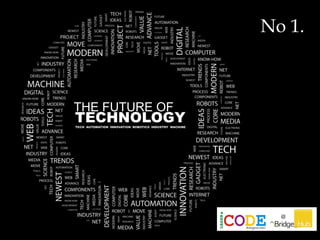
FUTURE TRENDS
THE FUTURE OF
No 1.
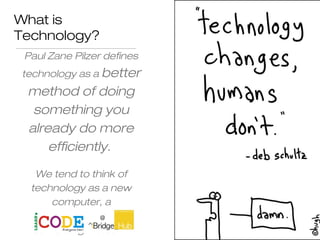
What is
Technology?
Paul Zane Pilzer defines
technology as a better
method of doing
something you
already do more
efficiently.
We tend to think of
technology as a new
computer, a
new semiconductor,
something we don't
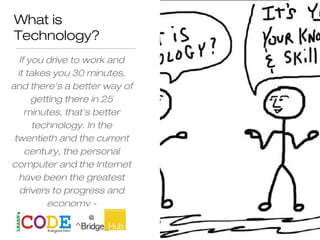
What is
Technology?
If you drive to work and
it takes you 30 minutes,
and there's a better way of
getting there in 25
minutes, that's better
technology. In the
twentieth and the current
century, the personal
computer and the Internet
have been the greatest
drivers to progress and
economy -
Paul Zane Pilzer
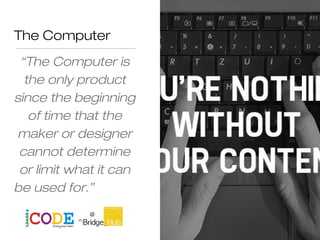
The Computer
“The Computer is
the only product
since the beginning
of time that the
maker or designer
cannot determine
or limit what it can
be used for.”
The Future of the
Computer & The
Internet
“One hundred
years ago, people
were faced with the
choice of learning to
read or remaining
illiterate laborers who
would be left behind as
have-nots in a rapidly
modernizing world.
Yishan Wong
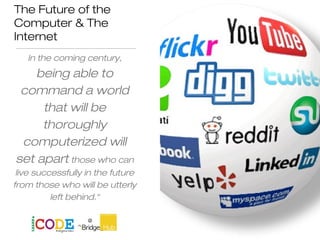
The Future of the
Computer & The
Internet
In the coming century,
being able to
command a world
that will be
thoroughly
computerized will
set apart those who can
live successfully in the future
from those who will be utterly
left behind.“
Yishan Wong
Some Facts
"Even with the *105million
penetration of mobile phones with
*less than 10% Smartphone and
even less than 1% of our population
can utilize these technologies,
neither do we have local apps
relevant and beneficial to this
population "
In Conclusion
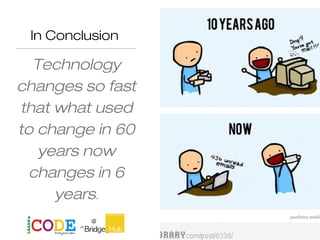
Technology
changes so fast
that what used
to change in 60
years now
changes in 6
years.
Paul Zane Pilzer
In Conclusion
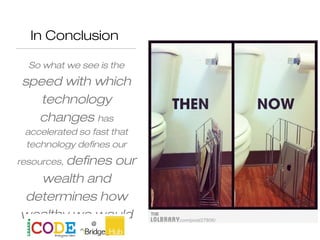
So what we see is the
speed with which
technology
changes has
accelerated so fast that
technology defines our
resources, defines our
wealth and
determines how
wealthy we would
be.
No.
2The Future of
No
2.
Why?
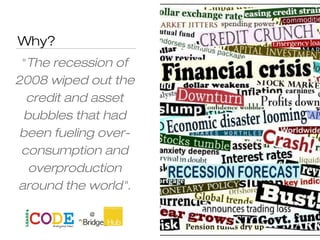
"The recession of
2008 wiped out the
credit and asset
bubbles that had
been fueling over-
consumption and
overproduction
around the world".
Ken Robinson
Why?
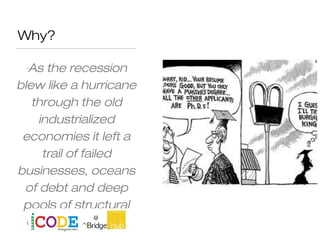
"As the recession
blew like a hurricane
through the old
industrialized
economies it left a
trail of failed
businesses, oceans
of debt and deep
pools of structural
Unemployment".
Why?
Among the worst affected are
young people. As I write this, global
levels of unemployment among
young people, aged from 15
to 24, are the highest on
record.
Unemployment
“Unemployment, while it is painful
for the workers who are temporarily
displaced, is a necessary and
positive sign that the economy is
growing".
Paul Zane Pilzer
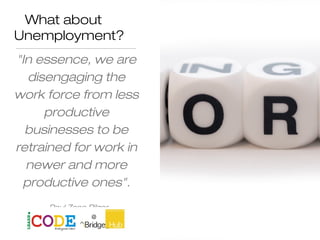
What about
Unemployment?
"In essence, we are
disengaging the
work force from less
productive
businesses to be
retrained for work in
newer and more
productive ones".
Paul Zane Pilzer
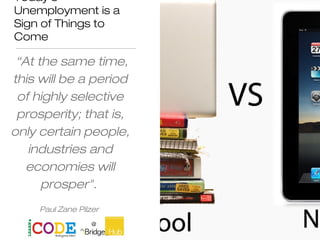
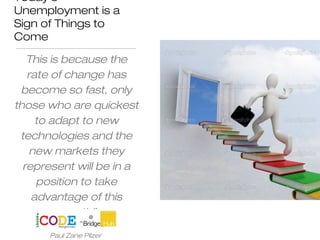
Today's
Unemployment is a
Sign of Things to
Come
“At the same time,
this will be a period
of highly selective
prosperity; that is,
only certain people,
industries and
economies will
prosper".
Paul Zane Pilzer
Today's
Unemployment is a
Sign of Things to
Come
This is because the
rate of change has
become so fast, only
those who are quickest
to adapt to new
technologies and the
new markets they
represent will be in a
position to take
advantage of this
growth”.
Paul Zane Pilzer
Consider this...
About ten years ago there
were no social networks.
Ten years before that we
didn't have the Web.
Consider this...
If you work in the web programming,
online marketing, or mobile phone
industries…
… your job did not exist
twenty years ago.
Consider this...
Who knows what jobs will exist
twenty years from now? The
people out of work today will
soon find jobs again.
But the work won't be the same.
One Opportunity
“At a time when people are saying "I
want a good job - I got out of college
and I couldn't find one," every single
year in America there is a standing
demand for 120,000 people who are
training in computer science”.
President Bill Clinton
No.
3
The
Future
of
Language & Literacy:
The last 6 inches of
the divide
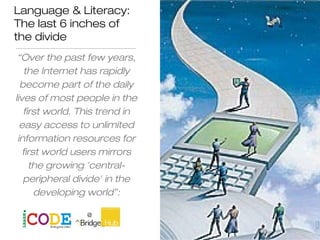
“Over the past few years,
the Internet has rapidly
become part of the daily
lives of most people in the
first world. This trend in
easy access to unlimited
information resources for
first world users mirrors
the growing 'central-
peripheral divide' in the
developing world”:
Andie Miller
Language & Literacy:
The last 6 inches of
the divide
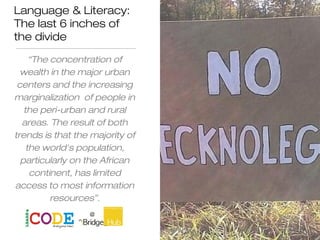
“The concentration of
wealth in the major urban
centers and the increasing
marginalization of people in
the peri-urban and rural
areas. The result of both
trends is that the majority of
the world's population,
particularly on the African
continent, has limited
access to most information
resources”.
Andie Miller
The Truth is...
"The future's already
happened, it's just
unequally distributed."
a quote by science fiction writer William Gibson.
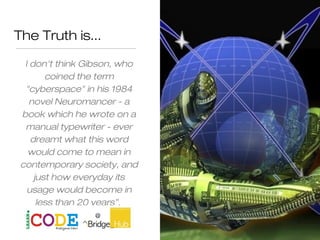
The Truth is...
I don't think Gibson, who
coined the term
"cyberspace" in his 1984
novel Neuromancer - a
book which he wrote on a
manual typewriter - ever
dreamt what this word
would come to mean in
contemporary society, and
just how everyday its
usage would become in
less than 20 years”.
The Truth is...
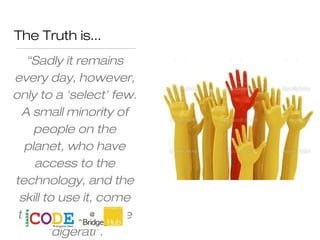
“Sadly it remains
every day, however,
only to a 'select' few.
A small minority of
people on the
planet, who have
access to the
technology, and the
skill to use it, come
to be known as the
"digerati".
The Truth is...
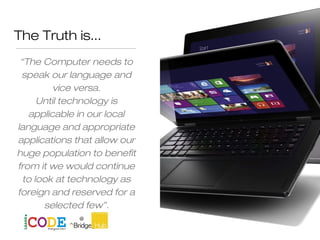
“The Computer needs to
speak our language and
vice versa.
Until technology is
applicable in our local
language and appropriate
applications that allow our
huge population to benefit
from it we would continue
to look at technology as
foreign and reserved for a
selected few”.
Dr Adegbola
Bridging the divide
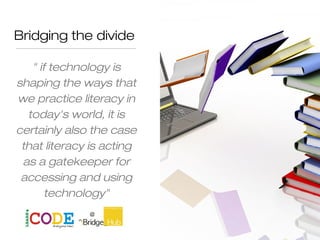
" if technology is
shaping the ways that
we practice literacy in
today's world, it is
certainly also the case
that literacy is acting
as a gatekeeper for
accessing and using
technology"
M Warschauer
Bridging the divide
"The real threat of a digital
divide in the US and the world
is not that some people will
have computers and some
won't, but that they will be
enabled to use them in entirely
different ways, with one group
able to muster a wide range of
semiotic tools and resources
to persuade, argue, analyze,
critique and interpret, and
another group, lacking these
semiotics skills, limited to pre-
packaged choices".
(Castells, 1996/2000; Warschauer,
No 4.
Information
Today, real life means mobile.
We consume more media on
smartphones than
computers and tablets
combined. We spend 82
percent of our mobile media
time in apps, and Facebook
accounts for 23 percent of
that in-app time. In short:
apps are the mobile web,
and Facebook is the most
used app in the world
Jason Stein
Information
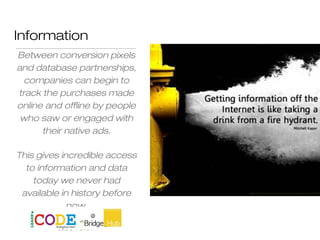
Between conversion pixels
and database partnerships,
companies can begin to
track the purchases made
online and offline by people
who saw or engaged with
their native ads.
This gives incredible access
to information and data
today we never had
available in history before
now.
Jason Stein
Data
"Errors using inadequate
data are much less than
those using no data at all.”
Charles Babbage
Making Sense of
Data and
Information
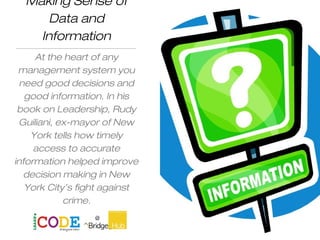
At the heart of any
management system you
need good decisions and
good information. In his
book on Leadership, Rudy
Guiliani, ex-mayor of New
York tells how timely
access to accurate
information helped improve
decision making in New
York City’s fight against
crime.
Elearn
Making Sense of
Data and
Information
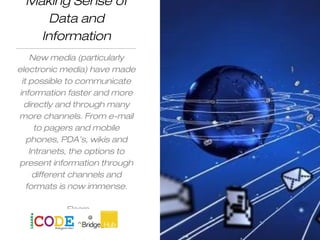
New media (particularly
electronic media) have made
it possible to communicate
information faster and more
directly and through many
more channels. From e-mail
to pagers and mobile
phones, PDA’s, wikis and
Intranets, the options to
present information through
different channels and
formats is now immense.
Elearn
Making Sense of
Data and
Information
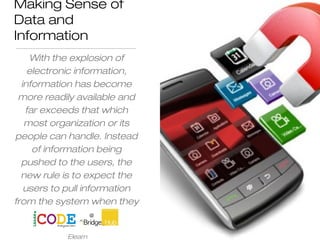
With the explosion of
electronic information,
information has become
more readily available and
far exceeds that which
most organization or its
people can handle. Instead
of information being
pushed to the users, the
new rule is to expect the
users to pull information
from the system when they
need it
Elearn
Making Sense of
Data and
Information
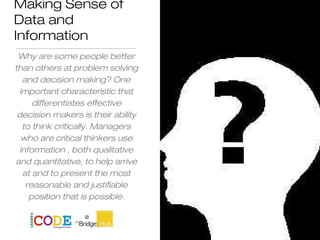
Why are some people better
than others at problem solving
and decision making? One
important characteristic that
differentiates effective
decision makers is their ability
to think critically. Managers
who are critical thinkers use
information , both qualitative
and quantitative, to help arrive
at and to present the most
reasonable and justifiable
position that is possible.
Elearn
Making Sense of Data and Information
Ultimately the tremendous amount of
information that is generated is only
useful if it can be applied to
create knowledge within the
organization. Building and managing
knowledge is one of the greatest challenges
that faces organization in the twenty first
Century.
World Wide Web
The biggest source
of secondary data
is now the World
Wide Web
and you
need to be
able to
Th
e
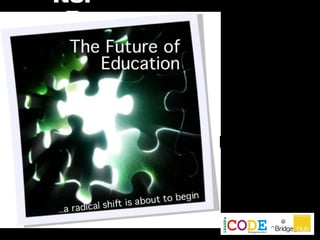
No.
5 No 5.
The
Future
of
Education
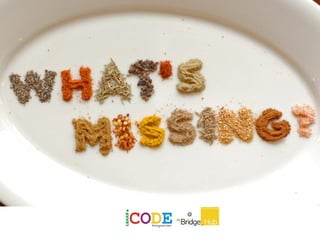
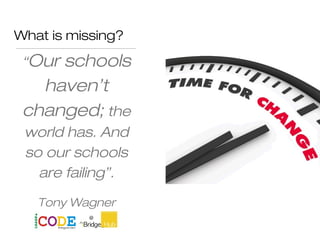
What is missing?
“Our schools
haven’t
changed; the
world has. And
so our schools
are failing”.
Tony Wagner
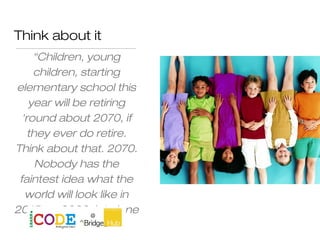
Think about it
“Children, young
children, starting
elementary school this
year will be retiring
'round about 2070, if
they ever do retire.
Think about that. 2070.
Nobody has the
faintest idea what the
world will look like in
2015, or 2020, let alone
2070".
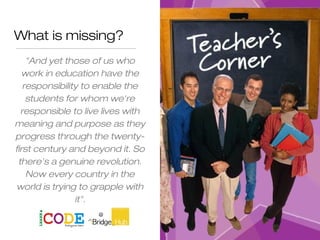
What is missing?
"And yet those of us who
work in education have the
responsibility to enable the
students for whom we're
responsible to live lives with
meaning and purpose as they
progress through the twenty-
first century and beyond it. So
there's a genuine revolution.
Now every country in the
world is trying to grapple with
it".
Sir Ken Robinson
What is missing?
In today‘s highly competitive global
knowledge economy, all students
need new skills for college,
careers, and citizenship. The
failure to give all students these new skills
leaves today‘s youth and our country at an
alarming competitive disadvantage.
What is missing?
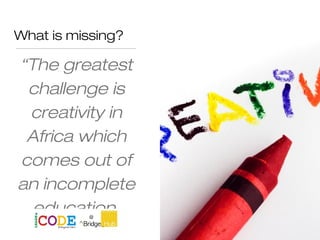
“The greatest
challenge is
creativity in
Africa which
comes out of
an incomplete
education.
We are “Certified
but not Educated”
We are “Certified but
not Educated” It is the
attitude of chasing after
certificates and not an
education that has become
the bane of our society. The
problem in the society today
is that skill is yet to be
developed in people. We
are yet to come to a place
where we truly use our
education to create wealth”.
Where Do We
Go From Here?
Go From Here?
Now that we know
the 5
Reasons...........
What
can we
do
about
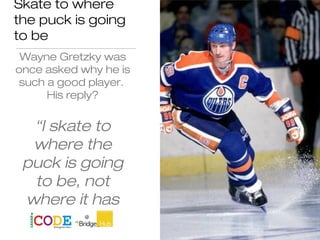
Skate to where
the puck is going
to be
Wayne Gretzky was
once asked why he is
such a good player.
His reply?
“I skate to
where the
puck is going
to be, not
where it has
been.”
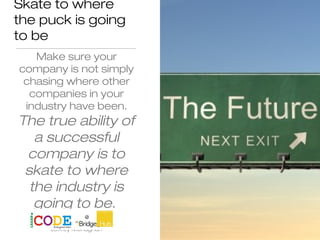
Skate to where
the puck is going
to be
Make sure your
company is not simply
chasing where other
companies in your
industry have been.
The true ability of
a successful
company is to
skate to where
the industry is
going to be.
Jeffrey Monaghan
The Seven Survival
Skills for Careers,
College, and
Citizenship
The Seven Survival Skills for
Careers, College, and
Citizenship
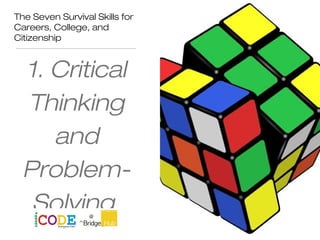
1. Critical
Thinking
and
Problem-
Solving
The Seven Survival Skills for
Careers, College, and
Citizenship
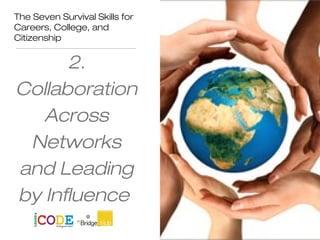
2.
Collaboration
Across
Networks
and Leading
by Influence
The Seven Survival Skills for
Careers, College, and
Citizenship
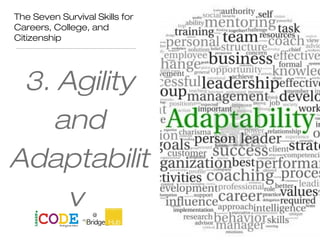
3. Agility
and
Adaptabilit
y
The Seven Survival Skills for
Careers, College, and
Citizenship
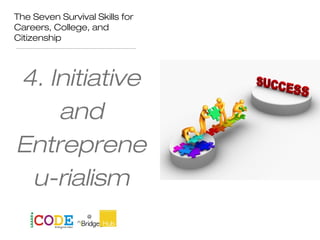
4. Initiative
and
Entreprene
u-rialism
The Seven Survival Skills for
Careers, College, and
Citizenship
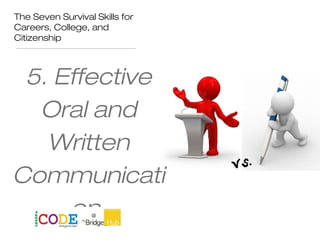
5. Effective
Oral and
Written
Communicati
on
The Seven Survival Skills for
Careers, College, and
Citizenship
6.
Accessing
and
Analyzing
Information
The Seven Survival Skills for
Careers, College, and
Citizenship
7.
Curiosity
and
Imaginatio
n
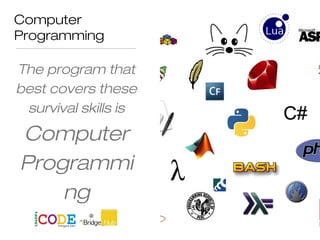
Computer
Programming
The program that
best covers these
survival skills is
Computer
Programmi
ng
What Is Coding?
The word coding is a slang
term for computer
programming, used
because programming
basically means writing
source code.
Emma
Mulqueeny
What Is Coding?
These actions are understood
by the computer in what is
known as binary code, that
lovely series of ones and
zeros loved by Hollywood
futuristic films
Emma
Mulqueeny
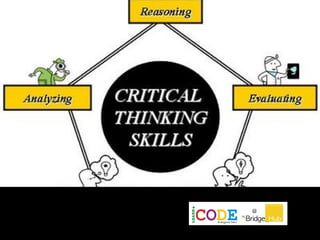
Critical
“We consider it critical that students
be able to read and write and
understand math, biology, chemistry
and physics. To be a well-educated
citizen in today’s computing-
intensive world, students must have
a deeper understanding of the
fundamentals of computing as well.“Chris Stephenson
Critical
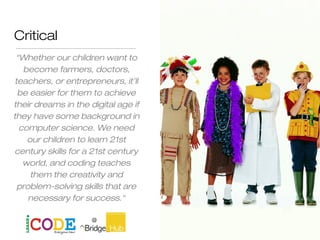
“Whether our children want to
become farmers, doctors,
teachers, or entrepreneurs, it’ll
be easier for them to achieve
their dreams in the digital age if
they have some background in
computer science. We need
our children to learn 21st
century skills for a 21st century
world, and coding teaches
them the creativity and
problem-solving skills that are
necessary for success.“
John Thune
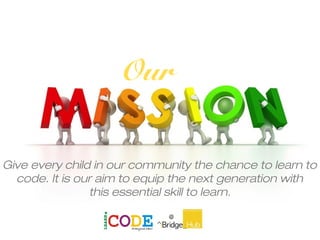
Our
Give every child in our community the chance to learn to
code. It is our aim to equip the next generation with
this essential skill to learn.
Consider This
“I think everybody in this
country should learn how
to program a computer
because it teaches you
how to think.”
How?
1. We believe and think every
individual, parent, kids; youth should
be encouraged to start to learn to
Code no matter what they want to
do or are already doing in life.
This will teach them to think and
solve problems.
How?
2.Campaign for, encourage
and assist schools and
parents to introduce coding
and computer programing
into their curriculum.
Do you know?
“The most popular class at Harvard today is Intro
to Computer Programming, because computers
are helping in almost every other field of study and
research - to search for a cure for cancer, to
understand the origins of ancient languages, etc.
We need more schools to offer computer
programming; it's a skill that will empower the next
generation in almost any field. Learning to code is
easy, fun, and a good thing to learn young.
Harry Lewis
How?
3. To provide a melting point
for leading hardware and software
providers and developers as well
programers and programing firms to
meet and work together and to
come up with relevant applications
for our local community and language
Consider This
"The point is that
the world does
not need more
code for its own
sake, but better
and more
universal thinking
about code"
Jeff Atwood
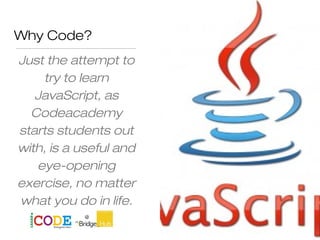
Why Code?
Just the attempt to
try to learn
JavaScript, as
Codeacademy
starts students out
with, is a useful and
eye-opening
exercise, no matter
what you do in life.
Jeff Atwood
Why Code?
“Here we are, 2013, we ALL depend on
technology to communicate, to bank,
and none of us know how to read and
write code. It's important for these kids,
right now, starting at 8 years old, to read
and write code
will.i.am
Why Code?
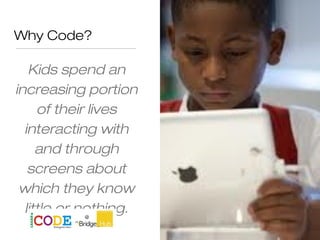
Kids spend an
increasing portion
of their lives
interacting with
and through
screens about
which they know
little or nothing.
Why Code?
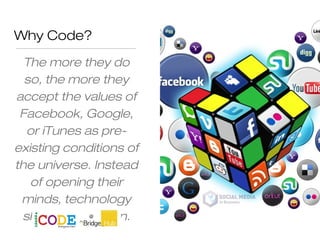
The more they do
so, the more they
accept the values of
Facebook, Google,
or iTunes as pre-
existing conditions of
the universe. Instead
of opening their
minds, technology
shuts them down.
Why Code?
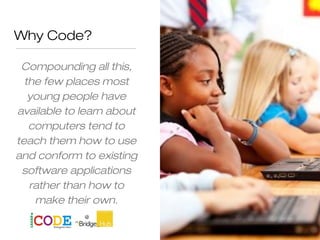
Compounding all this,
the few places most
young people have
available to learn about
computers tend to
teach them how to use
and conform to existing
software applications
rather than how to
make their own.
Why Code?
Introducing kids to
code reveals to
them how
computers are
really “anything”
machines,
capable of doing
pretty much
anything we
Why Code?
"It gives them the ability
both to read and to
write in the
foundational languages
of the digital age and,
in doing so,
fundamentally
transforms their
perspective from that
of user to maker,
consumer to creative”.
Strategic Partnership
In strategic partnership with leading hardware and
software providers and developers as well as
programming firms we would be using simple
coding curriculums from
code.org, code
academy.com and
scratch.mit.edu just to mention a few to
develop appropriate and relevant courses and
programs
The Scratch
Program
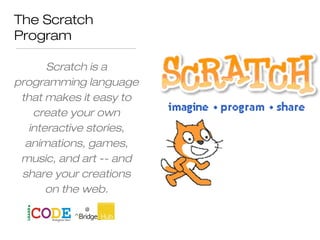
Scratch is a
programming language
that makes it easy to
create your own
interactive stories,
animations, games,
music, and art -- and
share your creations
on the web.
The Scratch
Program
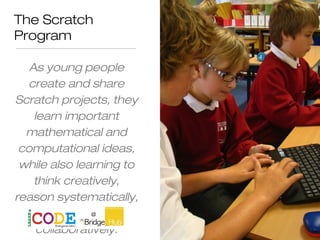
As young people
create and share
Scratch projects, they
learn important
mathematical and
computational ideas,
while also learning to
think creatively,
reason systematically,
and work
collaboratively.
Everyone Can Learn To Code
Children,
Youths,
Educators and Parents

5 Reasons Our Children Are About To Miss Out On The Greatest Opportunity In The World

  • 1.
  • 2.
    REASONS Our Children Are AboutTo Miss Out On The Greatest Opportunity In The World
  • 3.
    How the worldhas changed It's hard to believe how much the world has transformed in the past decade but our handy info graphic tells the whole story Charlie Jane Anders
  • 4.
    So what's changed? Technology has gotten unimaginably smallerand better — just look at the differences between an iMac in 2000 and an How the world has changed
  • 5.
  • 6.
    Did you know.......... Less than1% of our population can fully utilize today’s technology. *National Bureau of Statistics <
  • 7.
    Handling Change For usto take advantage of these changes, we need to know what the future holds
  • 8.
  • 9.
  • 10.
    What is Technology? Paul ZanePilzer defines technology as a better method of doing something you already do more efficiently. We tend to think of technology as a new computer, a new semiconductor, something we don't
  • 11.
    What is Technology? If youdrive to work and it takes you 30 minutes, and there's a better way of getting there in 25 minutes, that's better technology. In the twentieth and the current century, the personal computer and the Internet have been the greatest drivers to progress and economy - Paul Zane Pilzer
  • 12.
    The Computer “The Computeris the only product since the beginning of time that the maker or designer cannot determine or limit what it can be used for.”
  • 13.
    The Future ofthe Computer & The Internet “One hundred years ago, people were faced with the choice of learning to read or remaining illiterate laborers who would be left behind as have-nots in a rapidly modernizing world. Yishan Wong
  • 14.
    The Future ofthe Computer & The Internet In the coming century, being able to command a world that will be thoroughly computerized will set apart those who can live successfully in the future from those who will be utterly left behind.“ Yishan Wong
  • 15.
    Some Facts "Even withthe *105million penetration of mobile phones with *less than 10% Smartphone and even less than 1% of our population can utilize these technologies, neither do we have local apps relevant and beneficial to this population "
  • 16.
    In Conclusion Technology changes sofast that what used to change in 60 years now changes in 6 years. Paul Zane Pilzer
  • 17.
    In Conclusion So whatwe see is the speed with which technology changes has accelerated so fast that technology defines our resources, defines our wealth and determines how wealthy we would be.
  • 18.
  • 19.
    Why? "The recession of 2008wiped out the credit and asset bubbles that had been fueling over- consumption and overproduction around the world". Ken Robinson
  • 20.
    Why? "As the recession blewlike a hurricane through the old industrialized economies it left a trail of failed businesses, oceans of debt and deep pools of structural Unemployment".
  • 21.
    Why? Among the worstaffected are young people. As I write this, global levels of unemployment among young people, aged from 15 to 24, are the highest on record.
  • 22.
    Unemployment “Unemployment, while itis painful for the workers who are temporarily displaced, is a necessary and positive sign that the economy is growing". Paul Zane Pilzer
  • 23.
    What about Unemployment? "In essence,we are disengaging the work force from less productive businesses to be retrained for work in newer and more productive ones". Paul Zane Pilzer
  • 24.
    Today's Unemployment is a Signof Things to Come “At the same time, this will be a period of highly selective prosperity; that is, only certain people, industries and economies will prosper". Paul Zane Pilzer
  • 25.
    Today's Unemployment is a Signof Things to Come This is because the rate of change has become so fast, only those who are quickest to adapt to new technologies and the new markets they represent will be in a position to take advantage of this growth”. Paul Zane Pilzer
  • 26.
    Consider this... About tenyears ago there were no social networks. Ten years before that we didn't have the Web.
  • 27.
    Consider this... If youwork in the web programming, online marketing, or mobile phone industries… … your job did not exist twenty years ago.
  • 28.
    Consider this... Who knowswhat jobs will exist twenty years from now? The people out of work today will soon find jobs again. But the work won't be the same.
  • 29.
    One Opportunity “At atime when people are saying "I want a good job - I got out of college and I couldn't find one," every single year in America there is a standing demand for 120,000 people who are training in computer science”. President Bill Clinton
  • 30.
  • 31.
    Language & Literacy: Thelast 6 inches of the divide “Over the past few years, the Internet has rapidly become part of the daily lives of most people in the first world. This trend in easy access to unlimited information resources for first world users mirrors the growing 'central- peripheral divide' in the developing world”: Andie Miller
  • 32.
    Language & Literacy: Thelast 6 inches of the divide “The concentration of wealth in the major urban centers and the increasing marginalization of people in the peri-urban and rural areas. The result of both trends is that the majority of the world's population, particularly on the African continent, has limited access to most information resources”. Andie Miller
  • 33.
    The Truth is... "Thefuture's already happened, it's just unequally distributed." a quote by science fiction writer William Gibson.
  • 34.
    The Truth is... Idon't think Gibson, who coined the term "cyberspace" in his 1984 novel Neuromancer - a book which he wrote on a manual typewriter - ever dreamt what this word would come to mean in contemporary society, and just how everyday its usage would become in less than 20 years”.
  • 35.
    The Truth is... “Sadlyit remains every day, however, only to a 'select' few. A small minority of people on the planet, who have access to the technology, and the skill to use it, come to be known as the "digerati".
  • 36.
    The Truth is... “TheComputer needs to speak our language and vice versa. Until technology is applicable in our local language and appropriate applications that allow our huge population to benefit from it we would continue to look at technology as foreign and reserved for a selected few”. Dr Adegbola
  • 37.
    Bridging the divide "if technology is shaping the ways that we practice literacy in today's world, it is certainly also the case that literacy is acting as a gatekeeper for accessing and using technology" M Warschauer
  • 38.
    Bridging the divide "Thereal threat of a digital divide in the US and the world is not that some people will have computers and some won't, but that they will be enabled to use them in entirely different ways, with one group able to muster a wide range of semiotic tools and resources to persuade, argue, analyze, critique and interpret, and another group, lacking these semiotics skills, limited to pre- packaged choices". (Castells, 1996/2000; Warschauer,
  • 39.
  • 40.
    Information Today, real lifemeans mobile. We consume more media on smartphones than computers and tablets combined. We spend 82 percent of our mobile media time in apps, and Facebook accounts for 23 percent of that in-app time. In short: apps are the mobile web, and Facebook is the most used app in the world Jason Stein
  • 41.
    Information Between conversion pixels anddatabase partnerships, companies can begin to track the purchases made online and offline by people who saw or engaged with their native ads. This gives incredible access to information and data today we never had available in history before now. Jason Stein
  • 42.
    Data "Errors using inadequate dataare much less than those using no data at all.” Charles Babbage
  • 43.
    Making Sense of Dataand Information At the heart of any management system you need good decisions and good information. In his book on Leadership, Rudy Guiliani, ex-mayor of New York tells how timely access to accurate information helped improve decision making in New York City’s fight against crime. Elearn
  • 44.
    Making Sense of Dataand Information New media (particularly electronic media) have made it possible to communicate information faster and more directly and through many more channels. From e-mail to pagers and mobile phones, PDA’s, wikis and Intranets, the options to present information through different channels and formats is now immense. Elearn
  • 45.
    Making Sense of Dataand Information With the explosion of electronic information, information has become more readily available and far exceeds that which most organization or its people can handle. Instead of information being pushed to the users, the new rule is to expect the users to pull information from the system when they need it Elearn
  • 46.
    Making Sense of Dataand Information Why are some people better than others at problem solving and decision making? One important characteristic that differentiates effective decision makers is their ability to think critically. Managers who are critical thinkers use information , both qualitative and quantitative, to help arrive at and to present the most reasonable and justifiable position that is possible. Elearn
  • 47.
    Making Sense ofData and Information Ultimately the tremendous amount of information that is generated is only useful if it can be applied to create knowledge within the organization. Building and managing knowledge is one of the greatest challenges that faces organization in the twenty first Century.
  • 48.
    World Wide Web Thebiggest source of secondary data is now the World Wide Web and you need to be able to
  • 49.
  • 51.
    What is missing? “Ourschools haven’t changed; the world has. And so our schools are failing”. Tony Wagner
  • 52.
    Think about it “Children,young children, starting elementary school this year will be retiring 'round about 2070, if they ever do retire. Think about that. 2070. Nobody has the faintest idea what the world will look like in 2015, or 2020, let alone 2070".
  • 53.
    What is missing? "Andyet those of us who work in education have the responsibility to enable the students for whom we're responsible to live lives with meaning and purpose as they progress through the twenty- first century and beyond it. So there's a genuine revolution. Now every country in the world is trying to grapple with it". Sir Ken Robinson
  • 54.
    What is missing? Intoday‘s highly competitive global knowledge economy, all students need new skills for college, careers, and citizenship. The failure to give all students these new skills leaves today‘s youth and our country at an alarming competitive disadvantage.
  • 55.
    What is missing? “Thegreatest challenge is creativity in Africa which comes out of an incomplete education.
  • 56.
    We are “Certified butnot Educated” We are “Certified but not Educated” It is the attitude of chasing after certificates and not an education that has become the bane of our society. The problem in the society today is that skill is yet to be developed in people. We are yet to come to a place where we truly use our education to create wealth”.
  • 57.
    Where Do We GoFrom Here? Go From Here?
  • 58.
    Now that weknow the 5 Reasons........... What can we do about
  • 59.
    Skate to where thepuck is going to be Wayne Gretzky was once asked why he is such a good player. His reply? “I skate to where the puck is going to be, not where it has been.”
  • 60.
    Skate to where thepuck is going to be Make sure your company is not simply chasing where other companies in your industry have been. The true ability of a successful company is to skate to where the industry is going to be. Jeffrey Monaghan
  • 61.
    The Seven Survival Skillsfor Careers, College, and Citizenship
  • 62.
    The Seven SurvivalSkills for Careers, College, and Citizenship 1. Critical Thinking and Problem- Solving
  • 63.
    The Seven SurvivalSkills for Careers, College, and Citizenship 2. Collaboration Across Networks and Leading by Influence
  • 64.
    The Seven SurvivalSkills for Careers, College, and Citizenship 3. Agility and Adaptabilit y
  • 65.
    The Seven SurvivalSkills for Careers, College, and Citizenship 4. Initiative and Entreprene u-rialism
  • 66.
    The Seven SurvivalSkills for Careers, College, and Citizenship 5. Effective Oral and Written Communicati on
  • 67.
    The Seven SurvivalSkills for Careers, College, and Citizenship 6. Accessing and Analyzing Information
  • 68.
    The Seven SurvivalSkills for Careers, College, and Citizenship 7. Curiosity and Imaginatio n
  • 69.
    Computer Programming The program that bestcovers these survival skills is Computer Programmi ng
  • 70.
    What Is Coding? Theword coding is a slang term for computer programming, used because programming basically means writing source code. Emma Mulqueeny
  • 71.
    What Is Coding? Theseactions are understood by the computer in what is known as binary code, that lovely series of ones and zeros loved by Hollywood futuristic films Emma Mulqueeny
  • 72.
    Critical “We consider itcritical that students be able to read and write and understand math, biology, chemistry and physics. To be a well-educated citizen in today’s computing- intensive world, students must have a deeper understanding of the fundamentals of computing as well.“Chris Stephenson
  • 73.
    Critical “Whether our childrenwant to become farmers, doctors, teachers, or entrepreneurs, it’ll be easier for them to achieve their dreams in the digital age if they have some background in computer science. We need our children to learn 21st century skills for a 21st century world, and coding teaches them the creativity and problem-solving skills that are necessary for success.“ John Thune
  • 74.
    Our Give every childin our community the chance to learn to code. It is our aim to equip the next generation with this essential skill to learn.
  • 75.
    Consider This “I thinkeverybody in this country should learn how to program a computer because it teaches you how to think.”
  • 76.
    How? 1. We believeand think every individual, parent, kids; youth should be encouraged to start to learn to Code no matter what they want to do or are already doing in life. This will teach them to think and solve problems.
  • 77.
    How? 2.Campaign for, encourage andassist schools and parents to introduce coding and computer programing into their curriculum.
  • 78.
    Do you know? “Themost popular class at Harvard today is Intro to Computer Programming, because computers are helping in almost every other field of study and research - to search for a cure for cancer, to understand the origins of ancient languages, etc. We need more schools to offer computer programming; it's a skill that will empower the next generation in almost any field. Learning to code is easy, fun, and a good thing to learn young. Harry Lewis
  • 79.
    How? 3. To providea melting point for leading hardware and software providers and developers as well programers and programing firms to meet and work together and to come up with relevant applications for our local community and language
  • 80.
    Consider This "The pointis that the world does not need more code for its own sake, but better and more universal thinking about code" Jeff Atwood
  • 81.
    Why Code? Just theattempt to try to learn JavaScript, as Codeacademy starts students out with, is a useful and eye-opening exercise, no matter what you do in life. Jeff Atwood
  • 82.
    Why Code? “Here weare, 2013, we ALL depend on technology to communicate, to bank, and none of us know how to read and write code. It's important for these kids, right now, starting at 8 years old, to read and write code will.i.am
  • 83.
    Why Code? Kids spendan increasing portion of their lives interacting with and through screens about which they know little or nothing.
  • 84.
    Why Code? The morethey do so, the more they accept the values of Facebook, Google, or iTunes as pre- existing conditions of the universe. Instead of opening their minds, technology shuts them down.
  • 85.
    Why Code? Compounding allthis, the few places most young people have available to learn about computers tend to teach them how to use and conform to existing software applications rather than how to make their own.
  • 86.
    Why Code? Introducing kidsto code reveals to them how computers are really “anything” machines, capable of doing pretty much anything we
  • 87.
    Why Code? "It givesthem the ability both to read and to write in the foundational languages of the digital age and, in doing so, fundamentally transforms their perspective from that of user to maker, consumer to creative”.
  • 88.
    Strategic Partnership In strategicpartnership with leading hardware and software providers and developers as well as programming firms we would be using simple coding curriculums from code.org, code academy.com and scratch.mit.edu just to mention a few to develop appropriate and relevant courses and programs
  • 89.
    The Scratch Program Scratch isa programming language that makes it easy to create your own interactive stories, animations, games, music, and art -- and share your creations on the web.
  • 90.
    The Scratch Program As youngpeople create and share Scratch projects, they learn important mathematical and computational ideas, while also learning to think creatively, reason systematically, and work collaboratively.
  • 91.
    Everyone Can LearnTo Code Children, Youths, Educators and Parents