Future of work . How can one write on a topic that is ever evolving and ever growing. I
have been researching, exploring and studying this topic from last 5 years and I dis-
cover new insights , everyday. Nothing I say I this book is originalThis book is a curation
of insights on Future of work. Everywhere references and links have been
provided for reader to explore further. I have been
recognised as Worldwide Future of Work Expert and In-
fluencer by Onalytica (1) in 2016 and placed with illumi-
naries like Josh Bersin. Many HR Professionals already
know him but if you don’t know him , he is an HR Expert,
Influencer and industry analyst and a friend whose work I
really admire. You must follow his writings on LinkedIn
and articles which get published in different platforms.
1. http://www.onalytica.com/blog/posts/future-of-work-top-100-influencers-and-brands/
How to succeed in a world that is disrupted by technological forces.
Success is a relative term . Each one of us like to define success in our own
personalised ways.
This book is an attempt to bring the insights on Future of work that I discovered in last
5 years and help you prepare for Future and succeed in Life . I hope , you will appreci-
ate the effort and make the most of the learnings from this book.
5 Mega Global Trends - Tectonic shifts in the marketplace
The five global shifts are reshaping the world we live in. What are the implications for
organisations, industries and society, right now and in the future? How can we shape
and respond to them?
	 	 1
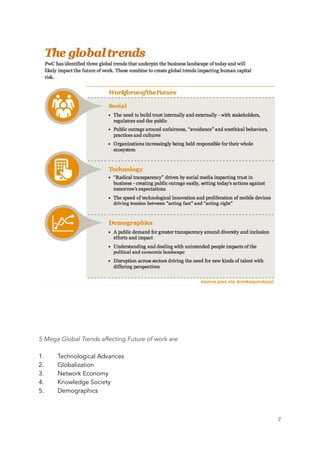
5 Mega Global Trends affecting Future of work are
1. Technological Advances
2. Globalization
3. Network Economy
4. Knowledge Society
5. Demographics
	 	 2
Technology - Advances in technology disrupt business models . The IT Revolution we
have witnessed includes ( PC, Mobile , Social, Online ) which have democratised data,
empowered consumers, and gave birth to new industries and companies. Facebook,
Google, Uber, Airbnb are new age companies which didn’t exist few years ago however
now influence the way we search, look for information, travel, communication, network
and connect.
Globalization - Thanks to trade liberalization and emerging market growth,
globalization has accelerated in recent decades. These trends disrupt existing business
models by creating new competitors, reordering supply chains and lowering price
points. The next waves – including the emergence of Africa and a more multipolar
world – will increase complexity and require flexible business models to respond to
global shifts. ( PwC )
Demographics – In the decades ahead, relatively high birth rates will make Africa and
India engines of economic opportunity. Aging populations will transform everything
from health care to real estate, while millennial-dominated workforces will reinvent the
workplace.
Meanwhile, urbanization will increase cities' economic and public policy clout, even as it
strains their ability to grow in sustainable ways. Migration and immigration will also have
profound impacts on workforces and economic development. All these demographic
shifts will require new strategies and business models. ( PwC)
	 	 3
Network Economy - Network economy is the next economic revolution. It offers un-
precedented opportunities and improves lives of billions worldwide.
A sort of revolution is already underway.
Over the last few years , we have grown from Industrial Economy to IT and Internet
Economy. Network economy is catalysed by hyper-connectivity and paving way for in-
novation.
“Over the next 10 to 15 years, it has the potential to double the size of the gross world
product,” SAP estimates that the Networked Economy will represent an economic value
of at least $90 trillion.
What exactly is the Networked Economy? It’s an emerging type of economic environ-
ment arising from the digitization of fast-growing, multilayered, highly interactive, real-
time connections among people, devices, and businesses.
What’s driving the Networked Economy? Over the past decade, the world has seen sig-
nificant changes in how people and businesses connect to each other. Social networks
let billions of people collaborate in a variety of ways. Meanwhile, business networks
have enabled new types of frictionless commerce. Now these two trends are converg-
ing, catalyzed by the exponential increase in the network of devices connected via the
Internet of Things (IoT). In fact, Gartner projects that the number of connected devices
in the IoT will increase nearly 30-fold in just over a decade, growing from about 900 mil-
lion connected devices in 2009 to more than 26 billion by 2020.
“The numbers of people-to-people connections — business networks, social networks
— they’ve all been growing over the past 10 years,” says Dinesh Sharma, SAP’s vice
president of marketing for the Internet of Things. “Now businesses, processes, data,
	 	 4
and things — everything — can be connected in a network. That is transforming every-
thing.”
What must businesses do to thrive in the Networked Economy? First, they must under-
stand that their customers, employees, and business partners expect them to be mo-
bile, social, always on, and continually connected. (Those who aren’t yet thinking about
that requirement should keep in mind that their competitors are already addressing it.)
But while social, mobile and cloud computing helped set the groundwork for the Net-
worked Economy, it’s important for businesses to understand that this revolutionary
economic environment goes far beyond those technologies, creating unprecedented
new opportunities for collaboration and
customization.
Equally important: Businesses must embrace and fully engage in both internal and ex-
ternal business networks. “We believe that revolutionary, disruptive business models
are now possible with these real-time digital connections across people, businesses,
and devices,” Bapat says. Pioneering companies that have leveraged such networks to
create new business models include Airbnb, the pioneering lodging-rental service; and
Uber, a mobile app that connects people seeking taxicabs or ridesharing services.
Businesses should also recognize, and take advantage of, one of the biggest and most
immediate changes of the Networked Economy: the convergence of business and con-
sumer networks. “They used to be entirely separate, “Now we’re seeing a dissolving of
those types of boundaries.”
For example: A business looking to purchase, say, a particular machine part can now
turn to the ultimate consumer marketplace — eBay. “A company traditionally had its
own limited B2B network of suppliers,” “Now technology can easily extend a search
via a consumer network like eBay. That dramatically increases the number of choices
available and creates new opportunities for savings.” (2)
2. https://www.technologyreview.com/s/530241/revolution-in-progress-the-networked-
economy/
	 	 5
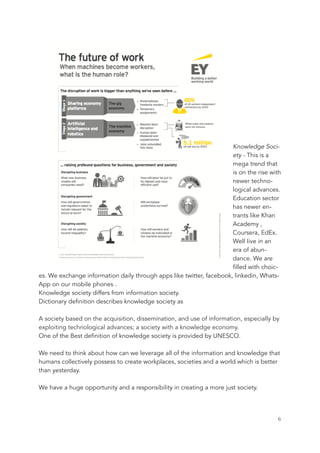
Knowledge Soci-
ety - This is a
mega trend that
is on the rise with
newer techno-
logical advances.
Education sector
has newer en-
trants like Khan
Academy ,
Coursera, EdEx.
Well Iive in an
era of abun-
dance. We are
filled with choic-
es. We exchange information daily through apps like twitter, facebook, linkedin, Whats-
App on our mobile phones .
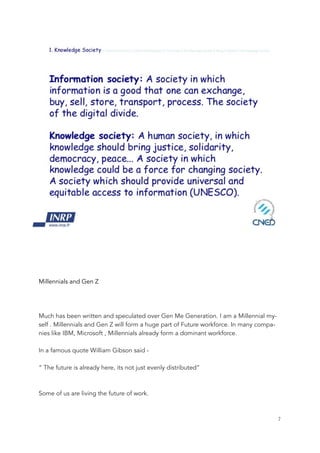
Knowledge society differs from information society.
Dictionary definition describes knowledge society as
A society based on the acquisition, dissemination, and use of information, especially by
exploiting technological advances; a society with a knowledge economy.
One of the Best definition of knowledge society is provided by UNESCO.
We need to think about how can we leverage all of the information and knowledge that
humans collectively possess to create workplaces, societies and a world which is better
than yesterday.
We have a huge opportunity and a responsibility in creating a more just society.
	 	 6
Millennials and Gen Z
Much has been written and speculated over Gen Me Generation. I am a Millennial my-
self . Millennials and Gen Z will form a huge part of Future workforce. In many compa-
nies like IBM, Microsoft , Millennials already form a dominant workforce.
In a famous quote William Gibson said -
“ The future is already here, its not just evenly distributed”
Some of us are living the future of work.
	 	 7
Millennial is an identity given to a broadly and vaguely defined group of people. There
are two wings of "Millennial" that are often at odds with each other: Generation Y
(people born between 1981-1991) and Generation Z (born between 1991-2001) . Peo-
ple of Generation Y often have characteristics similar to Generation X, which is why
Generation Z will confuse Generation Y with Generation X and then claim to be the
generation that represents "MIllennial," when in fact, birth years for Millennial range
from about 1981-2001, just as the birth-years for Baby Boomers ranged from
1946-1964.
Both Generation Y and Generation Z can be called "Millennials," with the primary dif-
ference between the two being technology. Generation Y grew-up on personal com-
puters, cell phones, and video game systems, while Generation Z has grown up on
tablets, smartphones, and apps. Yet the common ground between both generations is
that both have been transforming and altering communication and identity—not just in
the United States but globally. (2)
2 - By Rosebud2939 January 08, 2017 ( Urban Dictionary)
Millennials want Access, not ownership
Millennials have been reluctant to buy items such as cars, music and luxury goods. In-
stead, they’re turning to a new set of services that provide access to products without
the burdens of ownership, giving rise to what's being called a "sharing economy."
“25 YEARS FROM NOW, CAR SHARING WILL BE THE NORM, AND CAR OWNERSHIP
AN ANOMALY.”
- Jeremy Rifkin, Author and Economist
Source: Goldman Sachs Global Investment Research ( 3)
3 . http://www.goldmansachs.com/our-thinking/pages/millennials/
Brands and retail
Millennials’ affinity for technology is reshaping the retail space. With product informa-
tion, reviews and price comparisons at their fingertips, Millennials are turning to brands
that can offer maximum convenience at the lowest cost.
% OF MILLENNIALS
WHO COMPARE
PRICES IN STORE 57 %
Source: AIMIA Inc. “Born this Way: US Millennial Loyalty Survey” ©2012
	 	 8
Wellness
For Millennials, wellness is a daily, active pursuit. They’re exercising more, eating
smarter and smoking less than previous generations. They’re using apps to track train-
ing data, and online information to find the healthiest foods. And this is one space
where they’re willing to spend money on compelling brands.
Millennials have come of age during a time of technological change, globalization and
economic disruption. That’s given them a different set of behaviors and experiences
than their parents.
Millennials are the first Digital natives , their affinity for technology shapes how they
shop, lead their lives and behave at workplace. They are used to instant access to in-
formation for price comparisons, product reviews, and peer reviews.
Some of these behaviours they carry to workplace. Therefore we see rise of Apps and
Technologies at workplace. There are apps for Employee Wellness, Employee Engage-
ment, Learning, Receiving and Giving Feedback , Recognition .
Given that India will become the youngest country by 2021, with 64% of its population
in the working age group of 20-35, according to the 2013-14 Economic Survey, compa-
nies need to shape their strategies to remain relevant to this section, called millennial or
Generation Y.
Companies like Infosys, IBM India, InMobi and Microsoft India, where millennial talent is
a significant part of the workforce, are implementing initiatives to attract, retain and en-
gage this group.
Many companies are setting up reverse mentoring programs to leverage the skills and
talents offered by millenials. Since they are digital natives, they possess digital skills and
reverse mentor senior leaders in the organization to build their Digital Presence.
I am fairly comfortable with technology and use gadgets and apps frequently . however
when it comes to snapchat - it failed me. So I decided to give it a try and learnt
snapchat from my 10 year old niece Kashika .
My Dad who is in his 70s, use Mobile Phone with reluctance and find it cumbersome.
Each new generation has a way of giving complex to the previous one !
	 	 9
Millennials are often critiqued for being a Me generation. However , I feel they are the
most misunderstood generation. They are able to articulate their needs better at both
workplace and in personal life , they know what they want and go after it. They take
care of their needs and in the process serve everyone around well. You cant help other
people much if your own needs are unfulfilled.
Millennials bring diverse viewpoints to the workplace and catalyse innovation.
At IBM, we used Verse , which was developed by a Millennial.
Verse is a collaboration platform that combines email, social network, chat, instant mes-
senger ( sometime) , analytics to have a more productive workday.
IBM Verse is truly a futuristic application which changes how we collaborate at work-
place. No wonder it was developed by a Millennial.
Are you providing the Millennials the resources and tools to develop innovative product
and services ? Investing in this critical talent pool is pertinent since they understand the
consumer's mindset, behaviours and patterns ( consumers who are millennial them-
selves)
Millennials are Digital Natives who have grown up with Social Networking tools.
In organizations of the future, there will be less focus on hierarchies and much focus on
collaboration and networks. Good ideas can come from anywhere even from entry level
employees.
Many organisations have this culture of value HIPPO ( Highly paid persons opinion).
They suffer from loss of good ideas.
Susan Cain in her book “Quiet” emphasises the point that Introverts make good lead-
ers , they may be a quieter lot , conditions must be provided to listen to their insights .
What do Millennials want?
Findings of a November 2015 survey of 1,731 millennials by Avtar Career Creators and
Flexi Careers India, in Chennai, Mumbai, Delhi, Pune, Hyderabad and Kolkata
50% millennials look for jobs on employment portals and 43% on company’s career
Web page
60% millennials want to work for firms that are well recognized and over 40% look for
opportunities for virtual learning
Over 50% millennials prefer to be assessed by aptitude tests and personal interviews,
rather than internship performance
59% millennials seek scope for rapid growth in a company, while 41% look for compen-
sation
80% aspire to lead or reach a management position in the firm
	 	 10
76% women expect to rise to senior levels in the organization.
Looking to the future, Generation Z (4)
When his series was started in 2011, millennials were the “new generation” in the
workplace and we wondered what their impact might be. By now, either through our
day-to-day experience of working side-by-side with millennials, or through research
such as this, we have a pretty good idea. It is the next wave of employees—Generation
Z (GenZ), or as some have called them, “centennials”—that is starting to attract atten-
tion.
Link 4. https://www2.deloitte.com/global/en/pages/about-deloitte/articles/millennial-
survey-generation-z-welcomed.html#generation-z
When asked what guidance Millennials would give the next generation—based on their
own early career experiences—the main areas of advice were:Learn as much as possi-
ble: Begin your career open-minded and be ready to learn from others.Work hard: Do
your best and do not be lazy. Be patient: Take your time when entering the workforce
and go step-by-step. Be dedicated: Be committed to succeeding and persevering. Be
flexible: Be open and adaptable to change and try new things. 
Unilever Is another organisation along with IBM and Microsoft that is Winning With Mil-
lennials And Gen Z.
We had to ensure we had a digital hiring process, but one that that felt very human, not
robotic, and it had to be better and more efficient at selecting candidates than an in-
person interview.” - Unilever’s Director of HR Services on attracting the millennial talent.
Unilever’s new Digital hiring process: a system that saves $1 million/year, decreases hir-
ing time by 83%, and appeals to a new generation of employees.
Unilever has nailed Millennial hiring by digitising their processes.
By 2020, research suggests that 50 per cent of the workforce will have millennials as
employees
	 	 11
The world’s largest technology and information technology services firm IBM wants to
be clued into how the millennials think and work. For this, the company has created a
global team of 4,000 employees called IBM Millennial Corps.
Millennial is a generic term to describe those born between 1980 and 2000.
IBM’s global team (of all ages) is focused on improving the millennials' experience at
the company. This community of millennials are constantly interacting within themselves
and actively contributing to IBM projects. One of the recent key projects led by this
group is Checkpoint - a quarterly feedback system. Part of that initiative was the cre-
ation of a mobile-based appraisal application called Ace.
IBM also wants to give a push to the entrepreneurial spirit of millennials. For this, they
encourage employees to use Watson APls and its Bluemix Platform. “If they come up
with an idea, they co-create, co-learn and get funding. This builds and feeds into the
entrepreneurial desire of this generation (5)
Link 5 http://www.business-standard.com/article/companies/ibm-s-new-team-to-focus-
on-millennials-116053000677_1.html
“Millennial Corps.” It’s a digital group of thousands of IBM employees who converse on
their own internal platform, as well as attend local events.
Millennial Corps has ballooned in size to more than 5,000 people. It consists of a self-
selecting group of IBM employees who consider themselves part of the younger gener-
ation.
This sort of digital collective may soon be a corporate trend. (6)
Link 6 https://www.fastcompany.com/3059849/these-millennials-have-become-the-top-
decision-makers-at-ibm
	 	 12
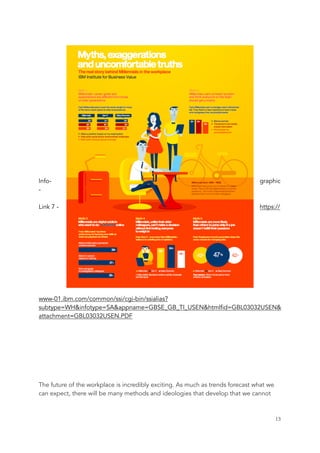
Info- graphic
-
Link 7 - https://
www-01.ibm.com/common/ssi/cgi-bin/ssialias?
subtype=WH&infotype=SA&appname=GBSE_GB_TI_USEN&htmlfid=GBL03032USEN&
attachment=GBL03032USEN.PDF
The future of the workplace is incredibly exciting. As much as trends forecast what we
can expect, there will be many methods and ideologies that develop that we cannot
	 	 13
predict today.  What is clear is that companies should pay attention to what’s needed
for a successful workplace of the future. (8)
Link 8
https://www.slideshare.net/ibmsocialbiz/ibm-fow-infographicsmaster030915?
ref=https://www.ibm.com/blogs/collaboration-solutions/2015/03/11/millennials-shak-
ing-up-the-future-of-the-workplace-2/
Exercise - Share your views on #Newwaytowork and update your posts on Social Media
using this hashtag. Be part of the global conversation Around FutureofWork.
T H E F U T U R E O F W O R K C U LT U R E #NewWayToWork Companies with happy
employees outperform the competition by 20% *Entrepreneur.com. It Really Pays to
Have a Rich Company Culture [Infographic], 2014 68% of employees feel their company
isn’t doing enough to create a work culture in which employees have a sense of pur-
pose and a meaningful impact *TalentCulture.com. How To Improve Work Culture (And
Avoid Staff Burnouts), 2014 65% of both Millennial and Gen X employees give their or-
ganization a high grade for using social media to engage customers *IBM Multigenera-
tional Study, 2015
1 T H E F U T U R E O F W O R K C U LT U R E #NewWayToWork 70% of
millennials say a company’s commitment to the community would influence their deci-
sion to work there *Nielsen Report: Millennials Breaking Myths, 2014 20% of executives
surveyed believe their organization is currently acting truly social *Charting the social
universe: Social ambitions drive business impact, 2014 43% of companies rely on em-
ployee evangelists to kick-start social adoption *Charting the social universe: Social
ambitions drive business impact, 2014
2 T H E F U T U R E O F W O R K T ECH NOLOGY #NewWayToWork 74%
of respondents define a “social” business as one that uses social technology to foster
collaboration among customers, employees and partners *#IBMSocialStudy, 2014 As of
today, at least 72% of businesses have adopted the cloud. Within 3 years, that number
will reach a staggering 91% of businesses *20 Cloud Computing Stats You Want to
Know, 2014 Drive Internal and External Collaboration: 64% Deployed capabilities via
mobile *#IBMSocialStudy, 2014
3 T H E F U T U R E O F W O R K T ECH NOLOGY #NewWayToWork Inte-
grating social technologies results in: 5x more likely to deliver social business via mo-
bile, 6x more likely to use social media analytics and 7x more likely to use social busi-
ness in the cloud *Sandy Carter, Social Insights Blog, 2014 2 out of 3 companies will
	 	 14
adopt a BYOD solution by 2017 *Seven Stats About The Future of BYOD, AKUITY, 2014
Over 60% of enterprises allow or tolerate employee use of personal devices to access
enterprise data *State of BYOD and Mobile Security Report, 2014
4 T H E F U T U R E O F W O R K T ECH NOLOGY #NewWayToWork By
2030, Millennials will make up to 75% of the workforce *Meghan M. Biro – Embracing
Change to the Re-Imagined Workforce, 2014 10 billion: This is the number of personal
mobile devices that are estimated to be in use by 2020 *Seven Stats About The Future
of BYOD, AKUITY, 2014 91% of us wake up and reach for our devices because we are
addicted to technology *Daniel Newman, In The Future Technology Will Be Invisible,
2015
5 T H E F U T U R E O F W O R K COLLABORATION/ C O M M U NI C
ATION #NewWayToWork Organizations offering workplace flexibility increased en-
gagement and motivation by more than 80% *Meghan M. Biro – Embracing Change to
the Re-Imagined Workforce, 2014 94% of surveyed workers have felt overwhelmed by
information to the point of incapacity *The Knowledge Worker’s Day: Our Findings, Ba-
sex, 2012 The average interaction worker spends an estimated 28% of the work week
managing email *McKinsey Global Institute - The social economy: Unlocking value and
productivity through social technologies, July 2012, and Susan Felman, Hidden cost of
information work: A progress report, International Data Corporation, May 2009
6 T H E F U T U R E O F W O R K COLLABORATION/ C O M M U NI C
ATION #NewWayToWork 79% of adults agree that a successful career today requires
collaborating and sharing credit with others *The Athena Doctrine, 2013 81% of people
said you need both masculine and feminine traits to thrive in today’s world *The Athena
Doctrine, 2013 In testing cooperative behavior, 50% of participants behaved coopera-
tively *The Unselfish Gene, 2011
7 T H E F U T U R E O F W O R K COLLABORATION/ C O M M U NI C
ATION #NewWayToWork Only 20% believe their organization is currently acting truly
“social” *#IBMSocialStudy, 2014 45% of companies are using social to identify internal
talent or key contributors *Meghan Biro - Embracing Change to the Re-imagined Work-
force, 2014 74% of respondents define a “social” business as one that uses social tech-
nology to foster collaboration among customers, employees and partners *#IBMSocial-
Study, 2014
8 T H E F U T U R E O F W O R K TA L E N T #NewWayToWork Mining
community expertise is a grassroots effort — 43% rely on employee evangelists to help
kickstart adoption *IBM Social Study, 2014 70% of U.S. workers are not engaged or ac-
tively disengaged at work *Gallup’s State of the American Workplace report, 2013 Tal-
ent development and employee engagement account for over 80% of top workforce
challenges for CHROs today *IBM CHRO Insight Study, 2013
9 T H E F U T U R E O F W O R K TA L E N T #NewWayToWork The CAI
study found that 82% of social organizations used social networks to recruit, versus
the16% average in a Jan. 2014 IBM Smarter Workforce Institute study *IBM Social
Study, 2014 Today, 47% of workers were born after 1980 *Will Stanley SHRM SlideShare
Millennials will be the majority workforce by2020 and 75% of the workforce by 2025
	 	 15
*Jacob Morgan, We Are All Cogs Working for Slave- Drovers as We Go about Out Daily
Drudgery
THE WORK CULTURE
The millennials are also driving the work culture  in big companies. They are used to
flexibility, openness and making instant connections with people regardless of their lo-
cation, according to Wired.
“For millennials, the first thing they want is the ability to learn and grow, as we all
should have,” Dan Negroni, who has worked as CEO and an attorney, told Forbes.
“The second thing they want is authenticity because they’ve been bombarded through
technology with a crazy amount of inauthentic things to just get them to buy things or
get their mind share.”
The needs and likes of the generation have brought about many changes across differ-
ent walks of life. Companies like Infosys, Coca-Cola and Visa Inc. have relaxed their
formal dress code. Many firms are looking at direct employee engagement to find ideas
to build into company strategy. An example that highlights this approach is Murmura-
tion, a crowd-sourcing initiative launched across Infosys offices in August 2014. They
launched this initiative because millennials expect a technology-enabled workplace that
promotes a collaborative, transparent and participative organisation culture and innova-
tion, and rewards individual contribution. ( 9)
Link 9 https://littleindia.com/indias-workforce-worlds-largest-2027/
It is interesting to think about what the future of the workplace will be like 20 years from
now. We live in such a fast paced, high tech, collaborative environment now, can you
imagine how advanced we will be even five years from today?
Future of work is a shifting goalpost.
Probably I will have to write a second edition of Future of Work , 5 years from now :-)
Millennials represent the first wave of digital natives to enter the workforce, and this
does distinguish them. Organizations that have embarked on their own transformation
urgently need this digital capital. They should eagerly look for ways to embrace Millen-
nials and create the work environments where top talent can flourish — across all gen-
erations. This will require nuanced strategies that reflect the reality of a multigenera-
tional workforce: employees of all ages are complex individuals working in an environ-
ment that’s becoming more virtual, more diverse and more volatile by the day. ( 10)
	 	 16
Link 10 - https://public.dhe.ibm.com/common/ssi/ecm/gb/en/gbe03637usen/global-
business-services-global-business-services-gb-executive-brief-
gbe03637usen-20180312.pdf
By 2020, research suggests that 50 per cent of the workforce will have millennials as
employees
So understanding the millennial mindset is becoming increasingly important for Man-
agement.
At IBM, we had a HR Project specifically focussed on understanding millennials, what
engages them and how to retain Millennial talent.
Millennials adopt different communication styles , are open to collaboration and net-
working, defy hierarchies , interested to join organisations which have a purpose and
believe in giving back to community . Millennials love to voice their ideas and views ,
advocate for themselves rather than silently complying with directives or taking orders.
Organizations can leverage these Millennials employees to be Brand Ambassadors of
organization.
Zappos is one company which encourages employees to speak at industry events about
the employment experience they are proud of . This is a neat way of turning employ-
ees into Brand Advocates.
According to a research , employees are connected to 10X more people than your
company’s brand.
Another research says that companies with engaged employees outperform others by
202%.
Brand messages reached 561% further when shared by employees versus the same
messages shares via official social brand channels.
Brand messages are reshared 24X more frequently when distributed by employees ver-
sus the brand.
77% of buyers are more likely to buy from a company whose CEO uses Social Media.
82% of buyers trust a company more then the CEO and senior leadership are active on
Social Media.
	 	 17
98% of all HR managers say Social Networking is an important tool for recruiting, retain-
ing and engaging employees. (11)
Link 11 -
Source- Forrester, Gallup
https://www.scribd.com/doc/249863818/Infographic-Social-Employee-Advocacy
I will discuss more about Social Media and an Employee Advocacy program we setup at
IBM and the exceptional business results we gained in subsequent chapters.
Millennials have a distinctive, informal work style
Millennials personify informality. They like to dress casually and prefer informal work en-
vironments where they can readily interact with coworkers and supervisors. Accustomed
to the frequent and informal communications predicated by the world of mobile com-
munications, millennials expect similar approaches in their work settings.
Forward-thinking companies will benefit from establishing flexible hours, working condi-
tions and career paths. (12)
Link 12 -
https://www.huffingtonpost.in/michelle-m-smith_1/how-to-get-the-best-out-
o_b_10607274.html
Infosys and IBM have done away with dress codes, employees can wear jeans and ca-
suals on all working days , except when they are meeting with clients .
Infosys sent an email to all employees regarding this development ‘From Monday, June
1, 2015, you can flaunt your smart business casuals all week long! This was a change
that many of you had voiced and requested on various platforms, so we are really excit-
ed that it is official now!’ the mail said. ( 13)
	 	 18
Link 13 -
//economictimes.indiatimes.com/articleshow/47501003.cms?utm_source=contentofin-
terest&utm_medium=text&utm_campaign=cppst
Millennials need personalized, timely, relevant recognition
While millennials seek frequent, specific feedback, they don't accept direct criticism
well. Managers should offer suggestions as part of regular feedback rather than waiting
for scheduled performance reviews. With their need for frequent, positive feedback,
millennials appreciate the use of recognition and reward programs as ways to spotlight
their accomplishments. Companies have also found success by including peer recogni-
tion and specific celebrations as motivators. (14)
Link 14
https://www.huffingtonpost.in/michelle-m-smith_1/how-to-get-the-best-out-
o_b_10607274.html
All of these data points indicate that Millennials and Gen Z will form a critical part of
company’s future workforce and will shape how business is done , how talent is hired,
how decisions are made, how products and services gets delivered and how these
products are bought in the marketplace.
By 2025, Millenials will compromise 75% of the workforce acc to World Economic Fo-
rum. Millenials are joining the workplaces in large numbers . Today , if you talk to any of
the HR Leader, the top most question on their mind is How to Recruit, Manage and En-
gage the Millenials.
 
Millenials are the people born after 1980. While earlier generations ie Baby Boomers,
Gen X followed the top down corporate structure, Millenials like to operate in Networks
.
 
Their mindset is all about networking . They have grown up with new technologies . So-
cial Media is their way of Life. Therefore , Gen Y or Millenials expect different employ-
ment experience . They are more comfortable with flat structures vis a vis hierarchies.
Command and control style of management doesn’t work with millennials therefore
Managers will have to learn to give up control. This is a new management shift that
	 	 19
managers will have to deal with caused by rising number of Millenials in the working
population. Millenials grew up in an environment where they have a say in everything
from electing Leaders to choosing vacation destination for Family.
 
They want their voices to be heard and have the need to have their inputs in collective
decision making. They are not comfortable with decisions being taken at the top and
thrown at them which affects their lives directly. The need to lend their share of voice is
greater.
At IBM, the policy to use Uber for transportation was shaped because a Millenial wrote
a blog that UBER is cost effective . Leaders took note of his blogpost and within 24
hours , policy decision was accordingly modified and adjusted. You cant ignore millen-
nials .
 
The employer culture, salary, every aspect of working environment is openly discussed
at Glassdoor by Millenials. If they don’t like something, they highlight it . Leaders are
paying attention to glassdoor in terms of what is being said about their Brand, culture,
management, leadership.   
 
Millennials thrive on fresh goals and challenges to keep them motivated
They embrace technology just like fish to water. Their working lives doesn’t have 9 to 6
schedule but are connected 24 by 7 . In this hyperconnected world, they demand flexi-
bility – the ability to do work anytime, anywhere. Hence more companies are offering
Telecommuting or flexi work or work from home to their employees especially as seen
in startups . When you let people control how and where they do their jobs, magic
happens. Some new age startups have lean and flat organization structures and achieve
operational efficiency and high productivity . Guess the number of employees at What-
sapp - just 55 employees , Facebook acquired Whatsapp for for $19 billion with 900
million user base. What a SuccessStory ! Can any Corporate mimic what Whatsapp 55
Employees achieved ? There is no shortage of Talent in Corporates , then why do star-
tups excel wrt innovation whereas traditional companies with rich legacy lag behind .
 
Millenials have also started occupying Leadership positions at workplaces. So we see, a
new breed of startups , and fresh thinking coming up at big corporates. They bring new
perspectives of how work gets done . They have underlying desire to shape workplace
policies, to make a contribution, to play a role which contributes to society. Their com-
munication style is open and transparent. They are open to be mentored , place em-
phasis on networking to succeed at work and at life. They demand flexibility and use
mobile phone and apps for routine and specific tasks. In fact , they are the ones who
are building these new apps for making lives easier.
 
Millennials are different and shaping up the Future of work and workplaces. It wont be
prudent of any Leader to ignore this pool of Talent, to move the
	 	 20
organization forward. Invest in Millennials, develop their Leadership skills and learn to
include them in decision making to ensure they remain engaged , productive and effec-
tive at workplaces.
 
When we tell people to do their jobs, we get workers. When we trust people to get the
job done, we get leaders - Simon Sinek
 
We live in world where technology is omni present. In this era of hi-tech world, Hi-
Touch becomes most important. Those organisations, departments, teams, individuals
stand out who provide Hi Touch experience to their employees. 
HR is undergoing through transformation .Almost every industry and every sector is dis-
rupted by Digital Technologies. Cognitive Computing, Cloud, Artificial Intelligence, Big
Data , Analytics are not just buzz words but real technologies which are shaping busi-
nesses. Almost every company has a department which is charged with the responsibili-
ty of Digital Transformation. That means newer technologies are making way into the
organisations across departments . HR is not left behind either . There are apps for well
being, reward and recognition, performance management, feedback, learning, social
referrals, recruitment . Almost every function of HR leverages technologies to provide
Hi Touch experience to employees. Employee engagement is still an issue which costs
companies across the globe several billion dollars. 
 Companies are mindful that this shift is not just about technological advancements but
as much about organisational cultural change which means providing better employee
experience. 
In a digital world with increasing transparency and the growing influence of Millennials,
employees expect a productive, engaging, enjoyable work experience 
The focus from organization perspective is on better experience to Customers, better
employment experience , to Clients, and Candidates who want to join the
organization . In the times we live in, millennials have become majority of the workforce.
They grew up with technology. Mobile and Social impact the experiences . Millennials
receive news about the world through apps. We live in the age of 24 by 7
connectivity. Work happens round the clock. In globally integrated enterprises, you of-
ten work with teams who are spread across geographies. There is pervasive use of
Videoconferencing, Virtual collaboration tools across the organisation. 
So, in the age of Hi Tech world, it is time again to bring back humanity into workplace . 
	 	 21
Human capital management technology works best when it enables people to act more
human. The goal is not to replace people, but to allow people to spend more time on
activities that drive engagement. They want to make a difference through their work,
develop their capabilities, and connect with other people. 
Designing a hi tech yet hi touch employee experience is the challenge in front of Man-
agement Professionals 
Have you heard of Amber ? She is the new #HR chatbot and 30,000 employees across
37 companies have opened up to her . 
Those organisations and Leaders will succeed which will crack the code of Hi Touch
employee experience and make employees feel valued at workplace. 
Before we look far into the future, a look at recent workplace trends that is triggered by
tech
The working environment is ever-changing. In 2018, the next revolution in the HR indus-
try will definitely be "Digital First." Leaders must create appropriate conditions for em-
ployees to optimize their productivity in the workplace. Many HR leaders are leveraging
technology that will enable them to find, hire, and engage people, for talent develop-
ment. It's inevitable that the focus in 2018 will be on technology as a way of life in the
workplace. In fact, it can be said that all significant trends in 2018 will involve technolo-
gy.
 
Employer Branding: Headhunting passive candidates, has always been a significant part
of the recruitment process, and the forthcoming of social media has made the process
of getting in touch with candidates easier than ever before. New and promising talent
pools can be wooed and attracted through unique branding campaigns on social me-
dia. Engagement with candidates can be done through the judicious use of LinkedIn
groups, company Facebook pages, etc. By analyzing their digital footprints, recruiters
can get a sense of their candidates, connect with them and explore if they are willing to
change their existing careers. Companies will also adopt employer branding strategies
to woo talent from the marketplace to attain a competitive advantage.
 
A Remote Workforce: Working from home or anywhere else where one has access to
Wi-Fi is on the rise. Millennials are also looking for flexibility when it comes to their job
description as well. Many startups are built with remote teams, such as WhatsApp and
WordPress. From a corporate perspective, it opens a promising pool of candidates, and
by offering remote work capabilities, it also transforms into a viable way to retain cur-
rent employees and boost job satisfaction by encouraging a better work-life equilibri-
	 	 22
um. With video conferencing and other connectivity tools evolving every year, this trend
will only continue to rise at an exponential rate. More on this in later chapters .
 
Gamification: This technique has been working its way into multiple industries, and for a
good reason. After all, the idea of turning engagement into a competitive game format
can prove to be quite efficient, whether it is used to augment the marketing, teaching
or even the hiring process itself. In the realm of business, the method of gamification
can be used as a form of a candidate screening by turning tests of critical skill sets and
cognitive abilities into an entertaining way of engagement. With the advent of smart-
phone apps, it’s also possible to have a specific user base play innocent recruitment
games, while sneaky algorithms help an organisation track critical analytics. The result
benefits both candidates and employers; candidates have a fun reason to try to in-
crease their scores and show off to potential employers while hiring managers to end
up gathering a ton of data that can help predict the strengths and weaknesses of can-
didates. — with the added possibility of finding that rare diamond in the rough.
 
Candidate Experience: Candidate experience is undoubtedly related to employer
branding. While the primary focus of 2017 has mainly been on employer branding as a
significant trend, candidate experience is just as necessary. It will be detrimental to the
overall efficiency if one builds a strong employment brand on the back of a weak can-
didate experience since it will never perform at the highest efficiency possible.
 
Having an awful candidate experience can demolish the great employer brand name
that you have strenuously built, and these negative experiences and candidates more
than likely will not recommend their friends or family to apply either.
 
What job seekers want in their candidate experience:
• More communication
• Notification if passed over
• Timeline of hiring process
• Human contact after application
• Timeliness of replies
 
Experience and Engagement: Free food, work from home programmes and other such
perks that are usually offered in the workplace are a great example of employee en-
gagement. Even though these perks might prove to be a neat touch, the sad truth is
that they don’t usually achieve excellent results for both employees and companies.
However, it's increasingly essential to improve the employee experience. To do this effi-
ciently, companies must redesign their workplace operations and develop a space that
fits their people.
 
There are three things influence the employee experience:
1 Culture
	 	 23
2 Technology
3 Physical workspace
 
Wellbeing: As per certain research studies, nearly 40% of employees assert that their
job environment and conditions can be attributed to creating negative stress in their
life. Employees want their employers to respect their physical, emotional, social, and
financial needs. They have a strong desire to better connect with themselves, the peo-
ple around them, and the world.
 
Provide adequate opportunities for employees to connect with your organization, so
that they're comfortable in saying, “I need a day off,” and feel validated in their de-
mands for an environment that promotes employee health and happiness.
 
Purpose and Organisational Culture: Only 54% of employees admit that their organiza-
tion’s purpose motivates them. Make sure that you have articulated your organization’s
reason for being and the vision for the future because research indicates that employ-
ees are no longer satisfied by merely going into work each day and leaving with a pay-
cheque. One needs to help them understand how the organization is positively chang-
ing the world, to begin with. Encourage management to meet with team members, and
explain how individual roles are effectively making a difference.
 
If you don’t already have one, craft a meaningful mission statement. Meet with your
employees to ensure they understand what it means.
 
One could also do well in helping team members align their personal goals with organi-
zational ones. In this way, they better “see” how their roles fit within the greater scope
of the company.
 
CONTINUOUS FEEDBACK LOOP = MORE PERSONAL GROWTH: Continuous feed-
back across hierarchies is a thing of utmost importance for the leading
organizations in the world. As a practice, many employees that receive input at more
regular intervals assert to be highly engaged in their workspace.
However, many employees report being uninterested in performance reviews. Ongoing
corrective feedback is far more desirable and constructive than any other form of feed-
back. You can give employees an old fashion pat on the back, but how will they know
what specifically went right, and what can be improved for next time? Professionals
want career advancement, and without any apparent direction, they won’t know where
to begin advancing.
 
BRINGING LEARNING ONLINE AND ACROSS THE ORGANIZATION: Continuous
learning will be a hot trend in 2018. HR leaders are recognising the need to improve
employee learning and development opportunities, especially when one considers that
careers are now likely to span more than 60 years. Another attractive option must be
	 	 24
digital training through Learning Management Software (LMS), which has become an
increasingly attractive option since it provides HR teams with the ability to measure
employee productivity through data analysis. It also makes for a more cohesive experi-
ence, as many internal functions across the organisation supply learning content.
 
In fact, companies like KFC and Walmart are adopting VR to train employees. Informal
learning through Social Media and Massive Online Open Courses (MOOCs) is also on
the rise. Flipkart hires candidates who have completed MOOCs, as this signifies that
employee takes ownership of their learning and careers.
 
Chatbots in HR: 2017 has undoubtedly been the year of AI technology. In fact, it is es-
timated that the overall market for AI is expected to cross $45 billion by 2020. The
technology is also being incorporated heavily into chatbots, and marketers are using
chatbots to deliver personalised experiences online. Human Resources should ideally
adapt to this trend of chatbots, as the future belongs to the automation of multiple
tasks to make the process of hiring easier. It's inevitable that chatbots are going to be-
come the AI-powered virtual personal assistant for HR professionals. Since this trend is
relatively new, several companies are smartly incorporating only one chatbot into the
HR department, to see how this improvement can be brought about seamlessly.
 
People Analytics: Analytics has been growing by leaps and bounds since the time
Google made it mainstream. Analytics is now also being utilized to understand how
business operations work and help in the daily decision-making process of an industry.
People analytics has now become a rather serious business, and the field of HR is no
exception. In fact, new-age HR experts are using a social network, interaction and data
analysis to properly understand what is going on within their organization. HR teams are
also applying the insights gained from these quality mediums to carry out efficient tal-
ent acquisition, workforce planning, task operations, and other such tasks. Analytics ser-
vices are being incorporated to identify the right candidates as per the required skillset.
 
And with everything, with continuous scientific and technological advancements hap-
pening at a rapid pace, there may be many other evolutions still to show up. So keep
looking!
Employer Branding as a strategic tool for hiring talent
Employer Branding has gained prominence in last few years. Companies are realising
that it is not enough to continue with old recruitment and hiring practices , if they were
to hire best talent from the market . 
Each hire in a critical role is an investment for the organization. Companies want to
make sure that there are fewer hiring mistakes and they hire the right candidates which
fit the culture of the organization and is a super star employee. The buzzword for 2018
is Candidate Experience. Candidate experience is as important as Employee Experi-
	 	 25
ence. Many a times , passive candidates don’t apply to opportunities because of the
time consuming application process. Linkedin offers an easy apply button and compa-
nies Recruitment systems i.e. ATS ( Applicant Tracking Systems ) are integrated with
LinkedIn. What it means for candidates is the ease of applying to companies with the
click of a mouse, they can submit their cv in companies database. Linkedin easy apply is
just one example of providing a seamless experience to potential candidates during
hiring. 
Employer branding is the process of promoting a company, or an organization, as the
employer of choice to a desired target group, one which a company needs and wants
to recruit and retain . 
Recruiters need to think and act like marketers to attract the best candidates. 
With the rise of different digital platforms , it is becoming increasingly difficult to
choose how to advertise or market your jobs to potential candidates . Gone are the
days , when candidates would apply to jobs without researching the company. Candi-
dates research their potential employer on Glassdoor , read reviews, see ratings as
much as companies try to find information about candidates. Candidates want to know
what it feels to work for your organization. What is the culture, what are the career and
advancement opportunities, what kind of learning does your company provide, what
are the rewards systems , what are the benefits and perks for working with your organi-
zation. In short, candidates assess their potential employers before applying for the
jobs. Thats where lies the importance of employer branding. Companies rely on differ-
ent source mix for diversity in hiring - example Career Sites , Employee Referrals, Job
Boards, Social Media, sometimes external Recruitment agencies and Vendors. All these
are potential options to reinforce your Brand messaging which has to be consistent as
well as Authentic. Employees stories make a really good option for Corporate Story-
telling which showcases culture of your organisation to external world. Stories of the
employees when narrated in first person are much more appealing to external candi-
dates than formal Corporate Brand message. Employees are adopting social media
platforms , hence the Corporate Brand gets humanised. Effective employer branding is
the combination of market research, advisory services, communications and marketing
to achieve both a credible and desirable brand position. Through talent acquisition and
retention, the end purpose of employer branding is to stimulate business growth and
achieve strategic business goals
Some questions to ponder over when designing Employer Brand Strategy 
            1. Why would someone want to work for you? What is your Employer Value
Proposition ? 
2. What percentage of your managers have received training in how to deliver the
brand experience? (Employer Brand International research found only 46 percent have!)
3. What is the perception employees and candidates have about your employer brand?
4. What level of visibility do you have of your employees/talent pool?
	 	 26
5. What percentage of your employees would recommend your company as a great
place to work?
6. Which companies are leading the way in employer brand strategy?
7. How do we measure the return on investment of employer branding?
8. How will market trends impact on how we attract, engage, and retain talent over the
next five years!
      9. Who are the employees who are actively engaged with my organisation and act
as Talent Ambassadors for my organisation ? 
     10. How do I activate employee advocacy program for my organisation ? 
According to a Survey , Social Media and Career websites are the most prominent
channel to showcase your employer Brand to external talent 
 
In a recent 2015 survey, 73% of CEOs reported being concerned about the availability
of key skills.
Times have changed. Social Media has forced organisations to become transparent .
People are more likely to trust a company based on what employees say rather than the
recruitment advertisement. This means that Talent Attraction relies far more heavily on
Employee Engagement and Employee Advocacy. Engaged Employees serve as the
Best Talent ambassadors for your organisation.
 Employer Branding has become a strategic priority for organisations of all sizes and
across all sectors. we believe the following steps will help leaders attract and retain the
talent they need:
1 Evaluate your current employer brand through internal and external re-
search and survey. 
2 Have a realistic assessment of your organisation’s current strengths and
translate unique traits into Employer Value Proposition. Define your EVP.
3 Be proactive in use of Social Media for Corporate Digital Storytelling.
Generate positive employee stories to build a more authentic and engaging employer
brand reputation. 
4 Ensure that there is collaboration between HR and Marketing function
and the role they need to play in sustaining a consistent Brand experience. 
5 Engage with multiple stakeholders inside the organisation and build em-
ployee advocacy program. 
6 Leverage Alumni to showcase culture of your organisation. 
 7. Engage the mind, heart and dreams of candidates
8. Develop and use metrics to assess and track success of the employer brand. Metrics
may include quality of hire, brand awareness, employee satisfaction, employee
referrals , offer to acceptance ratio, Best Employer Awards etc. 
	 	 27
Employer Brand is a Strategic tool to attract, recruit and retain talent . This will be the
tool of choice for progressive organisations to attract employees in Future.
Work is something you do, not a place where you go !
Millenials will make 50% of our workforce by 2020. Millenials are reshaping the work-
place.  Companies ability to attract, motivate, retain and develop young leaders will
make or break your company in the coming years.
After competitive pay and benefits, the top things employees say are very important in
a potential job are: “being able to work flexibly and still be on track for
promotion” .Workers around the world want the option to work flexibly– without penal-
ty – Ernst and Young study highlights.
There has been numerous studies and research on benefits of Telecommuting. The re-
ward of telecommuting is high: increased productivity, happier employees, and cost
savings (which you can invest into building a better business). Then why do we see only
a handful of Indian startups and few MNCs adopting Telecommuting work culture?
It is the cafeterias which offer free Wi-Fi, which is the birthplace of innovative, creative
products and services as many youngsters, startup founders believe in anytime any-
where working.  Visit any cafeteria in Bangalore and you will witness the energy and
passion of youngsters.
On the other hand HR practitioners in large organizations roll out one HR initiative after
the other and scratch their brains to engage disengaged workforce.
Telecommuting (work from home or from any other place other than office without be-
ing able to commute long distance) isn’t a new phenomenon, it has been in existence
for decades. However, telecommuting is gaining popularity amongst startup cultures.
Startups know what motivates young workers.
Is Telecommuting a critical tool in your Talent Acquisition Strategy? If not, then be pre-
pared to loose the best breed of talent to Startups which know the pulse of Millennial
Mindsets well. Amongst other perks and benefits, flexi –work, telecommuting is offered
as a choice to Millennial. It is a tool which startups use well.
Then what prevents large organizations to think about how to make their workplaces
more flexible and employee- friendly?  If organization values Putting People First, then
do listen to the voice of your customer – key talent in the market. They are demanding
workplaces to become bit more flexible. Start at policy level, put telecommuting / flexi-
work policies in place.  Commission a project team that will look at several factors to
implement Telecommuting at your workplace – 1. Policy angle 2. Manager Enablement
3. Infrastructure requirement 4. Culture Building 5. Collaborative Mindset
	 	 28
But has remote work lived up to the hype? In some organizations, yes. IBM, Automattic
(the creator of WordPress),Gitthub and the U.S. government are four good — and very
different — examples.
Questions that client ask companies - why are you special? what is different with your
talent? What do you do to retain top talent? how are you stacked up against competi-
tion? Are you employer of choice for top schools? for women etc?
Telecommuting is a choice that is sought after by talented women folks too. Many tal-
ented women drop out of workforce post maternity. Companies are planning to bring
them back to workforce and leverage this talent pool. Telecommuting is the tool of
choice to engage and attract Talented Women candidates too and make your work-
places more diverse and inclusive. Not only women, many Young Dads too seek this
option to work from home and choose alternate lifestyle.
With major shifts in the workplace, such as the large increase in Millennials and the fad-
ing line between work and life, remote work will become an even more critical tool for
recruitment and employee engagement.
Telecommuting is the #FutureofWork . Are you preparing a Future ready workforce ? 
Think about it.
90% employees want work from home but 70% Employers are not prepared .Survey of
800 employers http://economictimes.indiatimes.com/jobs/work-from-home-option-not-
yet-the-norm-for-india-inc/articleshow/53715639.cms … #HR #India
Gig Economy will be on the rise in Future
I quit IBM Job after serving over a decade in Nov 2017. Since then I have been part of
Gig Economy . I enjoy the creative freedom that comes with it. I take on projects which
appeal to me and work with people I like to work with. I offer Social Media Branding
expertise to companies and help them promote and market their products and services
on Social Media and ultimately grow their brand. Being a Gig worker, I have the flexi-
bility to travel, write , attend HR and networking events and catch up with my Friends.
My friend was earlier working with TCS, he is also part of Gig Economy now , offers
Leadership Coaching to clients. If you have the skills, internet connection, you can be
part of Gig Economy and offer your skills to world . You can teach on the expertise area
you have built over a long period ( Udemy allows you to create courses on topic of your
choice and offer them to students worldwide) , you can tutor kids on Maths, Science , or
	 	 29
offer English speaking lessons to citizens of different country who are interested in
Learning English. The possibilities are unlimited.
But what exactly is Gig Economy ?
The gig economy is made up of three main components: the independent workers paid
by the gig (i.e., a task or a project) as opposed to those workers who receive a salary or
hourly wage; the consumers who need a specific service, for example, a ride to their
next destination, or a particular item delivered; and the companies that connect the
worker to the consumer in a direct manner, including app-based technology platforms.
Companies such as Uber, Airbnb, Lyft, Etsy or TaskRabbit act as the medium through
which the worker is connected to – and ultimately paid by – the consumer. These com-
panies make it easier for workers to find a quick, temporary job (i.e., a gig), which can
include any kind of work, from a musical performance to fixing a leaky faucet. One of
the main differences between a gig and traditional work arrangements, however, is that
a gig is a temporary work engagement, and the worker is paid only for that specific job.
( Link 18)
“The gig economy is not new – people have always worked gigs… but today when
most people refer to the “gig economy,” they’re specifically talking about new technol-
ogy-enabled kinds of work.”
–Ms. Molly Turner, Lecturer, Haas School of Business, University of California Berkeley
and the former Director of Public Policy for Airbnb
Link 18 http://www.naco.org/featured-resources/future-work-rise-gig-economy
Gig Economy is a labour market characterized by the prevalence of short-term contracts
or freelance work as opposed to permanent jobs.
In America alone, Gig Economy workers will grow to be 43% of the total workforce by
2030.
Gig Economy presents both challenges and opportunities. Income is often inconsistent
and making it difficult to plan for future. Also you don’t gets perks and benefits that
come with a regular permanent job. You have to plan for your own health insurance and
retirement savings.
The first thing I did after leaving my permanent job was to opt for health insurance. In
the uncertain times that we live in, it is always prudent to plan for any exigency .
	 	 30
In Gig economy , being a freelance, You have more control of the work you do and can
work with clients whose values align with yours.
My Mom had retired as a school principal and teacher after serving the profession for
35 years.
To supplement her income, she used to give tuitions to kids after school hours in the
evening and make additional income . She took tutoring kids as a Gig to supplement
her income.
In that sense, Gig economy has been around for a long time.
Gig Economy is likely to stick around for a foreseeable future. Due to Automation ,
many permanent jobs are gone forever. However work is still available in the form of
projects. Thats where you can take advantage of the opportunities to offer your skills
and expertise and sign up for multiple gigs at same time.
Gig Economy has many shades. On one side there are , low end workers like plumbers ,
electricians, drivers, offering services through Apps like HouseJoy, UrbanClap, Uber,
Ola .
On the other hand , there are companies like Upwork, where you can offer high end
consulting services to clients which require high cognitive knowledge.
The most familiar form of working that is commonly known is 9 to 5, 5 days a week for
one employer.
With the rise of Digitization, independent work is rapidly evolving , since digital plat-
forms create large-scale, efficient marketplaces that facilitate direct and even real-time
connections between the customers who need a service performed and the workers
willing to provide that service. (15)
Link 15 https://www.mckinsey.com/global-themes/employment-and-growth/indepen-
dent-work-choice-necessity-and-the-gig-economy
	 	 31
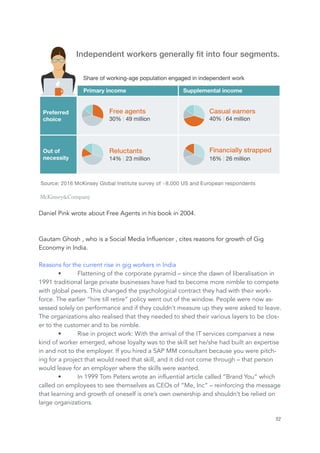
Daniel Pink wrote about Free Agents in his book in 2004.
Gautam Ghosh , who is a Social Media Influencer , cites reasons for growth of Gig
Economy in India.
Reasons for the current rise in gig workers in India
• Flattening of the corporate pyramid – since the dawn of liberalisation in
1991 traditional large private businesses have had to become more nimble to compete
with global peers. This changed the psychological contract they had with their work-
force. The earlier “hire till retire” policy went out of the window. People were now as-
sessed solely on performance and if they couldn’t measure up they were asked to leave.
The organizations also realised that they needed to shed their various layers to be clos-
er to the customer and to be nimble.
• Rise in project work: With the arrival of the IT services companies a new
kind of worker emerged, whose loyalty was to the skill set he/she had built an expertise
in and not to the employer. If you hired a SAP MM consultant because you were pitch-
ing for a project that would need that skill, and it did not come through – that person
would leave for an employer where the skills were wanted.
• In 1999 Tom Peters wrote an influential article called “Brand You” which
called on employees to see themselves as CEOs of “Me, Inc” – reinforcing the message
that learning and growth of oneself is one’s own ownership and shouldn’t be relied on
large organizations.
	 	 32
• Growth in other opportunities – with the rise of the internet and falling
barriers to erstwhile “elite” professions like writing, fashion design and photography
many people moved away from the traditional “engineering-medicine-government job”
paradigm to venture into these new creative fields. The rise of social media has given
rise to newer and newer professions like social media influencers in various niches from
technology to fashion, stand up comedy and performance poetry. Suddenly the only
limits were one’s creativity and imagination.
• The arrival of the platforms: In 2005 Amazon launched its Mechanical Turk
website for people to crowdsource small jobs they needed to be done for some money.
For high end knowledge work marketplaces like GLG emerged that connected compa-
nies who wanted insights and experts who could provide it to them for a fee. From
those beginnings we have the rise of the on-demand economy today with app based
platforms that match buyers and sellers (Ola, Uber for rides, OYO and Airbnb for stay)
( 17 A )
Link 17 A
http://www.vbeyond.com/whats-new-gig-economy-india/
Disruptive technologies, especially artificial intelligence (AI), robotics and automation,
are shaping the future of the global workforce, giving rise to the so-called gig economy
AI may be good for the economy too, even developing ones. Research released on 21
December by Accenture Plc., reveals that AI could add $957 billion to the Indian econ-
omy by changing the nature of work to create better outcomes for businesses and soci-
ety. The report, Rewire for Growth, estimates that AI has the potential to increase India’s
annual growth rate of gross value added (GVA) by 1.3 percentage points, lifting the
country’s income by 15% in 2035. ( 17)
Link 17 http://www.livemint.com/Technology/TG7aI955YvY0pQkwnptJxO/The-rise-of-
the-gig-economy.html
McKinsey & Company believes as many as 800 million adults worldwide will need to
find new ways to earn a living by 2030. Although some will simply change careers and
land in new full-time roles, others will decide to explore the growing freelance market-
place. This shift is already underway in many sectors, with 72 percent of
millennials telling the Intelligence Group that they prefer to be their own bosses. (18)
Link 18
https://www.entrepreneur.com/article/309291
	 	 33
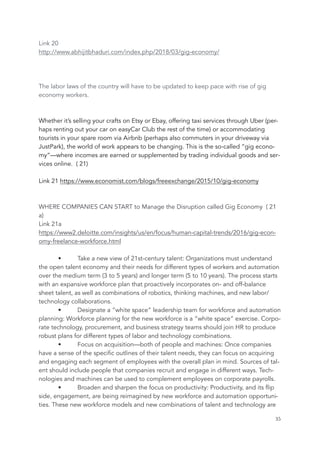
Job security in VUCA world is dead. Employees must learn to deal with layoffs, down-
sizing, mergers, acquisitions, rightsizing, failed startups, failure to raise money. You have
to think about how you can create a portfolio of work that gives you income security.
( 19)
Link 19 https://www.fastcompany.com/40530695/these-4-skills-are-essential-to-suc-
ceeding-in-the-gig-economy
Degrees or Certifications will matter less in the Future. You need to have the right skills
that are in demand and constantly relearn new skills to keep yourself updated as per
market scenario.
“Whilst the emerging gig economy is definitely something to be excited about in the
future of the workplace, the recruitment sector will always be considered vital in helping
candidates find the right job and companies filling their staffing needs”
So Recruitment sector will need to keep up pace with the automation, AI, machine
learning and new technologies that are disrupting the world of work
	 	 34
Link 20
http://www.abhijitbhaduri.com/index.php/2018/03/gig-economy/
The labor laws of the country will have to be updated to keep pace with rise of gig
economy workers.
Whether it’s selling your crafts on Etsy or Ebay, offering taxi services through Uber (per-
haps renting out your car on easyCar Club the rest of the time) or accommodating
tourists in your spare room via Airbnb (perhaps also commuters in your driveway via
JustPark), the world of work appears to be changing. This is the so-called “gig econo-
my”—where incomes are earned or supplemented by trading individual goods and ser-
vices online. ( 21)
Link 21 https://www.economist.com/blogs/freeexchange/2015/10/gig-economy
WHERE COMPANIES CAN START to Manage the Disruption called Gig Economy ( 21
a)
Link 21a
https://www2.deloitte.com/insights/us/en/focus/human-capital-trends/2016/gig-econ-
omy-freelance-workforce.html
• Take a new view of 21st-century talent: Organizations must understand
the open talent economy and their needs for different types of workers and automation
over the medium term (3 to 5 years) and longer term (5 to 10 years). The process starts
with an expansive workforce plan that proactively incorporates on- and off-balance
sheet talent, as well as combinations of robotics, thinking machines, and new labor/
technology collaborations.
• Designate a “white space” leadership team for workforce and automation
planning: Workforce planning for the new workforce is a “white space” exercise. Corpo-
rate technology, procurement, and business strategy teams should join HR to produce
robust plans for different types of labor and technology combinations.
• Focus on acquisition—both of people and machines: Once companies
have a sense of the specific outlines of their talent needs, they can focus on acquiring
and engaging each segment of employees with the overall plan in mind. Sources of tal-
ent should include people that companies recruit and engage in different ways. Tech-
nologies and machines can be used to complement employees on corporate payrolls.
• Broaden and sharpen the focus on productivity: Productivity, and its flip
side, engagement, are being reimagined by new workforce and automation opportuni-
ties. These new workforce models and new combinations of talent and technology are
	 	 35
critical for improving corporate productivity. New workforce planning approaches inte-
grating multiple workforce segments, automation, and cognitive technologies will en-
hance productivity and product and service quality.
• Develop new workforce and automation models that focus on engage-
ment and the skills of your critical workforce: Increasing employee engagement is one
of today’s most important workforce challenges. Companies today must learn how to
use new workforce segments and technologies to improve the quality, meaning, and
value of the work of their employees.
Automation won’t destroy jobs, but it will change them
The key to surviving digital technology disruption is finding ways to combine your skills
with the power of advanced robots and computers.
This is what Andrew McAfee and Erik Brynjolfsson call learning to race with the machine
not against the machine in their book The Second Machine Age.
Spreadsheets didn’t kill off accounting jobs. On the contrary, smart accountants learned
how to use spreadsheets to become more productive and more employable. ( 22 )
Link 22 https://theconversation.com/automation-wont-destroy-jobs-but-it-will-change-
them-55318
By 2020, Artificial Intelligence will create more jobs than it eliminates: Gartner
The firm says 1.8 million jobs will be eliminated by 2020, but 2.3 million new jobs will
be created by then.
In 2021, AI augmentation will generate $2.9 trillion in business value and recover 6.2
billion hours of worker productivity.
AI has already been applied to highly repeatable tasks where large quantities of obser-
vations and decisions can be analyzed for patterns. However, applying AI to less-routine
work that is more varied due to lower repeatability will soon start yielding superior ben-
efits. AI applied to non-routine work is more likely to assist humans than replace them
as combinations of humans and machines will perform more effectively than either hu-
man experts or AI-driven machines working alone will. ( Link 23)
Link 23
	 	 36
//economictimes.indiatimes.com/articleshow/62053363.cms?utm_source=contentofin-
terest&utm_medium=text&utm_campaign=cppst
To borrow a punch line from Duke professor Dan Ariely, artificial intelligence is like
teenage sex: “Everyone talks about it, nobody really knows how to do it, everyone
thinks everyone else is doing it, so everyone claims they are doing it.”
Automation replaced 800,000 workers… then created 3.5 million new jobs
A Deloitte study of automation in the U.K. found that 800,000 low-skilled jobs were
eliminated as the result of AI and other automation technologies. But get this: 3.5 mil-
lion new jobs were created as well, and those jobs paid on average nearly $13,000
more per year than the ones that were lost. ( 24)
Link 24
https://venturebeat.com/2017/09/07/automation-replaced-800000-workers-then-creat-
ed-3-5-million-new-jobs/
Technology is changing the way we work. These changes can improve people’s lives
and lead to a more creative engaged workforce . AI is best suited for jobs which are
repetitive , and humans are suited for jobs which require creativity and empathy.
Leadership job will never be automated by Technology.
Be a Leader, wherever you are , in your field and you will never be at risk of automation.
Companies that are investing in AI Talent
Automation Jobs Will Put 10,000 Humans to Work, Study Says ( 25)
Link 25 http://fortune.com/2017/05/01/automation-jobs-will-put-10000-humans-to-
work-study-says/
Don’t want a robot to steal your job? Be creative
	 	 37
A recent report by Nesta, a UK-based innovation and research foundation, found that
creative jobs will be much more resistant to automation, and 21% of US employment
requires people to be highly creative ( 26)
Link 26
https://qz.com/882779/creativity-could-stop-robots-from-automating-workers-out-of-
jobs/
Curiosity, Creativity, Empathy , Ingenuity will command a premium in future. People
with these traits are likely to succeed in future as well.
	 	 38
If you’re a global Fortune 500 company and you do not have a team that you are pay-
ing to disrupt your business, than someone else will.
Robots will not lead to fewer jobs – but the hollowing out of the middle class
T
hroughout modern history there has been a recurrent fear that jobs will be destroyed by
technology. Everybody knows the story of the Luddites, bands of workers who smashed
up machinery in the textile industry in the second decade of the 19th century.
The Luddites were wrong. There has been wave after wave of technological advance
since the first Industrial Revolution, and yet more people are working than ever before.
Jobs have certainly been destroyed. Banks, for example, no longer employ clerks to log
every transaction in ledgers with quill pens. At this time of year, 150 years ago, the
fields would have been full of people with scythes and pitchforks bringing in the har-
vest. That work is now done by motorised harvesters.
The reason new technology has not been the cause of mass unemployment is that new
kit will only be used when it makes the productive process more profitable. Higher pro-
ductivity frees up the resources to buy other goods and services. The rural workers that
Thomas Hardy described in Tess of the D’Urbervilles found work in factories and offices.
What’s more, it was better paid work, and so the upshot was an increase in living stan-
dards. ( 27)
Link 27
https://www.theguardian.com/business/2017/aug/20/robots-are-not-destroying-jobs-
but-they-are-hollow-out-the-middle-class
• Automation will cause declines in some occupations, change many more,
and create new occupations that don't exist today. Sixty percent of occupations have at
least 30 percent of constituent work activities that could be automated. 
• Half of all work activities around the globe could be automated, but
probably only one-third or less will be displaced by 2030 because of technical, econom-
ic, and social factors. 
• Even as automation changes labor dynamics, the "demand for work and
workers could increase," in part because of rising productivity fueled by technological
progress. Among the forces creating demand for work: increasing health care for aging
societies and investment in infrastructure and energy.
• Even with robust job growth, "major transitions" still lie ahead. By 2030,
75 million to 375 million workers—3 percent to 14 percent of the global workforce—will
	 	 39
need to change the kinds of work they do. And still more workers will have to adapt
what they do in order to work "alongside increasingly capable machines." Some of
those changes could require additional education, or more creativity or social and emo-
tional skills.
• "Midcareer job training will be essential." The need to retrain and rede-
ploy workers quickly "will challenge current educational and workforce training
models." Businesses and policymakers will have to rethink and strengthen "transition
and income support" for workers affected by automation. (28)
Link 28
http://blogs.edweek.org/edweek/high_school_and_beyond/2017/12/automa-
tion_will_create_more_jobs_than_it_will_eliminate.html
Automation Will Create 30 Cr New Jobs; Women Will Lose More Jobs Than Men!
As per a recent survey by Accenture, it was found that due to increased ‘AI and human-
machine collaboration’, global workforce will increase by 10% by 2022 – This means
that although automation and AI is taking away jobs right now, a paradigm shift is hap-
pening and newer opportunities are opening up, which never existed before.
The report states that as AI and Automation are fusing with human collaboration, rev-
enues of companies can increase by 38% by 2022, which will increase profits of compa-
nies to the tune of $4.8 trillion. Hence, on an average for S&P500 firm, this translates to
$7.5 billion of revenue and $880 million increase in profit
As per ILO, there are 3 billion employed people (in 2011), globally. Hence, as per Ac-
centure, AI and Automation will directly crease 10% or 300 million new jobs by 2022.
( 29)
Link 29
http://trak.in/tags/business/2018/01/25/automation-will-create-new-jobs/
Since new jobs will emerge due to automation, reskilling is an important criteria to keep
the current workers in the workforce.
In a first of its kind initiative, some of the largest global IT firms have joined forces un-
der World Economic Forum SkillSET portal for reskilling and re-training 10 lakh (1 mil-
lion) workers all over the world.
	 	 40
From India, Infosys and TCS have agreed to join this massive collaboration, which in-
cludes companies Accenture, CA Technologies, Cisco, Cognizant, Hewlett Packard En-
terprise (HPE), Pegasystems, PwC, Salesforce and SAP.
Under the Chairmanship of Chuck Robbins, who is the chairman and chief executive of-
ficer of Cisco, this IT Industry Skills Initiative was launched at the ongoing World Eco-
nomic Forum. (30)
Link 30
http://trak.in/tags/business/2018/01/24/tcs-infosys-join-global-it-firms-reskill-1-mn-
workers/
	 	 41
Skill, re-skill and re-skill again. How to keep up with the future of work
Today, in the 21st century, we’re seeing the rise of new work models such as freelancing
and remote work. In the most advanced companies, teams are learning to be more ag-
ile, to work with distributed and remote teams, and to scale up and down to adapt to
ever-changing conditions. This is the future of work.
Yet education hasn’t kept pace. We still send our children through a fixed set of primary
and secondary education steps, only now a college degree has been added on as a vir-
tual prerequisite for the best jobs. The model doesn’t actually prepare anyone well for a
flexible world, in which skills are typically outdated by the time you finish a four-year
degree.
Further, on-the-job training isn’t enough to close the gap. The World Economic Forum
report found that 63% of workers in the US say they’ve participated in job-related train-
ing in the past 12 months. Yet employers are reporting the highest talent shortages
since 2007. ( 31)
Link 31
https://www.weforum.org/agenda/2017/07/skill-reskill-prepare-for-future-of-work
ManpowerGroup: Multiple examples of skilling, upskilling and reskilling
Developing in-demand skills in France. In France, ManpowerGroup is helping redun-
dant workers through their career transitions by developing their skills for in- demand
sectors like IT and call centres. Through FuturSkill, ManpowerGroup delivers four
month-long programmes comprised of skills assessments, training and access to
an online learning management system in both hard and soft skills for more than 60,700
people across France. Following completion of the programme, the company’s Bridge
To Work program works as a matching platform for redeploying unemployed people to
ll in-demand positions. Thus far, the program has enjoyed a placement rate of 90% of
candidates into diverse roles such as IT help desk technicians, developers, customer
service representatives and production workers. This represents double the placement
	 	 42
rate of publicly funded programs in France that do not link training to direct employ-
ment opportunities.
Assessing skills for platform economy entrepreneurial talent
in China. When start-ups and small- and medium-size businesses are responsible for
creating up to two out of three new jobs, it’s perhaps no surprise that governments are
trying to gure out how to support and develop the skills of entrepreneurs. In Shanghai,
investment in training and access to capital and tax bene ts is substantial, so the gov-
ernment wanted a tool to maximize its return on investment. Building on its candidate
selection expertise, ManpowerGroup has created a unique New Business Starters (NBS)
assessment for entrepreneurial skills and aptitudes—to identify relevant cognitive skills,
personality traits and life experiences that accurately select individuals with the highest
potential to succeed. To date, over 225,000 candidates have been assessed, some fresh
to the labour market and others taking a new career direction, all bene tting from up-
skilling advice and training. Early results indicate that high scorers are two to three
times more likely to succeed as new business starters— and will be well placed to be
the job creators of tomorrow.
Training IT skills in India. When 40% of employers globally report talent shortages, the
rapid development of in-demand skills is critical. Last year in India, ManpowerGroup
trained 1,000 graduates in testing, Java and mainframe skills for a Hire-Train-Deploy
model, and developed a tailored curriculum and intensive boot-camp training in 30-40
day programmes. Participants were diverse, sourced from across India and from all
stages of their career. Some were new graduates
and others experienced professionals looking to reskill and make lateral moves. Impres-
sively, in this underrepresented sector 60% were female. By focusing on graduate ability
and desire to learn, the chosen candidates who completed the boot camp training were
motivated and well placed for applying their new skills. Thus, 90% of participants were
placed directly into jobs in large Fortune 500 companies.
Supporting local partnerships for adult reskilling in Italy’s motorsport industry. In 2013,
in response to skills shortages from Italy’s key motorsport manufacturing companies—
Ferrari, Maserati, Lamborghini and Dallara—ManpowerGroup’s Experis business (spe-
cializing in professional resourcing
for IT, engineering and nance) partnered with these
companies, local governments and universities to retrain adults from declining sectors -
including the textiles industry -with the skills needed for integration into the motor
sports car industry. The program trained these displaced workers for diverse roles as
carbon ber laminators and tters, CAD designers, aerodynamics engineers, vehicle per-
formance and data analysts, engine builders, chassis developers, programmers, race
track engineers, as well as interns, project managers, HR and IT specialists. The pro-
gramme trained
243 graduates in seven cities resulting in average wage increases of 30%, with place-
ment rates ranging from 55%- 70%. ManpowerGroup plans to expand this model across
Europe and to the US in partnership with local universities, technical schools and gov-
ernment stakeholders. (32)
	 	 43
Link 32 http://www3.weforum.org/docs/WEF_EGW_White_Paper_Reskilling.pdf
AT&T invests over $1B to retrain 100,000 employees
	 	 44
• AT&T, recently voted one of Forbes' 100 Best Employees to Work For, has
taken on the task of retraining 100,000 members (nearly one-third) of its current global
workforce, Forbes reports. AT&T says part of the reason behind the initiative is to en-
sure that its employees' skills will not be obsolete in the next 10 years.
• Much of that potential for skills disruption is caused by consumer use of
mobile phones and data plans; data usage among AT&T customers alone grew
250,000% since the iPhone was introduced to the market in 2007. The company has
replaced nearly 75% of its hardware with computer operated systems.
• The initiative, known as Workforce 2020, includes a suite of new learning
programs and facilities. AT&T plans to invest over a billion dollars in its push to prepare
employees to face the next wave of technology. (33)
Link 33
https://www.hrdive.com/news/att-invests-over-1b-to-retrain-100000-employees/
438072/
The Manpower Group report surveyed 18,000 employers over 43 countries, asking how
they expected technology to impact their businesses in the next couple of years and
how they are making sure that their workforce is prepared with the right skills and
adaptability. The survey revealed:
• 3 out of 4 businesses expect that automation will require new skills from
employees, therefore 60% are investing in internal training to keep skills fresh.
• 65% of the jobs Generation Z will perform do not yet exist in the work-
place, and many of the core skills we place value on today will be replaced by 2020.
• Around 45% of present day’s tasks could be automated in the next two
years, with roles in sales, business operations and administration primarily under threat.
• If current trends continue, women may lose their jobs at five times the
rate of men, which highlights the need for upskilling and retraining the workforce.
How automation will impact employee training and company leadership
According to Chris Canclalosi, contributor for Forbes, “The pace of the evolution of
work means that leaders will be increasingly challenged to provide clarity and direction
in a continuously changing and complex environment.”
Essentially: coaching will matter.
Leaders will need to actively participate in the day-to-day operational success of their
organizations by demonstrating leadership through action. Technology can and will
	 	 45
help leaders to be more effective in their roles by automating certain processes so that
they can engage with employees more often. So too, technology will require humans to
manage it and interact with it, so leaders will need to be there to ensure people do not
fear this change as it occurs.
The scarcity of talent in the AI market will continue to provide challenges for compa-
nies. It makes sense to focus on internal training measures to bring current employees
up to speed ( 34)
"The role of HR in the past was about helping people be as much like machines as pos-
sible. In the future, it's about helping them be as little like machines as possible."
~ Kristen A. Pressner at #Unleash18
Link 34
https://www.hrdive.com/news/how-automation-will-impact-employee-training-and-
company-leadership/434143/
	 	 46
Finding success in a VUCA world is all about adapting to change. Future can not be
predicted . People who succeed thrive on chaos and uncertainty.
In India, most of the people were shocked when PM announced demonetisation on
Nov 8, 2016.
With such announcement , companies like Paytm ( A platform for Digital Money ) be-
came overnight success.
Many small retailers who were accepting cash only, had to start accepting money via
paytm to keep up with their business transactions in the absence of cash money.
Businessmen who adapted to new mode of accepting payments continued with their
business as usual while others kept on criticising Government for such a move.
Digitization found a new push in the country after Nov 8, 2016.
Almost every occupation that McKinsey looked at had some aspect that could be au-
tomated. Even 25% of tasks inside of a CEO job, the analysis found, could be automat-
ed. But very few jobs could be entirely automated.
Impact of Automation
The automation gap: rich countries are expected to automate a much larger percentage
of work than poorer ones between now and 2030. MCKINSEY GLOBAL INSTITUTE
https://www.wired.com/story/robots-threaten-bigger-slice-of-jobs-in-us-other-rich-na-
tions/
CEO of Google, and announced plans to give away $1 billion.
The money will go to projects that offer training and career coaching to people short on
skills for a rapidly digitizing economy where businesses and their workers need fluency
in coding, mobile apps, and social media to compete. Google says it has already given
out $100 million of the total to nonprofits, including $10 million to Goodwill, for a pro-
gram offering digital-skills training. A "Grow With Google tour" will spin up training
events staffed by Google employees across the country
	 	 47
“The nature of work is fundamentally changing,” Pichai said in a blog post today. “It’s a
big problem and, at Google, whenever we see a big problem, we ask how we can make
it easier for everyone to solve it.” ( Link)
Link
https://www.wired.com/story/google-offers-help-to-industries-it-helps-to-destroy/
McKinsey’s conclusion was not that machines will take all of these jobs, but rather,
“more occupations will change than will be automated
away.” Our CEO, for example, won’t spend time analyzing reports if artificial intelli-
gence can draw conclusions more efficiently, so he can spend more time coaching his
team. (35)
Link 35
https://qz.com/904285/the-optimists-guide-to-the-robot-apocalypse/
Bill Gates has suggested that we tax robots’ productivity similar to how we tax humans’
income in order to finance retraining programs and jobs for which humans are well-suit-
ed, like care-taking
As MIT’s Erik Brynjolfsson and Andrew McAfee put it more recently than Keynes in their
2014 book about automation’s economic impact, The Second Machine Age: “Our gen-
eration has inherited more opportunities to transform the world than any other. That’s a
cause for optimism, but only if we’re mindful of our choices.”
	 	 48
Technology can help labor markets: Digital talent platforms improve matching between
workers and jobs
Digital talent platforms have the potential to improve the ways workers and jobs are
matched, creating transparency and efficiency in labor markets, and potentially raising
GDP. They can raise labor participation and working hours; evidence from around the
world suggests that some people would work more hours if they could. A US survey, for
example, reports that three-quarters of stay-at-home mothers would be likely to work if
they had flexible options. Even if a small fraction of inactive youth and adults use these
platforms to work a few hours per week, the economic impact would be significant.
With their powerful search capabilities and sophisticated screening algorithms, online
talent platforms can also speed the hiring process and cut the time individuals spend
searching between jobs, reducing unemployment. By aggregating data on candidates
and job openings across entire countries or regions, they may address some geograph-
ic mismatches and enable matches that otherwise would not have come about.
Finally, online talent platforms help put the right people in the right jobs, thereby in-
creasing their productivity along with their job satisfaction. They can draw people who
are engaged in informal work into formal employment, especially in emerging
economies. Both of these effects could increase output per worker, raising global GDP.
Digitally-enabled independent work is on the rise
While independent work is nothing new (and self-employment is still the predominant
form of work in emerging economies), the digital enablement of it is. MGI research
finds that 20 to 30 percent of the working age population in the United States and the
European Union is engaged in independent work. Just over half of these workers sup-
plement their income and have traditional jobs, or are students, retirees, or caregivers.
While 70 percent choose this type of work, 30 percent use it out of necessity because
they cannot find a traditional job at all, or one that meets their income and flexibility
needs. The proportion of independent work that is conducted on digital platforms,
while only about 15 percent of independent work overall, is growing rapidly, driven by
the scale, efficiency, and ease of use for workers and customers that these platforms
enable. Such platforms include Uber, Etsy, Didi, and others. While those who pursue
independent work (digitally enabled or not) out of preference are generally satisfied;
those who pursue it out of necessity are unsatisfied with the income variability and the
lack of benefits typically associated with traditional work. Policy makers and innovators
will need to grapple with solutions to these challenges. (36)
Link 36
https://www.mckinsey.com/global-themes/employment-and-growth/technology-jobs-
and-the-future-of-work
More than half the world’s population is still offline, limiting the potential to benefit
from digital
	 	 49
Rapid technology adoption can unlock huge economic value, even as it implies major
need for retraining and redeployment of labor. In India, for example, digital technolo-
gies provide the foundation for many innovations that could contribute $550 billion to
$1 trillion of economic impact per year in 2025. However, the value of digitization that is
captured depends on how many people and businesses have access to it.
More than four billion people, or over half of the world’s population, is still offline.
About 75 percent of this offline population is concentrated in 20 countries, including
Bangladesh, Ethiopia, Nigeria, Pakistan, and Tanzania, and is disproportionately rural,
low income, elderly, illiterate, and female. The value of connecting these people is sig-
nificant, and as they enter the global digital economy, the world of work will transform
in fundamental ways and at an unprecedented pace. Access to the technology alone is
not enough; even in countries where a large majority of the population has access, the
literacy and skills needed to capture digital gains are sometimes limited. ( McKinsey)
Commit yourself to lifelong learning. The most valuable asset you’ll ever have is your
mind and what you put into it.
Brian Tracy
How advancing women’s equality can add $12 trillion to global growth
Gender inequality is not only a pressing moral and social issue but also a critical eco-
nomic challenge. If women—who account for half the world’s working-age population—
do not achieve their full economic potential, the global economy will suffer. While all
types of inequality have economic consequences, in our new McKinsey Global Institute
(MGI) report, The power of parity: How advancing women’s equality can add $12 trillion
to global growth, we focus on the economic implications of lack of parity between men
and women.
Six types of intervention are necessary to bridge the gender gap: financial incentives
and support; technology and infrastructure; the creation of economic opportunity; ca-
pability building; advocacy and shaping attitudes; and laws, policies, and regulations.
We identify some 75 potential interventions that could be evaluated and tailored to suit
	 	 50
the social and economic context of each impact zone and country. Tackling gender in-
equality will require change within businesses as well as new coalitions. The private sec-
tor will need to play a more active role in concert with governments and nongovern-
mental organizations, and companies could benefit both directly and indirectly by tak-
ing action. (37)
Link 37
https://www.mckinsey.com/global-themes/employment-and-growth/how-advancing-
womens-equality-can-add-12-trillion-to-global-growth
	 	 51
Life is a tragedy for those who feel, and comedy for those who think – Charlie Chaplin
I can’t help feeling both tragic and comic when I think of Gender Diversity in organiza-
tions. When I started writing on the topic – lot of thoughts emerged in my mind. Ad-
vancing Women in Corporations and Society is my passion, this is close to my heart.
However, I wasn’t sure which side should I represent – an optimistic view that says that
we have done a lot for Women in organizations or pessimistic view that believes that
much hasn’t been achieved for women at workplace. Or there could be a 3rd view –
Realist. To see things as they are?
Recently, I attended Vipasana in the Himalayas, and there I learnt to observe reality as it
is. So I will try to make an attempt to present views of a realist to you, of course with my
own biases. My hobby is reading, I come across lot of research articles on women. I will
share those research findings with you.
I consider myself a feminist. A Feminist is someone who believes in Women having
Equal rights as Men at workplace, at home, in societies. So if you believe that Women
should have equal rights and fight for it, you are a Feminist.
I come from an organization which has an established reputation for celebrating diversi-
ty. Our CEO is a woman, Ginny Rometty (IBM) –which says a lot about how much we
value & celebrate gender diversity at work.
But the figures can worry across sectors and organizations and few can boast of the
gender ethic as I see it. Look at these:
• ´ Around 40% organizations anticipate more female employees at the
mid-level in their workforce, however; only 5% see a rise in number of women at CXO
levels reveals the latest Times Jobs study on gender diversity in India
TimesJob survey reveal that
• ´ 40% organizations are 'doing' diversity to access wide talent pool
• 25% are diverse to improve business performance
• 20% surveyed organizations said they are doing it to enhance corporate
reputation/brand image
• 10% are doing it for better corporate governance
• 5% are doing it out of compulsion as they are pressurized to take it up by
internal and external stakeholders
Across the world, governments and organizations are waking up to the prudence of
building diverse and inclusive workplaces. In India, there is still more reason to cele-
brate and promote women’s hiring, as it can lead to a sizeable additional economic
growth and could add $700 billion to the country’s GDP in 2025 (McKinsey Global Insti-
tute, 2015).
The report titled, The Power of Parity: Advancing Women’s Equality in India, claims that
this economic impact could translate into incremental GDP growth of 1.4 per cent per
year for the country. Bridging gender gap would also add $12 trillion to global GDP in
2025.
For every 100 girls that even enrol for education, just about 47 or so reach the high-
school level. And then, when you talk of graduation and post-graduation, the number
drops to may be 15, 16. And then, not just that, it’s also believed that, even out of the
	 	 52
workforce-ready women, about 75 to 78 per cent do not join the organized
workforce.” -
There are several business benefits of gender diversity, hence many executives root for
a more diverse workforce. Such teams, as per the Gallup study, perform better than
single gender ones by enabling different viewpoints, ideas, and market insights. These
together lead to better problem solving and superior performance. Diverse teams help
companies to serve a growing diverse customer base better.
The business case of gender diversity is borne out by the fact that organizations which
have higher level of women leadership, had 30 per cent higher return in equity and 34
per cent higher total return to shareholders. Not only this, across the consumer industry
70 to 80 per cent of all bank transactions are influenced by women. Women, even those
without independent financial resources, influence purchase decisions, and since a large
part of consumer class is women; who could understand them the best?
But of course women! The economics of all these cumulative reasons has lately led to
the belief that woman talent must form an integral part of the workforce. Clearly, a large
population with such veto power cannot be ignored!
Despite strong evidence on the business case of gender diversity, we are far off from
assimilating women into our workforce especially  after maternity break.
Research suggests that women pay the motherhood penalty. Do you agree?
 
While most leaders are stressing the importance of gender diversity across various fo-
rums, Times Job study   reveals that there still lies a yawning gap, between aspiration
and reality, which needs to be addressed by India Inc. for it to truly realize the potential
of diversity.
 
 
My experience with mentoring young women suggests that women pay the mother-
hood penalty. Do you agree?
Women in the Workplace, a survey conducted by LeanIn.org and McKinsey, notes that
women are less likely to advance than men, hold fewer roles leading to top manage-
ment positions, and are a century away from gender parity in the C-suite.
We are a century away from achieving Gender Pay Parity too. Imagine!
Women will get equal pay in 118 years according to World Economic Forum . Almost
no progress on wage equality around the globe in past seven years, according to report
 
The Unconscious Bias
Dell discovered the unconscious bias in its male employees when it conducted one-to-
one closed room interactions with them under a program called Men Advocating Real
Change. The fact that many were not even aware of it was a clincher. “There are more
men in corporate leadership and if they don’t want it or drive gender diversity, this
change will never happen.”
	 	 53
Every Men and Women should read book Own it by Aparna Jain to learn more about
unconscious bias against women at workplace and stories of Indian women at work-
place.
India is categorized as the “Under the 30% representation of women at workplace”
In Corporate world,
At entry level – we have 30% Women representation
By the time women reach Mid-Level – the figure drops to 15%
And at Senior Level, CEOs, and CXOs – Women representation is mere 4-5%
The pipeline of talent dries upwards and not many women can be seen in the C-suite.
What happens from entry to senior level that Women drop out of Workforce significant-
ly?
Let us examine …..
We get married
We go on Maternity Break
We have babies
We take sabbatical
We have homes to take care of
We put Career as Second priority because Indian Women and Sacrifices is synonymous,
you know
So essentially corporate world penalizes Women to have babies and to take care of
homes and husbands,
Instead of Making the Workplaces Flexible, and offering Flexi-work options to both Men
and Women.
Instead of offering Paternity leave, so that Men share responsibilities of babies, compa-
nies have expectations from Women not to produce babies at all. Ridiculous!
 
Facebook and Apple – 2 Companies and their Leaders I admire, Sheryl Sandberg and
Steve Jobs. Apple said in its diversity report that its workforce was 70% male, while
Facebook reported its workforce was 69% male.
These 2 companies rolled out policy to encourage Women to Freeze their Eggs.
Facebook will pay up to $20,000 while Apple provides perks in effort to attract more
women
The idea of freezing eggs was first proposed for cancer patients as chemotherapy can
damage a woman’s eggs.
But companies want Diversity Targets to be met at all levels , so instead of making our
Workplaces Inclusive for Women, let’s ask Women to freeze eggs so that they don’t quit
jobs for making babies at peak time in their careers.
Research Findings
 
55% organizations admit that there is still a compensation gap between #women & men
- Times Job Survey
Women still don’t change jobs for High Compensation but Men do – research
	 	 54
Women feel they are less supported than men at home, (McKinsey). We don’t need a
research study for that. Women experience it day in day out!
 
Women negotiate less than Men. Women don’t negotiate for compensation even when
they are deserving – research
 
So, Working Women must learn to negotiate tactics and enroll in a negotiation course.
You know what, it doesn’t end there. So Women who learn to negotiate are not liked by
colleagues at workplace - Another Research study
Damn if you do, damned if you don’t.
 
Diversity and Inclusion go hand in hand.
“You can get high diversity ratios but if your culture is not right then you can’t get those
diverse opinions.” 
You need to make a gender inclusive culture at workplace.
So it all boils down to Culture.
What Really Matters to Women?
Interestingly, in a survey done by People Matters, women respondents felt that factors
like ‘leadership development programs’, ‘mentoring and networking opportunities’,
‘sensitization of managers to gender’ along with some hygienic base of ‘flexible work
arrangement’ and ‘assistance in the form of leaves’ are vital to retain women (these fac-
tors were chosen by more than 75% of respondents as very important). Factors like
company providing ‘child care facilities at the workplace’ and ‘internal women forums’
Respondents in a survey see lack of flexible work solutions, work-life balance and lack of
an inclusive work culture as important barriers hindering women from rising to the top.
At the same time, they believe that training programs at the executive and leadership
level, mentoring opportunities and sensitizing managers will help retain women.
While most organizations are taking care of addressing the barriers, more emphasis
must be laid on what will actually ensure in retention.
Key Findings
• Lack of adequate re-entry opportunities (29%) is a problematic area. However, only
2% of organizations provide for reintegration programs.
• 85% respondents feel that leadership development programs are key retention mea-
sures for women. However, only 22% respondents claim that their organizations provide
such programs.
• Mentoring and networking opportunities is another key measure to retain women,
state 81% respondents. However, only 28% respondents claim that their organizations
undertake this initiative.
	 	 55
• 62% respondents claim that having an internal women forum is an important retention
factor for women. However, only 33% respondents claim that their organizations have
such a forum.
Only 16% of CEOs actually have the gender inclusion agenda as part of their scorecard.
The results show that organizations are not allocating their budgets, resources and tar-
gets to support the mandate on gender inclusion. Data shows that only 14% organiza-
tions have budgets and resources allocated within their organizations to drive this man-
date.
However, having said that there are some companies which are doing Gender Diversity
really well and go on to receive awards year after year
Citi, Deliotte, L’Oreal, P&G, Intel, Accenture, IBM, Johnson and Johnson, GE, PepsiCo,
Microsoft, Ernst and Young, Novartis, PwC, have earned several awards for many years
as Top Employers for Women
Dell has a unique initiative in place to create a diverse and inclusive workplace. It is
working with its menfolk to make them advocates of gender diversity
“Men have the potential to be powerful ambassadors for implementing many diversity
and inclusion initiatives, as well as influencing other male peers to support gender ini-
tiatives.
For every Shikha Sharma, Naina lal Kidwai, Chanda Kochhar, and Indira Nooyi – we
have Pooja, Shelly, and Mamta who have not been able to get equal pay for equal work
or find jobs post maternity or Career break in their Careers.
I have presented a case backed up by research on Gender Diversity in Organisations, I
will leave it to your judgment to reach your own conclusions!
Only 26% of companies have a returnee program to attract women who are on career
breaks.
Why is women representation in corporate India stagnant? Is India Inc. taking true ac-
countability and actions? 
Over 61% of companies have stated goals on diversity and 83% measure it at an orga-
nization level. However, in less than a third of companies, gender diversity is a part of
leadership KRA. At the managerial level, 68% companies provide line manager sensiti-
zation training and 54% expect line managers to drive gender balance, but only 9%
formally recognize managers who drive D&I in their teams. There is little incentive for
managers to promote gender diversity at the ground level. Companies with a higher
gender diverse representation have two common trends that could be critical for suc-
cess: 
	 	 56
• Tracking the agenda at micro entities like functions, levels, geographies,
beyond just the organization level helps in identifying opportunity areas and making
tangible progress.
•  
• While business case and targets for gender diversity work, personal buy-
in at the leadership level helps in moving the agenda forward faster.
•
Implementation at the ground level requires a strong partnership approach between
business and HR teams. ( 38)
Link38
https://www.peoplematters.in/article/diversity/is-india-inc-doing-enough-to-move-the-
needle-on-gender-diversity-14739?
Many employees think women are well represented in leadership when they see only a
few. And because they’ve become comfortable with the status quo, they don’t feel any
urgency for change. Further, many men don’t fully grasp the barriers that hold women
back at work. As a result, they are less committed to gender diversity, and we can’t get
there without them. ( 39)
So , whether you are a Man or a Woman , you need to champion the cause of Gender
Equality and root for women at work . It is good for your business and good for econo-
my.
Link 39
https://www.mckinsey.com/global-themes/gender-equality/women-in-the-
workplace-2017
Poll: Majority says #MeToo movement has helped address gender inequality
A majority of adults in the U.S. believe that the spotlight on sexual assault and harass-
ment has helped address gender inequality, according to the latest NBC News|Survey-
Monkey poll.
More than 150 young women came forward this year to say that they had been molest-
ed by longtime Olympics gymnastic doctor Larry Nassar, who was later sentenced to 40
to 175 years in prison.
	 	 57
The verdict is clear . The future workplace will be much safer for women , free from sex-
ual harassment.
Women all over world are saying Time is up. “Shape up“
Else the perpetuators will have to face consequences of their behaviours.
What you can do today to prepare for the future of work: Individuals, Families and Or-
ganizations
Albert Einstein said '**I have no special talents. I am only passionately curious**’.
**In a world where the rate of change is accelerating, we need to accelerate our rate of
learning, and so we need to become more curious all the time**.
Futurist Ross Dawson sheds some light on what can individuals, families and organisa-
tions do to be better prepared for Future of work
Individuals
Take the time to plan your future.
We all need to be our own futurists. In a busy world, we must carve out proper time to
consider how our skills and our dreams will fit with an economy that is swiftly changing.
We must work today to prepare ourselves for the jobs and opportunities of the future,
transitioning from our past career to our future careers.
Carefully choose your expertise.
Our livelihood tomorrow will be shaped by what we study today. To stand out, we
should aim to excel at one or two specific areas of work, at which we can become an
‘expert’. It is important to follow your passion, but also to consider whether the skills
you are developing will still be valuable in 5, 10 or 20 years’ time.
Fuel your appetite for learning.
We all need to keep learning throughout our lives to keep ahead in this fast-changing
world. Rather than this feeling like a chore, we need to make learning something we
want to do. Discover what you most want to learn about, and design it to be as fun and
social as you can.
Families
Learn how to learn.
There is no more vital capability for the future than the inclination and ability to learn.
Many children start to associate learning with tedium. They need to discover the joy of
learning by focusing on what they love best, whether it appears useful or not, and ac-
tively develop the habits and routines that will allow them to apply their learning skills
to any topic they choose.
	 	 58
Nurture human capabilities.
While specific skills in STEM and other areas will be in demand from employers, the
most valued attributes will be personal capabilities such as adaptability, resilience, op-
timism, creativity, emotional intelligence and judgment. Learning skills is critical for chil-
dren, developing into well-rounded adults is even more important.
Prepare for future jobs, not today’s jobs.
Careers advisors are one avenue to seek guidance when preparing for your future,
however as we live in a constant state of change it’s also important to do your own re-
search to consider whether careers you might pursue may still exist in decades to come,
and where the new work of the future may emerge.
Foster a growth mindset
In a rapidly changing world, children as well as adults of all ages must understand that
they can develop and increase their capabilities through study and perseverance. What
we learn from our experiences is not what we are able to do, but how we can get
better at creating our own personal success.
Organisations
Envisage your successful future organisation.
Today’s companies will fail if they simply try to eliminate some jobs and add others.
Every single work role will change in the future, shifting to draw more on uniquely hu-
man capabilities. Becoming tomorrow’s successful organisation requires a clear vision of
the skills and roles you will require, and planning how to transition your current team
from where they are to where they need to be.
Design work to tap your staff’s potential.
As human capabilities come to the fore, organisations should aim to tap the broadest
possible scope of their staff’s capabilities. In a flexible organisation, the best ideas and
skills can come from anywhere, bringing out everything people can contribute. Well-de-
signed collaboration will create outcomes that individuals could not achieve alone.
Hire for human capabilities, enable continuous learning.
Find people who are flexible, imaginative, empathic and hungry to learn. The best way
to attract the most talented is to provide them the opportunity to learn continuously.
Offer formal learning, but also design work so your staff develop their knowledge and
skills every day. ( 40)
Link 40
https://rossdawson.com/blog/can-today-prepare-future-work-individuals-families-orga-
nizations/
You can read the full report here
https://rossdawson.com/wp-content/uploads/2017/11/Commonwealth-Bank_Jobs-and-
Skills-of-the-Future-Report_November-2017.pdf
	 	 59
Future of Work Framework by Ross Dawson
	 	 60
Key Take Aways to prepare for Future of Work
1. Be a LifeLong Learner
2. Invest in learning new skills
3. Reinvent yourself continuously
4. Robots will work with humans , robots doing the repetitive tasks and humans will
take up creative jobs which require high empathy
5. Do not fear robots taking away jobs, AI age will create new jobs that don’t even ex-
ist yet
6. Be a champion for Gender Equality . Help develop Women Leaders. Working
Women are good for business and for Economy
7. Foster a growth mindset
8. Gig Economy will be on the rise
9. Be Curious
10. Be Empathetic. Empathy is what we need more of in Robotic world .
I think that the Uber platform model, and the way it is turning a job into work and mon-
etizing work, is the future of work says Thomas Friedman.
And that will have a huge impact on the future of learning. Because if work is being ex-
tracted from jobs, and if jobs and work are being extracted from companies—and be-
cause, as you and I have both written, we’re now in a world of flows1—then learning
has to become lifelong. We have to provide both the learning tools and the learning
resources for lifelong learning when your job becomes work and your company be-
comes a platform.
So I’m not sure what the work of the future is, but I know that the future of companies is
to be hiring people and constantly training people to be prepared for a job that has not
been invented yet. If you, as a company, are not providing both the resources and the
opportunity for lifelong learning, [you’re sunk], because you simply cannot be a lifelong
employee anymore unless you are a lifelong learner. ( 41)
Link 41
https://www2.deloitte.com/insights/us/en/deloitte-review/issue-21/tom-friedman-inter-
view-jobs-learning-future-of-work.html
	 	 61
AT&T gives its employees $8000 dollars per employee to complete nano degrees from
Udacity. Udacity is the learning platform , AT&T has partnered with to provide LifeLong-
Learning to its employees . Udacity offers nano degree programs on different subjects.
An example where machines work very well with humans in Watson. Watson is the IBM’s
supercomputer. IBM's Watson -- the language-fluent computer that beat the best hu-
man champions at a game of the US TV show Jeopardy! -- is being turned into a tool
for medical diagnosis.
Watson can detect cancer better than human doctors . If Watson’s read every article
ever written on cancer and no doctor can even think about approaching that, then be-
ing able to ask Watson the right question about a patient and then translate that in an
empathetic way to that patient—and use Watson not as a substitute, but an augmenter
for that doctor’s own innate skills—it’s in that combination that you’re going to get ab-
solutely the best jobs.
Thomas Friedman believes
PQ + CQ is greater than IQ
Passion and Curiosity Quotient trumps IQ.
Careers will mean Tours of Duty rather than fixed tenure in an Organisation
LinkedIn co-founder Reid Hoffman believes that careers are now simply “tours of
duty,”4 prompting companies to design organizations that assume people will only stay
a few years. And data bears this out: 58 percent of companies believe their new em-
ployees will stick around less than 10 years.5 (LinkedIn research shows that, on average,
new degree-holders have twice as many jobs in their first five post-college years now as
they did in the mid-1980s.6)
The bottom-line question is this: How can organizations build career models that en-
courage continuous learning, improve individual mobility, and foster a growth mind-set
in every employee, year after year? This is the opportunity for today; companies that
figure this out will outperform, out-innovate, and out-execute their peers
Let’s examine what a “career” really is. The traditional idea of a career has three com-
ponents:
• A career represents our expertise, our profession, and ultimately our iden-
tity. It defines who we are and what we do. This form of self-identity makes changing
careers dauntingly difficult: What if we switch careers and fail? Then who are we?
• A career is something that builds over time and endures. It gives us the
opportunity to progress, advance, and continuously feel proud. When we are asked to
	 	 62
change our career or path, what happens to all we have learned? Do we throw it all
away? Or can we carry it forward?
• A career gives us financial and psychological rewards. It makes life mean-
ingful, gives us purpose, and pays us enough to live well. What happens if our career
suddenly becomes less valuable, even if we still enjoy it? Should we continue to make
less money or jump to a new path?
The changing world of work has disrupted all three elements: expertise, duration, and
rewards. And as scary as this may be for employees trying to stay ahead, it’s equally dis-
ruptive for employers who must try to hire and develop the workforce of today, tomor-
row, and five years from now.
EXPERTISE HAS AN EVER-SHORTER SHELF LIFE
It used to be that only certain types of jobs—think of computer programmers and IT
troubleshooters—needed constant training and upskilling. Now, all of us are expected
to continuously learn new skills, new tools, and new systems. Just as COBOL program-
mers had to learn C++ and Java, administrative assistants have switched from typewrit-
ers and dictation machines to PCs and voice memos, assembly-line workers have had to
learn to operate robots, and designers have moved from sketchpads and clay models
to touchscreens and 3D printing.
In technical fields, there is constant pressure to master new technologies or risk becom-
ing instantly obsolete. One of our clients anonymously surveyed its IT department
about what skills people wanted to learn, and more than 80 percent said they were
desperate to learn tools such as AngularJS (a new open-source programming environ-
ment for mobile apps), even though the company was not yet using the technology.8
Today even experts find themselves disrupted. Few professions today are hotter than
that of a software engineer . . . and yet many foresee automation taking over the work
of coding in the near future.9 Artificial intelligence is doing the rote work of lawyers,10
simplifying the work of doctors,11 and changing skilled jobs from truck driver to finan-
cial analyst. As we describe later, it’s important for each one of us to learn new tools,
adapt our skills, and become more multidisciplinary in our expertise.
What this means to employers is simple: Your employees are constantly feeling a need
to “keep up.” Millennials, for example, rate “learning and development opportunities”
as the number-one driver of a “good job.”12 Managers should give people time, op-
portunity, and coaching to progress; if you don’t, people often just look elsewhere.
THE IDEA OF A SINGLE, LONG-LASTING CAREER IS BECOMING A THING OF THE
PAST
Remember the 30-year “lifelong career” that companies promoted during the last cen-
tury? Well, today only 19 percent of companies still have traditional functional career
models.13 Why have so many organizations let multi-decade career models fade away?
First, business structures have changed. The iconic industrial companies of the early
1900s (steel, automobile, energy, and manufacturing) have outsourced to smaller firms
many of their business processes and sales channels, as well as various parts of their
	 	 63
value chain. The result has been a steady increase in innovation and profitability, but a
dramatic decay in the security of a “company man” career.14
When I entered the workforce in 1978 as a fresh engineering graduate from Cornell, I
remember dozens of big companies looking for young engineers to train for lifetime
careers, each offering job rotation, heavy amounts of training, and seemingly lifelong
employment. I actually joined one of these companies—IBM—only to find my career
options altered entirely when management launched a massive turnaround. (I decided
to move to a smaller, faster-growing company.)
Similar stories can be told in automobile, manufacturing, financial services, retail, hospi-
tality, and many other industries. In 1970, the 25 biggest American corporations em-
ployed the equivalent of over 10 percent of the private labor force. Today, many of the
largest US employers by number are retailers, and the retail industry alone accounts for
more than 10 percent of US employment. In the current economic recovery, the fastest-
growing segment of work has been health care, including small and large hospitals, el-
dercare providers, and various types of personal-care work. However excellent these
employers might be, their primary workforce is mid-level labor—service and delivery
roles that neither pay as well nor offer the long-term “career professional” advance-
ment that large companies once routinely offered.
This has created opportunities for some workers but has left others behind their parents
at the same age. One study found that workers who entered the labor force in the
1980s and 1990s were more than twice as likely to stay in low-wage, dead-end jobs
over the next decade compared with similar employees who joined the workforce in the
late 1960s and early 1970s (at the high point of the corporate economy).Part of the rea-
son: Big corporations have outsourced many specialized (and highly paid tasks), which
can make it harder to “move up” in socioeconomic status.
Driven by opportunism (why stay at a company where advancement opportunities are
limited?) and necessity (what else can you do when your job is outsourced?), the prac-
tice of switching jobs and companies grew more common, until job-hopping became
the norm. People my age, for instance, typically worked for four to five companies dur-
ing their working lifetime. Today, a college graduate may work for as many companies
in their first 10 years after graduation.
SOFT SKILLS GROWING IN VALUE: FROM STEM TO STEAM
While many companies have outsourced specialized tasks over the years, big compa-
nies still need myriad technical and professional talent. Our research with Burning Glass
shows that skills in math, statistics, project management, and logical thinking are now
prerequisites for most positions (even those in marketing, finance, and HR). The prob-
lem, again: Such technical expertise may soon be outsourced, automated, or commodi-
tized by youth, giving way to new technical roles of which no one has yet dreamed. Al-
	 	 64
ready, thousands of people are working as “robotic trainers,”27 analyzing what self-dri-
ving cars do and working to make them smarter; it’s a good bet they’ll be doing some-
thing different a decade from now.
Today, anyone who wants a shot at a well-compensated position should consider de-
veloping skills in math, statistics, and logical thinking; comfort with data is increasingly
essential. It’s safe to say that anyone who lacks a basic understanding of science, tech-
nology, engineering, and math—the STEM fields—will likely find limited career options.
Managers, mentors, and HR teams should realize this shift and make training and reme-
dial education available to everyone in the company.
That said, STEM no longer tells the whole story of skills in the 21st century. Tasks based
on math, science, and engineering are vulnerable to automation, so they should be
complemented with soft skills and other strengths as well. In the 1800s, machinists and
metalworkers were the computer scientists of today; as automated manufacturing grew
and more powerful machines were invented, these “metal-bending” careers often
turned into careers developing, operating, and fixing machines. If you learned how to
be a draftsman in the 1970s, you likely watched your profession taken over by comput-
er-aided-design software in the 1980s and 1990s. And if you’re up to date on statistics
and math, you may increasingly find yourself stretching to do programming, analysis,
and interpretation of data, since software programs do many of the computations.
While the core need for technical skills remains strong, another theme has entered the
job market: the need for people with skills in communication, interpretation, design,
and synthetic thinking. In a way, we can think of these as the arts, hence the evolution
of education from STEM to STEAM.
What does it mean to add arts to STEM? It isn’t as simple as taking a few courses in art
history or reading Chaucer. The jobs of the future, driven by the increasing use of tech-
nology taking over rote tasks, require social skills complementing more technical abili-
ties.
Think about the job of a salesperson, bank teller, nurse or caregiver, or business leader
—all in-demand jobs that draw upon empathy, social skills, communication, and syn-
thetic thinking. When an angry bank customer strides up to a teller window, an AI pro-
gram lacks the tools to sense the best way to assess and defuse the situation, but a
well-trained, empathetic teller can—and that’s what makes her invaluable to the bank
( 42)
Link 42 https://www2.deloitte.com/insights/us/en/deloitte-review/issue-21/changing-
nature-of-careers-in-21st-century.html
Which Jobs require Social Skills
• Organizations are driving a huge increase in demand for analytic roles.
Jobs called “data scientist” or “analyst” are growing rapidly, with the overall number of
	 	 65
data science and analytics jobs expected to reach 2.7 million annual postings by 2020.
These jobs are growing in all industries and all developed economies, with particularly
high growth in the United Kingdom, Canada, and Australia.
• These jobs are not simply degreed positions—they are jobs that combine
math, statistics, critical thinking, and industry expertise, not just skills in data manage-
ment. Data scientists with industry expertise and experience, for example, command
almost 50 percent higher pay than those with pure technical skills.
• These new positions are creating what Burning Glass calls a “new
genome” for jobs, combining skills from previous roles into a new role. Whether called
“data analysts” or “digital marketing managers” or “HR and people analytics leaders,”
they combine technical skills with domain and systems expertise in the chosen domain.
• These roles now require new types of soft skills. Figure 2 shows the types
of expertise for which employers are looking in data analysis positions: research skills,
	 	 66
writing skills, and problem-solving skills, along with teamwork and creativity. These are
rarely developed through coursework in math or statistics—they’re more likely to
emerge from a background in English, history, art, or business. Hence the shift from
STEM to STEAM.
The evolution of learning
• Opening up learning and content to employees at all levels at no cost
(Bank of America now offers a prepaid “credit card” for employees to skill themselves,
for example)37
• Investing in a large library of training content for employees to use (IBM
and GE license courses and content from dozens of companies and have negotiated
pay-per-use contracts)38
• Creating a culture of learning among management: rewarding managers
for developing their people, re-engineering the performance management process to
focus on development, giving managers incentives for hiring internal candidates versus
external candidates (AT&T has focused its entire corporate culture on the continuous
reskilling of its employees)39
• Creating career paths and self-assessment tools to help employees find
new jobs and new career paths within the company (IBM does this)40
• Creating L&D programs to enable employees to develop hybrid skills;
design thinking, visualization, project management, problem solving, communication,
	 	 67
and other soft skills are vitally needed, and standard programs help create career flexi-
bility and a currency of consistent practices
• Offering micro-learning and macro-learning to let people learn quickly as
needed (that is, small nuggets of content in the flow of work as well as courses and tra-
ditional training)
• Investing in a chief learning officer with an established corporate budget
to watch over and shepherd learning solutions in all the various business units and func-
tional areas
• Investing in onboarding programs and transition-management programs
that help people move into new roles (Royal Bank of Canada has developed a new-hire
program for branch bankers that lasts an entire year, designed for both new employees
and transfers)41
	 	 68
• Working closely with business leaders on job design and organizational
design as technologies automate work, to help realign people, retrain people, and
move people into more “essentially human” roles as technology is adopted ( 43)
Link 43
https://www2.deloitte.com/insights/us/en/focus/technology-and-the-future-of-
work.html?icid=dcom_promo_featured|global;en
A new set of rules are emerging that govern future of work which are as follows -
	 	 69
Leaders are realising that Organizations hierarchal structures are nt best suited for mod-
ern network economy.
Hence the best organisations are adopting a new mindset. They put purpose over prof-
it, value networks over hierarchy , empower their people rather than control them and
believe in transparency and experimentation which leads to innovative products and
services.
All of us are entrepreneurs. We are born with an innate ability to survive . We all make
numerous choices during the course of our lives.
These choices are more important when we are faced with a challenge.
During a challenging situation, we normally think different so that it leads to a different
outcome . We need to be resilient during times of adversity. When we think innovatively
and act on that innovation , we are enterprenuers. Entrepreneurship doesn’t necessarily
imply building a cool app, or a new business model.
Entrepreneurs are free thinkers, problem solvers, they are willing to fail to eventually
win. Future of work demands people with Entrepreneurial mindset whether you work for
your own self or are employed with an organisation.
When I lost my job at IBM in Nov 2017 due to redundancy of role, I was forced to be-
come an entrepreneur.
I did not have a Vision for business model, but I learnt how to create a product, how to
reach out to customers, how to use networking and how to sell services to clients.
All these are precious skills that will help me in the Long run , even In my next job.
I was faced with only 2 options either to crib over what has happened to me or in the
face of adversity - take action and move forward.
I chose to move forward and Founded Employer Brand India - a boutique consulting
firm offering Branding services to employers.
If you solve problems for people , you will have work always and will be seen as value
creator.
An enterprenuer has faith in his /her abilities. They move out of comfort zone to pursue
their dreams. An enterpreneur is one whose dreams are
	 	 70
Bigger than his / her resources. Entrepreneurs thrive under pressure.
When faced with challenges, they step up their game and give it all they have got to
make their dreams come true.
I had always dreamt of writing a book but time was a rare resource with a full time de-
manding job at IBM. After I quit IBM, first thing I did was to buy a MacBook pro and
started writing. I started reaching out to publishers with my book proposal and soon
landed a contract with a publisher. Many people ask me how I landed the contract with
publisher. May be they also dream of writing a book someday. As Cheryl Strayed says,
your book has a birthday, you don’t know what it is its birthdate yet.
Writing has always been my passion. I have been a blogger for many years. I turned the
situation of adversity by thinking it as an opportunity to pursue my dream of becoming
a Published Author and Writer.
I recently heard the term Authorprenuers. So with this book, I will be a Solopreneur and
an Authorprenuer.
You too can become one and I anticipate future of work entails fulfilling your dreams .
Money is a necessity , but once you have enough savings to take care of your monthly
expenses for couple of years, you can take chance to give wings to your dreams and fly
with them.
Life is meaningful in the pursuit of worthy goals. I got an opportunity to give back to
women and make a difference in their lives by signing up to be a Mentor. We all have
unlimited potential and numerous talents and gifts. We all have desires and dreams.
Life throws challenges at you , and when you overcome them , you come out stronger .
You develop inner strength that speaks volumes of your abilities and your potential.
I once wrote to Tom Peters on twitter that we all have numerous potential , some of us
as potential actualised. And he immediately retweeted it. The fact that my insight res-
onated with a Thinker like Tom Peters made me feel satisfied.
I use twitter for Personal Learning and networking with people. It is through twitter I
gained visibility for my work and recognition by several platforms.
You can too reap the benefits of digital platforms to build your audience and connect
with like minded people who will help you in pursuit of your dreams . Future of work is
the one we create for ourselves where each and every one of us is engaged with the
work that we most truly enjoy , that fulfils us, provides us meaning and also gives us
enough financial security.
	 	 71
Blockchain - A technological fad or is it here to stay ?
Once every while, there is a shift. A real shift that lives up to its potential – to transforms
landscapes, change perspectives and usher in a new reality. Blockchain made a-not-so-
quiet entry some time ago and trailing in its wake, lay the promise to revolutionize
businesses and change how societies interact.
On a blockchain, data can be shared in real-time across a scalable group of individuals
and institutions. Every event or transaction is time-stamped and becomes part of a long
cha ..
As blockchain increases trust and transparency across value chains, organizations will
collaborate and compete in new ways that can’t yet be foreseen. As blockchain-sup-
ported value chains evolve, many intermediaries will inevitably fall away. The bound-
aries between industries could blur or fall away completely for new ecosystems evolve.
Democratize ecosystems— making it easier for smaller companies to prove they can be
trusted. The reasons to trust can be more easily and exhaustively verified. Proving
provenance on blockchains is useful for preventing everything from counterfeit semi-
conductors flooding the market to outbreaks of illness from contaminated foods.
Create excellent platforms for new ways of working. Another way to think of them is as
springboards, capable of launching organizations in new directions.
The difference between old and new business models has been described as the differ-
ence between pipes and platforms. Traditional business models are like pipes – where
organizations collaborate to push goods or services out to customers. This value chain
is linear, but business platforms aren’t. On platforms, producers and consumers in an
ecosystem are inter-connected in ways that enable creation of value.
Better Compliance.On blockchain, data can be shared and transactions can be trans-
parent without compromising security. Permissioned blockchains enforce identity-based
policies that can constrain both access to data and network participation. This enables
participating organizations to comply with data protection regulations. Permissioned
blockchains are also more effective at controlling the consistency of the data that gets
appended to the blockchain, allowing for more granular decision processes to be built
on  top of them.
Intensify collaboration. As more organizations move to platform business models, the
need for open collaboration will only intensify. Blockchains can support it. Algorithms
	 	 72
and bots can automate it, but only human beings ready to discard entrenched beliefs
can make it happen.
As blockchain impacts new ways of working and networking, one constant remains.
Whether you operate in a traditional market or a sharing exchange, adopt a linear val-
ue-chain approach, or participate in an ecosystem , trust provides the surest founda-
tions for success. ( Lin 44)
https://economictimes.indiatimes.com/tech/software/trust-in-the-time-of-blockchain/
articleshow/62834296.cms
Simply put, Blockchain is a digital ledger that keeps a shared record of transactions .
The premise of blockchain is that it enhances trust in the systems.
Blockchain technology has the potential to revolutionise banking, real estate, health-
care, supply chains, manufacturing .
	 	 73
Tamper-Proof Digital Degree Certificates is the first Blockchain project by Indian gov-
ernment. This will reduce hiring costs by employers as verification includes costs which
will now be reduced by use of Digital certificates which are verified.
Fake certificates are a big problem in India, and the blockchain network, termed India-
Chain, promises to resolve this issue.
he Indian government is getting increasingly serious about using blockchain technology
to usher in the growing digital economy of the country.
Blockchain is a decentralised distributed digital ledger collectively maintained by a
network of computers, called nodes. It resembles an electronic record book where all
relevant parties have equal access. Data cannot be modified by one person, without
everyone else who maintains the records agreeing to the change, which makes it se-
cure.
The blockchain-based solution, termed IndiaChain, will be used to issue digital certifi-
cates of education degrees, and the trials will be conducted with the Indian Institute of
Technology, Bombay and colleges under the Delhi University, under the aegis of the
Niti Aayog, the government’s policy think tank.
“The pilot trials will begin soon, and once that is completed, the full-scale implementa-
tion will start. The plan is to start issuing digital certificates on the blockchain (India-
Chain) from the 2019 batch onwards,” Factor Daily quoted a source as saying.
In addition to the educational certificates being issued next year, IndiaChain also plans
to expand this project to land titles, health records, benefit distribution and digital iden-
tity.
Andhra Pradesh, Telangana, and Karnataka have also shown an interest in implement-
ing this technology at the state level and in the departments of land titles, power distri-
bution, health records and insurance etc. ( 44)
So in 2019, Govt will Hand Out IIT Degrees Using Blockchain Technology . Surely, we
are on path to realise Modi’s dream of Digital India
Link 44
https://www.thebetterindia.com/130355/india-blockchain-digital-degree-certificates/
	 	 74
Future of Workplaces is more human !
"The best way to predict the future is to create it."
- Peter Drucker
Have you ever felt dissatisfied in a job ? Do you dread Monday mornings ?
Relax. This phenomena is not unique to you. All over the world, studies suggest that
employees have an engagement problem . They are least engaged at the workplaces.
Disengagement problem costs organisations billions of dollars each year.
What is the solution ?
To create more human workplaces. There is movement going on to make our work-
places more humane. Each year thousands of professionals gather up to learn and dis-
cuss how can we make our workplaces more conducive to employees where they can
thrive ? This is not just an HR Problem but a problem for all Leaders.
We all have to strive to make our workplaces where employees bring their whole selves
to work. Where employees don’t hide their true personalities.
It is the diversity of ideas, thoughts and actions that individuals bring with themselves
that create innovation. For companies to survive and thrive, they must focus on internal
stakeholders first , keep them engaged so that they work at their optimum capabilities.
The greatest predictor of long-term happiness is the breadth, depth, and the meaning
in your social relationships. And for me, WorkHuman hits all of those - Shawn Anchor
Globoforce pioneered the WorkHuman movement to galvanize leaders worldwide to
harness the transformative power of people for the next generation of HR. They cele-
brate breakthrough organizations building human-centric workplaces where employees
achieve their fullest potential – where people feel appreciated, connected, and em-
powered for who they are and what they do. WorkHuman recognizes businesses that
thrive by bringing humanity and crowdsourcing to the employee experience. WorkHu-
man is the future of the workplace. ( 45)
Link 45 https://www.workhuman.com/our-story/
	 	 75
Activity - Share your thoughts and views on how to make workplaces more human and
post on twitter using hashtag #WorkHuman . Participate in global conversations .
Ideas come from people, and when two or more people come together, they create
perspectives. Each perspective is a possible source of the idea that will define future
success, so enabling conversations and contribution is a safeguard of success.
Instead of waiting explicitly for permission to do something differently, if people have
the freedom to act in the interests of the organization (something I call freedom within
parameters), they are able to take responsibility for doing things the best way at any
given time. That creates a platform for people to thrive.
Providing them with the right environment to do their best work and make the right
contribution is essential. Whether physical or digital, that requires tools, a sense of be-
longing, personal benefit, and opportunities for personal health and wellness. Look at it
as developing a private members club for your community.
Because when people feel fully connected to a community and share in its goals, they
are passionate advocates who commit to the cause and go beyond exchanging a few
hours a day for a paycheck. The responsibility of leaders is to create the situation for
that to happen – deliver the amazing user interface and user experience that truly en-
ables people to thrive in the organization. ( 46)
Thats why you see concepts like wellbeing, mindfulness workshops being introduced at
some of the organizations.
Link 46
http://www.globoforce.com/gfblog/2018/more-human-workplaces/
A human workplace is a happy workplace.
“There is no inherent contradiction between a happy workplace and a profitable work-
place,”…ALEXANDER KJERULF ( Author of Leading with Happiness)
Recommended Reading
Leading with Happiness: How the Best Leaders Put Happiness First to Create Phenom-
enal Business Results and a Better World.
Positive feedback, praise, and recognition are some of the best ways to create results
and relationships. When you catch your employees doing something good and you tell
them about it, it gives them that feeling that they’re doing good work, which boosts
their feeling of results. But it also creates relationships, because it shows that you see
them and that you care about them. Of all the things that managers can do to create
	 	 76
happier and more productive workplaces, I honestly believe that positive feedback is
one of the most powerful.
There is specific research from a lot of places — including Harvard Business School —
on showing that if you praise people they are more creative, they are less stressed, they
are more productive, and they work better with others. So the business benefits are
clearly there.
It’s such a simple thing to do, and you can do it in so many ways. You don’t need to
make a big production out of it. Just an honest word of appreciation. Go up to an em-
ployee and say, ‘Hey, I just noticed the way you handled that last client. He was really
dissatisfied, then you found the perfect solution and now he’s totally happy again. Awe-
some work.’
You can tell them in person; you can write the employees an email praising them (which
is nice because then they can save the email); or you can praise employees in meetings
in front of the rest of the team. The important thing here is that the praise is genuine,
heartfelt, and meaningful.
It’s also important that you praise for something that is specific. You don’t just say ‘good
work,’ but you say what was good.
It takes no time and costs no money, yet many managers don’t do it. Why not? I think
there are two main reasons. First of all, in most workplaces, we have developed a cul-
ture of negativity. This is already a human psychological bias called negativity bias —
we notice the bad things first. If somebody presents their work and they’ve got 10 good
things and they made one mistake, most managers will instantly spot the mistake and
comment on that. That’s just the way our minds work.
In many companies, there is no tradition of talking about the good stuff, or the things
that work and the things that people do well. But all mistakes will be pointed out and
punished instantly. That’s a mistake, but that culture perpetuates itself, and it becomes
a habit — it becomes harder and harder to see the positive and easier and easier to see
the negative.
The other reason why positive feedback is so rare is that if an employee does excep-
tionally good work and the manager then praises that employee, then chances are that
the next piece of work that person does will be less good than what they just did.
A lot of managers have unconsciously developed the thought that whenever they praise
people for something good, the next time they do the same kind of work, they actually
do it worse. Now, they didn’t do it worse because of the praise, that’s just the law of av-
erages at work. But that’s the way many managers think. ( 47)
Link 47
http://www.globoforce.com/gfblog/2017/alexander-kjerulf-unhappy-bad-leadership/
Few questions are pertinent regarding Future of work
	 	 77
1 What impact will automation have on work?
2 What are possible scenarios for employment growth?
3 Will there be enough work in the future?
4 What will automation mean for skills and wages?
5 How do we manage the upcoming workforce transitions?
Seventy-five million to 375 million may need to switch occupational categories and
learn new skills.
Mckinsey estimates that between 400 million and 800 million individuals could be dis-
placed by automation and need to find new jobs by 2030 around the world, based on
our midpoint and earliest (that is, the most rapid) automation adoption scenarios.
	 	 78
Displaced workers will need to be reemployed quickly to avoid rising unemployment
Providing job retraining and enabling individuals to learn marketable new skills
throughout their lifetime will be a critical challenge—and for some countries, the central
challenge. Midcareer retraining will become ever more important as the skill mix need-
ed for a successful career changes. Business can take a lead in some areas, including
with on-the-job training and providing opportunities to workers to upgrade their skills.
We will all need creative visions for how our lives are organized and valued in the future,
in a world where the role and meaning of work start to shift. (Link 48)
https://www.mckinsey.com/global-themes/future-of-organizations-and-work/what-the-
future-of-work-will-mean-for-jobs-skills-and-wages
	 	 79
In order to improve the velocity of business transformation, the workplace must under-
go even more change to make jobs feel less like jobs. The physical workplace must use
an ‘agile’ working and ergonomic philosophy. This means seeing work as an activity and
not a place. Performance is emphasized over attendance. Team work is valued over in-
dividual contributions. Relationships matter, not hierarchies. Sustainability wins over
aesthetics.
When we have worked with clients to design and implement technologies for relaxed,
open and engaging work settings, with an emphasis on environmental sustainability, the
results have been notable. Team bonding has improved, and consequently so has col-
laboration. Skilled staff have stayed on longer and performed better. Creativity has in-
creased. Employees have been inspired and motivated to think differently, devise effec-
tive solutions and incubate new business ideas. The ethos of a cutting-edge technology
company has sprung up, replacing the musty, traditional feel of a bank or an insurance
organization.
Technology is changing the idea and nature of work. People want the freedom to
choose where they work from and the tools they use to deliver work. They want to
make better use of their intellect, instead of investing time in repetitive processes with
marginal value generation. They want to drive new thinking within the organization and
let it bloom in the form of cost-effective services that put the customer in control.
Occupations in fields such as predictive spend analysis, fraud detection, credit scoring,
risk analysis, regulatory conformance and transactions of every nature will vanish. Tech-
nologies including analytics and cognitive computing will become custodians of these
processes. Working at a bank, an insurance provider, a card company, a consumer fi-
nance organization or an investment bank will feel different. In fact, it won’t feel like
work at all. (49)
Link 49
https://www.weforum.org/agenda/2018/01/work-financial-services-finnovation-technol-
ogy-future
Davos leaders: As jobs disappear, it’s time to seriously consider a basic income
“If you went back 10,000 years and spoke with someone working in a field, they proba-
bly wouldn’t ask what you do for a living – that wouldn’t be a meaningful question,”
Google co-founder Sergey Brin told participants in Davos. He was referring to the
changing nature of work, a topic that has come up again and again at this year’s meet-
ing.
In much less than 10,000 years, the digital revolution has completely changed the world
of work.
	 	 80
“The machine learning revolution has really kicked in: machines can see better than
humans can, diagnose cancer from medical images, understand speech almost as well,
and do more and more analytical reasoning,” Erik Brynjolfsson of MIT explained in a
session on the future of work.
The result? As many as 47% of jobs could be completely wiped out by automation over
the next 20 years or so. ( Link 50)
https://www.weforum.org/agenda/2017/01/davos-jobless-world-unemployment
About
a dozen experiments are running or in the planning phases in cities and countries
around the world. Versions of basic income are playing out in Kenya, Finland, Canada,
and California, and others could soon come to Scotland, India, and the Netherlands.
The theory is that by giving everyone an income "floor," governments can help people
live healthy, prosperous lives.
	 	 81
Image: basicincome.org
Economists and tech experts who foresee a robot-run future where unemployment is
high also like the idea for its potential to offset lost wages. They believe that even if a
machine takes your job, basic income could save you from falling into poverty while you
look for new work.
In July 2017, Hawaii State Rep. Chris Lee published a bill to investigate basic income
for his state. Three months later, Mayor Michael Tubbs of Stockton, California an-
nounced his plans to launch a basic income study in his city, which became the first in
the US to file bankruptcy back in 2012. The two men joined Barack Obama and Hillary
Clinton as political figures intrigued by the idea.
"When I talk to people now about basic income, nearly everyone is familiar with the
concept, including elected officials," Pugh, the cofounder of the Universal Income
Project, an advocacy group.
Consider for a moment that from this day forward, on the first day of every month,
around $1,000 is deposited into your bank account – because you are a citizen. This in-
come is independent of every other source of income and guarantees you a monthly
starting salary above the poverty line for the rest of your life.
What do you do? Possibly of more importance, what don’t you do? How does this firm
foundation of economic security and positive freedom affect your present and future
decisions, from the work you choose to the relationships you maintain, to the risks you
take?
The idea is called unconditional or universal basic income, or UBI. It’s like social security
for all, and it’s taking root within minds around the world and across the entire political
spectrum, for a multitude of converging reasons. Rising inequality, decades of stagnant
wages, the transformation of lifelong careers into sub-hourly tasks, exponentially ad-
vancing technology like robots and deep neural networks increasingly capable of re-
placing potentially half of all human labour, world-changing events like Brexit and the
election of Donald Trump – all of these and more are pointing to the need to start per-
manently guaranteeing everyone at least some income.
	 	 82
“Basic income” would be an amount sufficient to secure basic needs as a permanent
earnings floor no one could fall beneath, and would replace many of today’s temporary
benefits, which are given only in case of emergency, and/or only to those who success-
fully pass the applied qualification tests. UBI would be a promise of equal opportunity,
not equal outcome, a new starting line set above the poverty line.
It may surprise you to learn that a partial UBI has already existed in Alaska since 1982,
and that a version of basic income was experimentally tested in the United States in the
1970s. The same is true in Canada, where the town of Dauphin managed to eliminate
poverty for five years. Full UBI experiments have been done more recently in places
such as Namibia, India and Brazil. Other countries are following suit: Finland, the
Netherlands and Canada are carrying out government-funded experiments to compare
against existing programmes. Organizations like Y Combinator and GiveDirectly have
launched privately funded experiments in the US and East Africa respectively.
I know what you’re thinking. It’s the same thing most people think when they’re new to
the idea. Giving money to everyone for doing nothing? That sounds both incredibly
expensive and a great way to encourage people to do nothing. Well, it may sound
counter-intuitive, but the exact opposite is true on both accounts. What’s incredibly ex-
pensive is not having basic income, and what really motivates people to work is, on one
hand, not taking money away from them for working, and on the other hand, not actual-
ly about money at all.
(51)
Link 51
https://www.weforum.org/agenda/2017/01/why-we-should-all-have-a-basic-income/
The real effects on motivation
But what about people then choosing not to work? Isn’t that a huge burden too? Well
that’s where things get really interesting. For one, conditional welfare assistance creates
a disincentive to work through removal of benefits in response to paid work. If accept-
ing any amount of paid work will leave someone on welfare barely better off, or even
worse off, what’s the point? With basic income, all income from paid work (after taxes) is
earned as additional income so that everyone is always better off in terms of total in-
come through any amount of employment – whether full time, part time or gig. Thus
basic income does not introduce a disincentive to work. It removes the existing disin-
centive to work that conditional welfare creates.
Fascinatingly, improved incentives are where basic income really shines. Studies of mo-
tivation reveal that rewarding activities with money is a good motivator for mechanistic
work but a poor motivator for creative work. Combine that with the fact that creative
work is to be what’s left after most mechanistic work is handed off to machines, and
we’re looking at a future where increasingly the work that’s left for humans is not best
motivated extrinsically with money, but intrinsically out of the pursuit of more important
	 	 83
goals. It’s the difference between doing meaningless work for money, and using money
to do meaningful work.
Basic income thus enables the future of work, and even recognizes all the unpaid intrin-
sically motivated work currently going on that could be amplified, for example in the
form of the $700 billion in unpaid work performed by informal caregivers in the US
every year, and all the work in the free/open source software movement (FOSSM) that’s
absolutely integral to the internet.
There is also another way basic income could affect work incentives that is rarely men-
tioned and somewhat more theoretical. UBI has the potential to better match workers
to jobs, dramatically increase engagement, and even transform jobs themselves
through the power UBI provides to refuse them.
A truly free market for labour
How many people are unhappy with their jobs? According to Gallup, worldwide, only
13% of those with jobs feel engaged with them. In the US, 70% of workers are not en-
gaged or actively disengaged, the cost of which is a productivity loss of around $500
billion per year. Poor engagement is even associated with a disinclination to donate
money, volunteer or help others. It measurably erodes social cohesion.
At the same time, there are those among the unemployed who would like to be em-
ployed, but the jobs are taken by those who don’t really want to be there. This is an in-
evitable result of requiring jobs in order to live. With no real choice, people do work
they don’t wish to do in exchange for money that may be insufficient – but that’s still
better than nothing – and then cling to that paid work despite being the “working
poor” and/or disengaged. It’s a mess.
The tip of a big iceberg
The idea of basic income is deceivingly simple sounding, but in reality it’s like an ice-
berg with far more to be revealed as you dive deeper. Its big picture price tag in the
form of investing in human capital for far greater returns, and its effects on what truly
motivates us are but glimpses of these depths. There are many more. Some are already
known, like the positive effects on social cohesion and physical and mental health as
seen in the 42% drop in crime in Namibia and the 8.5% reduction in hospitalizations in
Dauphin, Manitoba. Debts tend to fall. Entrepreneurship tends to grow. Other effects
have yet to be discovered by further experiments. But the growing body of evidence
behind cash transfers in general point to basic income as something far more transfor-
mative to the future of work than even its long history of consideration has imagined.
It’s like a game of Monopoly where the winning teams have rewritten the rules so play-
ers no longer collect money for passing Go. The rule change functions to exclude peo-
ple from markets. Basic income corrects this. But it’s more than just a tool for improving
markets by making them more inclusive; there’s something more fundamental going on.
Humans need security to thrive, and basic income is a secure economic base – the new
foundation on which to transform the precarious present, and build a more solid future.
That’s not to say it’s a silver bullet. It’s that our problems are not impossible to solve.
	 	 84
Poverty is not a supernatural foe, nor is extreme inequality or the threat of mass income
loss due to automation. They are all just choices. And at any point, we can choose to
make new ones.
Based on the evidence we already have and will likely continue to build, I firmly believe
one of those choices should be unconditional basic income as a new equal starting
point for all.
A monthly check of $1,000 delivered to every American adult would grow the US econ-
omy by roughly $2.5 trillion over eight years, a new study found.
Conducted by the left-leaning Roosevelt Institute, the study investigated three strate-
gies for implementing basic income, a form of wealth distribution that involves giving
everyone a standard salary just for being alive.
Proponents of basic income say it would reduce or even eliminate poverty, while skep-
tics say it could erase people's motivations to keep working, possibly ruining the econ-
omy instead of improving it.
The three basic incomes proposed by the study were $1,000 paid monthly to every US
adult; $500 paid monthly to every US adult; and $250 paid monthly to every US child.
"For all three designs," a summary of the report said, "enacting a UBI and paying for it
by increasing the federal debt would grow the economy."
Specifically, the study found that the largest of the three — $12,000 a year doled out to
every American adult — would grow the economy by 12.6% to 13.1% over eight years,
by which time the policy's effects would start to wane. That would translate to an in-
crease in gross domestic product of $2.5 trillion, according to data from the Congres-
sional Budget Office.
The researchers made some assumptions in the study that could lead to such an opti-
mistic conclusion.
At an unusually divisive time for politics in the West, there’s one thing most people can
agree on: the economy is not working well enough, for enough people.
Right now, just 1% of the world’s population holds over 35% of all private wealth, more
than the bottom 95% combined. According to Oxfam, the eight wealthiest individuals
in the world – all men – have the same wealth as 3.6 billion of the world’s poorest. The
world could see its first trillionaire in the next 25 years, yet one in nine people go to
bed hungry every night and one in 10 of us still earns less than $2 a day.
And while the problem is truly global, it also exists within countries – including some of
the world’s most advanced economies. By the late 2000s, income inequality had risen in
17 out of the 22 OECD countries, including by more than 4% in Finland, Germany, Is-
rael, New Zealand, Sweden and the US.
Inequality is, as Jaideep Prabhu, a Professor of Business at Cambridge University, writes,
“the defining social, political and economic phenomenon of our time.” The latest
	 	 85
Global Risks Report agrees. The report ranked “rising income and wealth disparity” as
the most important trend that will shape the world in the next decade.
Redistribution
We should share more of the world’s wealth, or face the populist consequences. That
was one of the over-riding messages from Davos 2017.
Oxfam’s Winnie Byanyima said it was time to “rebalance this unjust economy,” and oth-
er high profile voices agreed. “Individuals and societies need to be smart and well or-
ganized to emerge as ‘winners’ in a new renaissance,” said Oxford academic Ian
Goldin. “They should create social safety nets for the dispossessed” through greater
wealth distribution.
Jack Ma, the founder of Alibaba and one of China's most successful businessmen,
urged countries to avoid the mistakes made by the US, which he said has squandered
its wealth on foreign wars instead of investing in infrastructure and education. “You’re
supposed to spend money on your own people,” he argued.
In the session Squeezed and Angry: How to Fix the Middle-Class Crisis, Christine La-
garde, chief of the International Monetary Fund who warned Davos participants about
the dangers of inequality back in 2013, didn’t mince her words. “It’s an opportune time
to put in place the policies we know help,” she said. “When you have a real crisis, what
kind of measures do we take to reduce inequality? It probably means more redistribu-
tion.”
A 15-hour work week?
	 	 86
Most of us would like to work less, but would forcing us to spend fewer hours at our
desks be good for the global economy? Rutger Bregman thinks so.
The world’s major economies are richer than they’ve ever been, yet excessive work and
pressure is killing us, he argues in his book, Utopia for Realists.
“As we hurtle through the first decades of the 21st century, our biggest challenges are
not too much leisure and boredom, but stress and uncertainty,” he writes in this piece
for The Guardian.
If we worked less and cut out pointless jobs, we’d make fewer errors and have time to
do the things we enjoy. Furthermore, countries with shorter working weeks consistently
top gender-equality rankings, while “countries with the biggest disparities in wealth are
precisely those with the longest working weeks.”
Bregman isn’t the only one to call for a shorter working week. James W. Vaupel, from
the Max-Planck Odense Institute for Demographic Research, argues that we should only
work 25 hours a week (though we should keep this up until we’re 80). “In the 20th cen-
tury we had a redistribution of wealth. I believe that in this century, the great redistribu-
tion will be in terms of working hours,” he said. ( 52)
Link 52 https://www.weforum.org/agenda/2017/04/15-hour-weeks-basic-income-and-
other-big-ideas-for-a-new-economy
In 1930, the economist John Maynard Keynes predicted that technological change and
productivity improvements would eventually lead to a 15-hour work week.
But, despite significant productivity gains over the past few decades, we still work 40
hours a week on average.
Keynes's reasoning was that by producing more with less (also known as being more
productive), all of our needs would be met through less work, freeing up more time for
leisure.
But the data and research since Keynes's time suggest that companies have kept the
benefits of productivity for themselves.
In his own time, Keynes witnessed the rise of automated factories, mass production and
the greater use of electricity, steam and coal.
He writes of a 40 per cent increase in factory output in the United States from 1919 to
1925. This productivity increase allowed for a higher standard of living and radically
transformed the working world.
It was not a stretch for Keynes to predict future technologies would do the same thing
once more.
A productivity explosion
According to one study, productivity in "office-based sectors" has increased by 84 per
cent since 1970, almost solely due to computing power.
	 	 87
In other words, an office worker today can do in one hour what an office worker in 1970
took five hours to do. A full work day in 1970 can now be completed in 1.5 hours.
We are now twice as productive as Keynes imagined. The digital revolution has drasti-
cally increased the amount of work each individual worker can do.
Industries that benefited the most from new technology, including agriculture, had a 46
per cent increase in productivity from 1993 to 2004 alone, at the height of the tech
boom.
<div class="player-unavailable"><h1 class="message">An error occurred.</h1><div
class="submessage"><a href="http://www.youtube.com/watch?v=aJ6SbvrjxZA" tar-
get="_blank">Try watching this v
Innovation in farming technology was the root cause of this "productivity boom".
In the legal industry, the idea of a "paperless" office dramatically increased productivity
at the largest law firms from the late 1990s, when the internet came into play.
Now, large law firms are investing in new technologies like cloud computing, document
management systems and even rudimentary artificial intelligence.
The latter could be particularly transformative, allowing firms to quickly analyse large
documents and data sets.
Thanks to all of this technology, one report found that for "80 per cent of matters" a
recent law graduate is more productive than someone with ten years' experience at a
law firm.
In other words, technology is increasing productivity so fast that it is outpacing the pro-
ductivity benefits of having actual work experience.
Stagnant work hours
Yet these significant productivity gains are not translating into fewer working hours. The
reason for this is partly political and partly economic.
Instead of reducing working hours, productivity gains have been met by calls for greater
productivity gains.
Malcolm Turnbull and Bill Shorten, for instance, are in agreement that "higher produc-
tivity … leads to more jobs and higher wages". Keynes, on the other hand, was arguing
for an economy with fewer jobs, less working hours and, paradoxically, higher wages.
At an economic level, productivity gains have been absorbed into most companies'
bottom line.
	 	 88
While employee wage growth has stayed flat, CEO pay has risen dramatically over the
years, stalling only recently.
A report from the Economic Policy Institute found that CEO pay has increased by 937
per cent since 1978, compared to a mere 10.2 per cent increase in average wages. In
other words, the benefits of productivity have gone straight to the top.
In many industries companies have used productivity improvements to get larger, in-
creasing the amount of business they do.
By the end of the tech boom of the 1990s, for instance, Australia had six of the world's
40 largest law firms.
In accounting, the Big Four accounting firms have had record-breaking increases in rev-
enue in the 2010s, while their employees are reportedly "worked to death".
Instead of discussing the benefits of increasing productivity even further, our politicians
and business leaders need to start discussing the missed opportunities of our produc-
tivity boom.
Like the missed opportunity of taxing the mining boom, countries are missing out on a
massive reduction in working hours due to us from the productivity boom of the 1990s
and early 2000s.
As the spectre of AI and robotics looms ahead of us, and people again start talking
about future techno utopias, we must deal with the economic realities of the past.
Technology, far from freeing up our lives, has been used to keep us working the same
amount of time, benefiting only the top of our society.
Properly conceived, new technology should give us greater leisure time than ever be-
fore. But, to do so, increases in productivity need to be directly tied to wage growth
and working hours.
Increases in productivity should be met either with increased wages, or a reduction in
working hours at the same wage level. Failing this, the few will continue to benefit from
the harder and harder work of the many. ( 53)
Link 53
http://www.abc.net.au/news/2017-10-09/what-happened-to-15-hour-work-week-pre-
dicted-in-1930/9030702
	 	 89
Follow HRGurukul on Twitter - https://twitter.com/gurukul_hr
Follow HRGurukul on Instagram - https://www.instagram.com/explore/tags/hrgurukul/
Follow HRGurukul on Facebook - https://www.facebook.com/hrgurukul2019/
If you would like to stay in touch with HRGurukul , kindly fill this google form to sub-
scribe to HRGurukul updates.
http://bit.ly/2ZmoasF
Wish you success and happiness . Happy New Year 2020 !
Cheers,
Ruchi Bhatia
Twitter @rucsb
Linkedin https://www.linkedin.com/in/ruchibhatia23/
	 	 90
91

Hr gurukul futureof work curations

  • 1.
    Future of work. How can one write on a topic that is ever evolving and ever growing. I have been researching, exploring and studying this topic from last 5 years and I dis- cover new insights , everyday. Nothing I say I this book is originalThis book is a curation of insights on Future of work. Everywhere references and links have been provided for reader to explore further. I have been recognised as Worldwide Future of Work Expert and In- fluencer by Onalytica (1) in 2016 and placed with illumi- naries like Josh Bersin. Many HR Professionals already know him but if you don’t know him , he is an HR Expert, Influencer and industry analyst and a friend whose work I really admire. You must follow his writings on LinkedIn and articles which get published in different platforms. 1. http://www.onalytica.com/blog/posts/future-of-work-top-100-influencers-and-brands/ How to succeed in a world that is disrupted by technological forces. Success is a relative term . Each one of us like to define success in our own personalised ways. This book is an attempt to bring the insights on Future of work that I discovered in last 5 years and help you prepare for Future and succeed in Life . I hope , you will appreci- ate the effort and make the most of the learnings from this book. 5 Mega Global Trends - Tectonic shifts in the marketplace The five global shifts are reshaping the world we live in. What are the implications for organisations, industries and society, right now and in the future? How can we shape and respond to them? 1
  • 2.
    5 Mega GlobalTrends affecting Future of work are 1. Technological Advances 2. Globalization 3. Network Economy 4. Knowledge Society 5. Demographics 2
  • 3.
    Technology - Advancesin technology disrupt business models . The IT Revolution we have witnessed includes ( PC, Mobile , Social, Online ) which have democratised data, empowered consumers, and gave birth to new industries and companies. Facebook, Google, Uber, Airbnb are new age companies which didn’t exist few years ago however now influence the way we search, look for information, travel, communication, network and connect. Globalization - Thanks to trade liberalization and emerging market growth, globalization has accelerated in recent decades. These trends disrupt existing business models by creating new competitors, reordering supply chains and lowering price points. The next waves – including the emergence of Africa and a more multipolar world – will increase complexity and require flexible business models to respond to global shifts. ( PwC ) Demographics – In the decades ahead, relatively high birth rates will make Africa and India engines of economic opportunity. Aging populations will transform everything from health care to real estate, while millennial-dominated workforces will reinvent the workplace. Meanwhile, urbanization will increase cities' economic and public policy clout, even as it strains their ability to grow in sustainable ways. Migration and immigration will also have profound impacts on workforces and economic development. All these demographic shifts will require new strategies and business models. ( PwC) 3
  • 4.
    Network Economy -Network economy is the next economic revolution. It offers un- precedented opportunities and improves lives of billions worldwide. A sort of revolution is already underway. Over the last few years , we have grown from Industrial Economy to IT and Internet Economy. Network economy is catalysed by hyper-connectivity and paving way for in- novation. “Over the next 10 to 15 years, it has the potential to double the size of the gross world product,” SAP estimates that the Networked Economy will represent an economic value of at least $90 trillion. What exactly is the Networked Economy? It’s an emerging type of economic environ- ment arising from the digitization of fast-growing, multilayered, highly interactive, real- time connections among people, devices, and businesses. What’s driving the Networked Economy? Over the past decade, the world has seen sig- nificant changes in how people and businesses connect to each other. Social networks let billions of people collaborate in a variety of ways. Meanwhile, business networks have enabled new types of frictionless commerce. Now these two trends are converg- ing, catalyzed by the exponential increase in the network of devices connected via the Internet of Things (IoT). In fact, Gartner projects that the number of connected devices in the IoT will increase nearly 30-fold in just over a decade, growing from about 900 mil- lion connected devices in 2009 to more than 26 billion by 2020. “The numbers of people-to-people connections — business networks, social networks — they’ve all been growing over the past 10 years,” says Dinesh Sharma, SAP’s vice president of marketing for the Internet of Things. “Now businesses, processes, data, 4
  • 5.
    and things —everything — can be connected in a network. That is transforming every- thing.” What must businesses do to thrive in the Networked Economy? First, they must under- stand that their customers, employees, and business partners expect them to be mo- bile, social, always on, and continually connected. (Those who aren’t yet thinking about that requirement should keep in mind that their competitors are already addressing it.) But while social, mobile and cloud computing helped set the groundwork for the Net- worked Economy, it’s important for businesses to understand that this revolutionary economic environment goes far beyond those technologies, creating unprecedented new opportunities for collaboration and customization. Equally important: Businesses must embrace and fully engage in both internal and ex- ternal business networks. “We believe that revolutionary, disruptive business models are now possible with these real-time digital connections across people, businesses, and devices,” Bapat says. Pioneering companies that have leveraged such networks to create new business models include Airbnb, the pioneering lodging-rental service; and Uber, a mobile app that connects people seeking taxicabs or ridesharing services. Businesses should also recognize, and take advantage of, one of the biggest and most immediate changes of the Networked Economy: the convergence of business and con- sumer networks. “They used to be entirely separate, “Now we’re seeing a dissolving of those types of boundaries.” For example: A business looking to purchase, say, a particular machine part can now turn to the ultimate consumer marketplace — eBay. “A company traditionally had its own limited B2B network of suppliers,” “Now technology can easily extend a search via a consumer network like eBay. That dramatically increases the number of choices available and creates new opportunities for savings.” (2) 2. https://www.technologyreview.com/s/530241/revolution-in-progress-the-networked- economy/ 5
  • 6.
    Knowledge Soci- ety -This is a mega trend that is on the rise with newer techno- logical advances. Education sector has newer en- trants like Khan Academy , Coursera, EdEx. Well Iive in an era of abun- dance. We are filled with choic- es. We exchange information daily through apps like twitter, facebook, linkedin, Whats- App on our mobile phones . Knowledge society differs from information society. Dictionary definition describes knowledge society as A society based on the acquisition, dissemination, and use of information, especially by exploiting technological advances; a society with a knowledge economy. One of the Best definition of knowledge society is provided by UNESCO. We need to think about how can we leverage all of the information and knowledge that humans collectively possess to create workplaces, societies and a world which is better than yesterday. We have a huge opportunity and a responsibility in creating a more just society. 6
  • 7.
    Millennials and GenZ Much has been written and speculated over Gen Me Generation. I am a Millennial my- self . Millennials and Gen Z will form a huge part of Future workforce. In many compa- nies like IBM, Microsoft , Millennials already form a dominant workforce. In a famous quote William Gibson said - “ The future is already here, its not just evenly distributed” Some of us are living the future of work. 7
  • 8.
    Millennial is anidentity given to a broadly and vaguely defined group of people. There are two wings of "Millennial" that are often at odds with each other: Generation Y (people born between 1981-1991) and Generation Z (born between 1991-2001) . Peo- ple of Generation Y often have characteristics similar to Generation X, which is why Generation Z will confuse Generation Y with Generation X and then claim to be the generation that represents "MIllennial," when in fact, birth years for Millennial range from about 1981-2001, just as the birth-years for Baby Boomers ranged from 1946-1964. Both Generation Y and Generation Z can be called "Millennials," with the primary dif- ference between the two being technology. Generation Y grew-up on personal com- puters, cell phones, and video game systems, while Generation Z has grown up on tablets, smartphones, and apps. Yet the common ground between both generations is that both have been transforming and altering communication and identity—not just in the United States but globally. (2) 2 - By Rosebud2939 January 08, 2017 ( Urban Dictionary) Millennials want Access, not ownership Millennials have been reluctant to buy items such as cars, music and luxury goods. In- stead, they’re turning to a new set of services that provide access to products without the burdens of ownership, giving rise to what's being called a "sharing economy." “25 YEARS FROM NOW, CAR SHARING WILL BE THE NORM, AND CAR OWNERSHIP AN ANOMALY.” - Jeremy Rifkin, Author and Economist Source: Goldman Sachs Global Investment Research ( 3) 3 . http://www.goldmansachs.com/our-thinking/pages/millennials/ Brands and retail Millennials’ affinity for technology is reshaping the retail space. With product informa- tion, reviews and price comparisons at their fingertips, Millennials are turning to brands that can offer maximum convenience at the lowest cost. % OF MILLENNIALS WHO COMPARE PRICES IN STORE 57 % Source: AIMIA Inc. “Born this Way: US Millennial Loyalty Survey” ©2012 8
  • 9.
    Wellness For Millennials, wellnessis a daily, active pursuit. They’re exercising more, eating smarter and smoking less than previous generations. They’re using apps to track train- ing data, and online information to find the healthiest foods. And this is one space where they’re willing to spend money on compelling brands. Millennials have come of age during a time of technological change, globalization and economic disruption. That’s given them a different set of behaviors and experiences than their parents. Millennials are the first Digital natives , their affinity for technology shapes how they shop, lead their lives and behave at workplace. They are used to instant access to in- formation for price comparisons, product reviews, and peer reviews. Some of these behaviours they carry to workplace. Therefore we see rise of Apps and Technologies at workplace. There are apps for Employee Wellness, Employee Engage- ment, Learning, Receiving and Giving Feedback , Recognition . Given that India will become the youngest country by 2021, with 64% of its population in the working age group of 20-35, according to the 2013-14 Economic Survey, compa- nies need to shape their strategies to remain relevant to this section, called millennial or Generation Y. Companies like Infosys, IBM India, InMobi and Microsoft India, where millennial talent is a significant part of the workforce, are implementing initiatives to attract, retain and en- gage this group. Many companies are setting up reverse mentoring programs to leverage the skills and talents offered by millenials. Since they are digital natives, they possess digital skills and reverse mentor senior leaders in the organization to build their Digital Presence. I am fairly comfortable with technology and use gadgets and apps frequently . however when it comes to snapchat - it failed me. So I decided to give it a try and learnt snapchat from my 10 year old niece Kashika . My Dad who is in his 70s, use Mobile Phone with reluctance and find it cumbersome. Each new generation has a way of giving complex to the previous one ! 9
  • 10.
    Millennials are oftencritiqued for being a Me generation. However , I feel they are the most misunderstood generation. They are able to articulate their needs better at both workplace and in personal life , they know what they want and go after it. They take care of their needs and in the process serve everyone around well. You cant help other people much if your own needs are unfulfilled. Millennials bring diverse viewpoints to the workplace and catalyse innovation. At IBM, we used Verse , which was developed by a Millennial. Verse is a collaboration platform that combines email, social network, chat, instant mes- senger ( sometime) , analytics to have a more productive workday. IBM Verse is truly a futuristic application which changes how we collaborate at work- place. No wonder it was developed by a Millennial. Are you providing the Millennials the resources and tools to develop innovative product and services ? Investing in this critical talent pool is pertinent since they understand the consumer's mindset, behaviours and patterns ( consumers who are millennial them- selves) Millennials are Digital Natives who have grown up with Social Networking tools. In organizations of the future, there will be less focus on hierarchies and much focus on collaboration and networks. Good ideas can come from anywhere even from entry level employees. Many organisations have this culture of value HIPPO ( Highly paid persons opinion). They suffer from loss of good ideas. Susan Cain in her book “Quiet” emphasises the point that Introverts make good lead- ers , they may be a quieter lot , conditions must be provided to listen to their insights . What do Millennials want? Findings of a November 2015 survey of 1,731 millennials by Avtar Career Creators and Flexi Careers India, in Chennai, Mumbai, Delhi, Pune, Hyderabad and Kolkata 50% millennials look for jobs on employment portals and 43% on company’s career Web page 60% millennials want to work for firms that are well recognized and over 40% look for opportunities for virtual learning Over 50% millennials prefer to be assessed by aptitude tests and personal interviews, rather than internship performance 59% millennials seek scope for rapid growth in a company, while 41% look for compen- sation 80% aspire to lead or reach a management position in the firm 10
  • 11.
    76% women expectto rise to senior levels in the organization. Looking to the future, Generation Z (4) When his series was started in 2011, millennials were the “new generation” in the workplace and we wondered what their impact might be. By now, either through our day-to-day experience of working side-by-side with millennials, or through research such as this, we have a pretty good idea. It is the next wave of employees—Generation Z (GenZ), or as some have called them, “centennials”—that is starting to attract atten- tion. Link 4. https://www2.deloitte.com/global/en/pages/about-deloitte/articles/millennial- survey-generation-z-welcomed.html#generation-z When asked what guidance Millennials would give the next generation—based on their own early career experiences—the main areas of advice were:Learn as much as possi- ble: Begin your career open-minded and be ready to learn from others.Work hard: Do your best and do not be lazy. Be patient: Take your time when entering the workforce and go step-by-step. Be dedicated: Be committed to succeeding and persevering. Be flexible: Be open and adaptable to change and try new things.  Unilever Is another organisation along with IBM and Microsoft that is Winning With Mil- lennials And Gen Z. We had to ensure we had a digital hiring process, but one that that felt very human, not robotic, and it had to be better and more efficient at selecting candidates than an in- person interview.” - Unilever’s Director of HR Services on attracting the millennial talent. Unilever’s new Digital hiring process: a system that saves $1 million/year, decreases hir- ing time by 83%, and appeals to a new generation of employees. Unilever has nailed Millennial hiring by digitising their processes. By 2020, research suggests that 50 per cent of the workforce will have millennials as employees 11
  • 12.
    The world’s largesttechnology and information technology services firm IBM wants to be clued into how the millennials think and work. For this, the company has created a global team of 4,000 employees called IBM Millennial Corps. Millennial is a generic term to describe those born between 1980 and 2000. IBM’s global team (of all ages) is focused on improving the millennials' experience at the company. This community of millennials are constantly interacting within themselves and actively contributing to IBM projects. One of the recent key projects led by this group is Checkpoint - a quarterly feedback system. Part of that initiative was the cre- ation of a mobile-based appraisal application called Ace. IBM also wants to give a push to the entrepreneurial spirit of millennials. For this, they encourage employees to use Watson APls and its Bluemix Platform. “If they come up with an idea, they co-create, co-learn and get funding. This builds and feeds into the entrepreneurial desire of this generation (5) Link 5 http://www.business-standard.com/article/companies/ibm-s-new-team-to-focus- on-millennials-116053000677_1.html “Millennial Corps.” It’s a digital group of thousands of IBM employees who converse on their own internal platform, as well as attend local events. Millennial Corps has ballooned in size to more than 5,000 people. It consists of a self- selecting group of IBM employees who consider themselves part of the younger gener- ation. This sort of digital collective may soon be a corporate trend. (6) Link 6 https://www.fastcompany.com/3059849/these-millennials-have-become-the-top- decision-makers-at-ibm 12
  • 13.
    Info- graphic - Link 7- https:// www-01.ibm.com/common/ssi/cgi-bin/ssialias? subtype=WH&infotype=SA&appname=GBSE_GB_TI_USEN&htmlfid=GBL03032USEN& attachment=GBL03032USEN.PDF The future of the workplace is incredibly exciting. As much as trends forecast what we can expect, there will be many methods and ideologies that develop that we cannot 13
  • 14.
    predict today.  Whatis clear is that companies should pay attention to what’s needed for a successful workplace of the future. (8) Link 8 https://www.slideshare.net/ibmsocialbiz/ibm-fow-infographicsmaster030915? ref=https://www.ibm.com/blogs/collaboration-solutions/2015/03/11/millennials-shak- ing-up-the-future-of-the-workplace-2/ Exercise - Share your views on #Newwaytowork and update your posts on Social Media using this hashtag. Be part of the global conversation Around FutureofWork. T H E F U T U R E O F W O R K C U LT U R E #NewWayToWork Companies with happy employees outperform the competition by 20% *Entrepreneur.com. It Really Pays to Have a Rich Company Culture [Infographic], 2014 68% of employees feel their company isn’t doing enough to create a work culture in which employees have a sense of pur- pose and a meaningful impact *TalentCulture.com. How To Improve Work Culture (And Avoid Staff Burnouts), 2014 65% of both Millennial and Gen X employees give their or- ganization a high grade for using social media to engage customers *IBM Multigenera- tional Study, 2015 1 T H E F U T U R E O F W O R K C U LT U R E #NewWayToWork 70% of millennials say a company’s commitment to the community would influence their deci- sion to work there *Nielsen Report: Millennials Breaking Myths, 2014 20% of executives surveyed believe their organization is currently acting truly social *Charting the social universe: Social ambitions drive business impact, 2014 43% of companies rely on em- ployee evangelists to kick-start social adoption *Charting the social universe: Social ambitions drive business impact, 2014 2 T H E F U T U R E O F W O R K T ECH NOLOGY #NewWayToWork 74% of respondents define a “social” business as one that uses social technology to foster collaboration among customers, employees and partners *#IBMSocialStudy, 2014 As of today, at least 72% of businesses have adopted the cloud. Within 3 years, that number will reach a staggering 91% of businesses *20 Cloud Computing Stats You Want to Know, 2014 Drive Internal and External Collaboration: 64% Deployed capabilities via mobile *#IBMSocialStudy, 2014 3 T H E F U T U R E O F W O R K T ECH NOLOGY #NewWayToWork Inte- grating social technologies results in: 5x more likely to deliver social business via mo- bile, 6x more likely to use social media analytics and 7x more likely to use social busi- ness in the cloud *Sandy Carter, Social Insights Blog, 2014 2 out of 3 companies will 14
  • 15.
    adopt a BYODsolution by 2017 *Seven Stats About The Future of BYOD, AKUITY, 2014 Over 60% of enterprises allow or tolerate employee use of personal devices to access enterprise data *State of BYOD and Mobile Security Report, 2014 4 T H E F U T U R E O F W O R K T ECH NOLOGY #NewWayToWork By 2030, Millennials will make up to 75% of the workforce *Meghan M. Biro – Embracing Change to the Re-Imagined Workforce, 2014 10 billion: This is the number of personal mobile devices that are estimated to be in use by 2020 *Seven Stats About The Future of BYOD, AKUITY, 2014 91% of us wake up and reach for our devices because we are addicted to technology *Daniel Newman, In The Future Technology Will Be Invisible, 2015 5 T H E F U T U R E O F W O R K COLLABORATION/ C O M M U NI C ATION #NewWayToWork Organizations offering workplace flexibility increased en- gagement and motivation by more than 80% *Meghan M. Biro – Embracing Change to the Re-Imagined Workforce, 2014 94% of surveyed workers have felt overwhelmed by information to the point of incapacity *The Knowledge Worker’s Day: Our Findings, Ba- sex, 2012 The average interaction worker spends an estimated 28% of the work week managing email *McKinsey Global Institute - The social economy: Unlocking value and productivity through social technologies, July 2012, and Susan Felman, Hidden cost of information work: A progress report, International Data Corporation, May 2009 6 T H E F U T U R E O F W O R K COLLABORATION/ C O M M U NI C ATION #NewWayToWork 79% of adults agree that a successful career today requires collaborating and sharing credit with others *The Athena Doctrine, 2013 81% of people said you need both masculine and feminine traits to thrive in today’s world *The Athena Doctrine, 2013 In testing cooperative behavior, 50% of participants behaved coopera- tively *The Unselfish Gene, 2011 7 T H E F U T U R E O F W O R K COLLABORATION/ C O M M U NI C ATION #NewWayToWork Only 20% believe their organization is currently acting truly “social” *#IBMSocialStudy, 2014 45% of companies are using social to identify internal talent or key contributors *Meghan Biro - Embracing Change to the Re-imagined Work- force, 2014 74% of respondents define a “social” business as one that uses social tech- nology to foster collaboration among customers, employees and partners *#IBMSocial- Study, 2014 8 T H E F U T U R E O F W O R K TA L E N T #NewWayToWork Mining community expertise is a grassroots effort — 43% rely on employee evangelists to help kickstart adoption *IBM Social Study, 2014 70% of U.S. workers are not engaged or ac- tively disengaged at work *Gallup’s State of the American Workplace report, 2013 Tal- ent development and employee engagement account for over 80% of top workforce challenges for CHROs today *IBM CHRO Insight Study, 2013 9 T H E F U T U R E O F W O R K TA L E N T #NewWayToWork The CAI study found that 82% of social organizations used social networks to recruit, versus the16% average in a Jan. 2014 IBM Smarter Workforce Institute study *IBM Social Study, 2014 Today, 47% of workers were born after 1980 *Will Stanley SHRM SlideShare Millennials will be the majority workforce by2020 and 75% of the workforce by 2025 15
  • 16.
    *Jacob Morgan, WeAre All Cogs Working for Slave- Drovers as We Go about Out Daily Drudgery THE WORK CULTURE The millennials are also driving the work culture  in big companies. They are used to flexibility, openness and making instant connections with people regardless of their lo- cation, according to Wired. “For millennials, the first thing they want is the ability to learn and grow, as we all should have,” Dan Negroni, who has worked as CEO and an attorney, told Forbes. “The second thing they want is authenticity because they’ve been bombarded through technology with a crazy amount of inauthentic things to just get them to buy things or get their mind share.” The needs and likes of the generation have brought about many changes across differ- ent walks of life. Companies like Infosys, Coca-Cola and Visa Inc. have relaxed their formal dress code. Many firms are looking at direct employee engagement to find ideas to build into company strategy. An example that highlights this approach is Murmura- tion, a crowd-sourcing initiative launched across Infosys offices in August 2014. They launched this initiative because millennials expect a technology-enabled workplace that promotes a collaborative, transparent and participative organisation culture and innova- tion, and rewards individual contribution. ( 9) Link 9 https://littleindia.com/indias-workforce-worlds-largest-2027/ It is interesting to think about what the future of the workplace will be like 20 years from now. We live in such a fast paced, high tech, collaborative environment now, can you imagine how advanced we will be even five years from today? Future of work is a shifting goalpost. Probably I will have to write a second edition of Future of Work , 5 years from now :-) Millennials represent the first wave of digital natives to enter the workforce, and this does distinguish them. Organizations that have embarked on their own transformation urgently need this digital capital. They should eagerly look for ways to embrace Millen- nials and create the work environments where top talent can flourish — across all gen- erations. This will require nuanced strategies that reflect the reality of a multigenera- tional workforce: employees of all ages are complex individuals working in an environ- ment that’s becoming more virtual, more diverse and more volatile by the day. ( 10) 16
  • 17.
    Link 10 -https://public.dhe.ibm.com/common/ssi/ecm/gb/en/gbe03637usen/global- business-services-global-business-services-gb-executive-brief- gbe03637usen-20180312.pdf By 2020, research suggests that 50 per cent of the workforce will have millennials as employees So understanding the millennial mindset is becoming increasingly important for Man- agement. At IBM, we had a HR Project specifically focussed on understanding millennials, what engages them and how to retain Millennial talent. Millennials adopt different communication styles , are open to collaboration and net- working, defy hierarchies , interested to join organisations which have a purpose and believe in giving back to community . Millennials love to voice their ideas and views , advocate for themselves rather than silently complying with directives or taking orders. Organizations can leverage these Millennials employees to be Brand Ambassadors of organization. Zappos is one company which encourages employees to speak at industry events about the employment experience they are proud of . This is a neat way of turning employ- ees into Brand Advocates. According to a research , employees are connected to 10X more people than your company’s brand. Another research says that companies with engaged employees outperform others by 202%. Brand messages reached 561% further when shared by employees versus the same messages shares via official social brand channels. Brand messages are reshared 24X more frequently when distributed by employees ver- sus the brand. 77% of buyers are more likely to buy from a company whose CEO uses Social Media. 82% of buyers trust a company more then the CEO and senior leadership are active on Social Media. 17
  • 18.
    98% of allHR managers say Social Networking is an important tool for recruiting, retain- ing and engaging employees. (11) Link 11 - Source- Forrester, Gallup https://www.scribd.com/doc/249863818/Infographic-Social-Employee-Advocacy I will discuss more about Social Media and an Employee Advocacy program we setup at IBM and the exceptional business results we gained in subsequent chapters. Millennials have a distinctive, informal work style Millennials personify informality. They like to dress casually and prefer informal work en- vironments where they can readily interact with coworkers and supervisors. Accustomed to the frequent and informal communications predicated by the world of mobile com- munications, millennials expect similar approaches in their work settings. Forward-thinking companies will benefit from establishing flexible hours, working condi- tions and career paths. (12) Link 12 - https://www.huffingtonpost.in/michelle-m-smith_1/how-to-get-the-best-out- o_b_10607274.html Infosys and IBM have done away with dress codes, employees can wear jeans and ca- suals on all working days , except when they are meeting with clients . Infosys sent an email to all employees regarding this development ‘From Monday, June 1, 2015, you can flaunt your smart business casuals all week long! This was a change that many of you had voiced and requested on various platforms, so we are really excit- ed that it is official now!’ the mail said. ( 13) 18
  • 19.
    Link 13 - //economictimes.indiatimes.com/articleshow/47501003.cms?utm_source=contentofin- terest&utm_medium=text&utm_campaign=cppst Millennialsneed personalized, timely, relevant recognition While millennials seek frequent, specific feedback, they don't accept direct criticism well. Managers should offer suggestions as part of regular feedback rather than waiting for scheduled performance reviews. With their need for frequent, positive feedback, millennials appreciate the use of recognition and reward programs as ways to spotlight their accomplishments. Companies have also found success by including peer recogni- tion and specific celebrations as motivators. (14) Link 14 https://www.huffingtonpost.in/michelle-m-smith_1/how-to-get-the-best-out- o_b_10607274.html All of these data points indicate that Millennials and Gen Z will form a critical part of company’s future workforce and will shape how business is done , how talent is hired, how decisions are made, how products and services gets delivered and how these products are bought in the marketplace. By 2025, Millenials will compromise 75% of the workforce acc to World Economic Fo- rum. Millenials are joining the workplaces in large numbers . Today , if you talk to any of the HR Leader, the top most question on their mind is How to Recruit, Manage and En- gage the Millenials.   Millenials are the people born after 1980. While earlier generations ie Baby Boomers, Gen X followed the top down corporate structure, Millenials like to operate in Networks .   Their mindset is all about networking . They have grown up with new technologies . So- cial Media is their way of Life. Therefore , Gen Y or Millenials expect different employ- ment experience . They are more comfortable with flat structures vis a vis hierarchies. Command and control style of management doesn’t work with millennials therefore Managers will have to learn to give up control. This is a new management shift that 19
  • 20.
    managers will haveto deal with caused by rising number of Millenials in the working population. Millenials grew up in an environment where they have a say in everything from electing Leaders to choosing vacation destination for Family.   They want their voices to be heard and have the need to have their inputs in collective decision making. They are not comfortable with decisions being taken at the top and thrown at them which affects their lives directly. The need to lend their share of voice is greater. At IBM, the policy to use Uber for transportation was shaped because a Millenial wrote a blog that UBER is cost effective . Leaders took note of his blogpost and within 24 hours , policy decision was accordingly modified and adjusted. You cant ignore millen- nials .   The employer culture, salary, every aspect of working environment is openly discussed at Glassdoor by Millenials. If they don’t like something, they highlight it . Leaders are paying attention to glassdoor in terms of what is being said about their Brand, culture, management, leadership.      Millennials thrive on fresh goals and challenges to keep them motivated They embrace technology just like fish to water. Their working lives doesn’t have 9 to 6 schedule but are connected 24 by 7 . In this hyperconnected world, they demand flexi- bility – the ability to do work anytime, anywhere. Hence more companies are offering Telecommuting or flexi work or work from home to their employees especially as seen in startups . When you let people control how and where they do their jobs, magic happens. Some new age startups have lean and flat organization structures and achieve operational efficiency and high productivity . Guess the number of employees at What- sapp - just 55 employees , Facebook acquired Whatsapp for for $19 billion with 900 million user base. What a SuccessStory ! Can any Corporate mimic what Whatsapp 55 Employees achieved ? There is no shortage of Talent in Corporates , then why do star- tups excel wrt innovation whereas traditional companies with rich legacy lag behind .   Millenials have also started occupying Leadership positions at workplaces. So we see, a new breed of startups , and fresh thinking coming up at big corporates. They bring new perspectives of how work gets done . They have underlying desire to shape workplace policies, to make a contribution, to play a role which contributes to society. Their com- munication style is open and transparent. They are open to be mentored , place em- phasis on networking to succeed at work and at life. They demand flexibility and use mobile phone and apps for routine and specific tasks. In fact , they are the ones who are building these new apps for making lives easier.   Millennials are different and shaping up the Future of work and workplaces. It wont be prudent of any Leader to ignore this pool of Talent, to move the 20
  • 21.
    organization forward. Investin Millennials, develop their Leadership skills and learn to include them in decision making to ensure they remain engaged , productive and effec- tive at workplaces.   When we tell people to do their jobs, we get workers. When we trust people to get the job done, we get leaders - Simon Sinek   We live in world where technology is omni present. In this era of hi-tech world, Hi- Touch becomes most important. Those organisations, departments, teams, individuals stand out who provide Hi Touch experience to their employees.  HR is undergoing through transformation .Almost every industry and every sector is dis- rupted by Digital Technologies. Cognitive Computing, Cloud, Artificial Intelligence, Big Data , Analytics are not just buzz words but real technologies which are shaping busi- nesses. Almost every company has a department which is charged with the responsibili- ty of Digital Transformation. That means newer technologies are making way into the organisations across departments . HR is not left behind either . There are apps for well being, reward and recognition, performance management, feedback, learning, social referrals, recruitment . Almost every function of HR leverages technologies to provide Hi Touch experience to employees. Employee engagement is still an issue which costs companies across the globe several billion dollars.   Companies are mindful that this shift is not just about technological advancements but as much about organisational cultural change which means providing better employee experience.  In a digital world with increasing transparency and the growing influence of Millennials, employees expect a productive, engaging, enjoyable work experience  The focus from organization perspective is on better experience to Customers, better employment experience , to Clients, and Candidates who want to join the organization . In the times we live in, millennials have become majority of the workforce. They grew up with technology. Mobile and Social impact the experiences . Millennials receive news about the world through apps. We live in the age of 24 by 7 connectivity. Work happens round the clock. In globally integrated enterprises, you of- ten work with teams who are spread across geographies. There is pervasive use of Videoconferencing, Virtual collaboration tools across the organisation.  So, in the age of Hi Tech world, it is time again to bring back humanity into workplace .  21
  • 22.
    Human capital managementtechnology works best when it enables people to act more human. The goal is not to replace people, but to allow people to spend more time on activities that drive engagement. They want to make a difference through their work, develop their capabilities, and connect with other people.  Designing a hi tech yet hi touch employee experience is the challenge in front of Man- agement Professionals  Have you heard of Amber ? She is the new #HR chatbot and 30,000 employees across 37 companies have opened up to her .  Those organisations and Leaders will succeed which will crack the code of Hi Touch employee experience and make employees feel valued at workplace.  Before we look far into the future, a look at recent workplace trends that is triggered by tech The working environment is ever-changing. In 2018, the next revolution in the HR indus- try will definitely be "Digital First." Leaders must create appropriate conditions for em- ployees to optimize their productivity in the workplace. Many HR leaders are leveraging technology that will enable them to find, hire, and engage people, for talent develop- ment. It's inevitable that the focus in 2018 will be on technology as a way of life in the workplace. In fact, it can be said that all significant trends in 2018 will involve technolo- gy.   Employer Branding: Headhunting passive candidates, has always been a significant part of the recruitment process, and the forthcoming of social media has made the process of getting in touch with candidates easier than ever before. New and promising talent pools can be wooed and attracted through unique branding campaigns on social me- dia. Engagement with candidates can be done through the judicious use of LinkedIn groups, company Facebook pages, etc. By analyzing their digital footprints, recruiters can get a sense of their candidates, connect with them and explore if they are willing to change their existing careers. Companies will also adopt employer branding strategies to woo talent from the marketplace to attain a competitive advantage.   A Remote Workforce: Working from home or anywhere else where one has access to Wi-Fi is on the rise. Millennials are also looking for flexibility when it comes to their job description as well. Many startups are built with remote teams, such as WhatsApp and WordPress. From a corporate perspective, it opens a promising pool of candidates, and by offering remote work capabilities, it also transforms into a viable way to retain cur- rent employees and boost job satisfaction by encouraging a better work-life equilibri- 22
  • 23.
    um. With videoconferencing and other connectivity tools evolving every year, this trend will only continue to rise at an exponential rate. More on this in later chapters .   Gamification: This technique has been working its way into multiple industries, and for a good reason. After all, the idea of turning engagement into a competitive game format can prove to be quite efficient, whether it is used to augment the marketing, teaching or even the hiring process itself. In the realm of business, the method of gamification can be used as a form of a candidate screening by turning tests of critical skill sets and cognitive abilities into an entertaining way of engagement. With the advent of smart- phone apps, it’s also possible to have a specific user base play innocent recruitment games, while sneaky algorithms help an organisation track critical analytics. The result benefits both candidates and employers; candidates have a fun reason to try to in- crease their scores and show off to potential employers while hiring managers to end up gathering a ton of data that can help predict the strengths and weaknesses of can- didates. — with the added possibility of finding that rare diamond in the rough.   Candidate Experience: Candidate experience is undoubtedly related to employer branding. While the primary focus of 2017 has mainly been on employer branding as a significant trend, candidate experience is just as necessary. It will be detrimental to the overall efficiency if one builds a strong employment brand on the back of a weak can- didate experience since it will never perform at the highest efficiency possible.   Having an awful candidate experience can demolish the great employer brand name that you have strenuously built, and these negative experiences and candidates more than likely will not recommend their friends or family to apply either.   What job seekers want in their candidate experience: • More communication • Notification if passed over • Timeline of hiring process • Human contact after application • Timeliness of replies   Experience and Engagement: Free food, work from home programmes and other such perks that are usually offered in the workplace are a great example of employee en- gagement. Even though these perks might prove to be a neat touch, the sad truth is that they don’t usually achieve excellent results for both employees and companies. However, it's increasingly essential to improve the employee experience. To do this effi- ciently, companies must redesign their workplace operations and develop a space that fits their people.   There are three things influence the employee experience: 1 Culture 23
  • 24.
    2 Technology 3 Physicalworkspace   Wellbeing: As per certain research studies, nearly 40% of employees assert that their job environment and conditions can be attributed to creating negative stress in their life. Employees want their employers to respect their physical, emotional, social, and financial needs. They have a strong desire to better connect with themselves, the peo- ple around them, and the world.   Provide adequate opportunities for employees to connect with your organization, so that they're comfortable in saying, “I need a day off,” and feel validated in their de- mands for an environment that promotes employee health and happiness.   Purpose and Organisational Culture: Only 54% of employees admit that their organiza- tion’s purpose motivates them. Make sure that you have articulated your organization’s reason for being and the vision for the future because research indicates that employ- ees are no longer satisfied by merely going into work each day and leaving with a pay- cheque. One needs to help them understand how the organization is positively chang- ing the world, to begin with. Encourage management to meet with team members, and explain how individual roles are effectively making a difference.   If you don’t already have one, craft a meaningful mission statement. Meet with your employees to ensure they understand what it means.   One could also do well in helping team members align their personal goals with organi- zational ones. In this way, they better “see” how their roles fit within the greater scope of the company.   CONTINUOUS FEEDBACK LOOP = MORE PERSONAL GROWTH: Continuous feed- back across hierarchies is a thing of utmost importance for the leading organizations in the world. As a practice, many employees that receive input at more regular intervals assert to be highly engaged in their workspace. However, many employees report being uninterested in performance reviews. Ongoing corrective feedback is far more desirable and constructive than any other form of feed- back. You can give employees an old fashion pat on the back, but how will they know what specifically went right, and what can be improved for next time? Professionals want career advancement, and without any apparent direction, they won’t know where to begin advancing.   BRINGING LEARNING ONLINE AND ACROSS THE ORGANIZATION: Continuous learning will be a hot trend in 2018. HR leaders are recognising the need to improve employee learning and development opportunities, especially when one considers that careers are now likely to span more than 60 years. Another attractive option must be 24
  • 25.
    digital training throughLearning Management Software (LMS), which has become an increasingly attractive option since it provides HR teams with the ability to measure employee productivity through data analysis. It also makes for a more cohesive experi- ence, as many internal functions across the organisation supply learning content.   In fact, companies like KFC and Walmart are adopting VR to train employees. Informal learning through Social Media and Massive Online Open Courses (MOOCs) is also on the rise. Flipkart hires candidates who have completed MOOCs, as this signifies that employee takes ownership of their learning and careers.   Chatbots in HR: 2017 has undoubtedly been the year of AI technology. In fact, it is es- timated that the overall market for AI is expected to cross $45 billion by 2020. The technology is also being incorporated heavily into chatbots, and marketers are using chatbots to deliver personalised experiences online. Human Resources should ideally adapt to this trend of chatbots, as the future belongs to the automation of multiple tasks to make the process of hiring easier. It's inevitable that chatbots are going to be- come the AI-powered virtual personal assistant for HR professionals. Since this trend is relatively new, several companies are smartly incorporating only one chatbot into the HR department, to see how this improvement can be brought about seamlessly.   People Analytics: Analytics has been growing by leaps and bounds since the time Google made it mainstream. Analytics is now also being utilized to understand how business operations work and help in the daily decision-making process of an industry. People analytics has now become a rather serious business, and the field of HR is no exception. In fact, new-age HR experts are using a social network, interaction and data analysis to properly understand what is going on within their organization. HR teams are also applying the insights gained from these quality mediums to carry out efficient tal- ent acquisition, workforce planning, task operations, and other such tasks. Analytics ser- vices are being incorporated to identify the right candidates as per the required skillset.   And with everything, with continuous scientific and technological advancements hap- pening at a rapid pace, there may be many other evolutions still to show up. So keep looking! Employer Branding as a strategic tool for hiring talent Employer Branding has gained prominence in last few years. Companies are realising that it is not enough to continue with old recruitment and hiring practices , if they were to hire best talent from the market .  Each hire in a critical role is an investment for the organization. Companies want to make sure that there are fewer hiring mistakes and they hire the right candidates which fit the culture of the organization and is a super star employee. The buzzword for 2018 is Candidate Experience. Candidate experience is as important as Employee Experi- 25
  • 26.
    ence. Many atimes , passive candidates don’t apply to opportunities because of the time consuming application process. Linkedin offers an easy apply button and compa- nies Recruitment systems i.e. ATS ( Applicant Tracking Systems ) are integrated with LinkedIn. What it means for candidates is the ease of applying to companies with the click of a mouse, they can submit their cv in companies database. Linkedin easy apply is just one example of providing a seamless experience to potential candidates during hiring.  Employer branding is the process of promoting a company, or an organization, as the employer of choice to a desired target group, one which a company needs and wants to recruit and retain .  Recruiters need to think and act like marketers to attract the best candidates.  With the rise of different digital platforms , it is becoming increasingly difficult to choose how to advertise or market your jobs to potential candidates . Gone are the days , when candidates would apply to jobs without researching the company. Candi- dates research their potential employer on Glassdoor , read reviews, see ratings as much as companies try to find information about candidates. Candidates want to know what it feels to work for your organization. What is the culture, what are the career and advancement opportunities, what kind of learning does your company provide, what are the rewards systems , what are the benefits and perks for working with your organi- zation. In short, candidates assess their potential employers before applying for the jobs. Thats where lies the importance of employer branding. Companies rely on differ- ent source mix for diversity in hiring - example Career Sites , Employee Referrals, Job Boards, Social Media, sometimes external Recruitment agencies and Vendors. All these are potential options to reinforce your Brand messaging which has to be consistent as well as Authentic. Employees stories make a really good option for Corporate Story- telling which showcases culture of your organisation to external world. Stories of the employees when narrated in first person are much more appealing to external candi- dates than formal Corporate Brand message. Employees are adopting social media platforms , hence the Corporate Brand gets humanised. Effective employer branding is the combination of market research, advisory services, communications and marketing to achieve both a credible and desirable brand position. Through talent acquisition and retention, the end purpose of employer branding is to stimulate business growth and achieve strategic business goals Some questions to ponder over when designing Employer Brand Strategy              1. Why would someone want to work for you? What is your Employer Value Proposition ?  2. What percentage of your managers have received training in how to deliver the brand experience? (Employer Brand International research found only 46 percent have!) 3. What is the perception employees and candidates have about your employer brand? 4. What level of visibility do you have of your employees/talent pool? 26
  • 27.
    5. What percentageof your employees would recommend your company as a great place to work? 6. Which companies are leading the way in employer brand strategy? 7. How do we measure the return on investment of employer branding? 8. How will market trends impact on how we attract, engage, and retain talent over the next five years!       9. Who are the employees who are actively engaged with my organisation and act as Talent Ambassadors for my organisation ?       10. How do I activate employee advocacy program for my organisation ?  According to a Survey , Social Media and Career websites are the most prominent channel to showcase your employer Brand to external talent    In a recent 2015 survey, 73% of CEOs reported being concerned about the availability of key skills. Times have changed. Social Media has forced organisations to become transparent . People are more likely to trust a company based on what employees say rather than the recruitment advertisement. This means that Talent Attraction relies far more heavily on Employee Engagement and Employee Advocacy. Engaged Employees serve as the Best Talent ambassadors for your organisation.  Employer Branding has become a strategic priority for organisations of all sizes and across all sectors. we believe the following steps will help leaders attract and retain the talent they need: 1 Evaluate your current employer brand through internal and external re- search and survey.  2 Have a realistic assessment of your organisation’s current strengths and translate unique traits into Employer Value Proposition. Define your EVP. 3 Be proactive in use of Social Media for Corporate Digital Storytelling. Generate positive employee stories to build a more authentic and engaging employer brand reputation.  4 Ensure that there is collaboration between HR and Marketing function and the role they need to play in sustaining a consistent Brand experience.  5 Engage with multiple stakeholders inside the organisation and build em- ployee advocacy program.  6 Leverage Alumni to showcase culture of your organisation.   7. Engage the mind, heart and dreams of candidates 8. Develop and use metrics to assess and track success of the employer brand. Metrics may include quality of hire, brand awareness, employee satisfaction, employee referrals , offer to acceptance ratio, Best Employer Awards etc.  27
  • 28.
    Employer Brand isa Strategic tool to attract, recruit and retain talent . This will be the tool of choice for progressive organisations to attract employees in Future. Work is something you do, not a place where you go ! Millenials will make 50% of our workforce by 2020. Millenials are reshaping the work- place.  Companies ability to attract, motivate, retain and develop young leaders will make or break your company in the coming years. After competitive pay and benefits, the top things employees say are very important in a potential job are: “being able to work flexibly and still be on track for promotion” .Workers around the world want the option to work flexibly– without penal- ty – Ernst and Young study highlights. There has been numerous studies and research on benefits of Telecommuting. The re- ward of telecommuting is high: increased productivity, happier employees, and cost savings (which you can invest into building a better business). Then why do we see only a handful of Indian startups and few MNCs adopting Telecommuting work culture? It is the cafeterias which offer free Wi-Fi, which is the birthplace of innovative, creative products and services as many youngsters, startup founders believe in anytime any- where working.  Visit any cafeteria in Bangalore and you will witness the energy and passion of youngsters. On the other hand HR practitioners in large organizations roll out one HR initiative after the other and scratch their brains to engage disengaged workforce. Telecommuting (work from home or from any other place other than office without be- ing able to commute long distance) isn’t a new phenomenon, it has been in existence for decades. However, telecommuting is gaining popularity amongst startup cultures. Startups know what motivates young workers. Is Telecommuting a critical tool in your Talent Acquisition Strategy? If not, then be pre- pared to loose the best breed of talent to Startups which know the pulse of Millennial Mindsets well. Amongst other perks and benefits, flexi –work, telecommuting is offered as a choice to Millennial. It is a tool which startups use well. Then what prevents large organizations to think about how to make their workplaces more flexible and employee- friendly?  If organization values Putting People First, then do listen to the voice of your customer – key talent in the market. They are demanding workplaces to become bit more flexible. Start at policy level, put telecommuting / flexi- work policies in place.  Commission a project team that will look at several factors to implement Telecommuting at your workplace – 1. Policy angle 2. Manager Enablement 3. Infrastructure requirement 4. Culture Building 5. Collaborative Mindset 28
  • 29.
    But has remotework lived up to the hype? In some organizations, yes. IBM, Automattic (the creator of WordPress),Gitthub and the U.S. government are four good — and very different — examples. Questions that client ask companies - why are you special? what is different with your talent? What do you do to retain top talent? how are you stacked up against competi- tion? Are you employer of choice for top schools? for women etc? Telecommuting is a choice that is sought after by talented women folks too. Many tal- ented women drop out of workforce post maternity. Companies are planning to bring them back to workforce and leverage this talent pool. Telecommuting is the tool of choice to engage and attract Talented Women candidates too and make your work- places more diverse and inclusive. Not only women, many Young Dads too seek this option to work from home and choose alternate lifestyle. With major shifts in the workplace, such as the large increase in Millennials and the fad- ing line between work and life, remote work will become an even more critical tool for recruitment and employee engagement. Telecommuting is the #FutureofWork . Are you preparing a Future ready workforce ?  Think about it. 90% employees want work from home but 70% Employers are not prepared .Survey of 800 employers http://economictimes.indiatimes.com/jobs/work-from-home-option-not- yet-the-norm-for-india-inc/articleshow/53715639.cms … #HR #India Gig Economy will be on the rise in Future I quit IBM Job after serving over a decade in Nov 2017. Since then I have been part of Gig Economy . I enjoy the creative freedom that comes with it. I take on projects which appeal to me and work with people I like to work with. I offer Social Media Branding expertise to companies and help them promote and market their products and services on Social Media and ultimately grow their brand. Being a Gig worker, I have the flexi- bility to travel, write , attend HR and networking events and catch up with my Friends. My friend was earlier working with TCS, he is also part of Gig Economy now , offers Leadership Coaching to clients. If you have the skills, internet connection, you can be part of Gig Economy and offer your skills to world . You can teach on the expertise area you have built over a long period ( Udemy allows you to create courses on topic of your choice and offer them to students worldwide) , you can tutor kids on Maths, Science , or 29
  • 30.
    offer English speakinglessons to citizens of different country who are interested in Learning English. The possibilities are unlimited. But what exactly is Gig Economy ? The gig economy is made up of three main components: the independent workers paid by the gig (i.e., a task or a project) as opposed to those workers who receive a salary or hourly wage; the consumers who need a specific service, for example, a ride to their next destination, or a particular item delivered; and the companies that connect the worker to the consumer in a direct manner, including app-based technology platforms. Companies such as Uber, Airbnb, Lyft, Etsy or TaskRabbit act as the medium through which the worker is connected to – and ultimately paid by – the consumer. These com- panies make it easier for workers to find a quick, temporary job (i.e., a gig), which can include any kind of work, from a musical performance to fixing a leaky faucet. One of the main differences between a gig and traditional work arrangements, however, is that a gig is a temporary work engagement, and the worker is paid only for that specific job. ( Link 18) “The gig economy is not new – people have always worked gigs… but today when most people refer to the “gig economy,” they’re specifically talking about new technol- ogy-enabled kinds of work.” –Ms. Molly Turner, Lecturer, Haas School of Business, University of California Berkeley and the former Director of Public Policy for Airbnb Link 18 http://www.naco.org/featured-resources/future-work-rise-gig-economy Gig Economy is a labour market characterized by the prevalence of short-term contracts or freelance work as opposed to permanent jobs. In America alone, Gig Economy workers will grow to be 43% of the total workforce by 2030. Gig Economy presents both challenges and opportunities. Income is often inconsistent and making it difficult to plan for future. Also you don’t gets perks and benefits that come with a regular permanent job. You have to plan for your own health insurance and retirement savings. The first thing I did after leaving my permanent job was to opt for health insurance. In the uncertain times that we live in, it is always prudent to plan for any exigency . 30
  • 31.
    In Gig economy, being a freelance, You have more control of the work you do and can work with clients whose values align with yours. My Mom had retired as a school principal and teacher after serving the profession for 35 years. To supplement her income, she used to give tuitions to kids after school hours in the evening and make additional income . She took tutoring kids as a Gig to supplement her income. In that sense, Gig economy has been around for a long time. Gig Economy is likely to stick around for a foreseeable future. Due to Automation , many permanent jobs are gone forever. However work is still available in the form of projects. Thats where you can take advantage of the opportunities to offer your skills and expertise and sign up for multiple gigs at same time. Gig Economy has many shades. On one side there are , low end workers like plumbers , electricians, drivers, offering services through Apps like HouseJoy, UrbanClap, Uber, Ola . On the other hand , there are companies like Upwork, where you can offer high end consulting services to clients which require high cognitive knowledge. The most familiar form of working that is commonly known is 9 to 5, 5 days a week for one employer. With the rise of Digitization, independent work is rapidly evolving , since digital plat- forms create large-scale, efficient marketplaces that facilitate direct and even real-time connections between the customers who need a service performed and the workers willing to provide that service. (15) Link 15 https://www.mckinsey.com/global-themes/employment-and-growth/indepen- dent-work-choice-necessity-and-the-gig-economy 31
  • 32.
    Daniel Pink wroteabout Free Agents in his book in 2004. Gautam Ghosh , who is a Social Media Influencer , cites reasons for growth of Gig Economy in India. Reasons for the current rise in gig workers in India • Flattening of the corporate pyramid – since the dawn of liberalisation in 1991 traditional large private businesses have had to become more nimble to compete with global peers. This changed the psychological contract they had with their work- force. The earlier “hire till retire” policy went out of the window. People were now as- sessed solely on performance and if they couldn’t measure up they were asked to leave. The organizations also realised that they needed to shed their various layers to be clos- er to the customer and to be nimble. • Rise in project work: With the arrival of the IT services companies a new kind of worker emerged, whose loyalty was to the skill set he/she had built an expertise in and not to the employer. If you hired a SAP MM consultant because you were pitch- ing for a project that would need that skill, and it did not come through – that person would leave for an employer where the skills were wanted. • In 1999 Tom Peters wrote an influential article called “Brand You” which called on employees to see themselves as CEOs of “Me, Inc” – reinforcing the message that learning and growth of oneself is one’s own ownership and shouldn’t be relied on large organizations. 32
  • 33.
    • Growth inother opportunities – with the rise of the internet and falling barriers to erstwhile “elite” professions like writing, fashion design and photography many people moved away from the traditional “engineering-medicine-government job” paradigm to venture into these new creative fields. The rise of social media has given rise to newer and newer professions like social media influencers in various niches from technology to fashion, stand up comedy and performance poetry. Suddenly the only limits were one’s creativity and imagination. • The arrival of the platforms: In 2005 Amazon launched its Mechanical Turk website for people to crowdsource small jobs they needed to be done for some money. For high end knowledge work marketplaces like GLG emerged that connected compa- nies who wanted insights and experts who could provide it to them for a fee. From those beginnings we have the rise of the on-demand economy today with app based platforms that match buyers and sellers (Ola, Uber for rides, OYO and Airbnb for stay) ( 17 A ) Link 17 A http://www.vbeyond.com/whats-new-gig-economy-india/ Disruptive technologies, especially artificial intelligence (AI), robotics and automation, are shaping the future of the global workforce, giving rise to the so-called gig economy AI may be good for the economy too, even developing ones. Research released on 21 December by Accenture Plc., reveals that AI could add $957 billion to the Indian econ- omy by changing the nature of work to create better outcomes for businesses and soci- ety. The report, Rewire for Growth, estimates that AI has the potential to increase India’s annual growth rate of gross value added (GVA) by 1.3 percentage points, lifting the country’s income by 15% in 2035. ( 17) Link 17 http://www.livemint.com/Technology/TG7aI955YvY0pQkwnptJxO/The-rise-of- the-gig-economy.html McKinsey & Company believes as many as 800 million adults worldwide will need to find new ways to earn a living by 2030. Although some will simply change careers and land in new full-time roles, others will decide to explore the growing freelance market- place. This shift is already underway in many sectors, with 72 percent of millennials telling the Intelligence Group that they prefer to be their own bosses. (18) Link 18 https://www.entrepreneur.com/article/309291 33
  • 34.
    Job security inVUCA world is dead. Employees must learn to deal with layoffs, down- sizing, mergers, acquisitions, rightsizing, failed startups, failure to raise money. You have to think about how you can create a portfolio of work that gives you income security. ( 19) Link 19 https://www.fastcompany.com/40530695/these-4-skills-are-essential-to-suc- ceeding-in-the-gig-economy Degrees or Certifications will matter less in the Future. You need to have the right skills that are in demand and constantly relearn new skills to keep yourself updated as per market scenario. “Whilst the emerging gig economy is definitely something to be excited about in the future of the workplace, the recruitment sector will always be considered vital in helping candidates find the right job and companies filling their staffing needs” So Recruitment sector will need to keep up pace with the automation, AI, machine learning and new technologies that are disrupting the world of work 34
  • 35.
    Link 20 http://www.abhijitbhaduri.com/index.php/2018/03/gig-economy/ The laborlaws of the country will have to be updated to keep pace with rise of gig economy workers. Whether it’s selling your crafts on Etsy or Ebay, offering taxi services through Uber (per- haps renting out your car on easyCar Club the rest of the time) or accommodating tourists in your spare room via Airbnb (perhaps also commuters in your driveway via JustPark), the world of work appears to be changing. This is the so-called “gig econo- my”—where incomes are earned or supplemented by trading individual goods and ser- vices online. ( 21) Link 21 https://www.economist.com/blogs/freeexchange/2015/10/gig-economy WHERE COMPANIES CAN START to Manage the Disruption called Gig Economy ( 21 a) Link 21a https://www2.deloitte.com/insights/us/en/focus/human-capital-trends/2016/gig-econ- omy-freelance-workforce.html • Take a new view of 21st-century talent: Organizations must understand the open talent economy and their needs for different types of workers and automation over the medium term (3 to 5 years) and longer term (5 to 10 years). The process starts with an expansive workforce plan that proactively incorporates on- and off-balance sheet talent, as well as combinations of robotics, thinking machines, and new labor/ technology collaborations. • Designate a “white space” leadership team for workforce and automation planning: Workforce planning for the new workforce is a “white space” exercise. Corpo- rate technology, procurement, and business strategy teams should join HR to produce robust plans for different types of labor and technology combinations. • Focus on acquisition—both of people and machines: Once companies have a sense of the specific outlines of their talent needs, they can focus on acquiring and engaging each segment of employees with the overall plan in mind. Sources of tal- ent should include people that companies recruit and engage in different ways. Tech- nologies and machines can be used to complement employees on corporate payrolls. • Broaden and sharpen the focus on productivity: Productivity, and its flip side, engagement, are being reimagined by new workforce and automation opportuni- ties. These new workforce models and new combinations of talent and technology are 35
  • 36.
    critical for improvingcorporate productivity. New workforce planning approaches inte- grating multiple workforce segments, automation, and cognitive technologies will en- hance productivity and product and service quality. • Develop new workforce and automation models that focus on engage- ment and the skills of your critical workforce: Increasing employee engagement is one of today’s most important workforce challenges. Companies today must learn how to use new workforce segments and technologies to improve the quality, meaning, and value of the work of their employees. Automation won’t destroy jobs, but it will change them The key to surviving digital technology disruption is finding ways to combine your skills with the power of advanced robots and computers. This is what Andrew McAfee and Erik Brynjolfsson call learning to race with the machine not against the machine in their book The Second Machine Age. Spreadsheets didn’t kill off accounting jobs. On the contrary, smart accountants learned how to use spreadsheets to become more productive and more employable. ( 22 ) Link 22 https://theconversation.com/automation-wont-destroy-jobs-but-it-will-change- them-55318 By 2020, Artificial Intelligence will create more jobs than it eliminates: Gartner The firm says 1.8 million jobs will be eliminated by 2020, but 2.3 million new jobs will be created by then. In 2021, AI augmentation will generate $2.9 trillion in business value and recover 6.2 billion hours of worker productivity. AI has already been applied to highly repeatable tasks where large quantities of obser- vations and decisions can be analyzed for patterns. However, applying AI to less-routine work that is more varied due to lower repeatability will soon start yielding superior ben- efits. AI applied to non-routine work is more likely to assist humans than replace them as combinations of humans and machines will perform more effectively than either hu- man experts or AI-driven machines working alone will. ( Link 23) Link 23 36
  • 37.
    //economictimes.indiatimes.com/articleshow/62053363.cms?utm_source=contentofin- terest&utm_medium=text&utm_campaign=cppst To borrow apunch line from Duke professor Dan Ariely, artificial intelligence is like teenage sex: “Everyone talks about it, nobody really knows how to do it, everyone thinks everyone else is doing it, so everyone claims they are doing it.” Automation replaced 800,000 workers… then created 3.5 million new jobs A Deloitte study of automation in the U.K. found that 800,000 low-skilled jobs were eliminated as the result of AI and other automation technologies. But get this: 3.5 mil- lion new jobs were created as well, and those jobs paid on average nearly $13,000 more per year than the ones that were lost. ( 24) Link 24 https://venturebeat.com/2017/09/07/automation-replaced-800000-workers-then-creat- ed-3-5-million-new-jobs/ Technology is changing the way we work. These changes can improve people’s lives and lead to a more creative engaged workforce . AI is best suited for jobs which are repetitive , and humans are suited for jobs which require creativity and empathy. Leadership job will never be automated by Technology. Be a Leader, wherever you are , in your field and you will never be at risk of automation. Companies that are investing in AI Talent Automation Jobs Will Put 10,000 Humans to Work, Study Says ( 25) Link 25 http://fortune.com/2017/05/01/automation-jobs-will-put-10000-humans-to- work-study-says/ Don’t want a robot to steal your job? Be creative 37
  • 38.
    A recent reportby Nesta, a UK-based innovation and research foundation, found that creative jobs will be much more resistant to automation, and 21% of US employment requires people to be highly creative ( 26) Link 26 https://qz.com/882779/creativity-could-stop-robots-from-automating-workers-out-of- jobs/ Curiosity, Creativity, Empathy , Ingenuity will command a premium in future. People with these traits are likely to succeed in future as well. 38
  • 39.
    If you’re aglobal Fortune 500 company and you do not have a team that you are pay- ing to disrupt your business, than someone else will. Robots will not lead to fewer jobs – but the hollowing out of the middle class T hroughout modern history there has been a recurrent fear that jobs will be destroyed by technology. Everybody knows the story of the Luddites, bands of workers who smashed up machinery in the textile industry in the second decade of the 19th century. The Luddites were wrong. There has been wave after wave of technological advance since the first Industrial Revolution, and yet more people are working than ever before. Jobs have certainly been destroyed. Banks, for example, no longer employ clerks to log every transaction in ledgers with quill pens. At this time of year, 150 years ago, the fields would have been full of people with scythes and pitchforks bringing in the har- vest. That work is now done by motorised harvesters. The reason new technology has not been the cause of mass unemployment is that new kit will only be used when it makes the productive process more profitable. Higher pro- ductivity frees up the resources to buy other goods and services. The rural workers that Thomas Hardy described in Tess of the D’Urbervilles found work in factories and offices. What’s more, it was better paid work, and so the upshot was an increase in living stan- dards. ( 27) Link 27 https://www.theguardian.com/business/2017/aug/20/robots-are-not-destroying-jobs- but-they-are-hollow-out-the-middle-class • Automation will cause declines in some occupations, change many more, and create new occupations that don't exist today. Sixty percent of occupations have at least 30 percent of constituent work activities that could be automated.  • Half of all work activities around the globe could be automated, but probably only one-third or less will be displaced by 2030 because of technical, econom- ic, and social factors.  • Even as automation changes labor dynamics, the "demand for work and workers could increase," in part because of rising productivity fueled by technological progress. Among the forces creating demand for work: increasing health care for aging societies and investment in infrastructure and energy. • Even with robust job growth, "major transitions" still lie ahead. By 2030, 75 million to 375 million workers—3 percent to 14 percent of the global workforce—will 39
  • 40.
    need to changethe kinds of work they do. And still more workers will have to adapt what they do in order to work "alongside increasingly capable machines." Some of those changes could require additional education, or more creativity or social and emo- tional skills. • "Midcareer job training will be essential." The need to retrain and rede- ploy workers quickly "will challenge current educational and workforce training models." Businesses and policymakers will have to rethink and strengthen "transition and income support" for workers affected by automation. (28) Link 28 http://blogs.edweek.org/edweek/high_school_and_beyond/2017/12/automa- tion_will_create_more_jobs_than_it_will_eliminate.html Automation Will Create 30 Cr New Jobs; Women Will Lose More Jobs Than Men! As per a recent survey by Accenture, it was found that due to increased ‘AI and human- machine collaboration’, global workforce will increase by 10% by 2022 – This means that although automation and AI is taking away jobs right now, a paradigm shift is hap- pening and newer opportunities are opening up, which never existed before. The report states that as AI and Automation are fusing with human collaboration, rev- enues of companies can increase by 38% by 2022, which will increase profits of compa- nies to the tune of $4.8 trillion. Hence, on an average for S&P500 firm, this translates to $7.5 billion of revenue and $880 million increase in profit As per ILO, there are 3 billion employed people (in 2011), globally. Hence, as per Ac- centure, AI and Automation will directly crease 10% or 300 million new jobs by 2022. ( 29) Link 29 http://trak.in/tags/business/2018/01/25/automation-will-create-new-jobs/ Since new jobs will emerge due to automation, reskilling is an important criteria to keep the current workers in the workforce. In a first of its kind initiative, some of the largest global IT firms have joined forces un- der World Economic Forum SkillSET portal for reskilling and re-training 10 lakh (1 mil- lion) workers all over the world. 40
  • 41.
    From India, Infosysand TCS have agreed to join this massive collaboration, which in- cludes companies Accenture, CA Technologies, Cisco, Cognizant, Hewlett Packard En- terprise (HPE), Pegasystems, PwC, Salesforce and SAP. Under the Chairmanship of Chuck Robbins, who is the chairman and chief executive of- ficer of Cisco, this IT Industry Skills Initiative was launched at the ongoing World Eco- nomic Forum. (30) Link 30 http://trak.in/tags/business/2018/01/24/tcs-infosys-join-global-it-firms-reskill-1-mn- workers/ 41
  • 42.
    Skill, re-skill andre-skill again. How to keep up with the future of work Today, in the 21st century, we’re seeing the rise of new work models such as freelancing and remote work. In the most advanced companies, teams are learning to be more ag- ile, to work with distributed and remote teams, and to scale up and down to adapt to ever-changing conditions. This is the future of work. Yet education hasn’t kept pace. We still send our children through a fixed set of primary and secondary education steps, only now a college degree has been added on as a vir- tual prerequisite for the best jobs. The model doesn’t actually prepare anyone well for a flexible world, in which skills are typically outdated by the time you finish a four-year degree. Further, on-the-job training isn’t enough to close the gap. The World Economic Forum report found that 63% of workers in the US say they’ve participated in job-related train- ing in the past 12 months. Yet employers are reporting the highest talent shortages since 2007. ( 31) Link 31 https://www.weforum.org/agenda/2017/07/skill-reskill-prepare-for-future-of-work ManpowerGroup: Multiple examples of skilling, upskilling and reskilling Developing in-demand skills in France. In France, ManpowerGroup is helping redun- dant workers through their career transitions by developing their skills for in- demand sectors like IT and call centres. Through FuturSkill, ManpowerGroup delivers four month-long programmes comprised of skills assessments, training and access to an online learning management system in both hard and soft skills for more than 60,700 people across France. Following completion of the programme, the company’s Bridge To Work program works as a matching platform for redeploying unemployed people to ll in-demand positions. Thus far, the program has enjoyed a placement rate of 90% of candidates into diverse roles such as IT help desk technicians, developers, customer service representatives and production workers. This represents double the placement 42
  • 43.
    rate of publiclyfunded programs in France that do not link training to direct employ- ment opportunities. Assessing skills for platform economy entrepreneurial talent in China. When start-ups and small- and medium-size businesses are responsible for creating up to two out of three new jobs, it’s perhaps no surprise that governments are trying to gure out how to support and develop the skills of entrepreneurs. In Shanghai, investment in training and access to capital and tax bene ts is substantial, so the gov- ernment wanted a tool to maximize its return on investment. Building on its candidate selection expertise, ManpowerGroup has created a unique New Business Starters (NBS) assessment for entrepreneurial skills and aptitudes—to identify relevant cognitive skills, personality traits and life experiences that accurately select individuals with the highest potential to succeed. To date, over 225,000 candidates have been assessed, some fresh to the labour market and others taking a new career direction, all bene tting from up- skilling advice and training. Early results indicate that high scorers are two to three times more likely to succeed as new business starters— and will be well placed to be the job creators of tomorrow. Training IT skills in India. When 40% of employers globally report talent shortages, the rapid development of in-demand skills is critical. Last year in India, ManpowerGroup trained 1,000 graduates in testing, Java and mainframe skills for a Hire-Train-Deploy model, and developed a tailored curriculum and intensive boot-camp training in 30-40 day programmes. Participants were diverse, sourced from across India and from all stages of their career. Some were new graduates and others experienced professionals looking to reskill and make lateral moves. Impres- sively, in this underrepresented sector 60% were female. By focusing on graduate ability and desire to learn, the chosen candidates who completed the boot camp training were motivated and well placed for applying their new skills. Thus, 90% of participants were placed directly into jobs in large Fortune 500 companies. Supporting local partnerships for adult reskilling in Italy’s motorsport industry. In 2013, in response to skills shortages from Italy’s key motorsport manufacturing companies— Ferrari, Maserati, Lamborghini and Dallara—ManpowerGroup’s Experis business (spe- cializing in professional resourcing for IT, engineering and nance) partnered with these companies, local governments and universities to retrain adults from declining sectors - including the textiles industry -with the skills needed for integration into the motor sports car industry. The program trained these displaced workers for diverse roles as carbon ber laminators and tters, CAD designers, aerodynamics engineers, vehicle per- formance and data analysts, engine builders, chassis developers, programmers, race track engineers, as well as interns, project managers, HR and IT specialists. The pro- gramme trained 243 graduates in seven cities resulting in average wage increases of 30%, with place- ment rates ranging from 55%- 70%. ManpowerGroup plans to expand this model across Europe and to the US in partnership with local universities, technical schools and gov- ernment stakeholders. (32) 43
  • 44.
  • 45.
    • AT&T, recentlyvoted one of Forbes' 100 Best Employees to Work For, has taken on the task of retraining 100,000 members (nearly one-third) of its current global workforce, Forbes reports. AT&T says part of the reason behind the initiative is to en- sure that its employees' skills will not be obsolete in the next 10 years. • Much of that potential for skills disruption is caused by consumer use of mobile phones and data plans; data usage among AT&T customers alone grew 250,000% since the iPhone was introduced to the market in 2007. The company has replaced nearly 75% of its hardware with computer operated systems. • The initiative, known as Workforce 2020, includes a suite of new learning programs and facilities. AT&T plans to invest over a billion dollars in its push to prepare employees to face the next wave of technology. (33) Link 33 https://www.hrdive.com/news/att-invests-over-1b-to-retrain-100000-employees/ 438072/ The Manpower Group report surveyed 18,000 employers over 43 countries, asking how they expected technology to impact their businesses in the next couple of years and how they are making sure that their workforce is prepared with the right skills and adaptability. The survey revealed: • 3 out of 4 businesses expect that automation will require new skills from employees, therefore 60% are investing in internal training to keep skills fresh. • 65% of the jobs Generation Z will perform do not yet exist in the work- place, and many of the core skills we place value on today will be replaced by 2020. • Around 45% of present day’s tasks could be automated in the next two years, with roles in sales, business operations and administration primarily under threat. • If current trends continue, women may lose their jobs at five times the rate of men, which highlights the need for upskilling and retraining the workforce. How automation will impact employee training and company leadership According to Chris Canclalosi, contributor for Forbes, “The pace of the evolution of work means that leaders will be increasingly challenged to provide clarity and direction in a continuously changing and complex environment.” Essentially: coaching will matter. Leaders will need to actively participate in the day-to-day operational success of their organizations by demonstrating leadership through action. Technology can and will 45
  • 46.
    help leaders tobe more effective in their roles by automating certain processes so that they can engage with employees more often. So too, technology will require humans to manage it and interact with it, so leaders will need to be there to ensure people do not fear this change as it occurs. The scarcity of talent in the AI market will continue to provide challenges for compa- nies. It makes sense to focus on internal training measures to bring current employees up to speed ( 34) "The role of HR in the past was about helping people be as much like machines as pos- sible. In the future, it's about helping them be as little like machines as possible." ~ Kristen A. Pressner at #Unleash18 Link 34 https://www.hrdive.com/news/how-automation-will-impact-employee-training-and- company-leadership/434143/ 46
  • 47.
    Finding success ina VUCA world is all about adapting to change. Future can not be predicted . People who succeed thrive on chaos and uncertainty. In India, most of the people were shocked when PM announced demonetisation on Nov 8, 2016. With such announcement , companies like Paytm ( A platform for Digital Money ) be- came overnight success. Many small retailers who were accepting cash only, had to start accepting money via paytm to keep up with their business transactions in the absence of cash money. Businessmen who adapted to new mode of accepting payments continued with their business as usual while others kept on criticising Government for such a move. Digitization found a new push in the country after Nov 8, 2016. Almost every occupation that McKinsey looked at had some aspect that could be au- tomated. Even 25% of tasks inside of a CEO job, the analysis found, could be automat- ed. But very few jobs could be entirely automated. Impact of Automation The automation gap: rich countries are expected to automate a much larger percentage of work than poorer ones between now and 2030. MCKINSEY GLOBAL INSTITUTE https://www.wired.com/story/robots-threaten-bigger-slice-of-jobs-in-us-other-rich-na- tions/ CEO of Google, and announced plans to give away $1 billion. The money will go to projects that offer training and career coaching to people short on skills for a rapidly digitizing economy where businesses and their workers need fluency in coding, mobile apps, and social media to compete. Google says it has already given out $100 million of the total to nonprofits, including $10 million to Goodwill, for a pro- gram offering digital-skills training. A "Grow With Google tour" will spin up training events staffed by Google employees across the country 47
  • 48.
    “The nature ofwork is fundamentally changing,” Pichai said in a blog post today. “It’s a big problem and, at Google, whenever we see a big problem, we ask how we can make it easier for everyone to solve it.” ( Link) Link https://www.wired.com/story/google-offers-help-to-industries-it-helps-to-destroy/ McKinsey’s conclusion was not that machines will take all of these jobs, but rather, “more occupations will change than will be automated away.” Our CEO, for example, won’t spend time analyzing reports if artificial intelli- gence can draw conclusions more efficiently, so he can spend more time coaching his team. (35) Link 35 https://qz.com/904285/the-optimists-guide-to-the-robot-apocalypse/ Bill Gates has suggested that we tax robots’ productivity similar to how we tax humans’ income in order to finance retraining programs and jobs for which humans are well-suit- ed, like care-taking As MIT’s Erik Brynjolfsson and Andrew McAfee put it more recently than Keynes in their 2014 book about automation’s economic impact, The Second Machine Age: “Our gen- eration has inherited more opportunities to transform the world than any other. That’s a cause for optimism, but only if we’re mindful of our choices.” 48
  • 49.
    Technology can helplabor markets: Digital talent platforms improve matching between workers and jobs Digital talent platforms have the potential to improve the ways workers and jobs are matched, creating transparency and efficiency in labor markets, and potentially raising GDP. They can raise labor participation and working hours; evidence from around the world suggests that some people would work more hours if they could. A US survey, for example, reports that three-quarters of stay-at-home mothers would be likely to work if they had flexible options. Even if a small fraction of inactive youth and adults use these platforms to work a few hours per week, the economic impact would be significant. With their powerful search capabilities and sophisticated screening algorithms, online talent platforms can also speed the hiring process and cut the time individuals spend searching between jobs, reducing unemployment. By aggregating data on candidates and job openings across entire countries or regions, they may address some geograph- ic mismatches and enable matches that otherwise would not have come about. Finally, online talent platforms help put the right people in the right jobs, thereby in- creasing their productivity along with their job satisfaction. They can draw people who are engaged in informal work into formal employment, especially in emerging economies. Both of these effects could increase output per worker, raising global GDP. Digitally-enabled independent work is on the rise While independent work is nothing new (and self-employment is still the predominant form of work in emerging economies), the digital enablement of it is. MGI research finds that 20 to 30 percent of the working age population in the United States and the European Union is engaged in independent work. Just over half of these workers sup- plement their income and have traditional jobs, or are students, retirees, or caregivers. While 70 percent choose this type of work, 30 percent use it out of necessity because they cannot find a traditional job at all, or one that meets their income and flexibility needs. The proportion of independent work that is conducted on digital platforms, while only about 15 percent of independent work overall, is growing rapidly, driven by the scale, efficiency, and ease of use for workers and customers that these platforms enable. Such platforms include Uber, Etsy, Didi, and others. While those who pursue independent work (digitally enabled or not) out of preference are generally satisfied; those who pursue it out of necessity are unsatisfied with the income variability and the lack of benefits typically associated with traditional work. Policy makers and innovators will need to grapple with solutions to these challenges. (36) Link 36 https://www.mckinsey.com/global-themes/employment-and-growth/technology-jobs- and-the-future-of-work More than half the world’s population is still offline, limiting the potential to benefit from digital 49
  • 50.
    Rapid technology adoptioncan unlock huge economic value, even as it implies major need for retraining and redeployment of labor. In India, for example, digital technolo- gies provide the foundation for many innovations that could contribute $550 billion to $1 trillion of economic impact per year in 2025. However, the value of digitization that is captured depends on how many people and businesses have access to it. More than four billion people, or over half of the world’s population, is still offline. About 75 percent of this offline population is concentrated in 20 countries, including Bangladesh, Ethiopia, Nigeria, Pakistan, and Tanzania, and is disproportionately rural, low income, elderly, illiterate, and female. The value of connecting these people is sig- nificant, and as they enter the global digital economy, the world of work will transform in fundamental ways and at an unprecedented pace. Access to the technology alone is not enough; even in countries where a large majority of the population has access, the literacy and skills needed to capture digital gains are sometimes limited. ( McKinsey) Commit yourself to lifelong learning. The most valuable asset you’ll ever have is your mind and what you put into it. Brian Tracy How advancing women’s equality can add $12 trillion to global growth Gender inequality is not only a pressing moral and social issue but also a critical eco- nomic challenge. If women—who account for half the world’s working-age population— do not achieve their full economic potential, the global economy will suffer. While all types of inequality have economic consequences, in our new McKinsey Global Institute (MGI) report, The power of parity: How advancing women’s equality can add $12 trillion to global growth, we focus on the economic implications of lack of parity between men and women. Six types of intervention are necessary to bridge the gender gap: financial incentives and support; technology and infrastructure; the creation of economic opportunity; ca- pability building; advocacy and shaping attitudes; and laws, policies, and regulations. We identify some 75 potential interventions that could be evaluated and tailored to suit 50
  • 51.
    the social andeconomic context of each impact zone and country. Tackling gender in- equality will require change within businesses as well as new coalitions. The private sec- tor will need to play a more active role in concert with governments and nongovern- mental organizations, and companies could benefit both directly and indirectly by tak- ing action. (37) Link 37 https://www.mckinsey.com/global-themes/employment-and-growth/how-advancing- womens-equality-can-add-12-trillion-to-global-growth 51
  • 52.
    Life is atragedy for those who feel, and comedy for those who think – Charlie Chaplin I can’t help feeling both tragic and comic when I think of Gender Diversity in organiza- tions. When I started writing on the topic – lot of thoughts emerged in my mind. Ad- vancing Women in Corporations and Society is my passion, this is close to my heart. However, I wasn’t sure which side should I represent – an optimistic view that says that we have done a lot for Women in organizations or pessimistic view that believes that much hasn’t been achieved for women at workplace. Or there could be a 3rd view – Realist. To see things as they are? Recently, I attended Vipasana in the Himalayas, and there I learnt to observe reality as it is. So I will try to make an attempt to present views of a realist to you, of course with my own biases. My hobby is reading, I come across lot of research articles on women. I will share those research findings with you. I consider myself a feminist. A Feminist is someone who believes in Women having Equal rights as Men at workplace, at home, in societies. So if you believe that Women should have equal rights and fight for it, you are a Feminist. I come from an organization which has an established reputation for celebrating diversi- ty. Our CEO is a woman, Ginny Rometty (IBM) –which says a lot about how much we value & celebrate gender diversity at work. But the figures can worry across sectors and organizations and few can boast of the gender ethic as I see it. Look at these: • ´ Around 40% organizations anticipate more female employees at the mid-level in their workforce, however; only 5% see a rise in number of women at CXO levels reveals the latest Times Jobs study on gender diversity in India TimesJob survey reveal that • ´ 40% organizations are 'doing' diversity to access wide talent pool • 25% are diverse to improve business performance • 20% surveyed organizations said they are doing it to enhance corporate reputation/brand image • 10% are doing it for better corporate governance • 5% are doing it out of compulsion as they are pressurized to take it up by internal and external stakeholders Across the world, governments and organizations are waking up to the prudence of building diverse and inclusive workplaces. In India, there is still more reason to cele- brate and promote women’s hiring, as it can lead to a sizeable additional economic growth and could add $700 billion to the country’s GDP in 2025 (McKinsey Global Insti- tute, 2015). The report titled, The Power of Parity: Advancing Women’s Equality in India, claims that this economic impact could translate into incremental GDP growth of 1.4 per cent per year for the country. Bridging gender gap would also add $12 trillion to global GDP in 2025. For every 100 girls that even enrol for education, just about 47 or so reach the high- school level. And then, when you talk of graduation and post-graduation, the number drops to may be 15, 16. And then, not just that, it’s also believed that, even out of the 52
  • 53.
    workforce-ready women, about75 to 78 per cent do not join the organized workforce.” - There are several business benefits of gender diversity, hence many executives root for a more diverse workforce. Such teams, as per the Gallup study, perform better than single gender ones by enabling different viewpoints, ideas, and market insights. These together lead to better problem solving and superior performance. Diverse teams help companies to serve a growing diverse customer base better. The business case of gender diversity is borne out by the fact that organizations which have higher level of women leadership, had 30 per cent higher return in equity and 34 per cent higher total return to shareholders. Not only this, across the consumer industry 70 to 80 per cent of all bank transactions are influenced by women. Women, even those without independent financial resources, influence purchase decisions, and since a large part of consumer class is women; who could understand them the best? But of course women! The economics of all these cumulative reasons has lately led to the belief that woman talent must form an integral part of the workforce. Clearly, a large population with such veto power cannot be ignored! Despite strong evidence on the business case of gender diversity, we are far off from assimilating women into our workforce especially  after maternity break. Research suggests that women pay the motherhood penalty. Do you agree?   While most leaders are stressing the importance of gender diversity across various fo- rums, Times Job study   reveals that there still lies a yawning gap, between aspiration and reality, which needs to be addressed by India Inc. for it to truly realize the potential of diversity.     My experience with mentoring young women suggests that women pay the mother- hood penalty. Do you agree? Women in the Workplace, a survey conducted by LeanIn.org and McKinsey, notes that women are less likely to advance than men, hold fewer roles leading to top manage- ment positions, and are a century away from gender parity in the C-suite. We are a century away from achieving Gender Pay Parity too. Imagine! Women will get equal pay in 118 years according to World Economic Forum . Almost no progress on wage equality around the globe in past seven years, according to report   The Unconscious Bias Dell discovered the unconscious bias in its male employees when it conducted one-to- one closed room interactions with them under a program called Men Advocating Real Change. The fact that many were not even aware of it was a clincher. “There are more men in corporate leadership and if they don’t want it or drive gender diversity, this change will never happen.” 53
  • 54.
    Every Men andWomen should read book Own it by Aparna Jain to learn more about unconscious bias against women at workplace and stories of Indian women at work- place. India is categorized as the “Under the 30% representation of women at workplace” In Corporate world, At entry level – we have 30% Women representation By the time women reach Mid-Level – the figure drops to 15% And at Senior Level, CEOs, and CXOs – Women representation is mere 4-5% The pipeline of talent dries upwards and not many women can be seen in the C-suite. What happens from entry to senior level that Women drop out of Workforce significant- ly? Let us examine ….. We get married We go on Maternity Break We have babies We take sabbatical We have homes to take care of We put Career as Second priority because Indian Women and Sacrifices is synonymous, you know So essentially corporate world penalizes Women to have babies and to take care of homes and husbands, Instead of Making the Workplaces Flexible, and offering Flexi-work options to both Men and Women. Instead of offering Paternity leave, so that Men share responsibilities of babies, compa- nies have expectations from Women not to produce babies at all. Ridiculous!   Facebook and Apple – 2 Companies and their Leaders I admire, Sheryl Sandberg and Steve Jobs. Apple said in its diversity report that its workforce was 70% male, while Facebook reported its workforce was 69% male. These 2 companies rolled out policy to encourage Women to Freeze their Eggs. Facebook will pay up to $20,000 while Apple provides perks in effort to attract more women The idea of freezing eggs was first proposed for cancer patients as chemotherapy can damage a woman’s eggs. But companies want Diversity Targets to be met at all levels , so instead of making our Workplaces Inclusive for Women, let’s ask Women to freeze eggs so that they don’t quit jobs for making babies at peak time in their careers. Research Findings   55% organizations admit that there is still a compensation gap between #women & men - Times Job Survey Women still don’t change jobs for High Compensation but Men do – research 54
  • 55.
    Women feel theyare less supported than men at home, (McKinsey). We don’t need a research study for that. Women experience it day in day out!   Women negotiate less than Men. Women don’t negotiate for compensation even when they are deserving – research   So, Working Women must learn to negotiate tactics and enroll in a negotiation course. You know what, it doesn’t end there. So Women who learn to negotiate are not liked by colleagues at workplace - Another Research study Damn if you do, damned if you don’t.   Diversity and Inclusion go hand in hand. “You can get high diversity ratios but if your culture is not right then you can’t get those diverse opinions.”  You need to make a gender inclusive culture at workplace. So it all boils down to Culture. What Really Matters to Women? Interestingly, in a survey done by People Matters, women respondents felt that factors like ‘leadership development programs’, ‘mentoring and networking opportunities’, ‘sensitization of managers to gender’ along with some hygienic base of ‘flexible work arrangement’ and ‘assistance in the form of leaves’ are vital to retain women (these fac- tors were chosen by more than 75% of respondents as very important). Factors like company providing ‘child care facilities at the workplace’ and ‘internal women forums’ Respondents in a survey see lack of flexible work solutions, work-life balance and lack of an inclusive work culture as important barriers hindering women from rising to the top. At the same time, they believe that training programs at the executive and leadership level, mentoring opportunities and sensitizing managers will help retain women. While most organizations are taking care of addressing the barriers, more emphasis must be laid on what will actually ensure in retention. Key Findings • Lack of adequate re-entry opportunities (29%) is a problematic area. However, only 2% of organizations provide for reintegration programs. • 85% respondents feel that leadership development programs are key retention mea- sures for women. However, only 22% respondents claim that their organizations provide such programs. • Mentoring and networking opportunities is another key measure to retain women, state 81% respondents. However, only 28% respondents claim that their organizations undertake this initiative. 55
  • 56.
    • 62% respondentsclaim that having an internal women forum is an important retention factor for women. However, only 33% respondents claim that their organizations have such a forum. Only 16% of CEOs actually have the gender inclusion agenda as part of their scorecard. The results show that organizations are not allocating their budgets, resources and tar- gets to support the mandate on gender inclusion. Data shows that only 14% organiza- tions have budgets and resources allocated within their organizations to drive this man- date. However, having said that there are some companies which are doing Gender Diversity really well and go on to receive awards year after year Citi, Deliotte, L’Oreal, P&G, Intel, Accenture, IBM, Johnson and Johnson, GE, PepsiCo, Microsoft, Ernst and Young, Novartis, PwC, have earned several awards for many years as Top Employers for Women Dell has a unique initiative in place to create a diverse and inclusive workplace. It is working with its menfolk to make them advocates of gender diversity “Men have the potential to be powerful ambassadors for implementing many diversity and inclusion initiatives, as well as influencing other male peers to support gender ini- tiatives. For every Shikha Sharma, Naina lal Kidwai, Chanda Kochhar, and Indira Nooyi – we have Pooja, Shelly, and Mamta who have not been able to get equal pay for equal work or find jobs post maternity or Career break in their Careers. I have presented a case backed up by research on Gender Diversity in Organisations, I will leave it to your judgment to reach your own conclusions! Only 26% of companies have a returnee program to attract women who are on career breaks. Why is women representation in corporate India stagnant? Is India Inc. taking true ac- countability and actions?  Over 61% of companies have stated goals on diversity and 83% measure it at an orga- nization level. However, in less than a third of companies, gender diversity is a part of leadership KRA. At the managerial level, 68% companies provide line manager sensiti- zation training and 54% expect line managers to drive gender balance, but only 9% formally recognize managers who drive D&I in their teams. There is little incentive for managers to promote gender diversity at the ground level. Companies with a higher gender diverse representation have two common trends that could be critical for suc- cess:  56
  • 57.
    • Tracking theagenda at micro entities like functions, levels, geographies, beyond just the organization level helps in identifying opportunity areas and making tangible progress. •   • While business case and targets for gender diversity work, personal buy- in at the leadership level helps in moving the agenda forward faster. • Implementation at the ground level requires a strong partnership approach between business and HR teams. ( 38) Link38 https://www.peoplematters.in/article/diversity/is-india-inc-doing-enough-to-move-the- needle-on-gender-diversity-14739? Many employees think women are well represented in leadership when they see only a few. And because they’ve become comfortable with the status quo, they don’t feel any urgency for change. Further, many men don’t fully grasp the barriers that hold women back at work. As a result, they are less committed to gender diversity, and we can’t get there without them. ( 39) So , whether you are a Man or a Woman , you need to champion the cause of Gender Equality and root for women at work . It is good for your business and good for econo- my. Link 39 https://www.mckinsey.com/global-themes/gender-equality/women-in-the- workplace-2017 Poll: Majority says #MeToo movement has helped address gender inequality A majority of adults in the U.S. believe that the spotlight on sexual assault and harass- ment has helped address gender inequality, according to the latest NBC News|Survey- Monkey poll. More than 150 young women came forward this year to say that they had been molest- ed by longtime Olympics gymnastic doctor Larry Nassar, who was later sentenced to 40 to 175 years in prison. 57
  • 58.
    The verdict isclear . The future workplace will be much safer for women , free from sex- ual harassment. Women all over world are saying Time is up. “Shape up“ Else the perpetuators will have to face consequences of their behaviours. What you can do today to prepare for the future of work: Individuals, Families and Or- ganizations Albert Einstein said '**I have no special talents. I am only passionately curious**’. **In a world where the rate of change is accelerating, we need to accelerate our rate of learning, and so we need to become more curious all the time**. Futurist Ross Dawson sheds some light on what can individuals, families and organisa- tions do to be better prepared for Future of work Individuals Take the time to plan your future. We all need to be our own futurists. In a busy world, we must carve out proper time to consider how our skills and our dreams will fit with an economy that is swiftly changing. We must work today to prepare ourselves for the jobs and opportunities of the future, transitioning from our past career to our future careers. Carefully choose your expertise. Our livelihood tomorrow will be shaped by what we study today. To stand out, we should aim to excel at one or two specific areas of work, at which we can become an ‘expert’. It is important to follow your passion, but also to consider whether the skills you are developing will still be valuable in 5, 10 or 20 years’ time. Fuel your appetite for learning. We all need to keep learning throughout our lives to keep ahead in this fast-changing world. Rather than this feeling like a chore, we need to make learning something we want to do. Discover what you most want to learn about, and design it to be as fun and social as you can. Families Learn how to learn. There is no more vital capability for the future than the inclination and ability to learn. Many children start to associate learning with tedium. They need to discover the joy of learning by focusing on what they love best, whether it appears useful or not, and ac- tively develop the habits and routines that will allow them to apply their learning skills to any topic they choose. 58
  • 59.
    Nurture human capabilities. Whilespecific skills in STEM and other areas will be in demand from employers, the most valued attributes will be personal capabilities such as adaptability, resilience, op- timism, creativity, emotional intelligence and judgment. Learning skills is critical for chil- dren, developing into well-rounded adults is even more important. Prepare for future jobs, not today’s jobs. Careers advisors are one avenue to seek guidance when preparing for your future, however as we live in a constant state of change it’s also important to do your own re- search to consider whether careers you might pursue may still exist in decades to come, and where the new work of the future may emerge. Foster a growth mindset In a rapidly changing world, children as well as adults of all ages must understand that they can develop and increase their capabilities through study and perseverance. What we learn from our experiences is not what we are able to do, but how we can get better at creating our own personal success. Organisations Envisage your successful future organisation. Today’s companies will fail if they simply try to eliminate some jobs and add others. Every single work role will change in the future, shifting to draw more on uniquely hu- man capabilities. Becoming tomorrow’s successful organisation requires a clear vision of the skills and roles you will require, and planning how to transition your current team from where they are to where they need to be. Design work to tap your staff’s potential. As human capabilities come to the fore, organisations should aim to tap the broadest possible scope of their staff’s capabilities. In a flexible organisation, the best ideas and skills can come from anywhere, bringing out everything people can contribute. Well-de- signed collaboration will create outcomes that individuals could not achieve alone. Hire for human capabilities, enable continuous learning. Find people who are flexible, imaginative, empathic and hungry to learn. The best way to attract the most talented is to provide them the opportunity to learn continuously. Offer formal learning, but also design work so your staff develop their knowledge and skills every day. ( 40) Link 40 https://rossdawson.com/blog/can-today-prepare-future-work-individuals-families-orga- nizations/ You can read the full report here https://rossdawson.com/wp-content/uploads/2017/11/Commonwealth-Bank_Jobs-and- Skills-of-the-Future-Report_November-2017.pdf 59
  • 60.
    Future of WorkFramework by Ross Dawson 60
  • 61.
    Key Take Awaysto prepare for Future of Work 1. Be a LifeLong Learner 2. Invest in learning new skills 3. Reinvent yourself continuously 4. Robots will work with humans , robots doing the repetitive tasks and humans will take up creative jobs which require high empathy 5. Do not fear robots taking away jobs, AI age will create new jobs that don’t even ex- ist yet 6. Be a champion for Gender Equality . Help develop Women Leaders. Working Women are good for business and for Economy 7. Foster a growth mindset 8. Gig Economy will be on the rise 9. Be Curious 10. Be Empathetic. Empathy is what we need more of in Robotic world . I think that the Uber platform model, and the way it is turning a job into work and mon- etizing work, is the future of work says Thomas Friedman. And that will have a huge impact on the future of learning. Because if work is being ex- tracted from jobs, and if jobs and work are being extracted from companies—and be- cause, as you and I have both written, we’re now in a world of flows1—then learning has to become lifelong. We have to provide both the learning tools and the learning resources for lifelong learning when your job becomes work and your company be- comes a platform. So I’m not sure what the work of the future is, but I know that the future of companies is to be hiring people and constantly training people to be prepared for a job that has not been invented yet. If you, as a company, are not providing both the resources and the opportunity for lifelong learning, [you’re sunk], because you simply cannot be a lifelong employee anymore unless you are a lifelong learner. ( 41) Link 41 https://www2.deloitte.com/insights/us/en/deloitte-review/issue-21/tom-friedman-inter- view-jobs-learning-future-of-work.html 61
  • 62.
    AT&T gives itsemployees $8000 dollars per employee to complete nano degrees from Udacity. Udacity is the learning platform , AT&T has partnered with to provide LifeLong- Learning to its employees . Udacity offers nano degree programs on different subjects. An example where machines work very well with humans in Watson. Watson is the IBM’s supercomputer. IBM's Watson -- the language-fluent computer that beat the best hu- man champions at a game of the US TV show Jeopardy! -- is being turned into a tool for medical diagnosis. Watson can detect cancer better than human doctors . If Watson’s read every article ever written on cancer and no doctor can even think about approaching that, then be- ing able to ask Watson the right question about a patient and then translate that in an empathetic way to that patient—and use Watson not as a substitute, but an augmenter for that doctor’s own innate skills—it’s in that combination that you’re going to get ab- solutely the best jobs. Thomas Friedman believes PQ + CQ is greater than IQ Passion and Curiosity Quotient trumps IQ. Careers will mean Tours of Duty rather than fixed tenure in an Organisation LinkedIn co-founder Reid Hoffman believes that careers are now simply “tours of duty,”4 prompting companies to design organizations that assume people will only stay a few years. And data bears this out: 58 percent of companies believe their new em- ployees will stick around less than 10 years.5 (LinkedIn research shows that, on average, new degree-holders have twice as many jobs in their first five post-college years now as they did in the mid-1980s.6) The bottom-line question is this: How can organizations build career models that en- courage continuous learning, improve individual mobility, and foster a growth mind-set in every employee, year after year? This is the opportunity for today; companies that figure this out will outperform, out-innovate, and out-execute their peers Let’s examine what a “career” really is. The traditional idea of a career has three com- ponents: • A career represents our expertise, our profession, and ultimately our iden- tity. It defines who we are and what we do. This form of self-identity makes changing careers dauntingly difficult: What if we switch careers and fail? Then who are we? • A career is something that builds over time and endures. It gives us the opportunity to progress, advance, and continuously feel proud. When we are asked to 62
  • 63.
    change our careeror path, what happens to all we have learned? Do we throw it all away? Or can we carry it forward? • A career gives us financial and psychological rewards. It makes life mean- ingful, gives us purpose, and pays us enough to live well. What happens if our career suddenly becomes less valuable, even if we still enjoy it? Should we continue to make less money or jump to a new path? The changing world of work has disrupted all three elements: expertise, duration, and rewards. And as scary as this may be for employees trying to stay ahead, it’s equally dis- ruptive for employers who must try to hire and develop the workforce of today, tomor- row, and five years from now. EXPERTISE HAS AN EVER-SHORTER SHELF LIFE It used to be that only certain types of jobs—think of computer programmers and IT troubleshooters—needed constant training and upskilling. Now, all of us are expected to continuously learn new skills, new tools, and new systems. Just as COBOL program- mers had to learn C++ and Java, administrative assistants have switched from typewrit- ers and dictation machines to PCs and voice memos, assembly-line workers have had to learn to operate robots, and designers have moved from sketchpads and clay models to touchscreens and 3D printing. In technical fields, there is constant pressure to master new technologies or risk becom- ing instantly obsolete. One of our clients anonymously surveyed its IT department about what skills people wanted to learn, and more than 80 percent said they were desperate to learn tools such as AngularJS (a new open-source programming environ- ment for mobile apps), even though the company was not yet using the technology.8 Today even experts find themselves disrupted. Few professions today are hotter than that of a software engineer . . . and yet many foresee automation taking over the work of coding in the near future.9 Artificial intelligence is doing the rote work of lawyers,10 simplifying the work of doctors,11 and changing skilled jobs from truck driver to finan- cial analyst. As we describe later, it’s important for each one of us to learn new tools, adapt our skills, and become more multidisciplinary in our expertise. What this means to employers is simple: Your employees are constantly feeling a need to “keep up.” Millennials, for example, rate “learning and development opportunities” as the number-one driver of a “good job.”12 Managers should give people time, op- portunity, and coaching to progress; if you don’t, people often just look elsewhere. THE IDEA OF A SINGLE, LONG-LASTING CAREER IS BECOMING A THING OF THE PAST Remember the 30-year “lifelong career” that companies promoted during the last cen- tury? Well, today only 19 percent of companies still have traditional functional career models.13 Why have so many organizations let multi-decade career models fade away? First, business structures have changed. The iconic industrial companies of the early 1900s (steel, automobile, energy, and manufacturing) have outsourced to smaller firms many of their business processes and sales channels, as well as various parts of their 63
  • 64.
    value chain. Theresult has been a steady increase in innovation and profitability, but a dramatic decay in the security of a “company man” career.14 When I entered the workforce in 1978 as a fresh engineering graduate from Cornell, I remember dozens of big companies looking for young engineers to train for lifetime careers, each offering job rotation, heavy amounts of training, and seemingly lifelong employment. I actually joined one of these companies—IBM—only to find my career options altered entirely when management launched a massive turnaround. (I decided to move to a smaller, faster-growing company.) Similar stories can be told in automobile, manufacturing, financial services, retail, hospi- tality, and many other industries. In 1970, the 25 biggest American corporations em- ployed the equivalent of over 10 percent of the private labor force. Today, many of the largest US employers by number are retailers, and the retail industry alone accounts for more than 10 percent of US employment. In the current economic recovery, the fastest- growing segment of work has been health care, including small and large hospitals, el- dercare providers, and various types of personal-care work. However excellent these employers might be, their primary workforce is mid-level labor—service and delivery roles that neither pay as well nor offer the long-term “career professional” advance- ment that large companies once routinely offered. This has created opportunities for some workers but has left others behind their parents at the same age. One study found that workers who entered the labor force in the 1980s and 1990s were more than twice as likely to stay in low-wage, dead-end jobs over the next decade compared with similar employees who joined the workforce in the late 1960s and early 1970s (at the high point of the corporate economy).Part of the rea- son: Big corporations have outsourced many specialized (and highly paid tasks), which can make it harder to “move up” in socioeconomic status. Driven by opportunism (why stay at a company where advancement opportunities are limited?) and necessity (what else can you do when your job is outsourced?), the prac- tice of switching jobs and companies grew more common, until job-hopping became the norm. People my age, for instance, typically worked for four to five companies dur- ing their working lifetime. Today, a college graduate may work for as many companies in their first 10 years after graduation. SOFT SKILLS GROWING IN VALUE: FROM STEM TO STEAM While many companies have outsourced specialized tasks over the years, big compa- nies still need myriad technical and professional talent. Our research with Burning Glass shows that skills in math, statistics, project management, and logical thinking are now prerequisites for most positions (even those in marketing, finance, and HR). The prob- lem, again: Such technical expertise may soon be outsourced, automated, or commodi- tized by youth, giving way to new technical roles of which no one has yet dreamed. Al- 64
  • 65.
    ready, thousands ofpeople are working as “robotic trainers,”27 analyzing what self-dri- ving cars do and working to make them smarter; it’s a good bet they’ll be doing some- thing different a decade from now. Today, anyone who wants a shot at a well-compensated position should consider de- veloping skills in math, statistics, and logical thinking; comfort with data is increasingly essential. It’s safe to say that anyone who lacks a basic understanding of science, tech- nology, engineering, and math—the STEM fields—will likely find limited career options. Managers, mentors, and HR teams should realize this shift and make training and reme- dial education available to everyone in the company. That said, STEM no longer tells the whole story of skills in the 21st century. Tasks based on math, science, and engineering are vulnerable to automation, so they should be complemented with soft skills and other strengths as well. In the 1800s, machinists and metalworkers were the computer scientists of today; as automated manufacturing grew and more powerful machines were invented, these “metal-bending” careers often turned into careers developing, operating, and fixing machines. If you learned how to be a draftsman in the 1970s, you likely watched your profession taken over by comput- er-aided-design software in the 1980s and 1990s. And if you’re up to date on statistics and math, you may increasingly find yourself stretching to do programming, analysis, and interpretation of data, since software programs do many of the computations. While the core need for technical skills remains strong, another theme has entered the job market: the need for people with skills in communication, interpretation, design, and synthetic thinking. In a way, we can think of these as the arts, hence the evolution of education from STEM to STEAM. What does it mean to add arts to STEM? It isn’t as simple as taking a few courses in art history or reading Chaucer. The jobs of the future, driven by the increasing use of tech- nology taking over rote tasks, require social skills complementing more technical abili- ties. Think about the job of a salesperson, bank teller, nurse or caregiver, or business leader —all in-demand jobs that draw upon empathy, social skills, communication, and syn- thetic thinking. When an angry bank customer strides up to a teller window, an AI pro- gram lacks the tools to sense the best way to assess and defuse the situation, but a well-trained, empathetic teller can—and that’s what makes her invaluable to the bank ( 42) Link 42 https://www2.deloitte.com/insights/us/en/deloitte-review/issue-21/changing- nature-of-careers-in-21st-century.html Which Jobs require Social Skills • Organizations are driving a huge increase in demand for analytic roles. Jobs called “data scientist” or “analyst” are growing rapidly, with the overall number of 65
  • 66.
    data science andanalytics jobs expected to reach 2.7 million annual postings by 2020. These jobs are growing in all industries and all developed economies, with particularly high growth in the United Kingdom, Canada, and Australia. • These jobs are not simply degreed positions—they are jobs that combine math, statistics, critical thinking, and industry expertise, not just skills in data manage- ment. Data scientists with industry expertise and experience, for example, command almost 50 percent higher pay than those with pure technical skills. • These new positions are creating what Burning Glass calls a “new genome” for jobs, combining skills from previous roles into a new role. Whether called “data analysts” or “digital marketing managers” or “HR and people analytics leaders,” they combine technical skills with domain and systems expertise in the chosen domain. • These roles now require new types of soft skills. Figure 2 shows the types of expertise for which employers are looking in data analysis positions: research skills, 66
  • 67.
    writing skills, andproblem-solving skills, along with teamwork and creativity. These are rarely developed through coursework in math or statistics—they’re more likely to emerge from a background in English, history, art, or business. Hence the shift from STEM to STEAM. The evolution of learning • Opening up learning and content to employees at all levels at no cost (Bank of America now offers a prepaid “credit card” for employees to skill themselves, for example)37 • Investing in a large library of training content for employees to use (IBM and GE license courses and content from dozens of companies and have negotiated pay-per-use contracts)38 • Creating a culture of learning among management: rewarding managers for developing their people, re-engineering the performance management process to focus on development, giving managers incentives for hiring internal candidates versus external candidates (AT&T has focused its entire corporate culture on the continuous reskilling of its employees)39 • Creating career paths and self-assessment tools to help employees find new jobs and new career paths within the company (IBM does this)40 • Creating L&D programs to enable employees to develop hybrid skills; design thinking, visualization, project management, problem solving, communication, 67
  • 68.
    and other softskills are vitally needed, and standard programs help create career flexi- bility and a currency of consistent practices • Offering micro-learning and macro-learning to let people learn quickly as needed (that is, small nuggets of content in the flow of work as well as courses and tra- ditional training) • Investing in a chief learning officer with an established corporate budget to watch over and shepherd learning solutions in all the various business units and func- tional areas • Investing in onboarding programs and transition-management programs that help people move into new roles (Royal Bank of Canada has developed a new-hire program for branch bankers that lasts an entire year, designed for both new employees and transfers)41 68
  • 69.
    • Working closelywith business leaders on job design and organizational design as technologies automate work, to help realign people, retrain people, and move people into more “essentially human” roles as technology is adopted ( 43) Link 43 https://www2.deloitte.com/insights/us/en/focus/technology-and-the-future-of- work.html?icid=dcom_promo_featured|global;en A new set of rules are emerging that govern future of work which are as follows - 69
  • 70.
    Leaders are realisingthat Organizations hierarchal structures are nt best suited for mod- ern network economy. Hence the best organisations are adopting a new mindset. They put purpose over prof- it, value networks over hierarchy , empower their people rather than control them and believe in transparency and experimentation which leads to innovative products and services. All of us are entrepreneurs. We are born with an innate ability to survive . We all make numerous choices during the course of our lives. These choices are more important when we are faced with a challenge. During a challenging situation, we normally think different so that it leads to a different outcome . We need to be resilient during times of adversity. When we think innovatively and act on that innovation , we are enterprenuers. Entrepreneurship doesn’t necessarily imply building a cool app, or a new business model. Entrepreneurs are free thinkers, problem solvers, they are willing to fail to eventually win. Future of work demands people with Entrepreneurial mindset whether you work for your own self or are employed with an organisation. When I lost my job at IBM in Nov 2017 due to redundancy of role, I was forced to be- come an entrepreneur. I did not have a Vision for business model, but I learnt how to create a product, how to reach out to customers, how to use networking and how to sell services to clients. All these are precious skills that will help me in the Long run , even In my next job. I was faced with only 2 options either to crib over what has happened to me or in the face of adversity - take action and move forward. I chose to move forward and Founded Employer Brand India - a boutique consulting firm offering Branding services to employers. If you solve problems for people , you will have work always and will be seen as value creator. An enterprenuer has faith in his /her abilities. They move out of comfort zone to pursue their dreams. An enterpreneur is one whose dreams are 70
  • 71.
    Bigger than his/ her resources. Entrepreneurs thrive under pressure. When faced with challenges, they step up their game and give it all they have got to make their dreams come true. I had always dreamt of writing a book but time was a rare resource with a full time de- manding job at IBM. After I quit IBM, first thing I did was to buy a MacBook pro and started writing. I started reaching out to publishers with my book proposal and soon landed a contract with a publisher. Many people ask me how I landed the contract with publisher. May be they also dream of writing a book someday. As Cheryl Strayed says, your book has a birthday, you don’t know what it is its birthdate yet. Writing has always been my passion. I have been a blogger for many years. I turned the situation of adversity by thinking it as an opportunity to pursue my dream of becoming a Published Author and Writer. I recently heard the term Authorprenuers. So with this book, I will be a Solopreneur and an Authorprenuer. You too can become one and I anticipate future of work entails fulfilling your dreams . Money is a necessity , but once you have enough savings to take care of your monthly expenses for couple of years, you can take chance to give wings to your dreams and fly with them. Life is meaningful in the pursuit of worthy goals. I got an opportunity to give back to women and make a difference in their lives by signing up to be a Mentor. We all have unlimited potential and numerous talents and gifts. We all have desires and dreams. Life throws challenges at you , and when you overcome them , you come out stronger . You develop inner strength that speaks volumes of your abilities and your potential. I once wrote to Tom Peters on twitter that we all have numerous potential , some of us as potential actualised. And he immediately retweeted it. The fact that my insight res- onated with a Thinker like Tom Peters made me feel satisfied. I use twitter for Personal Learning and networking with people. It is through twitter I gained visibility for my work and recognition by several platforms. You can too reap the benefits of digital platforms to build your audience and connect with like minded people who will help you in pursuit of your dreams . Future of work is the one we create for ourselves where each and every one of us is engaged with the work that we most truly enjoy , that fulfils us, provides us meaning and also gives us enough financial security. 71
  • 72.
    Blockchain - Atechnological fad or is it here to stay ? Once every while, there is a shift. A real shift that lives up to its potential – to transforms landscapes, change perspectives and usher in a new reality. Blockchain made a-not-so- quiet entry some time ago and trailing in its wake, lay the promise to revolutionize businesses and change how societies interact. On a blockchain, data can be shared in real-time across a scalable group of individuals and institutions. Every event or transaction is time-stamped and becomes part of a long cha .. As blockchain increases trust and transparency across value chains, organizations will collaborate and compete in new ways that can’t yet be foreseen. As blockchain-sup- ported value chains evolve, many intermediaries will inevitably fall away. The bound- aries between industries could blur or fall away completely for new ecosystems evolve. Democratize ecosystems— making it easier for smaller companies to prove they can be trusted. The reasons to trust can be more easily and exhaustively verified. Proving provenance on blockchains is useful for preventing everything from counterfeit semi- conductors flooding the market to outbreaks of illness from contaminated foods. Create excellent platforms for new ways of working. Another way to think of them is as springboards, capable of launching organizations in new directions. The difference between old and new business models has been described as the differ- ence between pipes and platforms. Traditional business models are like pipes – where organizations collaborate to push goods or services out to customers. This value chain is linear, but business platforms aren’t. On platforms, producers and consumers in an ecosystem are inter-connected in ways that enable creation of value. Better Compliance.On blockchain, data can be shared and transactions can be trans- parent without compromising security. Permissioned blockchains enforce identity-based policies that can constrain both access to data and network participation. This enables participating organizations to comply with data protection regulations. Permissioned blockchains are also more effective at controlling the consistency of the data that gets appended to the blockchain, allowing for more granular decision processes to be built on  top of them. Intensify collaboration. As more organizations move to platform business models, the need for open collaboration will only intensify. Blockchains can support it. Algorithms 72
  • 73.
    and bots canautomate it, but only human beings ready to discard entrenched beliefs can make it happen. As blockchain impacts new ways of working and networking, one constant remains. Whether you operate in a traditional market or a sharing exchange, adopt a linear val- ue-chain approach, or participate in an ecosystem , trust provides the surest founda- tions for success. ( Lin 44) https://economictimes.indiatimes.com/tech/software/trust-in-the-time-of-blockchain/ articleshow/62834296.cms Simply put, Blockchain is a digital ledger that keeps a shared record of transactions . The premise of blockchain is that it enhances trust in the systems. Blockchain technology has the potential to revolutionise banking, real estate, health- care, supply chains, manufacturing . 73
  • 74.
    Tamper-Proof Digital DegreeCertificates is the first Blockchain project by Indian gov- ernment. This will reduce hiring costs by employers as verification includes costs which will now be reduced by use of Digital certificates which are verified. Fake certificates are a big problem in India, and the blockchain network, termed India- Chain, promises to resolve this issue. he Indian government is getting increasingly serious about using blockchain technology to usher in the growing digital economy of the country. Blockchain is a decentralised distributed digital ledger collectively maintained by a network of computers, called nodes. It resembles an electronic record book where all relevant parties have equal access. Data cannot be modified by one person, without everyone else who maintains the records agreeing to the change, which makes it se- cure. The blockchain-based solution, termed IndiaChain, will be used to issue digital certifi- cates of education degrees, and the trials will be conducted with the Indian Institute of Technology, Bombay and colleges under the Delhi University, under the aegis of the Niti Aayog, the government’s policy think tank. “The pilot trials will begin soon, and once that is completed, the full-scale implementa- tion will start. The plan is to start issuing digital certificates on the blockchain (India- Chain) from the 2019 batch onwards,” Factor Daily quoted a source as saying. In addition to the educational certificates being issued next year, IndiaChain also plans to expand this project to land titles, health records, benefit distribution and digital iden- tity. Andhra Pradesh, Telangana, and Karnataka have also shown an interest in implement- ing this technology at the state level and in the departments of land titles, power distri- bution, health records and insurance etc. ( 44) So in 2019, Govt will Hand Out IIT Degrees Using Blockchain Technology . Surely, we are on path to realise Modi’s dream of Digital India Link 44 https://www.thebetterindia.com/130355/india-blockchain-digital-degree-certificates/ 74
  • 75.
    Future of Workplacesis more human ! "The best way to predict the future is to create it." - Peter Drucker Have you ever felt dissatisfied in a job ? Do you dread Monday mornings ? Relax. This phenomena is not unique to you. All over the world, studies suggest that employees have an engagement problem . They are least engaged at the workplaces. Disengagement problem costs organisations billions of dollars each year. What is the solution ? To create more human workplaces. There is movement going on to make our work- places more humane. Each year thousands of professionals gather up to learn and dis- cuss how can we make our workplaces more conducive to employees where they can thrive ? This is not just an HR Problem but a problem for all Leaders. We all have to strive to make our workplaces where employees bring their whole selves to work. Where employees don’t hide their true personalities. It is the diversity of ideas, thoughts and actions that individuals bring with themselves that create innovation. For companies to survive and thrive, they must focus on internal stakeholders first , keep them engaged so that they work at their optimum capabilities. The greatest predictor of long-term happiness is the breadth, depth, and the meaning in your social relationships. And for me, WorkHuman hits all of those - Shawn Anchor Globoforce pioneered the WorkHuman movement to galvanize leaders worldwide to harness the transformative power of people for the next generation of HR. They cele- brate breakthrough organizations building human-centric workplaces where employees achieve their fullest potential – where people feel appreciated, connected, and em- powered for who they are and what they do. WorkHuman recognizes businesses that thrive by bringing humanity and crowdsourcing to the employee experience. WorkHu- man is the future of the workplace. ( 45) Link 45 https://www.workhuman.com/our-story/ 75
  • 76.
    Activity - Shareyour thoughts and views on how to make workplaces more human and post on twitter using hashtag #WorkHuman . Participate in global conversations . Ideas come from people, and when two or more people come together, they create perspectives. Each perspective is a possible source of the idea that will define future success, so enabling conversations and contribution is a safeguard of success. Instead of waiting explicitly for permission to do something differently, if people have the freedom to act in the interests of the organization (something I call freedom within parameters), they are able to take responsibility for doing things the best way at any given time. That creates a platform for people to thrive. Providing them with the right environment to do their best work and make the right contribution is essential. Whether physical or digital, that requires tools, a sense of be- longing, personal benefit, and opportunities for personal health and wellness. Look at it as developing a private members club for your community. Because when people feel fully connected to a community and share in its goals, they are passionate advocates who commit to the cause and go beyond exchanging a few hours a day for a paycheck. The responsibility of leaders is to create the situation for that to happen – deliver the amazing user interface and user experience that truly en- ables people to thrive in the organization. ( 46) Thats why you see concepts like wellbeing, mindfulness workshops being introduced at some of the organizations. Link 46 http://www.globoforce.com/gfblog/2018/more-human-workplaces/ A human workplace is a happy workplace. “There is no inherent contradiction between a happy workplace and a profitable work- place,”…ALEXANDER KJERULF ( Author of Leading with Happiness) Recommended Reading Leading with Happiness: How the Best Leaders Put Happiness First to Create Phenom- enal Business Results and a Better World. Positive feedback, praise, and recognition are some of the best ways to create results and relationships. When you catch your employees doing something good and you tell them about it, it gives them that feeling that they’re doing good work, which boosts their feeling of results. But it also creates relationships, because it shows that you see them and that you care about them. Of all the things that managers can do to create 76
  • 77.
    happier and moreproductive workplaces, I honestly believe that positive feedback is one of the most powerful. There is specific research from a lot of places — including Harvard Business School — on showing that if you praise people they are more creative, they are less stressed, they are more productive, and they work better with others. So the business benefits are clearly there. It’s such a simple thing to do, and you can do it in so many ways. You don’t need to make a big production out of it. Just an honest word of appreciation. Go up to an em- ployee and say, ‘Hey, I just noticed the way you handled that last client. He was really dissatisfied, then you found the perfect solution and now he’s totally happy again. Awe- some work.’ You can tell them in person; you can write the employees an email praising them (which is nice because then they can save the email); or you can praise employees in meetings in front of the rest of the team. The important thing here is that the praise is genuine, heartfelt, and meaningful. It’s also important that you praise for something that is specific. You don’t just say ‘good work,’ but you say what was good. It takes no time and costs no money, yet many managers don’t do it. Why not? I think there are two main reasons. First of all, in most workplaces, we have developed a cul- ture of negativity. This is already a human psychological bias called negativity bias — we notice the bad things first. If somebody presents their work and they’ve got 10 good things and they made one mistake, most managers will instantly spot the mistake and comment on that. That’s just the way our minds work. In many companies, there is no tradition of talking about the good stuff, or the things that work and the things that people do well. But all mistakes will be pointed out and punished instantly. That’s a mistake, but that culture perpetuates itself, and it becomes a habit — it becomes harder and harder to see the positive and easier and easier to see the negative. The other reason why positive feedback is so rare is that if an employee does excep- tionally good work and the manager then praises that employee, then chances are that the next piece of work that person does will be less good than what they just did. A lot of managers have unconsciously developed the thought that whenever they praise people for something good, the next time they do the same kind of work, they actually do it worse. Now, they didn’t do it worse because of the praise, that’s just the law of av- erages at work. But that’s the way many managers think. ( 47) Link 47 http://www.globoforce.com/gfblog/2017/alexander-kjerulf-unhappy-bad-leadership/ Few questions are pertinent regarding Future of work 77
  • 78.
    1 What impactwill automation have on work? 2 What are possible scenarios for employment growth? 3 Will there be enough work in the future? 4 What will automation mean for skills and wages? 5 How do we manage the upcoming workforce transitions? Seventy-five million to 375 million may need to switch occupational categories and learn new skills. Mckinsey estimates that between 400 million and 800 million individuals could be dis- placed by automation and need to find new jobs by 2030 around the world, based on our midpoint and earliest (that is, the most rapid) automation adoption scenarios. 78
  • 79.
    Displaced workers willneed to be reemployed quickly to avoid rising unemployment Providing job retraining and enabling individuals to learn marketable new skills throughout their lifetime will be a critical challenge—and for some countries, the central challenge. Midcareer retraining will become ever more important as the skill mix need- ed for a successful career changes. Business can take a lead in some areas, including with on-the-job training and providing opportunities to workers to upgrade their skills. We will all need creative visions for how our lives are organized and valued in the future, in a world where the role and meaning of work start to shift. (Link 48) https://www.mckinsey.com/global-themes/future-of-organizations-and-work/what-the- future-of-work-will-mean-for-jobs-skills-and-wages 79
  • 80.
    In order toimprove the velocity of business transformation, the workplace must under- go even more change to make jobs feel less like jobs. The physical workplace must use an ‘agile’ working and ergonomic philosophy. This means seeing work as an activity and not a place. Performance is emphasized over attendance. Team work is valued over in- dividual contributions. Relationships matter, not hierarchies. Sustainability wins over aesthetics. When we have worked with clients to design and implement technologies for relaxed, open and engaging work settings, with an emphasis on environmental sustainability, the results have been notable. Team bonding has improved, and consequently so has col- laboration. Skilled staff have stayed on longer and performed better. Creativity has in- creased. Employees have been inspired and motivated to think differently, devise effec- tive solutions and incubate new business ideas. The ethos of a cutting-edge technology company has sprung up, replacing the musty, traditional feel of a bank or an insurance organization. Technology is changing the idea and nature of work. People want the freedom to choose where they work from and the tools they use to deliver work. They want to make better use of their intellect, instead of investing time in repetitive processes with marginal value generation. They want to drive new thinking within the organization and let it bloom in the form of cost-effective services that put the customer in control. Occupations in fields such as predictive spend analysis, fraud detection, credit scoring, risk analysis, regulatory conformance and transactions of every nature will vanish. Tech- nologies including analytics and cognitive computing will become custodians of these processes. Working at a bank, an insurance provider, a card company, a consumer fi- nance organization or an investment bank will feel different. In fact, it won’t feel like work at all. (49) Link 49 https://www.weforum.org/agenda/2018/01/work-financial-services-finnovation-technol- ogy-future Davos leaders: As jobs disappear, it’s time to seriously consider a basic income “If you went back 10,000 years and spoke with someone working in a field, they proba- bly wouldn’t ask what you do for a living – that wouldn’t be a meaningful question,” Google co-founder Sergey Brin told participants in Davos. He was referring to the changing nature of work, a topic that has come up again and again at this year’s meet- ing. In much less than 10,000 years, the digital revolution has completely changed the world of work. 80
  • 81.
    “The machine learningrevolution has really kicked in: machines can see better than humans can, diagnose cancer from medical images, understand speech almost as well, and do more and more analytical reasoning,” Erik Brynjolfsson of MIT explained in a session on the future of work. The result? As many as 47% of jobs could be completely wiped out by automation over the next 20 years or so. ( Link 50) https://www.weforum.org/agenda/2017/01/davos-jobless-world-unemployment About a dozen experiments are running or in the planning phases in cities and countries around the world. Versions of basic income are playing out in Kenya, Finland, Canada, and California, and others could soon come to Scotland, India, and the Netherlands. The theory is that by giving everyone an income "floor," governments can help people live healthy, prosperous lives. 81
  • 82.
    Image: basicincome.org Economists andtech experts who foresee a robot-run future where unemployment is high also like the idea for its potential to offset lost wages. They believe that even if a machine takes your job, basic income could save you from falling into poverty while you look for new work. In July 2017, Hawaii State Rep. Chris Lee published a bill to investigate basic income for his state. Three months later, Mayor Michael Tubbs of Stockton, California an- nounced his plans to launch a basic income study in his city, which became the first in the US to file bankruptcy back in 2012. The two men joined Barack Obama and Hillary Clinton as political figures intrigued by the idea. "When I talk to people now about basic income, nearly everyone is familiar with the concept, including elected officials," Pugh, the cofounder of the Universal Income Project, an advocacy group. Consider for a moment that from this day forward, on the first day of every month, around $1,000 is deposited into your bank account – because you are a citizen. This in- come is independent of every other source of income and guarantees you a monthly starting salary above the poverty line for the rest of your life. What do you do? Possibly of more importance, what don’t you do? How does this firm foundation of economic security and positive freedom affect your present and future decisions, from the work you choose to the relationships you maintain, to the risks you take? The idea is called unconditional or universal basic income, or UBI. It’s like social security for all, and it’s taking root within minds around the world and across the entire political spectrum, for a multitude of converging reasons. Rising inequality, decades of stagnant wages, the transformation of lifelong careers into sub-hourly tasks, exponentially ad- vancing technology like robots and deep neural networks increasingly capable of re- placing potentially half of all human labour, world-changing events like Brexit and the election of Donald Trump – all of these and more are pointing to the need to start per- manently guaranteeing everyone at least some income. 82
  • 83.
    “Basic income” wouldbe an amount sufficient to secure basic needs as a permanent earnings floor no one could fall beneath, and would replace many of today’s temporary benefits, which are given only in case of emergency, and/or only to those who success- fully pass the applied qualification tests. UBI would be a promise of equal opportunity, not equal outcome, a new starting line set above the poverty line. It may surprise you to learn that a partial UBI has already existed in Alaska since 1982, and that a version of basic income was experimentally tested in the United States in the 1970s. The same is true in Canada, where the town of Dauphin managed to eliminate poverty for five years. Full UBI experiments have been done more recently in places such as Namibia, India and Brazil. Other countries are following suit: Finland, the Netherlands and Canada are carrying out government-funded experiments to compare against existing programmes. Organizations like Y Combinator and GiveDirectly have launched privately funded experiments in the US and East Africa respectively. I know what you’re thinking. It’s the same thing most people think when they’re new to the idea. Giving money to everyone for doing nothing? That sounds both incredibly expensive and a great way to encourage people to do nothing. Well, it may sound counter-intuitive, but the exact opposite is true on both accounts. What’s incredibly ex- pensive is not having basic income, and what really motivates people to work is, on one hand, not taking money away from them for working, and on the other hand, not actual- ly about money at all. (51) Link 51 https://www.weforum.org/agenda/2017/01/why-we-should-all-have-a-basic-income/ The real effects on motivation But what about people then choosing not to work? Isn’t that a huge burden too? Well that’s where things get really interesting. For one, conditional welfare assistance creates a disincentive to work through removal of benefits in response to paid work. If accept- ing any amount of paid work will leave someone on welfare barely better off, or even worse off, what’s the point? With basic income, all income from paid work (after taxes) is earned as additional income so that everyone is always better off in terms of total in- come through any amount of employment – whether full time, part time or gig. Thus basic income does not introduce a disincentive to work. It removes the existing disin- centive to work that conditional welfare creates. Fascinatingly, improved incentives are where basic income really shines. Studies of mo- tivation reveal that rewarding activities with money is a good motivator for mechanistic work but a poor motivator for creative work. Combine that with the fact that creative work is to be what’s left after most mechanistic work is handed off to machines, and we’re looking at a future where increasingly the work that’s left for humans is not best motivated extrinsically with money, but intrinsically out of the pursuit of more important 83
  • 84.
    goals. It’s thedifference between doing meaningless work for money, and using money to do meaningful work. Basic income thus enables the future of work, and even recognizes all the unpaid intrin- sically motivated work currently going on that could be amplified, for example in the form of the $700 billion in unpaid work performed by informal caregivers in the US every year, and all the work in the free/open source software movement (FOSSM) that’s absolutely integral to the internet. There is also another way basic income could affect work incentives that is rarely men- tioned and somewhat more theoretical. UBI has the potential to better match workers to jobs, dramatically increase engagement, and even transform jobs themselves through the power UBI provides to refuse them. A truly free market for labour How many people are unhappy with their jobs? According to Gallup, worldwide, only 13% of those with jobs feel engaged with them. In the US, 70% of workers are not en- gaged or actively disengaged, the cost of which is a productivity loss of around $500 billion per year. Poor engagement is even associated with a disinclination to donate money, volunteer or help others. It measurably erodes social cohesion. At the same time, there are those among the unemployed who would like to be em- ployed, but the jobs are taken by those who don’t really want to be there. This is an in- evitable result of requiring jobs in order to live. With no real choice, people do work they don’t wish to do in exchange for money that may be insufficient – but that’s still better than nothing – and then cling to that paid work despite being the “working poor” and/or disengaged. It’s a mess. The tip of a big iceberg The idea of basic income is deceivingly simple sounding, but in reality it’s like an ice- berg with far more to be revealed as you dive deeper. Its big picture price tag in the form of investing in human capital for far greater returns, and its effects on what truly motivates us are but glimpses of these depths. There are many more. Some are already known, like the positive effects on social cohesion and physical and mental health as seen in the 42% drop in crime in Namibia and the 8.5% reduction in hospitalizations in Dauphin, Manitoba. Debts tend to fall. Entrepreneurship tends to grow. Other effects have yet to be discovered by further experiments. But the growing body of evidence behind cash transfers in general point to basic income as something far more transfor- mative to the future of work than even its long history of consideration has imagined. It’s like a game of Monopoly where the winning teams have rewritten the rules so play- ers no longer collect money for passing Go. The rule change functions to exclude peo- ple from markets. Basic income corrects this. But it’s more than just a tool for improving markets by making them more inclusive; there’s something more fundamental going on. Humans need security to thrive, and basic income is a secure economic base – the new foundation on which to transform the precarious present, and build a more solid future. That’s not to say it’s a silver bullet. It’s that our problems are not impossible to solve. 84
  • 85.
    Poverty is nota supernatural foe, nor is extreme inequality or the threat of mass income loss due to automation. They are all just choices. And at any point, we can choose to make new ones. Based on the evidence we already have and will likely continue to build, I firmly believe one of those choices should be unconditional basic income as a new equal starting point for all. A monthly check of $1,000 delivered to every American adult would grow the US econ- omy by roughly $2.5 trillion over eight years, a new study found. Conducted by the left-leaning Roosevelt Institute, the study investigated three strate- gies for implementing basic income, a form of wealth distribution that involves giving everyone a standard salary just for being alive. Proponents of basic income say it would reduce or even eliminate poverty, while skep- tics say it could erase people's motivations to keep working, possibly ruining the econ- omy instead of improving it. The three basic incomes proposed by the study were $1,000 paid monthly to every US adult; $500 paid monthly to every US adult; and $250 paid monthly to every US child. "For all three designs," a summary of the report said, "enacting a UBI and paying for it by increasing the federal debt would grow the economy." Specifically, the study found that the largest of the three — $12,000 a year doled out to every American adult — would grow the economy by 12.6% to 13.1% over eight years, by which time the policy's effects would start to wane. That would translate to an in- crease in gross domestic product of $2.5 trillion, according to data from the Congres- sional Budget Office. The researchers made some assumptions in the study that could lead to such an opti- mistic conclusion. At an unusually divisive time for politics in the West, there’s one thing most people can agree on: the economy is not working well enough, for enough people. Right now, just 1% of the world’s population holds over 35% of all private wealth, more than the bottom 95% combined. According to Oxfam, the eight wealthiest individuals in the world – all men – have the same wealth as 3.6 billion of the world’s poorest. The world could see its first trillionaire in the next 25 years, yet one in nine people go to bed hungry every night and one in 10 of us still earns less than $2 a day. And while the problem is truly global, it also exists within countries – including some of the world’s most advanced economies. By the late 2000s, income inequality had risen in 17 out of the 22 OECD countries, including by more than 4% in Finland, Germany, Is- rael, New Zealand, Sweden and the US. Inequality is, as Jaideep Prabhu, a Professor of Business at Cambridge University, writes, “the defining social, political and economic phenomenon of our time.” The latest 85
  • 86.
    Global Risks Reportagrees. The report ranked “rising income and wealth disparity” as the most important trend that will shape the world in the next decade. Redistribution We should share more of the world’s wealth, or face the populist consequences. That was one of the over-riding messages from Davos 2017. Oxfam’s Winnie Byanyima said it was time to “rebalance this unjust economy,” and oth- er high profile voices agreed. “Individuals and societies need to be smart and well or- ganized to emerge as ‘winners’ in a new renaissance,” said Oxford academic Ian Goldin. “They should create social safety nets for the dispossessed” through greater wealth distribution. Jack Ma, the founder of Alibaba and one of China's most successful businessmen, urged countries to avoid the mistakes made by the US, which he said has squandered its wealth on foreign wars instead of investing in infrastructure and education. “You’re supposed to spend money on your own people,” he argued. In the session Squeezed and Angry: How to Fix the Middle-Class Crisis, Christine La- garde, chief of the International Monetary Fund who warned Davos participants about the dangers of inequality back in 2013, didn’t mince her words. “It’s an opportune time to put in place the policies we know help,” she said. “When you have a real crisis, what kind of measures do we take to reduce inequality? It probably means more redistribu- tion.” A 15-hour work week? 86
  • 87.
    Most of uswould like to work less, but would forcing us to spend fewer hours at our desks be good for the global economy? Rutger Bregman thinks so. The world’s major economies are richer than they’ve ever been, yet excessive work and pressure is killing us, he argues in his book, Utopia for Realists. “As we hurtle through the first decades of the 21st century, our biggest challenges are not too much leisure and boredom, but stress and uncertainty,” he writes in this piece for The Guardian. If we worked less and cut out pointless jobs, we’d make fewer errors and have time to do the things we enjoy. Furthermore, countries with shorter working weeks consistently top gender-equality rankings, while “countries with the biggest disparities in wealth are precisely those with the longest working weeks.” Bregman isn’t the only one to call for a shorter working week. James W. Vaupel, from the Max-Planck Odense Institute for Demographic Research, argues that we should only work 25 hours a week (though we should keep this up until we’re 80). “In the 20th cen- tury we had a redistribution of wealth. I believe that in this century, the great redistribu- tion will be in terms of working hours,” he said. ( 52) Link 52 https://www.weforum.org/agenda/2017/04/15-hour-weeks-basic-income-and- other-big-ideas-for-a-new-economy In 1930, the economist John Maynard Keynes predicted that technological change and productivity improvements would eventually lead to a 15-hour work week. But, despite significant productivity gains over the past few decades, we still work 40 hours a week on average. Keynes's reasoning was that by producing more with less (also known as being more productive), all of our needs would be met through less work, freeing up more time for leisure. But the data and research since Keynes's time suggest that companies have kept the benefits of productivity for themselves. In his own time, Keynes witnessed the rise of automated factories, mass production and the greater use of electricity, steam and coal. He writes of a 40 per cent increase in factory output in the United States from 1919 to 1925. This productivity increase allowed for a higher standard of living and radically transformed the working world. It was not a stretch for Keynes to predict future technologies would do the same thing once more. A productivity explosion According to one study, productivity in "office-based sectors" has increased by 84 per cent since 1970, almost solely due to computing power. 87
  • 88.
    In other words,an office worker today can do in one hour what an office worker in 1970 took five hours to do. A full work day in 1970 can now be completed in 1.5 hours. We are now twice as productive as Keynes imagined. The digital revolution has drasti- cally increased the amount of work each individual worker can do. Industries that benefited the most from new technology, including agriculture, had a 46 per cent increase in productivity from 1993 to 2004 alone, at the height of the tech boom. <div class="player-unavailable"><h1 class="message">An error occurred.</h1><div class="submessage"><a href="http://www.youtube.com/watch?v=aJ6SbvrjxZA" tar- get="_blank">Try watching this v Innovation in farming technology was the root cause of this "productivity boom". In the legal industry, the idea of a "paperless" office dramatically increased productivity at the largest law firms from the late 1990s, when the internet came into play. Now, large law firms are investing in new technologies like cloud computing, document management systems and even rudimentary artificial intelligence. The latter could be particularly transformative, allowing firms to quickly analyse large documents and data sets. Thanks to all of this technology, one report found that for "80 per cent of matters" a recent law graduate is more productive than someone with ten years' experience at a law firm. In other words, technology is increasing productivity so fast that it is outpacing the pro- ductivity benefits of having actual work experience. Stagnant work hours Yet these significant productivity gains are not translating into fewer working hours. The reason for this is partly political and partly economic. Instead of reducing working hours, productivity gains have been met by calls for greater productivity gains. Malcolm Turnbull and Bill Shorten, for instance, are in agreement that "higher produc- tivity … leads to more jobs and higher wages". Keynes, on the other hand, was arguing for an economy with fewer jobs, less working hours and, paradoxically, higher wages. At an economic level, productivity gains have been absorbed into most companies' bottom line. 88
  • 89.
    While employee wagegrowth has stayed flat, CEO pay has risen dramatically over the years, stalling only recently. A report from the Economic Policy Institute found that CEO pay has increased by 937 per cent since 1978, compared to a mere 10.2 per cent increase in average wages. In other words, the benefits of productivity have gone straight to the top. In many industries companies have used productivity improvements to get larger, in- creasing the amount of business they do. By the end of the tech boom of the 1990s, for instance, Australia had six of the world's 40 largest law firms. In accounting, the Big Four accounting firms have had record-breaking increases in rev- enue in the 2010s, while their employees are reportedly "worked to death". Instead of discussing the benefits of increasing productivity even further, our politicians and business leaders need to start discussing the missed opportunities of our produc- tivity boom. Like the missed opportunity of taxing the mining boom, countries are missing out on a massive reduction in working hours due to us from the productivity boom of the 1990s and early 2000s. As the spectre of AI and robotics looms ahead of us, and people again start talking about future techno utopias, we must deal with the economic realities of the past. Technology, far from freeing up our lives, has been used to keep us working the same amount of time, benefiting only the top of our society. Properly conceived, new technology should give us greater leisure time than ever be- fore. But, to do so, increases in productivity need to be directly tied to wage growth and working hours. Increases in productivity should be met either with increased wages, or a reduction in working hours at the same wage level. Failing this, the few will continue to benefit from the harder and harder work of the many. ( 53) Link 53 http://www.abc.net.au/news/2017-10-09/what-happened-to-15-hour-work-week-pre- dicted-in-1930/9030702 89
  • 90.
    Follow HRGurukul onTwitter - https://twitter.com/gurukul_hr Follow HRGurukul on Instagram - https://www.instagram.com/explore/tags/hrgurukul/ Follow HRGurukul on Facebook - https://www.facebook.com/hrgurukul2019/ If you would like to stay in touch with HRGurukul , kindly fill this google form to sub- scribe to HRGurukul updates. http://bit.ly/2ZmoasF Wish you success and happiness . Happy New Year 2020 ! Cheers, Ruchi Bhatia Twitter @rucsb Linkedin https://www.linkedin.com/in/ruchibhatia23/ 90
  • 91.