

Third Industrial Revolution
             ?
        Peter Troxler
Peter Troxler
• Industrial Engineer
   – PhD 1999
   – Factory Automation
   – Knowledge Management / Research
• Community
   – Fringe theater company and arts festivals (1990s; 2000s)
   – Knowledge management researchers (2000s)
• Fab Lab
   –   2008/09 Fab Lab Amsterdam
   –   2010 Fab6
   –   Fab Lab Luzern (Switzerland), Rotterdam (NL)
   –   International Fab Lab Association
Third Industrial Revolution
             ?
        Peter Troxler
Industrial Revolution
• Neil Gershenfeld, 2005:
  Fab. The Coming Revolution on Your Desktop
• Jeremy Rifkin, 2011:
  The Third Industrial Revolution. How Lateral
  Power is Transforming Energy, the Economy,
  and the World.
• Chris Anderson, 2012:
  Makers: The New Industrial Revolution
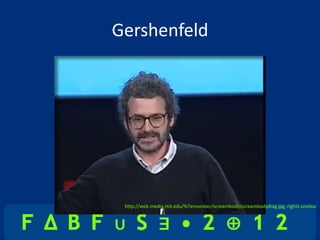
Gershenfeld
[P]ossession of the means for industrial production has long been the
dividing line between workers and owners. But if those means are easily
acquired, and designs freely shared, then hardware is likely to follow the
evolution of software. Like its software counterpart, opensource
hardware is starting with simple fabrication functions, while nipping at
the heels of complacent companies that don’t believe that personal
fabrication “toys” can do the work of their “real” machines. That
boundary will recede until today’s marketplace evolves into a continuum
from creators to consumers, servicing markets ranging from one to one
billion. (FAB. The Coming Revolution on Your Desktop, 2005)
Gershenfeld


 http://web.media.mit.edu/%7emonster/screambody/screambodydiag.jpg, rights unclear
Gershenfeld
[T]he killer app for personal fabrication in the developed world is

technology for a market of one, personal expression in technology (…).

And the killer app for the rest of the planet is [to overcome] the

instrumentation and the fabrication divide, people locally developing

solutions to local problems. (TED talk, 2006)
Gershenfeld 2
• Examples from book


                  http://web.media.mit.edu/%7emonster/screambody/screambodydiag.jpg, rights unclear
Anderson
In the Next Industrial Revolution, Atoms Are the
New Bits (Wired, January 25, 2010)
  Local Motors: Rally Fighter
  $50,000 off-road (but street-legal) racer
  “crowdsourced” design, BMW clean diesel engine
Gizmodo, January 26, 2010:
Atoms Are Not Bits; Wired Is Not A Business
Magazine
Rifkin
[T]he conventional top-down organization of society that characterized

much of the economic, social, and political life of the fossil-fuel based

industrial revolutions is giving way to distributed and collaborative

relationships in the emerging green industrial era. We are in the midst of

a profound shift in the very way society is structured, away from

hierarchical power and toward lateral power.
Rifkin
[A] new digital manufacturing revolution now opens up the possibility of

(…) the production of durable goods. In the new era, everyone can

potentially be their own manufacturer (…). Welcome to the world of

distributed manufacturing.
Rifkin
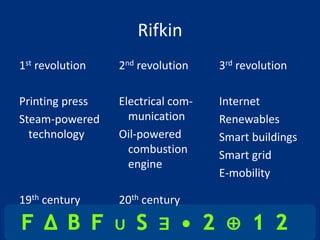
1st revolution   2nd revolution    3rd revolution

Printing press   Electrical com-   Internet
Steam-powered      munication      Renewables
  technology     Oil-powered       Smart buildings
                   combustion      Smart grid
                   engine
                                   E-mobility

19th century     20th century
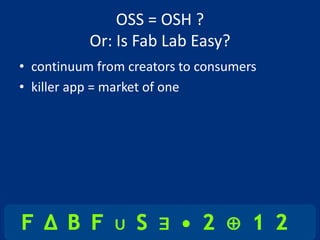
OSS = OSH ?
           Or: Is Fab Lab Easy?
• continuum from creators to consumers
• killer app = market of one
OSS = OSH ?
                  Or: Is Fab Lab Easy?
“[I]t would be naïve to believe that open source software practices could

be simply copied and applied to the manufacturing domain without any

alteration or adaptation, ignoring the constraints and opportunities that

the materiality of hardware entails.”

“[M]ore than four in five Fab Labs are set up and run by institutions

rooted in the old world order that by their very nature struggle to

understand polycentric structures and heterarchies, are alien to lateral

power relationships, and a fail to embrace a peer-production commons.”
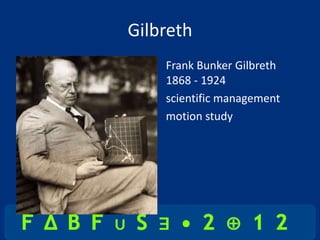
Gilbreth
    Frank Bunker Gilbreth
    1868 - 1924
    scientific management
    motion study
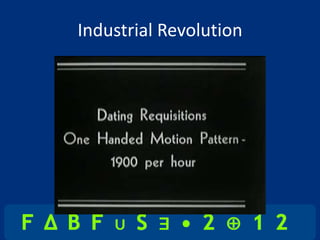
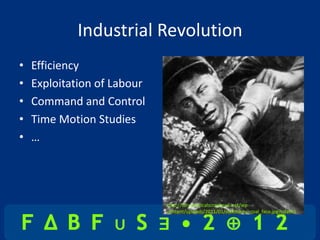
Industrial Revolution
•   Efficiency
•   Exploitation of Labour
•   Command and Control
•   Time Motion Studies
•   …


                             http://cdn.politicalscrapbook.net/wp-
                             content/uploads/2011/01/stakhanov_coal_face.jpg?cda6c1
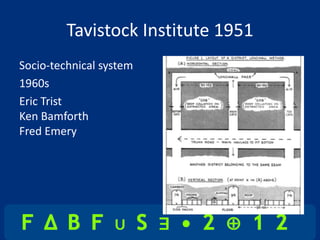
Tavistock Institute 1951
Socio-technical system
1960s
Eric Trist
Ken Bamforth
Fred Emery
HOW TO RUN A FACTORY
Eric Steven Raymond
The Cathedral and the Bazaar (2000)
Linux is subversive.

Linus Torvalds’s style of development—release early and often, delegate
everything you can, be open to the point of promiscuity—came as a surprise.

cathedral … carefully crafted by individual wizards or small bands of mages
working in splendid isolation

a great babbling bazaar of differing agendas and approaches (…) out of
which a coherent and stable system could seemingly emerge only by a
succession of miracles
Raymond
I think the future of open-source software will increasingly belong to

people who know how to play Linus’s game, people who leave behind the

cathedral and embrace the bazaar. This is not to say that individual

vision and brilliance will no longer matter; rather, I think that the cutting

edge of open-source software will belong to people who start from

individual vision and brilliance, then amplify it through the effective

construction of voluntary communities of interest. (p. 23)
Yochai Benkler
on a political economy of information
1. economic—concerned with the organization
   of production and consumption in this
   economy
2. political—concerned with how we pursue
   autonomy, democracy, and social justice in
   this new condition
Kurt Lewin (1952), Field theory in social science: Selected theoretical papers by Kurt Lewin. London: Tavistock. p. 169


THERE IS NOTHING MORE
PRACTICAL THAN A GOOD THEORY
Practice
• in music              • piracy is the new radio’
                          (Neil Young)
• in journalism         • e.g. Huffington Post
• in encyclopedia       • Wikipedia has outgrown
                          its printed predecessors
                          in volume, depth,
                          recency and use.
Yochai Benkler
COMMONS-BASED peer production is a socio-economic system of production
that is emerging in the digitally networked environment. Facilitated by the
technical infrastructure of the Internet, the hallmark of this socio-technical
system is collaboration among large groups of individuals, sometimes in the
order of tens or even hundreds of thousands, who cooperate effectively to
provide information, knowledge or cultural goods without relying on either
market pricing or managerial hierarchies to coordinate their common
enterprise.

      Benkler, Y., and H. Nissenbaum. (2006) Commons-Based Peer Production and Virtue.
                                   The Journal of Political Philosophy 14, no. 4: 394–419.
How do we organize the ecosystem
• Text books
• Industrial practice
• Consultants
Fab now
• Neil Gershenfeld
• “outreach programme”, started 2003
• FAB, the book
 “The future is already here — it's just not very evenly distributed” William Gibson
Landscape
How do we organize the ecosystem
• How to build effective forms of collective action and
  self-organisation, for Fab Labs?
• how to break free from traditional systems and
  creatively design new systems that tap into the
  capabilities of distributed digital manufacturing?
• How to evaluate developments and monitor progress?
• How to achieve equity and fairness?
• How to protect the interests and creative freedom of
  makers while also ensuring wide access to new
  knowledge, processes and products?
• What are appropriate and effective “business models”
  for distributed digital manufacturing?
How?
Option 1
 traditional knowledge of governance
Option 2
 experience from OSS
Option 3
 trial and error, perpetual beta
Option 3+
 what do we know
WHAT DO WE KNOW?
• Ronald H. Coase, 1937
  The Nature of the Firm
• Mancur Olson, 1965
  The Logic of Collective Action
• Oliver E. Williamson, 1981
  The Economics of Organization: The
  Transaction Cost Approach
Ellinor Ostrom
• 1990. Governing the Commons, Cambridge:
  Cambridge University Press.
• with Charlotte Hess, 2003. “Ideas, Artifacts,
  and Facilities: Information as a Common- Pool
  Resource.” Law and Contemporary Problems
  66, Winter/Spring: 111–145.
• with Charlotte Hess, 2007. Understanding
  Knowledge as a Commons. From Theory to
  Practice. Cambridge, MA: MIT Press.
Yochai Benkler
• 2002. “Coase's Penguin, or Linux and the Nature
  of the Firm.” Yale Law Journal, 112: 369–446
• 2003. “Freedom in the Commons: Towards a
  Political Economy of Information.” Duke Law
  Journal 52: 1245–1276.
• 2004. “Sharing nicely: on sharable goods and the
  emergence of sharing as a modality of economic
  production,” Yale Law Journal, 114 , 273–358.
Christian Siefkes
• 2008. “From Exchange to Contributions.
  Generalizing Peer Production Into the Physical
  World.” Berlin: Siefke.
Eric von Hippel
• with Jeroen P J de Jong and Stephen Flowers.
  2010. Comparing Business and Household
  Sector Innovation in Consumer Products:
  Findings From a Representative Study in the
  UK.
• Hippel, von, Eric. “Open Source Projects as
  Horizontal Innovation Networks - by and for
  Users.” MIT Sloan School of Management
  Working Paper.
Tineke M. Egyedi and Donna C. Mehos
• 2012. Inverse Infrastructures. Disrupting
  Networks from Below.
Peter Troxler
• 2010. “Commons-Based Peer-Production of Physical
  Goods Is There Room for a Hybrid Innovation
  Ecology?.” Free Culture Conference, Berlin.
• 2011. “Libraries of the Peer Production Era.” In: Open
  Design Now. Why Design Cannot Remain Exclusive.
• 2012. Making the Third Industrial Revolution. The
  Struggle for Polycentric Structures a New Peer-
  Production Commons in the Fab Lab Community. In:
  Shape your world. Theoretical, empirical and practical
  insights into FabLabs.
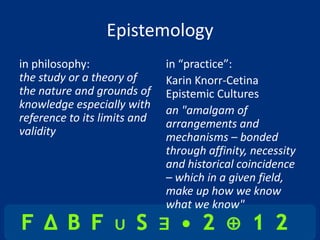
Epistemology
in philosophy:                in “practice”:
the study or a theory of      Karin Knorr-Cetina
the nature and grounds of     Epistemic Cultures
knowledge especially with     an "amalgam of
reference to its limits and   arrangements and
validity                      mechanisms – bonded
                              through affinity, necessity
                              and historical coincidence
                              – which in a given field,
                              make up how we know
                              what we know"
LET’S ORGANIZE THAT 3RD
INDUSTRIAL REVOLUTION
Organize? Really?
• YES
  – banque
  – Lenin
• NO
  – be prepared to get surprised
  – dare to fail
  – disagree, but constructively

Third Industrial Revolution?

  • 1.
  • 2.
    Peter Troxler • IndustrialEngineer – PhD 1999 – Factory Automation – Knowledge Management / Research • Community – Fringe theater company and arts festivals (1990s; 2000s) – Knowledge management researchers (2000s) • Fab Lab – 2008/09 Fab Lab Amsterdam – 2010 Fab6 – Fab Lab Luzern (Switzerland), Rotterdam (NL) – International Fab Lab Association
  • 3.
  • 4.
    Industrial Revolution • NeilGershenfeld, 2005: Fab. The Coming Revolution on Your Desktop • Jeremy Rifkin, 2011: The Third Industrial Revolution. How Lateral Power is Transforming Energy, the Economy, and the World. • Chris Anderson, 2012: Makers: The New Industrial Revolution
  • 5.
    Gershenfeld [P]ossession of themeans for industrial production has long been the dividing line between workers and owners. But if those means are easily acquired, and designs freely shared, then hardware is likely to follow the evolution of software. Like its software counterpart, opensource hardware is starting with simple fabrication functions, while nipping at the heels of complacent companies that don’t believe that personal fabrication “toys” can do the work of their “real” machines. That boundary will recede until today’s marketplace evolves into a continuum from creators to consumers, servicing markets ranging from one to one billion. (FAB. The Coming Revolution on Your Desktop, 2005)
  • 6.
  • 7.
    Gershenfeld [T]he killer appfor personal fabrication in the developed world is technology for a market of one, personal expression in technology (…). And the killer app for the rest of the planet is [to overcome] the instrumentation and the fabrication divide, people locally developing solutions to local problems. (TED talk, 2006)
  • 8.
    Gershenfeld 2 • Examplesfrom book http://web.media.mit.edu/%7emonster/screambody/screambodydiag.jpg, rights unclear
  • 9.
    Anderson In the NextIndustrial Revolution, Atoms Are the New Bits (Wired, January 25, 2010) Local Motors: Rally Fighter $50,000 off-road (but street-legal) racer “crowdsourced” design, BMW clean diesel engine Gizmodo, January 26, 2010: Atoms Are Not Bits; Wired Is Not A Business Magazine
  • 10.
    Rifkin [T]he conventional top-downorganization of society that characterized much of the economic, social, and political life of the fossil-fuel based industrial revolutions is giving way to distributed and collaborative relationships in the emerging green industrial era. We are in the midst of a profound shift in the very way society is structured, away from hierarchical power and toward lateral power.
  • 11.
    Rifkin [A] new digitalmanufacturing revolution now opens up the possibility of (…) the production of durable goods. In the new era, everyone can potentially be their own manufacturer (…). Welcome to the world of distributed manufacturing.
  • 12.
    Rifkin 1st revolution 2nd revolution 3rd revolution Printing press Electrical com- Internet Steam-powered munication Renewables technology Oil-powered Smart buildings combustion Smart grid engine E-mobility 19th century 20th century
  • 13.
    OSS = OSH? Or: Is Fab Lab Easy? • continuum from creators to consumers • killer app = market of one
  • 14.
    OSS = OSH? Or: Is Fab Lab Easy? “[I]t would be naïve to believe that open source software practices could be simply copied and applied to the manufacturing domain without any alteration or adaptation, ignoring the constraints and opportunities that the materiality of hardware entails.” “[M]ore than four in five Fab Labs are set up and run by institutions rooted in the old world order that by their very nature struggle to understand polycentric structures and heterarchies, are alien to lateral power relationships, and a fail to embrace a peer-production commons.”
  • 15.
    Gilbreth Frank Bunker Gilbreth 1868 - 1924 scientific management motion study
  • 16.
  • 17.
    Industrial Revolution • Efficiency • Exploitation of Labour • Command and Control • Time Motion Studies • … http://cdn.politicalscrapbook.net/wp- content/uploads/2011/01/stakhanov_coal_face.jpg?cda6c1
  • 18.
    Tavistock Institute 1951 Socio-technicalsystem 1960s Eric Trist Ken Bamforth Fred Emery
  • 19.
    HOW TO RUNA FACTORY
  • 20.
    Eric Steven Raymond TheCathedral and the Bazaar (2000) Linux is subversive. Linus Torvalds’s style of development—release early and often, delegate everything you can, be open to the point of promiscuity—came as a surprise. cathedral … carefully crafted by individual wizards or small bands of mages working in splendid isolation a great babbling bazaar of differing agendas and approaches (…) out of which a coherent and stable system could seemingly emerge only by a succession of miracles
  • 21.
    Raymond I think thefuture of open-source software will increasingly belong to people who know how to play Linus’s game, people who leave behind the cathedral and embrace the bazaar. This is not to say that individual vision and brilliance will no longer matter; rather, I think that the cutting edge of open-source software will belong to people who start from individual vision and brilliance, then amplify it through the effective construction of voluntary communities of interest. (p. 23)
  • 22.
    Yochai Benkler on apolitical economy of information 1. economic—concerned with the organization of production and consumption in this economy 2. political—concerned with how we pursue autonomy, democracy, and social justice in this new condition
  • 23.
    Kurt Lewin (1952),Field theory in social science: Selected theoretical papers by Kurt Lewin. London: Tavistock. p. 169 THERE IS NOTHING MORE PRACTICAL THAN A GOOD THEORY
  • 24.
    Practice • in music • piracy is the new radio’ (Neil Young) • in journalism • e.g. Huffington Post • in encyclopedia • Wikipedia has outgrown its printed predecessors in volume, depth, recency and use.
  • 25.
    Yochai Benkler COMMONS-BASED peerproduction is a socio-economic system of production that is emerging in the digitally networked environment. Facilitated by the technical infrastructure of the Internet, the hallmark of this socio-technical system is collaboration among large groups of individuals, sometimes in the order of tens or even hundreds of thousands, who cooperate effectively to provide information, knowledge or cultural goods without relying on either market pricing or managerial hierarchies to coordinate their common enterprise. Benkler, Y., and H. Nissenbaum. (2006) Commons-Based Peer Production and Virtue. The Journal of Political Philosophy 14, no. 4: 394–419.
  • 26.
    How do weorganize the ecosystem • Text books • Industrial practice • Consultants
  • 27.
    Fab now • NeilGershenfeld • “outreach programme”, started 2003 • FAB, the book “The future is already here — it's just not very evenly distributed” William Gibson
  • 28.
  • 29.
    How do weorganize the ecosystem • How to build effective forms of collective action and self-organisation, for Fab Labs? • how to break free from traditional systems and creatively design new systems that tap into the capabilities of distributed digital manufacturing? • How to evaluate developments and monitor progress? • How to achieve equity and fairness? • How to protect the interests and creative freedom of makers while also ensuring wide access to new knowledge, processes and products? • What are appropriate and effective “business models” for distributed digital manufacturing?
  • 30.
    How? Option 1 traditionalknowledge of governance Option 2 experience from OSS Option 3 trial and error, perpetual beta Option 3+ what do we know
  • 31.
  • 32.
    • Ronald H.Coase, 1937 The Nature of the Firm • Mancur Olson, 1965 The Logic of Collective Action • Oliver E. Williamson, 1981 The Economics of Organization: The Transaction Cost Approach
  • 33.
    Ellinor Ostrom • 1990.Governing the Commons, Cambridge: Cambridge University Press. • with Charlotte Hess, 2003. “Ideas, Artifacts, and Facilities: Information as a Common- Pool Resource.” Law and Contemporary Problems 66, Winter/Spring: 111–145. • with Charlotte Hess, 2007. Understanding Knowledge as a Commons. From Theory to Practice. Cambridge, MA: MIT Press.
  • 34.
    Yochai Benkler • 2002.“Coase's Penguin, or Linux and the Nature of the Firm.” Yale Law Journal, 112: 369–446 • 2003. “Freedom in the Commons: Towards a Political Economy of Information.” Duke Law Journal 52: 1245–1276. • 2004. “Sharing nicely: on sharable goods and the emergence of sharing as a modality of economic production,” Yale Law Journal, 114 , 273–358.
  • 35.
    Christian Siefkes • 2008.“From Exchange to Contributions. Generalizing Peer Production Into the Physical World.” Berlin: Siefke.
  • 36.
    Eric von Hippel •with Jeroen P J de Jong and Stephen Flowers. 2010. Comparing Business and Household Sector Innovation in Consumer Products: Findings From a Representative Study in the UK. • Hippel, von, Eric. “Open Source Projects as Horizontal Innovation Networks - by and for Users.” MIT Sloan School of Management Working Paper.
  • 37.
    Tineke M. Egyediand Donna C. Mehos • 2012. Inverse Infrastructures. Disrupting Networks from Below.
  • 38.
    Peter Troxler • 2010.“Commons-Based Peer-Production of Physical Goods Is There Room for a Hybrid Innovation Ecology?.” Free Culture Conference, Berlin. • 2011. “Libraries of the Peer Production Era.” In: Open Design Now. Why Design Cannot Remain Exclusive. • 2012. Making the Third Industrial Revolution. The Struggle for Polycentric Structures a New Peer- Production Commons in the Fab Lab Community. In: Shape your world. Theoretical, empirical and practical insights into FabLabs.
  • 39.
    Epistemology in philosophy: in “practice”: the study or a theory of Karin Knorr-Cetina the nature and grounds of Epistemic Cultures knowledge especially with an "amalgam of reference to its limits and arrangements and validity mechanisms – bonded through affinity, necessity and historical coincidence – which in a given field, make up how we know what we know"
  • 40.
    LET’S ORGANIZE THAT3RD INDUSTRIAL REVOLUTION
  • 41.
    Organize? Really? • YES – banque – Lenin • NO – be prepared to get surprised – dare to fail – disagree, but constructively

Editor's Notes

  • #5 Quiz – I have a tradition that in my lectures in the first 5 slides there has to be a quiz (audience participation)
  • #14  “That’s why it is called hardware.” Rein Aardse at FabFuse, 9 August 2012.
  • #15  “That’s why it is called hardware.” Rein Aardse at FabFuse, 9 August 2012.
  • #23 misconception that 1 = 2
  • #25 this is not
  • #40 something that technocrats don’t understand because they are not able to perceive that there are multiple epistemologies … while they love the sci-fi stories of parallel universes …!!!give Ronen workshop example (exercise with audience)