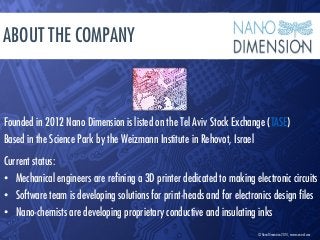
Nano Dimension is an Israeli company developing a desktop 3D printer dedicated to printing electric circuits. The printer uses sophisticated inkjet printheads to precisely deposit proprietary conductive and insulating nanotech inks layer-by-layer to produce multi-layer printed circuit boards. This additive manufacturing technique allows for faster prototyping of circuits and small-scale production compared to traditional manufacturing methods.



![[Startup Nations Summit 2014] Competition - Taiwan](https://cdn.slidesharecdn.com/ss_thumbnails/taiwanptmaterial-140929090856-phpapp02-thumbnail.jpg?width=640&height=640&fit=bounds)
![[Startup Nations Summit 2014] Competition - Philippines](https://cdn.slidesharecdn.com/ss_thumbnails/philliphines-140929090609-phpapp01-thumbnail.jpg?width=640&height=640&fit=bounds)
![[Startup Nations Summit 2014] Competition - Jamaica](https://cdn.slidesharecdn.com/ss_thumbnails/presentation-141004043144-conversion-gate02-thumbnail.jpg?width=640&height=640&fit=bounds)
![[Startup Nations Summit 2014] Competition - China - Beijing](https://cdn.slidesharecdn.com/ss_thumbnails/presentation-141004042145-conversion-gate02-thumbnail.jpg?width=640&height=640&fit=bounds)
![[Startup Nations Summit 2014] Competition - Singapore](https://cdn.slidesharecdn.com/ss_thumbnails/singaporeptmaterialpptx-140929090727-phpapp01-thumbnail.jpg?width=640&height=640&fit=bounds)
![[Startup Nations Summit 2014] Competition - Greece](https://cdn.slidesharecdn.com/ss_thumbnails/miroculusdeckstartupnations-141010010938-conversion-gate02-thumbnail.jpg?width=640&height=640&fit=bounds)
![[Startup Nations Summit 2014] Competition - India](https://cdn.slidesharecdn.com/ss_thumbnails/presentation-141004042747-conversion-gate02-thumbnail.jpg?width=640&height=640&fit=bounds)
![[Startup Nations Summit 2014] Competition - Russia](https://cdn.slidesharecdn.com/ss_thumbnails/34-140929090654-phpapp01-thumbnail.jpg?width=640&height=640&fit=bounds)
![[Startup Nations Summit 2014] Competition - Qatar](https://cdn.slidesharecdn.com/ss_thumbnails/fitechnologies-presentation-141010053147-conversion-gate01-thumbnail.jpg?width=640&height=640&fit=bounds)
![[Startup Nations Summit 2014] Competition - Croatia](https://cdn.slidesharecdn.com/ss_thumbnails/5-141001071633-phpapp02-thumbnail.jpg?width=640&height=640&fit=bounds)
![[Startup Nations Summit 2014] Competition - Romania](https://cdn.slidesharecdn.com/ss_thumbnails/43-140929215137-phpapp01-thumbnail.jpg?width=640&height=640&fit=bounds)
![[Startup Nations Summit 2014] Competition - Spain](https://cdn.slidesharecdn.com/ss_thumbnails/spainpresentationmaterial1pdf-140929090824-phpapp01-thumbnail.jpg?width=640&height=640&fit=bounds)
![[Startup Nations Summit 2014] Competition - Iceland](https://cdn.slidesharecdn.com/ss_thumbnails/presentation-141004042331-conversion-gate02-thumbnail.jpg?width=640&height=640&fit=bounds)
![[Startup Nations Summit 2014] Competition - Cambodia](https://cdn.slidesharecdn.com/ss_thumbnails/presentation-141004043106-conversion-gate02-thumbnail.jpg?width=640&height=640&fit=bounds)
![[Startup Nations Summit 2014] Competition - Chile](https://cdn.slidesharecdn.com/ss_thumbnails/babybepresentationstartupnation-141007201534-conversion-gate02-thumbnail.jpg?width=640&height=640&fit=bounds)
![[Startup Nations Summit 2014] Competition - Thailand](https://cdn.slidesharecdn.com/ss_thumbnails/thailandptmaterial-140929090926-phpapp01-thumbnail.jpg?width=640&height=640&fit=bounds)
![[Startup Nations Summit 2014] Competition - Ukraine](https://cdn.slidesharecdn.com/ss_thumbnails/ukraineptmaterial-140929090955-phpapp01-thumbnail.jpg?width=640&height=640&fit=bounds)
![[Startup Nations Summit 2014] Competition - Korea](https://cdn.slidesharecdn.com/ss_thumbnails/presentation-141004042828-conversion-gate02-thumbnail.jpg?width=640&height=640&fit=bounds)
![[Startup Nations Summit 2014] Competition - Lithuania](https://cdn.slidesharecdn.com/ss_thumbnails/lithuaniaptmaterial-141004040010-conversion-gate02-thumbnail.jpg?width=640&height=640&fit=bounds)
![[Startup Nations Summit 2014] Competition - Vietnam](https://cdn.slidesharecdn.com/ss_thumbnails/vietnamptmaterialpptx-140929091056-phpapp02-thumbnail.jpg?width=640&height=640&fit=bounds)


