Research Assignment

GROUP MEMBERS: KIMBERLEY EE SZE ANN (0315319),

KAWTHAR RASHID JEEWA (0314832)
LEE YAUE SHEN (0315381),
YUAN KHAI SHIEN (0314818),

KELVIN NG (0315381),
NOR AYUNI BINTI NORDIN (0315072).
Topic: Interpersonal Attraction



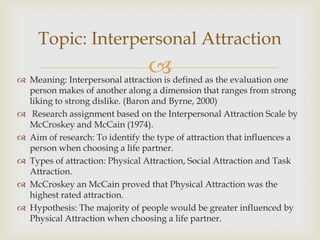
 Meaning: Interpersonal attraction is defined as the evaluation one
person makes of another along a dimension that ranges from strong
liking to strong dislike. (Baron and Byrne, 2000)
 Research assignment based on the Interpersonal Attraction Scale by
McCroskey and McCain (1974).
 Aim of research: To identify the type of attraction that influences a
person when choosing a life partner.
 Types of attraction: Physical Attraction, Social Attraction and Task
Attraction.
 McCroskey an McCain proved that Physical Attraction was the
highest rated attraction.
 Hypothesis: The majority of people would be greater influenced by
Physical Attraction when choosing a life partner.
Method

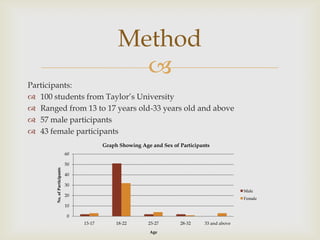
Participants:
 100 students from Taylor’s University
 Ranged from 13 to 17 years old-33 years old and above
 57 male participants
 43 female participants
Graph Showing Age and Sex of Participants
60
No. of Participants

50
40

30
Male

20

Female

10
0
13-17

18-22

23-27
Age

28-32

33 and above
Method

Materials/Apparatus:
 Questionnaires were used to collect data from participants
 Also to identify participants general demographics (sex and
age)
 Participants were asked questions relating to the Interpersonal
Attraction Scale
 Participants were asked to identify the type of individual they
would be answering the survey about:
a. A committed partner
b. A new/casual partner
c. An ideal partner
Method

Procedure:
 Participants were informed that the study was to investigate the
types of attraction that influence a person when choosing a life
partner.
 The purpose of the survey was clearly printed on the
questionnaire .
 Participants were verbally informed that they had the right to
withdraw from the survey at any time.
 The participants were each handed a questionnaire and given
some time to fill in the answers.
 The questionnaires were collected once participants were ready
to hand them in.
Results

No of Participants

Graph of Types of Attraction Desired by Females in a Committed
Partner
4.5
4
3.5
3
2.5
2
1.5
1
0.5
0

Physical Attraction
Social Attraction
Task Attraction

13-17

18-22

23-27

28-32

33 and above

Age

Types of Attraction Desired by Females in a Committed Partner:
 Female participants aged 13-17 = Physical Attraction
 Female participants aged 33 and above = Physical Attraction
 Female participants aged 18-22 = Social Attraction
 Female participants aged 28-32 = Social Attraction.
Results


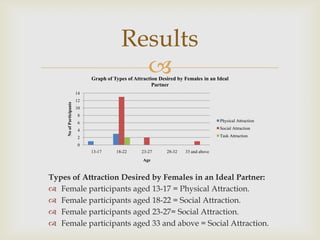
Graph of Types of Attraction Desired by Females in an Ideal
Partner

No of Participants

14
12
10
8
6

Physical Attraction

4

Social Attraction

2

Task Attraction

0
13-17

18-22

23-27

28-32

33 and above

Age

Types of Attraction Desired by Females in an Ideal Partner:
 Female participants aged 13-17 = Physical Attraction.
 Female participants aged 18-22 = Social Attraction.
 Female participants aged 23-27= Social Attraction.
 Female participants aged 33 and above = Social Attraction.
Results


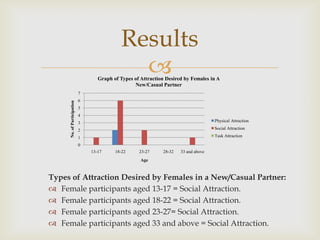
Graph of Types of Attraction Desired by Females in A
New/Casual Partner
No. of Participation

7
6
5
4
3

Physical Attraction

2

Social Attraction

1

Task Attraction

0
13-17

18-22

23-27

28-32

33 and above

Age

Types of Attraction Desired by Females in a New/Casual Partner:
 Female participants aged 13-17 = Social Attraction.
 Female participants aged 18-22 = Social Attraction.
 Female participants aged 23-27= Social Attraction.
 Female participants aged 33 and above = Social Attraction.
Results


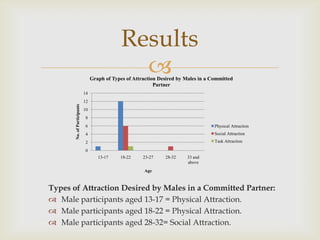
Graph of Types of Attraction Desired by Males in a Committed
Partner
14
No. of Participants

12
10
8
6

Physical Attraction

4

Social Attraction

2

Task Attraction

0
13-17

18-22

23-27

28-32

33 and
above

Age

Types of Attraction Desired by Males in a Committed Partner:
 Male participants aged 13-17 = Physical Attraction.
 Male participants aged 18-22 = Physical Attraction.
 Male participants aged 28-32= Social Attraction.
Results


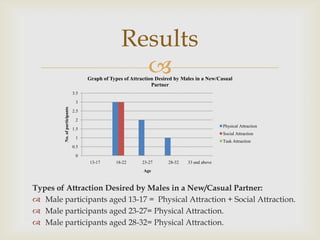
Graph of Types of Attraction Desired by Males in a New/Casual
Partner
3.5

No. of participants

3
2.5
2
Physical Attraction

1.5

Social Attraction
1

Task Attraction

0.5
0
13-17

18-22

23-27

28-32

33 and above

Age

Types of Attraction Desired by Males in a New/Casual Partner:
 Male participants aged 13-17 = Physical Attraction + Social Attraction.
 Male participants aged 23-27= Physical Attraction.
 Male participants aged 28-32= Physical Attraction.
DISCUSSION
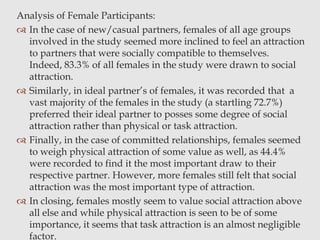
Analysis of Female Participants:
 In the case of new/casual partners, females of all age groups
involved in the study seemed more inclined to feel an attraction
to partners that were socially compatible to themselves.
Indeed, 83.3% of all females in the study were drawn to social
attraction.
 Similarly, in ideal partner’s of females, it was recorded that a
vast majority of the females in the study (a startling 72.7%)
preferred their ideal partner to posses some degree of social
attraction rather than physical or task attraction.
 Finally, in the case of committed relationships, females seemed
to weigh physical attraction of some value as well, as 44.4%
were recorded to find it the most important draw to their
respective partner. However, more females still felt that social
attraction was the most important type of attraction.
 In closing, females mostly seem to value social attraction above
all else and while physical attraction is seen to be of some
importance, it seems that task attraction is an almost negligible
factor.
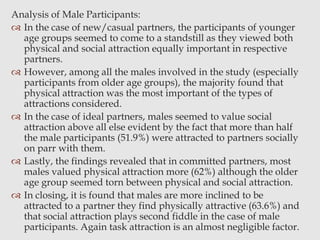
Analysis of Male Participants:
 In the case of new/casual partners, the participants of younger
age groups seemed to come to a standstill as they viewed both
physical and social attraction equally important in respective
partners.
 However, among all the males involved in the study (especially
participants from older age groups), the majority found that
physical attraction was the most important of the types of
attractions considered.
 In the case of ideal partners, males seemed to value social
attraction above all else evident by the fact that more than half
the male participants (51.9%) were attracted to partners socially
on parr with them.
 Lastly, the findings revealed that in committed partners, most
males valued physical attraction more (62%) although the older
age group seemed torn between physical and social attraction.
 In closing, it is found that males are more inclined to be
attracted to a partner they find physically attractive (63.6%) and
that social attraction plays second fiddle in the case of male
participants. Again task attraction is an almost negligible factor.
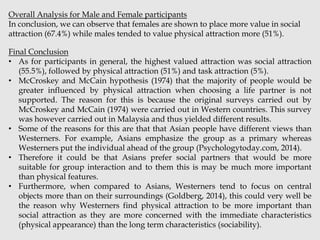
Overall Analysis for Male and Female participants
In conclusion, we can observe that females are shown to place more value in social
attraction (67.4%) while males tended to value physical attraction more (51%).
Final Conclusion
• As for participants in general, the highest valued attraction was social attraction
(55.5%), followed by physical attraction (51%) and task attraction (5%).
• McCroskey and McCain hypothesis (1974) that the majority of people would be
greater influenced by physical attraction when choosing a life partner is not
supported. The reason for this is because the original surveys carried out by
McCroskey and McCain (1974) were carried out in Western countries. This survey
was however carried out in Malaysia and thus yielded different results.
• Some of the reasons for this are that that Asian people have different views than
Westerners. For example, Asians emphasize the group as a primary whereas
Westerners put the individual ahead of the group (Psychologytoday.com, 2014).
• Therefore it could be that Asians prefer social partners that would be more
suitable for group interaction and to them this is may be much more important
than physical features.
• Furthermore, when compared to Asians, Westerners tend to focus on central
objects more than on their surroundings (Goldberg, 2014), this could very well be
the reason why Westerners find physical attraction to be more important than
social attraction as they are more concerned with the immediate characteristics
(physical appearance) than the long term characteristics (sociability).
References

1. Goldberg, C. (2014). Differences between east and west discovered in people’s brain activity the tech. [online] Retrieved from: http://tech.mit.edu/V128/N9/culture.html [Accessed:
21 Jan 2014].
2. Jamescmccroskey.com. (2014). Feelings about communicating with others. [online]
Retrieved from:
http://www.jamescmccroskey.com/measures/attraction_interpersonal.htm [Accessed:
21 Jan 2014].
3. Jamescmccroskey.com. (2014). [online] Retrieved from:
http://www.jamescmccroskey.com/publications/057.pdf [Accessed: 21 Jan 2014].
4. Midss.org. (2014). Measures of interpersonal attraction | measurement instrument database
for the social sciences. [online] Retrieved from: http://www.midss.org/content/measuresinterpersonal-attraction [Accessed: 21 Jan 2014].
5. Psychologytoday.com. (2014). Is there a difference between psyches east and west? [online]
Retrieved from: http://www.psychologytoday.com/blog/am-i-right/201304/is-theredifference-between-psyches-east-and-west [Accessed: 21 Jan 2014].

Presentation

  • 1.
    Research Assignment GROUP MEMBERS:KIMBERLEY EE SZE ANN (0315319), KAWTHAR RASHID JEEWA (0314832) LEE YAUE SHEN (0315381), YUAN KHAI SHIEN (0314818), KELVIN NG (0315381), NOR AYUNI BINTI NORDIN (0315072).
  • 2.
    Topic: Interpersonal Attraction  Meaning: Interpersonal attraction is defined as the evaluation one person makes of another along a dimension that ranges from strong liking to strong dislike. (Baron and Byrne, 2000)  Research assignment based on the Interpersonal Attraction Scale by McCroskey and McCain (1974).  Aim of research: To identify the type of attraction that influences a person when choosing a life partner.  Types of attraction: Physical Attraction, Social Attraction and Task Attraction.  McCroskey an McCain proved that Physical Attraction was the highest rated attraction.  Hypothesis: The majority of people would be greater influenced by Physical Attraction when choosing a life partner.
  • 3.
    Method  Participants:  100 studentsfrom Taylor’s University  Ranged from 13 to 17 years old-33 years old and above  57 male participants  43 female participants Graph Showing Age and Sex of Participants 60 No. of Participants 50 40 30 Male 20 Female 10 0 13-17 18-22 23-27 Age 28-32 33 and above
  • 4.
    Method  Materials/Apparatus:  Questionnaires wereused to collect data from participants  Also to identify participants general demographics (sex and age)  Participants were asked questions relating to the Interpersonal Attraction Scale  Participants were asked to identify the type of individual they would be answering the survey about: a. A committed partner b. A new/casual partner c. An ideal partner
  • 5.
    Method  Procedure:  Participants wereinformed that the study was to investigate the types of attraction that influence a person when choosing a life partner.  The purpose of the survey was clearly printed on the questionnaire .  Participants were verbally informed that they had the right to withdraw from the survey at any time.  The participants were each handed a questionnaire and given some time to fill in the answers.  The questionnaires were collected once participants were ready to hand them in.
  • 6.
    Results  No of Participants Graphof Types of Attraction Desired by Females in a Committed Partner 4.5 4 3.5 3 2.5 2 1.5 1 0.5 0 Physical Attraction Social Attraction Task Attraction 13-17 18-22 23-27 28-32 33 and above Age Types of Attraction Desired by Females in a Committed Partner:  Female participants aged 13-17 = Physical Attraction  Female participants aged 33 and above = Physical Attraction  Female participants aged 18-22 = Social Attraction  Female participants aged 28-32 = Social Attraction.
  • 7.
    Results  Graph of Typesof Attraction Desired by Females in an Ideal Partner No of Participants 14 12 10 8 6 Physical Attraction 4 Social Attraction 2 Task Attraction 0 13-17 18-22 23-27 28-32 33 and above Age Types of Attraction Desired by Females in an Ideal Partner:  Female participants aged 13-17 = Physical Attraction.  Female participants aged 18-22 = Social Attraction.  Female participants aged 23-27= Social Attraction.  Female participants aged 33 and above = Social Attraction.
  • 8.
    Results  Graph of Typesof Attraction Desired by Females in A New/Casual Partner No. of Participation 7 6 5 4 3 Physical Attraction 2 Social Attraction 1 Task Attraction 0 13-17 18-22 23-27 28-32 33 and above Age Types of Attraction Desired by Females in a New/Casual Partner:  Female participants aged 13-17 = Social Attraction.  Female participants aged 18-22 = Social Attraction.  Female participants aged 23-27= Social Attraction.  Female participants aged 33 and above = Social Attraction.
  • 9.
    Results  Graph of Typesof Attraction Desired by Males in a Committed Partner 14 No. of Participants 12 10 8 6 Physical Attraction 4 Social Attraction 2 Task Attraction 0 13-17 18-22 23-27 28-32 33 and above Age Types of Attraction Desired by Males in a Committed Partner:  Male participants aged 13-17 = Physical Attraction.  Male participants aged 18-22 = Physical Attraction.  Male participants aged 28-32= Social Attraction.
  • 11.
    Results  Graph of Typesof Attraction Desired by Males in a New/Casual Partner 3.5 No. of participants 3 2.5 2 Physical Attraction 1.5 Social Attraction 1 Task Attraction 0.5 0 13-17 18-22 23-27 28-32 33 and above Age Types of Attraction Desired by Males in a New/Casual Partner:  Male participants aged 13-17 = Physical Attraction + Social Attraction.  Male participants aged 23-27= Physical Attraction.  Male participants aged 28-32= Physical Attraction.
  • 12.
  • 13.
    Analysis of FemaleParticipants:  In the case of new/casual partners, females of all age groups involved in the study seemed more inclined to feel an attraction to partners that were socially compatible to themselves. Indeed, 83.3% of all females in the study were drawn to social attraction.  Similarly, in ideal partner’s of females, it was recorded that a vast majority of the females in the study (a startling 72.7%) preferred their ideal partner to posses some degree of social attraction rather than physical or task attraction.  Finally, in the case of committed relationships, females seemed to weigh physical attraction of some value as well, as 44.4% were recorded to find it the most important draw to their respective partner. However, more females still felt that social attraction was the most important type of attraction.  In closing, females mostly seem to value social attraction above all else and while physical attraction is seen to be of some importance, it seems that task attraction is an almost negligible factor.
  • 14.
    Analysis of MaleParticipants:  In the case of new/casual partners, the participants of younger age groups seemed to come to a standstill as they viewed both physical and social attraction equally important in respective partners.  However, among all the males involved in the study (especially participants from older age groups), the majority found that physical attraction was the most important of the types of attractions considered.  In the case of ideal partners, males seemed to value social attraction above all else evident by the fact that more than half the male participants (51.9%) were attracted to partners socially on parr with them.  Lastly, the findings revealed that in committed partners, most males valued physical attraction more (62%) although the older age group seemed torn between physical and social attraction.  In closing, it is found that males are more inclined to be attracted to a partner they find physically attractive (63.6%) and that social attraction plays second fiddle in the case of male participants. Again task attraction is an almost negligible factor.
  • 15.
    Overall Analysis forMale and Female participants In conclusion, we can observe that females are shown to place more value in social attraction (67.4%) while males tended to value physical attraction more (51%). Final Conclusion • As for participants in general, the highest valued attraction was social attraction (55.5%), followed by physical attraction (51%) and task attraction (5%). • McCroskey and McCain hypothesis (1974) that the majority of people would be greater influenced by physical attraction when choosing a life partner is not supported. The reason for this is because the original surveys carried out by McCroskey and McCain (1974) were carried out in Western countries. This survey was however carried out in Malaysia and thus yielded different results. • Some of the reasons for this are that that Asian people have different views than Westerners. For example, Asians emphasize the group as a primary whereas Westerners put the individual ahead of the group (Psychologytoday.com, 2014). • Therefore it could be that Asians prefer social partners that would be more suitable for group interaction and to them this is may be much more important than physical features. • Furthermore, when compared to Asians, Westerners tend to focus on central objects more than on their surroundings (Goldberg, 2014), this could very well be the reason why Westerners find physical attraction to be more important than social attraction as they are more concerned with the immediate characteristics (physical appearance) than the long term characteristics (sociability).
  • 16.
    References  1. Goldberg, C.(2014). Differences between east and west discovered in people’s brain activity the tech. [online] Retrieved from: http://tech.mit.edu/V128/N9/culture.html [Accessed: 21 Jan 2014]. 2. Jamescmccroskey.com. (2014). Feelings about communicating with others. [online] Retrieved from: http://www.jamescmccroskey.com/measures/attraction_interpersonal.htm [Accessed: 21 Jan 2014]. 3. Jamescmccroskey.com. (2014). [online] Retrieved from: http://www.jamescmccroskey.com/publications/057.pdf [Accessed: 21 Jan 2014]. 4. Midss.org. (2014). Measures of interpersonal attraction | measurement instrument database for the social sciences. [online] Retrieved from: http://www.midss.org/content/measuresinterpersonal-attraction [Accessed: 21 Jan 2014]. 5. Psychologytoday.com. (2014). Is there a difference between psyches east and west? [online] Retrieved from: http://www.psychologytoday.com/blog/am-i-right/201304/is-theredifference-between-psyches-east-and-west [Accessed: 21 Jan 2014].