S
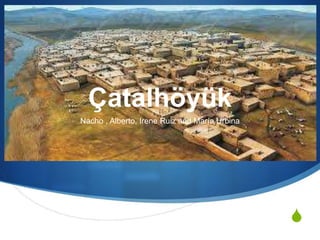
Çatalhöyük
Nacho , Alberto, Irene Ruiz and María Urbina
S
INDEX:
• Introduction
• Culture
• Buildings
• Religion
• Archaeology
S
INTRODUCTION:
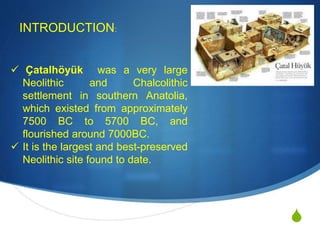
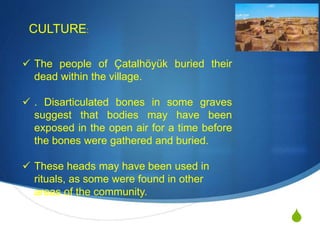
 Çatalhöyük was a very large
Neolithic and Chalcolithic
settlement in southern Anatolia,
which existed from approximately
7500 BC to 5700 BC, and
flourished around 7000BC.
 It is the largest and best-preserved
Neolithic site found to date.
S
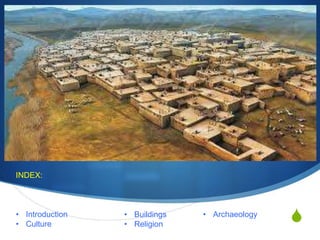
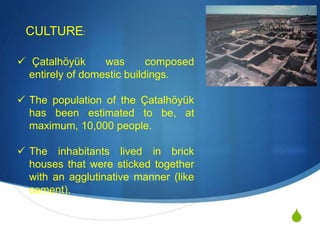
 Çatalhöyük was composed
entirely of domestic buildings.
 The population of the Çatalhöyük
has been estimated to be, at
maximum, 10,000 people.
 The inhabitants lived in brick
houses that were sticked together
with an agglutinative manner (like
cement).
CULTURE:
S
CULTURE:
 The people of Çatalhöyük buried their
dead within the village.
 . Disarticulated bones in some graves
suggest that bodies may have been
exposed in the open air for a time before
the bones were gathered and buried.
 These heads may have been used in
rituals, as some were found in other
areas of the community.
S
BUILDINGS
 Residential buldings that are rectangular
made of adobe like townhouses whitout
streets.
 Becouse of the position of the houses it
form a wall that can protect the villagers.
 The inside of the house are plastered and
they had very clean rooms.
S
RELIGION
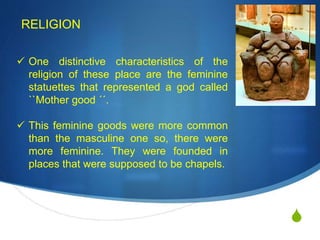
 One distinctive characteristics of the
religion of these place are the feminine
statuettes that represented a god called
``Mother good ´´.
 This feminine goods were more common
than the masculine one so, there were
more feminine. They were founded in
places that were supposed to be chapels.
S
RELIGION
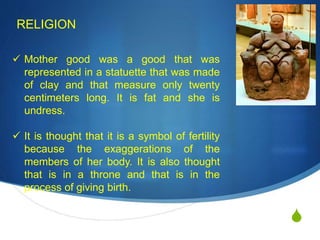
 Mother good was a good that was
represented in a statuette that was made
of clay and that measure only twenty
centimeters long. It is fat and she is
undress.
 It is thought that it is a symbol of fertility
because the exaggerations of the
members of her body. It is also thought
that is in a throne and that is in the
process of giving birth.
S
RELIGION
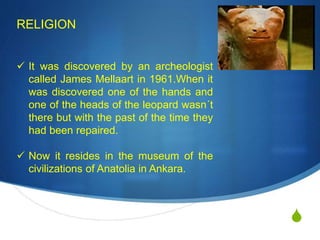
 It was discovered by an archeologist
called James Mellaart in 1961.When it
was discovered one of the hands and
one of the heads of the leopard wasn´t
there but with the past of the time they
had been repaired.
 Now it resides in the museum of the
civilizations of Anatolia in Ankara.
S
ARCHAEOLOGY
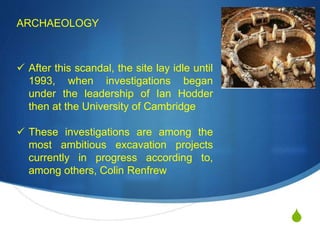
 After this scandal, the site lay idle until
1993, when investigations began
under the leadership of Ian Hodder
then at the University of Cambridge
 These investigations are among the
most ambitious excavation projects
currently in progress according to,
among others, Colin Renfrew
S
ARCHAEOLOGY
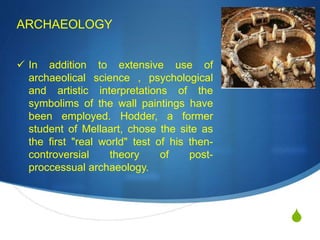
 In addition to extensive use of
archaeolical science , psychological
and artistic interpretations of the
symbolims of the wall paintings have
been employed. Hodder, a former
student of Mellaart, chose the site as
the first "real world" test of his then-
controversial theory of post-
proccessual archaeology.
S
VIDEO

Presentacion

  • 2.
    S Çatalhöyük Nacho , Alberto,Irene Ruiz and María Urbina
  • 3.
    S INDEX: • Introduction • Culture •Buildings • Religion • Archaeology
  • 4.
    S INTRODUCTION:  Çatalhöyük wasa very large Neolithic and Chalcolithic settlement in southern Anatolia, which existed from approximately 7500 BC to 5700 BC, and flourished around 7000BC.  It is the largest and best-preserved Neolithic site found to date.
  • 5.
    S  Çatalhöyük wascomposed entirely of domestic buildings.  The population of the Çatalhöyük has been estimated to be, at maximum, 10,000 people.  The inhabitants lived in brick houses that were sticked together with an agglutinative manner (like cement). CULTURE:
  • 6.
    S CULTURE:  The peopleof Çatalhöyük buried their dead within the village.  . Disarticulated bones in some graves suggest that bodies may have been exposed in the open air for a time before the bones were gathered and buried.  These heads may have been used in rituals, as some were found in other areas of the community.
  • 7.
    S BUILDINGS  Residential buldingsthat are rectangular made of adobe like townhouses whitout streets.  Becouse of the position of the houses it form a wall that can protect the villagers.  The inside of the house are plastered and they had very clean rooms.
  • 8.
    S RELIGION  One distinctivecharacteristics of the religion of these place are the feminine statuettes that represented a god called ``Mother good ´´.  This feminine goods were more common than the masculine one so, there were more feminine. They were founded in places that were supposed to be chapels.
  • 9.
    S RELIGION  Mother goodwas a good that was represented in a statuette that was made of clay and that measure only twenty centimeters long. It is fat and she is undress.  It is thought that it is a symbol of fertility because the exaggerations of the members of her body. It is also thought that is in a throne and that is in the process of giving birth.
  • 10.
    S RELIGION  It wasdiscovered by an archeologist called James Mellaart in 1961.When it was discovered one of the hands and one of the heads of the leopard wasn´t there but with the past of the time they had been repaired.  Now it resides in the museum of the civilizations of Anatolia in Ankara.
  • 11.
    S ARCHAEOLOGY  After thisscandal, the site lay idle until 1993, when investigations began under the leadership of Ian Hodder then at the University of Cambridge  These investigations are among the most ambitious excavation projects currently in progress according to, among others, Colin Renfrew
  • 12.
    S ARCHAEOLOGY  In additionto extensive use of archaeolical science , psychological and artistic interpretations of the symbolims of the wall paintings have been employed. Hodder, a former student of Mellaart, chose the site as the first "real world" test of his then- controversial theory of post- proccessual archaeology.
  • 13.