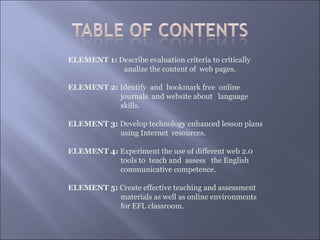
ELEMENT 1: Describe evaluation criteria to critically
            analize the content of web pages.

ELEMENT 2: Identify and bookmark free online
           journals and website about language
           skills.

ELEMENT 3: Develop technology enhanced lesson plans
           using Internet resources.

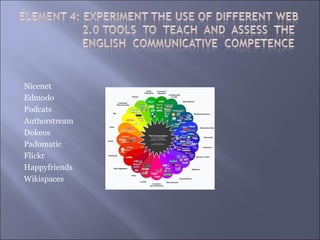
ELEMENT 4: Experiment the use of different web 2.0
           tools to teach and assess the English
           communicative competence.

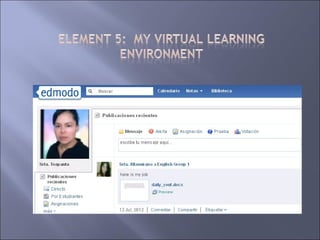
ELEMENT 5: Create effective teaching and assessment
           materials as well as online environments
           for EFL classroom.
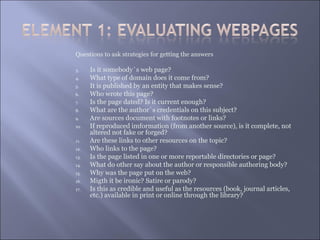
Questions to ask strategies for getting the answers

3.    Is it somebody`s web page?
4.    What type of domain does it come from?
5.    It is published by an entity that makes sense?
6.    Who wrote this page?
7.    Is the page dated? Is it current enough?
8.    What are the author`s credentials on this subject?
9.    Are sources document with footnotes or links?
10.   If reproduced imformation (from another source), is it complete, not
      altered not fake or forged?
11.   Are these links to other resources on the topic?
12.   Who links to the page?
13.   Is the page listed in one or more reportable directories or page?
14.   What do other say about the author or responsible authoring body?
15.   Why was the page put on the web?
16.   Migth it be ironic? Satire or parody?
17.   Is this as credible and useful as the resources (book, journal articles,
      etc.) available in print or online through the library?
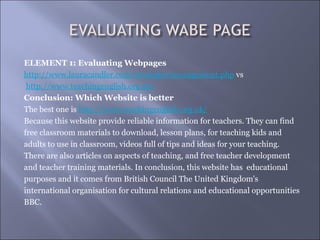
ELEMENT 1: Evaluating Webpages
http://www.lauracandler.com/strategies/management.php vs
 http://www.teachingenglish.org.uk/
Conclusion: Which Website is better
The best one is http://www.teachingenglish.org.uk/
Because this website provide reliable information for teachers. They can find
free classroom materials to download, lesson plans, for teaching kids and
adults to use in classroom, videos full of tips and ideas for your teaching.
There are also articles on aspects of teaching, and free teacher development
and teacher training materials. In conclusion, this website has educational
purposes and it comes from British Council The United Kingdom's
international organisation for cultural relations and educational opportunities
BBC.
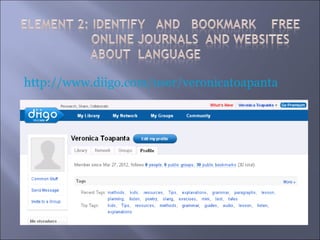
http://www.diigo.com/user/veronicatoapanta
Diigo is powerfull internet tool that allow us to save , classify,
highligh imformation, acess any information anywhere, as
well as share it with any one we want.

Performing this assigment was really productived , because I
learned how to use it in the classroom. In the past I used to
write the URL in a notebook. Today I can keep everything well
 organized in my library. For instance, I can save the URL, add
tittle, descriptions and tags in order to find easly and quicky.
QUESTIONS LESSON PLANNING

1.  Who are the learners?
2.  What is their English level?
3.  How long is the lesson going to last?
4.  What is the topic of the lesson?
5.  What are they going to learn in this lesson? (learning objectives)
6.  What materials and technology resources are they going to use?
7.  Are the activities in this lesson plan logically organized?
8.  Will the activities employed by the teacher helps students to achieve the lesson
    objectives?
9. Do you think the students will have enough practice?
10. Is the assessment according to the lesson objectives?
11. Is the homework assignment aimed to help students to have extra practice in the
    topic studies in class?
12. If you had to teach this lesson tomorrow, would this lesson plan help you?
Blogs in Education
Questions 1:
How would you define therm blog?
A blog is an online diary which contains your reflections, opinions,
thoughts, etc about any topic that you want. Furthermore, it allows
you update information and keep a record of them. In conclusion, a
blog ia a useful tool web 2.0 to comment and build relationships
with your readers.
There are three types og blogs for use in ESL classroom
   such as:

   Tutor blog.- It is used to give extra information, as
    well as other links for helping Ss in their learning
    process.

   Learner blog.- It is created by each Ss. Or small groups
    of Ss to help then to develop their reading and writing
    skills.

   Class blog.- It is a collaborative blog of an entire class.
    It is used for collaborative activities like: assignments,
    projects, etc.
Nicenet
Edmodo
Podcats
Authorstream
Dokeos
Padomatic
Flickr
Happyfriends
Wikispaces
Class: English Group 1

Level: Beginners

Topic: Adverbs of frequency

Objective: The main objective of this VLE is to provide extrainformation
and practice to the Ss of fourth grade of “Bachillerato”.
The students are teenagers from 15 to 16 year. They have a beginner
level. In this VLE I give them a great opportunity to put in practice their
knowledge acquired and develop their language skills. I included some
resources such as : a video, PPT, questions and answers. As an
evaluation I made a quiz in order to test students their knowledge

Group code: qol81p
The principal aim of my VLE is to provide extra information and practice to
the students of fourth grade of “Bachillerato” of Juan Francisco Montalvo .
The students are teenagers from 15 to 16 years old. They are beginners
English learners level .This VLE give them a great opportunity to put in
practice their knowledge acquire and develop their language skills. I
included in this VLE some resources such as: videos, slides presentations,
questions and answers. As an evaluation I made a quiz in order to test
students their knowledge. The code for Edmodo is qol81p

Presentación1 vero

  • 2.
    ELEMENT 1: Describeevaluation criteria to critically analize the content of web pages. ELEMENT 2: Identify and bookmark free online journals and website about language skills. ELEMENT 3: Develop technology enhanced lesson plans using Internet resources. ELEMENT 4: Experiment the use of different web 2.0 tools to teach and assess the English communicative competence. ELEMENT 5: Create effective teaching and assessment materials as well as online environments for EFL classroom.
  • 3.
    Questions to askstrategies for getting the answers 3. Is it somebody`s web page? 4. What type of domain does it come from? 5. It is published by an entity that makes sense? 6. Who wrote this page? 7. Is the page dated? Is it current enough? 8. What are the author`s credentials on this subject? 9. Are sources document with footnotes or links? 10. If reproduced imformation (from another source), is it complete, not altered not fake or forged? 11. Are these links to other resources on the topic? 12. Who links to the page? 13. Is the page listed in one or more reportable directories or page? 14. What do other say about the author or responsible authoring body? 15. Why was the page put on the web? 16. Migth it be ironic? Satire or parody? 17. Is this as credible and useful as the resources (book, journal articles, etc.) available in print or online through the library?
  • 4.
    ELEMENT 1: EvaluatingWebpages http://www.lauracandler.com/strategies/management.php vs http://www.teachingenglish.org.uk/ Conclusion: Which Website is better The best one is http://www.teachingenglish.org.uk/ Because this website provide reliable information for teachers. They can find free classroom materials to download, lesson plans, for teaching kids and adults to use in classroom, videos full of tips and ideas for your teaching. There are also articles on aspects of teaching, and free teacher development and teacher training materials. In conclusion, this website has educational purposes and it comes from British Council The United Kingdom's international organisation for cultural relations and educational opportunities BBC.
  • 5.
  • 6.
    Diigo is powerfullinternet tool that allow us to save , classify, highligh imformation, acess any information anywhere, as well as share it with any one we want. Performing this assigment was really productived , because I learned how to use it in the classroom. In the past I used to write the URL in a notebook. Today I can keep everything well organized in my library. For instance, I can save the URL, add tittle, descriptions and tags in order to find easly and quicky.
  • 7.
    QUESTIONS LESSON PLANNING 1. Who are the learners? 2. What is their English level? 3. How long is the lesson going to last? 4. What is the topic of the lesson? 5. What are they going to learn in this lesson? (learning objectives) 6. What materials and technology resources are they going to use? 7. Are the activities in this lesson plan logically organized? 8. Will the activities employed by the teacher helps students to achieve the lesson objectives? 9. Do you think the students will have enough practice? 10. Is the assessment according to the lesson objectives? 11. Is the homework assignment aimed to help students to have extra practice in the topic studies in class? 12. If you had to teach this lesson tomorrow, would this lesson plan help you?
  • 8.
    Blogs in Education Questions1: How would you define therm blog? A blog is an online diary which contains your reflections, opinions, thoughts, etc about any topic that you want. Furthermore, it allows you update information and keep a record of them. In conclusion, a blog ia a useful tool web 2.0 to comment and build relationships with your readers.
  • 9.
    There are threetypes og blogs for use in ESL classroom such as:  Tutor blog.- It is used to give extra information, as well as other links for helping Ss in their learning process.  Learner blog.- It is created by each Ss. Or small groups of Ss to help then to develop their reading and writing skills.  Class blog.- It is a collaborative blog of an entire class. It is used for collaborative activities like: assignments, projects, etc.
  • 10.
  • 12.
    Class: English Group1 Level: Beginners Topic: Adverbs of frequency Objective: The main objective of this VLE is to provide extrainformation and practice to the Ss of fourth grade of “Bachillerato”. The students are teenagers from 15 to 16 year. They have a beginner level. In this VLE I give them a great opportunity to put in practice their knowledge acquired and develop their language skills. I included some resources such as : a video, PPT, questions and answers. As an evaluation I made a quiz in order to test students their knowledge Group code: qol81p
  • 13.
    The principal aimof my VLE is to provide extra information and practice to the students of fourth grade of “Bachillerato” of Juan Francisco Montalvo . The students are teenagers from 15 to 16 years old. They are beginners English learners level .This VLE give them a great opportunity to put in practice their knowledge acquire and develop their language skills. I included in this VLE some resources such as: videos, slides presentations, questions and answers. As an evaluation I made a quiz in order to test students their knowledge. The code for Edmodo is qol81p