blancafort   Grammar
blancafort                 Grammar


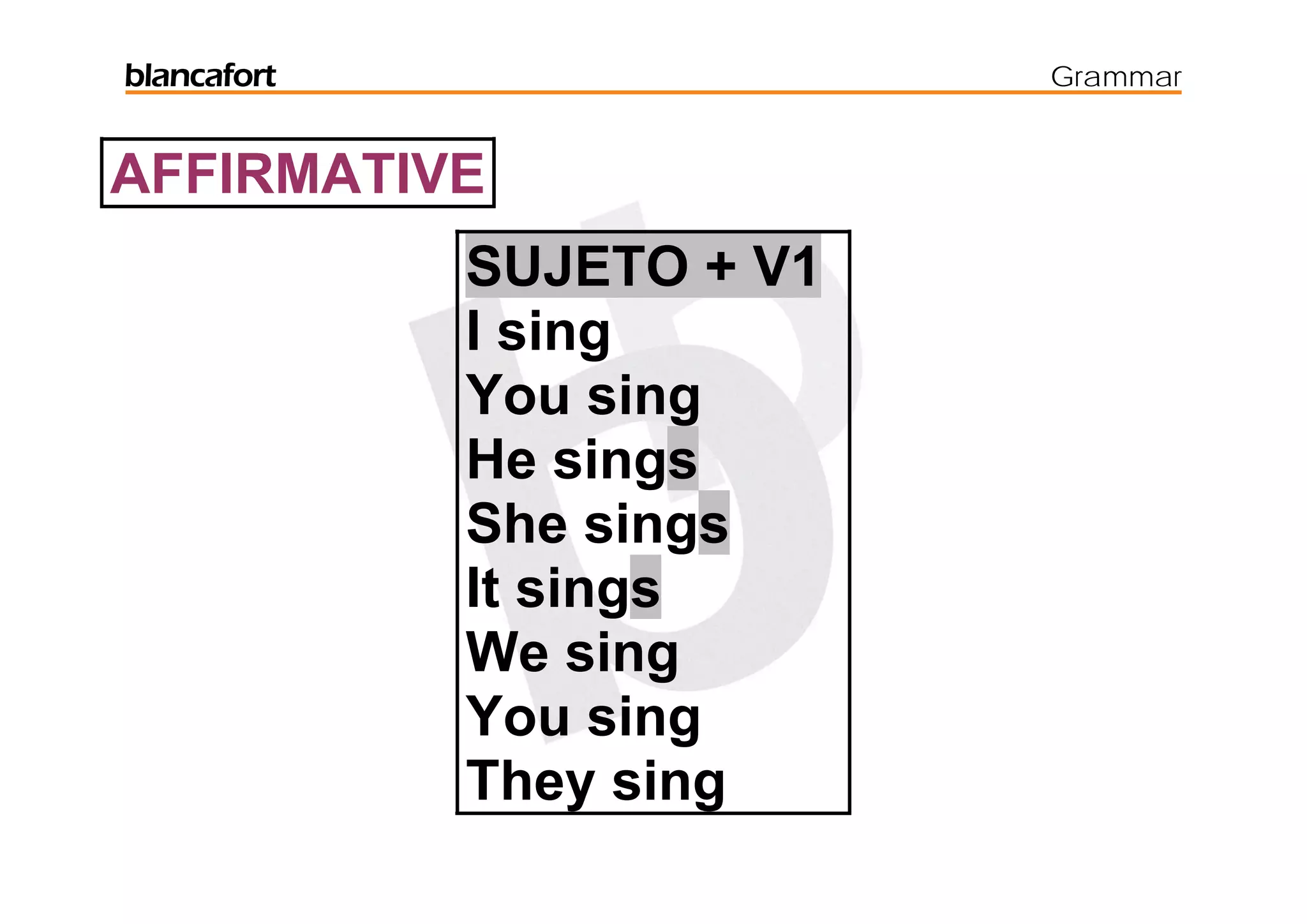
AFFIRMATIVE
             SUJETO + V1
             I sing
             You sing
             He sings
             She sings
             It sings
             We sing
             You sing
             They sing
blancafort                Grammar


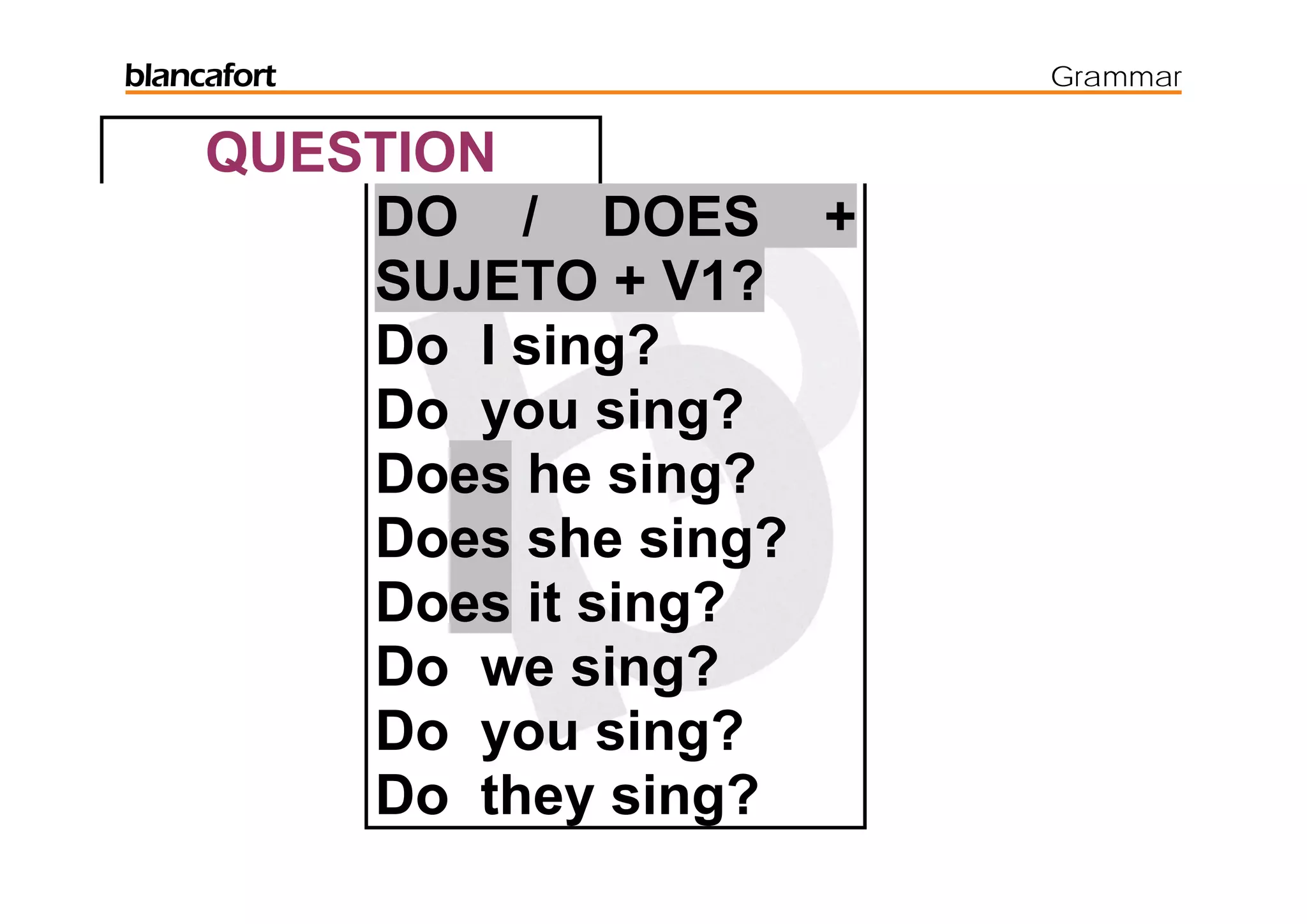
     QUESTION
         DO / DOES +
         SUJETO + V1?
         Do I sing?
         Do you sing?
         Does he sing?
         Does she sing?
         Does it sing?
         Do we sing?
         Do you sing?
         Do they sing?
blancafort                                   Grammar

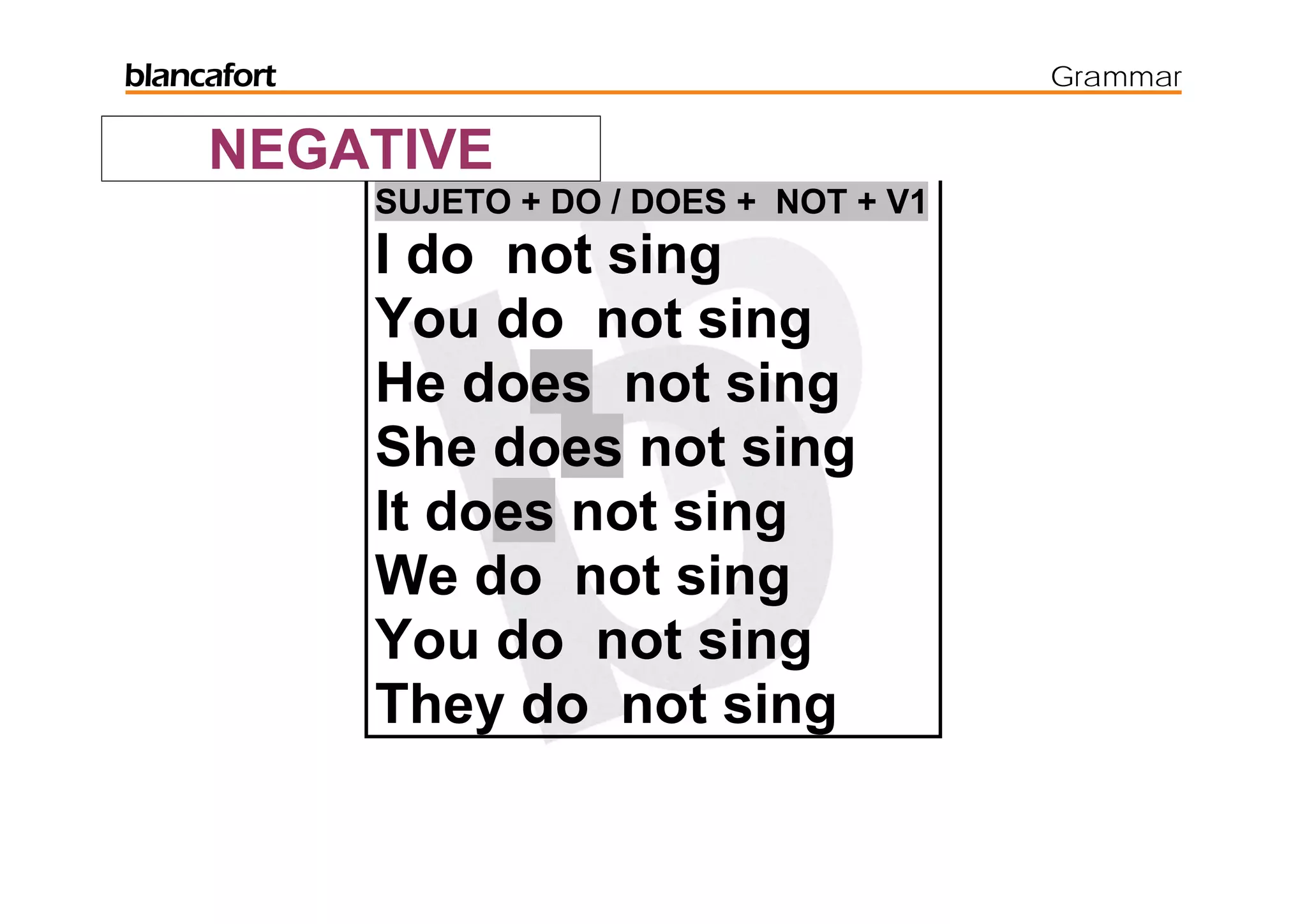
     NEGATIVE
             SUJETO + DO / DOES + NOT + V1
             I do not sing
             You do not sing
             He does not sing
             She does not sing
             It does not sing
             We do not sing
             You do not sing
             They do not sing
blancafort                                                                                Grammar
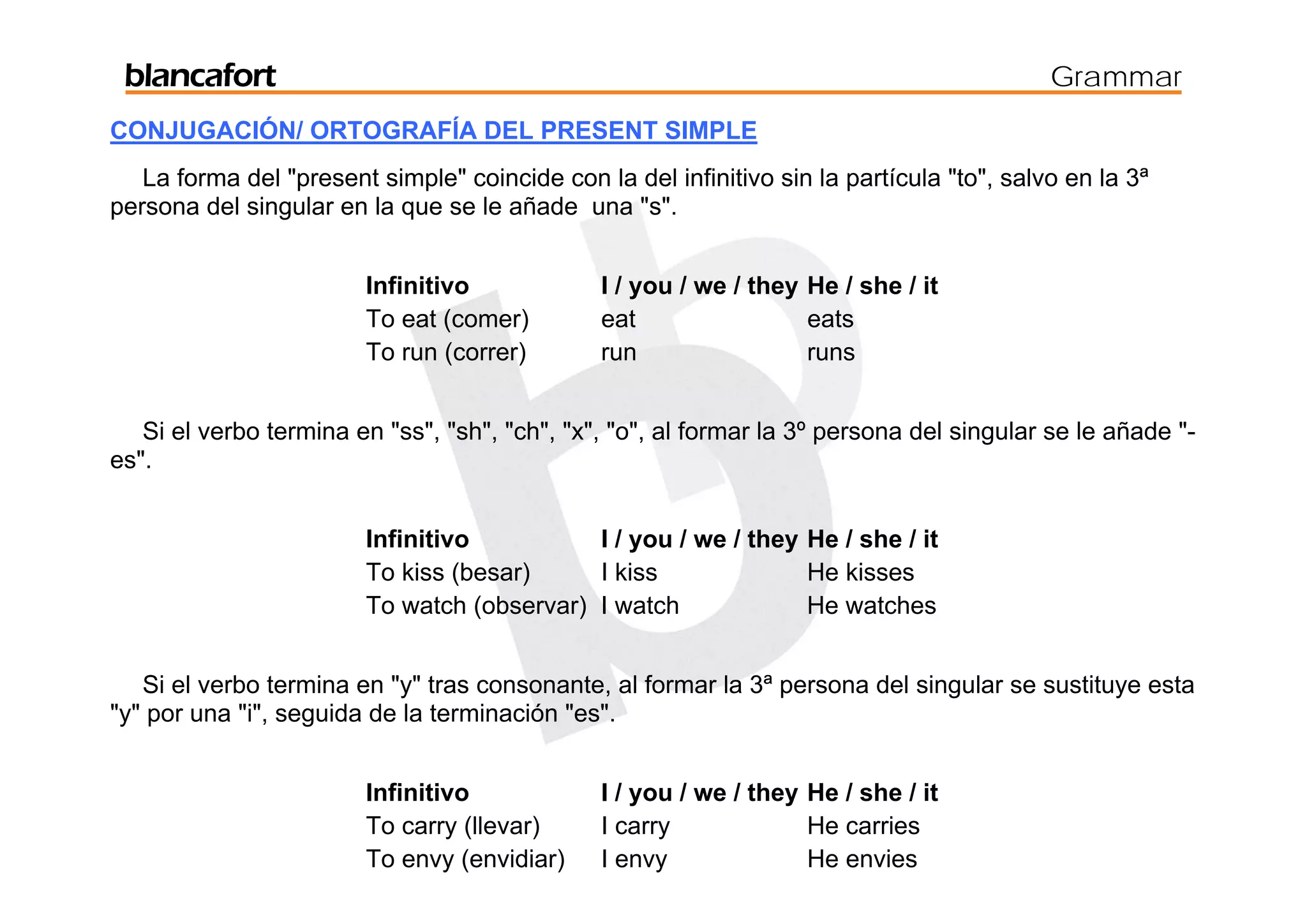
CONJUGACIÓN/ ORTOGRAFÍA DEL PRESENT SIMPLE
   La forma del "present simple" coincide con la del infinitivo sin la partícula "to", salvo en la 3ª
persona del singular en la que se le añade una "s".


                        Infinitivo             I / you / we / they He / she / it
                        To eat (comer)         eat                 eats
                        To run (correr)        run                 runs


   Si el verbo termina en "ss", "sh", "ch", "x", "o", al formar la 3º persona del singular se le añade "-
es".


                        Infinitivo          I / you / we / they He / she / it
                        To kiss (besar)     I kiss              He kisses
                        To watch (observar) I watch             He watches


   Si el verbo termina en "y" tras consonante, al formar la 3ª persona del singular se sustituye esta
"y" por una "i", seguida de la terminación "es".


                        Infinitivo             I / you / we / they He / she / it
                        To carry (llevar)      I carry             He carries
                        To envy (envidiar)     I envy              He envies
blancafort                                                                             Grammar


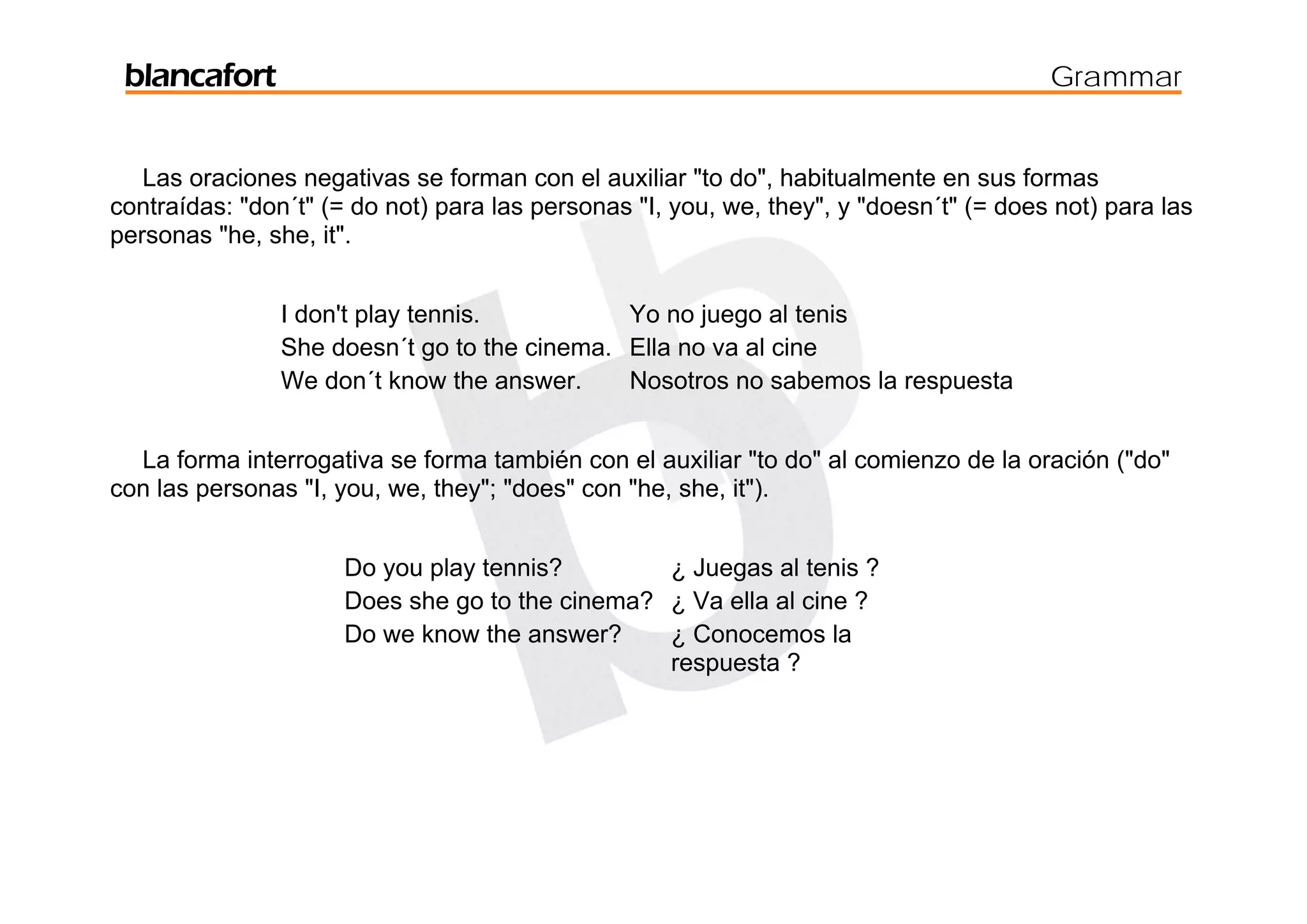
   Las oraciones negativas se forman con el auxiliar "to do", habitualmente en sus formas
contraídas: "don´t" (= do not) para las personas "I, you, we, they", y "doesn´t" (= does not) para las
personas "he, she, it".


                I don't play tennis.          Yo no juego al tenis
                She doesn´t go to the cinema. Ella no va al cine
                We don´t know the answer.     Nosotros no sabemos la respuesta


  La forma interrogativa se forma también con el auxiliar "to do" al comienzo de la oración ("do"
con las personas "I, you, we, they"; "does" con "he, she, it").


                      Do you play tennis?        ¿ Juegas al tenis ?
                      Does she go to the cinema? ¿ Va ella al cine ?
                      Do we know the answer?     ¿ Conocemos la
                                                 respuesta ?
blancafort                                                                         Grammar
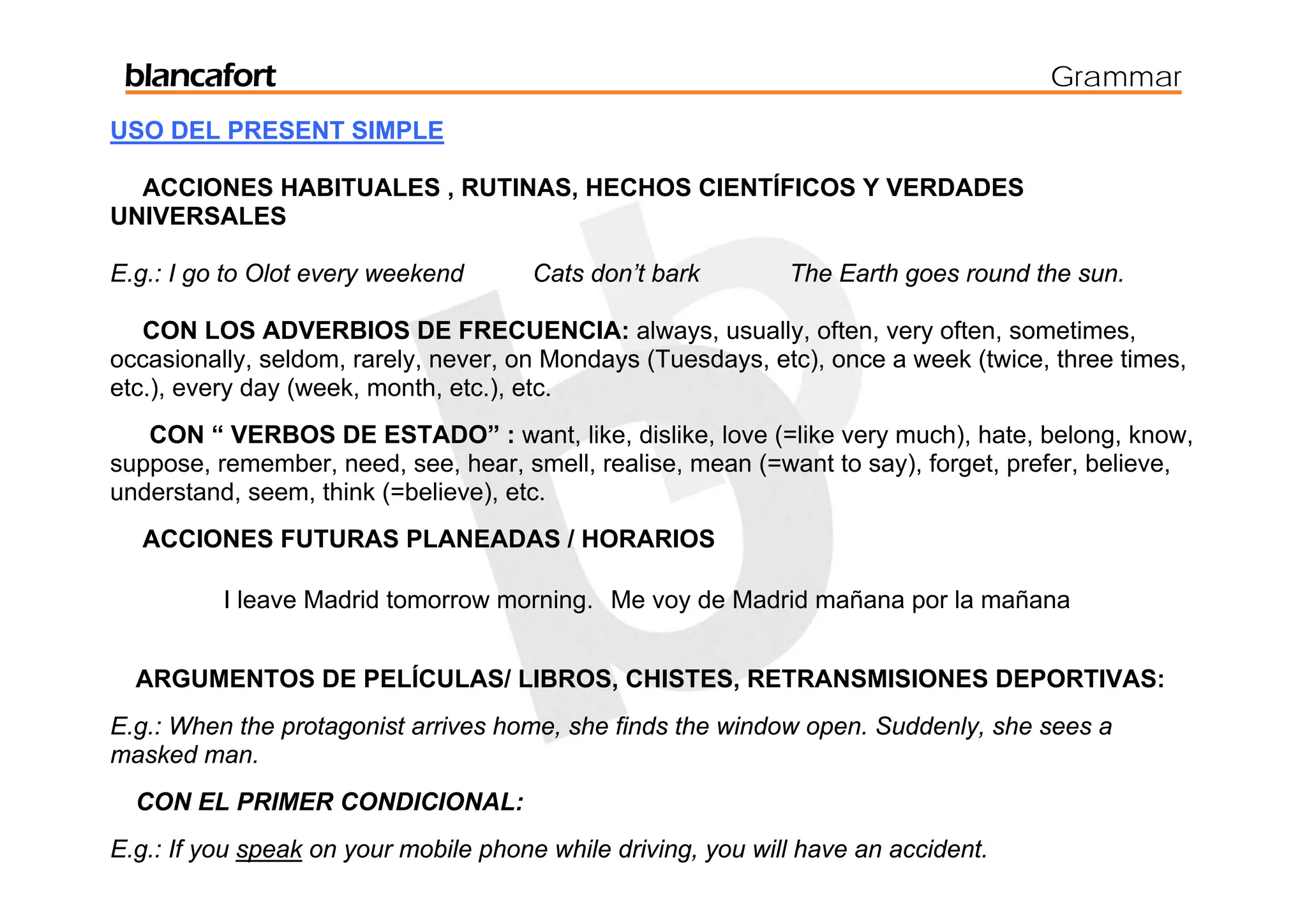
USO DEL PRESENT SIMPLE

  ACCIONES HABITUALES , RUTINAS, HECHOS CIENTÍFICOS Y VERDADES
UNIVERSALES

E.g.: I go to Olot every weekend      Cats don’t bark         The Earth goes round the sun.

   CON LOS ADVERBIOS DE FRECUENCIA: always, usually, often, very often, sometimes,
occasionally, seldom, rarely, never, on Mondays (Tuesdays, etc), once a week (twice, three times,
etc.), every day (week, month, etc.), etc.
   CON “ VERBOS DE ESTADO” : want, like, dislike, love (=like very much), hate, belong, know,
suppose, remember, need, see, hear, smell, realise, mean (=want to say), forget, prefer, believe,
understand, seem, think (=believe), etc.
  ACCIONES FUTURAS PLANEADAS / HORARIOS

          I leave Madrid tomorrow morning. Me voy de Madrid mañana por la mañana


  ARGUMENTOS DE PELÍCULAS/ LIBROS, CHISTES, RETRANSMISIONES DEPORTIVAS:
E.g.: When the protagonist arrives home, she finds the window open. Suddenly, she sees a
masked man.
  CON EL PRIMER CONDICIONAL:
E.g.: If you speak on your mobile phone while driving, you will have an accident.

Present simple

  • 1.
    blancafort Grammar
  • 2.
    blancafort Grammar AFFIRMATIVE SUJETO + V1 I sing You sing He sings She sings It sings We sing You sing They sing
  • 3.
    blancafort Grammar QUESTION DO / DOES + SUJETO + V1? Do I sing? Do you sing? Does he sing? Does she sing? Does it sing? Do we sing? Do you sing? Do they sing?
  • 4.
    blancafort Grammar NEGATIVE SUJETO + DO / DOES + NOT + V1 I do not sing You do not sing He does not sing She does not sing It does not sing We do not sing You do not sing They do not sing
  • 5.
    blancafort Grammar CONJUGACIÓN/ ORTOGRAFÍA DEL PRESENT SIMPLE La forma del "present simple" coincide con la del infinitivo sin la partícula "to", salvo en la 3ª persona del singular en la que se le añade una "s". Infinitivo I / you / we / they He / she / it To eat (comer) eat eats To run (correr) run runs Si el verbo termina en "ss", "sh", "ch", "x", "o", al formar la 3º persona del singular se le añade "- es". Infinitivo I / you / we / they He / she / it To kiss (besar) I kiss He kisses To watch (observar) I watch He watches Si el verbo termina en "y" tras consonante, al formar la 3ª persona del singular se sustituye esta "y" por una "i", seguida de la terminación "es". Infinitivo I / you / we / they He / she / it To carry (llevar) I carry He carries To envy (envidiar) I envy He envies
  • 6.
    blancafort Grammar Las oraciones negativas se forman con el auxiliar "to do", habitualmente en sus formas contraídas: "don´t" (= do not) para las personas "I, you, we, they", y "doesn´t" (= does not) para las personas "he, she, it". I don't play tennis. Yo no juego al tenis She doesn´t go to the cinema. Ella no va al cine We don´t know the answer. Nosotros no sabemos la respuesta La forma interrogativa se forma también con el auxiliar "to do" al comienzo de la oración ("do" con las personas "I, you, we, they"; "does" con "he, she, it"). Do you play tennis? ¿ Juegas al tenis ? Does she go to the cinema? ¿ Va ella al cine ? Do we know the answer? ¿ Conocemos la respuesta ?
  • 7.
    blancafort Grammar USO DEL PRESENT SIMPLE ACCIONES HABITUALES , RUTINAS, HECHOS CIENTÍFICOS Y VERDADES UNIVERSALES E.g.: I go to Olot every weekend Cats don’t bark The Earth goes round the sun. CON LOS ADVERBIOS DE FRECUENCIA: always, usually, often, very often, sometimes, occasionally, seldom, rarely, never, on Mondays (Tuesdays, etc), once a week (twice, three times, etc.), every day (week, month, etc.), etc. CON “ VERBOS DE ESTADO” : want, like, dislike, love (=like very much), hate, belong, know, suppose, remember, need, see, hear, smell, realise, mean (=want to say), forget, prefer, believe, understand, seem, think (=believe), etc. ACCIONES FUTURAS PLANEADAS / HORARIOS I leave Madrid tomorrow morning. Me voy de Madrid mañana por la mañana ARGUMENTOS DE PELÍCULAS/ LIBROS, CHISTES, RETRANSMISIONES DEPORTIVAS: E.g.: When the protagonist arrives home, she finds the window open. Suddenly, she sees a masked man. CON EL PRIMER CONDICIONAL: E.g.: If you speak on your mobile phone while driving, you will have an accident.