Le Participe PrésentLe Participe Présent
Using the Present Participle inUsing the Present Participle in
French!French!
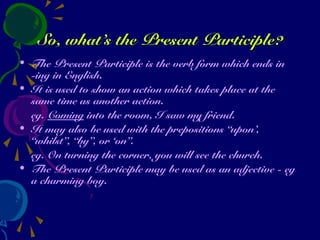
So, what’s the Present Participle?So, what’s the Present Participle?
• The Present Participle is the verb form which ends in
-ing in English.
• It is used to show an action which takes place at the
same time as another action.
eg. Coming into the room, I saw my friend.
• It may also be used with the prepositions “upon’,
“whilst”, “by”, or ‘on”.
eg. On turning the corner, you will see the church.
• The Present Participle may be used as an adjective - eg
a charming boy.
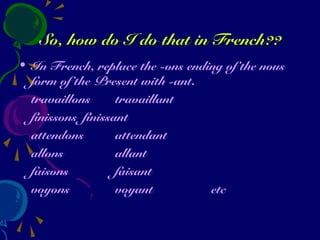
So, how do I do that in French??So, how do I do that in French??
• In French, replace the -ons ending of the nous
form of the Present with -ant.
travaillons travaillant
finissons finissant
attendons attendant
allons allant
faisons faisant
voyons voyant etc
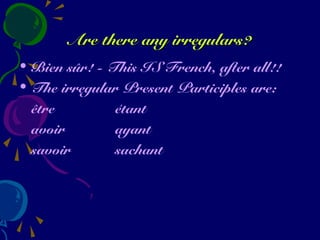
Are there any irregulars?Are there any irregulars?
• Bien sûr! - This IS French, after all!!
• The irregular Present Participles are:
être étant
avoir ayant
savoir sachant
And how do I USE it in French?And how do I USE it in French?
• Basically, the Present Participle is used in the same
way as in English.
• As a verb, to show simultaneous action.
Entrant dans la pièce, j’ai vu mon copain.
• With the preposition “en” - no other preposition may
be used. En translates as ‘whilst’, ‘by’, ‘upon’ or ‘on’.
En tournant le coin, tu verras l’église.
• As an adjective - it then agrees.
un garçon charmant, une fille charmante
When NOT to use it!When NOT to use it!
• DON’T use it to try to form a tense.
I am working is only ever je travaille.
I was working may only be je travaillais.
• DON’T use it with any preposition other than “en”. Use
the INFINITIVE instead.
Il est parti, sous la pluie, sans me parler, sans me
regarder.
• DON’T use it after verbs of perception - again, use the
INFINITIVE.
J’entends jouer les enfants. I hear the children playing.
(Note word order.)
Form the Present Participle...Form the Present Participle...
• parler
• choisir
• entendre
• aller
• faire
• lire
• écrire
• devoir
• parlant
• choisissant
• entendant
• allant
• faisant
• lisant
• écrivant
• devant (yep, cd be confusing)
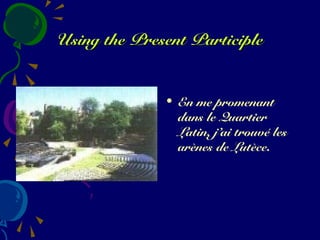
Using the Present ParticipleUsing the Present Participle
• En me promenant
dans le Quartier
Latin, j’ai trouvé les
arènes de Lutèce.
Using the present ParticipleUsing the present Participle
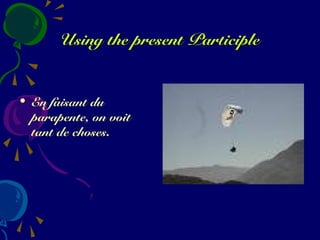
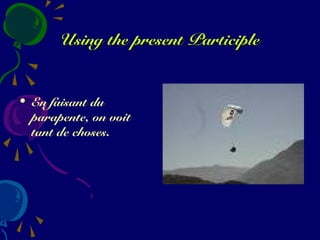
• En faisant du
parapente, on voit
tant de choses.
Using the present ParticipleUsing the present Participle
• En faisant du
parapente, on voit
tant de choses.

Present participle ppt

  • 1.
    Le Participe PrésentLeParticipe Présent Using the Present Participle inUsing the Present Participle in French!French!
  • 2.
    So, what’s thePresent Participle?So, what’s the Present Participle? • The Present Participle is the verb form which ends in -ing in English. • It is used to show an action which takes place at the same time as another action. eg. Coming into the room, I saw my friend. • It may also be used with the prepositions “upon’, “whilst”, “by”, or ‘on”. eg. On turning the corner, you will see the church. • The Present Participle may be used as an adjective - eg a charming boy.
  • 3.
    So, how doI do that in French??So, how do I do that in French?? • In French, replace the -ons ending of the nous form of the Present with -ant. travaillons travaillant finissons finissant attendons attendant allons allant faisons faisant voyons voyant etc
  • 4.
    Are there anyirregulars?Are there any irregulars? • Bien sûr! - This IS French, after all!! • The irregular Present Participles are: être étant avoir ayant savoir sachant
  • 5.
    And how doI USE it in French?And how do I USE it in French? • Basically, the Present Participle is used in the same way as in English. • As a verb, to show simultaneous action. Entrant dans la pièce, j’ai vu mon copain. • With the preposition “en” - no other preposition may be used. En translates as ‘whilst’, ‘by’, ‘upon’ or ‘on’. En tournant le coin, tu verras l’église. • As an adjective - it then agrees. un garçon charmant, une fille charmante
  • 6.
    When NOT touse it!When NOT to use it! • DON’T use it to try to form a tense. I am working is only ever je travaille. I was working may only be je travaillais. • DON’T use it with any preposition other than “en”. Use the INFINITIVE instead. Il est parti, sous la pluie, sans me parler, sans me regarder. • DON’T use it after verbs of perception - again, use the INFINITIVE. J’entends jouer les enfants. I hear the children playing. (Note word order.)
  • 7.
    Form the PresentParticiple...Form the Present Participle... • parler • choisir • entendre • aller • faire • lire • écrire • devoir • parlant • choisissant • entendant • allant • faisant • lisant • écrivant • devant (yep, cd be confusing)
  • 8.
    Using the PresentParticipleUsing the Present Participle • En me promenant dans le Quartier Latin, j’ai trouvé les arènes de Lutèce.
  • 9.
    Using the presentParticipleUsing the present Participle • En faisant du parapente, on voit tant de choses.
  • 10.
    Using the presentParticipleUsing the present Participle • En faisant du parapente, on voit tant de choses.