
GC Cloud Working Group
PJH
Cloud KICKSTART:
Preparing your Department to Consume Public
Cloud
EA DAY – September 29, 2017
Presented by Paul J Harding
(a pragmatic discussion for low-maturity Departments)
Please leave feedback for this workshop to myself @
paul@innogov.ca or Troy @ troy.macfarlane@tbs-sct.gc.ca .
So the next workshop can be better!
2
There is a follow-up workshop being planned for end of
October for Government broad.
Agenda
• Introductions
• GC Cloud Adoption update
• Buying Cloud from SSC – Scott Levac
• Shifting our Culture
• Being Agile
• Getting Started on a Cloud Program
• Portfolio Assessment and Selecting POC apps.
• Discussion
3
A relevant workshop for the audience…
Who’s here, where are you with Cloud?
4
TBS Cloud Guidance Documents
5
Government of Canada Cloud
Adoption Strategy
Government of Canada Security Control Profile
for Cloud-based GC IT Services
Government of Canada Right Cloud
Selection Guidance
Updates…
• PB is being worked on within GC Cloud Ninja Team
• GC Cloud Roundtable is discussing top issues, strategies, needs.
• GC Cloud Working Group is soon being revitalized.
• SSC Cloud RFP was closed in summer.
• SSC Cloud Vehicle is for Unclass only, (discuss other conditions)
6
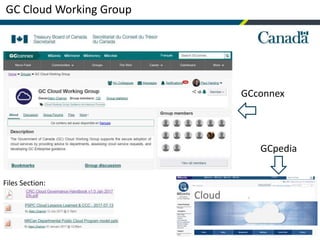
Files Section:
GCpedia
GCconnex
GC Cloud Working Group
Buying Cloud from SSC
Scott Levac, SSC
8
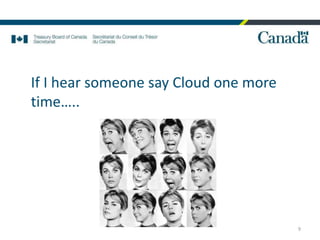
If I hear someone say Cloud one more
time…..
9
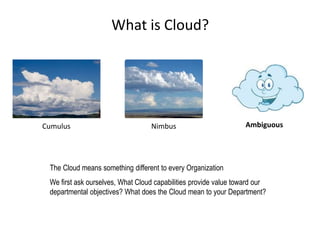
What is Cloud?
AmbiguousCumulus Nimbus
The Cloud means something different to every Organization
We first ask ourselves, What Cloud capabilities provide value toward our
departmental objectives? What does the Cloud mean to your Department?
What is Cloud?
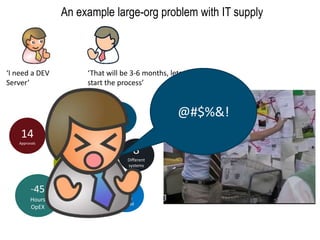
An example large-org problem with IT supply
‘I need a DEV
Server’
‘That will be 3-6 months, lets
start the process’
80
Touchp
oints
6
Tickets
14
People
Involved
~45
Hours
OpEX
14
Approvals
4000
hours of nothing
happening
8
Different
systems
@#$%&!
12
The Cloud provides the right Infrastructure,
Platforms, and Tools to Projects and Applications
when they need it, in a simple and instant way...
Enabling Developers to just….. Develop
Culture
13
14 1
4
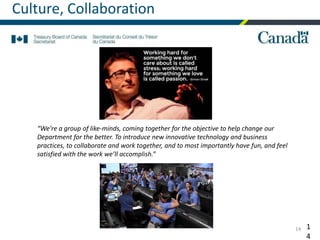
“We're a group of like-minds, coming together for the objective to help change our
Department for the better. To introduce new innovative technology and business
practices, to collaborate and work together, and to most importantly have fun, and feel
satisfied with the work we’ll accomplish.”
Culture, Collaboration
15
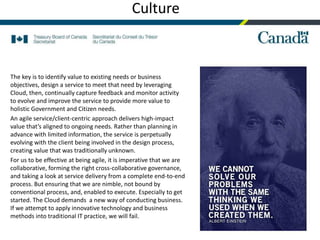
Culture
The key is to identify value to existing needs or business
objectives, design a service to meet that need by leveraging
Cloud, then, continually capture feedback and monitor activity
to evolve and improve the service to provide more value to
holistic Government and Citizen needs.
An agile service/client-centric approach delivers high-impact
value that’s aligned to ongoing needs. Rather than planning in
advance with limited information, the service is perpetually
evolving with the client being involved in the design process,
creating value that was traditionally unknown.
For us to be effective at being agile, it is imperative that we are
collaborative, forming the right cross-collaborative governance,
and taking a look at service delivery from a complete end-to-end
process. But ensuring that we are nimble, not bound by
conventional process, and, enabled to execute. Especially to get
started. The Cloud demands a new way of conducting business.
If we attempt to apply innovative technology and business
methods into traditional IT practice, we will fail.
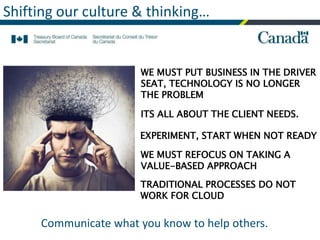
Shifting our culture & thinking…
WE MUST PUT BUSINESS IN THE DRIVER
SEAT, TECHNOLOGY IS NO LONGER
THE PROBLEM
ITS ALL ABOUT THE CLIENT NEEDS.
EXPERIMENT, START WHEN NOT READY
WE MUST REFOCUS ON TAKING A
VALUE-BASED APPROACH
TRADITIONAL PROCESSES DO NOT
WORK FOR CLOUD
Communicate what you know to help others.
Taking the Agile Approach to Cloud
Services
17
18
• The Cloud solves the problem of IT and
platform *supply*, NOT Business Solutions
Common Misconception
 This picture is to make this slide
look better.
19
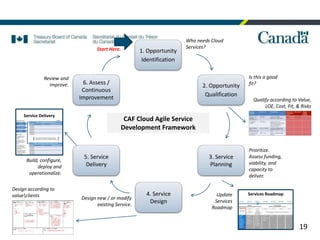
CAF Cloud Agile Service
Development Framework
Services RoadmapUpdate
Services
Roadmap
Who needs Cloud
Services?Start Here. 1. Opportunity
Identification
Prioritize.
Assess funding,
viability, and
capacity to
deliver.
3. Service
Planning
Service Delivery
Build, configure,
deploy and
operationalize.
5. Service
Delivery
Review and
improve. 6. Assess /
Continuous
Improvement
Is this a good
fit?2. Opportunity
Qualification
Qualify according to Value,
LOE, Cost, Fit, & Risks
Design new / or modify
existing Service.
4. Service
Design
Design according to
valueclients
Starting a Departmental Cloud Program
20
21
Dept.
Cloud
COE
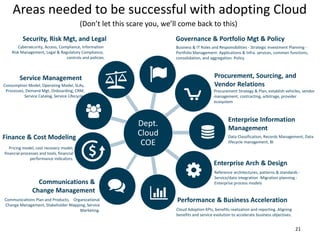
Security, Risk Mgt, and Legal
Cybersecurity, Access, Compliance, Information
Risk Management, Legal & Regulatory Compliance,
controls and policies
Communications &
Change Management
Communications Plan and Products, Organizational
Change Management, Stakeholder Mapping, Service
Marketing.
Service Management
Consumption Model, Operating Model, SLAs,
Processes, Demand Mgt, Onboarding, CRM,
Service Catalog, Service Lifecycle.
Finance & Cost Modeling
Governance & Portfolio Mgt & Policy
Business & IT Roles and Responsibilities - Strategic Investment Planning -
Portfolio Management: Applications & Infra. services, common functions,
consolidation, and aggregation. Policy
Procurement, Sourcing, and
Vendor Relations
Procurement Strategy & Plan, establish vehicles, vendor
management, contracting, arbitrage, provider
ecosystem
Enterprise Information
Management
Data Classification, Records Management, Data
lifecycle management, BI
Enterprise Arch & Design
Reference architectures, patterns & standards -
Service/data integration -Migration planning -
Enterprise process models
Performance & Business Acceleration
Cloud Adoption KPIs, benefits realization and reporting. Aligning
benefits and service evolution to accelerate business objectives.
Pricing model, cost recovery model,
financial processes and tools, financial
performance indicators.
Areas needed to be successful with adopting Cloud
(Don’t let this scare you, we’ll come back to this)
22
Departmen
tal Cloud
Adoption
Cloud
Start
Programmatic
Approach
Start Immediately
Pragmatic Programmatic
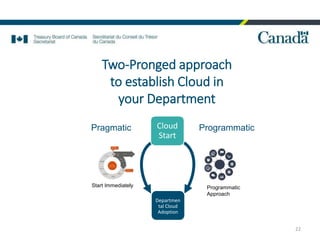
Two-Pronged approach
to establish Cloud in
your Department
23
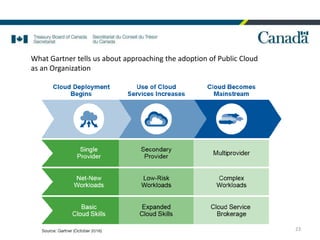
What Gartner tells us about approaching the adoption of Public Cloud
as an Organization
24
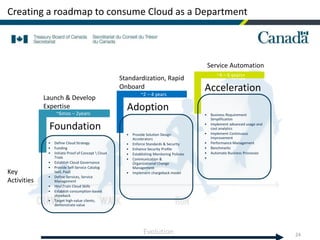
Foundation
Adoption
Acceleration
• Define Cloud Strategy
• Funding
• Initiate Proof of Concept  Cloud
Trials
• Establish Cloud Governance
• Provide Self-Service Catalog
IaaS, PaaS
• Define Services, Service
Management
• HireTrain Cloud Skills
• Establish consumption-based
showback
• Target high-value clients,
demonstrate value
• Provide Solution Design
Accelerators
• Enforce Standards & Security
• Enhance Security Profile
• Establishing Monitoring Policies
• Communication &
Organizational Change
Management
• Implement chargeback model
• Business Requirement
Simplification
• Implement advanced usage and
cost analytics
• Implement Continuous
Improvement
• Performance Management
• Benchmarks
• Automate Business Processes
•
~6mos – 2years
~2 – 4 years
~4 – 6 years+
Launch & Develop
Expertise
Standardization, Rapid
Onboard
Service Automation
Key
Activities
Evolution
Creating a roadmap to consume Cloud as a Department
25
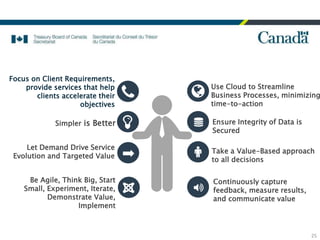
Use Cloud to Streamline
Business Processes, minimizing
time-to-action
Focus on Client Requirements,
provide services that help
clients accelerate their
objectives
Simpler is Better Ensure Integrity of Data is
Secured
Let Demand Drive Service
Evolution and Targeted Value
Take a Value-Based approach
to all decisions
Be Agile, Think Big, Start
Small, Experiment, Iterate,
Demonstrate Value,
Implement
Continuously capture
feedback, measure results,
and communicate value
26
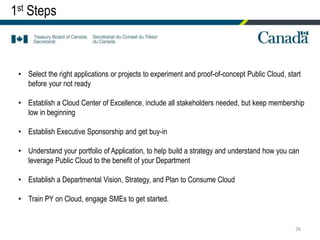
• Select the right applications or projects to experiment and proof-of-concept Public Cloud, start
before your not ready
• Establish a Cloud Center of Excellence, include all stakeholders needed, but keep membership
low in beginning
• Establish Executive Sponsorship and get buy-in
• Understand your portfolio of Application, to help build a strategy and understand how you can
leverage Public Cloud to the benefit of your Department
• Establish a Departmental Vision, Strategy, and Plan to Consume Cloud
• Train PY on Cloud, engage SMEs to get started.
1st Steps
Selecting the right Cloud POC apps
27
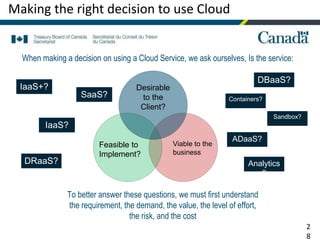
Making the right decision to use Cloud
2
8
Desirable
to the
Client?
Viable to the
business
Feasible to
Implement?
When making a decision on using a Cloud Service, we ask ourselves, Is the service:
To better answer these questions, we must first understand
the requirement, the demand, the value, the level of effort,
the risk, and the cost
IaaS+?
IaaS?
SaaS?
DBaaS?
DRaaS?
Containers?
Sandbox?
ADaaS?
Analytics
?
29
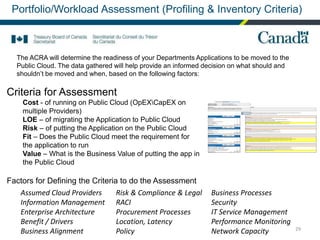
Portfolio/Workload Assessment (Profiling & Inventory Criteria)
The ACRA will determine the readiness of your Departments Applications to be moved to the
Public Cloud. The data gathered will help provide an informed decision on what should and
shouldn’t be moved and when, based on the following factors:
Criteria for Assessment
Cost - of running on Public Cloud (OpEXCapEX on
multiple Providers)
LOE – of migrating the Application to Public Cloud
Risk – of putting the Application on the Public Cloud
Fit – Does the Public Cloud meet the requirement for
the application to run
Value – What is the Business Value of putting the app in
the Public Cloud
Factors for Defining the Criteria to do the Assessment
Assumed Cloud Providers
Information Management
Enterprise Architecture
Benefit / Drivers
Business Alignment
Risk & Compliance & Legal
RACI
Procurement Processes
Location, Latency
Policy
Business Processes
Security
IT Service Management
Performance Monitoring
Network Capacity
<Show ACRA Approach image>
30
<Show ACRA.xlsx>
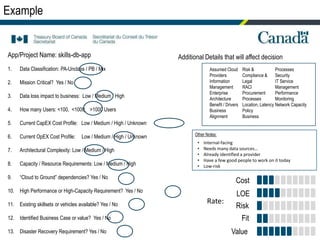
Cost
Example
Fit
LOE
Risk
Value
App/Project Name: skills-db-app
1. Data Classification: PA-Unclass / PB / Mix
2. Mission Critical? Yes / No
3. Data loss impact to business: Low / Medium / High
4. How many Users: <100, <1000, >1000 Users
5. Current CapEX Cost Profile: Low / Medium / High / Unknown
6. Current OpEX Cost Profile: Low / Medium / High / Unknown
7. Architectural Complexity: Low / Medium / High
8. Capacity / Resource Requirements: Low / Medium / High
9. “Cloud to Ground” dependencies? Yes / No
10. High Performance or High-Capacity Requirement? Yes / No
11. Existing skillsets or vehicles available? Yes / No
12. Identified Business Case or value? Yes / No
13. Disaster Recovery Requirement? Yes / No
Additional Details that will affect decision
Assumed Cloud
Providers
Information
Management
Enterprise
Architecture
Benefit / Drivers
Business
Alignment
Risk &
Compliance &
Legal
RACI
Procurement
Processes
Location, Latency
Policy
Business
Processes
Security
IT Service
Management
Performance
Monitoring
Network Capacity
Other Notes:
Rate:
• Internal-facing
• Needs many data sources…
• Already identified a provider
• Have a few good people to work on it today
• Low-risk
Cost
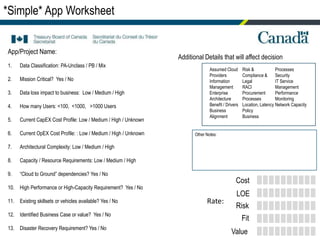
*Simple* App Worksheet
Fit
LOE
Risk
Value
App/Project Name:
1. Data Classification: PA-Unclass / PB / Mix
2. Mission Critical? Yes / No
3. Data loss impact to business: Low / Medium / High
4. How many Users: <100, <1000, >1000 Users
5. Current CapEX Cost Profile: Low / Medium / High / Unknown
6. Current OpEX Cost Profile: : Low / Medium / High / Unknown
7. Architectural Complexity: Low / Medium / High
8. Capacity / Resource Requirements: Low / Medium / High
9. “Cloud to Ground” dependencies? Yes / No
10. High Performance or High-Capacity Requirement? Yes / No
11. Existing skillsets or vehicles available? Yes / No
12. Identified Business Case or value? Yes / No
13. Disaster Recovery Requirement? Yes / No
Additional Details that will affect decision
Assumed Cloud
Providers
Information
Management
Enterprise
Architecture
Benefit / Drivers
Business
Alignment
Risk &
Compliance &
Legal
RACI
Procurement
Processes
Location, Latency
Policy
Business
Processes
Security
IT Service
Management
Performance
Monitoring
Network Capacity
Other Notes:
Rate:
33
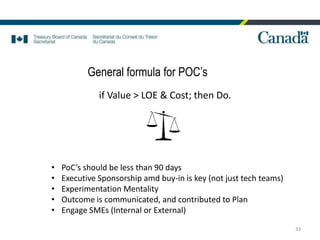
General formula for POC’s
if Value > LOE & Cost; then Do.
• PoC’s should be less than 90 days
• Executive Sponsorship amd buy-in is key (not just tech teams)
• Experimentation Mentality
• Outcome is communicated, and contributed to Plan
• Engage SMEs (Internal or External)
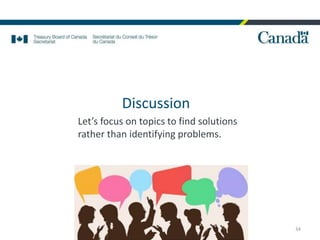
Discussion
Let’s focus on topics to find solutions
rather than identifying problems.
34
Extra Slides
35
36
Current GC Cloud Skillset Problems:
• Cloud is new to GC, there’s a gap of Cloud skillsets within GC
• GC must use existing Procurement Vehicles to engage Cloud
Professional Services.
• Lack of Cloud Professional Services within the NCR.
• No formal GC-wide Cloud training Program
• No easy way to buy CSP training services or specialized online-
courses yet.
• No centralized place to indicate on where training sessions are
happening, you’ve got to know somebody.
• No centralized place that curates all the freely available online-
training resources
37
- A change toward a subscription-based OpEX procurement model for Public Cloud may be
difficult
- New Skill-sets are required, each Public Cloud Provider has their own platform and APIs.
Every Cloud Service Provider operates differently, The Consumer needs to resource
accordingly
- Learn through practice. Start immediately with a PoC and low-hanging fruit
(DEVTESTIAAS)
- Public Cloud Adoption increases network load. If network+bandwidth is provided by the
broker, the broker will need to plan accordingly
- Cloud Service Providers have different catalogs, different API’s, and different RBAC’s.
Understanding what credential, or ‘tenant’ services, the broker will provide is important to
the success of consuming cloud
- Assets within the Cloud still require Operation & Management. Sometimes requiring skill
sets that may not currently be resourced (DB Services, OS Patching, Software Defined
Networking, eg.)
- Data Classification, Cloud Solution Design, Onboarding, are all responsibility of the client
Lessons learned & Considerations from other
Departments
Requirements & Value Focused
Focus on Requirements & Needs, let customer demands drive Service
Evolution and targeted Value
Be Agile
Establish the Vision, be ready to switch directions quickly on how to get
there. Ensure the path is cleared for success.
Time to Value
What can the Cloud do in the short-term to solve immediate challenges.
Keep it Simple
By making IT easier to provision and manage, the Organization will use it
more.
Start Small, think Big
Start when you’re not ready, start with POC with client on board.
Get Buy-in & Invest in People
Executive Sponsorship is paramount to success
Key Thinking for Success
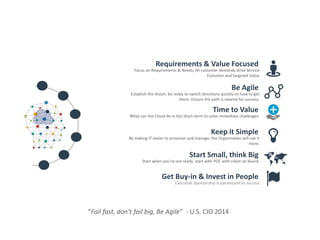
“Fail fast, don’t fail big, Be Agile” - U.S. CIO 2014
39
A discussion on Guiding Principles & Key
thinking to be successful at consuming Cloud
• Establish the Vision, be ready to switch directions quickly on how to get there.
• Executive Sponsorship is paramount to success.
• Financial Planning and Procurement are part of the first steps
• It’s not about Technology, Technology is now powerful enough to be molded to
the business. Let the Business needs drive.
• Communications, Awareness, Change Management, and Organizational
Transformation are key parts to a Government run Cloud Service.
• Focus on targeted Business Requirements, let demands drive Service Evolution.
• Agile, Cross-Functional Teams are Critical for Success
• Time to Value – What can the Cloud do in the short-term to solve Business
challenges.
• Simplicity Drives Adoption
• Fail fast, don’t fail big, Be Agile - U.S. CIO
• Start Small, think Big, Start when you’re not ready, start with POC with client on
board.
• Monitor usage, gather feedback, use feedback to evolve service
• It takes an investment in people & team to get started
• Collaboration fosters Innovation

Preparing your Department to consume public cloud

  • 1.
    GC Cloud WorkingGroup PJH Cloud KICKSTART: Preparing your Department to Consume Public Cloud EA DAY – September 29, 2017 Presented by Paul J Harding (a pragmatic discussion for low-maturity Departments)
  • 2.
    Please leave feedbackfor this workshop to myself @ paul@innogov.ca or Troy @ troy.macfarlane@tbs-sct.gc.ca . So the next workshop can be better! 2 There is a follow-up workshop being planned for end of October for Government broad.
  • 3.
    Agenda • Introductions • GCCloud Adoption update • Buying Cloud from SSC – Scott Levac • Shifting our Culture • Being Agile • Getting Started on a Cloud Program • Portfolio Assessment and Selecting POC apps. • Discussion 3
  • 4.
    A relevant workshopfor the audience… Who’s here, where are you with Cloud? 4
  • 5.
    TBS Cloud GuidanceDocuments 5 Government of Canada Cloud Adoption Strategy Government of Canada Security Control Profile for Cloud-based GC IT Services Government of Canada Right Cloud Selection Guidance
  • 6.
    Updates… • PB isbeing worked on within GC Cloud Ninja Team • GC Cloud Roundtable is discussing top issues, strategies, needs. • GC Cloud Working Group is soon being revitalized. • SSC Cloud RFP was closed in summer. • SSC Cloud Vehicle is for Unclass only, (discuss other conditions) 6
  • 7.
  • 8.
    Buying Cloud fromSSC Scott Levac, SSC 8
  • 9.
    If I hearsomeone say Cloud one more time….. 9
  • 10.
    What is Cloud? AmbiguousCumulusNimbus The Cloud means something different to every Organization We first ask ourselves, What Cloud capabilities provide value toward our departmental objectives? What does the Cloud mean to your Department? What is Cloud?
  • 11.
    An example large-orgproblem with IT supply ‘I need a DEV Server’ ‘That will be 3-6 months, lets start the process’ 80 Touchp oints 6 Tickets 14 People Involved ~45 Hours OpEX 14 Approvals 4000 hours of nothing happening 8 Different systems @#$%&!
  • 12.
    12 The Cloud providesthe right Infrastructure, Platforms, and Tools to Projects and Applications when they need it, in a simple and instant way... Enabling Developers to just….. Develop
  • 13.
  • 14.
    14 1 4 “We're agroup of like-minds, coming together for the objective to help change our Department for the better. To introduce new innovative technology and business practices, to collaborate and work together, and to most importantly have fun, and feel satisfied with the work we’ll accomplish.” Culture, Collaboration
  • 15.
    15 Culture The key isto identify value to existing needs or business objectives, design a service to meet that need by leveraging Cloud, then, continually capture feedback and monitor activity to evolve and improve the service to provide more value to holistic Government and Citizen needs. An agile service/client-centric approach delivers high-impact value that’s aligned to ongoing needs. Rather than planning in advance with limited information, the service is perpetually evolving with the client being involved in the design process, creating value that was traditionally unknown. For us to be effective at being agile, it is imperative that we are collaborative, forming the right cross-collaborative governance, and taking a look at service delivery from a complete end-to-end process. But ensuring that we are nimble, not bound by conventional process, and, enabled to execute. Especially to get started. The Cloud demands a new way of conducting business. If we attempt to apply innovative technology and business methods into traditional IT practice, we will fail.
  • 16.
    Shifting our culture& thinking… WE MUST PUT BUSINESS IN THE DRIVER SEAT, TECHNOLOGY IS NO LONGER THE PROBLEM ITS ALL ABOUT THE CLIENT NEEDS. EXPERIMENT, START WHEN NOT READY WE MUST REFOCUS ON TAKING A VALUE-BASED APPROACH TRADITIONAL PROCESSES DO NOT WORK FOR CLOUD Communicate what you know to help others.
  • 17.
    Taking the AgileApproach to Cloud Services 17
  • 18.
    18 • The Cloudsolves the problem of IT and platform *supply*, NOT Business Solutions Common Misconception  This picture is to make this slide look better.
  • 19.
    19 CAF Cloud AgileService Development Framework Services RoadmapUpdate Services Roadmap Who needs Cloud Services?Start Here. 1. Opportunity Identification Prioritize. Assess funding, viability, and capacity to deliver. 3. Service Planning Service Delivery Build, configure, deploy and operationalize. 5. Service Delivery Review and improve. 6. Assess / Continuous Improvement Is this a good fit?2. Opportunity Qualification Qualify according to Value, LOE, Cost, Fit, & Risks Design new / or modify existing Service. 4. Service Design Design according to valueclients
  • 20.
    Starting a DepartmentalCloud Program 20
  • 21.
    21 Dept. Cloud COE Security, Risk Mgt,and Legal Cybersecurity, Access, Compliance, Information Risk Management, Legal & Regulatory Compliance, controls and policies Communications & Change Management Communications Plan and Products, Organizational Change Management, Stakeholder Mapping, Service Marketing. Service Management Consumption Model, Operating Model, SLAs, Processes, Demand Mgt, Onboarding, CRM, Service Catalog, Service Lifecycle. Finance & Cost Modeling Governance & Portfolio Mgt & Policy Business & IT Roles and Responsibilities - Strategic Investment Planning - Portfolio Management: Applications & Infra. services, common functions, consolidation, and aggregation. Policy Procurement, Sourcing, and Vendor Relations Procurement Strategy & Plan, establish vehicles, vendor management, contracting, arbitrage, provider ecosystem Enterprise Information Management Data Classification, Records Management, Data lifecycle management, BI Enterprise Arch & Design Reference architectures, patterns & standards - Service/data integration -Migration planning - Enterprise process models Performance & Business Acceleration Cloud Adoption KPIs, benefits realization and reporting. Aligning benefits and service evolution to accelerate business objectives. Pricing model, cost recovery model, financial processes and tools, financial performance indicators. Areas needed to be successful with adopting Cloud (Don’t let this scare you, we’ll come back to this)
  • 22.
    22 Departmen tal Cloud Adoption Cloud Start Programmatic Approach Start Immediately PragmaticProgrammatic Two-Pronged approach to establish Cloud in your Department
  • 23.
    23 What Gartner tellsus about approaching the adoption of Public Cloud as an Organization
  • 24.
    24 Foundation Adoption Acceleration • Define CloudStrategy • Funding • Initiate Proof of Concept Cloud Trials • Establish Cloud Governance • Provide Self-Service Catalog IaaS, PaaS • Define Services, Service Management • HireTrain Cloud Skills • Establish consumption-based showback • Target high-value clients, demonstrate value • Provide Solution Design Accelerators • Enforce Standards & Security • Enhance Security Profile • Establishing Monitoring Policies • Communication & Organizational Change Management • Implement chargeback model • Business Requirement Simplification • Implement advanced usage and cost analytics • Implement Continuous Improvement • Performance Management • Benchmarks • Automate Business Processes • ~6mos – 2years ~2 – 4 years ~4 – 6 years+ Launch & Develop Expertise Standardization, Rapid Onboard Service Automation Key Activities Evolution Creating a roadmap to consume Cloud as a Department
  • 25.
    25 Use Cloud toStreamline Business Processes, minimizing time-to-action Focus on Client Requirements, provide services that help clients accelerate their objectives Simpler is Better Ensure Integrity of Data is Secured Let Demand Drive Service Evolution and Targeted Value Take a Value-Based approach to all decisions Be Agile, Think Big, Start Small, Experiment, Iterate, Demonstrate Value, Implement Continuously capture feedback, measure results, and communicate value
  • 26.
    26 • Select theright applications or projects to experiment and proof-of-concept Public Cloud, start before your not ready • Establish a Cloud Center of Excellence, include all stakeholders needed, but keep membership low in beginning • Establish Executive Sponsorship and get buy-in • Understand your portfolio of Application, to help build a strategy and understand how you can leverage Public Cloud to the benefit of your Department • Establish a Departmental Vision, Strategy, and Plan to Consume Cloud • Train PY on Cloud, engage SMEs to get started. 1st Steps
  • 27.
    Selecting the rightCloud POC apps 27
  • 28.
    Making the rightdecision to use Cloud 2 8 Desirable to the Client? Viable to the business Feasible to Implement? When making a decision on using a Cloud Service, we ask ourselves, Is the service: To better answer these questions, we must first understand the requirement, the demand, the value, the level of effort, the risk, and the cost IaaS+? IaaS? SaaS? DBaaS? DRaaS? Containers? Sandbox? ADaaS? Analytics ?
  • 29.
    29 Portfolio/Workload Assessment (Profiling& Inventory Criteria) The ACRA will determine the readiness of your Departments Applications to be moved to the Public Cloud. The data gathered will help provide an informed decision on what should and shouldn’t be moved and when, based on the following factors: Criteria for Assessment Cost - of running on Public Cloud (OpEXCapEX on multiple Providers) LOE – of migrating the Application to Public Cloud Risk – of putting the Application on the Public Cloud Fit – Does the Public Cloud meet the requirement for the application to run Value – What is the Business Value of putting the app in the Public Cloud Factors for Defining the Criteria to do the Assessment Assumed Cloud Providers Information Management Enterprise Architecture Benefit / Drivers Business Alignment Risk & Compliance & Legal RACI Procurement Processes Location, Latency Policy Business Processes Security IT Service Management Performance Monitoring Network Capacity
  • 30.
    <Show ACRA Approachimage> 30 <Show ACRA.xlsx>
  • 31.
    Cost Example Fit LOE Risk Value App/Project Name: skills-db-app 1.Data Classification: PA-Unclass / PB / Mix 2. Mission Critical? Yes / No 3. Data loss impact to business: Low / Medium / High 4. How many Users: <100, <1000, >1000 Users 5. Current CapEX Cost Profile: Low / Medium / High / Unknown 6. Current OpEX Cost Profile: Low / Medium / High / Unknown 7. Architectural Complexity: Low / Medium / High 8. Capacity / Resource Requirements: Low / Medium / High 9. “Cloud to Ground” dependencies? Yes / No 10. High Performance or High-Capacity Requirement? Yes / No 11. Existing skillsets or vehicles available? Yes / No 12. Identified Business Case or value? Yes / No 13. Disaster Recovery Requirement? Yes / No Additional Details that will affect decision Assumed Cloud Providers Information Management Enterprise Architecture Benefit / Drivers Business Alignment Risk & Compliance & Legal RACI Procurement Processes Location, Latency Policy Business Processes Security IT Service Management Performance Monitoring Network Capacity Other Notes: Rate: • Internal-facing • Needs many data sources… • Already identified a provider • Have a few good people to work on it today • Low-risk
  • 32.
    Cost *Simple* App Worksheet Fit LOE Risk Value App/ProjectName: 1. Data Classification: PA-Unclass / PB / Mix 2. Mission Critical? Yes / No 3. Data loss impact to business: Low / Medium / High 4. How many Users: <100, <1000, >1000 Users 5. Current CapEX Cost Profile: Low / Medium / High / Unknown 6. Current OpEX Cost Profile: : Low / Medium / High / Unknown 7. Architectural Complexity: Low / Medium / High 8. Capacity / Resource Requirements: Low / Medium / High 9. “Cloud to Ground” dependencies? Yes / No 10. High Performance or High-Capacity Requirement? Yes / No 11. Existing skillsets or vehicles available? Yes / No 12. Identified Business Case or value? Yes / No 13. Disaster Recovery Requirement? Yes / No Additional Details that will affect decision Assumed Cloud Providers Information Management Enterprise Architecture Benefit / Drivers Business Alignment Risk & Compliance & Legal RACI Procurement Processes Location, Latency Policy Business Processes Security IT Service Management Performance Monitoring Network Capacity Other Notes: Rate:
  • 33.
    33 General formula forPOC’s if Value > LOE & Cost; then Do. • PoC’s should be less than 90 days • Executive Sponsorship amd buy-in is key (not just tech teams) • Experimentation Mentality • Outcome is communicated, and contributed to Plan • Engage SMEs (Internal or External)
  • 34.
    Discussion Let’s focus ontopics to find solutions rather than identifying problems. 34
  • 35.
  • 36.
    36 Current GC CloudSkillset Problems: • Cloud is new to GC, there’s a gap of Cloud skillsets within GC • GC must use existing Procurement Vehicles to engage Cloud Professional Services. • Lack of Cloud Professional Services within the NCR. • No formal GC-wide Cloud training Program • No easy way to buy CSP training services or specialized online- courses yet. • No centralized place to indicate on where training sessions are happening, you’ve got to know somebody. • No centralized place that curates all the freely available online- training resources
  • 37.
    37 - A changetoward a subscription-based OpEX procurement model for Public Cloud may be difficult - New Skill-sets are required, each Public Cloud Provider has their own platform and APIs. Every Cloud Service Provider operates differently, The Consumer needs to resource accordingly - Learn through practice. Start immediately with a PoC and low-hanging fruit (DEVTESTIAAS) - Public Cloud Adoption increases network load. If network+bandwidth is provided by the broker, the broker will need to plan accordingly - Cloud Service Providers have different catalogs, different API’s, and different RBAC’s. Understanding what credential, or ‘tenant’ services, the broker will provide is important to the success of consuming cloud - Assets within the Cloud still require Operation & Management. Sometimes requiring skill sets that may not currently be resourced (DB Services, OS Patching, Software Defined Networking, eg.) - Data Classification, Cloud Solution Design, Onboarding, are all responsibility of the client Lessons learned & Considerations from other Departments
  • 38.
    Requirements & ValueFocused Focus on Requirements & Needs, let customer demands drive Service Evolution and targeted Value Be Agile Establish the Vision, be ready to switch directions quickly on how to get there. Ensure the path is cleared for success. Time to Value What can the Cloud do in the short-term to solve immediate challenges. Keep it Simple By making IT easier to provision and manage, the Organization will use it more. Start Small, think Big Start when you’re not ready, start with POC with client on board. Get Buy-in & Invest in People Executive Sponsorship is paramount to success Key Thinking for Success “Fail fast, don’t fail big, Be Agile” - U.S. CIO 2014
  • 39.
    39 A discussion onGuiding Principles & Key thinking to be successful at consuming Cloud • Establish the Vision, be ready to switch directions quickly on how to get there. • Executive Sponsorship is paramount to success. • Financial Planning and Procurement are part of the first steps • It’s not about Technology, Technology is now powerful enough to be molded to the business. Let the Business needs drive. • Communications, Awareness, Change Management, and Organizational Transformation are key parts to a Government run Cloud Service. • Focus on targeted Business Requirements, let demands drive Service Evolution. • Agile, Cross-Functional Teams are Critical for Success • Time to Value – What can the Cloud do in the short-term to solve Business challenges. • Simplicity Drives Adoption • Fail fast, don’t fail big, Be Agile - U.S. CIO • Start Small, think Big, Start when you’re not ready, start with POC with client on board. • Monitor usage, gather feedback, use feedback to evolve service • It takes an investment in people & team to get started • Collaboration fosters Innovation

Editor's Notes

  • #2 Introduce myself Cloud strategies at other Departments President of a Blockchain Cloud company in Sunnyvale President of InnoGov Currently lead the CAF Cloud Service History with RAD Cloud- PSAE Award
  • #3 Might have colleagues that wanted…
  • #4 Not covering all topics… tight workshiop with small team
  • #11 Cloud means something different to everyone Cloud to Parents could mean, Google or Apple photos of their kids. Cloud to a Sales Organization could mean signing up to Salesforce, outsourcing their sales process and tools into Cloud to a startup business, could be Google for Business (email, calendar, domani, etc) The first step is to define what Cloud means to AGRI What does the Cloud mean to AGRI? What Cloud capabilities provide value toward our objectives? The first question to ask ourselves is, What does the Cloud mean to AGRI? What are the capabilities the Cloud offers that provide value toward our objectives. In order to answer those questions we must understand the ‘Business’ of AGRI. What are the requiremetns from our Lines of Business that would help us determine which capabilities have the most value
  • #39 Keeping it SImple, - including our ability to secure and ensure compliance Focus on Requirements & Needs, let customer demands drive Service Evolution and targeted Value Establish the Vision, be ready to switch directions quickly on how to get there. Time to Value – What can the Cloud do in the short-term to solve Business challenges. Simplicity Drives Adoption. By making IT easier to provision and manage, the Organization will use it more. Fail fast, don’t fail big, Be Agile - U.S. CIO Start Small, think Big, Start when you’re not ready, start with POC with client on board. Monitor usage, gather feedback, use feedback to evolve service It takes an investment in people & team to get started Executive Sponsorship is paramount to success. Collaboration fosters Innovation Cloud is more of a Service, less of a Technology