Realizing the Value of Cloud
the way we do itEnterprise Cloud Solutions
Leveraging the
value of Cloud
Companies are realizing that the Cloud is an inevitable part of
their future — not a question of “if” but rather “when,” “where,”
“what extent,” and “how”. For some companies, it may be a
key enabler to reduce IT cost while improving responsiveness
to the business. For other companies, it may be niche play,
focusing Cloud on pre-production environments or as more
cost-effective disaster recovery or backup option. Others
would use it, in conjunction with DevOps and Platform-as-
a-Service (PaaS) solutions, to enhance IT agility, enabling
quicker releases and responsive innovation. And, a bold
few may make it an integral part of their business enabling
strategic capabilities that disrupt industries; case in point
companies include Uber, Airbnb, and Netflix. Regardless of
intent, determining what makes sense to move to the Cloud is
a key IT imperative today.
Defining the Right Cloud Strategy
Determining the right Cloud strategy entails answering the
following questions about an application:
1.	 Whether it’s Cloud-feasible or it stays on premise
2.	 If it’s Cloud feasible—
–– Should it be on a public or private Cloud
–– Which Cloud option makes sense – Infrastructure-
as-a-Service (IaaS), Platform-as-a-Service (PaaS) or
Software-as-a-Service (SaaS), makes sense
In answering these questions, there are a multitude of
business and technical factors to consider. First, there are
factors that help answer the first question and determine if an
application is even viable for the Cloud:
•	 A Tier 1, mission critical, or difficult-to-virtualize application
may not be good candidates for the Cloud.
•	 An application that has a heavy client component or near
real-time device integration, is not Cloud-feasible.
•	 Applications that are close to end-of-life-cycle, lack
documentation or access to the source code are not
ideal candidates.
Another key factor of Cloud feasibility is the technical
compatibility of an application to the technology stack of a
public or private Cloud platform. A legacy application that is
tightly integrated to OS/400 or an older Solaris version will
be cost-prohibitive to migrate to the Cloud, unless a rewrite
is warranted.
Also, there are a number of factors to consider that bolsters or
diminishes the case for Cloud. Some examples:
•	 How complex is the application? How many integrations
and dependencies does it have? What is the network
pattern and latency of these dependencies?
•	 Does the application have unpredictable demand or
transaction volume?
•	 Will the application require significant change or
enhancements in the next 12-18 months?
At the end of this first step, one would have a better sense
if an application were Cloud-feasible. Doing this requires a
structured, logical approach that does not result in analysis
paralysis. The intent of this brief is to describe a proven
approach that has been built over experience.
Once the applications are deemed Cloud-feasible, the next
step involves determining the correct Cloud pattern: public
versus private; IaaS, PaaS and/or SaaS. Consideration factors
for private Cloud versus public Cloud include:
•	 Data, security, and compliance policy and requirements:
a private Cloud can potentially provide a more secure and
compliant platform
•	 Higher performance, availability, or technology stack
concerns: a private Cloud enables a company to have
more control to design the right hosting platform for
an application
•	 Cost: a public Cloud, being multi-tenant, has economies
of scale
Determining the appropriate Cloud option, IaaS, PaaS or
SaaS, revolves around the characteristics of the applications
and desired business or IT outcomes. If an application is a
custom digital asset it can immensely benefit from PaaS. An
application that has significant functional gaps and is in an
established domain area like CRM, HR, or supply chain, a
SaaS solution may be the better play. Or, if application is fairly
stable and virtualized, simply re-hosting it on the Cloud, IaaS,
makes perfect sense.
There are many factors to think about which can easily
result into analysis and paralysis. A recommended approach
is to determine which ones are most applicable given the
company’s intent, the applications to be assessed, and the
IT context. Typically this results in looking at a dozen factors.
2 
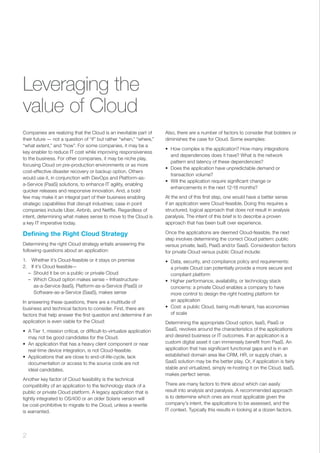
For instance, a company simplified its decision criteria into a
decision tree:
Yes
No
Yes
Yes
Yes
Yes
Yes
Yes
Yes
Yes
Yes
Yes
Yes
Yes
Is app near
EOSL
x86
Architecture
compatible
Can use
virtualized
server
Software
License is
Cloud
compatible?
Requires
high
remediation/
replatform
approved
Data
residency
requirements
approved?
Legacy or Cloud Hosting Public or Private Cloud
Cloud Provider and Level of Service
(Managed Service Tier, Infrastructure Tier,
Security Tier)
Contains
highly
restricted
data?
Client
server
application?
Latency
sensitive
integ. with
on-premise
component
Tightly
ocupied with
on-promise
component
Disaster
recovery
can be aptly
replaced in
public
Cloud
Service and
Support
Level
Business
Criticality
Static
Websites
Data
Restrictions
User Base
PoC or
Sandbox
Requires
LDA/AD
integration?
Compatiable
with Public
Cloud tech.
stack?
Apps with high
volume data
transfer need to
be further
evaluated
Public CloudPrivate Cloud
Yes
Yes
Yes
Cloud
Legacy
hosting
Source
code/App
Doc.
available?
Figure 1: Cloud Decision Tree
3
the way we see itEnterprise Cloud Solutions
Deciding to Move or Not
Once you’ve determined an application is Cloud viable,
the next step is to determine if it makes sense to make the
move. In this regard, a deeper discovery and analysis of
the application is needed. More specifically, the following
information is required:
•	 Architecture, configuration, usage profile, metadata
•	 Integration and dependency mapping
•	 Data rate of change (gravity)
•	 OS or app licensing provisions and updates needed
•	 Privacy, security, and compliance requirements
•	 Identity and user access management requirements
•	 Infrastructure requirements — storage, network, disaster
recovery, backup, performance, availability
•	 Financials
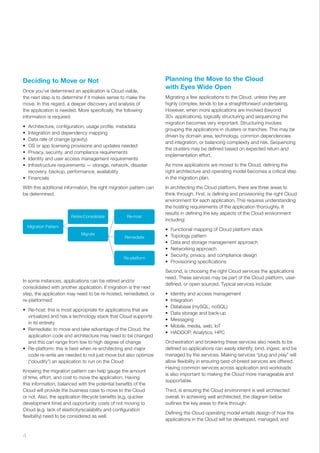
With this additional information, the right migration pattern can
be determined.
In some instances, applications can be retired and/or
consolidated with another application. If migration is the next
step, the application may need to be re-hosted, remediated, or
re-platformed:
•	 Re-host: this is most appropriate for applications that are
virtualized and has a technology stack that Cloud supports
in its entirety
•	 Remediate: to move and take advantage of the Cloud, the
application code and architecture may need to be changed
and this can range from low to high degree of change
•	 Re-platform: this is best when re-architecting and major
code re-write are needed to not just move but also optimize
(“cloudify”) an application to run on the Cloud
Knowing the migration pattern can help gauge the amount
of time, effort, and cost to move the application. Having
this information, balanced with the potential benefits of the
Cloud will provide the business case to move to the Cloud
or not. Also, the application lifecycle benefits (e.g. quicker
development time) and opportunity costs of not moving to
Cloud (e.g. lack of elasticity/scalability and configuration
flexibility) need to be considered as well.
Migration Pattern
Re-host
Remediate
Re-platform
Retire/Consolidate
Migrate
Planning the Move to the Cloud
with Eyes Wide Open
Migrating a few applications to the Cloud, unless they are
highly complex, tends to be a straightforward undertaking.
However, when more applications are involved (beyond
30+ applications), logically structuring and sequencing the
migration becomes very important. Structuring involves
grouping the applications in clusters or tranches. This may be
driven by domain area, technology, common dependencies
and integration, or balancing complexity and risk. Sequencing
the clusters may be defined based on expected return and
implementation effort.
As more applications are moved to the Cloud, defining the
right architecture and operating model becomes a critical step
in the migration plan.
In architecting the Cloud platform, there are three areas to
think through. First, is defining and provisioning the right Cloud
environment for each application. This requires understanding
the hosting requirements of the application thoroughly. It
results in defining the key aspects of the Cloud environment
including:
•	 Functional mapping of Cloud platform stack
•	 Topology pattern
•	 Data and storage management approach
•	 Networking approach
•	 Security, privacy, and compliance design
•	 Provisioning specifications
Second, is choosing the right Cloud services the applications
need. These services may be part of the Cloud platform, user-
defined, or open sourced. Typical services include:
•	 Identity and access management
•	 Integration
•	 Database (mySQL, noSQL)
•	 Data storage and back-up
•	 Messaging
•	 Mobile, media, web, IoT
•	 HADOOP, Analytics, HPC
Orchestration and brokering these services also needs to be
defined so applications can easily identify, bind, ingest, and be
managed by the services. Making services “plug and play” will
allow flexibility in ensuring best-of-breed services are offered.
Having common services across application and workloads
is also important to making the Cloud more manageable and
supportable.
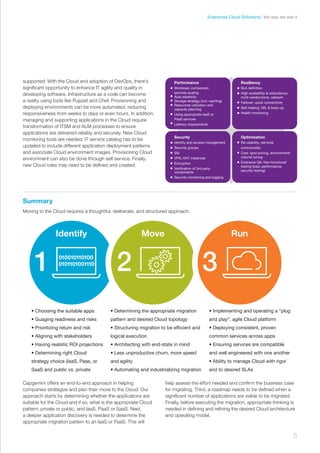
Third, is ensuring the Cloud environment is well architected
overall. In achieving well architected, the diagram below
outlines the key areas to think through:
Defining the Cloud operating model entails design of how the
applications in the Cloud will be developed, managed, and
4 
supported. With the Cloud and adoption of DevOps, there’s
significant opportunity to enhance IT agility and quality in
developing software. Infrastructure as a code can become
a reality using tools like Puppet and Chef. Provisioning and
deploying environments can be more automated, reducing
responsiveness from weeks to days or even hours. In addition,
managing and supporting applications in the Cloud require
transformation of ITSM and ALM processes to ensure
applications are delivered reliably and securely. New Cloud
monitoring tools are needed. IT service catalog has to be
updated to include different application deployment patterns
and associate Cloud environment images. Provisioning Cloud
environment can also be done through self-service. Finally,
new Cloud roles may need to be defined and created.
Performance
Workload, component,
services scaling
Auto-elasticity
Storage strategy (incl. caching)
Resources utilization and
capacity planning
Using appropriate IaaS or
PaaS services
Latency requirements
Security
Identity and access management
Security groups
SSl
VPN, NAT instances
Encryption
Verification of 3rd party
components
Security monitoring and logging
Resiliency
SLA definition
High availability & redundancy:
multi-vendor/zone, network
Failover: quick connectivity
Self-healing, DR, & back-up
Health monitoring
Optimization
Re-usability, services
commonality
Cost: spot pricing, environment/
volume tuning
Extensive QA: Non-functional
testing (load, performance,
security testing)
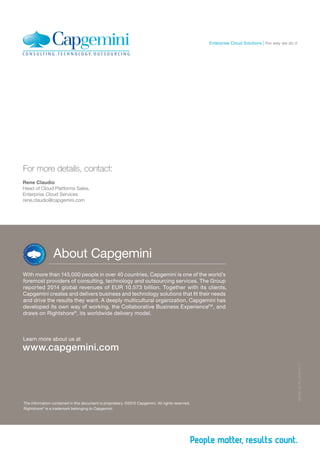
1
Identify
2
Move
3
Run
• Choosing the suitable apps
• Guaging readiness and risks
• Prioritizing return and risk
• Aligning with stakeholders
• Having realistic ROI projections
• Determining right Cloud
strategy choice (IaaS, Paas, or
SaaS and public vs. private
• Determining the appropriate migration
pattern and desired Cloud topology
• Structuring migration to be efficient and
logical execution
• Architecting with end-state in mind
• Less unproductive churn, more speed
and agility
• Automating and industrializing migration
• Implementing and operating a “plug
and play”, agile Cloud platform
• Deploying consistent, proven
common services across apps
• Ensuring services sre compatible
and well engineered with one another
• Ability to manage Cloud with rigor
and to desired SLAs
Capgemini offers an end-to-end approach in helping
companies strategize and plan their move to the Cloud. Our
approach starts by determining whether the applications are
suitable for the Cloud and if so, what is the appropriate Cloud
pattern: private or public, and IaaS, PaaS or SaaS. Next,
a deeper application discovery is needed to determine the
appropriate migration pattern to an IaaS or PaaS. This will
help assess the effort needed and confirm the business case
for migrating. Third, a roadmap needs to be defined when a
significant number of applications are viable to be migrated.
Finally, before executing the migration, appropriate thinking is
needed in defining and refining the desired Cloud architecture
and operating model.
Summary
Moving to the Cloud requires a thoughtful, deliberate, and structured approach.
5
the way we see itEnterprise Cloud Solutions
The information contained in this document is proprietary. ©2015 Capgemini. All rights reserved.
Rightshore®
is a trademark belonging to Capgemini.
MCOS_GI_PT_2015.04.17
About Capgemini
With more than 145,000 people in over 40 countries, Capgemini is one of the world’s
foremost providers of consulting, technology and outsourcing services. The Group
reported 2014 global revenues of EUR 10.573 billion. Together with its clients,
Capgemini creates and delivers business and technology solutions that fit their needs
and drive the results they want. A deeply multicultural organization, Capgemini has
developed its own way of working, the Collaborative Business ExperienceTM
, and
draws on Rightshore®
, its worldwide delivery model.
Learn more about us at
www.capgemini.com
For more details, contact:
Rene Claudio
Head of Cloud Platforms Sales,
Enterprise Cloud Services
rene.claudio@capgemini.com
the way we do itEnterprise Cloud Solutions

Realizing Cloud POV

  • 1.
    Realizing the Valueof Cloud the way we do itEnterprise Cloud Solutions
  • 2.
    Leveraging the value ofCloud Companies are realizing that the Cloud is an inevitable part of their future — not a question of “if” but rather “when,” “where,” “what extent,” and “how”. For some companies, it may be a key enabler to reduce IT cost while improving responsiveness to the business. For other companies, it may be niche play, focusing Cloud on pre-production environments or as more cost-effective disaster recovery or backup option. Others would use it, in conjunction with DevOps and Platform-as- a-Service (PaaS) solutions, to enhance IT agility, enabling quicker releases and responsive innovation. And, a bold few may make it an integral part of their business enabling strategic capabilities that disrupt industries; case in point companies include Uber, Airbnb, and Netflix. Regardless of intent, determining what makes sense to move to the Cloud is a key IT imperative today. Defining the Right Cloud Strategy Determining the right Cloud strategy entails answering the following questions about an application: 1. Whether it’s Cloud-feasible or it stays on premise 2. If it’s Cloud feasible— –– Should it be on a public or private Cloud –– Which Cloud option makes sense – Infrastructure- as-a-Service (IaaS), Platform-as-a-Service (PaaS) or Software-as-a-Service (SaaS), makes sense In answering these questions, there are a multitude of business and technical factors to consider. First, there are factors that help answer the first question and determine if an application is even viable for the Cloud: • A Tier 1, mission critical, or difficult-to-virtualize application may not be good candidates for the Cloud. • An application that has a heavy client component or near real-time device integration, is not Cloud-feasible. • Applications that are close to end-of-life-cycle, lack documentation or access to the source code are not ideal candidates. Another key factor of Cloud feasibility is the technical compatibility of an application to the technology stack of a public or private Cloud platform. A legacy application that is tightly integrated to OS/400 or an older Solaris version will be cost-prohibitive to migrate to the Cloud, unless a rewrite is warranted. Also, there are a number of factors to consider that bolsters or diminishes the case for Cloud. Some examples: • How complex is the application? How many integrations and dependencies does it have? What is the network pattern and latency of these dependencies? • Does the application have unpredictable demand or transaction volume? • Will the application require significant change or enhancements in the next 12-18 months? At the end of this first step, one would have a better sense if an application were Cloud-feasible. Doing this requires a structured, logical approach that does not result in analysis paralysis. The intent of this brief is to describe a proven approach that has been built over experience. Once the applications are deemed Cloud-feasible, the next step involves determining the correct Cloud pattern: public versus private; IaaS, PaaS and/or SaaS. Consideration factors for private Cloud versus public Cloud include: • Data, security, and compliance policy and requirements: a private Cloud can potentially provide a more secure and compliant platform • Higher performance, availability, or technology stack concerns: a private Cloud enables a company to have more control to design the right hosting platform for an application • Cost: a public Cloud, being multi-tenant, has economies of scale Determining the appropriate Cloud option, IaaS, PaaS or SaaS, revolves around the characteristics of the applications and desired business or IT outcomes. If an application is a custom digital asset it can immensely benefit from PaaS. An application that has significant functional gaps and is in an established domain area like CRM, HR, or supply chain, a SaaS solution may be the better play. Or, if application is fairly stable and virtualized, simply re-hosting it on the Cloud, IaaS, makes perfect sense. There are many factors to think about which can easily result into analysis and paralysis. A recommended approach is to determine which ones are most applicable given the company’s intent, the applications to be assessed, and the IT context. Typically this results in looking at a dozen factors. 2 
  • 3.
    For instance, acompany simplified its decision criteria into a decision tree: Yes No Yes Yes Yes Yes Yes Yes Yes Yes Yes Yes Yes Yes Is app near EOSL x86 Architecture compatible Can use virtualized server Software License is Cloud compatible? Requires high remediation/ replatform approved Data residency requirements approved? Legacy or Cloud Hosting Public or Private Cloud Cloud Provider and Level of Service (Managed Service Tier, Infrastructure Tier, Security Tier) Contains highly restricted data? Client server application? Latency sensitive integ. with on-premise component Tightly ocupied with on-promise component Disaster recovery can be aptly replaced in public Cloud Service and Support Level Business Criticality Static Websites Data Restrictions User Base PoC or Sandbox Requires LDA/AD integration? Compatiable with Public Cloud tech. stack? Apps with high volume data transfer need to be further evaluated Public CloudPrivate Cloud Yes Yes Yes Cloud Legacy hosting Source code/App Doc. available? Figure 1: Cloud Decision Tree 3 the way we see itEnterprise Cloud Solutions
  • 4.
    Deciding to Moveor Not Once you’ve determined an application is Cloud viable, the next step is to determine if it makes sense to make the move. In this regard, a deeper discovery and analysis of the application is needed. More specifically, the following information is required: • Architecture, configuration, usage profile, metadata • Integration and dependency mapping • Data rate of change (gravity) • OS or app licensing provisions and updates needed • Privacy, security, and compliance requirements • Identity and user access management requirements • Infrastructure requirements — storage, network, disaster recovery, backup, performance, availability • Financials With this additional information, the right migration pattern can be determined. In some instances, applications can be retired and/or consolidated with another application. If migration is the next step, the application may need to be re-hosted, remediated, or re-platformed: • Re-host: this is most appropriate for applications that are virtualized and has a technology stack that Cloud supports in its entirety • Remediate: to move and take advantage of the Cloud, the application code and architecture may need to be changed and this can range from low to high degree of change • Re-platform: this is best when re-architecting and major code re-write are needed to not just move but also optimize (“cloudify”) an application to run on the Cloud Knowing the migration pattern can help gauge the amount of time, effort, and cost to move the application. Having this information, balanced with the potential benefits of the Cloud will provide the business case to move to the Cloud or not. Also, the application lifecycle benefits (e.g. quicker development time) and opportunity costs of not moving to Cloud (e.g. lack of elasticity/scalability and configuration flexibility) need to be considered as well. Migration Pattern Re-host Remediate Re-platform Retire/Consolidate Migrate Planning the Move to the Cloud with Eyes Wide Open Migrating a few applications to the Cloud, unless they are highly complex, tends to be a straightforward undertaking. However, when more applications are involved (beyond 30+ applications), logically structuring and sequencing the migration becomes very important. Structuring involves grouping the applications in clusters or tranches. This may be driven by domain area, technology, common dependencies and integration, or balancing complexity and risk. Sequencing the clusters may be defined based on expected return and implementation effort. As more applications are moved to the Cloud, defining the right architecture and operating model becomes a critical step in the migration plan. In architecting the Cloud platform, there are three areas to think through. First, is defining and provisioning the right Cloud environment for each application. This requires understanding the hosting requirements of the application thoroughly. It results in defining the key aspects of the Cloud environment including: • Functional mapping of Cloud platform stack • Topology pattern • Data and storage management approach • Networking approach • Security, privacy, and compliance design • Provisioning specifications Second, is choosing the right Cloud services the applications need. These services may be part of the Cloud platform, user- defined, or open sourced. Typical services include: • Identity and access management • Integration • Database (mySQL, noSQL) • Data storage and back-up • Messaging • Mobile, media, web, IoT • HADOOP, Analytics, HPC Orchestration and brokering these services also needs to be defined so applications can easily identify, bind, ingest, and be managed by the services. Making services “plug and play” will allow flexibility in ensuring best-of-breed services are offered. Having common services across application and workloads is also important to making the Cloud more manageable and supportable. Third, is ensuring the Cloud environment is well architected overall. In achieving well architected, the diagram below outlines the key areas to think through: Defining the Cloud operating model entails design of how the applications in the Cloud will be developed, managed, and 4 
  • 5.
    supported. With theCloud and adoption of DevOps, there’s significant opportunity to enhance IT agility and quality in developing software. Infrastructure as a code can become a reality using tools like Puppet and Chef. Provisioning and deploying environments can be more automated, reducing responsiveness from weeks to days or even hours. In addition, managing and supporting applications in the Cloud require transformation of ITSM and ALM processes to ensure applications are delivered reliably and securely. New Cloud monitoring tools are needed. IT service catalog has to be updated to include different application deployment patterns and associate Cloud environment images. Provisioning Cloud environment can also be done through self-service. Finally, new Cloud roles may need to be defined and created. Performance Workload, component, services scaling Auto-elasticity Storage strategy (incl. caching) Resources utilization and capacity planning Using appropriate IaaS or PaaS services Latency requirements Security Identity and access management Security groups SSl VPN, NAT instances Encryption Verification of 3rd party components Security monitoring and logging Resiliency SLA definition High availability & redundancy: multi-vendor/zone, network Failover: quick connectivity Self-healing, DR, & back-up Health monitoring Optimization Re-usability, services commonality Cost: spot pricing, environment/ volume tuning Extensive QA: Non-functional testing (load, performance, security testing) 1 Identify 2 Move 3 Run • Choosing the suitable apps • Guaging readiness and risks • Prioritizing return and risk • Aligning with stakeholders • Having realistic ROI projections • Determining right Cloud strategy choice (IaaS, Paas, or SaaS and public vs. private • Determining the appropriate migration pattern and desired Cloud topology • Structuring migration to be efficient and logical execution • Architecting with end-state in mind • Less unproductive churn, more speed and agility • Automating and industrializing migration • Implementing and operating a “plug and play”, agile Cloud platform • Deploying consistent, proven common services across apps • Ensuring services sre compatible and well engineered with one another • Ability to manage Cloud with rigor and to desired SLAs Capgemini offers an end-to-end approach in helping companies strategize and plan their move to the Cloud. Our approach starts by determining whether the applications are suitable for the Cloud and if so, what is the appropriate Cloud pattern: private or public, and IaaS, PaaS or SaaS. Next, a deeper application discovery is needed to determine the appropriate migration pattern to an IaaS or PaaS. This will help assess the effort needed and confirm the business case for migrating. Third, a roadmap needs to be defined when a significant number of applications are viable to be migrated. Finally, before executing the migration, appropriate thinking is needed in defining and refining the desired Cloud architecture and operating model. Summary Moving to the Cloud requires a thoughtful, deliberate, and structured approach. 5 the way we see itEnterprise Cloud Solutions
  • 6.
    The information containedin this document is proprietary. ©2015 Capgemini. All rights reserved. Rightshore® is a trademark belonging to Capgemini. MCOS_GI_PT_2015.04.17 About Capgemini With more than 145,000 people in over 40 countries, Capgemini is one of the world’s foremost providers of consulting, technology and outsourcing services. The Group reported 2014 global revenues of EUR 10.573 billion. Together with its clients, Capgemini creates and delivers business and technology solutions that fit their needs and drive the results they want. A deeply multicultural organization, Capgemini has developed its own way of working, the Collaborative Business ExperienceTM , and draws on Rightshore® , its worldwide delivery model. Learn more about us at www.capgemini.com For more details, contact: Rene Claudio Head of Cloud Platforms Sales, Enterprise Cloud Services rene.claudio@capgemini.com the way we do itEnterprise Cloud Solutions