Cloud Adoption Lifecycle
More and more organizations are looking to
implement cloud and gain benefits like scalability,
responsiveness and cost-efficiencies. As this is a major
change, organizations have to carefully gauge the
impact of the transformation to a cloud environment.
This paper can guide an organization through the
various stages in the adoption of the cloud platform,
from‘What’(Foresee) to‘What Else’(Reinvigorate). It
lists the lifecycle stages, and how to begin cloud
adoption.
The paper concludes on the note that an organization
can utilize the knowledge of the Cloud Adoption
Lifecycle to relate to the stage where it is currently at
and identify the next stages involved.
White Paper
About the Author
Kumar Anand
Kumar Anand is a Business Analyst working with TCS’Global
Consulting Practice - IT Infrastructure Group. He has extensive
experience in IT strategy, infrastructure optimization, architecture
solutions, system integration in large consulting engagements. He has
consulted with clients across United States, Switzerland, Poland and
India and has a Master’s Degree in Business Administration from a
premier business school in India.
2
3
Table of Contents
Introduction 4
Cloud Adoption Lifecycle 4
1. (F)oresee 5
2. (A)ssess 5
3. (S)trategize 6
4. (T)est 7
5. (E)stablish 8
6. (R)einvigorate 8
Conclusion 9
4
Introduction
Cloud Adoption Lifecycle
Many organizations are planning to adopt the cloud platform for several reasons – some to achieve scale, while
others wish to cut costs. However, all promising and emerging technologies evolve over time and one needs to be
cautious before moving ahead of the curve. This can be further analyzed by studying Gartner’s‘Hype Cycle for
Emerging Technologies’released in July 2011. This report places Cloud computing at the‘Peak of Inflated
Expectations’phase (Gartner’s terminology for over-enthusiastic and unrealistic expectations of a technology).
Cloud computing has been in this phase for the last 3 years. The next phase is the‘Trough of Disillusionment’
(Gartner’s terminology for when a technology fails to meet expectations). Organizations should make all efforts to
avoid falling into this trough by carefully considering all aspects of cloud computing, before adopting it. Hence, a
systematic approach is needed to ensure that the organization moves in the right direction right from the first step
it takes towards adoption of the cloud platform.
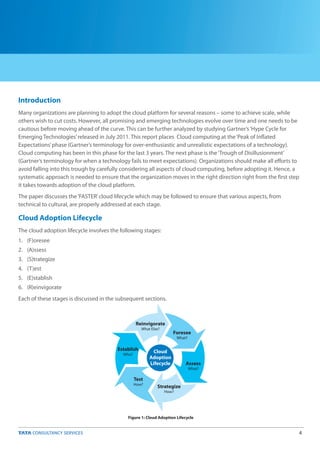
The paper discusses the‘FASTER’cloud lifecycle which may be followed to ensure that various aspects, from
technical to cultural, are properly addressed at each stage.
The cloud adoption lifecycle involves the following stages:
1. (F)oresee
2. (A)ssess
3. (S)trategize
4. (T)est
5. (E)stablish
6. (R)einvigorate
Each of these stages is discussed in the subsequent sections.
Figure 1: Cloud Adoption Lifecycle
Cloud
Adoption
Lifecycle
Strategize
How?
Test
How?
Establish
Who?
Reinvigorate
What Else?
Foresee
What?
Assess
What?
5
1. Foresee
2. Assess
Once the organization answers the previous question in the affirmative, this stage propels the organization
towards the following steps:
a. Predict: As a first step in the Foresee stage, an organization should be able to understand the importance
and need for a flexible and elastic response from IT systems as the organization grows. The organization
should know if the applications and the underlying infrastructure are scalable and reliable enough to take
on constantly increasing workloads and whether they have the ability to absorb the spikes, as well as the
agility in responding to the need for quicker deployment of services. To address these aspects, the
organization should pre-empt the challenges that it could face in the future. Some of the points which
should be looked at are:
Does the current delivery model enable the provisioning of IT services at the speed required by the
business?
Are the daily operations of IT consuming extra time and diverting the team’s focus from important
activities?
Is the organization unable to fully utilize the potential of IT, through underutilization of its assets,
because of cultural issues, or due to the existence of dedicated IT setups for each department?
Introspecting on the above points can help formulate the vision for IT which can enable business to grow
rapidly.
Once the organization is able to foresee challenges and the growing need for an IT function which can
support and sustain the organization’s growth, it can start looking for opportunities to build such an IT
landscape.
b. Aware: This step should focus on exploring the potential methods to address the challenges and realize the
vision laid down for IT; cloud computing is one such opportunity. An organization should try to understand
the following aspects of cloud technology:
Ongoing industry trends
An assessment of Cloud’s current maturity & adoption level across industries
Potential value it can generate
This exercise should lead to an answer to the following question:“Is it beneficial to adopt cloud and will it
answer all our challenges, and secure the vision of the organization?”
a. Understand: Understand in detail the technicalities of cloud such as: what are the various cloud services, the
delivery models and the architecture models. Gaining knowledge of the architecture and delivery models
of cloud is critical to understanding what will suit the organization’s needs.
n
n
n
n
n
n
6
b. Assess: An insight into the organization’s current service delivery model and architecture for delivering IT
services is also necessary to assess the changes required before migrating to a cloud setup. To get a
complete picture, it is imperative to have technical and financial assessments done in order to build a
business case for cloud adoption.
I. Technical Assessment: A detailed technical-readiness assessment of the entire IT landscape should be
conducted to evaluate the readiness of the organization. The following pointers can help in conducting
a complete technical assessment:
Infrastructure Assessment: Percentage of virtualized environment [As a thumb rule, the higher the
percentage of virtualized environment (infrastructure and application), the readier it is to be
migrated to the cloud]
Security Assessment: Critical security requirements of the organization; this includes data and
regulatory security requirements, user authentication and access controls
Application Assessment: Identification and categorization of the applications based on criticality,
dependencies, age, customization and so on
Process Assessment: Governance processes for deploying services and applications, change
requests, regulating policies for backup and archival, audits, monitoring, managing and agreement
of SLAs
ii. Financial Assessment: To get a buy-in from the decision makers, it is important to conduct a
comparative Total Cost of Ownership (TCO) study of the‘As–Is’and‘To–Be’environments over a
multiyear period. This should include both direct (hardware, software) and indirect costs (energy
consumption, carbon footprint) incurred in running the environment. Also tangible (quicker
deployment of services) and intangible benefits (faster go-to-market) that will accrue over a period of
time should be considered.
n
n
n
n
n
n
n
n
3. Strategize
This is a critical stage in which the actual decision of moving towards the cloud platform is made. The key points
which should be discussed to formulate a strategy for cloud adoption are as follows:
With huge investments already made in data center space, hardware, software, licenses and so on, is it
wise to migrate the organization’s applications to a cloud vendor OR is it advisable to build a private cloud
internally?
What applications can be migrated to cloud, and what are the risks associated with migrating them?
Instead of using in-house resources, will it be more convenient to consult a cloud vendor, while avoiding a
vendor lock-in (retaining the freedom of shifting to another vendor, in case of unsatisfactory service)?
How to convince the business or IT teams to accept the changes, and provide them comfort against any
unforeseeable circumstances?
7
Answers to the above questions may vary across organizations. In case of a startup organization (which may not
have the financial strength to set up a dedicated IT environment to run its business), it is advisable to start
operations on a cloud and consult the vendor to build cloud skills over a period of time.
A large organization (spread across the globe, and with critical applications) may not want to leverage the cloud,
due to the fear of security breaches. On the other hand, it may be able to leverage the expertise available within its
own IT team to gradually build a private cloud environment of its own.
Hence, based on the needs of the organization, a strategy must be developed:
1. Prepare a Business Case: To enable decision making, the organization should build a business case to
promote the benefits of moving to the cloud. The groundwork for building the business case should have
already been initiated in the previous stage while conducting the technical and financial assessments. The
objective behind the cloud adoption project and its alignment to overall IT and business strategy should be
considered.
2. Draw up a Roadmap: Once the business case has been approved, a high level roadmap for cloud adoption
may be drawn up. The roadmap should categorize the planned initiatives for the adoption of the cloud
platform as short term, medium term and long term.
Short term – In the short term, an organization can start with a pilot project
Medium term – If the pilot project successful, the organization may roll out a private cloud platform in the
medium term
Long Term – The organization may move to the hybrid cloud model, through which it can bring its business
partners into its fold as well
Additionally, the roadmap should be strengthened by a risk and mitigation strategy, which should include rollback
plans, in case the rollout plan does not succeed.
n
n
n
n
n
n
n
n
n
4. Test
Here, the strategy devised in the previous stage is tested by implementing it in a pilot project. This stage involves
migrating applications, identified for the pilot project, into the cloud. Applications should undergo the following
checks before being migrated to the cloud:
Capability to run in virtual environments (applications whose code is bound with the hardware will require
recoding to make them compatible to virtual environments)
Redevelopment of highly customized applications to make them compatible to software supported by the
cloud [Software as a service (SaaS)]
Replatforming to a cloud compatible platform [Platform as a service (PaaS)]
Re-porting (Hardware portability) to a cloud compatible infrastructure [Infrastructure as a service (IaaS)]
Repackaging the application in case of any porting changes done to the application
Testing the applications before finally migrating to the cloud
8
Once the application has gone live in the cloud environment, business and IT users should provide a feedback on
the response of the applications. Any lessons learnt or feedback provided should be incorporated during the rollout
of the cloud across the organization. After that, the organizations can stabilize the cloud operations and monitor
performance of the cloud over a period of a few weeks.
The pilot project’s success will help instill confidence in the business and IT teams. Also, if a vendor has been
engaged during the consulting or implementation of the pilot project, the performance can be measured.
5. Establish
Upon successful completion of the pilot project, the organization should establish new governance processes to
monitor and manage the cloud infrastructure and also establish cloud-sourced services and applications by rolling
them out as per the roadmap defined in the‘Strategize’stage.
Enable: New established governance processes should look at ways of enabling wider adoption of the cloud
across the organization, by integrating applications which are not yet on the cloud or by creating an interface
between them. This will ensure the smooth functioning of daily business until most of the applications are
phased into the cloud. Businesses and departments may now be allocated resources based on their usage
pattern.
Train: To further strengthen the cloud culture in the organization, training sessions may be conducted for
business and end users, which can help them derive more benefits from the cloud.
Govern: The organization should be cautious about the benefits associated with service provisioning through
the cloud. The reason for this is the potential increase in‘Cloud Sprawl.’Since cloud allows users to provision
services at will, it is important to establish a control mechanism through a proper governance process, which
checks provisioning duplicated services from cloud.
Delineate Roles and Responsibilities: Depending on the kind of cloud service delivery model adopted, the roles
and responsibilities of running the cloud should be clearly defined between the consumer and the provider of
the cloud. For example, for a PaaS service delivery model, the responsibility of decisions taken, managing and
maintaining the cloud at and below this layer (PaaS + IaaS) lies with the cloud provider (internal IT team or the
cloud vendor). However, the responsibility of handling any IT-related issues above the PaaS layer rests with the
consumer of the cloud (application developers and business users).
6. Reinvigorate
This stage is an ongoing process to continuously improve, strengthen and sustain the established cloud platform
through meeting and improving SLA commitments, new cloud-based services, increased availability to business and
reinventing the cloud.
To sustain and improve cloud performance, a benchmarking assessment should be done to assess all-round cloud
performance. The following performance parameters may be used:
Service Level Agreements (high availability, impregnable security, compliance, high performance)
Key Performance Indicators (virtualization)
n
n
n
n
n
n
9
n
n
n
Maturity level of cloud services offered, based on industry benchmarks
Comparative studies on current cloud offerings across the organization and those offered across the
industry
Unit cost incurred on providing cloud services
Conclusion
This paper attempts to provide a methodological approach towards cloud adoption, highlighting the various
activities involved at each stage. Organizations can utilize this paper to carefully evaluate their progress at each
stage and give due consideration to the vital steps involved at each stage.
The activities described in this paper are not exhaustive, but can be used as leads to trigger discussion points
amongst the various stakeholders involved during the cloud adoption lifecycle. Activities, though generic in
nature, can be added on and tailored to the organization’s needs, to exploit the full potential of the cloud
platform. We hope that following the steps outlined will help organizations derive more out of cloud computing
and prevent any eventualities which may lead to disillusionment for those who plan on adopting a cloud
computing platform.
Note
[1] This paper has been published in IOAJ journal on 'Cloud Computing' with ISBN (978-93-81693-17-9)
All content / information present here is the exclusive property of Tata Consultancy Services Limited (TCS). The content / information contained here is
correct at the time of publishing. No material from here may be copied, modified, reproduced, republished, uploaded, transmitted, posted or distributed in
any form without prior written permission fromTCS. Unauthorized use of the content / information appearing here may violate copyright, trademark and
otherapplicablelaws,andcouldresultincriminalorcivilpenalties. Copyright©2012TataConsultancyServicesLimited
TCSDesignServicesM0612III
IT Services
Business Solutions
Outsourcing
Subscribe to TCS White Papers
TCS.com RSS: http://www.tcs.com/rss_feeds/Pages/feed.aspx?f=w
Feedburner: http://feeds2.feedburner.com/tcswhitepapers
Contact
For more information about TCS’ consulting services, contact
global.consulting@tcs.com
About TCS’Global Consulting Practice
TCS’Global Consulting Practice (GCP) is a key component in how TCS delivers additional value
to clients. Using our collective industry insight, technology expertise, and consulting know-
how, we partner with enterprises worldwide to deliver integrated end-to-end IT enabled
business transformation services.
By tapping our worldwide pool of resources - onsite, offshore and nearshore, our high caliber
consultants leverage solution accelerators and practice capabilities, balanced with our
knowledge of local market demands, to enable enterprises to effectively meet their business
goals.
GCP spearheads TCS' consulting capacity with consultants located in North America, UK,
Europe, Asia Pacific, India, Ibero-America and Australia.
About Tata Consultancy Services (TCS)
www.tcs.com
Tata Consultancy Services is an IT services, consulting and business solutions organization that
delivers real results to global business, ensuring a level of certainty no other firm can match.
TCS offers a consulting-led, integrated portfolio of IT and IT-enabled infrastructure, engineering
TM
and assurance services. This is delivered through its unique Global Network Delivery Model ,
recognized as the benchmark of excellence in software development. A part of the Tata Group,
India’s largest industrial conglomerate, TCS has a global footprint and is listed on the National
Stock Exchange and Bombay Stock Exchange in India.
For more information, visit us at

Consulting whitepaper cloud-adoption-lifecycle_0612-1

  • 1.
    Cloud Adoption Lifecycle Moreand more organizations are looking to implement cloud and gain benefits like scalability, responsiveness and cost-efficiencies. As this is a major change, organizations have to carefully gauge the impact of the transformation to a cloud environment. This paper can guide an organization through the various stages in the adoption of the cloud platform, from‘What’(Foresee) to‘What Else’(Reinvigorate). It lists the lifecycle stages, and how to begin cloud adoption. The paper concludes on the note that an organization can utilize the knowledge of the Cloud Adoption Lifecycle to relate to the stage where it is currently at and identify the next stages involved. White Paper
  • 2.
    About the Author KumarAnand Kumar Anand is a Business Analyst working with TCS’Global Consulting Practice - IT Infrastructure Group. He has extensive experience in IT strategy, infrastructure optimization, architecture solutions, system integration in large consulting engagements. He has consulted with clients across United States, Switzerland, Poland and India and has a Master’s Degree in Business Administration from a premier business school in India. 2
  • 3.
    3 Table of Contents Introduction4 Cloud Adoption Lifecycle 4 1. (F)oresee 5 2. (A)ssess 5 3. (S)trategize 6 4. (T)est 7 5. (E)stablish 8 6. (R)einvigorate 8 Conclusion 9
  • 4.
    4 Introduction Cloud Adoption Lifecycle Manyorganizations are planning to adopt the cloud platform for several reasons – some to achieve scale, while others wish to cut costs. However, all promising and emerging technologies evolve over time and one needs to be cautious before moving ahead of the curve. This can be further analyzed by studying Gartner’s‘Hype Cycle for Emerging Technologies’released in July 2011. This report places Cloud computing at the‘Peak of Inflated Expectations’phase (Gartner’s terminology for over-enthusiastic and unrealistic expectations of a technology). Cloud computing has been in this phase for the last 3 years. The next phase is the‘Trough of Disillusionment’ (Gartner’s terminology for when a technology fails to meet expectations). Organizations should make all efforts to avoid falling into this trough by carefully considering all aspects of cloud computing, before adopting it. Hence, a systematic approach is needed to ensure that the organization moves in the right direction right from the first step it takes towards adoption of the cloud platform. The paper discusses the‘FASTER’cloud lifecycle which may be followed to ensure that various aspects, from technical to cultural, are properly addressed at each stage. The cloud adoption lifecycle involves the following stages: 1. (F)oresee 2. (A)ssess 3. (S)trategize 4. (T)est 5. (E)stablish 6. (R)einvigorate Each of these stages is discussed in the subsequent sections. Figure 1: Cloud Adoption Lifecycle Cloud Adoption Lifecycle Strategize How? Test How? Establish Who? Reinvigorate What Else? Foresee What? Assess What?
  • 5.
    5 1. Foresee 2. Assess Oncethe organization answers the previous question in the affirmative, this stage propels the organization towards the following steps: a. Predict: As a first step in the Foresee stage, an organization should be able to understand the importance and need for a flexible and elastic response from IT systems as the organization grows. The organization should know if the applications and the underlying infrastructure are scalable and reliable enough to take on constantly increasing workloads and whether they have the ability to absorb the spikes, as well as the agility in responding to the need for quicker deployment of services. To address these aspects, the organization should pre-empt the challenges that it could face in the future. Some of the points which should be looked at are: Does the current delivery model enable the provisioning of IT services at the speed required by the business? Are the daily operations of IT consuming extra time and diverting the team’s focus from important activities? Is the organization unable to fully utilize the potential of IT, through underutilization of its assets, because of cultural issues, or due to the existence of dedicated IT setups for each department? Introspecting on the above points can help formulate the vision for IT which can enable business to grow rapidly. Once the organization is able to foresee challenges and the growing need for an IT function which can support and sustain the organization’s growth, it can start looking for opportunities to build such an IT landscape. b. Aware: This step should focus on exploring the potential methods to address the challenges and realize the vision laid down for IT; cloud computing is one such opportunity. An organization should try to understand the following aspects of cloud technology: Ongoing industry trends An assessment of Cloud’s current maturity & adoption level across industries Potential value it can generate This exercise should lead to an answer to the following question:“Is it beneficial to adopt cloud and will it answer all our challenges, and secure the vision of the organization?” a. Understand: Understand in detail the technicalities of cloud such as: what are the various cloud services, the delivery models and the architecture models. Gaining knowledge of the architecture and delivery models of cloud is critical to understanding what will suit the organization’s needs. n n n n n n
  • 6.
    6 b. Assess: Aninsight into the organization’s current service delivery model and architecture for delivering IT services is also necessary to assess the changes required before migrating to a cloud setup. To get a complete picture, it is imperative to have technical and financial assessments done in order to build a business case for cloud adoption. I. Technical Assessment: A detailed technical-readiness assessment of the entire IT landscape should be conducted to evaluate the readiness of the organization. The following pointers can help in conducting a complete technical assessment: Infrastructure Assessment: Percentage of virtualized environment [As a thumb rule, the higher the percentage of virtualized environment (infrastructure and application), the readier it is to be migrated to the cloud] Security Assessment: Critical security requirements of the organization; this includes data and regulatory security requirements, user authentication and access controls Application Assessment: Identification and categorization of the applications based on criticality, dependencies, age, customization and so on Process Assessment: Governance processes for deploying services and applications, change requests, regulating policies for backup and archival, audits, monitoring, managing and agreement of SLAs ii. Financial Assessment: To get a buy-in from the decision makers, it is important to conduct a comparative Total Cost of Ownership (TCO) study of the‘As–Is’and‘To–Be’environments over a multiyear period. This should include both direct (hardware, software) and indirect costs (energy consumption, carbon footprint) incurred in running the environment. Also tangible (quicker deployment of services) and intangible benefits (faster go-to-market) that will accrue over a period of time should be considered. n n n n n n n n 3. Strategize This is a critical stage in which the actual decision of moving towards the cloud platform is made. The key points which should be discussed to formulate a strategy for cloud adoption are as follows: With huge investments already made in data center space, hardware, software, licenses and so on, is it wise to migrate the organization’s applications to a cloud vendor OR is it advisable to build a private cloud internally? What applications can be migrated to cloud, and what are the risks associated with migrating them? Instead of using in-house resources, will it be more convenient to consult a cloud vendor, while avoiding a vendor lock-in (retaining the freedom of shifting to another vendor, in case of unsatisfactory service)? How to convince the business or IT teams to accept the changes, and provide them comfort against any unforeseeable circumstances?
  • 7.
    7 Answers to theabove questions may vary across organizations. In case of a startup organization (which may not have the financial strength to set up a dedicated IT environment to run its business), it is advisable to start operations on a cloud and consult the vendor to build cloud skills over a period of time. A large organization (spread across the globe, and with critical applications) may not want to leverage the cloud, due to the fear of security breaches. On the other hand, it may be able to leverage the expertise available within its own IT team to gradually build a private cloud environment of its own. Hence, based on the needs of the organization, a strategy must be developed: 1. Prepare a Business Case: To enable decision making, the organization should build a business case to promote the benefits of moving to the cloud. The groundwork for building the business case should have already been initiated in the previous stage while conducting the technical and financial assessments. The objective behind the cloud adoption project and its alignment to overall IT and business strategy should be considered. 2. Draw up a Roadmap: Once the business case has been approved, a high level roadmap for cloud adoption may be drawn up. The roadmap should categorize the planned initiatives for the adoption of the cloud platform as short term, medium term and long term. Short term – In the short term, an organization can start with a pilot project Medium term – If the pilot project successful, the organization may roll out a private cloud platform in the medium term Long Term – The organization may move to the hybrid cloud model, through which it can bring its business partners into its fold as well Additionally, the roadmap should be strengthened by a risk and mitigation strategy, which should include rollback plans, in case the rollout plan does not succeed. n n n n n n n n n 4. Test Here, the strategy devised in the previous stage is tested by implementing it in a pilot project. This stage involves migrating applications, identified for the pilot project, into the cloud. Applications should undergo the following checks before being migrated to the cloud: Capability to run in virtual environments (applications whose code is bound with the hardware will require recoding to make them compatible to virtual environments) Redevelopment of highly customized applications to make them compatible to software supported by the cloud [Software as a service (SaaS)] Replatforming to a cloud compatible platform [Platform as a service (PaaS)] Re-porting (Hardware portability) to a cloud compatible infrastructure [Infrastructure as a service (IaaS)] Repackaging the application in case of any porting changes done to the application Testing the applications before finally migrating to the cloud
  • 8.
    8 Once the applicationhas gone live in the cloud environment, business and IT users should provide a feedback on the response of the applications. Any lessons learnt or feedback provided should be incorporated during the rollout of the cloud across the organization. After that, the organizations can stabilize the cloud operations and monitor performance of the cloud over a period of a few weeks. The pilot project’s success will help instill confidence in the business and IT teams. Also, if a vendor has been engaged during the consulting or implementation of the pilot project, the performance can be measured. 5. Establish Upon successful completion of the pilot project, the organization should establish new governance processes to monitor and manage the cloud infrastructure and also establish cloud-sourced services and applications by rolling them out as per the roadmap defined in the‘Strategize’stage. Enable: New established governance processes should look at ways of enabling wider adoption of the cloud across the organization, by integrating applications which are not yet on the cloud or by creating an interface between them. This will ensure the smooth functioning of daily business until most of the applications are phased into the cloud. Businesses and departments may now be allocated resources based on their usage pattern. Train: To further strengthen the cloud culture in the organization, training sessions may be conducted for business and end users, which can help them derive more benefits from the cloud. Govern: The organization should be cautious about the benefits associated with service provisioning through the cloud. The reason for this is the potential increase in‘Cloud Sprawl.’Since cloud allows users to provision services at will, it is important to establish a control mechanism through a proper governance process, which checks provisioning duplicated services from cloud. Delineate Roles and Responsibilities: Depending on the kind of cloud service delivery model adopted, the roles and responsibilities of running the cloud should be clearly defined between the consumer and the provider of the cloud. For example, for a PaaS service delivery model, the responsibility of decisions taken, managing and maintaining the cloud at and below this layer (PaaS + IaaS) lies with the cloud provider (internal IT team or the cloud vendor). However, the responsibility of handling any IT-related issues above the PaaS layer rests with the consumer of the cloud (application developers and business users). 6. Reinvigorate This stage is an ongoing process to continuously improve, strengthen and sustain the established cloud platform through meeting and improving SLA commitments, new cloud-based services, increased availability to business and reinventing the cloud. To sustain and improve cloud performance, a benchmarking assessment should be done to assess all-round cloud performance. The following performance parameters may be used: Service Level Agreements (high availability, impregnable security, compliance, high performance) Key Performance Indicators (virtualization) n n n n n n
  • 9.
    9 n n n Maturity level ofcloud services offered, based on industry benchmarks Comparative studies on current cloud offerings across the organization and those offered across the industry Unit cost incurred on providing cloud services Conclusion This paper attempts to provide a methodological approach towards cloud adoption, highlighting the various activities involved at each stage. Organizations can utilize this paper to carefully evaluate their progress at each stage and give due consideration to the vital steps involved at each stage. The activities described in this paper are not exhaustive, but can be used as leads to trigger discussion points amongst the various stakeholders involved during the cloud adoption lifecycle. Activities, though generic in nature, can be added on and tailored to the organization’s needs, to exploit the full potential of the cloud platform. We hope that following the steps outlined will help organizations derive more out of cloud computing and prevent any eventualities which may lead to disillusionment for those who plan on adopting a cloud computing platform. Note [1] This paper has been published in IOAJ journal on 'Cloud Computing' with ISBN (978-93-81693-17-9)
  • 10.
    All content /information present here is the exclusive property of Tata Consultancy Services Limited (TCS). The content / information contained here is correct at the time of publishing. No material from here may be copied, modified, reproduced, republished, uploaded, transmitted, posted or distributed in any form without prior written permission fromTCS. Unauthorized use of the content / information appearing here may violate copyright, trademark and otherapplicablelaws,andcouldresultincriminalorcivilpenalties. Copyright©2012TataConsultancyServicesLimited TCSDesignServicesM0612III IT Services Business Solutions Outsourcing Subscribe to TCS White Papers TCS.com RSS: http://www.tcs.com/rss_feeds/Pages/feed.aspx?f=w Feedburner: http://feeds2.feedburner.com/tcswhitepapers Contact For more information about TCS’ consulting services, contact global.consulting@tcs.com About TCS’Global Consulting Practice TCS’Global Consulting Practice (GCP) is a key component in how TCS delivers additional value to clients. Using our collective industry insight, technology expertise, and consulting know- how, we partner with enterprises worldwide to deliver integrated end-to-end IT enabled business transformation services. By tapping our worldwide pool of resources - onsite, offshore and nearshore, our high caliber consultants leverage solution accelerators and practice capabilities, balanced with our knowledge of local market demands, to enable enterprises to effectively meet their business goals. GCP spearheads TCS' consulting capacity with consultants located in North America, UK, Europe, Asia Pacific, India, Ibero-America and Australia. About Tata Consultancy Services (TCS) www.tcs.com Tata Consultancy Services is an IT services, consulting and business solutions organization that delivers real results to global business, ensuring a level of certainty no other firm can match. TCS offers a consulting-led, integrated portfolio of IT and IT-enabled infrastructure, engineering TM and assurance services. This is delivered through its unique Global Network Delivery Model , recognized as the benchmark of excellence in software development. A part of the Tata Group, India’s largest industrial conglomerate, TCS has a global footprint and is listed on the National Stock Exchange and Bombay Stock Exchange in India. For more information, visit us at