
1
Cloud Enablement
Discussion
Prepared By: Vishal, Mar 16, 2015
2
Agenda
 Organistaion – Background, CIO Challenges and Symptom
 IT Maturity – Capability, Spending
 Why Cloud – Run, Grow & Transform, Be Agile and Digital
 Cloud Platform – Evolution, Cloud offering Heat Map
 Why Cloud
 Global Cloud Pitch
 Q&A
 Appendix
3
Organisation
Background and Challenges
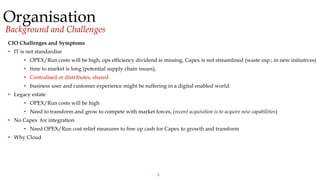
CIO Challenges and Symptoms
• IT is not standardise
• OPEX/Run costs will be high, ops efficiency dividend is missing, Capex is not streamlined (waste esp.; in new initiatives)
• time to market is long (potential supply chain issues),
• Centralised or distributes, shared
• business user and customer experience might be suffering in a digital enabled world.
• Legacy estate
• OPEX/Run costs will be high
• Need to transform and grow to compete with market forces, (recent acquisition is to acquire new capabilities)
• No Capex for integration
• Need OPEX/Run cost relief measures to free up cash for Capex to growth and transform
• Why Cloud
4
IT Maturity
Capability – Today
IT Maturity
Business Silos
Standardised
Technology
Optimised
Core
Business
ModularityPercentageOfInvestment(0–100%)
HighFlexibilityLowFlexibility
Global
Flexibility
Local
Flexibility
Source:2005MITSloanCenterForInformationSystemsResearch
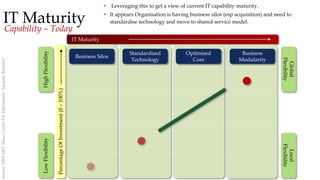
• Leveraging this to get a view of current IT capability maturity.
• It appears Organisation is having business silos (esp acquisition) and need to
standardise technology and move to shared service model.
5
IT Maturity
Spending - Segmentation
Low Maturity Market Leader
CAPEX - 24%
OPEX – 76%
Industry Generic Industry Specific
Cross - Industry
Transform - 14%
Run – 66%
Cross - Industry Private Education Financial Services
Grow - 20%
Efficiency – 17%
Quality – 44%
Customer - 25%
Regulation – 8%
Cost – 5 %
Rev - 5%
Reduce
Cost – 18%
Grow
Revenue – 14%
Protect
Revenue - 54%
Avoid Cost – 9%
Risk - 5%
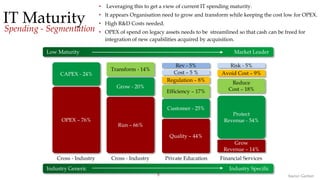
• Leveraging this to get a view of current IT spending maturity.
• It appears Organisation need to grow and transform while keeping the cost low for OPEX.
• High R&D Costs needed.
• OPEX of spend on legacy assets needs to be streamlined so that cash can be freed for
integration of new capabilities acquired by acquisition.
Source: Gartner
6
IT Maturity
Architecture and Cost Value
Low High
LowValueIndex
Revenue
Efficiency
Commodity
Cost Index
Value
For
Money
Cost
Efficiency
Low High
Low
LevelofArchitecture
ThinkingHigh
Isolated
Losing
Integration
Fragmented
Organisation
Maturity - Today
Source: HBR, Gartner
High
Optimising
7
Why Cloud
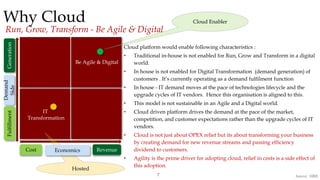
Cloud platform would enable following characteristics :
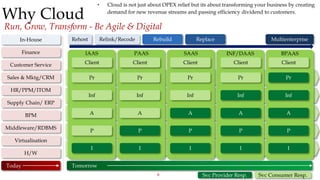
• Traditional in-house is not enabled for Run, Grow and Transform in a digital
world.
• In house is not enabled for Digital Transformation (demand generation) of
customers . It’s currently operating as a demand fulfilment function
• In house - IT demand moves at the pace of technologies lifecycle and the
upgrade cycles of IT vendors. Hence this organisation is aligned to this.
• This model is not sustainable in an Agile and a Digital world.
• Cloud driven platform drives the demand at the pace of the market,
competition, and customer expectations rather than the upgrade cycles of IT
vendors.
• Cloud is not just about OPEX relief but its about transforming your business
by creating demand for new revenue streams and passing efficiency
dividend to customers.
• Agility is the prime driver for adopting cloud, relief in costs is a side effect of
this adoption.
Source: HBR.
Cost Revenue
Fulfillment
Demand
Side
Generation
IT
Transformation
Be Agile & Digital
Hosted
Cloud Enabler
Economics
Run, Grow, Transform - Be Agile & Digital
8
Why Cloud
Run, Grow, Transform - Be Agile & Digital
IAAS
Pr
In-House
BPM
PAAS SAAS INF/DAAS BPAAS
Middleware/RDBMS
Virtualisation
H/W
Inf
A
P
I
Pr
Inf
A
P
I
Pr
Inf
A
P
I
Pr
Inf
A
P
I
Pr
Inf
A
P
I
Client Client Client Client Client
Svc Provider Resp. Svc Consumer Resp.
TomorrowToday
Rehost Relink/Recode Rebuild Replace Multienterprise
Supply Chain/ ERP
Sales & Mktg/CRM
Finance
HR/PPM/ITOM
Customer Service
• Cloud is not just about OPEX relief but its about transforming your business by creating
demand for new revenue streams and passing efficiency dividend to customers.
9
Why Cloud
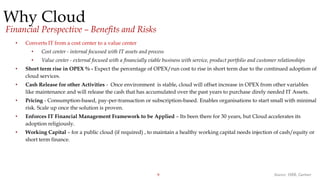
• Converts IT from a cost center to a value center
• Cost center - internal focussed with IT assets and process
• Value center - external focused with a financially viable business with service, product portfolio and customer relationships
• Short term rise in OPEX % - Expect the percentage of OPEX/run cost to rise in short term due to the continued adoption of
cloud services.
• Cash Release for other Activities - Once environment is stable, cloud will offset increase in OPEX from other variables
like maintenance and will release the cash that has accumulated over the past years to purchase direly needed IT Assets.
• Pricing - Consumption-based, pay-per-transaction or subscription-based. Enables organisations to start small with minimal
risk. Scale up once the solution is proven.
• Enforces IT Financial Management Framework to be Applied – Its been there for 30 years, but Cloud accelerates its
adoption religiously.
• Working Capital – for a public cloud (if required) , to maintain a healthy working capital needs injection of cash/equity or
short term finance.
Source: HBR, Gartner
Financial Perspective – Benefits and Risks
10
Long Term Debt
Goodwill & Other
Intangible Assets
Shareholders Equity
Assets Equity + Liability
Operational
Assets
Current Liabilities
Current Assets
Current Liability
Cloud Sales Roadblock
Impact on Balance Sheet and Conversation
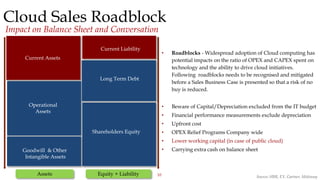
• Roadblocks - Widespread adoption of Cloud computing has
potential impacts on the ratio of OPEX and CAPEX spent on
technology and the ability to drive cloud initiatives.
Following roadblocks needs to be recognised and mitigated
before a Sales Business Case is presented so that a risk of no
buy is reduced.
• Beware of Capital/Depreciation excluded from the IT budget
• Financial performance measurements exclude depreciation
• Upfront cost
• OPEX Relief Programs Company wide
• Lower working capital (in case of public cloud)
• Carrying extra cash on balance sheet
Source: HBR, EY, Gartner, Mckinsey
11
0
10
20
30
40
50
60
70
CSB Prosumer
CSB SMB
CSB
Enterprise
CSB
Other
Last Mile
Ntwk
WAN
IP (HW/SW)
Colo
White Label
Iaas
IAAS
Cloud
Enabled
Mgd Svc
B2C
B2B2C
B2B
M2M
Cloud Offering Heat Map
Portfolio Mix
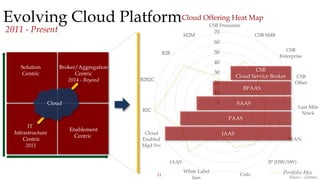
Evolving Cloud Platform
2011 - Present
IT
Infrastructure
Centric
2011
Solution
Centric
Enablement
Centric
Broker/Aggregation
Centric
2014 - Beyond
Cloud
Source - Gartner
SAAS
BPAAS
PAAS
IAAS
CSB
Cloud Service Broker
12
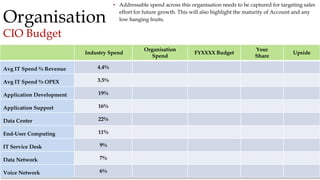
Organisation
CIO Budget
• Addressable spend across this organisation needs to be captured for targeting sales
effort for future growth. This will also highlight the maturity of Account and any
low hanging fruits.
Industry Spend
Organisation
Spend
FYXXXX Budget
Your
Share
Upside
Avg IT Spend % Revenue 4.4%
Avg IT Spend % OPEX 3.5%
Application Development 19%
Application Support 16%
Data Center 22%
End-User Computing 11%
IT Service Desk 9%
Data Network 7%
Voice Network 6%
13
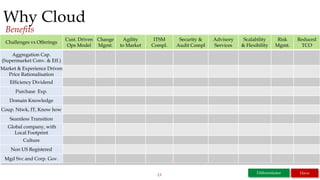
Why Cloud
Benefits
Challenges vs Offerings
Cust. Driven
Ops Model
Change
Mgmt.
Agility
to Market
ITSM
Compl.
Security &
Audit Compl
Advisory
Services
Scalability
& Flexibility
Risk
Mgmt.
Reduced
TCO
Aggregation Cap.
(Supermarket Conv. & Eff.)
Market & Experience Driven
Price Rationalisation
Efficiency Dividend
Purchase Exp.
Domain Knowledge
Coup. Ntwk, IT, Know how
Seamless Transition
Global company, with
Local Footprint
Culture
Non US Registered
Mgd Svc and Corp. Gov.
Differentiator Have
14
Q&A
15
Thank you
Contact
For further information, please contact:
Name: Vishal

How To Position Cloud

  • 1.
  • 2.
    2 Agenda  Organistaion –Background, CIO Challenges and Symptom  IT Maturity – Capability, Spending  Why Cloud – Run, Grow & Transform, Be Agile and Digital  Cloud Platform – Evolution, Cloud offering Heat Map  Why Cloud  Global Cloud Pitch  Q&A  Appendix
  • 3.
    3 Organisation Background and Challenges CIOChallenges and Symptoms • IT is not standardise • OPEX/Run costs will be high, ops efficiency dividend is missing, Capex is not streamlined (waste esp.; in new initiatives) • time to market is long (potential supply chain issues), • Centralised or distributes, shared • business user and customer experience might be suffering in a digital enabled world. • Legacy estate • OPEX/Run costs will be high • Need to transform and grow to compete with market forces, (recent acquisition is to acquire new capabilities) • No Capex for integration • Need OPEX/Run cost relief measures to free up cash for Capex to growth and transform • Why Cloud
  • 4.
    4 IT Maturity Capability –Today IT Maturity Business Silos Standardised Technology Optimised Core Business ModularityPercentageOfInvestment(0–100%) HighFlexibilityLowFlexibility Global Flexibility Local Flexibility Source:2005MITSloanCenterForInformationSystemsResearch • Leveraging this to get a view of current IT capability maturity. • It appears Organisation is having business silos (esp acquisition) and need to standardise technology and move to shared service model.
  • 5.
    5 IT Maturity Spending -Segmentation Low Maturity Market Leader CAPEX - 24% OPEX – 76% Industry Generic Industry Specific Cross - Industry Transform - 14% Run – 66% Cross - Industry Private Education Financial Services Grow - 20% Efficiency – 17% Quality – 44% Customer - 25% Regulation – 8% Cost – 5 % Rev - 5% Reduce Cost – 18% Grow Revenue – 14% Protect Revenue - 54% Avoid Cost – 9% Risk - 5% • Leveraging this to get a view of current IT spending maturity. • It appears Organisation need to grow and transform while keeping the cost low for OPEX. • High R&D Costs needed. • OPEX of spend on legacy assets needs to be streamlined so that cash can be freed for integration of new capabilities acquired by acquisition. Source: Gartner
  • 6.
    6 IT Maturity Architecture andCost Value Low High LowValueIndex Revenue Efficiency Commodity Cost Index Value For Money Cost Efficiency Low High Low LevelofArchitecture ThinkingHigh Isolated Losing Integration Fragmented Organisation Maturity - Today Source: HBR, Gartner High Optimising
  • 7.
    7 Why Cloud Cloud platformwould enable following characteristics : • Traditional in-house is not enabled for Run, Grow and Transform in a digital world. • In house is not enabled for Digital Transformation (demand generation) of customers . It’s currently operating as a demand fulfilment function • In house - IT demand moves at the pace of technologies lifecycle and the upgrade cycles of IT vendors. Hence this organisation is aligned to this. • This model is not sustainable in an Agile and a Digital world. • Cloud driven platform drives the demand at the pace of the market, competition, and customer expectations rather than the upgrade cycles of IT vendors. • Cloud is not just about OPEX relief but its about transforming your business by creating demand for new revenue streams and passing efficiency dividend to customers. • Agility is the prime driver for adopting cloud, relief in costs is a side effect of this adoption. Source: HBR. Cost Revenue Fulfillment Demand Side Generation IT Transformation Be Agile & Digital Hosted Cloud Enabler Economics Run, Grow, Transform - Be Agile & Digital
  • 8.
    8 Why Cloud Run, Grow,Transform - Be Agile & Digital IAAS Pr In-House BPM PAAS SAAS INF/DAAS BPAAS Middleware/RDBMS Virtualisation H/W Inf A P I Pr Inf A P I Pr Inf A P I Pr Inf A P I Pr Inf A P I Client Client Client Client Client Svc Provider Resp. Svc Consumer Resp. TomorrowToday Rehost Relink/Recode Rebuild Replace Multienterprise Supply Chain/ ERP Sales & Mktg/CRM Finance HR/PPM/ITOM Customer Service • Cloud is not just about OPEX relief but its about transforming your business by creating demand for new revenue streams and passing efficiency dividend to customers.
  • 9.
    9 Why Cloud • ConvertsIT from a cost center to a value center • Cost center - internal focussed with IT assets and process • Value center - external focused with a financially viable business with service, product portfolio and customer relationships • Short term rise in OPEX % - Expect the percentage of OPEX/run cost to rise in short term due to the continued adoption of cloud services. • Cash Release for other Activities - Once environment is stable, cloud will offset increase in OPEX from other variables like maintenance and will release the cash that has accumulated over the past years to purchase direly needed IT Assets. • Pricing - Consumption-based, pay-per-transaction or subscription-based. Enables organisations to start small with minimal risk. Scale up once the solution is proven. • Enforces IT Financial Management Framework to be Applied – Its been there for 30 years, but Cloud accelerates its adoption religiously. • Working Capital – for a public cloud (if required) , to maintain a healthy working capital needs injection of cash/equity or short term finance. Source: HBR, Gartner Financial Perspective – Benefits and Risks
  • 10.
    10 Long Term Debt Goodwill& Other Intangible Assets Shareholders Equity Assets Equity + Liability Operational Assets Current Liabilities Current Assets Current Liability Cloud Sales Roadblock Impact on Balance Sheet and Conversation • Roadblocks - Widespread adoption of Cloud computing has potential impacts on the ratio of OPEX and CAPEX spent on technology and the ability to drive cloud initiatives. Following roadblocks needs to be recognised and mitigated before a Sales Business Case is presented so that a risk of no buy is reduced. • Beware of Capital/Depreciation excluded from the IT budget • Financial performance measurements exclude depreciation • Upfront cost • OPEX Relief Programs Company wide • Lower working capital (in case of public cloud) • Carrying extra cash on balance sheet Source: HBR, EY, Gartner, Mckinsey
  • 11.
    11 0 10 20 30 40 50 60 70 CSB Prosumer CSB SMB CSB Enterprise CSB Other LastMile Ntwk WAN IP (HW/SW) Colo White Label Iaas IAAS Cloud Enabled Mgd Svc B2C B2B2C B2B M2M Cloud Offering Heat Map Portfolio Mix Evolving Cloud Platform 2011 - Present IT Infrastructure Centric 2011 Solution Centric Enablement Centric Broker/Aggregation Centric 2014 - Beyond Cloud Source - Gartner SAAS BPAAS PAAS IAAS CSB Cloud Service Broker
  • 12.
    12 Organisation CIO Budget • Addressablespend across this organisation needs to be captured for targeting sales effort for future growth. This will also highlight the maturity of Account and any low hanging fruits. Industry Spend Organisation Spend FYXXXX Budget Your Share Upside Avg IT Spend % Revenue 4.4% Avg IT Spend % OPEX 3.5% Application Development 19% Application Support 16% Data Center 22% End-User Computing 11% IT Service Desk 9% Data Network 7% Voice Network 6%
  • 13.
    13 Why Cloud Benefits Challenges vsOfferings Cust. Driven Ops Model Change Mgmt. Agility to Market ITSM Compl. Security & Audit Compl Advisory Services Scalability & Flexibility Risk Mgmt. Reduced TCO Aggregation Cap. (Supermarket Conv. & Eff.) Market & Experience Driven Price Rationalisation Efficiency Dividend Purchase Exp. Domain Knowledge Coup. Ntwk, IT, Know how Seamless Transition Global company, with Local Footprint Culture Non US Registered Mgd Svc and Corp. Gov. Differentiator Have
  • 14.
  • 15.
    15 Thank you Contact For furtherinformation, please contact: Name: Vishal